
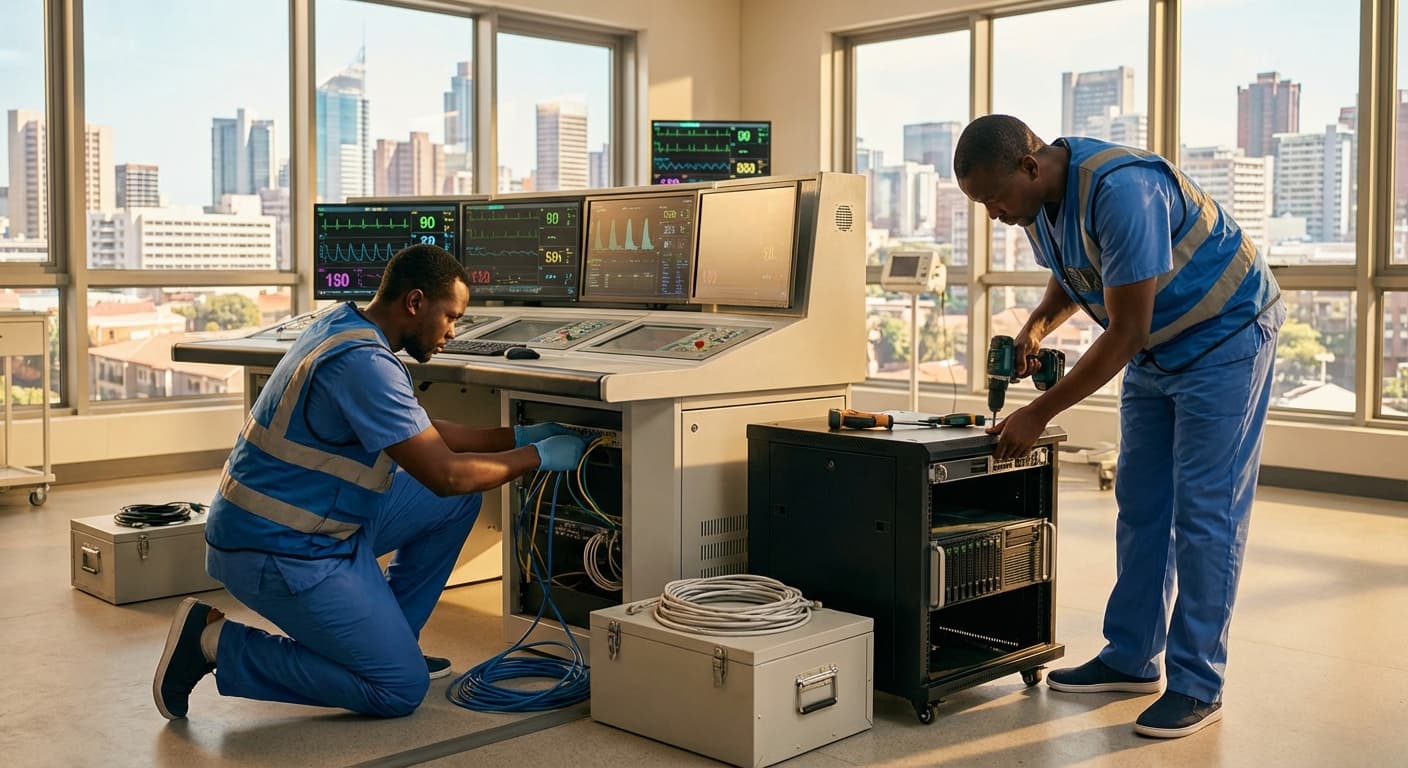
ICU Central Monitoring Station Installation Service in Kenya
Engineering Excellence & Technical Support
ICU Central Monitoring Station Installation Service High-standard technical execution following OEM protocols and local regulatory frameworks.
Robust Network Infrastructure
We design and implement secure, high-availability network architectures leveraging advanced Cisco and Juniper hardware. Our installations ensure seamless data flow and real-time vital sign transmission for critical patient monitoring across your ICU.
Scalable Server & Storage Solutions
Our team deploys enterprise-grade server and storage solutions (e.g., Dell EMC, HPE) optimized for high-performance data logging and retrieval. We ensure your monitoring data is reliably stored and readily accessible for clinical analysis and auditing.
Interoperable Software Integration
We specialize in integrating leading ICU monitoring software platforms (e.g., Philips IntelliVue, GE CARESCAPE) with existing hospital information systems (HIS/EMR). Our expertise in HL7 and FHIR standards ensures seamless data exchange and enhanced clinical decision-making.
What Is Icu Central Monitoring Station Installation Service In Kenya?
ICU Central Monitoring Station Installation Service in Kenya refers to the comprehensive process of setting up and integrating a centralized system designed for real-time surveillance of multiple Intensive Care Unit (ICU) patient vital signs and critical parameters. This service ensures that healthcare facilities can effectively monitor patients from a dedicated station, enabling prompt clinical intervention and improved patient outcomes. The installation encompasses the physical deployment of network infrastructure, specialized monitoring hardware, software configuration, and comprehensive system testing to guarantee seamless data flow and alarm management.
| Who Needs This Service? | Typical Use Cases | ||||||
|---|---|---|---|---|---|---|---|
| Hospitals and Healthcare Facilities in Kenya operating Intensive Care Units (ICUs). | High-Patient-Volume ICUs: Facilities with a large number of critically ill patients requiring continuous, unified monitoring. | Remote or Large Facilities: Hospitals where a dedicated nursing station needs to oversee multiple patient rooms spread across a significant area. | Training and Research Hospitals: Institutions requiring advanced data acquisition and analysis capabilities for clinical research and education. | New Hospital Construction or Renovation: Integration of a modern ICU monitoring system during the initial build or upgrade phases. | Upgrade to Existing Monitoring Systems: Replacing or enhancing outdated central monitoring infrastructure. | ||
| Real-time Hemodynamic Monitoring: Continuous surveillance of invasive and non-invasive blood pressure, heart rate, and central venous pressure. | Respiratory Monitoring: Tracking of oxygen saturation (SpO2), respiratory rate, and capnography (EtCO2). | Cardiac Monitoring: ECG waveform display, arrhythmia detection, and ST-segment analysis. | Neurological Monitoring: Integration with advanced devices for intracranial pressure (ICP) monitoring and bispectral index (BIS) monitoring. | Thermoregulation Monitoring: Continuous tracking of body temperature. | Alarm Management and Event Notification: Automated alerts for critical parameter deviations, ensuring timely clinical response. | Data Archiving and Retrieval: Storage and access to historical patient data for review, trend analysis, and auditing purposes. | Interoperability with Other Medical Devices: Seamless integration with ventilators, infusion pumps, and other critical care equipment for a holistic view of patient status. |
Key Components of ICU Central Monitoring Station Installation Service
- Hardware Deployment: Installation and connection of central monitoring workstations, bedside monitors (e.g., ECG, SpO2, NIBP, respiration, temperature), and associated networking devices (switches, routers, cabling).
- Network Configuration: Setting up a secure and reliable network infrastructure to transmit physiological data from bedside monitors to the central station. This includes IP addressing, subnetting, and ensuring data integrity.
- Software Installation and Integration: Deployment of specialized patient monitoring software, patient demographic integration with Electronic Health Records (EHR) systems, and configuration of alarm parameters and notification protocols.
- System Calibration and Testing: Rigorous testing of all components, including signal acquisition, data transmission latency, alarm functionality, and user interface responsiveness, to validate system performance.
- User Training: Providing comprehensive training to clinical staff (nurses, physicians, technicians) on the operation, maintenance, and troubleshooting of the central monitoring system.
- Documentation and Support: Provision of detailed system documentation, including network diagrams, configuration guides, and warranty information, along with ongoing technical support agreements.
Who Needs Icu Central Monitoring Station Installation Service In Kenya?
ICU Central Monitoring Station (CMS) installation services are crucial for healthcare facilities that aim to provide high-level, continuous patient care in critical settings. These advanced systems allow a limited number of skilled nurses or clinicians to remotely monitor the vital signs and physiological data of multiple ICU patients simultaneously from a central location. This significantly enhances patient safety, improves response times to critical events, optimizes staff allocation, and can lead to better patient outcomes. Therefore, any healthcare institution in Kenya seeking to upgrade or establish a sophisticated ICU infrastructure would benefit immensely from professional CMS installation.
| Department/Area | Key Needs Addressed by CMS Installation | Specific Benefits | Examples of Patients Monitored |
|---|---|---|---|
| Intensive Care Unit (ICU) | Real-time, continuous monitoring of critically ill patients; early detection of deterioration; efficient staff utilization; improved alarm management. | Reduced response times to adverse events, enhanced patient safety, optimized workflow for ICU nurses, comprehensive data for clinical decision-making. | Patients on mechanical ventilation, severe sepsis, post-operative critical cases, trauma patients, patients with cardiac arrhythmias, respiratory failure. |
| High Dependency Unit (HDU) / Step-down ICU | Bridging the gap between ICU and general ward; monitoring of patients requiring closer observation than a standard ward but not full ICU care. | Preventing escalation to full ICU by early intervention, smoother transition of care, freeing up ICU beds for the most critical patients. | Patients recovering from surgery with potential complications, moderate respiratory distress, early stages of organ dysfunction. |
| Cardiac Care Unit (CCU) / Coronary Care Unit (CCU) | Specialized monitoring of cardiac patients, including ECG, hemodynamic parameters, and arrhythmia detection. | Prompt identification and management of cardiac emergencies, precise analysis of cardiac rhythms, improved patient outcomes for cardiovascular conditions. | Patients with myocardial infarction (heart attack), unstable angina, severe arrhythmias, post-cardiac surgery patients, patients with heart failure. |
| Surgical Intensive Care Unit (SICU) | Monitoring of patients recovering from complex surgeries, trauma, and those with multi-organ failure. | Early detection of surgical complications (e.g., bleeding, infection), effective management of post-operative pain and hemodynamic stability, optimized recovery pathways. | Post-major abdominal surgery, trauma patients with extensive injuries, complex orthopedic reconstructions, neurosurgical patients. |
| Neonatal Intensive Care Unit (NICU) - for severe cases | Monitoring of premature infants and critically ill newborns requiring advanced life support and continuous observation. | Precise tracking of vital signs in fragile neonates, early detection of sepsis, respiratory distress, or neurological events, vital for the survival and development of vulnerable infants. | Extremely premature infants, infants with congenital heart defects, respiratory distress syndrome, birth asphyxia, neonatal sepsis. |
Target Customers & Departments for ICU Central Monitoring Station Installation in Kenya
- Tertiary and quaternary care hospitals
- Teaching hospitals and medical schools
- Government and private hospitals with advanced critical care units
- Military and national security healthcare facilities
- Large specialized medical centers (e.g., cardiac centers, neurological centers)
Icu Central Monitoring Station Installation Service Process In Kenya
This document outlines the comprehensive workflow for the Installation Service of an ICU Central Monitoring Station in Kenya, from initial customer inquiry to project completion and handover. The process emphasizes clear communication, thorough planning, and meticulous execution to ensure a seamless and successful implementation.
| Phase | Stage | Key Activities | Responsible Party | Deliverables/Outcomes |
|---|---|---|---|---|
| 1: Pre-Installation & Planning | Inquiry & Initial Consultation | Customer expresses interest. Service provider conducts initial needs assessment, discusses project scope, and provides preliminary information. | Customer, Service Provider Sales/Technical Team | Understanding of customer requirements, initial proposal/quote outline. |
| 1: Pre-Installation & Planning | Site Survey & Technical Assessment | Detailed site visit to assess infrastructure (power, networking, space), existing systems, and specific requirements for the ICU monitoring station. | Service Provider Technical Team | Detailed site assessment report, identification of potential challenges, refined technical specifications. |
| 1: Pre-Installation & Planning | Proposal & Quotation Finalization | Based on the site survey, a detailed technical proposal, Bill of Materials (BOM), and a formal quotation are prepared and submitted to the customer. | Service Provider Technical & Sales Team | Finalized technical proposal, accurate quotation, project timeline. |
| 1: Pre-Installation & Planning | Contract & Agreement | Customer reviews and accepts the proposal. Contract is drafted, negotiated, and signed by both parties, outlining terms, conditions, payment schedule, and scope of work. | Customer, Service Provider Management | Signed contract, agreed payment terms, commencement of project. |
| 1: Pre-Installation & Planning | Project Planning & Scheduling | Development of a detailed project plan, including resource allocation, installation schedule, and communication protocols. Coordination with hospital stakeholders for access and minimal disruption. | Service Provider Project Manager | Detailed project plan, Gantt chart, resource allocation schedule, communication plan. |
| 1: Pre-Installation & Planning | Procurement & Logistics | Ordering of all necessary equipment and components. Arranging for secure transportation and delivery to the site in Kenya. | Service Provider Procurement & Logistics Team | All equipment and materials delivered to the site as per schedule. |
| 2: On-Site Execution & Installation | Site Preparation | Ensuring the designated area for the monitoring station is ready, including any necessary civil works, network cabling, and power outlet installation. | Service Provider Installation Team, Hospital Facilities | Ready and compliant installation space. |
| 2: On-Site Execution & Installation | Equipment Installation & Mounting | Physical installation of the central monitoring unit, workstations, servers, and any associated hardware. Secure mounting of all components. | Service Provider Installation Technicians | All hardware physically installed and secured. |
| 2: On-Site Execution & Installation | System Configuration & Integration | Configuring the central monitoring software, integrating with existing patient monitors, and establishing network connectivity. Setting up user accounts and permissions. | Service Provider Integration Specialists | Fully configured and integrated monitoring system. |
| 2: On-Site Execution & Installation | Testing & Quality Assurance (QA) | Comprehensive testing of all system functionalities, including data display, alarm management, data logging, and connectivity. Performing thorough QA checks to ensure optimal performance. | Service Provider QA Engineers, Installation Team | Successful completion of all system tests, verified functionality. |
| 2: On-Site Execution & Installation | User Training | Providing hands-on training to the ICU medical staff and IT personnel on operating the central monitoring station, its features, and basic troubleshooting. | Service Provider Training Specialists | Competent and confident users, training materials provided. |
| 3: Post-Installation & Handover | System Handover & Acceptance | Formal handover of the installed system to the hospital. Customer signs off on the installation, confirming satisfaction with the work performed and system functionality. | Service Provider Project Manager, Customer Representative | Signed project acceptance certificate. |
| 3: Post-Installation & Handover | Documentation & Reporting | Providing all relevant documentation, including user manuals, technical guides, warranty information, and a final project report. | Service Provider Project Manager | Complete set of system documentation. |
| 3: Post-Installation & Handover | Warranty & Support Commencement | Initiating the warranty period and establishing the agreed-upon post-installation support and maintenance plan. | Service Provider Support Team | Active warranty and support agreement. |
| 3: Post-Installation & Handover | Project Closure & Feedback | Finalizing all project-related administrative tasks, including invoicing and payment reconciliation. Gathering customer feedback to identify areas for improvement. | Service Provider Project Manager, Finance Team | Closed project, feedback for continuous improvement. |
ICU Central Monitoring Station Installation Service Process in Kenya
- Phase 1: Pre-Installation & Planning
- Phase 2: On-Site Execution & Installation
- Phase 3: Post-Installation & Handover
Icu Central Monitoring Station Installation Service Cost In Kenya
Installing an ICU Central Monitoring Station (CMS) in Kenya involves a complex set of services and equipment, leading to a variable cost. This cost is influenced by several factors, making it crucial for healthcare facilities to conduct thorough assessments and obtain detailed quotes from reputable vendors. The typical installation service encompasses everything from the initial site survey and design to the final commissioning and staff training. The range of costs can fluctuate significantly based on the size of the ICU, the number of patient monitoring beds, the type and sophistication of the chosen monitoring equipment, and the specific vendor's pricing structure.
| Service Component | Estimated Cost Range (KES) | Notes |
|---|---|---|
| Basic Bedside Monitor (per unit) | 80,000 - 300,000 | Varies based on vital signs parameters and features. |
| Advanced Bedside Monitor (per unit) | 250,000 - 700,000+ | Includes advanced parameters like invasive BP, cardiac output, etc. |
| Central Monitoring Station Hardware & Software | 500,000 - 2,500,000+ | Depends on the number of beds supported, data storage, and features. |
| Networking & Cabling Installation | 100,000 - 600,000+ | Highly dependent on existing infrastructure and distance. |
| Installation Labor & Project Management | 200,000 - 1,000,000+ | Based on project complexity, duration, and team size. |
| Commissioning, Testing & Validation | 50,000 - 250,000 | Essential for ensuring system functionality. |
| Staff Training | 30,000 - 150,000 | Covers clinical and technical staff. |
| Total Estimated Installation Service Cost (for a small to medium ICU) | 1,500,000 - 7,000,000+ KES | This is a broad estimate and can vary significantly. |
Key Pricing Factors for ICU Central Monitoring Station Installation Services in Kenya
- Number of Patient Monitoring Beds: This is a primary driver of cost. Each bed requires a bedside monitor, and the central station's capacity and complexity will scale with the number of connected devices.
- Type and Sophistication of Monitoring Equipment: High-fidelity monitors with advanced features (e.g., invasive blood pressure, cardiac output monitoring, advanced waveform analysis) will naturally be more expensive than basic vital signs monitors.
- Central Monitoring Station Software and Hardware: The capabilities of the central station software (e.g., data storage, trend analysis, alert management, integration with Electronic Health Records - EHR) and the dedicated hardware for the station contribute significantly to the overall cost.
- Networking Infrastructure and Cabling: The existing network infrastructure at the hospital may need upgrades or extensive new cabling to support the CMS. The complexity of running cables through existing structures impacts labor and material costs.
- Site Survey and System Design: Initial consultations, site assessments, and detailed system design are crucial for a successful installation and are factored into the service cost.
- Installation Labor Costs: The number of technicians, their skill levels, and the duration of the installation project will influence labor expenses. Specialized IT and biomedical engineering expertise is required.
- Commissioning and Testing: Thorough testing of all components, ensuring proper data flow, alarm functionality, and integration, is a critical part of the service and adds to the cost.
- Staff Training: Comprehensive training for clinical staff and IT personnel on operating and maintaining the CMS is usually included and impacts the pricing.
- Warranty and Support Services: The duration and scope of post-installation warranty and ongoing technical support are often bundled with the installation service.
- Vendor Reputation and Service Offerings: Established vendors with a proven track record and comprehensive service packages may command higher prices, but often offer greater reliability and after-sales support.
Affordable Icu Central Monitoring Station Installation Service Options
Investing in an ICU Central Monitoring Station (CMS) is crucial for patient safety and efficient clinical workflow. However, the cost can be a significant consideration. This guide explores affordable installation service options, focusing on value bundles and effective cost-saving strategies to help healthcare facilities make informed decisions without compromising quality or essential functionality.
| Cost-Saving Strategy | Description | Potential Benefit |
|---|---|---|
| Phased Installation | Instead of installing the entire CMS at once, break down the project into phases. Start with critical areas and expand as budget allows. | Spreads out capital expenditure, allowing for better cash flow management. |
| Leverage Existing Infrastructure | Assess if any existing networking, cabling, or power infrastructure can be utilized or upgraded for the CMS. This can significantly reduce installation labor and material costs. | Minimizes disruption and reduces the need for new construction or extensive rewiring. |
| Negotiate with Multiple Vendors | Obtain quotes from several reputable CMS installation service providers. Compare pricing, service offerings, and contract terms thoroughly. | Drives down installation costs through competitive bidding. |
| Consider Refurbished or Certified Pre-Owned Equipment | For non-critical components or less demanding applications, explore high-quality refurbished or certified pre-owned monitoring units or displays. Ensure they come with a warranty. | Substantially reduces hardware acquisition costs without sacrificing reliability for certain components. |
| Prioritize Essential Features | Focus on installing only the features and functionalities that are absolutely critical for your current ICU operations. Non-essential features can be added later. | Avoids paying for features that may not be immediately utilized, lowering upfront investment. |
| Bulk Purchasing Discounts | If purchasing multiple monitoring units or related hardware, inquire about bulk discounts from the vendor or through third-party distributors. | Reduces the overall cost of hardware acquisition. |
| In-House Training Coordination | While professional training is often included, coordinate with the vendor to see if some aspects of user training can be facilitated internally using existing IT or clinical education staff. | Potentially reduces the per-user training cost or allows for more flexible scheduling. |
| Long-Term Maintenance Agreements | Negotiate favorable terms for long-term service and maintenance agreements. A well-structured agreement can prevent costly emergency repairs and ensure optimal system performance. | Predictable maintenance costs, extended equipment lifespan, and reduced downtime. |
Value Bundles for ICU Central Monitoring Station Installation
- Core Monitoring Bundle: This foundational package typically includes essential hardware (monitoring units, central station display, basic networking) and standard installation services. It's ideal for facilities with budget constraints or those looking to upgrade their existing CMS with essential capabilities.
- Integrated Workflow Bundle: This bundle expands on the core offering by incorporating features that enhance clinical workflow. It might include integration with EMR/EHR systems, advanced alarm management, and reporting tools. This adds significant value by streamlining data access and communication.
- Scalable & Future-Proof Bundle: Designed for growing facilities, this option provides a robust core system with the flexibility to easily expand capacity and integrate advanced features in the future. It often includes higher-end networking infrastructure and modular components, allowing for phased upgrades.
- Turnkey Solution Bundle: This comprehensive package covers everything from initial site assessment and hardware procurement to installation, configuration, integration, and even initial user training. It's the most convenient option, offering a single point of accountability for the entire project.
Verified Providers In Kenya
In Kenya's evolving healthcare landscape, identifying truly verified healthcare providers is paramount for ensuring quality care and peace of mind. Among these, Franance Health stands out, not just as a network, but as a seal of trust and excellence. This document outlines the credentials that solidify Franance Health's position as a superior choice for medical services in Kenya.
| Why Franance Health Represents the Best Choice | Key Differentiators | Patient Benefits |
|---|---|---|
| Comprehensive Verification Process: Unlike basic listings, Franance Health employs a multi-faceted verification system that goes beyond surface-level checks. | Deep dive into licensing, facility standards, and specialized qualifications. | Assurance of receiving care from genuinely qualified and reputable professionals and institutions. |
| Focus on Quality & Outcomes: The network prioritizes not just availability, but the quality of care provided and positive patient outcomes. | Continuous performance monitoring and peer review mechanisms. | Access to providers known for their effectiveness and patient satisfaction. |
| Streamlined Healthcare Experience: Franance Health aims to simplify the process of finding and accessing reliable healthcare. | Integrated network with insurance compatibility and efficient referral systems. | Reduced stress and time spent searching for trusted medical services, and easier navigation of the healthcare system. |
| Commitment to Patient Well-being: The core philosophy revolves around patient safety, ethical practices, and a patient-centric approach. | Vetting for ethical conduct and dedication to patient rights. | Peace of mind knowing your health is in safe, professional, and ethical hands. |
Franance Health Credentials & Verification Pillars:
- Strict Medical Professional Licensing & Accreditation: All healthcare professionals listed on the Franance Health network undergo rigorous verification of their active licenses with the Kenya Medical Practitioners and Dentists Council (KMPDC) and relevant professional bodies. This ensures they meet the minimum standards of competency and ethical practice.
- Facility Accreditation & Compliance: Healthcare facilities, including hospitals, clinics, and diagnostic centers, are assessed for compliance with national health regulations and accredited by recognized bodies. Franance Health prioritizes facilities that adhere to stringent safety, hygiene, and operational standards.
- Peer Review & Performance Monitoring: Franance Health actively engages in peer review processes and continuous performance monitoring of its network providers. This involves tracking patient outcomes, adherence to best practices, and patient feedback to maintain high-quality service delivery.
- Specialized Expertise Verification: For specialists, Franance Health verifies their specific areas of expertise and certifications. This ensures that patients are matched with the right doctors for their unique medical needs, leading to more effective and efficient treatment.
- Insurance & Regulatory Compliance: All Franance Health providers are vetted for their compliance with insurance regulations and their ability to seamlessly integrate with various medical insurance schemes prevalent in Kenya, simplifying the claims process for patients.
- Commitment to Patient Safety & Ethics: Beyond regulatory requirements, Franance Health upholds a strong commitment to patient safety and ethical medical practices, actively vetting providers who demonstrate a patient-centered approach and a dedication to medical integrity.
Scope Of Work For Icu Central Monitoring Station Installation Service
This Scope of Work (SOW) details the services required for the installation of an Intensive Care Unit (ICU) Central Monitoring Station. The objective is to establish a robust and reliable central monitoring system that allows healthcare professionals to effectively observe and manage patients in critical condition. This includes the procurement, installation, configuration, testing, and commissioning of all necessary hardware and software components.
| Technical Deliverable | Description | Standard Specification Reference |
|---|---|---|
| Central Monitoring Workstation(s) | High-performance computers designed to display patient data streams from multiple bedside monitors. Features include large, high-resolution displays, robust processing power, and specialized monitoring software. | ISO 13485:2016 (Medical devices – Quality management systems), IEC 60601 series (Medical electrical equipment) for electrical safety and EMC. |
| Central Monitoring Server(s) | Server infrastructure to aggregate, store, and process data from bedside monitors. May include redundant servers for high availability and data backup solutions. | HIPAA compliance standards for data privacy and security, RAID configurations for data redundancy, enterprise-grade server hardware specifications. |
| Bedside Monitor Integration Cables & Adapters | Specialized cables and adapters to ensure seamless data transmission from various models of bedside patient monitors to the central station. | Compatibility with leading bedside monitor manufacturers (e.g., Philips, GE Healthcare, Dräger), medical-grade connectors, UL certified cabling. |
| Network Infrastructure (Cabling, Switches, Routers) | Installation of secure, high-bandwidth network infrastructure to support real-time data transmission. Includes structured cabling, managed network switches, and potentially routers for network segmentation and security. | TIA/EIA-568 standards for structured cabling, IEEE 802.3 standards for Ethernet, hospital IT security policies, VLAN implementation. |
| Central Monitoring Software Suite | The core software application for receiving, displaying, and managing patient data. Includes alarm management, data archiving, trending, and reporting functionalities. May integrate with existing Hospital Information Systems (HIS) or Electronic Health Records (EHR). | HL7 (Health Level Seven) standards for interoperability, DICOM (Digital Imaging and Communications in Medicine) for medical imaging integration (if applicable), vendor-specific software requirements, cybersecurity best practices. |
| Alarm Management System | Configurable system to manage patient alarms, ensuring timely and appropriate notifications to clinical staff. Includes audible and visual alerts, escalation protocols, and silenced alarm logging. | Clinical best practices for alarm fatigue reduction, customizable alarm thresholds, integration with nurse call systems (if required). |
| Data Archiving and Backup Solution | Secure storage of historical patient data for audit and analysis purposes. Includes defined retention periods and robust backup and recovery procedures. | Data retention policies as per institutional guidelines and regulatory requirements, secure, encrypted storage solutions, regular backup verification. |
| User Training Materials | Comprehensive documentation and training sessions for clinical staff on the operation, maintenance, and troubleshooting of the central monitoring system. | Role-based training modules, user manuals, quick reference guides, hands-on training sessions. |
| System Test Plan and Report | Detailed plan outlining the testing procedures for all system components, including functional, performance, and security testing. Includes a final report documenting test results and any identified issues and resolutions. | Verification and validation protocols, performance benchmarking standards, security penetration testing (if required). |
| As-Built Documentation | Finalized documentation detailing the installed system configuration, network topology, wiring diagrams, and all modifications made during the installation process. | Industry-standard technical drawing conventions, detailed component lists, configuration parameters. |
Key Services Provided:
- Site assessment and preparation
- Installation of central monitoring workstations and servers
- Connection and integration of bedside patient monitors
- Network infrastructure setup and configuration
- Software installation, configuration, and customization
- System testing and performance validation
- User training and documentation
- Post-installation support and warranty
Service Level Agreement For Icu Central Monitoring Station Installation Service
This Service Level Agreement (SLA) outlines the response times and uptime guarantees for the installation services provided by [Your Company Name] for the ICU Central Monitoring Station. This SLA is an addendum to the Master Service Agreement (MSA) between [Your Company Name] and [Client Name], dated [Date of MSA].
| Service Component / Issue Severity | Response Time (during Service Hours) | Response Time (during Emergency Service Hours) | Target Resolution Time (during Service Hours) | Target Resolution Time (during Emergency Service Hours) |
|---|---|---|---|---|
| Critical Issue (System-wide outage, impact on multiple patients) | 1 Hour | 30 Minutes | 4 Hours | 2 Hours |
| High Issue (Failure of a key component, impact on a section of ICU) | 2 Hours | 1 Hour | 8 Hours | 4 Hours |
| Medium Issue (Partial functionality loss, workaround available) | 4 Business Hours | 2 Hours | 24 Business Hours | 8 Hours |
| Low Issue (Minor cosmetic or non-critical functionality bug) | 1 Business Day | 4 Business Hours | 72 Business Hours | 24 Business Hours |
Definitions
- Installation Service: The complete process of setting up and configuring the ICU Central Monitoring Station hardware and software at the Client's designated facility.
- Service Hours: [Specify Service Hours, e.g., Monday to Friday, 9:00 AM to 5:00 PM Local Time], excluding public holidays.
- Emergency Service Hours: [Specify Emergency Service Hours, e.g., 24x7x365]
- Response Time: The maximum time allowed for [Your Company Name] to acknowledge a reported issue and initiate troubleshooting or dispatch a technician.
- Resolution Time: The maximum time allowed for [Your Company Name] to resolve a reported issue, restoring full functionality of the ICU Central Monitoring Station.
- Downtime: Any period during which the ICU Central Monitoring Station is unavailable for use due to issues related to the installation, configuration, or core functionality as determined by [Your Company Name].
- Uptime Guarantee: The percentage of time the ICU Central Monitoring Station is expected to be operational and functional, excluding scheduled maintenance.
- Scheduled Maintenance: Pre-planned periods of downtime for system updates, upgrades, or preventive maintenance, communicated to the Client at least [Number] days in advance.
Frequently Asked Questions

Ready when you are
Let's scope your ICU Central Monitoring Station Installation Service in Kenya project in Kenya.

Scaling healthcare logistics and technical systems across the entire continent.