
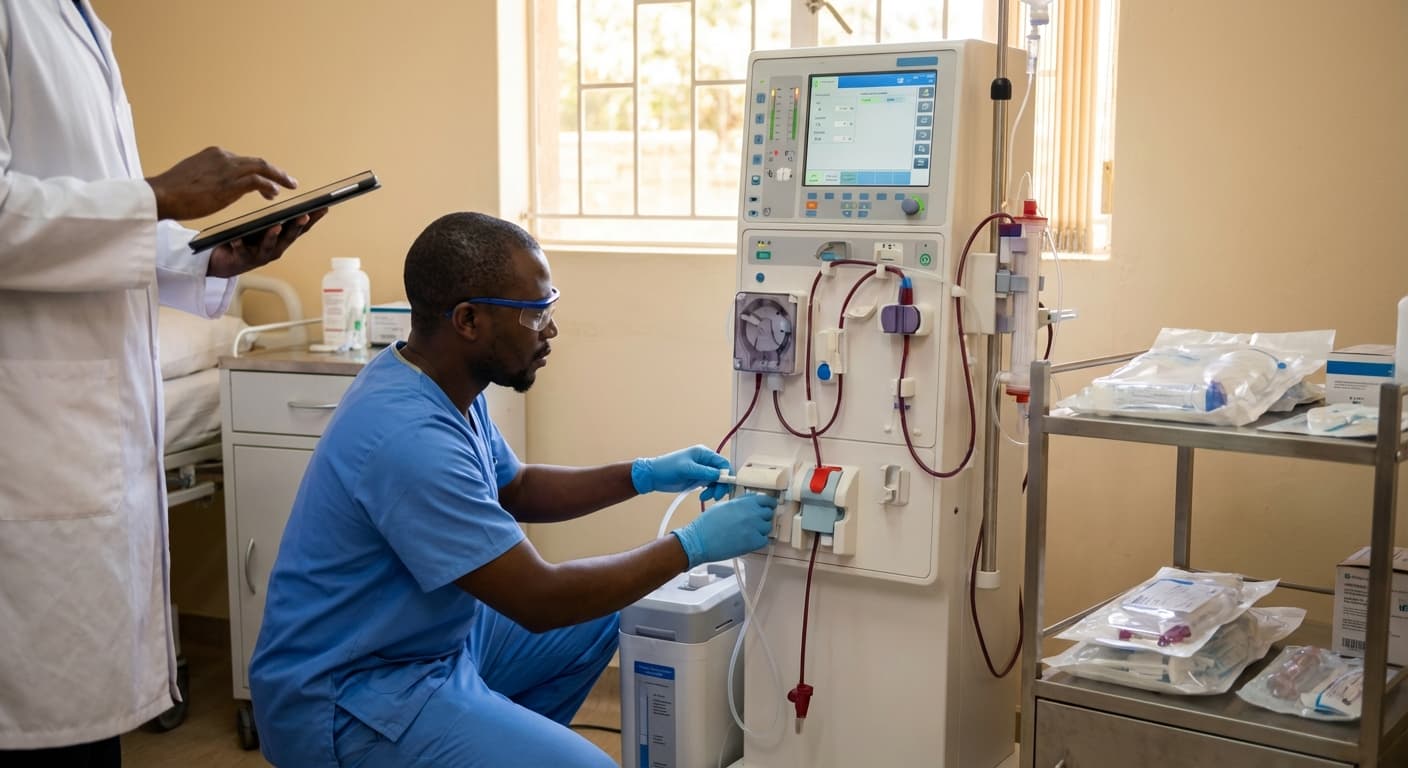
Hemodialysis Machine Installation Service in Kenya
Engineering Excellence & Technical Support
Hemodialysis Machine Installation Service High-standard technical execution following OEM protocols and local regulatory frameworks.
Certified Hemodialysis Technicians
Our team comprises highly trained and certified biomedical engineers and technicians with extensive experience in the installation and commissioning of a wide range of hemodialysis machines. We adhere to stringent international standards and manufacturer protocols to ensure optimal performance and patient safety.
Comprehensive Site Assessment & Planning
We conduct thorough on-site assessments of your facility, evaluating infrastructure readiness, power supply stability, water purification systems, and waste management requirements. This meticulous planning phase ensures a seamless and efficient installation process tailored to your specific needs.
End-to-End Installation & Support
From initial delivery and unboxing to intricate calibration, testing, and final handover, our service covers every aspect of hemodialysis machine installation. We provide comprehensive post-installation training for your clinical staff and offer ongoing technical support to ensure continuous, reliable operation.
What Is Hemodialysis Machine Installation Service In Kenya?
Hemodialysis machine installation service in Kenya refers to the comprehensive process of setting up, configuring, and commissioning hemodialysis machines within healthcare facilities. This service ensures that the sophisticated medical equipment is properly integrated into the existing infrastructure, adheres to all safety and operational standards, and is ready for immediate patient use. The installation encompasses the physical placement of the machine, connection to essential utilities (water, power, waste disposal), calibration, functional testing, and initial user training. It is a critical step in establishing or expanding dialysis services, guaranteeing the reliability and efficacy of treatment delivery.
| Who Needs Hemodialysis Machine Installation Service in Kenya? | Typical Use Cases | ||||
|---|---|---|---|---|---|
| New Dialysis Centers: Facilities establishing their first hemodialysis unit or expanding an existing one. | Public Hospitals: Government-run healthcare institutions acquiring new machines to increase patient capacity or replace aging equipment. | Private Hospitals and Clinics: Healthcare providers investing in advanced dialysis technology to offer comprehensive renal care. | Non-Governmental Organizations (NGOs) and Charitable Foundations: Organizations supporting healthcare initiatives and requiring functional dialysis units for underserved populations. | Medical Equipment Suppliers and Distributors: Companies selling hemodialysis machines that offer installation as part of their service package. | Relocation or Renovation Projects: Healthcare facilities moving or reconfiguring their dialysis units, necessitating re-installation or upgrades. |
| Establishment of New Renal Units: Setting up a fully operational dialysis unit from scratch. | Capacity Expansion: Increasing the number of dialysis stations to accommodate a growing patient population. | Equipment Upgrade or Replacement: Installing newer, more advanced hemodialysis machines with enhanced features and improved efficiency. | Disaster Recovery and Contingency Planning: Rapid installation in response to unforeseen events requiring immediate dialysis service restoration. | Research and Clinical Trials: Setting up specialized dialysis configurations for investigational purposes. | Mobile Dialysis Units: Installation in mobile units for remote or emergency service provision. |
Key Components of Hemodialysis Machine Installation Service:
- Site Assessment and Planning: Evaluating the designated installation area for space, structural integrity, utility availability, and compliance with medical facility design guidelines.
- Equipment Delivery and Unpacking: Secure transportation of the hemodialysis machine and associated accessories to the site, followed by careful unpacking and inspection for any transit damage.
- Physical Placement and Mounting: Positioning the machine according to ergonomic and functional requirements, including any necessary wall mounting or securing mechanisms.
- Utility Connections: Connecting the machine to a reliable and purified water supply (often via a reverse osmosis system), appropriate electrical outlets, and an effective medical waste disposal system.
- System Configuration and Calibration: Setting up machine parameters, including dialysate composition, flow rates, and safety features, as per manufacturer specifications and clinical protocols. This also involves calibrating sensors and alarms.
- Testing and Validation: Conducting comprehensive diagnostic tests, including leak tests, pressure checks, and simulated dialysis runs, to verify functionality and performance against predetermined benchmarks.
- Integration with Ancillary Systems: Connecting the machine to central monitoring systems, electronic health records (EHRs), or other networked medical devices if applicable.
- Initial User Training: Providing hands-on training to nephrology nurses, technicians, and biomedical engineers on the operation, routine maintenance, troubleshooting, and emergency procedures for the installed machines.
- Documentation and Handover: Providing detailed installation reports, user manuals, warranty information, and maintenance schedules to the healthcare facility. This signifies the formal handover of the operational equipment.
Who Needs Hemodialysis Machine Installation Service In Kenya?
The installation of hemodialysis machines is a critical process that ensures these life-saving devices function optimally. In Kenya, several entities and departments require expert hemodialysis machine installation services to provide essential renal replacement therapy to patients suffering from kidney failure. This service is not a one-off purchase but an ongoing need as healthcare facilities expand, upgrade their equipment, or face breakdowns requiring replacements or new installations.
| Customer Type | Key Departments Involved | Reasons for Need |
|---|---|---|
| Public Hospitals (National & County) | Nephrology Department, Biomedical Engineering Department, Procurement Department, Estates/Facilities Management | Provision of essential dialysis services to a large patient population, upgrades to older facilities, replacement of aging equipment, expansion of dialysis units. |
| Private Hospitals | Nephrology Department, Clinical Engineering Department, Procurement Department, Facilities Department | Meeting growing demand for private dialysis services, attracting patients seeking advanced care, equipping new medical wings or centers, maintaining high-quality patient care standards. |
| Specialized Kidney Treatment Centers | Medical Director's Office, Head of Dialysis, Biomedical Engineering, Operations Management | Establishing new centers, expanding existing capacity, upgrading to newer, more efficient dialysis machines, ensuring seamless integration with existing infrastructure. |
| NGOs with Healthcare Initiatives | Program Manager, Healthcare Coordinator, Technical Support Staff (if available) | Setting up dialysis units in underserved areas, providing free or subsidized dialysis, equipping mobile dialysis units, training local staff on machine operation and basic maintenance. |
| Missionary Hospitals | Hospital Administrator, Head of Medical Services, Biomedical Technician (if employed) | Expanding access to healthcare in remote or marginalized communities, providing essential dialysis services to patients who cannot afford it elsewhere, maintaining and replacing equipment in resource-limited settings. |
| Academic & Teaching Hospitals | Nephrology Department, Biomedical Engineering Department, Research & Development Unit, Hospital Administration | Training future nephrologists and dialysis technicians, research into new dialysis technologies, ensuring state-of-the-art equipment for both patient care and educational purposes, replacing outdated research equipment. |
Target Customers and Departments Requiring Hemodialysis Machine Installation Services in Kenya:
- Public Hospitals (National and County Level)
- Private Hospitals
- Specialized Kidney Treatment Centers
- Non-Governmental Organizations (NGOs) with Healthcare Initiatives
- Missionary Hospitals
- Academic and Teaching Hospitals
Hemodialysis Machine Installation Service Process In Kenya
This document outlines the typical workflow for Hemodialysis Machine Installation Services in Kenya, from the initial inquiry to the final execution and handover. The process is designed to ensure a smooth, efficient, and compliant installation, meeting the specific needs of healthcare facilities.
| Phase | Key Steps | Description | Key Stakeholders Involved | Timeline (Indicative) |
|---|---|---|---|---|
| Phase 1: Inquiry and Pre-Assessment | Initial Contact & Requirement Gathering | Client (Hospital/Clinic) contacts the service provider with a requirement for hemodialysis machine installation. Information regarding the number of machines, type, existing infrastructure, and desired timeline is collected. | Client (Procurement/Biomedical Dept.), Service Provider (Sales/Technical Team) | 1-3 Business Days |
| Phase 1: Inquiry and Pre-Assessment | Site Survey & Technical Assessment | A technical team visits the client's site to assess the installation location. This includes evaluating power supply, water quality and plumbing, drainage, ventilation, space requirements, and any necessary structural modifications. | Client (Biomedical Dept./Facilities), Service Provider (Field Service Engineer/Technical Specialist) | 2-5 Business Days |
| Phase 2: Quotation and Agreement | Preparation of Detailed Quotation | Based on the site survey and requirements, a comprehensive quotation is prepared. This includes costs for the machine (if applicable), installation labor, materials, necessary modifications, and any associated services. | Service Provider (Sales/Finance), Client (Procurement/Finance) | 3-7 Business Days |
| Phase 2: Quotation and Agreement | Review and Agreement | The client reviews the quotation. Negotiations may occur. Upon agreement, a formal contract or purchase order is issued, outlining terms, scope of work, payment schedule, and warranty. | Client (Procurement/Management), Service Provider (Sales/Management) | 1-2 Weeks |
| Phase 3: Site Preparation and Logistics | Site Modifications & Infrastructure Readiness | Any identified structural, electrical, plumbing, or ventilation modifications are carried out by the client or sub-contractors as per the agreed specifications. Ensure all necessary permits are obtained. | Client (Facilities/Contractors), Service Provider (Consulting) | Varies based on scope (Weeks to Months) |
| Phase 3: Site Preparation and Logistics | Machine Delivery & Logistics | The hemodialysis machine(s) are delivered to the client's site. This involves transportation, customs clearance (if imported), and secure handling to prevent damage. | Service Provider (Logistics Team/Suppliers), Client (Receiving Dept.) | Varies based on origin and transport (Weeks) |
| Phase 4: Installation and Configuration | Unpacking and Initial Setup | The machines are unpacked, and preliminary physical setup is performed in the designated installation area. | Service Provider (Installation Team) | 1-2 Days per machine |
| Phase 4: Installation and Configuration | Connection to Utilities | Machines are connected to the prepared power supply, water purification systems, and drainage. This requires careful adherence to manufacturer specifications and local regulations. | Service Provider (Installation Team), Client (Biomedical/Facilities) | 1-3 Days per machine |
| Phase 4: Installation and Configuration | Software Configuration & Calibration | The machine's software is configured according to the client's needs and protocols. Initial calibration is performed to ensure accurate operation. | Service Provider (Technical Specialist/Engineer) | 0.5-1 Day per machine |
| Phase 5: Testing, Commissioning, and Training | Functional Testing | All machine functions are thoroughly tested using simulation fluids or protocols to verify correct operation, alarms, and safety features. | Service Provider (Technical Specialist/Engineer) | 1-2 Days per machine |
| Phase 5: Testing, Commissioning, and Training | Water System Integration Testing | If a water purification system is part of the installation, its integration with the dialysis machines and water quality testing is performed. | Service Provider (Technical Specialist/Engineer), Client (Biomedical/Water Treatment) | 1-2 Days |
| Phase 5: Testing, Commissioning, and Training | Client Training | Comprehensive training is provided to the client's biomedical engineers, nurses, and technicians on machine operation, maintenance, troubleshooting, and safety protocols. | Service Provider (Trainer/Technical Specialist), Client (Biomedical Staff, Nurses) | 1-3 Days |
| Phase 5: Testing, Commissioning, and Training | Commissioning and Handover Documentation | Upon successful testing and training, the machine is officially commissioned. All relevant documentation, including installation reports, test results, and training certificates, are compiled. | Service Provider (Project Manager/Technical Lead), Client (Biomedical Dept.) | 1-2 Days |
| Phase 6: Handover and Post-Installation Support | Formal Handover | The installed and commissioned hemodialysis machine is formally handed over to the client, along with all necessary documentation. | Service Provider (Project Manager), Client (Management/Biomedical Head) | 1 Day |
| Phase 6: Handover and Post-Installation Support | Warranty and Support Commencement | The warranty period begins, and details of post-installation support, including maintenance contracts, technical assistance, and spare parts availability, are clarified. | Service Provider (Sales/Support Team), Client (Procurement/Biomedical Dept.) | Ongoing |
| Phase 6: Handover and Post-Installation Support | Follow-up and Feedback | A follow-up visit or call may be scheduled to ensure client satisfaction and address any initial operational queries. | Service Provider (Account Manager/Technical Support) | 1-4 Weeks post-handover |
Hemodialysis Machine Installation Service Process in Kenya: Workflow
- Phase 1: Inquiry and Pre-Assessment
- Phase 2: Quotation and Agreement
- Phase 3: Site Preparation and Logistics
- Phase 4: Installation and Configuration
- Phase 5: Testing, Commissioning, and Training
- Phase 6: Handover and Post-Installation Support
Hemodialysis Machine Installation Service Cost In Kenya
Installing a hemodialysis machine in Kenya involves several cost considerations beyond just the price of the machine itself. The installation service is a crucial step ensuring the machine operates safely and effectively. Factors influencing the cost include the type and complexity of the hemodialysis unit, the location of the healthcare facility within Kenya, the specific services included in the installation package, and the expertise of the chosen service provider. The range of costs can vary significantly, impacting the overall budget for healthcare providers acquiring this vital medical equipment.
| Service Component | Estimated Cost Range (KES) |
|---|---|
| Basic Installation (Machine Setup & Initial Testing) | 50,000 - 150,000 |
| Installation with Integrated Water Treatment System (RO) | 150,000 - 400,000+ |
| Comprehensive Installation (including training & initial consumables) | 200,000 - 500,000+ |
| Additional Plumbing/Electrical Upgrades | Varies significantly based on facility needs (e.g., 50,000 - 300,000+) |
| Remote Location Surcharge | 10,000 - 50,000+ |
Key Pricing Factors for Hemodialysis Machine Installation in Kenya
- Type and Model of Hemodialysis Machine: More advanced or specialized machines may require more complex installation procedures and specialized technicians, potentially increasing costs.
- Complexity of Installation: This includes the need for plumbing, electrical work, water treatment systems (like reverse osmosis units), and ventilation. Older facilities might require more extensive modifications.
- Location of the Healthcare Facility: Installation costs can be higher in remote or less accessible areas due to travel expenses for technicians and potential logistical challenges.
- Scope of Services: Does the installation package include initial setup, calibration, testing, staff training, and post-installation support? A comprehensive package will naturally cost more.
- Service Provider Expertise and Reputation: Established and reputable service providers with specialized technicians might command higher fees, but often offer greater reliability and warranty.
- Water Treatment System Integration: The cost and complexity of integrating a suitable water purification system are often a significant component of the overall installation cost.
- Electrical and Plumbing Infrastructure: Existing infrastructure may need upgrades to meet the power and water supply requirements of the hemodialysis machine. This can be a substantial cost driver.
- Testing and Calibration: Thorough testing and calibration are essential for ensuring the machine's accuracy and safety, and these services are factored into the installation cost.
- Staff Training: Many installation services include basic training for healthcare staff on operating and maintaining the machine. The duration and depth of this training can affect pricing.
Affordable Hemodialysis Machine Installation Service Options
Installing a hemodialysis machine is a critical step in establishing or expanding dialysis services. Beyond the machine itself, the installation process requires specialized expertise, careful planning, and adherence to stringent medical standards. Fortunately, several affordable options and strategic approaches can significantly reduce the overall cost of this essential service. Understanding value bundles and implementing cost-saving strategies are key to making hemodialysis machine installation accessible and efficient.
| Service Component | Typical Cost Range (USD) | Cost-Saving Strategies |
|---|---|---|
| Site Assessment & Planning | $500 - $2,500 | Thorough initial assessment to avoid rework; bundle with other services. |
| Plumbing & Electrical Modifications | $2,000 - $10,000+ | Standardize modifications across multiple rooms; obtain multiple quotes; leverage in-house maintenance if qualified. |
| Water Purification System Installation | $5,000 - $25,000+ | Choose energy-efficient models; negotiate bulk discounts; compare different filtration technologies. |
| Hemodialysis Machine Installation & Calibration | $1,000 - $5,000 | Bundle with machine purchase; explore manufacturer-offered installation packages. |
| Waste Disposal System Setup | $500 - $3,000 | Standardize disposal methods; inquire about integrated solutions with water systems. |
| Staff Training & Certification | $1,000 - $5,000 | Train existing qualified staff; negotiate comprehensive training packages. |
| Post-Installation Support & Warranty | Varies (often included in bundles/contracts) | Prioritize vendors with strong service reputations; consider extended warranties for predictable costs. |
Value Bundles and Cost-Saving Strategies for Hemodialysis Machine Installation
- Value Bundles: These are pre-packaged service offerings that combine multiple installation-related components at a potentially discounted rate compared to purchasing each service individually. They often aim to streamline the process and ensure all necessary elements are covered.
- Component of Value Bundles: Typically include site assessment, plumbing and electrical modifications, water purification system integration, waste disposal setup, machine calibration, staff training, and post-installation support.
- Benefits of Value Bundles: Predictable pricing, reduced administrative overhead, integrated service delivery, and potentially faster turnaround times.
- Cost-Saving Strategies: Proactive planning, exploring multiple vendor quotes, negotiating bulk discounts, considering refurbished equipment, leveraging in-house expertise where appropriate, and phased installation approaches.
- Site Assessment Importance: Thorough evaluation of existing infrastructure (water supply, power, drainage) to identify necessary modifications, preventing costly last-minute changes.
- Water Purification System Integration: This is a significant cost. Bundles may offer integrated solutions or discounts on specific reputable brands. Cost-saving lies in choosing a system that meets regulatory requirements and patient needs efficiently.
- Staff Training: Essential for safe and effective operation. Bundles often include this. Cost-saving can be achieved by training existing staff where feasible and ensuring comprehensive training from the start to minimize errors.
- Negotiating with Vendors: Don't hesitate to negotiate pricing, payment terms, and included services. Discounts for multiple machine installations or long-term service contracts are common.
- Refurbished Equipment: Certified refurbished hemodialysis machines can offer substantial savings, provided they come with warranties and are rigorously tested.
- Phased Installation: For larger facilities, a phased approach can spread the cost over time and allow for operational adjustments based on early experiences.
- Preventive Maintenance Contracts: While an upfront cost, a good preventive maintenance contract can save significant money in the long run by preventing costly breakdowns and ensuring optimal machine performance.
Verified Providers In Kenya
In Kenya's evolving healthcare landscape, identifying reliable and qualified medical service providers is paramount. Franance Health stands out as a beacon of trust, distinguished by its rigorous credentialing process and commitment to excellence. This ensures that every provider affiliated with Franance Health meets the highest standards of medical expertise, ethical practice, and patient-centered care. Choosing a Franance Health verified provider means opting for quality, safety, and peace of mind.
| Provider Type | Why Franance Health Credentials Matter | Benefits for Patients |
|---|---|---|
| Doctors (Specialists & General Practitioners) | Ensures up-to-date knowledge, proven expertise in their field, and a commitment to patient well-being. Verified credentials guarantee they have met stringent educational and practical requirements. | Access to highly competent and ethical medical professionals, reducing the risk of misdiagnosis or inadequate treatment. Confidence in the quality of care received. |
| Nurses | Confirms professional training, practical skills, and adherence to nursing ethics and standards of care. Verification indicates a dedication to patient safety and supportive care. | Receiving compassionate and competent nursing care, whether in a clinic, hospital, or home setting. Assurance of safety and adherence to best practices. |
| Pharmacists | Guarantees proper pharmaceutical training, understanding of drug interactions, and adherence to dispensing regulations. Verified pharmacists ensure safe and accurate medication management. | Receiving correct medications, appropriate dosage advice, and information on potential side effects. Trust in the safe handling and dispensing of prescribed treatments. |
| Hospitals & Clinics | Indicates adherence to regulatory standards for infrastructure, equipment, hygiene, and staffing. Verified facilities demonstrate a commitment to providing a safe and effective healthcare environment. | Access to well-equipped and professionally managed healthcare facilities, ensuring a high standard of medical services and patient comfort. Reduced risk of hospital-acquired infections or operational failures. |
| Laboratories & Diagnostic Centers | Confirms compliance with quality control measures, use of calibrated equipment, and competency of laboratory personnel. Verified centers ensure accurate and reliable diagnostic results. | Receiving trustworthy test results crucial for accurate diagnosis and effective treatment planning. Confidence in the precision and reliability of diagnostic information. |
Key Credentials Franance Health Verifies:
- Valid Medical Licenses and Registrations
- Specialty Board Certifications
- Proof of Continuing Medical Education (CME)
- Clean Disciplinary Records
- Professional Liability Insurance
- Demonstrated Patient Care Experience
- Adherence to Ethical Guidelines
Scope Of Work For Hemodialysis Machine Installation Service
This Scope of Work (SOW) outlines the requirements for the professional installation services of new hemodialysis machines at [Client Facility Name]. The service includes all necessary tasks from site preparation to final testing and commissioning, ensuring the hemodialysis machines are fully operational and compliant with all relevant standards and regulations. This SOW defines the technical deliverables and standard specifications expected for this project.
| Item | Description | Standard Specification / Requirement |
|---|---|---|
| Hemodialysis Machine Model | Installation of specified hemodialysis machine model(s). | As per manufacturer's specifications and client purchase order (PO # [PO Number]). |
| Site Preparation | Ensuring the installation area meets all environmental and safety requirements. | Adequate space (minimum [Space Dimensions] m² per machine), ventilation, lighting, temperature control ([Temperature Range] °C), and humidity control ([Humidity Range] %). Access for equipment delivery and movement. |
| Electrical Requirements | Connecting machines to the facility's power supply. | Dedicated circuits with appropriate breaker size ([Breaker Size] A), voltage ([Voltage] V), and frequency ([Frequency] Hz). Hospitals grade outlets. Compliance with local electrical codes and standards (e.g., NEC, IEC). |
| Water Supply & Quality | Connecting machines to the facility's purified water system. | Water pressure ([Pressure Range] psi), temperature ([Temperature Range] °C), and flow rate ([Flow Rate] L/min) meeting manufacturer specifications. Water quality meeting AAMI standards (or equivalent regional standards) for hemodialysis. |
| Dialysate Supply/Return | Connecting machines to the dialysate supply and drain systems. | Appropriate piping size and material, leak-free connections. Compatible with existing facility infrastructure. Compliance with sanitary codes. |
| Grounding | Ensuring proper electrical grounding of all installed equipment. | Continuous, low-resistance path to earth ground, meeting electrical safety standards. |
| Ventilation | Ensuring adequate ventilation for machine operation. | As per manufacturer's guidelines to prevent overheating and ensure air quality. |
| Testing & Calibration | Performing pre-installation checks, functional tests, and calibration. | Verification of all machine functions, alarms, and safety features. Calibration of sensors and flow meters. Adherence to manufacturer's testing protocols. |
| Commissioning | Final verification and operational readiness assessment. | Complete system check, simulated treatment scenarios, and validation of performance against design specifications. Formal sign-off by client representative. |
| Documentation | Providing comprehensive documentation of the installation process. | Installation manuals, as-built drawings, test reports, maintenance logs, and any required regulatory compliance certificates. |
| Training | Providing training on machine operation and basic maintenance to clinical staff. | Hands-on sessions covering setup, operation, troubleshooting, and routine cleaning. Training materials provided (e.g., user manuals, quick reference guides). |
| Waste Disposal | Safe and compliant disposal of packaging materials and any replaced components. | Following local environmental regulations for medical waste and packaging materials. Client to specify preferred disposal contractors if not included. |
Technical Deliverables
- Detailed installation plan and schedule.
- Site assessment report confirming readiness for installation.
- Installed and connected hemodialysis machines (quantity: [Number]).
- Properly grounded and supplied electrical connections.
- Functional water treatment system integration (if applicable).
- Functional dialysate supply and return line connections.
- Tested and calibrated machine parameters.
- User training sessions conducted for clinical staff.
- Commissioning report with test results and sign-off.
- As-built documentation, including schematics and connection diagrams.
- Disposal plan for packaging and old equipment (if applicable).
Service Level Agreement For Hemodialysis Machine Installation Service
This Service Level Agreement (SLA) outlines the commitment and responsibilities of [Service Provider Name] regarding the installation of hemodialysis machines for [Client Name]. It defines the expected response times for technical issues and the guaranteed uptime for the installed machinery. This SLA is effective as of [Effective Date].
| Service Element | Response Time Guarantee | Resolution Time Target | Uptime Guarantee |
|---|---|---|---|
| Installation Scheduling Confirmation | Within 4 business hours of request | N/A | N/A |
| On-site Technician Arrival (Critical Failure Post-Installation) | Within 8 business hours of reported critical failure | Within 24 business hours of arrival | 98% uptime for critical functions (dialysis delivery, monitoring) |
| On-site Technician Arrival (Non-Critical Issue Post-Installation) | Within 16 business hours of reported non-critical issue | Within 48 business hours of arrival | N/A |
| Remote Troubleshooting & Support | Within 2 business hours of reported issue | Within 8 business hours of reported issue (if resolvable remotely) | N/A |
Key Service Commitments
- Scope of Service: This SLA covers the installation, initial setup, and basic functional testing of hemodialysis machines provided by [Service Provider Name] at [Client Name]'s designated facility.
- Service Hours: Standard service hours are from [Start Time] to [End Time], [Days of the Week], excluding national holidays.
- Exclusions: This SLA does not cover routine maintenance, repairs due to user error or misuse, consumable supplies, or software updates not directly related to the initial installation.
Frequently Asked Questions

Ready when you are
Let's scope your Hemodialysis Machine Installation Service in Kenya project in Kenya.

Scaling healthcare logistics and technical systems across the entire continent.