
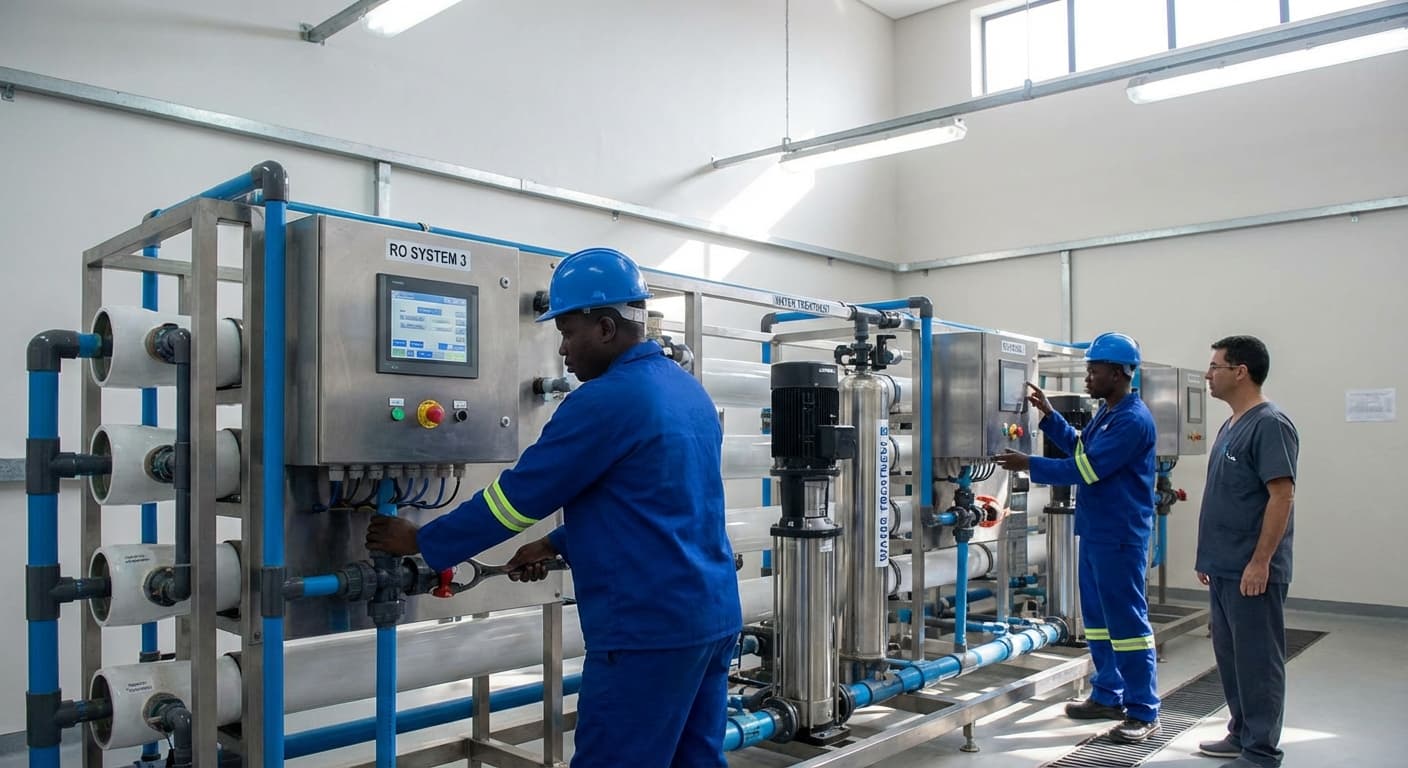
Dialysis RO/Water Treatment Plant Installation Service in Kenya
Engineering Excellence & Technical Support
Dialysis RO/Water Treatment Plant Installation Service High-standard technical execution following OEM protocols and local regulatory frameworks.
Cutting-Edge RO Technology
We deploy state-of-the-art Reverse Osmosis (RO) systems specifically engineered for the unique water quality challenges in Kenya, ensuring the highest purity levels crucial for dialysis treatments and exceeding international standards.
Localized Installation & Support
Our Kenyan-based technical teams possess deep understanding of local regulations, infrastructure, and water sources, guaranteeing seamless, compliant installations and offering rapid, on-site support for optimal plant uptime.
Durable, Climate-Resilient Solutions
We provide robust RO and water treatment plant designs built to withstand Kenya's diverse climate conditions, utilizing high-quality components for long-term reliability and minimal maintenance requirements, even in remote locations.
What Is Dialysis Ro/water Treatment Plant Installation Service In Kenya?
Dialysis RO/Water Treatment Plant Installation Service in Kenya refers to the comprehensive process of designing, supplying, installing, commissioning, and maintaining specialized water purification systems specifically engineered for hemodialysis applications within healthcare facilities in Kenya. These systems are critical for producing ultrapure water required for dialysis procedures, ensuring patient safety by removing contaminants such as bacteria, endotoxins, heavy metals, dissolved salts, and pyrogens. The service encompasses a multi-stage treatment process, typically including pre-filtration, reverse osmosis (RO), and optional polishing stages like deionization (DI) or UV sterilization, tailored to meet the stringent water quality standards set by national and international health organizations. It involves technical expertise in hydraulics, water chemistry, electrical engineering, and compliance with medical device regulations. Ongoing maintenance, servicing, and water quality monitoring are integral to this service to guarantee consistent performance and prevent dialysis-related complications.
| Who Needs This Service? | Typical Use Cases | Importance of Proper Installation | ||||||||
|---|---|---|---|---|---|---|---|---|---|---|
| Hospitals and Dialysis Centers: Facilities providing hemodialysis treatment to patients with end-stage renal disease. | New Dialysis Unit Setup: Establishing a new clinical space dedicated to renal replacement therapy. | Upgrade or Replacement of Existing Systems: Modernizing outdated water treatment plants to meet current standards or expand capacity. | Public and Private Healthcare Providers: Across various scales of medical institutions. | Research Institutions: Requiring high-purity water for related medical research. | Setting up Emergency Dialysis Facilities: During public health crises or disaster relief efforts. | Ensuring Patient Safety: Preventing infections, electrolyte imbalances, and other complications arising from contaminated dialysate. | System Longevity and Reliability: Proper installation minimizes wear and tear, reducing unexpected downtime. | Compliance with Regulatory Standards: Meeting the requirements of the Ministry of Health and international bodies for medical water quality. | Optimized Treatment Efficacy: High-purity water is essential for effective solute removal and fluid balance during dialysis. | Cost-Effectiveness: Preventing premature equipment failure and reducing the need for frequent repairs. |
Key Components and Stages of Dialysis RO/Water Treatment Plant Installation:
- Site Assessment and Design: Evaluating existing water sources, flow rates, and quality to design a bespoke system.
- Component Selection and Procurement: Sourcing high-quality membranes, pumps, filters, tanks, and control systems compliant with medical standards.
- System Installation and Plumbing: Assembling and connecting all water treatment modules, ensuring leak-proof connections and appropriate material compatibility.
- Electrical Wiring and Control System Integration: Connecting power supply, configuring automation, and integrating monitoring systems.
- Commissioning and Performance Testing: Running the system, verifying water quality parameters (conductivity, TOC, microbial counts) against dialysis standards, and performing validation tests.
- Operator Training: Educating facility staff on system operation, routine maintenance, and emergency procedures.
- Documentation and Certification: Providing detailed system manuals, operational logs, and compliance certificates.
- Post-Installation Support and Maintenance: Offering scheduled maintenance, troubleshooting, parts replacement, and water quality re-validation.
Who Needs Dialysis Ro/water Treatment Plant Installation Service In Kenya?
Dialysis RO/Water Treatment Plant Installation Services in Kenya cater to a critical need within the healthcare sector and other industries requiring highly purified water. These services are essential for facilities that perform hemodialysis, where the purity of the water used in the treatment process directly impacts patient safety and treatment efficacy. Beyond healthcare, industries with stringent water quality requirements also benefit from such installations to ensure the reliability and quality of their products and processes.
| Customer Type | Primary Department(s) Involved | Key Needs/Reasons for Installation |
|---|---|---|
| Hospitals (Public and Private) | Nephrology/Dialysis Department, Biomedical Engineering, Procurement Department, Facilities Management | Ensuring patient safety and treatment quality for hemodialysis patients, compliance with healthcare regulations, efficient and reliable water supply for dialysis machines. |
| Specialty Dialysis Centers | Clinical Operations, Maintenance Department, Procurement | Dedicated focus on dialysis services necessitates high-quality water, operational efficiency, and compliance with industry standards. |
| Clinics with Dialysis Units | Clinic Management, Technical Staff, Procurement | Providing essential dialysis services requires a reliable and safe water source, often on a smaller scale than large hospitals. |
| Research and Development Laboratories | Laboratory Management, Research Scientists, Facilities Department, Procurement | Ultra-pure water is critical for sensitive experiments, analysis, and media preparation to ensure accurate and reproducible results. |
| Pharmaceutical Manufacturing Facilities | Quality Control/Assurance, Production Department, Engineering Department, Procurement | Meeting stringent pharmacopoeial standards for purified water (e.g., USP, EP) used in drug manufacturing, cleaning of equipment, and formulation. |
| Food and Beverage Processing Plants | Quality Assurance, Production Management, Engineering Department, Procurement | Ensuring the safety, quality, and consistency of food and beverage products by using treated water for processing, cleaning, and ingredient formulation. |
| Electronics Manufacturing Companies | Production Engineering, Quality Control, Facilities Management, Procurement | Ultra-pure water is essential for cleaning sensitive electronic components and semiconductor manufacturing to prevent contamination and ensure product reliability. |
| Industrial Water Treatment Facilities | Operations Management, Engineering Department, Maintenance | Providing purified water as a service to various industries, requiring robust and efficient RO/water treatment plants for large-scale applications. |
Target Customers and Departments for Dialysis RO/Water Treatment Plant Installation Service in Kenya
- Hospitals (Public and Private)
- Specialty Dialysis Centers
- Clinics with Dialysis Units
- Research and Development Laboratories
- Pharmaceutical Manufacturing Facilities
- Food and Beverage Processing Plants
- Electronics Manufacturing Companies
- Industrial Water Treatment Facilities
Dialysis Ro/water Treatment Plant Installation Service Process In Kenya
This document outlines the typical workflow for Dialysis RO/Water Treatment Plant Installation Services in Kenya, from the initial customer inquiry to the final execution and handover. It covers the key stages, responsibilities, and considerations involved in ensuring a successful installation that meets the stringent requirements for dialysis water.
| Stage | Key Activities | Responsible Party |
|---|---|---|
| Understanding client needs, capacity, budget; Initial discussion. | Client, Service Provider Sales/Technical Team |
| Evaluating space, water source quality, power, plumbing; Detailed survey. | Service Provider Technical Team/Engineer |
| Custom system design, component selection, proposal generation (specs, timeline, cost). | Service Provider Technical Team/Engineer |
| Contract signing, advance payment, equipment procurement. | Client, Service Provider |
| Sourcing components, potential pre-assembly of modules. | Service Provider Procurement & Workshop Team |
| Physical installation of all system components, piping, and electrical connections. | Service Provider Installation Technicians/Engineers |
| System flushing, water quality testing, performance verification. | Service Provider Technical Team/Commissioning Engineer |
| Training client staff on operation, maintenance, and monitoring. | Service Provider Technical Trainer |
| Formal transfer of the system, provision of all documentation. | Service Provider Project Manager/Technical Lead |
| Ongoing maintenance, repairs, spare parts, troubleshooting. | Service Provider After-Sales/Maintenance Team |
Workflow Stages
- {"title":"1. Inquiry and Initial Consultation","description":"The process begins when a client (e.g., a hospital, dialysis center, or clinic) expresses interest in a Dialysis RO/Water Treatment Plant. This involves an initial discussion to understand their specific needs, capacity requirements, existing water source quality, and budget."}
- {"title":"2. Site Assessment and Survey","description":"A qualified technician or engineer visits the client's site. This crucial step involves: evaluating the available space for the plant, assessing the existing water source (quality, pressure, flow rate), identifying power supply availability and capacity, and understanding plumbing and drainage connections. Detailed measurements and observations are recorded."}
- {"title":"3. System Design and Proposal Generation","description":"Based on the site assessment and client requirements, the service provider designs a customized RO/Water Treatment Plant. This includes selecting appropriate filtration stages (pre-filters, RO membranes, post-filters), UV sterilization, and potentially other treatment methods. A comprehensive proposal is then generated, detailing the system specifications, components, installation plan, timeline, and quotation."}
- {"title":"4. Contract Agreement and Order Placement","description":"Upon client approval of the proposal, a formal contract is signed. The client typically makes an advance payment to initiate the procurement of equipment and commencement of services. The service provider then places orders for all necessary components and materials."}
- {"title":"5. Equipment Procurement and Pre-Assembly","description":"The service provider sources high-quality RO membranes, filters, pumps, tanks, piping, control panels, and other essential components from reputable suppliers. Some pre-assembly of modules or skids may occur at the provider's workshop to optimize on-site installation time."}
- {"title":"6. On-Site Installation","description":"This is the core execution phase. A team of trained technicians will: \n - Prepare the installation site.\n - Install the main RO unit, pre-treatment filters, and post-treatment components.\n - Connect piping for incoming water, treated water, and wastewater.\n - Install electrical connections, including control panels and sensors.\n - Set up storage tanks and distribution lines."}
- {"title":"7. Commissioning and Testing","description":"Once installation is complete, the system undergoes rigorous commissioning and testing. This involves: \n - Flushing the entire system to remove any manufacturing residues.\n - Testing the water quality at various stages to ensure it meets dialysis standards (TDS, microbial load, etc.).\n - Verifying the functionality of all components, including pumps, valves, and control systems.\n - Conducting performance tests to confirm flow rates and treatment efficiency."}
- {"title":"8. Staff Training","description":"The service provider conducts comprehensive training for the client's operational staff. This covers system operation, routine maintenance procedures (filter replacement, sanitization), troubleshooting common issues, and water quality monitoring protocols."}
- {"title":"9. Handover and Documentation","description":"Upon successful commissioning and training, the RO/Water Treatment Plant is formally handed over to the client. This includes providing all relevant documentation, such as user manuals, maintenance logs, test reports, warranty certificates, and a schematic diagram of the system."}
- {"title":"10. Post-Installation Support and Maintenance","description":"The service provider typically offers ongoing support, including routine maintenance services, emergency repairs, and spare parts supply, as per the service agreement. This ensures the long-term reliability and optimal performance of the dialysis water system."}
Dialysis Ro/water Treatment Plant Installation Service Cost In Kenya
Installing a Reverse Osmosis (RO) and water treatment plant for dialysis in Kenya involves a range of costs influenced by several key factors. These plants are critical for ensuring the purity of water used in hemodialysis, protecting patients from waterborne contaminants. The pricing is not uniform and can vary significantly based on the complexity of the system, capacity, brand of components, and the specific requirements of the healthcare facility.
Factors influencing the cost include:
- Capacity and Flow Rate: The volume of purified water the plant needs to produce per hour directly impacts the size and cost of the RO membranes, pumps, filters, and storage tanks. Larger capacities for busy hospitals will be more expensive than smaller units for clinics.
- Level of Filtration and Treatment: The degree of purification required is a primary cost driver. This includes the number and type of pre-treatment filters (sediment, carbon), the quality of the RO membranes, and the inclusion of post-treatment processes like UV sterilization or electrodeionization (EDI) for ultra-pure water.
- Brand and Quality of Components: Reputable international brands for RO membranes, pumps, and control systems generally come with a higher price tag but often offer better reliability, efficiency, and longevity. Localized or less-known brands might offer lower upfront costs but could have higher maintenance expenses in the long run.
- Installation Complexity and Site Requirements: The existing water source quality, space availability for the plant, plumbing modifications, electrical connections, and the need for specialized civil works can all add to the installation cost. Remote locations might also incur higher logistical expenses.
- After-Sales Service and Maintenance Contracts: The cost of installation often includes initial setup and commissioning. However, ongoing maintenance, regular filter replacements, membrane cleaning, and technical support are crucial and will factor into the overall investment. Facilities opting for comprehensive service contracts will see a higher initial or bundled price.
- Additional Features and Automation: Advanced features like remote monitoring, automated backwashing systems, integrated water quality sensors, and redundant systems to ensure continuous supply can increase the overall cost.
Estimated Cost Ranges in Kenyan Shillings (KES):
It's important to note that these are broad estimates and a precise quote requires a site assessment and detailed system design.
Small Clinic/Unit (e.g., 5-10 liters per minute flow rate):
- Basic RO with essential pre-treatment and UV sterilization.
- Estimated range: KES 400,000 - KES 800,000
Medium-Sized Hospital/Dialysis Center (e.g., 10-25 liters per minute flow rate):
- More robust pre-treatment, higher-quality RO membranes, possibly EDI, larger storage tanks, and better automation.
- Estimated range: KES 800,000 - KES 2,000,000
Large Hospital/Multi-Dialysis Unit (e.g., 25+ liters per minute flow rate):
- High-capacity systems with advanced multi-stage filtration, redundancy, sophisticated monitoring, and potentially custom-built solutions.
- Estimated range: KES 2,000,000 - KES 5,000,000+
| System Size/Application | Estimated Cost Range (KES) |
|---|---|
| Small Clinic/Unit (5-10 L/min) | 400,000 - 800,000 |
| Medium-Sized Hospital/Dialysis Center (10-25 L/min) | 800,000 - 2,000,000 |
| Large Hospital/Multi-Dialysis Unit (25+ L/min) | 2,000,000 - 5,000,000+ |
Key Factors Influencing Dialysis RO/Water Treatment Plant Installation Cost in Kenya
- Capacity and Flow Rate
- Level of Filtration and Treatment
- Brand and Quality of Components
- Installation Complexity and Site Requirements
- After-Sales Service and Maintenance Contracts
- Additional Features and Automation
Affordable Dialysis Ro/water Treatment Plant Installation Service Options
Finding affordable dialysis RO/water treatment plant installation services is crucial for healthcare facilities. These systems are essential for ensuring the purity and safety of water used in dialysis, directly impacting patient well-being. This guide explores value bundles and cost-saving strategies to help you make informed decisions without compromising quality.
| Value Bundle Type | Description | Potential Cost Savings | Ideal For |
|---|---|---|---|
| Basic Installation Package | Includes the installation of a standard RO unit, essential pre-filtration, and basic piping. Focuses on core functionality. | Lower upfront cost, good for facilities with existing infrastructure or smaller patient volumes. | Small clinics, new facilities with budget constraints. |
| Comprehensive Solution Bundle | Combines RO installation with advanced pre-filtration, post-filtration, a larger storage tank, and basic monitoring. Offers a more complete system. | Slightly higher upfront cost, but reduces the need for future upgrades and minimizes potential operational issues, leading to long-term savings. | Medium-sized clinics, facilities looking for a robust and reliable system. |
| Premium Integrated System | Encompasses full installation, high-efficiency RO membranes, advanced multi-stage filtration, automated monitoring with remote access, and integrated alarm systems. Often includes training. | Highest upfront investment, but offers significant long-term savings through reduced maintenance, optimized water usage, enhanced safety, and extended equipment lifespan. | Large dialysis centers, hospitals, facilities prioritizing maximum efficiency and patient safety. |
| Service & Maintenance Add-on | Bundling installation with a service contract for regular maintenance, filter replacements, and performance checks. Not a direct installation bundle, but a cost-saving strategy. | Reduces unexpected repair costs, prevents system failures, ensures optimal water quality, and extends the life of the equipment. Predictable operational expenses. | All facilities, especially those wanting to minimize downtime and ensure continuous operation. |
Key Components of Dialysis Water Treatment Systems
- Reverse Osmosis (RO) Unit: The core of the system, removing dissolved salts, minerals, and impurities.
- Pre-filtration: Sediment filters and carbon filters to remove larger particles and chlorine, protecting the RO membrane.
- Post-filtration: Polishing filters to remove any residual contaminants.
- Storage Tank: To maintain a consistent supply of purified water.
- Distribution Loop: To deliver purified water to dialysis machines.
- Monitoring and Control Systems: For ensuring water quality and system performance.
Verified Providers In Kenya
Navigating the healthcare landscape in Kenya can be challenging, with numerous providers offering a wide range of services. When seeking quality and trustworthy medical care, it's crucial to identify 'Verified Providers'. These are healthcare facilities and practitioners who have undergone rigorous vetting processes, ensuring they meet stringent standards for medical expertise, ethical practices, and patient safety. Franance Health stands out as a prime example of such a verified provider, offering a comprehensive and reliable healthcare solution for individuals and families across Kenya. Their commitment to excellence, transparent operations, and patient-centric approach make them a leading choice.
| Feature | Franance Health's Commitment | Benefit to Patients |
|---|---|---|
| Provider Verification | Extensive credentialing and background checks for all affiliated doctors and facilities. | Peace of mind knowing you are receiving care from qualified and legitimate medical professionals. |
| Quality Assurance | Adherence to strict medical protocols and regular performance reviews. | Consistent delivery of high-quality medical services and treatments. |
| Patient Experience | Focus on empathy, clear communication, and timely access to care. | A comfortable and supportive healthcare journey with minimal stress. |
| Service Range | Wide network of specialists and general practitioners across various medical disciplines. | Convenient access to a broad range of medical needs under one umbrella. |
| Technology Utilization | Implementation of digital health solutions for efficient management and communication. | Streamlined appointment booking, record keeping, and potentially remote consultations. |
Why Franance Health is a Top Verified Provider in Kenya:
- Rigorous Credentialing and Vetting: Franance Health meticulously vets all its affiliated healthcare providers, ensuring they possess valid licenses, specialized training, and a proven track record of patient care.
- Commitment to Quality Standards: They adhere to international best practices and local regulatory requirements, guaranteeing that patients receive care that is both effective and safe.
- Patient-Centric Approach: Franance Health prioritizes patient well-being, offering personalized care plans, accessible services, and a supportive environment.
- Comprehensive Service Offering: From primary care to specialized treatments, Franance Health provides a broad spectrum of medical services, making it a one-stop solution for diverse healthcare needs.
- Technological Integration: They leverage modern technology to enhance patient experience, including efficient appointment scheduling, electronic health records, and telemedicine options where applicable.
- Ethical Practice and Transparency: Franance Health operates with a strong ethical framework, ensuring clear communication, fair pricing, and respect for patient privacy.
- Accessibility and Affordability: Striving to make quality healthcare accessible, they work towards offering competitive pricing and convenient locations.
Scope Of Work For Dialysis Ro/water Treatment Plant Installation Service
This Scope of Work (SOW) outlines the requirements for the installation services of a Reverse Osmosis (RO) and Water Treatment Plant (WTP) specifically designed for dialysis units. The service includes all necessary activities from site preparation to commissioning and handover, ensuring the plant meets all specified technical requirements and adheres to relevant standard specifications for medical water purification. The vendor will be responsible for the complete installation, integration, testing, and validation of the RO/WTP system as per the design provided and industry best practices.
| Technical Deliverable | Description | Standard Specification Reference |
|---|---|---|
| Installed RO/WTP Unit | Fully assembled and operational Reverse Osmosis and Water Treatment Plant as per design specifications. | Manufacturer's specifications, project design drawings, and relevant industry standards (e.g., AS/NZS 3718, ISO 13485 for medical device related aspects). |
| Piping and Connections | All water-carrying pipes and connections are installed, leak-free, and made of materials suitable for purified water used in dialysis. | AS/NZS 3500, AS/NZS 4020 (Materials for contact with potable water), FDA-approved materials where applicable. |
| Electrical Wiring and Control Panel | Complete electrical installation, including the control panel, wiring, and connections, adhering to safety standards and ensuring reliable operation. | AS/NZS 3000 (Electrical installations), relevant PLC/automation standards. |
| Instrumentation and Calibration | All sensors, gauges, and monitoring equipment are installed, calibrated, and functioning correctly. | Manufacturer's calibration procedures, traceable calibration to national standards. |
| Pre-Treatment System | Installation and connection of sediment filters, activated carbon filters, water softeners, etc. | Manufacturer's specifications and relevant water treatment standards. |
| RO Membrane Modules | Proper installation and sealing of RO membrane housings and modules. | Manufacturer's installation guidelines. |
| Post-Treatment System | Installation of UV sterilizers, post-carbon filters, or other polishing units as specified. | Manufacturer's specifications and relevant disinfection standards. |
| Storage and Distribution Piping | Installation of purified water storage tanks and distribution lines to dialysis stations. | AS/NZS 3500, materials conforming to potable water standards, potential antimicrobial properties. |
| Waste Water Management | Proper connection and routing of reject water and backwash lines to designated drainage points. | Local plumbing codes and environmental regulations. |
| Performance Test Report | Documented results of all performance tests verifying water quality parameters. | AS/NZS 3718, relevant ISO standards for water quality testing (e.g., ISO 11731 for microbial analysis), project-specific acceptance criteria. |
| Commissioning Report | Detailed report of the commissioning process, including start-up procedures, adjustments, and final system status. | Project-specific commissioning protocol. |
| Operation and Maintenance Manuals | Comprehensive manuals for the installed system, including troubleshooting guides. | Manufacturer's documentation, project-specific additions. |
| As-Built Drawings | Updated drawings reflecting the final installed configuration of the RO/WTP. | Industry standard CAD formats. |
| Training Materials | Documentation and resources provided for operator training. | Clear, concise language, visual aids. |
Key Responsibilities of the Installation Service Provider
- Site Assessment and Preparation: Conduct a thorough site survey to assess existing conditions, including space availability, power supply, water inlet, drainage, and structural integrity. Prepare the site as per the project plan, ensuring all necessary civil works, electrical connections, and plumbing modifications are completed.
- Equipment Delivery and Handling: Receive, unload, inspect, and safely transport all components of the RO/WTP system to their designated installation locations.
- Mechanical Installation: Assemble and install all major equipment, including pre-treatment filters, RO membranes, post-treatment units, storage tanks, pumps, and associated piping.
- Electrical Installation: Install and connect all electrical components, including control panels, sensors, wiring, and power supply to the system. Ensure compliance with all electrical safety codes.
- Plumbing and Piping: Connect all water inlet, outlet, and drain lines, ensuring leak-free connections and proper material selection for potable water applications. This includes high-purity tubing for the final dialysis water distribution.
- Instrumentation and Control: Install and calibrate all necessary instrumentation (e.g., pressure gauges, flow meters, conductivity meters) and connect them to the control system.
- System Integration: Integrate all individual components and subsystems to form a fully functional RO/WTP.
- Pre-Commissioning Checks: Perform all necessary pre-commissioning checks, including pressure testing, flushing, and leak detection.
- Commissioning and Start-up: Supervise the initial start-up of the system, monitor operational parameters, and make necessary adjustments to ensure optimal performance.
- Performance Testing and Validation: Conduct comprehensive performance tests to verify that the treated water quality meets the specified parameters for dialysis use (e.g., conductivity, total dissolved solids, microbial counts). This includes validation as per relevant standards.
- Operator Training: Provide thorough training to the facility's designated personnel on the operation, maintenance, and troubleshooting of the RO/WTP system.
- Documentation and Handover: Provide all necessary project documentation, including as-built drawings, operation and maintenance manuals, test reports, and warranty information. Officially hand over the installed system to the client.
- Post-Installation Support: Offer a defined period of post-installation support to address any initial issues or queries.
Service Level Agreement For Dialysis Ro/water Treatment Plant Installation Service
This Service Level Agreement (SLA) outlines the guaranteed response times and uptime for the installation services of a dialysis Reverse Osmosis (RO)/Water Treatment Plant. This SLA is established between [Your Company Name] (hereinafter referred to as 'Provider') and [Client Company Name] (hereinafter referred to as 'Client'), for the specific project of installing a dialysis RO/Water Treatment Plant at [Client's Facility Address].
| Service Component | Response Time (Business Hours) | Uptime Guarantee |
|---|---|---|
| Initial Site Assessment & Design Consultation | Within 2 business days of request/agreement. | N/A (Installation phase) |
| Equipment Procurement & Delivery | Not Applicable (Project Milestone) | N/A (Installation phase) |
| Installation Commencement | Within 10 business days of equipment availability (unless otherwise specified in the project plan). | N/A (Installation phase) |
| Critical System Malfunction during Installation (e.g., major component failure preventing progress) | Within 4 business hours. | N/A (Installation phase, but indicates risk to schedule) |
| Post-Installation System Testing & Commissioning | Within 2 business days of installation completion. | N/A (Installation phase, but indicates functional readiness) |
| System Uptime (after successful commissioning and handover) | 99.5% (for critical water production for dialysis treatments) | 99.5% guaranteed uptime for the installed dialysis RO/Water Treatment Plant, measured monthly. This excludes scheduled maintenance and planned downtime communicated in advance. |
| Emergency Technical Support (post-installation, during warranty period) | On-site or remote response within 6 business hours for critical system failures impacting dialysis operations. Non-critical issues will be addressed within 24 business hours. | The goal is to restore full functionality as quickly as possible. Specific penalties for downtime beyond the 99.5% guarantee will be detailed in the main contract. |
| Routine/Preventive Maintenance Visit (scheduled) | Scheduled as per the agreed maintenance plan. Client will be given at least 7 days' notice. | N/A (Planned downtime) |
Scope of Service
- On-site assessment and design consultation for the dialysis RO/Water Treatment Plant installation.
- Procurement and delivery of all necessary equipment and materials.
- Professional installation of the dialysis RO/Water Treatment Plant, including piping, electrical connections, and system integration.
- System testing, commissioning, and initial calibration.
- On-site training for designated client personnel on operation and basic maintenance.
- Post-installation support for a defined warranty period.
Frequently Asked Questions

Ready when you are
Let's scope your Dialysis RO/Water Treatment Plant Installation Service in Kenya project in Kenya.

Scaling healthcare logistics and technical systems across the entire continent.