
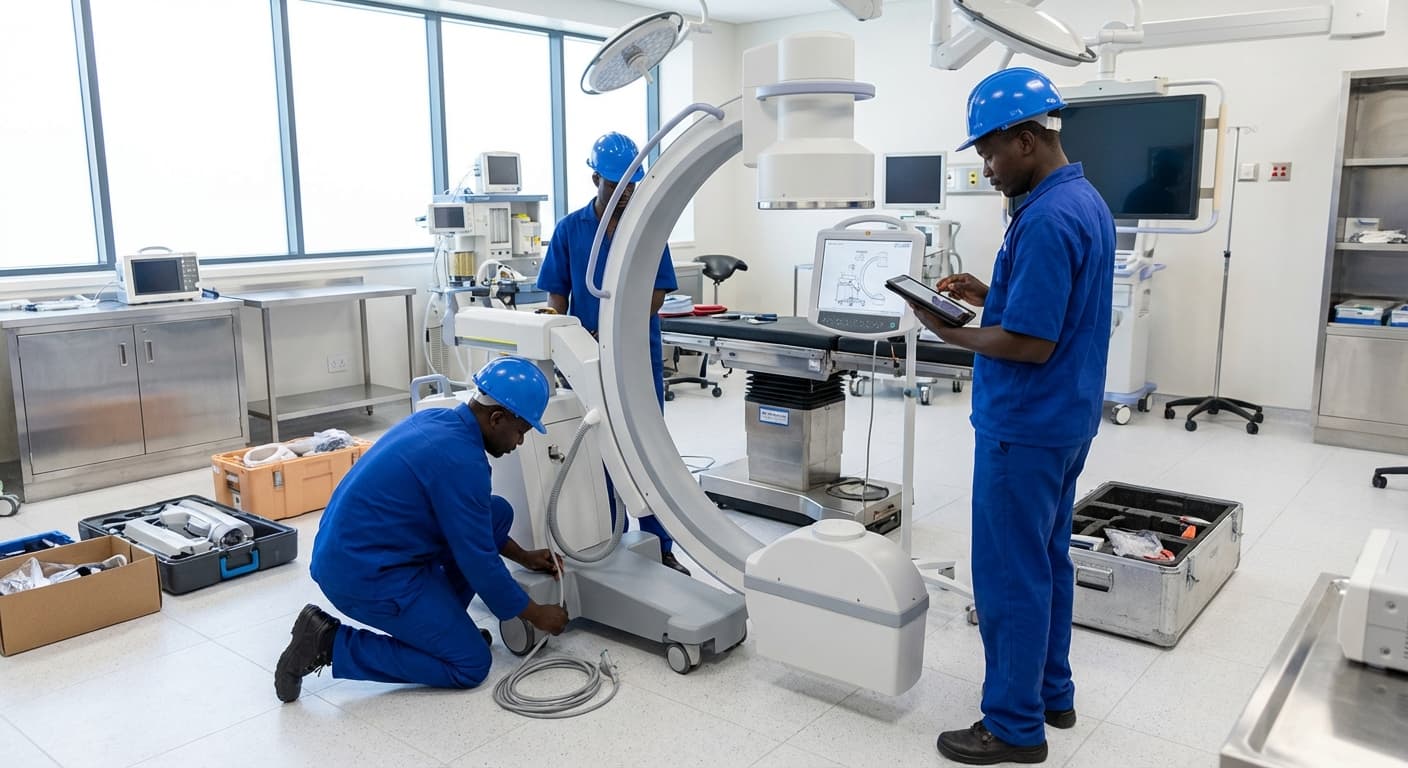
C-Arm Installation Service in Kenya
Engineering Excellence & Technical Support
C-Arm Installation Service High-standard technical execution following OEM protocols and local regulatory frameworks.
Advanced C-Arm Integration
Expertly integrate your state-of-the-art C-arm systems, ensuring seamless compatibility with existing medical imaging infrastructure and PACS for optimized workflow and image quality.
Precision Site Preparation & Calibration
Meticulous site assessment and preparation to meet stringent power, shielding, and environmental requirements, followed by precise calibration for accurate diagnostic imaging and minimal patient radiation.
Regulatory Compliance & Safety Assurance
Navigate and ensure full adherence to Kenyan medical device regulations and radiation safety standards, providing comprehensive documentation and training for your clinical staff and technicians.
What Is C-arm Installation Service In Kenya?
C-Arm Installation Service in Kenya refers to the comprehensive process of setting up, calibrating, and validating a mobile X-ray imaging device, commonly known as a C-arm, within a healthcare facility in Kenya. This service encompasses the physical placement of the C-arm system, its integration with existing hospital infrastructure (such as power, network, and medical gas systems), and the rigorous testing required to ensure optimal performance, safety, and compliance with relevant medical and regulatory standards. It is a specialized technical undertaking that requires trained personnel with expertise in medical imaging equipment, radiology, and electrical/mechanical engineering principles.
| Who Needs C-Arm Installation Service? | Typical Use Cases | ||||||
|---|---|---|---|---|---|---|---|
| Hospitals (public and private) | Operating Rooms (Orthopedics, Spine, General Surgery, Urology, Cardiology) | Diagnostic Imaging Departments | Pain Management Clinics | Emergency Departments | Interventional Radiology Suites | Veterinary Clinics (specialized facilities) | |
| Orthopedic surgery (fracture fixation, joint replacements) | Spinal surgery (decompression, fusion) | Cardiovascular interventions (angiography, stenting) | Urological procedures (lithotripsy, stent placement) | Pain management injections (epidural, facet joint) | Pacemaker insertion | Foreign body localization | Biopsy guidance |
Key Components of C-Arm Installation Service
- Site assessment and planning
- Unpacking and physical positioning of the C-arm unit
- Power and electrical grounding
- Network and data connectivity (PACS integration)
- Radiation shielding assessment and verification
- Initial system boot-up and configuration
- Image quality calibration and optimization
- Functional testing of all imaging modes and components
- Operator training and familiarization
- Documentation and certification of installation
- Post-installation support and maintenance planning
Who Needs C-arm Installation Service In Kenya?
C-Arm installation services in Kenya are crucial for healthcare facilities that utilize mobile X-ray imaging systems for intraoperative and interventional procedures. These systems offer real-time imaging, enhancing surgical precision, pain management, and diagnostic capabilities across various medical specialties. Ensuring proper installation and calibration is paramount for optimal performance, patient safety, and regulatory compliance.
| Department | Typical C-Arm Usage | Importance of Professional Installation |
|---|---|---|
| Orthopedic Surgery | Fracture reduction, joint replacements, spinal surgery, trauma care | Ensures accurate placement of implants, real-time assessment of bone alignment, and visualization of surgical instruments. |
| Cardiology / Interventional Cardiology | Angiography, angioplasty, stent placement, pacemaker implantation | Critical for visualizing blood vessels, guiding catheters, and ensuring accurate stent deployment in real-time. |
| Pain Management | Epidural steroid injections, nerve blocks, radiofrequency ablation | Precise needle placement is essential for effective pain relief and avoiding critical structures. |
| General Surgery | Foreign body localization, instrument verification, minimally invasive procedures | Aids in identifying and removing foreign objects, confirming instrument position, and guiding laparoscopic or endoscopic interventions. |
| Urology | Stent placement, stone removal, urinary tract imaging | Facilitates visualization of the urinary tract for stone treatment and stent insertion. |
| Emergency Department | Trauma assessment, fracture identification, foreign body detection | Provides immediate imaging capabilities for critical patients, aiding in rapid diagnosis and treatment planning. |
Target Customers for C-Arm Installation Service in Kenya
- Hospitals (Public and Private)
- Specialized Clinics (Orthopedic, Cardiac, Pain Management, etc.)
- Diagnostic Imaging Centers
- Surgical Centers
- Veterinary Clinics (for advanced procedures)
C-arm Installation Service Process In Kenya
This document outlines the typical workflow for a C-Arm Installation Service Process in Kenya, from the initial customer inquiry to the successful execution of the installation. This structured approach ensures all necessary steps are covered, from pre-installation planning to post-installation support, guaranteeing a seamless experience for the client.
| Stage | Description | Key Activities | Deliverables/Outcomes | Responsible Party |
|---|---|---|---|---|
| The process begins when a healthcare facility or individual expresses interest in acquiring and installing a C-Arm. This stage involves understanding the client's needs and providing initial information. |
|
| Client, Service Provider Sales Team |
| A detailed inspection of the installation site is conducted to ensure it meets all technical and environmental requirements for the C-Arm. |
|
| Service Provider Technical Team |
| Based on the consultation and site survey, a formal quotation is prepared, detailing the costs and scope of the installation. Upon acceptance, an agreement is signed. |
|
| Service Provider Sales/Commercial Team, Client |
| This stage involves planning the delivery of the C-Arm and scheduling the installation with the client, considering their operational needs. |
|
| Service Provider Logistics & Project Management, Client |
| Ensuring the installation site is fully prepared and all necessary materials are on-site before the technicians arrive. |
|
| Client, Service Provider Installation Team |
| The C-Arm is transported to the site and carefully unpacked, with all components checked for damage. |
|
| Service Provider Installation Team, Logistics Partner |
| The C-Arm is assembled, connected to power and necessary networks, and positioned according to the room layout. |
|
| Service Provider Installation Team |
| The C-Arm undergoes rigorous testing and calibration to ensure it functions optimally and meets imaging quality standards. |
|
| Service Provider Installation Team, Biomedical Engineers |
| Key personnel from the healthcare facility are trained on the operation, basic maintenance, and safety procedures of the C-Arm. |
|
| Service Provider Application Specialists/Trainers, Client Staff |
| The installed C-Arm is formally handed over to the client, along with all relevant documentation. |
|
| Service Provider Project Manager, Client Representative |
| Ongoing support is provided to ensure the C-Arm continues to operate efficiently and effectively. |
|
| Service Provider Technical Support & Maintenance Team, Client |
C-Arm Installation Service Process Workflow
- Inquiry & Initial Consultation
- Site Survey & Assessment
- Quotation & Agreement
- Logistics & Scheduling
- Pre-Installation Preparations
- Delivery & Unpacking
- Installation & Setup
- Testing & Calibration
- User Training
- Handover & Documentation
- Post-Installation Support
C-arm Installation Service Cost In Kenya
The cost of installing a C-arm in Kenya can vary significantly based on several key factors. C-arms are specialized medical imaging devices, and their installation involves technical expertise, specialized equipment, and compliance with local regulations. Understanding these pricing determinants is crucial for healthcare facilities budgeting for such an investment. The primary elements influencing the overall installation cost include the type and model of the C-arm, the complexity of the installation site, the required infrastructure modifications, the vendor's pricing structure, and any additional services or support needed.
| Installation Cost Component | Estimated Range (KES) | Notes |
|---|---|---|
| Basic Installation & Setup | 50,000 - 150,000 | Includes unboxing, initial positioning, and basic connectivity for standard C-arms. Does not include significant infrastructure work. |
| Site Preparation & Minor Modifications | 100,000 - 300,000 | Minor electrical work, basic cable management, and initial structural adjustments. |
| Radiation Shielding (Lead Lining) | 200,000 - 800,000+ | Highly variable based on room size, existing walls, and the extent of shielding required. This is a significant cost driver. |
| Major Infrastructure Upgrades (Electrical, HVAC) | 150,000 - 500,000+ | Dedicated power lines, robust cooling systems, and enhanced ventilation if the existing infrastructure is inadequate. |
| Vendor Installation Fees & Project Management | 100,000 - 400,000 | Covers the vendor's specialized labor, project coordination, and technical expertise. Can be bundled with the C-arm purchase. |
| Ancillary Equipment Integration (e.g., PACS) | 50,000 - 200,000 | Connecting and configuring the C-arm with existing IT infrastructure or new peripherals. |
| Training & Commissioning | 50,000 - 150,000 | Initial hands-on training for radiographers and physicians, ensuring the system is fully operational and calibrated. |
| Total Estimated Installation Cost (excluding C-arm unit) | 500,000 - 2,500,000+ | This is a broad range. A comprehensive installation with significant shielding and infrastructure upgrades will fall at the higher end. Basic installations in prepared rooms will be at the lower end. |
Key Pricing Factors for C-Arm Installation in Kenya
- C-Arm Model & Specifications: Advanced C-arms with higher imaging capabilities, larger detectors, and advanced software features generally command higher installation costs. This is often tied to the initial purchase price and the vendor's expertise in handling more sophisticated systems.
- Site Assessment & Preparation: A thorough site assessment is essential. The complexity of the existing room (e.g., size, accessibility, existing wiring), the need for radiation shielding (lead lining for walls, doors, and windows), and structural modifications will significantly impact costs. Hospitals with pre-designed imaging suites will incur lower preparation costs.
- Infrastructure Requirements: This includes the need for dedicated power supply with surge protection, proper ventilation, cooling systems, and network connectivity. Upgrading or installing new infrastructure will add to the overall expense.
- Vendor & Service Provider: Different C-arm manufacturers and their authorized service providers have varying pricing models for installation. Factors like brand reputation, the comprehensiveness of their installation package, and their geographical reach within Kenya can influence costs.
- Installation Labor & Expertise: The number of technicians required, their skill level, and the duration of the installation process contribute to labor costs. Specialized C-arm engineers are typically involved.
- Permits & Regulatory Compliance: Obtaining necessary permits and ensuring compliance with local health and safety regulations (e.g., radiation safety standards) can incur administrative fees and may require specific modifications.
- Ancillary Equipment & Accessories: Installation may also involve the setup of related equipment like imaging workstations, printers, PACS (Picture Archiving and Communication System) integration, and patient monitoring devices.
- Post-Installation Services: This can include initial training for medical staff, warranty periods, and ongoing maintenance contracts, which might be bundled with the installation or offered as separate packages.
- Geographical Location: While less of a factor for the core installation, travel and accommodation costs for technicians might increase if the hospital is located in a remote area of Kenya.
Affordable C-arm Installation Service Options
Navigating the installation of a C-arm can be a significant undertaking, both in terms of logistics and cost. Fortunately, a range of affordable C-arm installation service options are available to healthcare facilities. Understanding these options, particularly value bundles and employing cost-saving strategies, can help streamline the process and minimize expenditure without compromising on quality or safety.
| Cost-Saving Strategy | Description | Potential Benefit |
|---|---|---|
| Early Planning & Site Preparation | Thoroughly assessing the installation site and completing necessary structural, electrical, and environmental modifications well in advance of the C-arm's arrival. This includes ensuring adequate power, ventilation, and space. | Minimizes delays, reduces last-minute costly emergency work, and prevents potential downtime for the C-arm once it's delivered. |
| Negotiate Service Level Agreements (SLAs) | Carefully reviewing and negotiating the terms of the installation service contract, including scope of work, timelines, and post-installation support. Comparing quotes from multiple reputable providers is crucial. | Ensures all required services are covered, prevents scope creep and unexpected charges, and secures competitive pricing. |
| Leverage Existing Infrastructure | If a facility has existing imaging rooms or has recently undergone renovations, identifying and utilizing existing infrastructure (e.g., pre-wired power, network drops) can reduce the need for extensive new installations. | Significantly lowers labor and material costs associated with electrical and network setup. |
| Phased Installation | For complex installations or when budget constraints are a concern, consider breaking the installation into phases. This might involve initial setup and calibration followed by advanced feature integration or training at a later date. | Allows for budget management over time and can distribute costs more evenly. |
| Staff Training & Internal Support | Investing in training for internal biomedical engineers or IT staff to handle minor troubleshooting or basic maintenance post-installation can reduce reliance on external support for routine issues. | Lowers ongoing service costs and ensures quicker resolution of minor problems. |
| Bundled Equipment & Installation Deals | When purchasing a new or refurbished C-arm, inquire about bundled packages that include installation services at a discounted rate or as part of the overall equipment cost. | Streamlines procurement and often results in a lower combined price. |
Affordable C-Arm Installation Service Options
- Full-Service Installation Packages: These comprehensive bundles typically include site assessment, system delivery, physical installation, electrical work, imaging system setup, calibration, and initial training. While seemingly an upfront investment, they often offer better value through integrated services and reduced coordination efforts.
- Modular Installation Services: Facilities can opt for specific components of the installation, such as basic physical placement or electrical upgrades, and handle other aspects in-house or with separate vendors. This can be cost-effective for those with existing infrastructure or internal technical expertise.
- Regional or Multi-Facility Discounts: Negotiating with installation providers for bulk services across multiple locations or for multiple C-arms can unlock significant discounts. Providers are often willing to offer tiered pricing for larger projects.
- Used or Refurbished C-Arm Installation: Installing pre-owned C-arms often comes with a lower initial equipment cost, and installation services for these systems can also be more competitively priced.
- Service Contracts Post-Installation: Bundling installation with a multi-year service contract can sometimes result in a reduced installation fee, as providers secure long-term revenue. This also ensures ongoing maintenance and support.
Verified Providers In Kenya
In Kenya's dynamic healthcare landscape, identifying truly verified and high-quality healthcare providers is paramount. Franance Health has emerged as a leading platform, meticulously vetting and showcasing a network of credentialed professionals and facilities. This commitment to verification ensures that patients can access care with confidence, knowing they are engaging with providers who meet stringent standards for expertise, ethical practice, and patient safety. Choosing Franance Health means prioritizing your well-being through a curated selection of Kenya's finest healthcare resources.
| Provider Type | Franance Health Verification Criteria | Benefits for Patients |
|---|---|---|
| Doctors (Specialists & General Practitioners) | Valid medical license (KMPDC), recognized medical degrees, board certifications, professional affiliations, continuous medical education (CME) compliance. | Access to highly qualified physicians with demonstrated expertise in their fields; assurance of up-to-date medical knowledge and ethical practice. |
| Hospitals and Clinics | Accreditation from relevant health bodies (e.g., NHIF-compliant), adherence to national healthcare standards, qualified medical staff, safety protocols, infection control measures. | Safe and well-equipped facilities with competent healthcare professionals; reliable emergency services and comprehensive treatment options. |
| Laboratories and Diagnostic Centers | Accreditation (e.g., KENAS), quality control measures, qualified laboratory technologists, use of validated equipment and reagents. | Accurate and reliable diagnostic test results essential for proper diagnosis and treatment; confidence in the precision of medical investigations. |
| Pharmacies | Valid registration with the Pharmacy and Poisons Board (PPB), licensed pharmacists, proper drug storage and handling procedures, authenticity of medications. | Access to genuine and quality-assured medications; professional guidance from pharmacists on drug usage and potential side effects. |
Why Franance Health Credentials Matter
- Rigorous Verification Process: Franance Health employs a multi-faceted vetting system, scrutinizing licenses, certifications, qualifications, and adherence to ethical guidelines.
- Focus on Patient Safety: Verified providers undergo checks to ensure they maintain up-to-date safety protocols and provide a secure healthcare environment.
- Expertise and Specialization: The platform highlights providers with proven track records and specialized skills, ensuring you find the right care for your specific needs.
- Trust and Transparency: Franance Health builds trust by providing transparent information about provider credentials, empowering informed decision-making.
- Improved Access to Quality Care: By simplifying the search for verified providers, Franance Health makes accessing high-quality healthcare in Kenya more accessible than ever before.
Scope Of Work For C-arm Installation Service
This Scope of Work (SOW) outlines the requirements for the professional installation of a C-Arm imaging system. It covers the technical deliverables and standard specifications to ensure a successful and compliant installation. This document serves as a guide for the service provider and the client, detailing all aspects of the installation process from site preparation to final system validation.
| Section | Description | Technical Deliverables | Standard Specifications |
|---|---|---|---|
| Evaluation of the installation environment to ensure it meets the C-Arm's requirements. | Detailed site assessment report including electrical, structural, environmental, and space requirements. Recommendation of any necessary modifications. | Compliance with manufacturer's site requirements. Adherence to local building codes and regulations. Adequate shielding in the procedure room (if applicable). |
| Receipt, inspection, and unpacking of the C-Arm system and associated components. | Confirmation of all delivered items against the packing list. Documentation of any shipping damage. | Secure and careful handling of all equipment to prevent damage. Verification of serial numbers and model numbers. |
| Physical assembly and positioning of the C-Arm unit, imaging monitor(s), generator, and control console. | Correct assembly of the C-Arm gantry, table, and detector. Precise positioning of all components as per layout drawings. | Alignment of C-Arm with designated imaging coordinates. Secure mounting and cabling of all components. |
| Connection of the C-Arm system to the facility's power supply. | Installation of dedicated, properly grounded, and surge-protected power circuits. Load balancing of electrical circuits. | Compliance with local electrical codes and manufacturer's voltage and amperage specifications. Use of hospital-grade power outlets. |
| Connection of the C-Arm to the hospital's Picture Archiving and Communication System (PACS) and other relevant networks. | Successful establishment of network connectivity. Configuration of DICOM settings for image transfer and retrieval. Verification of data integrity. | Adherence to hospital IT security policies and network protocols. Successful transmission of test images to PACS. |
| Performance of initial system calibration and diagnostic tests. | Full system diagnostics run and documented. Image quality assessment and calibration. Radiation output measurement and verification. | Calibration according to manufacturer's protocol. Acceptance testing performed by certified biomedical engineers. Radiation safety checks by qualified personnel. |
| Final verification of system functionality and performance with the client. | Demonstration of all system features and functionalities. Client sign-off on system performance and installation. | Compliance with pre-defined acceptance criteria. Successful completion of all functional tests. |
| Provision of all necessary documentation and basic user training. | Delivery of installation reports, calibration certificates, and user manuals. Basic operational training for clinical staff. | Comprehensive documentation package. Training session tailored to the specific C-Arm model and clinical workflow. |
| Removal of all installation debris and packaging materials. | Thorough cleaning of the installation area. Proper disposal of packaging and any removed materials. | Adherence to hospital waste management policies and environmental regulations. |
Key Objectives
- To ensure the C-Arm system is installed safely, accurately, and in accordance with manufacturer specifications.
- To verify that all components are correctly integrated and operational.
- To provide the client with a fully functional and calibrated C-Arm system.
- To ensure compliance with all relevant regulatory and safety standards.
- To minimize disruption to clinical operations during the installation process.
Service Level Agreement For C-arm Installation Service
This Service Level Agreement (SLA) outlines the terms and conditions governing the installation services provided for C-Arm imaging systems. It defines the responsibilities of both the Service Provider and the Customer, with a particular focus on response times and uptime guarantees related to the installation process and immediate post-installation support. This SLA is supplementary to the main Service Agreement and Purchase Order.
| Service Component | Service Level Objective (SLO) | Measurement Method | Remedy/Penalty |
|---|---|---|---|
| Installation Scheduling Confirmation | Confirmation of installation date and time within 2 business days of Purchase Order. | Date of confirmation email/communication from Service Provider. | Rescheduling of installation at the Customer's convenience without penalty. |
| Installation Commencement | Commencement of installation within the Scheduled Installation Window. | Time of technician arrival on-site. | Rescheduling of installation without penalty if delayed by more than 1 hour beyond the window, at Customer's request. |
| Response to Critical Installation Issues | Within Scheduled Installation Window: < 1 hour acknowledgment and initiation of troubleshooting. | Time of logged support ticket and Service Provider's acknowledgment timestamp. | Expedited technician dispatch. Potential credit for delayed installation completion based on severity. |
| Resolution of Critical Installation Issues | Within Scheduled Installation Window: Best effort to resolve within 4 business hours. If resolution exceeds 4 hours, provide daily updates and a revised resolution plan. | Time of issue resolution verified by Customer sign-off. | If resolution is not achieved within 8 business hours (extendable by mutual agreement for complex issues), Customer may be entitled to a partial refund of installation fees or a credit towards future services. |
| Post-Installation Support Response Time | During Business Hours: < 4 business hours acknowledgment. | Time of logged support ticket and Service Provider's acknowledgment timestamp. | Credit of 0.5% of the installation fee for each instance of failure to meet response time, capped at 5% of the installation fee per incident. |
| Post-Installation Support Resolution Time | During Business Hours: Best effort to resolve within 1 business day. For complex issues requiring parts or vendor involvement, provide a clear resolution timeline. | Time of issue resolution verified by Customer. | Credit of 1% of the installation fee for each instance where the issue is not resolved within the stated timeframe, capped at 10% of the installation fee per incident. |
| System Uptime (Post-Installation) | Guaranteed 99.5% uptime for the C-Arm system during the first 30 days post-installation, excluding scheduled maintenance or planned downtime. | Service Provider's remote monitoring logs and Customer reported downtime. | For every 4 hours of unplanned downtime exceeding the 0.5% threshold within the first 30 days, Customer receives a credit equivalent to 0.25% of the C-Arm system purchase price. |
Key Definitions
- C-Arm System: A portable X-ray imaging device used in medical procedures.
- Installation Service: The process of delivering, setting up, connecting, and verifying the operational readiness of a C-Arm system at the Customer's designated site.
- Scheduled Installation Window: The pre-agreed date and time period for the commencement and completion of the installation service.
- Critical Installation Issue: A problem encountered during installation that prevents the C-Arm system from being fully operational and ready for initial testing or use.
- Post-Installation Support Period: The defined period immediately following successful installation, during which the Service Provider offers support for initial operational issues.
- Business Hours: Defined as Monday to Friday, 9:00 AM to 5:00 PM local time, excluding public holidays.
- Response Time: The time elapsed from the moment a support request is logged by the Customer to the time a Service Provider representative acknowledges and begins addressing the request.
- Resolution Time: The time elapsed from the initial acknowledgment of a request to the successful resolution of the issue, restoring the C-Arm system to its intended operational state.
Frequently Asked Questions

Ready when you are
Let's scope your C-Arm Installation Service in Kenya project in Kenya.

Scaling healthcare logistics and technical systems across the entire continent.