
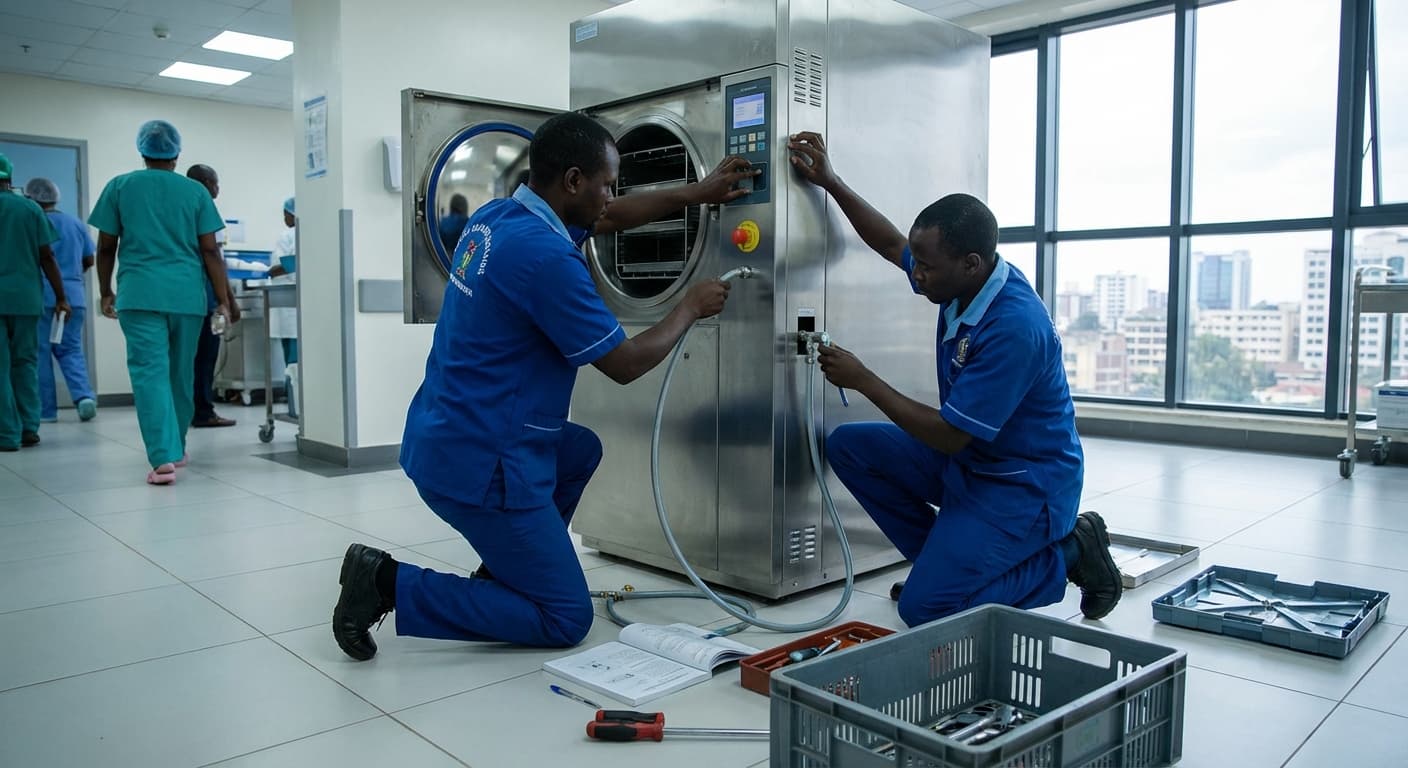
Autoclave & Sterilizer Installation Service in Kenya
Engineering Excellence & Technical Support
Autoclave & Sterilizer Installation Service High-standard technical execution following OEM protocols and local regulatory frameworks.
Optimized Installation for Peak Sterilization Efficacy
Our certified technicians ensure autoclaves and sterilizers are installed according to manufacturer specifications, optimizing steam penetration, temperature uniformity, and pressure control for guaranteed microbial inactivation and compliance with Kenyan healthcare standards.
Seamless Integration with Existing Utilities
We provide expert plumbing, electrical, and ventilation integration, ensuring your new autoclave or sterilizer operates efficiently and safely within your facility's infrastructure, minimizing downtime and maximizing operational readiness.
Comprehensive Safety Compliance & Commissioning
Our installation process includes rigorous safety checks, pressure testing, and full functional commissioning to meet all relevant Kenyan safety regulations and industry best practices, providing you with peace of mind and a fully operational, safe sterilization unit.
What Is Autoclave & Sterilizer Installation Service In Kenya?
Autoclave and sterilizer installation service in Kenya refers to the professional process of setting up, commissioning, and validating medical and laboratory equipment designed to eliminate or destroy all forms of microbial life. This service ensures that these critical sterilization devices are operational according to manufacturer specifications and regulatory standards, guaranteeing the safety and efficacy of sterilization processes. The installation encompasses the physical placement, connection to utilities (power, water, steam, drainage), system testing, calibration, and provision of initial user training. Proper installation is paramount for maintaining the integrity of sterile supplies and preventing healthcare-associated infections (HAIs) and laboratory contamination.
| Who Needs Autoclave & Sterilizer Installation Service? | Typical Use Cases |
|---|---|
| Hospitals and Healthcare Facilities: Including operating theatres, central sterile supply departments (CSSDs), dental clinics, veterinary clinics, and laboratories within these facilities. | Sterilization of surgical instruments, medical devices, laboratory glassware, waste, and personal protective equipment (PPE). |
| Research and Development Laboratories: In academic institutions, pharmaceutical companies, biotechnology firms, and food testing facilities. | Sterilization of culture media, laboratory equipment, glassware, and waste to prevent contamination and ensure experimental integrity. |
| Manufacturing Facilities: Particularly in the pharmaceutical, medical device, and food processing industries. | Sterilization of production equipment, packaging materials, and components to maintain product sterility and meet regulatory requirements (e.g., GMP). |
| Specialized Clinics: Such as tattoo and piercing studios, opticians, and physiotherapy clinics requiring instrument sterilization. | Sterilization of instruments and tools used in direct patient contact to prevent cross-contamination and infection. |
| Government and Public Health Agencies: Including public health laboratories and disaster relief organizations. | Sterilization of medical supplies and equipment for public health initiatives, outbreak response, and field operations. |
Key Aspects of Autoclave & Sterilizer Installation Service:
- Site Assessment and Preparation: Evaluating the installation site for space, ventilation, load-bearing capacity, and proximity to necessary utilities. Minor structural modifications or utility upgrades may be recommended.
- Equipment Placement and Anchoring: Positioning the autoclave/sterilizer accurately and securing it to prevent movement and ensure stability, particularly for larger or floor-standing units.
- Utility Connections: Connecting the device to its required power supply (single-phase/three-phase, voltage, amperage), water supply (quality and pressure considerations), drainage systems, and potentially compressed air or steam lines.
- System Integration and Configuration: Setting up control panels, software configurations, data logging capabilities, and interfacing with building management systems if applicable.
- Initial Testing and Commissioning: Performing pre-operational checks, leak tests, cycle simulations, and verifying all functional parameters according to manufacturer protocols. This includes safety interlocks and alarm systems.
- Performance Qualification (PQ) and Operational Qualification (OQ): Conducting documented tests to ensure the equipment operates consistently and reliably under expected load conditions and meets predefined performance criteria. This may involve using biological and chemical indicators.
- User Training: Providing comprehensive training to end-users on the proper operation, routine maintenance, troubleshooting, and safety procedures associated with the specific autoclave or sterilizer model.
- Documentation and Certification: Providing installation reports, commissioning certificates, calibration records, and operation manuals, which are crucial for regulatory compliance and quality assurance.
Who Needs Autoclave & Sterilizer Installation Service In Kenya?
Ensuring the highest standards of hygiene and safety is paramount in numerous sectors across Kenya. Autoclave and sterilizer installation services are crucial for facilities that require meticulous sterilization of equipment and instruments to prevent the spread of infections and diseases. This service goes beyond simply placing a machine; it involves expert setup, calibration, and initial testing to guarantee optimal performance and compliance with relevant health and safety regulations.
| Customer Segment | Key Departments/Areas | Primary Need for Sterilization |
|---|---|---|
| Hospitals & Medical Centers | Operating Theaters, Sterilization & Central Supply Department (CSD), Emergency Rooms, Intensive Care Units (ICUs), Outpatient Departments, Infection Control Department | Sterilization of surgical instruments, medical devices, linens, and other critical supplies to prevent Healthcare-Associated Infections (HAIs). |
| Clinics (General & Specialized) | Treatment Rooms, Minor Surgery Suites, Examination Rooms | Sterilization of diagnostic and minor surgical instruments, ensuring patient safety. |
| Dental Clinics | Sterilization Room, Treatment Rooms | Sterilization of dental instruments (handpieces, explorers, scalers, etc.) to prevent transmission of oral pathogens. |
| Laboratories (Medical, Research, Industrial) | Microbiology Labs, Molecular Biology Labs, Pathology Labs, Quality Control Labs, Biotechnology Labs | Sterilization of glassware, media, instruments, and biohazardous waste to maintain experimental integrity and prevent contamination. |
| Veterinary Clinics & Hospitals | Operating Theaters, Examination Rooms, Surgical Suites | Sterilization of veterinary surgical instruments and equipment for animal healthcare. |
| Beauty Salons & Spas | Treatment Rooms (for procedures involving piercing or cutting) | Sterilization of needles, razors, tweezers, and other tools to prevent infections for clients. |
| Tattoo and Piercing Studios | Sterilization Area | Sterilization of tattoo needles, ink caps, tubes, and piercing instruments to ensure client safety and prevent bloodborne pathogen transmission. |
| Research & Development Institutions | Research Labs, Vivarium, Pilot Plants | Sterilization of equipment, consumables, and waste for scientific research and experimentation. |
| Food & Beverage Industry | Packaging Lines, Specific Processing Stages (where sterile environments are required) | Sterilization of packaging materials or specific equipment to ensure product safety and shelf-life. |
| Pharmaceutical Manufacturing | Cleanrooms, Filling & Packaging Departments, Quality Control Labs | Sterilization of equipment, containers, and components to maintain product sterility and prevent contamination during drug production. |
Target Customers and Departments Requiring Autoclave & Sterilizer Installation Service in Kenya:
- Healthcare Facilities
- Laboratories
- Dental Clinics
- Veterinary Clinics
- Beauty and Tattoo Parlors
- Research Institutions
- Food and Beverage Processing Plants (specific applications)
- Pharmaceutical Manufacturing
Autoclave & Sterilizer Installation Service Process In Kenya
This document outlines the typical workflow for Autoclave & Sterilizer Installation Service in Kenya, from the initial customer inquiry to the final execution and handover. This process ensures a smooth, efficient, and professional installation, meeting the specific needs of healthcare facilities, laboratories, and other institutions requiring sterilization solutions.
| Phase | Key Activities | Responsible Party | Deliverables |
|---|---|---|---|
| Inquiry & Consultation | Initial contact, needs assessment, preliminary advice, site visit scheduling | Service Provider & Client | Understanding of needs, potential solutions, site visit plan |
| Site Assessment & Quotation | On-site inspection, detailed requirements gathering, quotation preparation | Service Provider | Detailed quotation, agreement on scope of work |
| Procurement & Preparation | Equipment ordering, site preparation, logistics planning | Service Provider & Client | Ordered equipment, prepared installation site |
| Installation Execution | Delivery, positioning, utility connections, initial testing | Service Provider | Installed and connected autoclave/sterilizer |
| Commissioning & Testing | Pre-operational checks, functional tests, basic validation, adjustments | Service Provider | Fully functional and tested autoclave/sterilizer |
| Training & Handover | Operational training, documentation delivery, final sign-off | Service Provider & Client | Trained staff, complete documentation, client acceptance |
| Post-Installation Support | Warranty support, maintenance services, technical assistance | Service Provider | Ongoing operational efficiency, client satisfaction |
Autoclave & Sterilizer Installation Service Workflow in Kenya
- 1. Initial Inquiry & Consultation:
- Customer Contact: The client contacts the service provider via phone, email, or website form, expressing interest in autoclave/sterilizer installation.
- Information Gathering: The provider gathers initial details about the client's needs, including type of facility, space availability, expected usage volume, existing infrastructure (power, water, drainage), and budget.
- Preliminary Consultation: A discussion (in-person or virtual) to understand specific requirements, recommend suitable autoclave/sterilizer models, and provide a general overview of the installation process and potential costs.
- Site Assessment Scheduling: If necessary, a site visit is scheduled to assess the installation location thoroughly.
- 2. Site Assessment & Quotation:
- On-site Inspection: A qualified technician visits the client's premises to evaluate the installation site. This includes checking:
- **Space Dimensions:** Ensuring adequate space for the unit and maneuvering during installation.- **Utilities:** Verifying the availability and capacity of electrical outlets, water supply, and drainage points.- **Ventilation:** Assessing the need for and feasibility of ventilation systems.- **Structural Integrity:** Confirming the floor can support the weight of the equipment.- **Access Routes:** Planning the safest and most efficient path for equipment delivery and placement.- Detailed Requirements Analysis: Further discussion with the client to finalize equipment selection, accessories, and any specific customization needs.
- Formal Quotation Preparation: Based on the site assessment and finalized requirements, a detailed quotation is prepared. This includes:
- **Equipment Cost:** Price of the selected autoclave/sterilizer.- **Installation Labor:** Cost of skilled technicians.- **Materials & Accessories:** Costs of piping, fittings, electrical components, exhaust systems, etc.- **Ancillary Services:** (e.g., minor civil works, electrical modifications).- **Warranty Information:** Details on equipment and installation warranties.- Quotation Review & Acceptance: The quotation is presented to the client for review. Upon acceptance, a formal agreement or purchase order is issued.
- 3. Procurement & Preparation:
- Equipment Ordering: The selected autoclave/sterilizer and any necessary accessories are ordered from the manufacturer or supplier.
- Site Preparation: The client, in coordination with the service provider, prepares the installation site according to agreed-upon specifications (e.g., ensuring power points are ready, drainage is accessible).
- Logistics Planning: The service provider plans the transportation of the equipment to the client's site, considering accessibility and safety.
- 4. Installation Execution:
- Equipment Delivery & Unpacking: The autoclave/sterilizer is safely transported and carefully unpacked at the installation site.
- Positioning & Leveling: The unit is moved into its final position and precisely leveled for optimal operation.
- Utility Connections:
- **Electrical:** Connecting the unit to the power supply, ensuring compliance with safety standards.- **Water:** Connecting to the water supply, potentially including filtration systems.- **Drainage:** Connecting to the drainage system for steam and water discharge.- **Ventilation:** Installing any required exhaust or ventilation systems.- Mounting & Securing: If required, the unit is secured to the floor or wall for stability.
- System Testing (Initial): Basic checks of all connections and power systems are performed.
- 5. Commissioning & Testing:
- Pre-operational Checks: A thorough inspection of all installed components and connections.
- Power-Up & System Initialization: The autoclave/sterilizer is powered on, and its control systems are initialized.
- Functional Testing: The equipment undergoes a series of operational tests, including running empty cycles and testing basic functions (e.g., door locking, temperature/pressure control).
- Validation Testing (if applicable): For critical applications, basic validation procedures might be performed to ensure it meets basic sterilization parameters (further validation may be a separate service).
- Troubleshooting & Adjustments: Any issues identified during testing are addressed, and necessary adjustments are made.
- 6. Client Training & Handover:
- Operational Training: The service provider's technicians conduct comprehensive training for the client's staff on the operation, basic maintenance, and safety procedures of the autoclave/sterilizer.
- Documentation Handover: Providing the client with:
- **User Manuals:** For the specific model installed.- **Installation Report:** Documenting the installation process, connections, and tests performed.- **Warranty Certificates:** For the equipment and installation.- **Maintenance Schedule Recommendations:** Guidance on routine maintenance.- Final Walkthrough & Sign-off: A final review of the installed system with the client, addressing any remaining questions, and obtaining their formal acceptance of the completed installation.
- 7. Post-Installation Support & Follow-up:
- Warranty Support: Providing support as per the warranty terms.
- Routine Maintenance Services: Offering ongoing maintenance contracts to ensure optimal performance and longevity of the equipment.
- Technical Support: Availability for troubleshooting and answering technical queries.
- Follow-up Calls/Visits: Periodic checks to ensure client satisfaction and address any emerging needs.
Autoclave & Sterilizer Installation Service Cost In Kenya
Installing an autoclave or sterilizer in Kenya involves various costs influenced by factors such as the type and size of the unit, the complexity of the installation site, and the specific services required. These essential medical and laboratory devices require professional installation to ensure optimal performance, safety, and compliance with health regulations. Understanding these pricing factors is crucial for budgeting and selecting the right service provider. The overall cost can vary significantly, making it important to get detailed quotes from qualified technicians or companies specializing in medical equipment installation.
| Sterilizer/Autoclave Type | Estimated Installation Cost Range (KES) | Notes |
|---|---|---|
| Small Tabletop Autoclave (e.g., < 50 Liters) | 15,000 - 40,000 | Basic electrical and plumbing hook-up, minimal site prep. |
| Medium Floor-Standing Autoclave (e.g., 50-150 Liters) | 30,000 - 80,000 | May require dedicated circuits, more complex plumbing, and basic ventilation. |
| Large Capacity Autoclave (e.g., > 150 Liters) | 70,000 - 200,000+ | Significant electrical upgrades, robust plumbing, ventilation systems, and potentially structural considerations. |
| Small/Medium Dry Heat Sterilizer | 10,000 - 30,000 | Primarily electrical connection, generally less complex than steam autoclaves. |
| Chemical Sterilizers/Disinfectors | 20,000 - 60,000 | Varies based on the type of chemical used and whether ventilation or specific chemical handling equipment is needed. |
| Installation with Extensive Site Modifications | Additional 50,000 - 150,000+ | Applies when significant electrical rewiring, major plumbing overhaul, or specialized ventilation installation is required. |
Key Pricing Factors for Autoclave & Sterilizer Installation in Kenya
- {"title":"Type of Sterilizer/Autoclave","description":"Different types of sterilizers (e.g., steam autoclaves, dry heat sterilizers, chemical sterilizers) and autoclaves (e.g., tabletop, floor-standing, large-capacity) have varying installation requirements and complexities."}
- {"title":"Unit Size and Capacity","description":"Larger and higher-capacity units generally require more robust infrastructure (e.g., stronger electrical outlets, dedicated plumbing, ventilation) and more labor for installation, thus increasing costs."}
- {"title":"Location of Installation","description":"The accessibility of the installation site within the facility (e.g., ground floor vs. upper floors, tight spaces) and the geographic location within Kenya (urban vs. rural) can affect labor and transportation costs."}
- {"title":"Electrical and Plumbing Requirements","description":"If the existing electrical supply or plumbing does not meet the sterilizer's specifications, new wiring, circuits, or pipework may need to be installed, adding significantly to the cost."}
- {"title":"Ventilation and Exhaust Systems","description":"Certain sterilizers, particularly steam autoclaves, require proper ventilation or exhaust systems to dissipate heat and steam safely. Installation of these systems incurs additional expenses."}
- {"title":"Site Preparation","description":"This includes any necessary modifications to the space, such as creating a dedicated area, reinforcing flooring, or ensuring adequate clearance around the unit."}
- {"title":"Ancillary Equipment Installation","description":"Installation of associated equipment like water purification systems, data loggers, or specific shelving can add to the overall service fee."}
- {"title":"Testing and Commissioning","description":"Thorough testing and commissioning of the unit to ensure it functions correctly and meets safety standards is a standard part of the installation service and is included in the pricing."}
- {"title":"Service Provider's Expertise and Reputation","description":"Experienced and reputable installation companies may charge more due to their specialized knowledge, reliability, and guarantees, but this often translates to a more secure and efficient installation."}
- {"title":"Geographic Location and Travel Costs","description":"Installation services in major cities like Nairobi or Mombasa might have different pricing structures compared to more remote areas due to varying operational costs and travel expenses."}
Affordable Autoclave & Sterilizer Installation Service Options
Acquiring and installing an autoclave or sterilizer is a critical step for many businesses and healthcare facilities. Beyond the initial purchase price, understanding installation service options and how to optimize costs can significantly impact your budget. This guide explores affordable autoclave and sterilizer installation services, highlighting value bundles and effective cost-saving strategies.
| Value Bundle Components | Description | Potential Cost Savings |
|---|---|---|
| Basic Installation + Training | Includes delivery to the site, connection to existing utilities (if compatible), basic operational testing, and an introductory training session for your staff on daily use and basic maintenance. | Lower upfront cost compared to comprehensive packages. Saves on separate training fees. |
| Standard Installation + Extended Warranty | Includes basic installation plus a guaranteed uptime service level agreement and an extended warranty beyond the standard manufacturer's period. May also include initial consumables (e.g., distilled water, indicator strips). | Protects against unexpected repair costs, reducing long-term operational expenses. Peace of mind. |
| Premium Installation + Preventative Maintenance Plan | This comprehensive package often includes full site assessment, all necessary utility modifications (plumbing, electrical, ventilation), installation, thorough testing, staff training, and a multi-year preventative maintenance contract. May also include calibration services. | Bundling can offer a discount compared to purchasing services individually. Proactive maintenance minimizes costly breakdowns and ensures optimal performance, extending the sterilizer's lifespan. |
| 'All-Inclusive' Package (Equipment + Installation + Consumables) | This might be offered by some suppliers, where the cost of the sterilizer, professional installation, and an initial supply of essential consumables are bundled together at a fixed price. | Simplifies budgeting and can provide significant savings through bulk purchasing and bundled discounts. |
Key Considerations for Affordable Installation
- Understanding Installation Scope: Installation can range from simple plug-and-play setups to complex plumbing and electrical modifications. Clearly define what's included.
- Location and Accessibility: The ease of access to the installation site (e.g., ground floor vs. upper floor, narrow doorways) can affect labor costs.
- Existing Infrastructure: Assess if your current plumbing, electrical, and ventilation systems meet the sterilizer's requirements. Upgrades can add to the cost.
- Type of Sterilizer: Different sterilizer types (e.g., steam autoclaves, dry heat sterilizers, chemical sterilizers) have varying installation needs.
- Manufacturer vs. Third-Party Installers: Compare pricing and warranty coverage from the manufacturer's certified technicians versus independent, experienced service providers.
- Warranty and Service Agreements: Ensure installation is covered by a warranty and consider ongoing service plans for long-term cost-effectiveness.
- Local Regulations and Permits: Be aware of any local building codes or permits required for installation, which may incur additional fees.
Verified Providers In Kenya
In Kenya's rapidly evolving healthcare landscape, identifying reliable and high-quality medical providers is paramount. Franance Health stands out as a leading platform committed to connecting individuals with verified healthcare professionals and facilities. Their rigorous credentialing process ensures that all listed providers meet stringent standards of expertise, experience, and ethical practice, offering patients peace of mind and confidence in their healthcare choices. This verification is crucial in a market where quality can vary, and Franance Health's dedication to transparency and excellence makes them the optimal choice for anyone seeking trusted medical services in Kenya.
| Credential Type | Franance Health Verification Standard | Benefit to Patient |
|---|---|---|
| Medical Licenses & Registrations | Mandatory verification of current and valid professional licenses with the relevant Kenyan medical boards (e.g., KMPDC). | Confirms legal qualification and authorization to practice. |
| Educational Qualifications | Scrutiny of academic degrees and specialist certifications from recognized institutions. | Ensures foundational knowledge and specialized expertise. |
| Professional Experience | Assessment of years in practice and specific areas of experience. | Indicates practical application of knowledge and skill. |
| Reputation & Peer Review | Consideration of feedback and reviews from other healthcare professionals and, where applicable, patient testimonials. | Provides insight into professional standing and patient satisfaction. |
| Facility Accreditation (for clinics/hospitals) | Verification of compliance with national health facility accreditation standards and safety regulations. | Guarantees a safe and well-equipped environment for care. |
| Continuing Professional Development (CPD) | Confirmation of ongoing training and adherence to CPD requirements. | Ensures providers stay updated with the latest medical advancements. |
Why Choose Franance Health Verified Providers?
- Uncompromising Quality Assurance: Franance Health meticulously vets all listed providers, including doctors, specialists, hospitals, and clinics, ensuring they meet established medical and ethical benchmarks.
- Enhanced Patient Safety: By opting for verified providers, patients significantly reduce the risk of encountering unqualified or subpar medical services.
- Access to Expertise: Franance Health curates a comprehensive network, giving you access to a wide range of medical specialties and experienced professionals across Kenya.
- Time and Effort Savings: Eliminate the guesswork and extensive research involved in finding a trustworthy doctor or facility. Franance Health streamlines the process for you.
- Transparency and Trust: Their commitment to verification fosters an environment of trust, allowing patients to make informed decisions about their health.
- Improved Health Outcomes: Partnering with verified, competent healthcare providers directly contributes to better diagnosis, treatment, and overall health outcomes.
Scope Of Work For Autoclave & Sterilizer Installation Service
This Scope of Work (SOW) outlines the requirements for the installation of an autoclave and sterilizer system at [Client Facility Name], [Client Facility Address]. The objective is to ensure the safe, efficient, and compliant installation and commissioning of the equipment, meeting all relevant industry standards and client specifications.
| Task | Description | Deliverables | Standard Specifications / References |
|---|---|---|---|
| Site Survey and Preparation | Conduct a detailed site survey to assess space, utility availability, access routes, and any potential installation challenges. Prepare the installation area, including any necessary modifications. | Site survey report, detailed installation plan, modified site layout (if applicable). | Client-provided site schematics, local building codes, safety regulations (e.g., OSHA). |
| Equipment Delivery and Unpacking | Coordinate the delivery of the autoclave and sterilizer unit to the designated installation site. Carefully unpack and inspect all components for any damage. | Delivery confirmation, equipment inspection checklist. | Manufacturer's shipping and handling guidelines. |
| Installation of Autoclave/Sterilizer Unit | Physically install the autoclave and sterilizer unit in its final location, ensuring it is level, stable, and securely anchored. | Installed equipment, confirmation of proper placement. | Manufacturer's installation manual, applicable engineering standards (e.g., ASME BPE for sanitary applications). |
| Utility Connections | Connect the unit to all required utilities: electrical power, water supply, drainage, and steam/gas supply (as applicable). Ensure all connections are made safely and according to specifications. | Completed utility connections, pressure testing of relevant lines. | Electrical codes (e.g., NEC), plumbing codes, manufacturer's specifications for utility requirements (voltage, pressure, flow rate, temperature). |
| Ventilation and Exhaust Systems | Install and connect any required ventilation or exhaust systems to safely dissipate steam, gases, or byproducts, ensuring compliance with safety and environmental regulations. | Functional ventilation/exhaust system, airflow measurements. | Local exhaust ventilation standards, building codes, environmental regulations. |
| Control System Integration | Connect and configure the control system for the autoclave/sterilizer, ensuring proper communication with the unit and any integrated building management systems. | Configured control system, functional system interface. | Manufacturer's control system documentation, relevant automation standards. |
| Testing and Calibration | Perform a series of comprehensive tests to verify the functionality of all cycles, safety features, and operational parameters. Calibrate sensors and critical components. | Test logs, calibration certificates for sensors. | Manufacturer's testing protocols, validation documentation (IQ/OQ/PQ procedures if required), relevant ISO standards (e.g., ISO 13485 for medical devices). |
| Commissioning | Officially commission the installed system, demonstrating its full operational capability and readiness for use. This may include performing test runs with actual loads. | Commissioning report, signed acceptance form. | Manufacturer's commissioning guidelines, client-specific operational requirements. |
| User Training | Provide comprehensive training to designated client personnel on the operation, routine maintenance, troubleshooting, and safety procedures for the autoclave/sterilizer. | Training materials, attendance records, certificate of training. | Manufacturer's operation and maintenance manuals, site-specific safety protocols. |
| Documentation and Handover | Compile and deliver all relevant documentation, including installation manuals, operating manuals, maintenance logs, test reports, calibration certificates, and warranty information. | Complete documentation package, handover meeting. | Manufacturer's documentation standards, client's record-keeping policies. |
Key Objectives
- Successful installation of the autoclave and sterilizer unit.
- Integration with existing utility systems (electrical, water, drainage, steam/gas as applicable).
- Thorough testing and commissioning of all functionalities.
- User training on operation, maintenance, and safety protocols.
- Provision of all necessary documentation for compliance and future reference.
Service Level Agreement For Autoclave & Sterilizer Installation Service
This Service Level Agreement (SLA) outlines the guaranteed response times and uptime commitments for the installation and initial setup of Autoclave and Sterilizer equipment provided by [Your Company Name]. This SLA aims to ensure minimal disruption and prompt support for our clients during the critical phase of equipment deployment.
| Service Level | Definition | Target Response Time | Uptime Guarantee |
|---|---|---|---|
| Standard Installation Support | Assistance with standard installation procedures, initial setup, and basic functionality testing. | Within 4 business hours of notification | N/A (Focus on successful installation) |
| Post-Installation Critical Issue (within 7 days of handover) | Issues preventing the core functionality of the Autoclave/Sterilizer from operating as intended. | Within 2 business hours of notification | N/A (Focus on critical issue resolution) |
| Scheduled System Uptime (post-successful installation & handover) | The installed Autoclave/Sterilizer's operational availability for its intended purpose, excluding planned preventative maintenance and scheduled downtime. | N/A | 99.5% (averaged monthly) |
Key Service Level Objectives
- Response Time: The maximum time allowed for [Your Company Name] to acknowledge and begin addressing a reported issue or request.
- Uptime Guarantee: The percentage of time the installed Autoclave/Sterilizer is expected to be operational and available for its intended use, excluding scheduled maintenance and unforeseen circumstances beyond our control.
Frequently Asked Questions

Ready when you are
Let's scope your Autoclave & Sterilizer Installation Service in Kenya project in Kenya.

Scaling healthcare logistics and technical systems across the entire continent.