
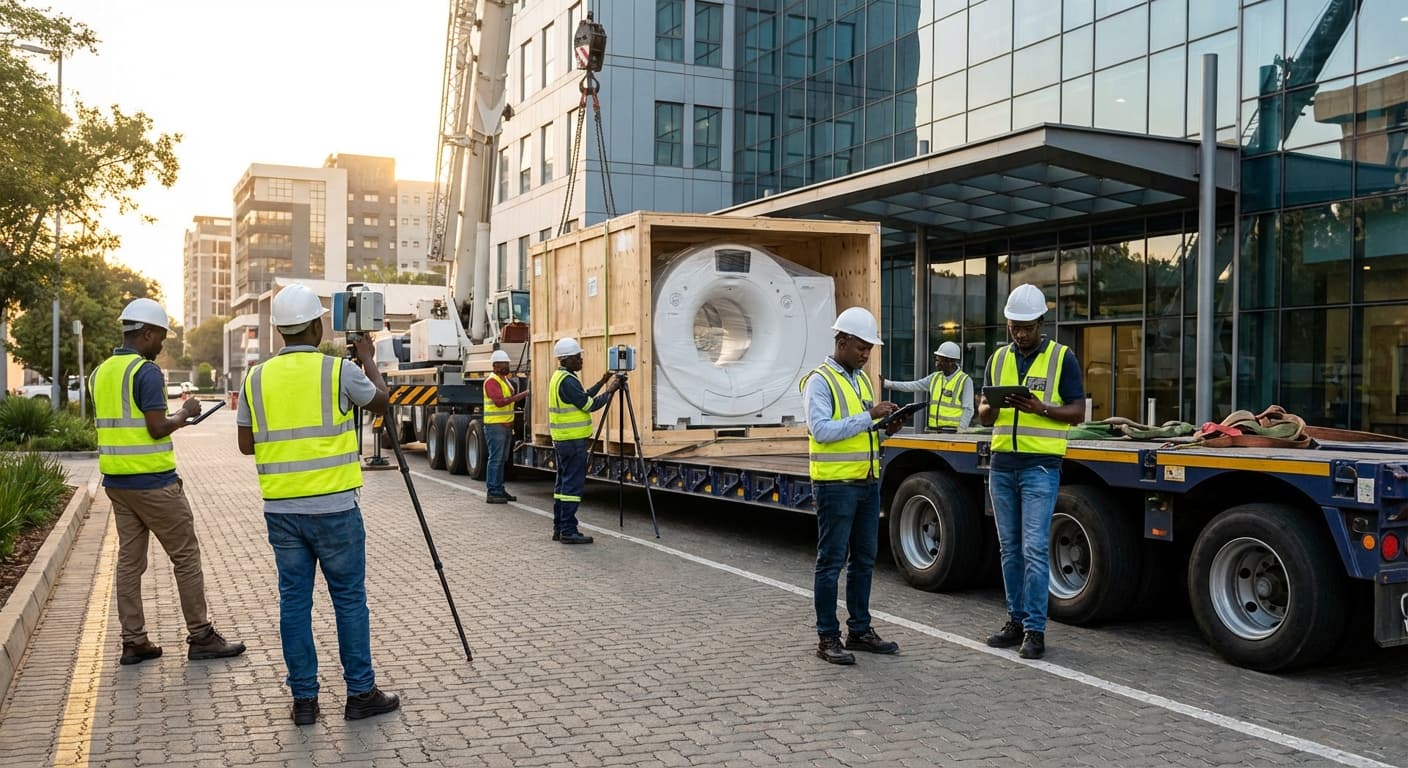
Route Survey & Rigging Plan Service for Heavy Medical Equipment in Kenya
Engineering Excellence & Technical Support
Route Survey & Rigging Plan Service for Heavy Medical Equipment High-standard technical execution following OEM protocols and local regulatory frameworks.
Precise Route Mapping & Obstacle Identification
Leveraging advanced GPS and LiDAR technology, our route surveys meticulously map the safest and most efficient pathways for heavy medical equipment transport across Kenya. We identify and mitigate potential obstacles such as low bridges, narrow roads, overhead cables, and uneven terrain, ensuring a smooth and secure transit.
Load-Specific Rigging & Securing Strategy
Our expert rigging plans are tailored to the unique weight, dimensions, and fragility of each medical unit. We design custom lifting and lashing strategies, utilizing specialized equipment and trained personnel to guarantee the secure placement and stability of sensitive machinery throughout the entire transportation process, minimizing risk of damage.
Comprehensive Risk Assessment & Mitigation Plan
We conduct thorough risk assessments, analyzing potential hazards from traffic, weather conditions, and site-specific challenges in Kenya. Our service includes the development of a detailed mitigation plan, outlining emergency procedures, contingency measures, and ensuring compliance with all local regulations for the safe and compliant delivery of your vital medical equipment.
What Is Route Survey & Rigging Plan Service For Heavy Medical Equipment In Kenya?
Route Survey & Rigging Plan Service for Heavy Medical Equipment in Kenya is a specialized engineering and logistics solution designed to ensure the safe, efficient, and compliant transportation and installation of oversized, overweight, or technically sensitive medical apparatus. This service encompasses a detailed assessment of transportation routes, identification of logistical challenges, and the development of precise rigging and lifting methodologies. The primary objective is to mitigate risks associated with moving such critical infrastructure from port of entry or manufacturing site to its final operational destination within Kenyan healthcare facilities, minimizing potential damage to the equipment, infrastructure, and personnel, while adhering to all relevant national and international safety standards.
| Who Needs This Service? | Typical Use Cases in Kenya |
|---|---|
| Hospitals and Healthcare Providers (Public & Private): Acquiring or relocating large-scale medical imaging equipment (MRI, CT scanners), linear accelerators for radiotherapy, surgical robots, modular operating theaters, and specialized laboratory equipment. | Importation and installation of new advanced medical equipment requiring specialized transport and handling from port to hospital. Relocation of existing heavy medical machinery within or between healthcare facilities. Disaster recovery or emergency deployment of critical medical infrastructure. |
| Medical Equipment Manufacturers and Suppliers: Ensuring the safe delivery and installation of their products at client sites. | Commissioning of a new wing or specialized medical center requiring the precise placement of multiple heavy-duty medical devices. Upgrading existing hospital infrastructure with larger or heavier medical technology. |
| Logistics and Heavy Lift Companies: Subcontracting specialized surveying and rigging design services for their medical equipment projects. | Facilitating the transfer of heavy medical equipment from manufacturing sites in Kenya to various regional hospitals. Managing the logistics of donating or installing medical equipment in remote or underserved areas where infrastructure challenges are prevalent. |
| Government Health Ministries and Agencies: Overseeing the procurement and deployment of national medical infrastructure. | Centralized procurement and deployment of advanced diagnostic and treatment equipment across national healthcare networks. Ensuring standardized safe installation practices for all publicly funded medical facilities. |
Key Components of the Service:
- Route Reconnaissance and Analysis: Comprehensive inspection of proposed transportation corridors, including road conditions, bridge load capacities, overhead obstructions (power lines, signage, building overhangs), and traffic management requirements. Identification of potential bottlenecks, sharp turns, and areas requiring temporary infrastructure modifications or special permits.
- Load Calculation and Stress Analysis: Determination of the precise weight and dimensional characteristics of the medical equipment. Analysis of potential stresses on the equipment, transport vehicles, lifting equipment, and supporting structures during transit and erection.
- Rigging Design and Methodology: Development of detailed rigging plans, including selection of appropriate lifting gear (cranes, hoists, slings, shackles), securing methods, and lifting points. Consideration of center of gravity, stability, and payload capacity of lifting equipment.
- Transportation Planning: Specification of specialized transport vehicles (e.g., low-bed trailers, multi-axle modular transporters) and staging requirements. Coordination with local authorities for traffic control, road closures, and escorts.
- Installation and Placement Strategy: Planning for the final positioning and installation of the equipment within the healthcare facility, including ingress/egress points, floor load bearing capacities, and necessary structural modifications.
- Risk Assessment and Mitigation: Identification of potential hazards at each stage of the process and development of contingency plans. This includes emergency procedures, weather considerations, and site-specific safety protocols.
- Permitting and Regulatory Compliance: Facilitation and acquisition of all necessary permits from relevant Kenyan authorities, including road transport permits, special movement authorizations, and environmental impact clearances.
- Documentation and Reporting: Generation of comprehensive reports detailing survey findings, rigging plans, risk assessments, and a final execution methodology.
Who Needs Route Survey & Rigging Plan Service For Heavy Medical Equipment In Kenya?
The specialized service of Route Survey & Rigging Plan for Heavy Medical Equipment is crucial for organizations in Kenya facing the logistical challenge of transporting and installing large, sensitive, and high-value medical machinery. This service ensures the safe, efficient, and compliant movement of equipment from point of origin to its final operational location, minimizing risks of damage and operational disruption.
| Target Customer | Specific Departments / Roles Involved | Key Needs & Challenges |
|---|---|---|
| Hospitals and Healthcare Facilities | Procurement Department, Facilities Management, Biomedical Engineering Department, Clinical Departments (e.g., Radiology, Oncology, Cardiology) | Need to ensure new equipment (MRI, CT scanners, linear accelerators, large X-ray machines) can be physically delivered and installed without damaging the building or the equipment. Require minimal downtime during installation. Must comply with safety regulations. |
| Medical Equipment Suppliers and Distributors | Logistics Department, Project Management Team, Installation Teams | Responsible for the safe delivery and installation of equipment to their clients. Need to mitigate risks associated with transit and site access. Must provide a complete service offering that includes pre-installation planning. Often subcontract this specialized service. |
| Government Health Ministries and Agencies | Procurement Unit, Health Infrastructure Department, Project Management Offices | Oversee the acquisition and deployment of medical equipment to public health facilities across the country. Face challenges with diverse infrastructure across different regions. Need to ensure public funds are protected by preventing equipment damage. Require adherence to national standards. |
| Non-Governmental Organizations (NGOs) in Healthcare | Program Managers, Logistics Officers, Project Coordinators | Often involved in donating or establishing healthcare infrastructure in remote or underserved areas with potentially challenging access. Need cost-effective yet safe solutions. Must account for limited local infrastructure and expertise. |
| Research and Development Institutions | Laboratory Managers, Research Project Leaders, Facilities Management | Acquire specialized and often highly sensitive research equipment (e.g., advanced microscopy, genetic sequencers, particle accelerators for research). These require precise placement and environmental controls. Need to ensure research continuity and data integrity. |
Who Needs Route Survey & Rigging Plan Service for Heavy Medical Equipment in Kenya?
- Hospitals and Healthcare Facilities
- Medical Equipment Suppliers and Distributors
- Government Health Ministries and Agencies
- Non-Governmental Organizations (NGOs) in Healthcare
- Research and Development Institutions
Route Survey & Rigging Plan Service For Heavy Medical Equipment Process In Kenya
This document outlines the comprehensive workflow for our Route Survey & Rigging Plan Service for the process of transporting and installing heavy medical equipment in Kenya. Our service is designed to ensure the safe, efficient, and compliant movement of critical healthcare infrastructure, from the initial inquiry to final execution.
| Stage | Description | Key Activities | Deliverables | Timeline (Est.) |
|---|---|---|---|---|
| Understanding the client's needs and the specifics of the heavy medical equipment. | Receive equipment specifications (dimensions, weight, center of gravity), origin and destination details. Discuss project timelines, budget, and any special requirements. Initial risk assessment. | Project brief, preliminary understanding of scope, quotation. | 1-2 business days |
| Thorough inspection of the proposed route and installation sites to identify potential challenges. | On-site visits to origin, transit routes, and destination. Measurement of clearances (height, width, turning radii). Identification of road conditions, potential obstructions (bridges, power lines, tight corners). Assessment of installation space at the destination. | Detailed route survey report, including maps, photographic evidence, and identified constraints. Potential alternative route proposals. | 2-5 business days (depending on route complexity) |
| Creation of a detailed, step-by-step plan for the safe lifting, moving, and positioning of the medical equipment. | Analysis of equipment weight distribution and lifting points. Selection of appropriate lifting equipment (cranes, forklifts, jacks). Design of lifting frames, slings, and rigging accessories. Calculation of load capacities and safety factors. Development of detailed rigging diagrams and procedures. | Comprehensive Rigging Plan document, including equipment specifications, load calculations, safety protocols, and rigging diagrams. | 3-7 business days (depending on equipment complexity) |
| Presentation of the developed plans to the client for their review and formal approval. | Submission of Route Survey Report and Rigging Plan to the client. Q&A session to address any client concerns or modifications. Formal client sign-off on both documents. | Approved Route Survey Report, Approved Rigging Plan. | 1-3 business days |
| Securing necessary permits and coordinating all logistical aspects for a smooth operation. | Application for road permits, escort services, and any other regulatory approvals required by Kenyan authorities. Coordination with transport providers, crane operators, and other service personnel. Scheduling of operations to minimize disruption. | All required permits and licenses, confirmed logistics schedule. | 5-15 business days (can vary significantly based on local regulations) |
| Implementation of the approved route survey and rigging plan. | Pre-operation safety briefing. Execution of route preparation (if any). Mobilization of rigging equipment and personnel. Controlled lifting and movement of the medical equipment as per the rigging plan. On-site supervision by qualified personnel. | Successful transit and positioning of equipment at the installation site. | 1-3 business days (depending on equipment size and complexity) |
| Assisting with the final positioning and integration of the medical equipment. | Placement of equipment in its final designated location. Liaison with the client's installation team. Final checks to ensure equipment is safely positioned. | Equipment safely positioned for installation. | Concurrent with Execution or 1 business day |
| Finalizing project documentation and conducting a review of the operation. | Debriefing with the client. Compilation of all project documentation, including as-built diagrams and incident reports (if any). Final invoicing and project closure. | Final project report, completed documentation, client satisfaction confirmation. | 1-2 business days |
Workflow Stages
- Inquiry & Initial Consultation
- Site Assessment & Route Planning
- Rigging Plan Development
- Client Review & Approval
- Permitting & Logistics Coordination
- Execution: Survey & Rigging Operations
- Equipment Installation & Handover
- Post-Execution Review & Documentation
Route Survey & Rigging Plan Service For Heavy Medical Equipment Cost In Kenya
Estimating the cost of a route survey and rigging plan service for heavy medical equipment in Kenya involves several key pricing factors. These factors influence the complexity of the survey, the required expertise, the duration of the service, and the potential risks involved. Understanding these elements is crucial for obtaining accurate quotes from service providers. The actual cost will be a combination of these variables, tailored to the specific project.
| Service Component | Estimated Cost Range (KES) | Notes |
|---|---|---|
| Initial Route Survey & Assessment | 20,000 - 70,000 | Covers preliminary site visits, road condition analysis, and identification of major obstacles. |
| Detailed Route Survey & Engineering Analysis | 50,000 - 150,000 | Includes detailed mapping, obstacle identification, structural assessments (bridges, etc.), and development of traffic management plans. Varies significantly with route complexity. |
| Rigging Plan Development | 40,000 - 120,000 | Focuses on safe lifting, lashing, and maneuvering of the equipment within the facility. Highly dependent on equipment specifics. |
| Permits & Liaison with Authorities | 10,000 - 50,000+ | Can be highly variable depending on the number and type of permits required and the complexity of negotiations. |
| Traffic Management & Escorts (if required) | 25,000 - 100,000+ | Includes police escorts, pilot vehicles, and potential temporary road closures. Per day/per kilometer rates apply. |
| Project Management & Supervision | 30,000 - 80,000 | Overseeing the entire process, ensuring safety and adherence to the plan. |
| Comprehensive Service Package (Survey + Rigging Plan) | 150,000 - 500,000+ | This is a broad estimate for a complete service. Very large or complex projects can exceed this significantly. Often bundled for better value. |
Key Pricing Factors for Route Survey & Rigging Plan Services in Kenya:
- Equipment Size and Weight: Larger and heavier equipment (e.g., MRI machines, CT scanners, large X-ray units) require more extensive planning, specialized rigging gear, and potentially more personnel. This directly impacts labor costs and equipment rental.
- Distance and Accessibility of the Delivery Location: The geographical distance from the port of entry (e.g., Mombasa) or the equipment's origin to the final installation site is a major cost driver. Difficult terrain, poor road conditions, and remote locations will increase transportation and survey time.
- Complexity of the Route: The survey needs to identify potential obstacles such as narrow roads, low bridges, sharp turns, overhead power lines, traffic congestion, and weight restrictions on bridges or roads. More complex routes necessitate detailed planning and potentially traffic management solutions.
- Nature of the Installation Site: The ease of access to the final installation point within the hospital or clinic is critical. This includes factors like building entry points, elevator capacity and dimensions, stairwells, and the internal layout of the facility.
- Required Survey and Planning Expertise: Specialized knowledge in structural engineering, heavy lifting, logistics, and safety protocols is required. The experience and qualifications of the survey and rigging team will influence their hourly or project rates.
- Time Sensitivity and Urgency: Rush jobs or projects with tight deadlines may incur premium charges due to the need for expedited planning, resource allocation, and potential overtime for the team.
- Permits and Authorizations: Obtaining necessary permits for oversized or overweight transport, road closures, or special escorts can add to the overall cost. This often involves liaising with local authorities.
- Equipment and Tools Required: The specific rigging equipment (cranes, forklifts, dollies, specialized lifting frames), transportation vehicles (low-bed trailers, multi-axle trucks), and safety gear needed will be factored into the cost.
- Insurance and Risk Mitigation: Comprehensive insurance coverage for the equipment during transport and rigging, as well as measures to mitigate potential risks, will be included in the pricing.
- Number of Personnel: The size of the survey and rigging crew, including project managers, surveyors, riggers, and safety officers, will directly impact labor costs.
Affordable Route Survey & Rigging Plan Service For Heavy Medical Equipment Options
Navigating the complexities of transporting and installing heavy medical equipment requires a meticulous route survey and rigging plan. Our service ensures a safe, efficient, and cost-effective process. We offer tailored solutions, providing clear, actionable plans that minimize risks and potential delays. Understanding the unique challenges associated with medical equipment, from sensitivity to sheer weight, our expert team meticulously plans every step, from initial site assessment to final placement. This proactive approach prevents unexpected issues, damage to the equipment, and costly operational downtime for your healthcare facility. We also provide valuable insights into optimizing the entire logistics process, offering peace of mind and ensuring your critical medical technology is operational as quickly and safely as possible.
| Service Component | Description | Value Proposition | Cost-Saving Strategy |
|---|---|---|---|
| Route Survey | On-site assessment of all potential transport routes, including road conditions, bridge capacities, turning radii, and overhead obstructions. | Ensures equipment can reach its destination safely and without damage. Identifies potential bottlenecks early. | Avoids costly detours, specialized transport permits, and potential delays due to unforeseen route issues. Minimizes risk of equipment damage during transit. |
| Rigging Plan Development | Detailed engineering plans for lifting, securing, and maneuvering equipment at origin and destination. Includes equipment specifications, load calculations, and personnel requirements. | Guarantees safe and secure handling of sensitive and heavy medical equipment. Prevents damage and injury. | Reduces the need for emergency re-planning or specialized, more expensive rigging equipment. Minimizes insurance claims related to accidents or damage. |
| Site Assessment (Origin & Destination) | Evaluation of loading/unloading areas, interior pathways, door clearances, and final placement locations. | Confirms feasibility of equipment movement within facilities. Identifies any necessary modifications or preparations. | Prevents delays and additional costs associated with discovering access issues on the day of the move. Avoids the need for costly last-minute structural modifications. |
| Risk Assessment & Mitigation | Proactive identification of potential hazards (e.g., weather, site conditions, equipment failure) and development of contingency plans. | Enhances safety and minimizes the likelihood of unforeseen disruptions. | Reduces the financial impact of project delays, equipment damage, or personnel injury. Avoids costly downtime for medical facilities. |
| Value Bundles (Example) | Bundle 1: Basic Route Survey & Rigging Plan (standard equipment). Bundle 2: Comprehensive Service (complex equipment, multiple sites, on-site supervision). Bundle 3: Integrated Logistics Management (includes transport coordination). | Offers tiered options to match project scope and budget. Provides clear packages for easier decision-making. | Volume discounts on bundled services. Fixed pricing for predictable budgeting. Bundles can offer a slight discount compared to individual service pricing. |
| Cost-Saving Strategies | Early engagement, detailed planning, leveraging existing infrastructure where possible, standardized procedures, and clear communication. | Streamlines the entire process, reducing the likelihood of errors and rework. | Minimizes overtime, reduces the need for expedited services, prevents damage-related repair costs, and optimizes resource allocation. Negotiated rates for specialized equipment and transport due to established relationships. |
Our Affordable Route Survey & Rigging Plan Service
- Expert assessment of transport routes and site access for heavy medical equipment.
- Detailed rigging plans, including equipment, personnel, and safety protocols.
- Identification and mitigation of potential logistical challenges.
- Comprehensive documentation for compliance and insurance purposes.
- On-site supervision and coordination during the move.
- Focus on minimizing downtime and ensuring operational readiness.
Verified Providers In Kenya
In Kenya's rapidly evolving healthcare landscape, identifying reliable and accredited medical providers is paramount for individuals seeking quality care. "Verified Providers" signifies entities that have undergone rigorous checks and met specific standards for their services, ensuring patient safety and satisfaction. Franance Health stands out as a premier example of such a verified provider, offering a compelling combination of advanced credentials and a patient-centric approach that positions them as the best choice for many.
| Credential Type | Significance for Patients | Franance Health's Standing |
|---|---|---|
| KHRA Accreditation | Guarantees adherence to national healthcare regulations, patient safety standards, and ethical practices. | Franance Health is fully accredited by the KHRA, ensuring compliance with all mandatory requirements. |
| ISO Certification (Quality Management) | Indicates a commitment to consistent service quality, efficient processes, and customer satisfaction. | Franance Health adheres to rigorous quality management systems, often evidenced by ISO certifications, leading to a superior patient experience. |
| Insurance Partnerships | Facilitates easier access to care for insured individuals, signifies financial transparency, and trust from other entities. | Their extensive network of partnerships with leading insurance providers makes their services accessible and financially manageable. |
| Professional Licensing of Staff | Ensures that medical professionals are qualified, competent, and authorized to practice in Kenya. | All medical personnel at Franance Health are fully licensed and regulated by their respective professional boards. |
| Specialized Training/Certifications | Demonstrates expertise in specific medical fields and a dedication to staying at the forefront of medical advancements. | Franance Health invests in advanced training for its staff, ensuring they are equipped to handle complex medical needs. |
Key Credentials of Franance Health:
- Accreditation by the Kenya Healthcare Regulatory Authority (KHRA): This is a fundamental requirement for any healthcare institution operating legally and ethically in Kenya. KHRA accreditation ensures adherence to national healthcare standards, quality control, and patient safety protocols.
- ISO Certification (e.g., ISO 9001 for Quality Management): While not always mandatory, ISO certification demonstrates a commitment to continuous improvement and operational excellence. It signifies robust quality management systems are in place, impacting everything from patient flow to service delivery.
- Partnerships with Reputable Insurance Providers: Franance Health's collaborations with major health insurance companies indicate their financial stability, transparent billing practices, and acceptance by trusted third-party payers. This often reflects their adherence to stringent operational and ethical standards.
- Qualified and Licensed Medical Professionals: Beyond institutional credentials, Franance Health prioritizes employing doctors, nurses, and specialists who are fully licensed by their respective professional bodies in Kenya. This ensures that patients are treated by competent and ethically sound practitioners.
- Specialized Certifications and Training: Depending on their service offerings, Franance Health may hold specialized certifications in areas like advanced diagnostics, specific surgical procedures, or specialized therapeutic approaches. Continuous professional development for their staff is also a key indicator of quality.
Scope Of Work For Route Survey & Rigging Plan Service For Heavy Medical Equipment
This Scope of Work (SOW) outlines the services required for route surveying and developing a rigging plan for the transportation and installation of heavy medical equipment. The objective is to ensure safe, efficient, and compliant movement of specialized equipment from its delivery point to its final installation location within the facility, considering all technical constraints and safety regulations.
| Service Component | Description of Work | Technical Deliverables | Standard Specifications / Requirements |
|---|---|---|---|
| Conduct a thorough survey of the proposed transport route from the delivery point (e.g., loading dock, receiving area) to the final installation site. This includes internal building pathways, corridors, elevators, doorways, and any external access points. | Detailed route map with identified obstacles and potential hazards (e.g., tight corners, inclines, overhead obstructions, floor load capacity limitations, door dimensions, ceiling heights). | High-resolution photographs and/or videos of the route. Accurate measurements of all critical dimensions. Identification of any structural or environmental challenges. Floor load capacity assessment where applicable. (Refer to relevant building codes and facility guidelines). |
| Identify all potential obstacles that may impede the movement of the heavy medical equipment. Propose solutions or mitigation strategies for each identified obstacle. | List of all identified obstacles with their dimensions and locations. Proposed mitigation strategies (e.g., temporary removal of fixtures, padding, specialized handling equipment, route diversion). | Clear and concise descriptions of mitigation methods. Assessment of feasibility and cost implications for each mitigation strategy. Coordination with facility management for any required modifications. |
| Develop a comprehensive rigging plan detailing the procedures for lifting, moving, and positioning the heavy medical equipment. This includes selecting appropriate rigging gear, determining load distribution, and outlining safety protocols. | Detailed rigging plan document including:
| Adherence to OSHA, ASME, and other relevant rigging safety standards. Use of certified rigging equipment with current inspection records. Load calculations based on equipment weight and rigging configuration. Detailed AutoCAD drawings or 3D models illustrating rigging setup and movement path. Risk assessment matrix for the rigging operation. (Refer to manufacturer's installation manual for specific equipment handling recommendations). |
| Specify the qualified personnel and specialized equipment required to execute the rigging and transportation plan safely and efficiently. | List of required personnel roles and their certifications (e.g., certified riggers, crane operators, spotters). Specifications for all required rigging and transport equipment, including capacity and certifications. | Minimum number of personnel required for each phase of the operation. Verification of equipment certifications and maintenance records. (Refer to industry best practices and regulatory requirements for qualified personnel). |
| Develop a comprehensive safety plan and conduct a thorough risk assessment for all stages of the route survey, rigging, and installation process. | Detailed safety plan including:
| Compliance with all site-specific safety regulations and general industry safety standards. Job Hazard Analysis (JHA) for all critical tasks. Pre-lift planning and toolbox talks documentation. |
| Compile all survey data, rigging plans, safety documentation, and provide final deliverables for review and approval. | Consolidated project documentation package including all technical deliverables listed above. Final report summarizing the survey findings, proposed plan, and recommendations. | Formal sign-off by the client and designated authorities. Submission of all documentation in electronic and/or hard copy format as required. |
Key Objectives
- Identify and document the optimal route for equipment transport.
- Assess all potential obstacles and hazards along the route.
- Determine the precise lifting and maneuvering requirements.
- Develop a comprehensive rigging plan with detailed procedures and equipment specifications.
- Ensure compliance with all relevant safety standards and regulations.
- Minimize risk of damage to the equipment, facility infrastructure, and personnel.
- Provide clear and actionable documentation for execution by the rigging and installation teams.
Service Level Agreement For Route Survey & Rigging Plan Service For Heavy Medical Equipment
This Service Level Agreement (SLA) outlines the response times and uptime guarantees for the Route Survey & Rigging Plan Service specifically for the transportation and installation of heavy medical equipment. This service is critical for ensuring the safe and efficient delivery and setup of specialized medical devices, and therefore, requires a robust support structure.
| Severity Level | Description | Response Time Guarantee | Uptime Guarantee (During Scheduled Project Phase) | Escalation Procedure |
|---|---|---|---|---|
| Critical | Complete inability to proceed with a scheduled route survey, rigging plan development, or a critical deficiency identified in an existing plan that immediately jeopardizes project safety or timeline. Example: Imminent site access blockage, critical rigging component failure in plan. | 1 Hour | 99.9% | Immediate escalation to senior management and dedicated project lead. |
| High | Significant impediment to the route survey or rigging plan development process, causing potential delays or requiring substantial rework. Example: Unavailability of key survey data, required clarification on complex rigging configurations. | 4 Business Hours | 99.5% | Escalation to a team lead after initial response if not resolved within SLA. |
| Medium | Minor issues or requests for information that do not immediately halt progress but require timely attention to maintain project momentum. Example: Clarification on standard rigging procedures, requests for minor plan adjustments. | 8 Business Hours | 99.0% | Standard support channel, with escalation to a team lead if resolution is delayed. |
| Low | General inquiries, requests for documentation updates, or non-urgent questions. Example: Request for previous survey reports, general process inquiries. | 24 Business Hours | N/A (General inquiry, not tied to active project uptime) |
Key Service Level Objectives
- 1. Response Times: Defined as the time from when a service request is logged by the client to when a qualified technician begins active work on the issue or provides an initial diagnostic assessment.
- 2. Uptime Guarantees: Applies to the availability of the planning and consultation support during scheduled project timelines. This does not directly refer to the uptime of the client's medical equipment itself, but rather the availability of the service to support its planning and execution.
- 3. Severity Levels: Service requests will be categorized by severity to prioritize responses, ensuring critical issues are addressed with the highest urgency.
Frequently Asked Questions

Ready when you are
Let's scope your Route Survey & Rigging Plan Service for Heavy Medical Equipment in Kenya project in Kenya.

Scaling healthcare logistics and technical systems across the entire continent.