
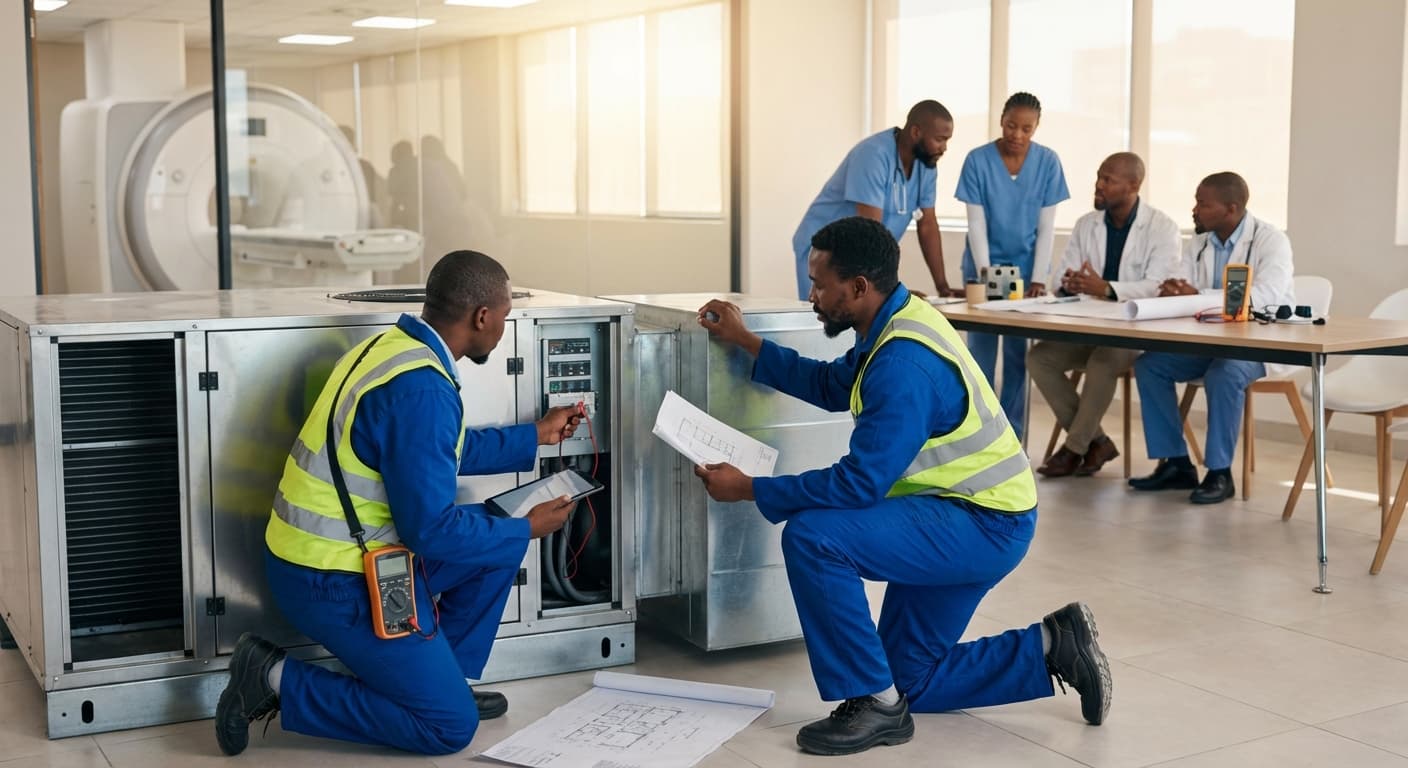
Site Readiness Assessment Service (Space/Access/HVAC/Power/Shielding) in Kenya
Engineering Excellence & Technical Support
Site Readiness Assessment Service (Space/Access/HVAC/Power/Shielding) High-standard technical execution following OEM protocols and local regulatory frameworks.
Comprehensive Site Viability Analysis
Our Kenya-focused Site Readiness Assessment meticulously evaluates critical infrastructure including spatial layout for optimal equipment placement, secure access control points, robust HVAC systems for environmental stability, reliable power supply capabilities (grid, backup, and solar potential), and advanced shielding considerations for sensitive equipment, ensuring your operational foundation is sound and future-proofed.
In-Depth Power Infrastructure Evaluation
We provide a granular analysis of Kenya's power grid stability, voltage fluctuations, and load capacities at potential sites. Our assessment extends to evaluating existing backup power solutions, identifying solar energy generation potential, and recommending optimal power delivery and redundancy strategies to guarantee uninterrupted operations and mitigate risks associated with power outages.
Climate-Optimized HVAC Design & Assessment
Understanding Kenya's diverse climatic conditions, our service assesses existing HVAC systems for efficiency and suitability, or designs new ones to ensure precise temperature and humidity control. This guarantees optimal performance and longevity for your critical equipment, adhering to international standards and local environmental factors.
What Is Site Readiness Assessment Service (Space/access/hvac/power/shielding) In Kenya?
The Site Readiness Assessment Service (Space/Access/HVAC/Power/Shielding) in Kenya is a comprehensive evaluation process designed to determine the suitability and capability of a proposed physical location for hosting critical infrastructure, such as data centers, telecommunications equipment, server rooms, or other sensitive technological installations. This service meticulously analyzes key environmental, structural, and utility parameters to ensure the site can reliably and securely support the intended operational requirements. The assessment is crucial for mitigating risks associated with environmental factors, utility failures, and physical security vulnerabilities before significant capital investment is made in hardware deployment.
| Who Needs This Service? | Typical Use Cases | ||||||
|---|---|---|---|---|---|---|---|
| Organizations planning to establish or expand data centers, colocation facilities, or cloud infrastructure. | Deployment of new server rooms or telecommunications exchange points. | Relocation or consolidation of IT infrastructure. | Businesses requiring secure and reliable environments for mission-critical IT equipment. | Government agencies implementing secure communication networks or data storage solutions. | Companies in industries with stringent uptime and data integrity requirements (e.g., finance, healthcare, telecommunications). | Project managers and IT infrastructure planners evaluating potential sites for new deployments. | Businesses seeking to ensure compliance with industry standards and regulations related to IT infrastructure resilience and security. |
| Establishing a new enterprise data center or colocation facility. | Deploying edge computing nodes or micro data centers. | Setting up a disaster recovery site. | Installing new telecommunications base stations or network hubs. | Upgrading existing IT infrastructure to accommodate increased capacity or new technologies. | Assessing the viability of a leased space for IT operations. | Planning for the expansion of existing data center facilities. | Ensuring the physical security and environmental stability of critical IT assets. |
Key Components of Site Readiness Assessment:
- Space Assessment: Evaluating the available physical footprint, ceiling heights, floor loading capacity, and structural integrity to accommodate equipment racks, cooling infrastructure, and personnel access pathways. This includes assessing potential expansion capacity.
- Access Assessment: Determining the ease of access for equipment delivery, installation, maintenance, and emergency personnel. This covers site accessibility, loading docks, elevator capacity, and security protocols for entry and egress.
- HVAC (Heating, Ventilation, and Air Conditioning) Assessment: Analyzing the existing or proposed cooling infrastructure's capacity, redundancy, and efficiency to maintain optimal operating temperatures for electronic equipment, thereby preventing thermal throttling and equipment damage. This includes evaluating air flow, humidity control, and the availability of backup cooling systems.
- Power Assessment: Evaluating the availability, reliability, and capacity of electrical power supply from the grid. This includes assessing the quality of power (voltage stability, frequency), the capacity of existing electrical infrastructure, and the feasibility of implementing redundant power sources such as Uninterruptible Power Supplies (UPS) and diesel generators, including fuel storage and refueling logistics.
- Shielding Assessment: Determining the site's susceptibility to and potential for electromagnetic interference (EMI), radio frequency interference (RFI), and other forms of environmental noise that could disrupt sensitive electronic operations. This may involve assessing the need for and feasibility of implementing RF shielding, EMI filtering, and vibration isolation.
Who Needs Site Readiness Assessment Service (Space/access/hvac/power/shielding) In Kenya?
Site readiness assessment is a crucial step for any organization undertaking projects involving physical infrastructure, especially in a dynamic market like Kenya. This service ensures that a proposed site is adequately prepared to support specific operational needs. It evaluates critical aspects such as available space, accessibility for personnel and equipment, HVAC (Heating, Ventilation, and Air Conditioning) capacity, power supply reliability, and the necessity and feasibility of shielding (e.g., for sensitive equipment or security). Organizations that require robust, secure, and efficiently functioning environments will benefit immensely from this proactive evaluation.
| Target Customer/Industry | Key Departments Involved | Primary Needs Addressed by Site Readiness Assessment |
|---|---|---|
| Data Centers & Cloud Providers | IT Operations, Facilities Management, Network Engineering, Security | Space for servers/racks, robust power (UPS, generator backup), efficient HVAC for cooling, secure access, network connectivity, potential EMI shielding. |
| Telecommunications Companies | Network Operations, Site Acquisition, Engineering, Maintenance | Space for equipment, reliable power, adequate cooling, physical security, accessibility for maintenance crews, antenna mounting feasibility. |
| Financial Institutions | IT Infrastructure, Security, Facilities Management, Risk Management | Secure physical space, redundant power, climate control for sensitive equipment, physical and potentially electromagnetic shielding for sensitive data. |
| Healthcare Facilities | IT Departments, Facilities Management, Biomedical Engineering, Radiology | Adequate space for medical equipment, stable and reliable power, precise temperature and humidity control, radiation shielding (if applicable), secure access to patient data areas. |
| Manufacturing & Industrial Plants | Operations Management, Engineering, Facilities, Health & Safety | Sufficient floor space and load-bearing capacity, power requirements for machinery, ventilation and exhaust systems, accessibility for material handling, safety considerations. |
| Research & Development Labs | Research Scientists, Lab Technicians, Facilities Management, IT | Specialized space requirements, precise environmental controls (temperature, humidity, air purity), specific power needs (e.g., clean power), fume hoods/ventilation, shielding for sensitive experiments. |
| Government Agencies & Embassies | IT Departments, Facilities Management, Security, Protocol | Secure office space, reliable power and HVAC for critical systems, physical security measures, potential shielding for sensitive communications, accessibility for diplomatic staff and visitors. |
| Large Retail Chains & Logistics | Operations Management, IT, Facilities, Supply Chain | Warehouse/retail space, power for POS systems and lighting, HVAC for inventory/customer comfort, accessibility for deliveries and customers, security systems. |
| Companies Installing Sensitive Electronics | Engineering, IT, Quality Assurance | Controlled environment (temperature, humidity, dust), stable power, vibration control, potential EMI/RFI shielding. |
| Renewable Energy Companies (e.g., Solar) | Project Management, Engineering, Site Development, Operations | Sufficient land area, structural integrity for installations, grid connection feasibility (power), environmental controls for electronics, security. |
Who Needs Site Readiness Assessment Service in Kenya?
- Data Centers and Cloud Service Providers
- Telecommunications Companies
- Financial Institutions (Banks, Investment Firms)
- Healthcare Facilities (Hospitals, Diagnostic Centers)
- Manufacturing and Industrial Plants
- Research and Development Laboratories
- Government Agencies and Embassies
- Large Retail Chains and Logistics Hubs
- Companies Installing Sensitive Electronic Equipment
- Organizations Implementing New Energy Solutions (e.g., Solar Farms)
Site Readiness Assessment Service (Space/access/hvac/power/shielding) Process In Kenya
The Site Readiness Assessment Service in Kenya is a crucial process for businesses looking to establish or upgrade critical infrastructure, such as data centers, laboratories, or communication hubs. This service ensures that a chosen site meets all the necessary technical and logistical requirements for the intended application, covering aspects like space, access, HVAC, power, and shielding. The workflow is meticulously designed to be efficient and comprehensive, guiding clients from the initial expression of interest to the final delivery of a detailed assessment report. This structured approach minimizes risks and ensures a smooth project execution.
| Phase | Stage | Activities | Key Deliverables | Responsibility |
|---|---|---|---|---|
| Phase 1: Inquiry & Initial Consultation | Initial Contact | Client expresses interest. Service provider explains the scope, benefits, and typical engagement process. Initial discussion of client's needs and project objectives. | Understanding of client's requirements. Preliminary project scope definition. | Client, Service Provider |
| Phase 1: Inquiry & Initial Consultation | Proposal & Agreement | Service provider prepares a detailed proposal outlining scope of work, methodology, timelines, and costs. Negotiation and signing of Service Level Agreement (SLA) or contract. | Formal Proposal, Signed Contract/SLA. | Service Provider, Client |
| Phase 2: Site Survey & Data Gathering | Pre-Site Visit | Service provider requests access to the site and relevant documentation (e.g., building plans, existing infrastructure details). Site visit planning and coordination with client. | Site access granted, relevant documents shared. Scheduled site visit. | Client, Service Provider |
| Phase 2: Site Survey & Data Gathering | On-Site Assessment | Expert team conducts a thorough inspection of the physical space (dimensions, layout, structural integrity), accessibility (ingress/egress, loading docks), HVAC systems (capacity, redundancy, air quality), power infrastructure (availability, capacity, backup systems, cabling), and shielding requirements (EMI/RFI, security). | Raw data collected on space, access, HVAC, power, and shielding. Photographic and video evidence. | Service Provider Team |
| Phase 2: Site Survey & Data Gathering | Information Collation | All gathered data, measurements, and observations are systematically organized and cross-referenced. | Organized site assessment data. | Service Provider Team |
| Phase 3: Analysis & Report Generation | Data Analysis | Detailed analysis of collected data against industry standards, client requirements, and regulatory compliance (e.g., Kenyan building codes, environmental regulations). Identifying any gaps, risks, or areas requiring improvement. | Identified compliance issues, risks, and areas for improvement. | Service Provider Analysts |
| Phase 3: Analysis & Report Generation | Report Drafting | Compilation of findings into a comprehensive Site Readiness Assessment Report. This includes detailed sections on Space, Access, HVAC, Power, and Shielding, along with a summary of the overall readiness. | Draft Site Readiness Assessment Report. | Service Provider Analysts |
| Phase 4: Presentation & Recommendations | Report Review & Refinement | Internal review of the draft report to ensure accuracy and completeness. Client may be provided with an interim summary for early feedback. | Finalized Draft Report. | Service Provider Management |
| Phase 4: Presentation & Recommendations | Client Presentation | Formal presentation of the Site Readiness Assessment Report to the client. Discussion of findings, implications, and proposed solutions or recommendations. | Verbal presentation of findings and recommendations. | Service Provider Team, Client |
| Phase 4: Presentation & Recommendations | Recommendations & Action Plan | Specific, actionable recommendations for addressing identified deficiencies, including potential upgrades, modifications, or alternative solutions. Development of a high-level action plan if required. | Detailed Recommendations, Potential Action Plan Outline. | Service Provider Team |
| Phase 5: Follow-up & Support | Final Report Delivery | Delivery of the final, approved Site Readiness Assessment Report to the client. | Final Site Readiness Assessment Report. | Service Provider |
| Phase 5: Follow-up & Support | Post-Assessment Support | Answering any follow-up questions from the client. Offering further consultation for implementation of recommendations, if agreed upon. | Client queries addressed, ongoing support. | Service Provider |
Site Readiness Assessment Service Workflow (Kenya)
- Phase 1: Inquiry & Initial Consultation
- Phase 2: Site Survey & Data Gathering
- Phase 3: Analysis & Report Generation
- Phase 4: Presentation & Recommendations
- Phase 5: Follow-up & Support
Site Readiness Assessment Service (Space/access/hvac/power/shielding) Cost In Kenya
Assessing site readiness for projects, particularly those requiring specialized infrastructure like data centers, research facilities, or certain manufacturing operations, is a crucial step. In Kenya, the cost of a Site Readiness Assessment Service (covering Space, Access, HVAC, Power, and Shielding) can vary significantly based on several factors. This assessment ensures that a chosen location meets all the technical and logistical requirements for a successful project implementation.
Understanding these cost drivers is essential for accurate budgeting and planning.
| Service Component | Typical Cost Range (KES) | Notes |
|---|---|---|
| Space Assessment | 20,000 - 75,000 | Evaluating dimensions, layout suitability, structural integrity. |
| Access Assessment | 15,000 - 50,000 | Reviewing physical access routes, security, logistics for equipment and personnel. |
| HVAC Assessment | 30,000 - 150,000+ | Analyzing existing systems, cooling capacity, airflow, and requirements for climate control (critical for data centers). |
| Power Assessment | 30,000 - 200,000+ | Evaluating grid capacity, generator availability, UPS systems, power distribution, and redundancy requirements. |
| Shielding Assessment | 40,000 - 250,000+ | Assessing needs for electromagnetic shielding (EMI), radio frequency interference (RFI), or radiation shielding, depending on the application. |
| Comprehensive Assessment (All Components) | 150,000 - 750,000+ | This is a broad range depending heavily on the size, complexity, and specific requirements of the project and site. Includes detailed reporting and recommendations. |
Key Factors Influencing Site Readiness Assessment Costs in Kenya:
- Scope of Assessment: The depth and breadth of the assessment are primary determinants. A comprehensive review covering all five aspects (Space, Access, HVAC, Power, Shielding) will naturally cost more than an assessment focused on one or two specific areas.
- Size and Complexity of the Site: Larger or more complex sites (e.g., multi-building campuses, underground facilities, or sites with existing, intricate infrastructure) require more time and expertise to evaluate, thus increasing costs.
- Existing Infrastructure: The presence and condition of existing HVAC, power, and shielding systems will influence the assessment. Evaluating and documenting pre-existing elements takes time.
- Required Expertise/Specialization: The assessment might necessitate specialized engineers (e.g., HVAC engineers, electrical engineers with experience in high-power systems, or shielding specialists). The availability and rates of these specialists impact the overall cost.
- Travel and Logistics: If the site is located in a remote area or requires extensive travel for the assessment team, transportation, accommodation, and per diem expenses will be added to the total cost.
- Reporting and Deliverables: The complexity and detail required in the final report (e.g., detailed schematics, risk assessments, recommendations for upgrades) can influence pricing.
- Time Sensitivity: Urgent assessments requiring expedited service may incur higher fees due to the need for rapid mobilization and resource allocation.
- Consultant's Experience and Reputation: Established and highly reputable consulting firms often command higher fees due to their proven track record and specialized knowledge.
- Geographic Location within Kenya: While not always a primary driver, certain regions might have slightly different cost structures for professional services and travel.
Affordable Site Readiness Assessment Service (Space/access/hvac/power/shielding) Options
Our affordable Site Readiness Assessment Service provides a comprehensive evaluation of your facility's readiness for new technology deployments, critical infrastructure upgrades, or data center expansions. We focus on key areas including Space, Access, HVAC (Heating, Ventilation, and Air Conditioning), Power, and Shielding to ensure a smooth and cost-effective transition. By identifying potential bottlenecks and inefficiencies early on, we help you avoid costly delays, overspending on unnecessary upgrades, and operational disruptions. Our service is designed to be flexible and scalable, offering various value bundles and cost-saving strategies tailored to your specific needs and budget.
| Value Bundle Name | Included Assessments | Key Benefits | Ideal For | Estimated Price Range (USD) |
|---|---|---|---|---|
| Essential Site Check | Space, Access | Basic readiness verification, identifies immediate physical constraints. | Small deployments, initial site screening, budget-conscious projects. | $500 - $1,500 |
| Core Infrastructure Audit | Space, Access, HVAC, Power | Comprehensive review of critical utility and physical needs, identifies power and cooling gaps. | Medium-sized deployments, server room upgrades, network expansions. | $1,200 - $3,000 |
| Full Facility Readiness | Space, Access, HVAC, Power, Shielding | In-depth evaluation of all critical aspects, including specialized shielding requirements, provides a complete picture. | Data center builds/expansions, high-density deployments, mission-critical applications, sensitive equipment. | $2,500 - $6,000+ |
| Customized Solution | Select Assessment Areas | Tailored to your unique project requirements, focusing only on the most critical areas. | Specific upgrade projects, phased assessments, unique environmental concerns. | Varies based on scope |
Key Assessment Areas:
- Space: Evaluating available physical space for equipment, cabling, and future expansion.
- Access: Assessing physical access for equipment delivery, installation, maintenance, and personnel.
- HVAC: Analyzing existing cooling and ventilation capacity, airflow, and redundancy for thermal management.
- Power: Determining power availability, capacity, distribution, and UPS/generator redundancy.
- Shielding: Evaluating electromagnetic shielding (EMI) and radio frequency interference (RFI) mitigation strategies for sensitive equipment.
Verified Providers In Kenya
Finding reliable and credentialed healthcare providers is paramount for quality care. In Kenya, the landscape of healthcare is vast, and identifying trustworthy institutions can be a challenge. Franance Health stands out as a beacon of trust and excellence. Their rigorous vetting process ensures that all affiliated providers meet the highest standards of medical practice, ethical conduct, and patient safety. This commitment to verification means that when you choose a provider through Franance Health, you are choosing expertise, integrity, and a dedication to your well-being. Their credentials reflect a deep understanding of the Kenyan healthcare system, coupled with a global perspective on best practices, making them the best choice for discerning patients.
| Credential Type | Franance Health Verification Standard | Benefit to Patient |
|---|---|---|
| Medical Licenses | Valid, current, and verified with relevant Kenyan medical boards. | Ensures providers are legally qualified and authorized to practice medicine. |
| Specialty Certifications | Confirmed through recognized national and international bodies. | Guarantees expertise in specific medical fields and advanced knowledge. |
| Continuing Professional Development (CPD) | Proof of ongoing learning and up-to-date medical knowledge. | Indicates commitment to staying current with medical advancements and techniques. |
| Professional Experience | Thorough review of work history and previous practice environments. | Provides confidence in the provider's practical skills and experience in handling various cases. |
| Ethical Conduct and Reputation | Background checks and reference verification. | Ensures providers adhere to high ethical standards and have a positive professional standing. |
| Facility Standards (if applicable) | Inspection and compliance with health and safety regulations. | Confirms that the healthcare facility meets necessary standards for a safe and effective treatment environment. |
Why Franance Health Credentials Matter
- Rigorous Vetting: Franance Health meticulously verifies the qualifications, licenses, and experience of all their partner providers.
- Commitment to Excellence: Their standards are set high, ensuring that only the most skilled and ethical practitioners are affiliated.
- Patient Safety Focus: Credentials guarantee that providers adhere to stringent safety protocols and best practices.
- Trust and Reliability: Franance Health's verification process provides a layer of assurance for patients seeking dependable care.
- Holistic Approach: Beyond medical qualifications, Franance Health assesses providers' dedication to patient-centered care and empathy.
- Accessibility and Quality: They bridge the gap by connecting patients with high-quality, verified healthcare professionals across Kenya.
Scope Of Work For Site Readiness Assessment Service (Space/access/hvac/power/shielding)
This document outlines the Scope of Work (SOW) for a comprehensive Site Readiness Assessment Service. The service will evaluate the existing conditions of a designated facility to determine its suitability for the installation of specialized equipment, focusing on key infrastructure elements: Space, Access, HVAC, Power, and Shielding. The objective is to identify any deficiencies, recommend remediation strategies, and provide detailed technical deliverables in accordance with established standards.
| Area of Assessment | Objective | Key Activities | Technical Deliverables | Standard Specifications |
|---|---|---|---|---|
| Space/Access | Verify adequate physical space and clear access routes for equipment delivery, installation, and maintenance. | Measure room dimensions, ceiling heights, doorway widths, and corridor clearances. Identify potential obstructions (e.g., structural elements, existing equipment). Assess accessibility for rigging and heavy lifting equipment. Document entry/exit points and any necessary modifications. | Site Layout Drawings (annotated with dimensions and clearances). Access Route Maps. Obstruction Log. Access Equipment Recommendations. | ANSI/ASME A10.19 (Safety Requirements for Construction and Demolition Operations - Material Handling). Manufacturer's equipment dimensional requirements. Local building codes for egress. |
| HVAC | Determine if the existing HVAC system can maintain required environmental conditions (temperature, humidity, particulate levels) for the intended equipment. | Measure current temperature and humidity levels. Analyze air change rates (ACH) and filtration capabilities. Review system capacity and redundancy. Identify potential points of heat load or contamination. Recommend upgrades or modifications if necessary. | Environmental Data Log (temperature, humidity). HVAC Capacity Analysis Report. Airflow and Filtration Specifications. Recommended HVAC Upgrades/Modifications. | ASHRAE Standards (e.g., Standard 55 for thermal comfort, Standard 129 for air change rates). Equipment manufacturer's environmental specifications. Cleanroom standards (e.g., ISO 14644) if applicable. |
| Power | Assess the availability, capacity, and quality of electrical power to meet the equipment's demands. | Identify existing power sources, panel capacities, and circuit breaker ratings. Measure voltage and frequency stability. Evaluate grounding and bonding. Determine if existing infrastructure can support the equipment's power requirements, including surge and UPS needs. Document required power outlets, conduit, and wiring. | Power Load Calculation Report. Existing Electrical Panel Schedule Analysis. Voltage and Frequency Stability Report. Recommended Power Infrastructure Upgrades (e.g., new circuits, panel upgrades, UPS integration). | NFPA 70 (National Electrical Code). IEEE standards for power quality. Equipment manufacturer's power specifications (voltage, amperage, phase, frequency, plug types). |
| Shielding | Evaluate existing shielding (if applicable) and determine if it meets regulatory or operational requirements for the intended equipment (e.g., RF shielding, EMI shielding, radiation shielding). | Identify existing shielding materials and construction. Measure attenuation levels (e.g., dB for RF shielding). Assess potential sources of interference. Recommend new shielding or improvements to existing systems to meet specifications. | Shielding Attenuation Measurement Report. Interference Source Identification. Recommended Shielding Design and Materials. | FCC Part 15 (for RF emissions). MIL-STD-461 (for EMI). Regulatory standards for specific types of radiation (e.g., FDA for medical devices). Manufacturer's shielding requirements. |
Scope of Work Breakdown
- Site Access Assessment
- Space Suitability Assessment
- HVAC System Evaluation
- Power Infrastructure Assessment
- Shielding Requirements Analysis
Service Level Agreement For Site Readiness Assessment Service (Space/access/hvac/power/shielding)
This Service Level Agreement (SLA) outlines the commitment of [Your Company Name] (hereinafter referred to as "Provider") to its client, [Client Company Name] (hereinafter referred to as "Client"), regarding the Site Readiness Assessment Service. This service encompasses the evaluation of crucial infrastructure components including Space, Access, HVAC (Heating, Ventilation, and Air Conditioning), Power, and Shielding. The SLA details response times for critical issues and establishes uptime guarantees for the assessment process itself.
| Service Component | Response Time (Business Hours) | Uptime Guarantee (Assessment Phase) |
|---|---|---|
| Overall Site Readiness Assessment Process | Initial Report within [Number] business days of Site Visit Completion | 99.9% availability of assessment tools and designated assessment personnel during scheduled assessment windows. |
| Critical Issues (e.g., complete HVAC failure impacting critical equipment testing, power outage impacting core assessment functions) | Acknowledgement within 1 hour; Resolution Plan within 4 business hours | N/A (Focus is on prompt resolution of disruptive issues) |
| Major Issues (e.g., significant HVAC performance degradation, intermittent power fluctuations affecting data integrity) | Acknowledgement within 2 business hours; Resolution Plan within 8 business hours | N/A (Focus is on prompt resolution of disruptive issues) |
| Minor Issues (e.g., minor access control malfunction, documentation clarification) | Acknowledgement within 4 business hours; Resolution Plan within 24 business hours | N/A (Focus is on prompt resolution of disruptive issues) |
Scope of Service Readiness Assessment
- Space: Evaluation of physical space availability, dimensions, and suitability for intended use.
- Access: Assessment of entry and exit points, security, and accessibility for personnel and equipment.
- HVAC: Analysis of heating, ventilation, and air conditioning systems, including capacity, redundancy, and environmental controls.
- Power: Review of electrical infrastructure, including capacity, reliability, backup power, and distribution.
- Shielding: Evaluation of electromagnetic, RF, or other necessary shielding measures.
Frequently Asked Questions

Ready when you are
Let's scope your Site Readiness Assessment Service (Space/Access/HVAC/Power/Shielding) in Kenya project in Kenya.

Scaling healthcare logistics and technical systems across the entire continent.