
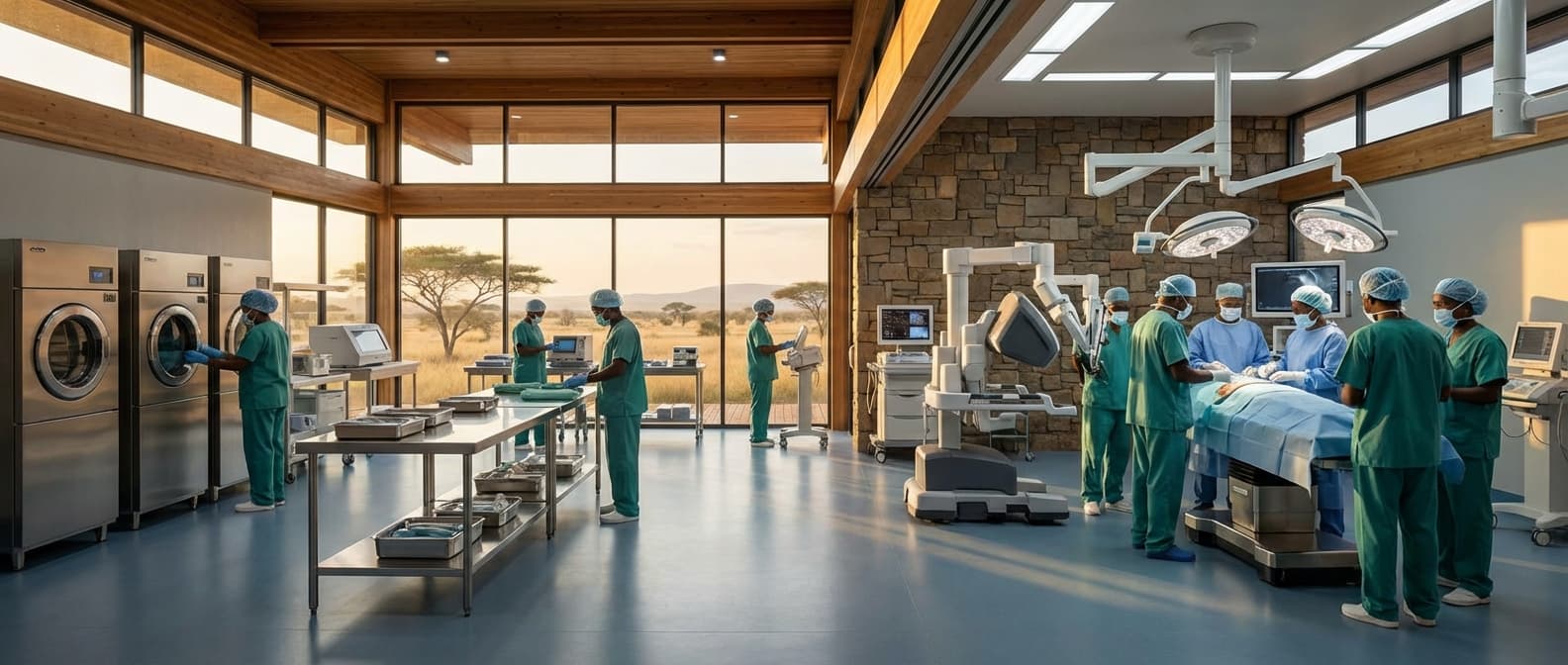
CSSD Design & Validation in Kenya
Engineering Excellence & Technical Support
CSSD workflow design, validation and process development High-standard technical execution following OEM protocols and local regulatory frameworks.
ISO 13485 Compliant CSSD Design
Ensuring sterile processing departments in Kenyan healthcare facilities are designed and validated to meet stringent ISO 13485 standards for medical device quality management, guaranteeing patient safety and regulatory compliance.
Validation of Decontamination Cycles
Expert validation of instrument decontamination cycles using advanced monitoring techniques and microbiological testing to confirm effective removal of pathogens, crucial for infection control in Kenyan hospitals.
Performance Verification & Process Optimization
Implementing rigorous performance verification for all CSSD equipment and processes, utilizing data analytics to identify areas for optimization and enhance workflow efficiency within Kenyan healthcare settings.
What Is Cssd Design & Validation In Kenya?
CSSD (Central Sterile Services Department) design and validation in Kenya refers to the comprehensive process of planning, establishing, and verifying the functional integrity of a sterile processing facility. This service ensures that the department is configured to meet stringent infection control standards, regulatory requirements, and operational efficiency for the decontamination, sterilization, and storage of medical devices. It encompasses architectural considerations, equipment selection and layout, workflow optimization, environmental controls, and the implementation of robust quality management systems. The validation phase confirms that all systems and processes consistently achieve the intended sterile outcome, minimizing the risk of healthcare-associated infections (HAAs).
| Who Needs CSSD Design & Validation? | Typical Use Cases | ||||
|---|---|---|---|---|---|
| Hospitals (Public & Private): Requiring the establishment or upgrade of sterile processing departments to handle surgical instruments and medical devices. | Specialty Clinics & Surgical Centers: Needing dedicated facilities for reprocessing instruments used in specific procedures (e.g., ophthalmology, dentistry, endoscopy). | Diagnostic Laboratories: Processing reusable diagnostic equipment and instruments requiring sterilization. | Medical Device Manufacturers (for testing/validation purposes): Ensuring their devices can be effectively sterilized in a CSSD environment. | Government Health Institutions: Establishing or renovating CSSD facilities in alignment with national healthcare infrastructure development goals. | Contract Sterilization Facilities: Designing and validating their operations to serve multiple healthcare providers. |
| New Hospital Construction/Renovation: Ensuring the CSSD is integrated from the design phase to meet current and future needs. | Acquisition of New Sterilization Equipment: Validating that the new equipment integrates seamlessly and performs to specifications. | Expansion of Surgical Services: Increasing the capacity and efficiency of the CSSD to accommodate higher patient volumes and a wider range of procedures. | Addressing Infection Control Deficiencies: Redesigning or revalidating existing CSSDs to rectify workflow issues or non-compliance with standards. | Introduction of New Medical Devices or Sterilization Technologies: Ensuring compatibility and efficacy of reprocessing protocols. | Routine Performance Monitoring and Re-validation: Periodically verifying the ongoing effectiveness of the CSSD's processes and equipment. |
Key Components of CSSD Design & Validation in Kenya:
- Needs Assessment: Determining the volume and types of instruments, surgical procedures, and patient throughput to inform capacity and functionality requirements.
- Facility Layout and Design: Optimizing the physical space for a unidirectional workflow (dirty to clean to sterile) to prevent cross-contamination. This includes designated areas for receiving, cleaning, inspection, packaging, sterilization, storage, and dispatch.
- Equipment Selection and Integration: Specifying and integrating appropriate sterilization technologies (e.g., steam autoclaves, low-temperature sterilizers), washer-disinfectors, ultrasonic cleaners, drying cabinets, and packaging systems.
- Environmental Controls: Designing and verifying HVAC systems for temperature, humidity, air changes per hour (ACPH), and pressure differentials to maintain a controlled environment and prevent microbial contamination.
- Workflow Analysis and Optimization: Developing efficient Standard Operating Procedures (SOPs) for all stages of sterile processing, ensuring staff competence and material flow.
- Regulatory Compliance: Adhering to Kenyan Ministry of Health guidelines, international standards (e.g., ISO 13485, AAMI ST series), and best practices for medical device reprocessing.
- Validation and Qualification (IQ/OQ/PQ): Performing Installation Qualification (IQ) to ensure equipment is installed correctly, Operational Qualification (OQ) to verify equipment operates as intended, and Performance Qualification (PQ) to confirm the entire process consistently produces sterile products.
- Quality Management System (QMS) Implementation: Establishing protocols for documentation, record-keeping, biological monitoring, chemical indicators, process monitoring, and staff training.
- Sterile Storage and Distribution: Designing secure and appropriate storage environments to maintain sterility until use and establishing efficient distribution logistics.
Who Needs Cssd Design & Validation In Kenya?
Central Sterile Supply Departments (CSSDs) are critical for maintaining patient safety and preventing healthcare-associated infections (HAIs) within any healthcare facility. Their efficient and effective operation relies heavily on proper design and ongoing validation processes. In Kenya, as the healthcare sector continues to grow and modernize, the demand for robust CSSD design and validation services is increasingly vital.
| Target Customer | Relevant Departments |
|---|---|
| Public Hospitals | Infection Prevention and Control, Nursing Services, Biomedical Engineering, Administration, Procurement |
| Private Hospitals | Infection Prevention and Control, Nursing Services, Hospital Management, Estates/Facilities Management, Procurement |
| Missionary Hospitals | Infection Prevention and Control, Clinical Services, Administration, Operations Management |
| Specialized Clinics (e.g., Dental, Eye, Surgical Centers) | Clinical Leads, Nursing Supervisors, Facility Managers, Infection Control Officers |
| Healthcare Training Institutions (with clinical training components) | Department Heads (Nursing, Clinical Medicine), Simulation Lab Managers, Infection Control Coordinators |
| Government Health Agencies (for policy and oversight) | Public Health Departments, Quality Assurance Units, Standards & Regulations Bodies |
| Medical Equipment Suppliers & Installers (offering integrated solutions) | Technical and Sales Departments, Project Management Teams |
Who Needs CSSD Design & Validation in Kenya?
- Healthcare facilities of all sizes
- New hospital constructions and expansions
- Existing facilities undergoing renovations or upgrades
- Facilities aiming to improve infection control practices
- Organizations seeking to meet international healthcare standards
Cssd Design & Validation Process In Kenya
Designing and validating a Central Sterile Services Department (CSSD) in Kenya is a multi-faceted process that ensures the highest standards of infection prevention and control. This workflow details the typical journey from an initial inquiry to the successful execution and validation of a CSSD, emphasizing key steps and considerations within the Kenyan context. The process is crucial for hospitals and healthcare facilities seeking to comply with national healthcare regulations and international best practices.
| Phase | Key Activities | Key Kenyan Considerations |
|---|---|---|
| Design & Planning | Needs Assessment, Site Survey, Conceptual Design, Detailed Design, Regulatory Approvals | Compliance with Kenya Ministry of Health (MOH) Guidelines for Healthcare Facilities, local building codes, and infectious disease control regulations. Availability of local engineering expertise and material suppliers. |
| Construction & Procurement | Construction, Fit-out, Equipment Selection & Procurement | Sourcing equipment from reputable manufacturers with good after-sales support and readily available spare parts in Kenya. Local sourcing of construction materials where feasible. |
| Installation & Commissioning | Equipment Installation, Utility Connections, Initial Testing | Ensuring qualified technicians for installation. Verification of utility capacities (power, water, steam) as per Kenyan standards. |
| Validation | Installation Qualification (IQ), Operational Qualification (OQ), Performance Qualification (PQ) | Adherence to international validation standards (e.g., ISO, AAMI) adapted for the Kenyan context. Use of accredited laboratories for biological indicator testing if not available locally. |
| Operations & Maintenance | Staff Training, Routine Monitoring, Record Keeping, Re-validation | Training aligned with MOH standards for infection prevention and control. Establishing robust record-keeping systems for traceability and audits. Planning for periodic maintenance contracts with local service providers. |
CSSD Design & Validation Process in Kenya Workflow
- Inquiry & Initial Consultation: The process begins with a healthcare facility expressing interest in CSSD design and/or validation services. This usually involves contacting a specialized firm or consultant.
- Needs Assessment & Site Survey: A thorough understanding of the facility's current needs, patient volume, surgical procedures, and available space is conducted. A site survey assesses existing infrastructure, utilities, and workflow.
- Conceptual Design & Space Planning: Based on the needs assessment, a preliminary conceptual design is developed. This includes layout, zoning (clean, sterile, dirty areas), and flow of materials and personnel.
- Detailed Design & Engineering: This phase involves creating detailed architectural, mechanical, electrical, and plumbing (MEP) drawings. Equipment specifications, material selection, and compliance with Kenyan building codes and healthcare standards are finalized.
- Regulatory Approvals (Kenya Ministry of Health): Submission of design plans to the Kenya Ministry of Health (or relevant county health department) for review and approval is a critical step. This ensures compliance with national healthcare facility guidelines.
- Procurement & Equipment Selection: Sourcing and selecting appropriate sterilization equipment (autoclaves, washer-disinfectors, ultrasonic cleaners), sterile storage solutions, and other CSSD machinery. Vendor selection often considers local support and spare parts availability.
- Construction & Fit-out: The physical construction and renovation of the CSSD space according to the approved detailed designs. This includes partitioning, flooring, wall finishes, ventilation, and utility connections.
- Equipment Installation & Commissioning: Installation of all procured CSSD equipment. Commissioning involves initial testing to ensure equipment operates according to manufacturer specifications and design requirements.
- Staff Training: Comprehensive training for CSSD personnel on proper procedures for instrument decontamination, sterilization, packaging, storage, and record-keeping, aligned with Kenyan protocols.
- Validation Process (IQ/OQ/PQ): This is the core of ensuring the CSSD meets its intended purpose and regulatory requirements.
- Installation Qualification (IQ): Verifies that the installed equipment and facility meet the design specifications and manufacturer's requirements. This includes checking power, water, steam, and ventilation. For equipment, it confirms correct installation and calibration.
- Operational Qualification (OQ): Verifies that the installed equipment operates consistently within its defined operating parameters and specifications throughout its intended operational range. This involves testing the equipment under various load conditions and cycle parameters.
- Performance Qualification (PQ): Demonstrates that the CSSD, including all its equipment and processes, consistently produces sterile products that meet predetermined specifications and regulatory requirements under normal operating conditions. This involves running multiple cycles with actual instruments and biological/chemical indicators.
- Documentation & Record Keeping: Meticulous documentation of all design, construction, installation, commissioning, and validation activities. This forms the basis of the CSSD's operational manual and regulatory compliance records.
- Final Handover & Approval: Once validation is successfully completed and all documentation is in order, the CSSD is formally handed over to the healthcare facility. Final approvals from the Ministry of Health may be required.
- Ongoing Monitoring & Re-validation: Regular internal monitoring of CSSD processes and periodic re-validation of equipment and processes are essential to maintain compliance and ensure continued sterility assurance.
Cssd Design & Validation Cost In Kenya
Designing and validating a Central Sterile Services Department (CSSD) is a critical undertaking for any healthcare facility in Kenya. It involves meticulous planning, adherence to stringent international and local standards, and investment in specialized equipment and infrastructure. The costs associated with CSSD design and validation are influenced by a multitude of factors, leading to a wide range of pricing. This discussion outlines these key pricing factors and provides an estimated cost range in Kenyan Shillings (KES).
| Cost Component | Estimated Range (KES) | Notes |
|---|---|---|
| CSSD Design & Architectural Planning | 150,000 - 750,000+ | Varies based on facility size, complexity, and consultant fees. |
| Equipment Procurement (Sterilizers, Washer-Disinfectors, etc.) | 2,000,000 - 15,000,000+ | Highly dependent on brand, capacity, and technological features. This is the largest single cost component. |
| Ancillary Equipment (Trolleys, Sealers, Drying Cabinets, etc.) | 500,000 - 2,500,000 | Includes essential accessories for efficient workflow. |
| Infrastructure Development & Renovation | 1,000,000 - 10,000,000+ | Significant variation based on existing building condition, structural changes, HVAC, plumbing, and electrical upgrades. |
| Validation Services (IQ, OQ, PQ) | 300,000 - 1,500,000+ | Includes testing, documentation, and reporting. May involve third-party specialists. |
| Project Management & Consultancy | 200,000 - 1,000,000+ | Covers overall project oversight and specialist advice. |
| Total Estimated Range (excluding major construction) | 3,150,000 - 20,750,000+ | This is a broad estimate for a moderately sized facility with standard equipment. Larger, more specialized CSSDs can easily exceed this range. |
| Total Estimated Range (including extensive renovation/new build) | 5,000,000 - 30,000,000+ | This range accounts for significant civil works and construction. |
Key Pricing Factors for CSSD Design & Validation in Kenya:
- Facility Size and Complexity: The larger the CSSD and the more complex its workflow and service offerings (e.g., including instrument repair, specialized sterilization methods), the higher the design and validation costs.
- Scope of Services: The range of instruments and equipment requiring sterilization and the types of sterilization processes (steam, low-temperature, etc.) will impact the design requirements and, consequently, the cost.
- Current Infrastructure and Renovation Needs: If the facility requires extensive renovations or new construction to accommodate the CSSD, costs will increase significantly compared to utilizing existing space.
- Equipment Selection and Quality: The choice of sterilization equipment (autoclaves, washer-disinfectors, ultrasonic cleaners), drying cabinets, and material handling systems is a major cost driver. High-end, technologically advanced equipment will be more expensive.
- Regulatory Compliance and Standards: Adherence to Kenyan healthcare regulations, international standards (e.g., ISO 13485, AAMI), and best practices for infection control necessitates specific design features and validation protocols, adding to the cost.
- Consultancy Fees: Engaging experienced CSSD designers, architects, engineers, and validation specialists will incur professional fees. The experience and reputation of these consultants will influence their charges.
- Validation Protocols and Testing: Comprehensive validation involves IQ (Installation Qualification), OQ (Operational Qualification), and PQ (Performance Qualification) of all equipment and processes. This requires specialized testing, documentation, and potentially third-party validation services.
- Training and Staffing: While not directly a design/validation cost, the need for trained personnel to operate and maintain the validated CSSD is a related investment that influences overall project planning and budgeting.
- Location and Accessibility: For large-scale projects requiring extensive material transport or specialized labor, the geographic location of the facility might have a marginal impact on logistics costs.
- Technology Integration: The integration of IT systems for tracking, inventory management, and data logging can add to the complexity and cost of the design.
- Contingency Planning: As with any construction or renovation project, a contingency fund is essential to cover unforeseen issues, which can influence the overall allocated budget.
Affordable Cssd Design & Validation Options
Designing and validating a Central Sterile Services Department (CSSD) is crucial for patient safety and operational efficiency. However, it can also be a significant investment. This guide explores affordable CSSD design and validation options, focusing on value bundles and cost-saving strategies to help facilities optimize their resources without compromising quality.
| Value Bundle Type | Description | Cost-Saving Strategies | Benefits |
|---|---|---|---|
| 'Lean Start-Up' Design Package | Focuses on essential workflow optimization and layout for newly established or small-scale CSSDs. | Utilizes modular design elements, standard equipment configurations, and streamlined validation processes. | Lower upfront design costs, faster implementation, suitable for budget-conscious facilities. |
| 'Upgrade & Optimize' Validation Bundle | Targets existing CSSDs needing to re-validate equipment or processes due to upgrades or new regulations. | Offers bundled validation services for multiple equipment types, multi-site validation discounts, and remote support options. | Reduced validation expenditure per item, minimized downtime, ensured regulatory compliance. |
| 'Integrated Workflow' Solution | Combines initial design consultation with a curated selection of energy-efficient and space-saving equipment. | Negotiated bulk discounts on equipment, leasing options for high-cost items, recommendations for reusable consumables. | Improved operational efficiency, reduced utility costs, predictable equipment maintenance expenses. |
| 'Remote Consultation & Planning' Package | Leverages virtual tools and expert consultants for initial design and planning phases, particularly for facilities far from service providers. | Reduces travel expenses for consultants, allows for iterative feedback loops, utilizes digital tools for space planning. | Significant reduction in travel and accommodation costs, flexibility in scheduling, access to specialized expertise. |
| 'Phased Implementation' Approach | Breaks down large CSSD projects into manageable phases, allowing for budget allocation over time. | Prioritizes critical areas first (e.g., decontamination), defers non-essential upgrades, focuses on immediate needs. | Spreads capital expenditure, allows for learning and adjustment between phases, reduces immediate financial strain. |
Key Components of CSSD Design & Validation
- Space Planning & Workflow: Efficient layout minimizes cross-contamination and maximizes throughput.
- Equipment Selection: Choosing the right sterilizers, washer-disinfectors, and ancillary equipment is critical.
- Material Handling: Implementing robust systems for receiving, decontamination, packaging, and sterile storage.
- Validation Protocols: Ensuring all equipment and processes meet regulatory and manufacturer requirements.
- Staff Training & Competency: Equipping personnel with the knowledge and skills for safe and effective operation.
- Quality Management Systems: Establishing protocols for monitoring, documentation, and continuous improvement.
Verified Providers In Kenya
In Kenya's dynamic healthcare landscape, identifying truly 'Verified Providers' is paramount for ensuring quality, safety, and patient satisfaction. This is where Franance Health shines, setting a benchmark for excellence through its rigorous credentialing process and unwavering commitment to patient well-being. Franance Health's verification isn't merely a formality; it's a comprehensive evaluation that delves into the core of a healthcare provider's capabilities, ethical standing, and operational integrity.
| Provider Type | Franance Health Verification Benefits | What it means for you |
|---|---|---|
| Doctors & Specialists | Verified qualifications, extensive experience, adherence to ethical practices, access to advanced medical knowledge. | Receive expert medical advice and treatment from highly competent and trustworthy professionals. |
| Hospitals & Clinics | Accredited facilities, state-of-the-art equipment, stringent hygiene protocols, qualified medical staff. | Access safe, clean, and well-equipped healthcare environments for all your medical needs. |
| Laboratories & Diagnostic Centers | Certified technicians, calibrated equipment, adherence to quality control standards, accurate and reliable results. | Get precise and dependable diagnostic test results essential for accurate diagnosis and treatment planning. |
| Pharmacies | Licensed and registered pharmacies, verified drug authenticity, professional pharmacist consultation. | Purchase authentic medications from reputable sources and receive expert advice on drug usage and safety. |
Why Franance Health Credentials Matter:
- Rigorous Qualification Checks: We meticulously examine the academic, professional, and licensing credentials of all affiliated healthcare providers, ensuring they meet and exceed national and international standards.
- Experience Validation: Beyond qualifications, we assess the practical experience and proven track record of our providers in their respective specializations.
- Ethical Conduct Review: Franance Health upholds the highest ethical standards. Our verification process includes background checks and a review of past conduct to guarantee trustworthy patient care.
- Facility and Equipment Standards: We ensure that our verified providers operate in facilities that meet stringent safety and hygiene requirements, equipped with modern, well-maintained medical equipment.
- Continuing Professional Development (CPD): We mandate and track CPD for all our providers, ensuring they remain at the forefront of medical advancements and best practices.
- Patient Feedback Integration: Our system actively incorporates patient feedback, providing valuable insights into provider performance and areas for continuous improvement.
Scope Of Work For Cssd Design & Validation
This Scope of Work (SOW) outlines the requirements for the design and validation of a Central Sterile Supply Department (CSSD). It details the technical deliverables, standard specifications, and the overarching goals of the project to ensure a safe, efficient, and compliant CSSD operation. The design phase will focus on optimizing workflow, material flow, and personnel movement while adhering to international and local standards for infection control and sterile processing. The validation phase will rigorously test and document all aspects of the CSSD to confirm it meets the specified design requirements and regulatory expectations. The ultimate objective is to establish a CSSD that provides consistently sterile medical devices, minimizes the risk of healthcare-associated infections (HAIs), and operates within budgetary and operational parameters.
| Phase | Key Activities | Technical Deliverables | Standard Specifications / References |
|---|---|---|---|
| Design | Needs Assessment & Requirements Gathering | Detailed functional program, space requirements, preliminary equipment list. | Hospital infection control guidelines, WHO guidelines on CSSD, local building codes. |
| Design | Conceptual Design & Layout Development | Schematic design drawings, 3D visualizations, preliminary workflow diagrams. | HTM 01-01 (UK), AAMI ST79 (USA), ISO 13485 (Medical Device Quality Management). |
| Design | Detailed Design & Engineering | Architectural drawings, mechanical, electrical, plumbing (MEP) drawings, detailed equipment specifications, IT/data integration plan. | Relevant national building codes, electrical safety standards, ventilation standards (e.g., ASHRAE), water quality standards. |
| Design | Equipment Selection & Procurement Support | Finalized equipment specifications, tender documents, vendor evaluation criteria. | Manufacturer's specifications, performance validation requirements, energy efficiency ratings. |
| Design | SOP Development & Training Material Preparation | Draft SOPs for all CSSD processes (receiving, cleaning, disinfection, packaging, sterilization, storage, distribution), training manuals. | AAMI TIR12 (Biological indicators), ISO 17665 (Sterilization by moist heat), ISO 11135 (Sterilization by ethylene oxide), manufacturer's instructions for use (IFU). |
| Validation | Equipment Installation & Commissioning | Installation verification reports, functional performance tests (FPTs) for all equipment. | Manufacturer's installation guidelines, commissioning protocols. |
| Validation | Process Validation (Cleaning & Disinfection) | Validation protocols, cleaning efficacy studies, microbial challenge tests, detergent efficacy tests. | AAMI ST58 (Chemical Sterilants and Disinfectants), FDA guidelines for reprocessing medical devices. |
| Validation | Process Validation (Sterilization) | Sterilization validation protocols (e.g., for steam, low-temperature sterilization), biological indicator studies, chemical indicator studies, process parameter monitoring. | ISO 11135 (Ethylene Oxide), ISO 17665 (Moist Heat), ISO 14937 (General requirements for validation of sterile device manufacturers), AAMI ST46 (Steam Sterilization). |
| Validation | Sterile Storage & Distribution Validation | Environmental monitoring reports (temperature, humidity), air quality testing, package integrity testing, event-related and time-related shelf-life studies (if applicable). | AAMI ST79 (Sterilization in health care facilities), ISO 11607 (Packaging for terminally sterilized medical devices). |
| Validation | Validation Report Generation | Comprehensive validation reports for each validation activity, summary validation report, IQ/OQ/PQ documentation. | Regulatory requirements for medical device reprocessing, quality management system documentation. |
| Validation | Training & Competency Assessment | Training completion records, competency assessment results for CSSD staff. | CSSD staff competency frameworks, specific equipment training requirements. |
Key Objectives of CSSD Design & Validation
- To design a CSSD layout that ensures optimal workflow and segregation of clean, sterile, and dirty areas.
- To select and integrate appropriate equipment for cleaning, disinfection, sterilization, and storage.
- To develop comprehensive Standard Operating Procedures (SOPs) for all CSSD processes.
- To ensure compliance with relevant international standards (e.g., ISO, AAMI) and local healthcare regulations.
- To validate the efficacy and reliability of all equipment and processes through rigorous testing.
- To establish robust quality control and assurance mechanisms for sterile processing.
- To facilitate efficient inventory management and traceability of sterile supplies.
- To provide a safe and ergonomically sound working environment for CSSD personnel.
- To minimize the risk of contamination and cross-infection.
Service Level Agreement For Cssd Design & Validation
This Service Level Agreement (SLA) outlines the performance standards and commitments for the design and validation of Central Sterile Supply Department (CSSD) facilities. It defines the agreed-upon response times for critical issues and the expected uptime of relevant systems and services during the design and validation phases.
| Service Area | Uptime Guarantee (%) | Response Time for Critical Issues |
|---|---|---|
| Design Documentation & Review Platform (e.g., BIM, project management software) | 99.5% | 4 Business Hours |
| Equipment Specification & Procurement Support | N/A (Service is responsive) | 8 Business Hours |
| Validation Protocol Development & Review Platform | 99.5% | 4 Business Hours |
| Validation Execution Support (e.g., remote monitoring, expert consultation) | N/A (Service is responsive) | 2 Business Hours (for urgent on-site requirements, subject to availability and travel) |
| Data Management & Reporting for Validation | 99.5% | 6 Business Hours |
| Communication Channels (e.g., dedicated project portal, scheduled calls) | 99.9% | Immediate acknowledgement, with resolution commitment based on issue severity |
Key Service Areas and Definitions
- CSSD Design: The process of planning, specifying, and documenting the layout, workflow, equipment, and infrastructure required for an efficient and compliant CSSD.
- CSSD Validation: The documented process of establishing by objective evidence that a system, process, or equipment consistently produces a result meeting predetermined specifications and quality attributes. This includes Installation Qualification (IQ), Operational Qualification (OQ), and Performance Qualification (PQ) phases for relevant CSSD systems.
- Critical Issue: An issue that directly impacts the ability to proceed with CSSD design or validation activities, poses a significant risk to project timelines, or compromises patient safety/regulatory compliance.
- Response Time: The maximum time allowed from when a critical issue is reported to the initiation of investigation and action by the service provider.
- Uptime Guarantee: The percentage of time that critical systems or services are expected to be available and functional for CSSD design and validation activities.
Frequently Asked Questions

Ready when you are
Let's scope your CSSD Design & Validation in Kenya project in Kenya.

Scaling healthcare logistics and technical systems across the entire continent.