
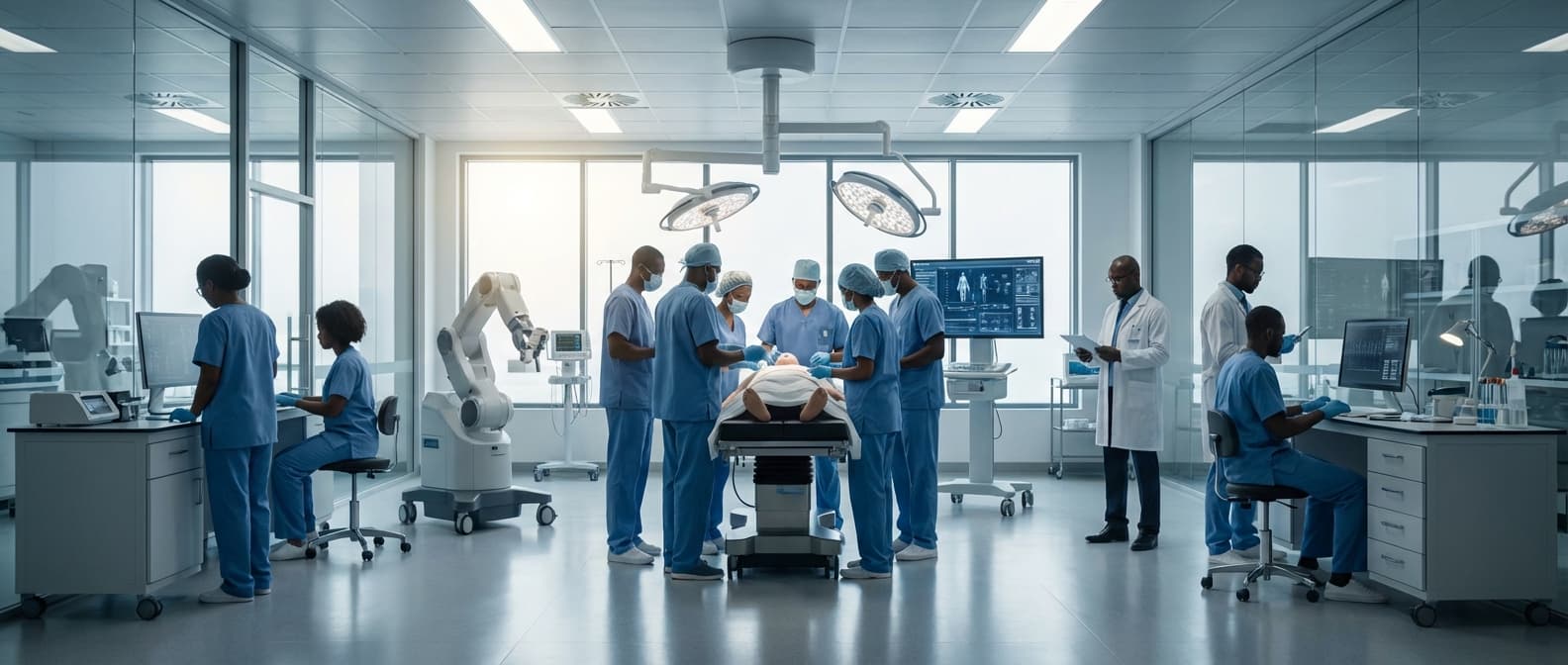
Biomedical Engineering Consulting in Kenya
Engineering Excellence & Technical Support
Equipment selection, procurement and implementation consulting High-standard technical execution following OEM protocols and local regulatory frameworks.
Advanced Biomedical Device Prototyping & Validation
Leveraging cutting-edge simulation software and rapid prototyping technologies (3D printing, CNC machining), we design, develop, and rigorously validate novel biomedical devices. Our expertise spans diagnostic tools, therapeutic equipment, and assistive technologies tailored to the specific needs of the Kenyan healthcare landscape, ensuring regulatory compliance and optimal performance.
Healthcare Data Analytics & Health Informatics Solutions
We empower Kenyan healthcare institutions with robust health informatics systems and advanced data analytics capabilities. Our services include developing integrated Electronic Health Records (EHRs), implementing data warehousing solutions, and applying machine learning algorithms for predictive diagnostics, population health management, and operational efficiency improvements.
Biocompatibility & Sterilization Protocol Optimization
Ensuring the safety and efficacy of medical devices is paramount. We provide specialized consulting on biocompatibility testing strategies according to international standards (ISO 10993) and develop optimized sterilization validation protocols for diverse medical materials and devices, guaranteeing patient safety and regulatory adherence within the Kenyan context.
What Is Biomedical Engineering Consulting In Kenya?
Biomedical Engineering Consulting in Kenya is a specialized professional service that provides expert advice and technical solutions related to medical devices, healthcare technology, and biological systems. It bridges the gap between engineering principles and healthcare applications, addressing the unique challenges and opportunities within the Kenyan healthcare landscape. This service encompasses a broad spectrum of activities, from the design and development of medical equipment to the strategic planning, procurement, installation, maintenance, and regulatory compliance of healthcare facilities and their technological infrastructure.
| Who Needs Biomedical Engineering Consulting in Kenya? | Typical Use Cases |
|---|---|
| Hospitals and Healthcare Facilities (Public & Private): Need assistance in managing their extensive medical equipment inventory, planning for technology upgrades, ensuring regulatory compliance, and optimizing operational efficiency. | Procurement and installation of new diagnostic imaging equipment (MRI, CT scanners). Developing a preventive maintenance schedule for critical care units. Assessing and upgrading the medical gas supply system. Designing the layout and equipment needs for a new operating theatre complex. |
| Medical Device Manufacturers and Distributors: Require support in product design, validation, regulatory submissions, market access, and after-sales service strategy within the Kenyan context. | Navigating the registration process for new medical devices with Kenyan regulatory bodies. Providing technical expertise for local assembly or manufacturing. Developing quality control protocols for imported medical devices. Training local service engineers for a new range of surgical instruments. |
| Government Ministries and Health Agencies: Seek guidance on national health technology policies, procurement frameworks, and public health infrastructure development. | Developing national guidelines for medical equipment management. Advising on the procurement strategy for essential medical equipment for public health programs. Evaluating the suitability of emerging health technologies for widespread adoption. Assisting in the establishment of national medical device repair and maintenance centers. |
| Research Institutions and Universities: Benefit from expertise in designing and validating novel biomedical devices, conducting clinical trials, and establishing research infrastructure. | Designing and prototyping a new diagnostic device for a specific endemic disease. Advising on the technical aspects of a clinical trial for a new implantable device. Setting up a biomechanics laboratory for rehabilitation research. Ensuring compliance with ethical and technical standards for biomedical research. |
| Non-Governmental Organizations (NGOs) and International Development Agencies: Require technical support for healthcare projects, capacity building, and the deployment of medical technologies in underserved areas. | Assessing the technological needs of rural health clinics. Developing training modules for healthcare workers on using donated medical equipment. Implementing solar-powered medical refrigeration systems for remote areas. Evaluating the impact and sustainability of introduced medical technologies. |
| Investors and Financial Institutions: Need due diligence and technical feasibility assessments for investments in the healthcare technology sector. | Conducting technical due diligence on a healthcare startup developing a new diagnostic tool. Assessing the market potential and technical viability of a proposed medical device manufacturing plant. |
Key Areas of Biomedical Engineering Consulting in Kenya
- Medical Device Lifecycle Management: Advising on the selection, acquisition, installation, validation, maintenance, repair, and decommissioning of medical equipment, ensuring optimal performance, safety, and cost-effectiveness.
- Healthcare Facility Planning and Design: Providing technical input for the design and construction of new healthcare facilities or the renovation of existing ones, focusing on optimal workflow, equipment placement, infrastructure requirements (e.g., power, medical gases, ventilation), and compliance with healthcare standards.
- Technology Assessment and Strategy: Evaluating existing healthcare technologies, identifying needs for new or upgraded systems, and developing strategic roadmaps for technology adoption and integration.
- Regulatory Compliance and Quality Assurance: Assisting healthcare providers and manufacturers in navigating national and international regulations governing medical devices and healthcare services, including quality management systems (e.g., ISO 13485) and local standards (e.g., by the Pharmacy and Poisons Board of Kenya).
- Risk Management: Identifying, assessing, and mitigating risks associated with the use of medical technology, patient safety, and operational efficiency.
- Training and Capacity Building: Developing and delivering training programs for healthcare professionals and technical staff on the operation, maintenance, and safe use of medical equipment.
- Biomaterial and Biomechanics Applications: Consulting on the application of biomaterials in medical devices, prosthetics, and implantable devices, as well as biomechanical analysis for rehabilitation and assistive technologies.
- Infection Prevention and Control Technologies: Advising on the selection and implementation of technologies and strategies to enhance infection control within healthcare settings.
- Healthcare Informatics and Digital Health: Providing expertise on the integration of information technology in healthcare, including electronic health records (EHRs), telemedicine platforms, and medical imaging systems.
Who Needs Biomedical Engineering Consulting In Kenya?
Biomedical Engineering Consulting in Kenya is a vital service catering to a diverse range of clients who require specialized expertise to navigate the complexities of healthcare technology, infrastructure, and regulatory compliance. These consultants bridge the gap between cutting-edge medical innovation and the practical implementation and maintenance of healthcare solutions within the Kenyan context.
| Target Customer/Department | Specific Needs & Services Provided | Examples of Projects |
|---|---|---|
| Hospitals (Public & Private) | Procurement planning, equipment selection & validation, clinical engineering management, facility design & planning, maintenance strategies, risk management, technology assessment, staff training. | Developing a hospital's capital equipment acquisition plan. Implementing a preventive maintenance program for critical care units. Designing the layout and equipment specifications for a new surgical theater. Conducting a needs assessment for a specialized diagnostic imaging center. |
| Medical Device Manufacturers/Distributors | Regulatory affairs support (e.g., KEBS registration), market entry strategy, product lifecycle management, quality assurance, post-market surveillance, technical documentation, training for local partners. | Assisting a foreign manufacturer in obtaining product registration for new medical devices in Kenya. Developing a distribution and service network strategy for a new line of diagnostic equipment. Providing technical training to local biomedical technicians on complex imaging systems. |
| Ministry of Health & Other Government Bodies | Policy development related to medical technology, national equipment standards, procurement guidelines, capacity building for public health facilities, health infrastructure planning, regulatory framework development. | Contributing to the development of national guidelines for medical equipment maintenance. Advising on procurement strategies for essential medical equipment for public hospitals. Developing training modules for biomedical engineers in public health institutions. |
| Research Institutions & Universities | Setting up and equipping research laboratories, managing research equipment, advising on technology acquisition for research purposes, grant proposal support for equipment needs. | Advising on the acquisition of advanced microscopy equipment for a university research department. Developing a plan for the maintenance and calibration of specialized research instruments. Assisting in grant applications by providing technical specifications for research equipment. |
| NGOs & International Development Agencies | Needs assessments for healthcare projects, procurement of medical equipment for specific programs, infrastructure development, capacity building for local healthcare providers, project evaluation related to medical technology. | Conducting a needs assessment for medical equipment in a rural health clinic funded by an NGO. Overseeing the procurement and installation of solar-powered medical equipment for off-grid facilities. Developing a training program for local technicians to maintain donated medical devices. |
| Diagnostic Laboratories | Laboratory equipment selection & validation, workflow optimization, LIMS (Laboratory Information Management System) integration, quality control system implementation, compliance with international standards (e.g., ISO 15189). | Advising on the selection and implementation of automated laboratory analysers. Developing a quality management system for a medical laboratory. Optimizing sample processing workflows to improve efficiency and reduce turnaround times. |
| Pharmaceutical Companies | Cold chain management solutions for drug storage and transportation, equipment for pharmaceutical quality control, packaging technology assessment. | Designing and implementing robust cold chain monitoring systems for temperature-sensitive medications. Advising on the selection of equipment for pharmaceutical quality testing. |
Target Customers & Departments for Biomedical Engineering Consulting in Kenya
- Hospitals and Healthcare Facilities
- Medical Device Manufacturers and Distributors
- Government Ministries and Regulatory Bodies
- Research Institutions and Universities
- Non-Governmental Organizations (NGOs) and International Development Agencies
- Diagnostic Laboratories
- Pharmaceutical Companies
Biomedical Engineering Consulting Process In Kenya
Biomedical Engineering consulting in Kenya follows a structured workflow designed to deliver specialized expertise and solutions to healthcare facilities, medical device manufacturers, research institutions, and government bodies. This process typically begins with an initial inquiry and culminates in the successful execution and closure of the project. The stages are outlined below, detailing the typical steps involved.
| Stage | Description | Key Activities | Deliverables | Typical Timeframe |
|---|---|---|---|---|
| Client expresses a need for biomedical engineering expertise. The consultant aims to understand the scope and requirements. | Initial consultation, understanding client's challenges, defining preliminary project goals, site visits (if applicable). | Understanding of client's needs, preliminary scope document. | 1-3 days |
| Based on the needs assessment, the consultant prepares a detailed proposal outlining the approach, methodology, timeline, team, and cost. | Defining specific services, developing a detailed work plan, estimating resources, creating a cost breakdown, writing and presenting the proposal. | Formal proposal document, detailed quotation. | 3-7 days |
| Client reviews the proposal. Negotiations on scope, budget, timelines, and terms. Formalization of the agreement. | Discussion of proposal details, contract drafting and review, negotiation of terms, signing of the service agreement/contract. | Signed service agreement/contract. | 2-5 days |
| Formal commencement of the project. Detailed planning of all project phases and activities. | Project kick-off meeting, establishing communication channels, refining project plan, identifying key stakeholders, risk assessment. | Detailed project plan, communication protocol, risk management plan. | 2-4 days |
| Gathering all necessary information relevant to the project. This could involve site assessments, user interviews, literature reviews, or technical data. | Site surveys, equipment audits, interviews, data gathering, data analysis, identifying root causes of issues. | Raw data, analyzed data, preliminary findings report. | Variable (depends on project complexity) |
| Developing and designing the specific solutions or recommendations to address the client's needs. | Developing technical specifications, designing workflows, creating schematics, recommending equipment, formulating strategies. | Technical designs, process maps, strategic recommendations, concept designs. | Variable (depends on project complexity) |
| Putting the designed solutions into practice. This stage involves the actual installation, integration, or execution of the plan. | Equipment installation, software integration, process implementation, system deployment, calibration, testing. | Implemented solutions, installed systems, functional processes. | Variable (depends on project complexity) |
| Ensuring the client's staff are adequately trained to operate and maintain the implemented solutions. | Developing training materials, conducting workshops, hands-on training, knowledge transfer. | Trained personnel, training manuals, user guides. | Variable (depends on project scope) |
| Assessing the effectiveness and impact of the implemented solutions. Making adjustments as needed. | Performance monitoring, user feedback collection, outcome evaluation, identifying areas for improvement. | Performance reports, feedback summaries, proposed optimizations. | Ongoing during implementation and for a period post-deployment |
| Formal conclusion of the project. Documentation of all project activities, outcomes, and lessons learned. | Final project report preparation, presentation of findings to the client, handover of documentation, final invoicing. | Final project report, project completion certificate (if applicable), lessons learned document. | 3-5 days |
| Providing ongoing assistance or maintenance after project completion. | Troubleshooting, warranty support, further optimization, phased upgrades. | Continued operational efficiency, resolved issues. | As per contractual agreement |
Biomedical Engineering Consulting Workflow in Kenya
- 1. Initial Inquiry & Needs Assessment:
- 2. Proposal Development & Quotation:
- 3. Contract Negotiation & Agreement:
- 4. Project Kick-off & Detailed Planning:
- 5. Data Collection & Analysis:
- 6. Solution Design & Development:
- 7. Implementation & Deployment:
- 8. Training & Capacity Building:
- 9. Monitoring & Evaluation:
- 10. Project Closure & Reporting:
- 11. Post-Project Support (Optional):
Biomedical Engineering Consulting Cost In Kenya
Biomedical Engineering consulting costs in Kenya can vary significantly based on several factors. These include the complexity of the project, the expertise and experience of the consultant, the duration of the engagement, and the specific services required. Biomedical engineering consulting is a specialized field, often involving technical assessments, regulatory compliance, equipment lifecycle management, and strategic planning within healthcare facilities. Clients typically seek these services to optimize medical device performance, ensure safety and efficacy, navigate regulatory landscapes, and improve overall healthcare delivery through technological integration. The cost is often calculated on an hourly, daily, or project basis, with a range of pricing structures reflecting the value and specialized knowledge brought to the table.
| Service Type/Engagement | Typical Hourly Rate (KES) | Typical Daily Rate (KES) | Project-Based (Estimated Range - KES) |
|---|---|---|---|
| Junior/Entry-Level Consultant | 5,000 - 10,000 | 25,000 - 50,000 | 50,000 - 200,000 (for simple tasks) |
| Mid-Level Consultant | 10,000 - 20,000 | 50,000 - 100,000 | 200,000 - 750,000 |
| Senior/Lead Consultant/Specialist | 20,000 - 40,000+ | 100,000 - 200,000+ | 750,000 - 3,000,000+ |
| Specialized Services (e.g., Regulatory Affairs, Advanced Risk Management, Cybersecurity) | Often higher than general rates, potentially 30,000 - 60,000+ per hour or substantial project fees. | Varies significantly based on complexity. | Highly variable, can range from 1,000,000 KES upwards for complex regulatory submissions or system implementations. |
| Retainer Agreements | Negotiated based on expected monthly hours and scope of services. | N/A | Typically a fixed monthly fee for ongoing advisory services. |
Key Factors Influencing Biomedical Engineering Consulting Costs in Kenya
- Project Scope and Complexity: Larger, more intricate projects requiring extensive research, analysis, or implementation will naturally command higher fees. This could include a full hospital equipment audit versus a single device evaluation.
- Consultant's Experience and Reputation: Highly experienced consultants with a proven track record and specialized expertise in specific areas (e.g., medical imaging, radiation safety, medical device cybersecurity) will charge premium rates.
- Duration of Engagement: Short-term, ad-hoc consultations will typically have a different pricing model (often hourly) compared to long-term, retainer-based engagements.
- Specific Services Required: The type of service is a major determinant. For example, regulatory submissions (e.g., to the Pharmacy and Poisons Board) are more complex and time-consuming than providing basic training on a medical device.
- Travel and Expenses: If the consultant needs to travel within Kenya or internationally for the project, these costs will be factored in.
- Report Generation and Deliverables: The depth and detail of the final reports, presentations, and other deliverables can influence the overall cost.
- Urgency of the Project: Rush projects with tight deadlines may incur additional charges due to the expedited nature of the work.
- Market Demand and Competition: While a niche field, the availability of qualified local consultants and the general demand for their services in Kenya can also play a role.
Affordable Biomedical Engineering Consulting Options
Biomedical engineering consulting can be a crucial asset for startups and established companies alike, helping navigate complex design, regulatory, manufacturing, and market access challenges. However, the cost can be a significant barrier. Fortunately, there are ways to access expert biomedical engineering guidance without breaking the bank. This includes understanding "value bundles" – packaged services designed for specific project phases or needs – and implementing smart cost-saving strategies.
| Consulting Area | Typical Value Bundle Deliverables | Potential Cost-Saving Strategies |
|---|---|---|
| Feasibility & Concept Development | Market analysis, technology assessment, risk identification, feasibility report | Phased engagement, remote collaboration, clear scope definition |
| Design & Prototyping Support | Design reviews, material selection, iterative design, initial manufacturing planning | Leverage internal design expertise, fixed-price for specific design iterations |
| Regulatory Strategy & Documentation | Regulatory pathway identification, submission plan, initial document drafting | Focus on specific regulatory bodies, knowledge transfer for internal team |
| DHF / Technical File Assembly | DHF/Technical File organization, gap analysis, documentation review | Use standardized templates, prioritize critical documentation elements |
| Usability Engineering & Human Factors | Use specifications, formative/summative study planning & execution support, HE/HF reports | Remote observation of studies, phased approach to study execution |
| Small-Scale Manufacturing & Transfer | Process validation planning, supplier qualification guidance, transfer documentation | Focus on critical process parameters, leverage existing supplier relationships |
Affordable Biomedical Engineering Consulting Options
- Value Bundles: Maximizing Impact and Predictability
- Value bundles are pre-defined service packages that offer a curated set of consulting activities for a specific project stage or objective. They provide clarity on deliverables, timelines, and often a more predictable cost structure compared to hourly engagements. These bundles are designed to deliver focused expertise and tangible outcomes efficiently.
- Common Value Bundle Examples:
* **Feasibility & Concept Development Bundle:** For early-stage ideas, this might include market research, technology assessment, initial risk analysis, and a high-level concept validation report.* **Design & Prototyping Support Bundle:** Focused on taking a concept to a functional prototype. This could involve design reviews, material selection guidance, iterative design support, and initial manufacturing process planning.* **Regulatory Strategy & Documentation Bundle:** Essential for market entry. This often includes identifying applicable regulations (FDA, CE Mark, etc.), developing a regulatory pathway, creating a submission plan, and assisting with initial documentation preparation.* **Design History File (DHF) / Technical File Assembly Bundle:** A critical component for regulatory submissions. This bundle focuses on gathering, organizing, and ensuring the completeness of all necessary design and development documentation.* **Usability Engineering & Human Factors Bundle:** Crucial for product safety and adoption. This might involve defining use specifications, conducting formative and summative usability studies, and creating usability engineering files.* **Small-Scale Manufacturing & Transfer Bundle:** For companies transitioning from R&D to early production. This can involve process validation planning, supplier qualification guidance, and initial manufacturing transfer support.- Cost-Saving Strategies: Smart Approaches to Consulting
- Beyond value bundles, several strategies can help manage and reduce consulting costs.
* **Phased Engagements:** Break down large projects into smaller, manageable phases with clear deliverables and review points. This allows for reassessment and adjustment of scope and budget between phases.* **Leverage Internal Expertise:** Identify areas where your internal team has strong capabilities and focus external consulting on areas requiring specialized knowledge or experience that you lack.* **Remote Consulting:** Many consulting tasks, especially those involving documentation review, strategy development, and virtual meetings, can be effectively performed remotely, reducing travel and associated expenses.* **Project-Specific Scope Definition:** Clearly define the project scope from the outset. Ambiguity leads to scope creep and increased costs. Detailed Statements of Work (SOWs) are crucial.* **Fixed-Price vs. Hourly:** While hourly can offer flexibility, fixed-price engagements (often seen in value bundles) can provide cost certainty. Negotiate based on the defined scope and deliverables.* **Seek Niche Expertise:** Instead of a large, generalist firm, consider smaller, specialized consulting groups or individual experts who possess deep knowledge in your specific area of need. This can often be more cost-effective.* **Collaborative Knowledge Transfer:** Ensure that consultants actively transfer knowledge to your internal team. This builds your team's capabilities and reduces the need for future external support on similar issues.* **Utilize Government Grants and Funding:** Explore programs that offer funding or grants for innovation and R&D, which may include provisions for consulting services.* **Early Engagement:** Engaging consultants early in the product development lifecycle can prevent costly mistakes and redesigns down the line. The cost of expert advice is often far less than the cost of fixing errors later.
Verified Providers In Kenya
In Kenya, ensuring access to quality healthcare is paramount. This involves identifying and partnering with healthcare providers who demonstrate unwavering commitment to ethical practices, patient well-being, and adherence to regulatory standards. 'Verified Providers' in Kenya represent those who have undergone rigorous credentialing processes, assuring individuals and organizations of their competence and reliability. Among these, Franance Health stands out as a leading example of excellence, offering a comprehensive suite of services backed by a foundation of trust and professionalism. Their credentials not only meet but often exceed the expected benchmarks, making them a premier choice for individuals and businesses seeking exceptional healthcare solutions.
| Credential Area | Franance Health Standard | Benefit to Patient/Client |
|---|---|---|
| Licensing & Accreditation | All providers hold current, valid licenses; many are accredited by reputable health organizations. | Guarantees legal and ethical practice; ensures high operational and safety standards. |
| Medical Expertise | Verified degrees, specialized certifications, and ongoing training for all medical staff. | Access to highly skilled and knowledgeable healthcare professionals for accurate diagnosis and effective treatment. |
| Patient Care Philosophy | Emphasis on patient rights, confidentiality, empathy, and personalized treatment plans. | A supportive and respectful healthcare experience where patient needs and preferences are prioritized. |
| Technological Integration | Adoption of modern medical technologies and secure patient data management systems. | Efficient service delivery, improved diagnostic accuracy, and enhanced patient record security. |
| Insurance & Affordability | Works with various insurance providers and offers transparent pricing structures. | Facilitates easier access to care through insurance coverage and clear understanding of costs. |
Key Credentials & Why They Matter
- {"title":"Accreditation & Licensing","description":"Franance Health providers are fully licensed by the relevant Kenyan medical authorities (e.g., Kenya Medical Practitioners and Dentists Council - KMPDC). This ensures they meet the minimum standards for practice, safety, and quality of care. Accreditation by recognized health bodies further validates their operational excellence and commitment to patient safety protocols."}
- {"title":"Professional Qualifications & Experience","description":"All medical professionals within the Franance Health network possess verified academic qualifications, specialized training, and extensive practical experience in their respective fields. Continuous professional development is a cornerstone, ensuring they remain at the forefront of medical advancements."}
- {"title":"Ethical Practice & Patient Rights","description":"Franance Health rigorously vets providers for adherence to ethical medical codes and a strong patient-centric approach. This includes upholding patient confidentiality, informed consent, and a commitment to treating all individuals with dignity and respect, aligning with the best interests of the patient."}
- {"title":"Quality Assurance & Patient Feedback","description":"The organization implements robust quality assurance mechanisms, regularly reviewing clinical outcomes and patient satisfaction. Actively soliciting and acting upon patient feedback is integral to their continuous improvement strategy."}
- {"title":"Regulatory Compliance","description":"Franance Health ensures all its partner providers strictly adhere to all national and international healthcare regulations and guidelines. This commitment minimizes risks and guarantees that patients receive care that meets global standards."}
Scope Of Work For Biomedical Engineering Consulting
This Scope of Work (SOW) outlines the consulting services to be provided by [Consulting Firm Name] (hereinafter referred to as "Consultant") to [Client Name] (hereinafter referred to as "Client") for a biomedical engineering project. The objective of this project is to [briefly state the project objective, e.g., develop a novel diagnostic device, improve the safety of a medical implant, conduct a feasibility study for a new clinical technology]. This SOW details the technical deliverables, the standard specifications that will be adhered to, and the overall framework for the consulting engagement.
| Deliverable Category | Technical Deliverables | Standard Specifications / Regulatory Frameworks | Description |
|---|---|---|---|
| Requirements | Functional Requirements Specification (FRS) | ISO 13485:2016 (Quality Management Systems), IEC 62366-1 (Usability Engineering), Client-specific SOPs | Document outlining the detailed functional requirements of the biomedical device or system, including performance criteria, intended use, and user needs. |
| Design | Conceptual Design Report | ISO 14971:2019 (Risk Management), Relevant industry best practices | Report detailing potential design concepts, architectural choices, and a preliminary risk assessment for each concept. |
| Design | Detailed Design Specifications (DDS) | FDA 21 CFR Part 820 (Quality System Regulation), ISO 9001:2015 (Quality Management Systems), IPC standards (for electronics) | Comprehensive documentation of the chosen design, including schematics, CAD models, material specifications, and manufacturing instructions. |
| Prototyping (if applicable) | Working Prototype(s) | GMP guidelines (Good Manufacturing Practices), Client-specific testing protocols | Functional prototype(s) demonstrating key functionalities and design principles, ready for initial testing. |
| Verification & Validation | Verification Protocols and Reports | IEC 60601 series (Medical Electrical Equipment - Safety and Essential Performance), ASTM standards (for specific materials/tests), Client's V&V Plan | Documentation outlining the tests performed to confirm that the design outputs meet the design inputs. Includes test plans, execution records, and summary reports. |
| Verification & Validation | Validation Protocols and Reports | ISO 14971:2019 (Risk Management), Clinical trial guidelines (if applicable), User feedback summaries | Documentation outlining the tests performed to confirm that the device meets user needs and intended uses in its intended environment. |
| Risk Management | Risk Management File (RMF) | ISO 14971:2019 (Medical devices — Application of risk management to medical devices) | Comprehensive documentation of identified hazards, risk assessment, risk control measures, and residual risk evaluation throughout the product lifecycle. |
| Regulatory | Regulatory Strategy Document | FDA guidance documents (e.g., 510(k), PMA, De Novo), EU MDR (Medical Device Regulation 2017/745), Other relevant national regulations | Outline of the intended regulatory pathway, required submissions, and anticipated timelines for market clearance or approval. |
| Regulatory | Technical Documentation Package (e.g., Design History File - DHF, Technical File) | ISO 13485:2016, FDA 21 CFR Part 820, EU MDR Annex II and III | Compilation of all documentation required to demonstrate compliance with applicable regulations, including design history, risk management, V&V, and manufacturing information. |
| Usability | Usability Engineering File (UEF) | IEC 62366-1:2015 (Medical devices — Application of usability engineering to medical devices) | Documentation detailing the usability engineering process, including user needs analysis, use specification, design and evaluation of user interfaces, and risk mitigation related to usability. |
| Project Management | Project Status Reports | Client-defined reporting frequency and format | Regular updates on project progress, milestones achieved, risks and issues, and planned activities. |
| Project Management | Final Project Report | Client-defined format | Comprehensive summary of the project, including achievements, challenges, lessons learned, and recommendations for future steps. |
Project Phases and Key Activities
- Phase 1: Needs Assessment and Requirements Definition
- Phase 2: Conceptual Design and Feasibility Analysis
- Phase 3: Detailed Design and Prototyping (if applicable)
- Phase 4: Verification and Validation (V&V)
- Phase 5: Regulatory Strategy and Documentation Support
- Phase 6: Project Management and Reporting
Service Level Agreement For Biomedical Engineering Consulting
This Service Level Agreement (SLA) outlines the guaranteed response times and uptime for biomedical engineering consulting services provided by [Consulting Firm Name] (hereinafter referred to as "Provider") to [Client Name] (hereinafter referred to as "Client"). This SLA is an integral part of the Master Service Agreement (MSA) between the parties.
| Service Category | Severity Level | Response Time Target | Resolution Target | Uptime Guarantee |
|---|---|---|---|---|
| Technical Support & Troubleshooting | Critical (System Failure/Data Loss Risk) | 1 Hour | 4 Business Hours | 99.5% |
| Technical Support & Troubleshooting | High (Significant Functionality Impairment) | 2 Business Hours | 8 Business Hours | 99.5% |
| Technical Support & Troubleshooting | Medium (Minor Functionality Impairment) | 4 Business Hours | 24 Business Hours | 99.5% |
| Technical Support & Troubleshooting | Low (Information Request/Minor Inquiry) | 8 Business Hours | As per Project Timeline | N/A |
| Project Consulting & Advisory | N/A | As per Project Schedule/Milestones | As per Project Schedule/Milestones | N/A |
Key Service Levels
- Response Time: The maximum time the Provider will take to acknowledge and begin addressing a reported issue.
- Uptime Guarantee: The minimum percentage of time the consulting services are expected to be available and functional.
Frequently Asked Questions

Ready when you are
Let's scope your Biomedical Engineering Consulting in Kenya project in Kenya.

Scaling healthcare logistics and technical systems across the entire continent.