
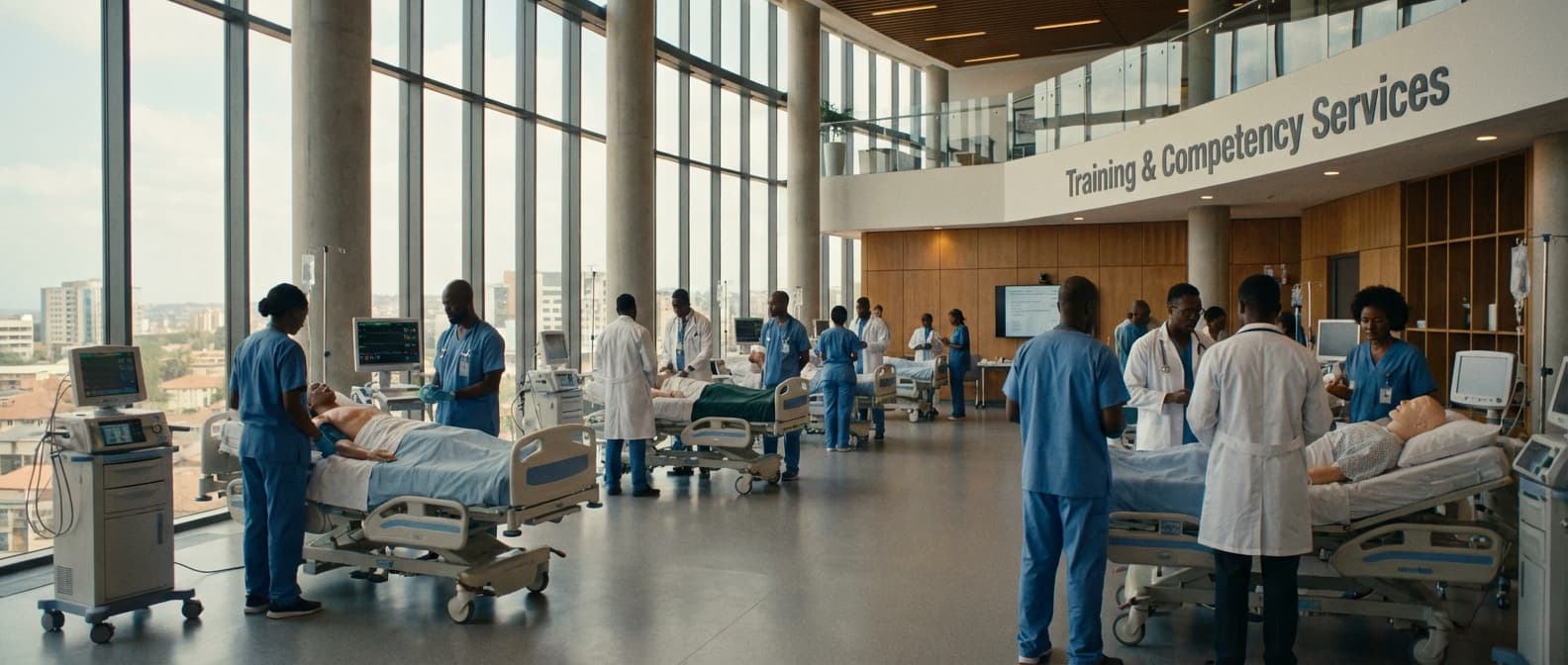
Biomedical Engineering First-Line Support Training Service in Ivory Coast
Engineering Excellence & Technical Support
Biomedical Engineering First-Line Support Training Service High-standard technical execution following OEM protocols and local regulatory frameworks.
Enhanced Network Diagnostics & Troubleshooting
Master rapid identification and resolution of network connectivity issues impacting biomedical equipment. Gain expertise in analyzing network traffic, understanding IP configurations, and implementing effective troubleshooting strategies to minimize downtime and ensure seamless device communication.
Advanced Software & Firmware Update Management
Develop proficiency in deploying, configuring, and verifying software and firmware updates for critical medical devices. Learn best practices for risk assessment, rollback procedures, and documentation to ensure system integrity and regulatory compliance.
Core Biomedical Device Calibration & Performance Verification
Acquire hands-on skills in performing essential calibration and performance verification procedures for a range of biomedical equipment. Understand the principles behind accurate measurements, identify common calibration errors, and document findings meticulously to uphold patient safety and device functionality.
What Is Biomedical Engineering First-line Support Training Service In Ivory Coast?
Biomedical Engineering First-Line Support Training Service in Ivory Coast refers to a specialized training program designed to equip individuals with the foundational knowledge and practical skills necessary to perform initial troubleshooting, basic maintenance, and preliminary diagnostics on biomedical equipment. This service is critical for ensuring the operational readiness and reliability of medical devices within healthcare facilities, thereby contributing to improved patient care and operational efficiency. The training focuses on understanding the principles of operation, identifying common malfunctions, executing standardized diagnostic procedures, and performing minor repairs or component replacements under the guidance of more experienced biomedical engineers or as per manufacturer specifications. It emphasizes safety protocols for handling medical equipment and adherence to relevant regulatory standards.
| Who Needs It | Typical Use Cases |
|---|---|
| Healthcare Professionals (Nurses, Technicians, Laboratory Staff) | Performing routine checks and basic troubleshooting on bedside monitors or lab equipment before escalating to specialized support. |
| Entry-Level Biomedical Technicians | Acquiring foundational skills for immediate deployment in healthcare facilities to manage routine equipment issues. |
| Biomedical Engineering Department Support Staff | Augmenting the primary engineering team by handling a higher volume of less complex equipment problems. |
| Personnel in Remote or Underserved Healthcare Facilities | Empowering local staff to manage and maintain essential medical equipment when specialized engineers are not readily available. |
| Medical Equipment Users in Training | Ensuring end-users understand basic operational checks and reporting procedures to minimize downtime and prevent user-induced errors. |
Key Components of Biomedical Engineering First-Line Support Training
- Introduction to Biomedical Equipment Fundamentals: Principles of operation for common medical devices (e.g., vital signs monitors, ECG machines, basic laboratory equipment).
- Basic Troubleshooting Methodologies: Systematic approaches to identify and diagnose common equipment failures.
- Preventive Maintenance Procedures: Understanding and executing scheduled maintenance tasks to prevent malfunctions.
- Safe Handling and Operation: Protocols for interacting with medical devices, including electrical safety and infection control.
- Documentation and Reporting: Recording maintenance activities, reported issues, and resolutions.
- Introduction to Diagnostic Tools and Test Equipment: Familiarization with basic tools for verification and calibration.
- Basic Repair and Component Replacement: Guidelines for simple repairs and replacement of user-replaceable parts.
- Regulatory Compliance Overview: Awareness of relevant national and international standards governing medical devices.
Who Needs Biomedical Engineering First-line Support Training Service In Ivory Coast?
This document outlines the critical need for Biomedical Engineering First-Line Support Training Services in Ivory Coast. Such training is essential for a range of healthcare facilities and professionals tasked with the maintenance, troubleshooting, and basic repair of medical equipment. Effective first-line support ensures optimal equipment functionality, minimizes downtime, and contributes to improved patient care and safety. The target customers are diverse, encompassing both public and private healthcare providers, as well as institutions involved in medical technology. Key departments within these organizations that would benefit immensely from this training include biomedical engineering departments, clinical engineering, and directly, the medical staff who rely on the equipment's functionality.
| Target Customer Group | Key Departments Benefiting from Training | ||||||||||||
|---|---|---|---|---|---|---|---|---|---|---|---|---|---|
| Public Healthcare Institutions | Biomedical Engineering Department, Clinical Engineering Unit, Departmental Technicians, Nursing and Medical Staff (basic equipment operation and reporting) | Private Healthcare Institutions | Biomedical Engineering Department, In-house Technical Staff, Clinical Staff (basic troubleshooting and reporting) | Specialized Medical Centers | Biomedical Engineering Staff, Technicians responsible for specific modalities (e.g., radiology, cardiology) | Missions and NGO-operated Facilities | Designated Technical Personnel, Clinical Coordinators, Healthcare Workers | Medical Equipment Distributors/Service Providers | Field Service Technicians, Technical Support Staff, Customer Service Representatives | Government Health Ministries/Agencies | Technical Departments, Training and Capacity Building Units, Regulatory Affairs | Medical Training Institutions | Biomedical Engineering Faculty, Technical Instructors, Student Interns |
Target Customers for Biomedical Engineering First-Line Support Training Service in Ivory Coast
- Public Hospitals and Clinics (National, Regional, and District Level)
- Private Hospitals and Clinics
- Specialized Medical Centers (e.g., diagnostic imaging centers, cardiac units, dialysis centers)
- Missions and NGO-operated Healthcare Facilities
- Medical Equipment Distributors and Service Providers (for enhancing their local support capabilities)
- Government Health Ministries and Agencies (for capacity building and regulatory oversight)
- Medical Training Institutions and Universities (to integrate practical skills into their curricula)
Biomedical Engineering First-line Support Training Service Process In Ivory Coast
This document outlines the Biomedical Engineering First-Line Support Training Service Process in Ivory Coast, detailing the workflow from initial inquiry to the successful execution of training services. The process is designed to be efficient, transparent, and responsive to the needs of healthcare institutions and biomedical professionals.
| Stage | Description | Key Activities | Responsible Party | Deliverables/Outcomes |
|---|---|---|---|---|
| The initial point of contact where a client expresses interest in first-line biomedical engineering support training. | Receive and acknowledge inquiry; understand client's specific training needs (equipment types, skill gaps, number of participants); gather information on existing infrastructure and constraints. | Client/Healthcare Institution, Training Service Provider | Initial understanding of training requirements; list of potential training topics and target audience. |
| Based on the needs assessment, a detailed proposal outlining the training solution is prepared and presented. | Develop a comprehensive training proposal including scope of work, curriculum, duration, trainer profiles, methodology, proposed dates, and cost; submit proposal to the client for review. | Training Service Provider | Formal training proposal; detailed quotation. |
| Formalization of the training service agreement between the provider and the client. | Discuss and negotiate terms and conditions of the proposal (pricing, payment schedule, cancellation policy, intellectual property); finalize and sign the service contract. | Client/Healthcare Institution, Training Service Provider | Signed service contract/agreement. |
| Tailoring the training content and methodology to the specific needs identified. | Develop or adapt training modules; create practical exercises and case studies; select appropriate training materials (manuals, presentations, simulators); confirm training schedule and logistics. | Training Service Provider (Instructional Designers, Subject Matter Experts) | Customized training curriculum and materials; confirmed training schedule and location. |
| Ensuring all necessary resources are in place and the training is scheduled effectively. | Assign qualified trainers; book training facilities and equipment; prepare training materials for distribution; confirm participant list and communicate pre-training information. | Training Service Provider | Allocated trainers; confirmed training venue and equipment; distributed pre-training materials. |
| The actual delivery of the training program to the participants. | Conduct theoretical sessions; facilitate practical hands-on sessions on equipment; administer assessments (quizzes, practical evaluations); provide on-the-spot feedback and support. | Assigned Trainers, Participants | Completed training sessions; participant engagement and learning progress. |
| Providing ongoing assistance and assessing the effectiveness of the training. | Offer post-training Q&A sessions; provide access to training materials and resources; collect participant feedback through surveys; assess knowledge retention and skill application (if applicable). | Training Service Provider, Participants | Participant feedback reports; post-training support documentation; training effectiveness assessment. |
| Concluding the training service and documenting the overall experience. | Issue training certificates to participants; prepare a final training report detailing outcomes and recommendations; conduct a debriefing with the client; solicit final feedback for continuous improvement. | Training Service Provider, Client/Healthcare Institution | Training certificates; final training report; client satisfaction feedback. |
Key Stages of the Training Service Process
- Inquiry and Needs Assessment
- Proposal Development and Submission
- Contract Negotiation and Agreement
- Training Program Design and Customization
- Resource Allocation and Scheduling
- Training Delivery and Execution
- Post-Training Support and Evaluation
- Service Closure and Feedback
Biomedical Engineering First-line Support Training Service Cost In Ivory Coast
Biomedical Engineering First-Line Support Training is a crucial service for healthcare facilities in Ivory Coast to ensure the proper functioning and maintenance of medical equipment. The cost of such training is influenced by several factors, leading to a range of pricing. These factors include the experience and reputation of the training provider, the duration and depth of the training curriculum, the number of participants, and the inclusion of hands-on practical sessions with specific equipment. Customization of the training to meet the unique needs of a facility also impacts the overall cost. Costs are typically quoted in the local currency, the West African CFA franc (XOF).
| Training Type/Scope | Estimated Cost Range (XOF) | Notes |
|---|---|---|
| Basic Introduction to First-Line Support (e.g., troubleshooting common issues, preventive maintenance awareness for a few equipment types) | 150,000 - 350,000 | Typically for a 1-2 day session, focusing on general principles. |
| Intermediate First-Line Support (e.g., in-depth troubleshooting, basic repair for specific equipment categories, safety protocols) | 300,000 - 750,000 | Usually a 3-5 day program with more practical exercises. |
| Advanced First-Line Support / Specialized Equipment Training (e.g., hands-on training on high-value or complex medical devices, manufacturer-specific training) | 600,000 - 1,500,000+ | Can range from a few days to a week, often involving specialized instructors and equipment. |
| On-site Training (per day, for a group of 5-10 participants) | 100,000 - 300,000 | This is in addition to the core training content cost and covers travel, accommodation (if applicable), and instructor fees for that day. |
| Customized Training Package (tailored curriculum) | Negotiable, generally higher than standard packages | Price depends on the extent of customization and specific requirements. |
Key Pricing Factors for Biomedical Engineering First-Line Support Training in Ivory Coast:
- Training Provider's Expertise and Reputation
- Training Duration and Curriculum Complexity
- Number of Participants
- Inclusion of Practical/Hands-on Sessions
- Customization of Training Content
- Location and Logistics (if conducted on-site at the client's facility)
- Accreditation and Certification (if applicable)
Affordable Biomedical Engineering First-line Support Training Service Options
This document outlines affordable first-line support training service options for biomedical engineering departments, emphasizing value bundles and cost-saving strategies. Effective first-line support is crucial for minimizing equipment downtime, ensuring patient safety, and optimizing resource allocation. Investing in well-trained technicians can significantly reduce reliance on expensive external service contracts and speed up issue resolution.
| Service Option | Description | Value Bundle Components | Estimated Cost Savings Strategy | Typical Cost Range (per technician) |
|---|---|---|---|---|
| On-Demand Online Modules | Self-paced, interactive online courses accessible anytime, anywhere. | Core curriculum modules, knowledge checks, downloadable guides. | Reduces travel and instructor fees, allows for staggered training. | $150 - $400 |
| Blended Learning Packages | Combines online modules with live virtual or in-person workshops. | Online modules + scheduled virtual Q&A sessions or 1-day workshops. | Balances flexibility with practical, hands-on experience, reducing workshop duration. | $300 - $800 |
| Group Training Workshops (In-house/External) | Instructor-led sessions, either at your facility or a training center. | Comprehensive curriculum, practical exercises, certification opportunities. | Bulk discounts for multiple attendees, reduces individual travel costs if held internally. | $500 - $1,500 (per participant, depending on duration and customization) |
| Train-the-Trainer Programs | Equips experienced biomedical staff to train new team members internally. | Advanced module content, teaching methodologies, curriculum development resources. | Leverages internal expertise for long-term, scalable training, significant cost reduction over time. | $800 - $2,000 (per trainer) |
| Device-Specific Certification Programs | Focused training on specific high-use or high-cost medical equipment manufacturers. | Manufacturer-approved curriculum, hands-on practice on actual equipment (may require collaboration with vendors). | Reduces reliance on OEM service calls for common issues, speeds up repair times. | Varies widely by vendor and device complexity ($500 - $5,000+) |
Key Areas Covered in First-Line Support Training
- Basic troubleshooting and diagnostics of common medical devices (e.g., vital signs monitors, infusion pumps).
- Preventive maintenance procedures and scheduling.
- Safe handling and operation of medical equipment.
- Understanding of essential electrical safety principles.
- Basic software updates and configuration for medical devices.
- Documentation and reporting of support activities.
- Introduction to regulatory compliance relevant to medical equipment.
- Effective communication skills with clinical staff.
Verified Providers In Ivory Coast
In the Ivory Coast's burgeoning healthcare landscape, discerning patients seek trusted and accredited medical partners. Franance Health stands out as a beacon of reliability, offering a network of verified providers who embody excellence in patient care, ethical practices, and adherence to international standards. Their rigorous credentialing process ensures that every affiliated clinic and hospital has met stringent criteria, from state-of-the-art facilities and advanced equipment to highly qualified medical professionals and transparent billing. Choosing a Franance Health verified provider means opting for peace of mind, knowing you are receiving care from institutions committed to your well-being and safety. This commitment translates into superior diagnostic accuracy, effective treatment plans, and a consistently positive patient experience, making Franance Health providers the optimal choice for your healthcare needs in Ivory Coast.
| Category | Franance Health Verification Standard | Patient Benefit |
|---|---|---|
| Medical Staff | Verification of licenses, certifications, and specialized training. | Access to expert and experienced healthcare professionals. |
| Facilities & Equipment | Assessment of infrastructure, technology, and maintenance protocols. | Accurate diagnostics and advanced treatment options. |
| Patient Care | Review of patient safety measures, privacy policies, and complaint resolution. | Safe, respectful, and effective treatment experience. |
| Ethical Practices | Confirmation of adherence to medical ethics and legal regulations. | Trustworthy and transparent healthcare services. |
| Quality Management | Evaluation of ongoing quality improvement initiatives and performance monitoring. | Consistently high standards of care and service. |
Key Credentials of Franance Health Verified Providers
- Accreditation by recognized national and international health bodies.
- Demonstrated commitment to patient safety and infection control protocols.
- Possession of state-of-the-art medical equipment and technology.
- Staffed by highly qualified and licensed medical professionals with continuous training.
- Adherence to ethical medical practices and patient rights.
- Transparent and fair billing practices.
- Positive patient testimonials and satisfaction rates.
- Robust quality assurance and continuous improvement programs.
Scope Of Work For Biomedical Engineering First-line Support Training Service
This Scope of Work (SOW) outlines the requirements for a Biomedical Engineering First-Line Support Training Service. The objective is to equip support personnel with the foundational knowledge and practical skills necessary to effectively troubleshoot and resolve common issues with biomedical devices, thereby improving device uptime, patient safety, and overall healthcare facility efficiency. This document details the technical deliverables, standard specifications, and training methodology.
| Deliverable | Description | Standard Specification / Format | Acceptance Criteria |
|---|---|---|---|
| Curriculum Development | Comprehensive training curriculum covering core biomedical engineering first-line support topics. | Modular format, including theoretical modules, practical exercises, case studies, and assessments. Delivered in editable digital format (e.g., Word, PDF, SCORM compliant). | Curriculum aligns with stated training objectives. Content is accurate, up-to-date, and relevant to common biomedical devices used in healthcare settings. |
| Training Materials | All necessary training materials for trainees and instructors. | Participant workbooks, instructor guides, presentation slides, reference manuals, cheat sheets, and simulation exercises. Delivered digitally. | Materials are clear, concise, well-organized, and directly support the curriculum. Easily accessible and printable. |
| Hands-on Training Sessions | Practical, instructor-led training sessions utilizing actual or simulated biomedical devices. | Minimum of X hours of hands-on training per trainee. Sessions conducted in a controlled environment with appropriate safety measures. Devices should represent a diverse range of commonly used equipment (e.g., patient monitors, infusion pumps, ECG machines). | Trainees demonstrate proficiency in performing diagnostic and troubleshooting procedures on simulated or actual equipment. Successful completion of practical assessments and simulations. |
| Competency Assessments | Formal assessments to evaluate trainee comprehension and skill acquisition. | Includes written/online quizzes, practical skill demonstrations, and scenario-based troubleshooting exercises. Passing score of X% for each assessment component. | Trainees achieve the minimum passing score on all assessment components. Demonstrable understanding of theoretical concepts and practical application of skills. |
| Post-Training Support | Limited period of support for trainees after the formal training concludes. | Access to a dedicated support channel (e.g., email, forum) for X weeks to address follow-up questions. Facilitation of knowledge sharing and peer support. | Timely responses to trainee inquiries. Positive feedback from trainees regarding the usefulness of post-training support. |
| Training Report | Comprehensive report detailing the training program's execution and outcomes. | Includes participant attendance records, assessment results, feedback summaries, and recommendations for future training. Delivered in PDF format. | Report is accurate, complete, and provides actionable insights into the effectiveness of the training program. |
| Device Specific Modules (Optional but Recommended) | Specialized modules focusing on high-priority or complex biomedical devices. | Tailored curriculum and hands-on sessions for specific device families (e.g., ventilators, anesthesia machines). | Trainees demonstrate advanced troubleshooting capabilities for specified device types. |
Training Objectives
- Understand fundamental principles of biomedical device operation and safety.
- Identify and categorize common hardware and software issues.
- Perform basic diagnostic procedures and troubleshooting steps.
- Execute standard maintenance and calibration tasks.
- Apply proper documentation and escalation protocols.
- Adhere to relevant regulatory standards and facility policies.
- Develop effective communication skills for interacting with clinical staff and senior engineers.
Service Level Agreement For Biomedical Engineering First-line Support Training Service
This Service Level Agreement (SLA) outlines the response times and uptime guarantees for the Biomedical Engineering First-Line Support Training Service. This agreement is designed to ensure prompt and effective support for trainees and instructors utilizing the training platform and resources.
| Severity Level | Response Time Target | Resolution Time Target | Uptime Guarantee |
|---|---|---|---|
| Severity Level 1 (Critical) | 15 minutes | 4 hours | 99.5% |
| Severity Level 2 (High) | 30 minutes | 8 business hours | 99.5% |
| Severity Level 3 (Medium) | 2 business hours | 3 business days | 99.8% |
| Severity Level 4 (Low) | 4 business hours | 5 business days | 99.9% |
Key Definitions
- Service: Biomedical Engineering First-Line Support Training Service, encompassing access to the training platform, simulation tools, virtual labs, and initial technical support for platform-related issues.
- Trainee: Any individual enrolled in a biomedical engineering first-line support training program and utilizing the Service.
- Instructor: Any individual providing training and utilizing the Service.
- Incident: Any event that causes, or may cause, an interruption to or a reduction in the quality of the Service. This includes platform unavailability, functional errors, or inability to access training materials.
- Severity Level 1 (Critical): Service is completely unavailable or a critical function is non-operational, preventing all users from performing core training activities.
- Severity Level 2 (High): A significant function of the Service is unavailable or degraded, impacting a large number of users or preventing core training activities for a substantial portion of users.
- Severity Level 3 (Medium): A non-critical function of the Service is unavailable or degraded, causing inconvenience or minor disruption to training activities.
- Severity Level 4 (Low): Minor issue with no significant impact on training activities, such as cosmetic errors or documentation inaccuracies.
- Response Time: The maximum time allowed from the reported incident to the first acknowledgment and assessment by the support team.
- Resolution Time: The maximum time allowed from the reported incident to the successful resolution or implementation of a workaround for the incident.
- Uptime: The percentage of time the Service is available and operational, excluding scheduled maintenance.
Frequently Asked Questions

Ready when you are
Let's scope your Biomedical Engineering First-Line Support Training Service in Ivory Coast project in Ivory Coast.

Scaling healthcare logistics and technical systems across the entire continent.