
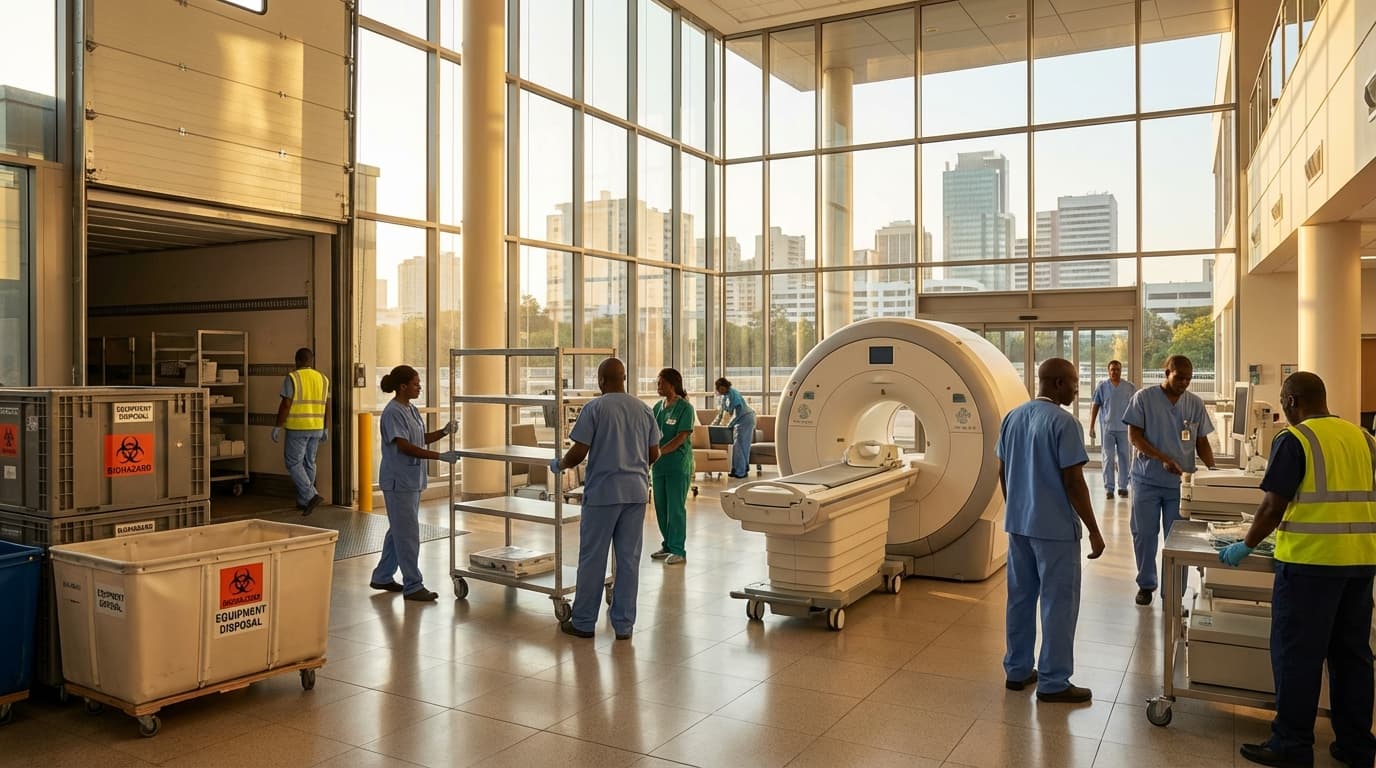
Heavy Medical Equipment De-Installation Service (MRI/CT/Cath Lab) in Ivory Coast
Engineering Excellence & Technical Support
Heavy Medical Equipment De-Installation Service (MRI/CT/Cath Lab) High-standard technical execution following OEM protocols and local regulatory frameworks.
Expert MRI/CT/Cath Lab De-Installation
Our certified technicians possess specialized expertise in the safe and meticulous de-installation of high-field MRI, CT scanners, and Cath Labs. We adhere to stringent international safety protocols and manufacturer guidelines, ensuring zero risk to your valuable medical imaging equipment and facility infrastructure in Ivory Coast.
Secure Logistics & Transportation Management
We provide comprehensive logistics management, including secure packaging, specialized transport, and coordination of customs clearance for your de-installed medical equipment within Ivory Coast and for international export. Our robust network ensures timely and damage-free delivery to your next destination.
Compliance & Regulatory Adherence
Navigating the complexities of medical equipment de-installation requires strict adherence to local and international regulations. We guarantee full compliance with Ivorian health and safety standards, environmental regulations, and industry best practices, ensuring a smooth and legally sound de-installation process for your facility.
What Is Heavy Medical Equipment De-installation Service (Mri/ct/cath Lab) In Ivory Coast?
Heavy medical equipment de-installation service (MRI/CT/Cath Lab) in Ivory Coast refers to the specialized process of safely and meticulously dismantling, disconnecting, and preparing large-scale, high-value medical imaging and interventional equipment for relocation, disposal, or long-term storage. This service is critical for healthcare facilities undergoing renovations, upgrades, equipment replacement, or closure, ensuring that sensitive and complex machinery is handled by trained professionals to prevent damage, ensure safety, and comply with regulatory requirements. The objective is to return the equipment to a transportable state while preserving its operational integrity for potential reinstallation or resale.
| Who Needs This Service? | Typical Use Cases | ||||||
|---|---|---|---|---|---|---|---|
| Hospitals and Clinics: Both public and private healthcare institutions. | Infrastructure Upgrades: When a facility is undergoing renovations or expansions that require the temporary or permanent removal of medical equipment. | Equipment Replacement: Replacing older or outdated MRI, CT, or Cath Lab systems with newer models. | Relocation: Moving a healthcare facility to a new location or transferring equipment between sites. | Closure or Downsizing: When a healthcare facility ceases operations or reduces its service offerings. | Equipment Repurposing or Resale: Preparing equipment for sale on the secondary market or for donation. | Manufacturers and Service Providers: Companies that sell, service, or refurbish heavy medical equipment. | Equipment Leasing Companies: For the return of leased high-value medical machinery at the end of a contract term. |
Key Aspects of Heavy Medical Equipment De-Installation Service:
- Site Assessment and Planning: Comprehensive evaluation of the equipment's installation environment, including structural limitations, access routes, power requirements, and existing infrastructure. Development of a detailed de-installation plan.
- System Disconnection and Isolation: Expert disconnection of all power, data, cooling, and ancillary systems. This includes high-voltage electrical systems, cryogenic lines (for MRI), and pneumatic or hydraulic systems.
- Component Disassembly: Gradual and systematic dismantling of the equipment into manageable components. This may involve the removal of gantry sections, superconducting magnets, patient tables, control consoles, and other modular parts.
- Securing and Packaging: Proper securing of components to prevent movement during transit. Use of specialized padding, bracing, and protective packaging materials to safeguard against shock and vibration.
- Logistics and Transportation Coordination: Planning and management of transportation, including coordination with specialized heavy-haulage providers, route surveys, and necessary permits.
- Waste Management and Disposal: Environmentally responsible handling and disposal of any ancillary materials, coolants, or components that are no longer serviceable.
- Documentation and Certification: Provision of detailed documentation of the de-installation process, including photographic records and sign-offs, to ensure accountability and facilitate future reinstallation.
- Safety and Compliance: Adherence to all relevant national and international safety standards, environmental regulations, and manufacturer guidelines throughout the de-installation process.
Who Needs Heavy Medical Equipment De-installation Service (Mri/ct/cath Lab) In Ivory Coast?
Heavy medical equipment like MRI, CT scanners, and Cath Labs are complex and expensive assets that require specialized handling for de-installation. This service is crucial for various entities in Ivory Coast undertaking significant upgrades, relocations, or closures of medical facilities. Proper de-installation ensures the equipment remains functional for future use, minimizes damage, and complies with safety regulations. It also frees up valuable space and allows for the seamless transition to new technologies or facilities.
| Customer Type | Primary Need for De-installation | Relevant Departments |
|---|---|---|
| Hospitals (Public & Private) | Renovations, Upgrades, Relocations, Closures | Radiology, Cardiology, Surgery, Imaging Departments, Facilities Management |
| Specialized Medical Centers | Equipment Refresh, Capacity Expansion, Service Consolidation | Cardiology, Neurology, Oncology, Advanced Imaging Centers |
| Government Health Ministries & Agencies | Infrastructure Upgrades, Inter-facility Transfers, Decommissioning | Public Health, Hospital Administration, Procurement Departments |
| Medical Equipment Manufacturers & Distributors | New Equipment Delivery, Old Equipment Removal (Resale/Refurbishment), Client Transitions | Service & Support, Logistics, Sales Departments |
| Healthcare Real Estate Developers & Facility Managers | New Construction, Renovation of Medical Spaces | Project Management, Facilities Management, Construction Departments |
| Insurance Companies & Asset Management Firms | Facility Closure, Bankruptcy, Asset Recovery, Insurance Claims | Claims Department, Asset Valuation, Liquidation Teams |
| Research Institutions & Universities | Lab Repurposing, Department Relocation, Equipment Upgrades | Research Departments, Biomedical Engineering, Facilities Management |
Target Customers & Departments in Ivory Coast Requiring Heavy Medical Equipment De-Installation Service
- Hospitals (Public & Private): The primary consumers of these advanced imaging and diagnostic technologies. De-installation is needed during renovations, upgrades to newer models, or when a hospital is undergoing structural changes or relocation.
- Specialized Medical Centers: Facilities focusing on cardiology, neurology, oncology, or advanced diagnostics will frequently have Cath Labs, MRI, and CT scanners. De-installation is critical for equipment refreshes, capacity expansion, or consolidation of services.
- Government Health Ministries & Agencies: When national health initiatives involve upgrading public healthcare infrastructure or relocating equipment between government-run facilities. This also applies to decommissioning outdated equipment from public hospitals.
- Medical Equipment Manufacturers & Distributors: Companies that sell, service, or relocate these high-value machines. They require de-installation expertise when delivering new equipment, removing old units for refurbishment or resale, or managing client transitions.
- Healthcare Real Estate Developers & Facility Managers: For new hospital constructions or the renovation of existing medical spaces, de-installation of old equipment is a necessary precursor to redevelopment. They need to manage the removal of outdated systems to make way for new installations.
- Insurance Companies & Asset Management Firms: In cases of facility closure, bankruptcy, or insurance claims involving medical equipment, de-installation services are required to secure, appraise, or remove the assets.
- Research Institutions & Universities with Medical Programs: Facilities conducting advanced medical research or training medical professionals often possess these specialized machines. De-installation might be needed for upgrades, repurposing of labs, or relocation of research departments.
Heavy Medical Equipment De-installation Service (Mri/ct/cath Lab) Process In Ivory Coast
This document outlines the comprehensive workflow for our Heavy Medical Equipment De-Installation Service (MRI/CT/Cath Lab) in Ivory Coast. We aim to provide a seamless and efficient process from initial inquiry to the successful completion of the de-installation, ensuring minimal disruption to your operations and the safe handling of sensitive, high-value equipment.
| Phase | Step | Description | Key Activities | Deliverables/Outcomes |
|---|---|---|---|---|
| 1. Initial Inquiry & Consultation | 1.1 Inquiry Receipt | The process begins with an incoming request for de-installation services. | Receive inquiry via phone, email, or online form. Initial contact to understand basic requirements. | Confirmation of inquiry receipt. Basic understanding of equipment type, location, and desired timeline. |
| 1.2 Preliminary Consultation | A detailed discussion to gather essential information and assess feasibility. | In-depth discussion on equipment model, manufacturer, current installation status, reason for de-installation (e.g., relocation, upgrade, disposal), and desired timeline. Provide preliminary quotation based on information provided. | Clarified project scope. Initial feasibility assessment. Preliminary quotation provided. | |
| 2. Site Assessment & Planning | 2.1 Site Visit & Technical Survey | On-site evaluation of the equipment and its surroundings. | Our specialized technical team visits the site in Ivory Coast to physically inspect the equipment, surrounding infrastructure, access routes, power supply, ventilation, and any potential challenges. Detailed measurements are taken. | Comprehensive site assessment report. Identification of any logistical or technical constraints. Accurate measurement data. |
| 2.2 De-Installation Plan Development | Creation of a detailed, step-by-step plan tailored to the specific equipment and site. | Based on the site assessment, a meticulous de-installation plan is formulated. This includes disassembly procedures, required tools and equipment, safety protocols, personnel allocation, and a detailed timeline. | Approved de-installation plan. Risk assessment and mitigation strategies outlined. | |
| 2.3 Quotation Finalization & Agreement | Presentation of a final, comprehensive quotation and contract. | A detailed and finalized quotation is presented, outlining all costs associated with the de-installation. Upon agreement, a formal service contract is signed. | Finalized and signed service contract. Confirmation of project commencement. | |
| 3. Pre-De-Installation Preparations | 3.1 Permitting & Approvals | Securing necessary permissions for the de-installation work. | Assist in obtaining any required local permits or regulatory approvals from relevant authorities in Ivory Coast. | All necessary permits and approvals secured. |
| 3.2 Logistics & Transportation Arrangement | Planning and arranging for the safe transport of the de-installed equipment. | Coordinate specialized transportation vehicles, packaging materials, and logistics for moving the de-installed equipment to its new location or designated storage/disposal facility. | Logistics plan confirmed. Transportation arranged and booked. | |
| 3.3 Personnel & Equipment Mobilization | Assembling and dispatching the specialized de-installation team and equipment. | Mobilize our certified technicians, engineers, and support staff to the site in Ivory Coast. Ensure all specialized tools, lifting equipment, and safety gear are on-site. | De-installation team and equipment on-site and ready. | |
| 4. De-Installation Execution | 4.1 Site Safety Briefing | Ensuring all personnel are aware of and adhere to safety protocols. | Conduct a pre-work safety briefing with the entire team to review the de-installation plan, potential hazards, and emergency procedures. | All personnel briefed on safety protocols. Safe work environment established. |
| 4.2 Equipment De-Energization & Shutdown | Safely disconnecting power and bringing the equipment to a complete shutdown state. | Following manufacturer guidelines and established safety procedures, safely disconnect power and auxiliary systems to render the equipment inert. | Equipment confirmed as de-energized and safe for disassembly. | |
| 4.3 Controlled Disassembly | Expertly dismantling the medical equipment. | Our skilled technicians meticulously follow the de-installation plan to carefully dismantle the MRI, CT scanner, or Cath Lab system component by component, ensuring no damage to sensitive parts. | Equipment components safely disassembled and categorized. | |
| 4.4 Component Packaging & Labeling | Preparing disassembled parts for transport. | Each component is individually inspected, cleaned (if necessary), carefully packaged using appropriate protective materials, and clearly labeled for identification and reassembly. | All components securely packaged and labeled. | |
| 4.5 Site Restoration (Optional) | Returning the de-installation area to its previous state. | If agreed upon, we will clear the de-installation area, remove debris, and restore the site to its pre-installation condition. | De-installation area cleared and restored. | |
| 5. Post-De-Installation & Handover | 5.1 Final Site Inspection | Ensuring the site is clear and all work is completed. | A final walkthrough of the de-installation site to confirm all work is completed as per the plan and the site is clean. | Site cleared and ready for handover. |
| 5.2 Equipment Loading & Transportation | Supervising the loading of equipment onto transport vehicles. | Oversee the safe and secure loading of all packaged components onto the arranged transportation, ensuring proper weight distribution and securing of the load. | Equipment safely loaded and secured for transit. | |
| 5.3 Documentation & Handover | Providing all relevant documentation and completing the handover process. | Provide a final report detailing the de-installation process, including photos, any encountered issues, and a manifest of all de-installed components. Formal handover of the de-installed equipment to the client or designated party. | De-installation completion report. Equipment handover confirmed. Sign-off on services rendered. | |
| 5.4 Invoicing & Payment | Processing of the final invoice and settlement of payment. | Issue final invoice based on the agreed contract. Process payment according to the agreed terms. | Invoicing completed. Payment settled. |
De-Installation Workflow: Inquiry to Execution
- Phase 1: Initial Inquiry & Consultation
- Phase 2: Site Assessment & Planning
- Phase 3: Pre-De-Installation Preparations
- Phase 4: De-Installation Execution
- Phase 5: Post-De-Installation & Handover
Heavy Medical Equipment De-installation Service (Mri/ct/cath Lab) Cost In Ivory Coast
The cost of de-installing heavy medical equipment such as MRI, CT scanners, and Cath Labs in Ivory Coast is a complex process influenced by several key factors. These factors collectively determine the overall pricing, which can vary significantly. The service involves highly specialized technicians, intricate procedures to ensure equipment integrity, and logistical challenges specific to the African continent. Understanding these elements is crucial for accurate budgeting. The pricing is typically quoted in local currency, the West African CFA franc (XOF).
| Equipment Type | Estimated Cost Range (XOF) | Notes |
|---|---|---|
| CT Scanner (Mid-Range) | 1,500,000 - 3,500,000 | Includes basic de-installation, disconnection, and preparation for transport. Excludes complex site challenges or long-distance logistics. |
| MRI Scanner (Mid-Range) | 2,500,000 - 6,000,000 | Higher cost due to magnet handling and complex safety procedures. Range depends heavily on magnet strength and system complexity. |
| Cath Lab (Basic System) | 2,000,000 - 4,500,000 | Covers standard de-installation. Advanced systems with multiple components and integrated imaging will be at the higher end. |
| MRI Scanner (High-End/Large Bore) | 5,000,000 - 10,000,000+ | Significant increase for larger, more powerful, or specialized MRI systems. May involve specialized heavy lifting and extended downtime. |
| Cath Lab (Advanced/Hybrid) | 4,000,000 - 8,000,000+ | Complex, integrated systems with robotics or advanced imaging will command higher de-installation costs. |
| Preparation for International Shipping | 500,000 - 1,500,000 (additional) | Cost for professional crating, packaging, and ensuring compliance with international transport regulations. This is often a separate line item. |
Key Pricing Factors for Medical Equipment De-Installation in Ivory Coast
- {"title":"Equipment Type and Complexity","description":"The specific type of equipment (MRI, CT, Cath Lab) dictates the complexity and therefore the cost. MRI machines, with their powerful magnets, require more specialized handling and safety precautions than CT scanners. Cath Labs, involving intricate plumbing and electrical systems, also add to the complexity."}
- {"title":"Size and Weight of Equipment","description":"Larger and heavier units necessitate more robust lifting equipment, specialized transport vehicles, and a larger team of technicians, all of which contribute to higher costs."}
- {"title":"Dismantling and Reassembly Scope","description":"Whether the service includes partial dismantling for transport or complete de-installation down to its core components impacts the labor hours and expertise required. Some clients may require basic disconnection, while others need a full breakdown for long-distance shipping."}
- {"title":"Site Conditions and Accessibility","description":"The physical location of the equipment within the hospital or clinic, including narrow corridors, staircases, or the need for specialized access routes, can significantly increase the time and effort involved, thus affecting the price. Ease of access for cranes or specialized transport is also a factor."}
- {"title":"Technical Expertise and Certification","description":"The level of training, experience, and specific certifications of the de-installation team is paramount. Highly skilled technicians familiar with the specific manufacturers' protocols will command higher rates."}
- {"title":"Logistics and Transportation","description":"The distance to the new location, the required transportation methods (e.g., road, sea), and any necessary permits or customs clearance will be factored into the overall cost. International shipping adds further layers of expense."}
- {"title":"Downtime and Scheduling","description":"Urgency or specific scheduling requirements that necessitate working outside standard hours or during peak hospital operational times can lead to premium charges."}
- {"title":"Ancillary Services","description":"Additional services such as packaging, crating, temporary storage, or commissioning at the new site will incur extra costs."}
- {"title":"Manufacturer vs. Third-Party Service Provider","description":"De-installation services provided directly by the equipment manufacturer are often more expensive than those offered by specialized third-party medical equipment service companies."}
Affordable Heavy Medical Equipment De-installation Service (Mri/ct/cath Lab) Options
Specializing in the safe and efficient de-installation of heavy medical equipment such as MRI, CT scanners, and Cath Labs. We offer affordable solutions designed to minimize downtime and your overall project costs. Our services are tailored to meet the specific needs of hospitals, imaging centers, and medical facilities undergoing renovations, relocations, or equipment upgrades. We understand the critical nature of these procedures and prioritize precision, safety, and cost-effectiveness.
| Value Bundle | Key Features | Cost-Saving Benefit |
|---|---|---|
| 'Essential De-install' Package | Standard de-installation of one major equipment unit (MRI, CT, or Cath Lab). Includes basic dismantling, disconnection from utilities, and securing for transport. | Ideal for straightforward de-installations, offering competitive base pricing. |
| 'Complete Project' Bundle | Includes 'Essential De-install' plus advanced project management, coordination with your chosen transport/rigging, and detailed site preparation assessment. | Reduces internal management overhead, streamlines logistics, and potentially secures volume discounts through coordinated efforts. |
| 'Relocation Ready' Package | Combines 'Complete Project' with pre-de-installation site survey for the new location, preliminary rigging pathway assessment, and secure packaging for transit. | Minimizes unforeseen issues at the destination, preventing costly delays and additional on-site modifications. |
| 'Decommission & Prep' Bundle | Focuses on preparing equipment for permanent decommissioning or sale. Includes full de-installation, thorough cleaning, and detailed condition reporting. | Maximizes resale value by presenting equipment in optimal condition and provides essential documentation for asset management. |
Our Value-Added Services & Cost-Saving Strategies:
- Comprehensive De-installation Expertise: Our certified technicians have extensive experience with all major brands and models of MRI, CT, and Cath Lab equipment, ensuring a smooth and compliant removal process.
- Strategic Planning & Project Management: We work closely with your team to develop a detailed de-installation plan, minimizing disruption to your operations and identifying potential cost savings early on.
- Risk Mitigation & Safety Protocols: Adherence to strict safety standards protects your staff, our team, and your facility, preventing costly accidents or damage.
- Efficient Dismantling & Packaging: Optimized techniques reduce the time and resources required for de-installation and preparation for transport.
- Flexible Scheduling: We offer adaptable scheduling options to accommodate your operational needs and minimize downtime.
- Coordination with Third Parties: Seamless collaboration with riggers, transport companies, and your chosen decommissioning or disposal partners.
- Documentation & Compliance: Provision of all necessary documentation for regulatory compliance and your records.
- Transparent Pricing & No Hidden Fees: Clear and upfront cost breakdowns ensure budget predictability.
Verified Providers In Ivory Coast
In the pursuit of quality healthcare, identifying verified providers is paramount. In Ivory Coast, understanding which entities offer credible and reliable medical services ensures patients receive the best possible care. Franance Health stands out as a premier example of such a verified provider, distinguished by its rigorous credentialing process and unwavering commitment to excellence. This dedication to verification not only builds trust but also signifies a higher standard of medical practice, patient safety, and ethical conduct.
| Credentialing Aspect | Franance Health Verification Standard | Patient Benefit |
|---|---|---|
| Professional Licensing | Mandatory validation of current and active medical licenses. | Ensures practitioners are legally qualified and competent. |
| Specialty Certifications | Verification of recognized board certifications in relevant medical fields. | Guarantees specialized knowledge and advanced expertise. |
| Quality Assurance Protocols | Assessment of institutional adherence to quality improvement measures. | Promotes consistent, high-quality patient care and safety. |
| Malpractice History Review | Thorough checks for any history of professional misconduct or malpractice claims. | Minimizes risk and ensures accountability. |
| Continuing Medical Education (CME) | Confirmation of active participation in ongoing professional development. | Ensures providers stay updated with the latest medical advancements. |
Why Franance Health Credentials Represent the Best Choice:
- Rigorous Accreditation: Franance Health partners with facilities and professionals who undergo stringent accreditation processes, ensuring they meet national and international standards for quality and safety.
- Skilled and Certified Professionals: All healthcare providers associated with Franance Health are carefully vetted, holding valid licenses and certifications, and demonstrating a consistent record of expertise.
- Patient-Centric Approach: Verification through Franance Health implies a commitment to patient well-being, emphasizing compassionate care, clear communication, and personalized treatment plans.
- Adherence to Ethical Standards: Franance Health ensures its network upholds the highest ethical principles, including patient confidentiality, informed consent, and transparent billing practices.
- Access to Advanced Technologies: Verified providers are often equipped with modern medical technology and adhere to best practices, leading to more accurate diagnoses and effective treatments.
Scope Of Work For Heavy Medical Equipment De-installation Service (Mri/ct/cath Lab)
This Scope of Work outlines the requirements for the professional de-installation of heavy medical imaging equipment, specifically Magnetic Resonance Imaging (MRI) scanners, Computed Tomography (CT) scanners, and Cardiac Catheterization (Cath Lab) systems. The objective is to safely and efficiently disconnect, dismantle, and prepare these complex systems for relocation or disposal, adhering to industry best practices and manufacturer specifications. The service provider will be responsible for all labor, tools, equipment, and consumables necessary to complete the de-installation process in accordance with the highest safety and quality standards.
| Task | Description | Key Technical Considerations | Standard Specifications/Requirements | Deliverables |
|---|---|---|---|---|
| Pre-De-installation Survey | Conduct a thorough site survey to assess equipment access, facility infrastructure, potential hazards, and necessary safety measures. | Accessibility for large equipment, power availability, ventilation, cooling, structural integrity, room dimensions. | Detailed site report, risk assessment, proposed de-installation plan, equipment inventory. | Comprehensive Site Survey Report, Risk Assessment, De-installation Plan. |
| De-energization and Safety | Safely disconnect all power sources and ensure the equipment is rendered inert and safe for disassembly. | Lockout/Tagout procedures, residual energy discharge (e.g., cryogen venting for MRI), grounding. | Adherence to all relevant electrical safety codes (e.g., NFPA 70E), manufacturer's specific safety protocols. | Verification of de-energization, safety signage in place, confirmation of no residual hazards. |
| Systematic Disassembly | Dismantle the equipment into manageable components according to manufacturer guidelines and safe lifting practices. | Component identification, specialized tools, lifting equipment (cranes, hoists, dollies), packing materials, preservation of sensitive parts. | Manufacturer's service manuals, OEM disassembly procedures, safe working load limits for lifting equipment. | Dismantled components, labeled and organized, photographed at key stages. |
| Cable and Infrastructure Management | Carefully disconnect, label, and secure all associated cabling and interface with facility infrastructure. | Cable identification and labeling, protection from damage, coordination with facility engineers regarding power, data, and cooling lines. | Manufacturer's wiring diagrams, adherence to clean cable management practices, protection of facility outlets and connections. | Labeled and bundled cables, protected interface points, documentation of disconnected infrastructure. |
| Environmental Controls | Maintain appropriate environmental conditions during disassembly to prevent damage to sensitive components. | Temperature, humidity control, dust mitigation, static discharge prevention (especially for sensitive electronics). | Cleanroom standards (if applicable), use of ESD-safe materials, proper ventilation. | Environmentally controlled work area, documented environmental monitoring (if required). |
| Documentation | Record all de-installation steps, component inventory, and any encountered issues. | Photography, detailed notes, component labeling system, creation of a comprehensive de-installation log. | Manufacturer's specifications, chain of custody protocols for critical components. | De-installation logbook, photographic evidence of the process, final component inventory list. |
| Site Handover | Ensure the de-installation area is clean, safe, and ready for the next phase (e.g., relocation, renovation). | Removal of all debris, restoration of the work area, final site inspection with client representative. | Standard cleaning protocols, compliance with facility safety regulations. | Clean and safe work area, signed site handover form. |
Key Stages and Responsibilities
- Pre-De-installation Survey and Planning
- Equipment De-energization and Safety Procedures
- Systematic Component Disassembly
- Cable and Infrastructure Management
- Environmental Controls and Protection
- Documentation and Reporting
- Post-De-installation Site Handover
Service Level Agreement For Heavy Medical Equipment De-installation Service (Mri/ct/cath Lab)
This Service Level Agreement (SLA) outlines the guaranteed response times and uptime for the de-installation of heavy medical equipment, specifically MRI, CT scanners, and Cath Labs. This agreement is between [Your Company Name] ('Service Provider') and [Client Company Name] ('Client').
| Service Type | Severity Level | Response Time (On-Site Arrival) | Guaranteed Commencement of Work (after on-site arrival) | Maximum Downtime/Interruption Window (from scheduled start to completion) |
|---|---|---|---|---|
| MRI De-Installation | Critical (e.g., immediate relocation, site closure) | 4 Business Hours | 1 Business Hour | 48 Business Hours (from commencement) |
| MRI De-Installation | Standard (e.g., planned upgrade, relocation) | 8 Business Hours | 2 Business Hours | 72 Business Hours (from commencement) |
| CT Scanner De-Installation | Critical (e.g., immediate relocation, site closure) | 4 Business Hours | 1 Business Hour | 36 Business Hours (from commencement) |
| CT Scanner De-Installation | Standard (e.g., planned upgrade, relocation) | 8 Business Hours | 2 Business Hours | 48 Business Hours (from commencement) |
| Cath Lab De-Installation | Critical (e.g., immediate relocation, site closure) | 6 Business Hours | 2 Business Hours | 48 Business Hours (from commencement) |
| Cath Lab De-Installation | Standard (e.g., planned upgrade, relocation) | 12 Business Hours | 4 Business Hours | 72 Business Hours (from commencement) |
Service Level Objectives
- Response Time: The time elapsed from the moment a service request is officially logged by the Client and acknowledged by the Service Provider, until a qualified technician is dispatched and has arrived on-site.
- Uptime Guarantee: While de-installation is a singular event and not an ongoing service requiring uptime in the traditional sense, this section will focus on the guaranteed timeframe for the commencement and completion of the de-installation process once scheduled and confirmed, ensuring minimal disruption to the Client's operational planning.
Frequently Asked Questions

Ready when you are
Let's scope your Heavy Medical Equipment De-Installation Service (MRI/CT/Cath Lab) in Ivory Coast project in Ivory Coast.

Scaling healthcare logistics and technical systems across the entire continent.