
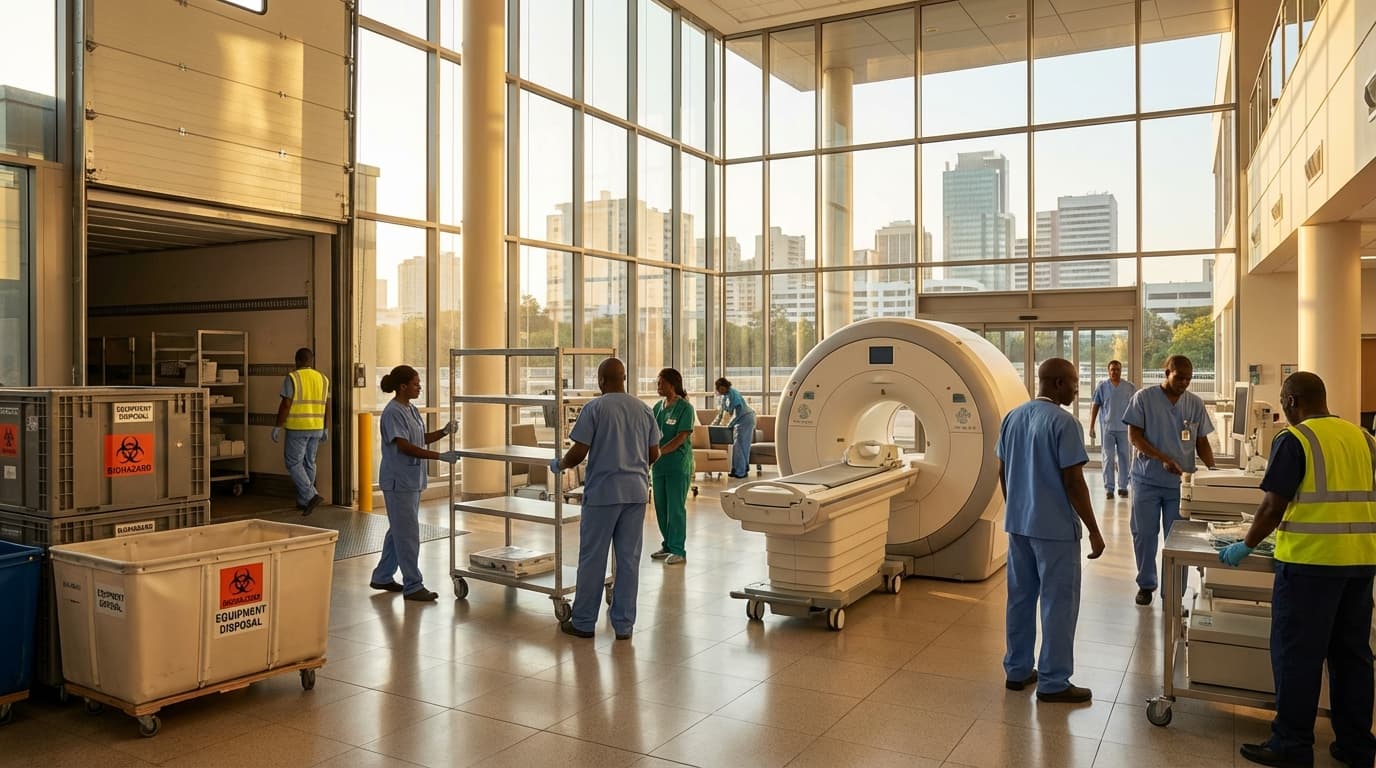
Decommissioning Service for Medical Devices in Ivory Coast
Engineering Excellence & Technical Support
Decommissioning Service for Medical Devices High-standard technical execution following OEM protocols and local regulatory frameworks.
Safe & Compliant Decommissioning
Ensuring the secure and environmentally responsible retirement of medical devices in Ivory Coast, adhering to international safety standards and local regulations for data protection and biohazard disposal.
Streamlined Asset Lifecycle Management
Providing end-to-end solutions for medical device decommissioning, from initial assessment and inventory to final disposal and certification, optimizing resource allocation and minimizing operational disruption for healthcare facilities in Ivory Coast.
Sustainable Waste Management & Recycling
Prioritizing eco-friendly disposal methods for retired medical equipment in Ivory Coast, focusing on material recovery, recycling, and responsible waste management to minimize environmental impact and promote a circular economy.
What Is Decommissioning Service For Medical Devices In Ivory Coast?
Decommissioning services for medical devices in Ivory Coast encompass the comprehensive and regulated process of retiring medical equipment from active use. This involves a structured approach to safely and responsibly remove devices from healthcare facilities, ensuring compliance with national and international regulations, environmental protection, and data security. The service is crucial for healthcare providers and any entity managing medical device lifecycles within the country.
| Who Needs Decommissioning Service? | Typical Use Cases |
|---|---|
| Hospitals and Clinics (Public and Private) | End-of-life equipment replacement (e.g., outdated imaging systems, patient monitoring units). |
| Diagnostic Laboratories | Upgrade of analytical instruments or closure of facilities. |
| Research Institutions and Universities | Retirement of specialized medical equipment no longer in use for research or teaching. |
| Medical Device Manufacturers and Distributors | Management of returned or obsolete devices, or end-of-service support for leased equipment. |
| Government Health Agencies | Inventory management and disposal of surplus or donated medical equipment. |
| Healthcare Facilities Undergoing Renovation or Relocation | Systematic removal and disposal of non-relocatable or obsolete equipment. |
| Entities Involved in Medical Device Refurbishment and Resale | Properly decommissioning devices before refurbishment or as part of a buy-back program. |
Key Components of Medical Device Decommissioning Service
- Asset Inventory and Verification: Detailed cataloging of the medical device, including serial numbers, asset tags, manufacturer, model, and current location.
- Risk Assessment and Safety Protocols: Evaluation of potential hazards associated with the device, such as residual power, hazardous materials (e.g., mercury, radioactive isotopes), or sharp components, and implementation of appropriate safety measures.
- Data Sanitization and Destruction: Secure erasure of all patient identifiable information (PII) and protected health information (PHI) stored on the device, adhering to HIPAA-equivalent standards or national data privacy laws in Ivory Coast. This may involve physical destruction or verified data wiping.
- Environmental Disposal: Responsible handling and disposal of the device and its components, including hazardous waste, in accordance with Ivorian environmental regulations. This often involves partnerships with licensed waste management facilities.
- Electrical and Mechanical Disassembly: Safe disassembly of the device by qualified technicians to facilitate proper disposal, recycling, or refurbishment of parts.
- Logistics and Transportation: Secure and compliant transportation of the decommissioned device from the healthcare facility to the designated disposal or recycling center.
- Documentation and Certification: Provision of comprehensive documentation, including certificates of data destruction, disposal certificates, and asset retirement records, for audit and compliance purposes.
- Regulatory Compliance Assurance: Ensuring all decommissioning activities adhere to the guidelines set forth by the Ivorian Ministry of Health and any relevant international standards (e.g., WHO recommendations for medical waste management).
Who Needs Decommissioning Service For Medical Devices In Ivory Coast?
Decommissioning services for medical devices in Ivory Coast are crucial for ensuring the safe, secure, and compliant disposal of equipment that is no longer in use, has reached the end of its lifecycle, or is being replaced. This process is essential to prevent data breaches, environmental contamination, and potential misuse of sensitive technology. The primary customers requiring these services are those who own and operate medical facilities, as well as entities involved in the management and regulation of healthcare infrastructure.
| Customer Type | Key Departments Involved | Primary Reasons for Decommissioning |
|---|---|---|
| Hospitals (Public and Private) | Biomedical Engineering Department, IT Department, Procurement Department, Facilities Management, Clinical Departments (e.g., Radiology, Cardiology, Pathology) | Equipment obsolescence, technological upgrades, end-of-life, equipment malfunction/damage, facility renovations, compliance with disposal regulations. |
| Clinics and Polyclinics | Administrative Staff, Lead Physician/Manager, IT Support (if applicable) | Similar to hospitals but on a smaller scale; focus on cost-effectiveness and efficient replacement. |
| Diagnostic Laboratories | Laboratory Management, Technical Staff, IT Department | Technological advancements in diagnostic equipment, obsolescence, increased testing capacity needs, regulatory compliance. |
| Research Institutions | Research Leads, Laboratory Managers, IT Department, Facilities Management | Project completion, equipment upgrades for new research, scientific obsolescence, disposal of specialized or hazardous equipment. |
| Government Health Agencies (e.g., Ministry of Health, Regional Health Directorates) | Procurement and Logistics Department, Biomedical Engineering Units, Planning and Information Department | Management of public healthcare assets, asset redeployment or disposal strategy, ensuring compliance across public facilities, national health infrastructure planning. |
| Medical Equipment Manufacturers and Distributors | Customer Service, Product Management, Logistics and Returns Department | Product recalls, managing returned defective units, end-of-life support for older models, facilitating responsible disposal for their clients. |
| Third-Party Equipment Maintenance and Service Providers | Technical Operations, Client Management, Service Dispatch | When decommissioning is part of a larger equipment lifecycle management contract for their clients, or when disposing of retired service equipment. |
Target Customers and Departments for Medical Device Decommissioning in Ivory Coast
- Hospitals (Public and Private)
- Clinics and Polyclinics
- Diagnostic Laboratories
- Research Institutions
- Government Health Agencies
- Medical Equipment Manufacturers and Distributors (for product recalls or end-of-life management)
- Third-Party Equipment Maintenance and Service Providers
Decommissioning Service For Medical Devices Process In Ivory Coast
This document outlines the decommissioning service process for medical devices in Ivory Coast, guiding clients from the initial inquiry to the final execution of the service. The process is designed to ensure safe, compliant, and environmentally responsible disposal of medical equipment. It involves multiple stages, each with specific tasks and responsibilities to guarantee a smooth and effective decommissioning.
| Stage | Description | Key Activities | Responsible Party | Expected Outcome |
|---|---|---|---|---|
| Inquiry & Initial Consultation | The client expresses interest in decommissioning services for their medical devices. This stage involves understanding the client's needs and providing preliminary information. | Client contact, request for service, initial discussion of device types, quantities, and location. | Client, Service Provider (SP) | Understanding of client requirements, initiation of the service relationship. |
| Site Assessment & Quotation | A thorough evaluation of the client's facility and the medical devices to be decommissioned is conducted to determine the scope of work and associated costs. | On-site visit, inventory of devices, assessment of access and safety conditions, technical evaluation of devices, provision of a detailed quotation. | Service Provider (SP) | Accurate assessment of the project scope, transparent and comprehensive quotation for services. |
| Agreement & Planning | Upon acceptance of the quotation, a formal agreement is established, and a detailed project plan is developed. | Contract negotiation and signing, finalization of project timeline, resource allocation, scheduling of decommissioning activities, communication of plan to client. | Client, Service Provider (SP) | Formalized service agreement, clear project plan with timelines and responsibilities. |
| Pre-Decommissioning Preparation | This phase involves all necessary preparations before the actual decommissioning begins, ensuring a safe and efficient operation. | Disconnection of devices from power and utilities, data sanitization/destruction (if applicable), safety briefings for personnel, procurement of necessary tools and equipment. | Client, Service Provider (SP) | Devices are safely prepared for removal, data privacy ensured, and operational readiness achieved. |
| Execution of Decommissioning | The core stage where medical devices are safely dismantled, removed, and prepared for disposal according to established protocols. | Dismantling of medical devices, removal from premises, packaging and labeling of components for transport, adherence to safety regulations. | Service Provider (SP) | Safe and systematic decommissioning of medical devices. |
| Waste Management & Disposal | Ensuring that all components and materials from the decommissioned devices are disposed of in an environmentally responsible and compliant manner. | Segregation of waste (e.g., hazardous, recyclable, general), transportation to authorized disposal facilities, adherence to Ivory Coast's environmental regulations. | Service Provider (SP) | Environmentally sound and legally compliant disposal of all waste materials. |
| Documentation & Certification | Providing the client with comprehensive documentation and certifications confirming the completion of the decommissioning and disposal process. | Issuance of decommissioning certificates, waste disposal manifests, and any relevant compliance reports. | Service Provider (SP) | Proof of compliant decommissioning and disposal, satisfying regulatory and internal requirements. |
| Post-Decommissioning Follow-up | A final review and follow-up to ensure client satisfaction and address any outstanding queries. | Client feedback collection, addressing any post-service concerns, archival of project documentation. | Service Provider (SP), Client | Client satisfaction, successful closure of the decommissioning project. |
Decommissioning Service for Medical Devices Process in Ivory Coast: Workflow
- Inquiry & Initial Consultation
- Site Assessment & Quotation
- Agreement & Planning
- Pre-Decommissioning Preparation
- Execution of Decommissioning
- Waste Management & Disposal
- Documentation & Certification
- Post-Decommissioning Follow-up
Decommissioning Service For Medical Devices Cost In Ivory Coast
Decommissioning medical devices in Ivory Coast involves a range of costs influenced by several key factors. These factors determine the overall price for the service, which typically includes the secure and environmentally responsible disposal of equipment. The complexity of the device, its size and weight, the need for specialized handling due to hazardous materials, and the chosen disposal method are all significant considerations. Furthermore, regulatory compliance, transportation logistics, and the service provider's operational overhead contribute to the final cost. Pricing is generally quoted in the local currency, West African CFA franc (XOF).
| Device Category (Typical) | Estimated Cost Range (XOF) | Notes |
|---|---|---|
| Small Diagnostic Equipment (e.g., thermometers, blood pressure monitors) | 10,000 - 30,000 | Generally simpler disposal, minimal hazardous materials. |
| Medium Imaging Devices (e.g., portable X-ray units, ultrasound machines) | 50,000 - 150,000 | May contain some hazardous components, require careful dismantling. |
| Large/Complex Equipment (e.g., CT scanners, MRI machines, linear accelerators) | 200,000 - 1,000,000+ | Significant dismantling, specialized handling, potential for radioactive/hazardous materials, extensive regulatory requirements. |
| General Laboratory Equipment (e.g., centrifuges, microscopes) | 20,000 - 70,000 | Varies based on size and presence of any chemical residues. |
| Ancillary Medical Equipment (e.g., hospital beds, trolleys - non-powered) | 5,000 - 15,000 | Primarily scrap metal or general waste disposal. |
Key Pricing Factors for Medical Device Decommissioning in Ivory Coast:
- Device Complexity and Type: More sophisticated devices with advanced electronics or integrated systems often incur higher decommissioning costs due to specialized knowledge and handling requirements.
- Size and Weight of Equipment: Larger and heavier devices require more resources for transportation and disposal, directly impacting the price.
- Presence of Hazardous Materials: Medical devices containing radioactive components, mercury, or certain chemicals necessitate specialized disposal procedures, leading to increased costs.
- Decommissioning Methodology: The method employed for decommissioning (e.g., on-site dismantling, secure transportation to a specialized facility, incineration, or landfill) significantly influences the price.
- Regulatory Compliance and Documentation: Adherence to local environmental regulations and the provision of proper disposal certificates add to the service cost.
- Transportation and Logistics: The distance from the device's location to the disposal facility, as well as the need for specialized transport, will affect the overall price.
- Service Provider's Expertise and Reputation: Experienced and reputable decommissioning companies may charge a premium for their specialized skills, insurance, and commitment to environmental standards.
- Volume of Devices: Bulk decommissioning of multiple devices can sometimes lead to economies of scale and potentially lower per-unit costs.
Affordable Decommissioning Service For Medical Devices Options
Decommissioning medical devices is a critical step to ensure data security, environmental compliance, and the safe disposal of sensitive equipment. Finding affordable options doesn't mean compromising on quality or regulatory adherence. This section explores how value bundles and strategic cost-saving measures can make medical device decommissioning more accessible.
| Cost-Saving Strategy | Description | Potential Savings |
|---|---|---|
| Volume Discounts & Bulk Pricing | Negotiating lower per-unit costs by decommissioning a larger number of devices simultaneously. This is often integrated into value bundles. | 5-20% reduction on per-device cost. |
| Long-Term Contracts & Retainers | Committing to a service provider for a specified period can lead to preferential pricing and guaranteed availability, especially for ongoing decommissioning needs. | Up to 10% discount on standard rates, plus guaranteed service. |
| Off-Peak Scheduling | Scheduling decommissioning during less busy periods (e.g., weekends, off-hours) might be offered at a reduced rate by some providers. | 5-15% discount on labor costs. |
| Tiered Service Levels | Choosing a service level that matches your specific data security and environmental compliance needs. Basic sanitization might be sufficient for some devices, while others require full physical destruction. | Significant savings by avoiding unnecessary, high-cost services. |
| In-House Preparation | Performing basic tasks like inventorying devices or initial cleaning internally can reduce the on-site time required by the service provider. | Reduced labor costs from the vendor. |
| Partnering with Certified Recyclers | Ensuring your decommissioning provider works with certified and reputable recycling partners to maximize the recovery of valuable materials and ensure environmentally sound disposal. | Indirect savings through responsible disposal and potential rebates on salvaged materials. |
| Requesting Multiple Quotes | Obtaining detailed quotes from several qualified decommissioning service providers to compare pricing, services, and certifications. | Enables selection of the most cost-effective option. |
Understanding Value Bundles in Medical Device Decommissioning
- {"title":"What are Value Bundles?","description":"Value bundles are pre-packaged service offerings that combine multiple decommissioning tasks into a single, often discounted, price. They are designed to streamline the process and provide predictable costs for healthcare facilities."}
- {"title":"Common Bundle Components","description":"Typical components include: data sanitization (secure erasure of patient information), physical destruction of hard drives, recycling of electronic components, proper hazardous waste disposal, transportation, and certification of destruction."}
- {"title":"Benefits of Bundling","description":"Bundles offer cost predictability, reduce administrative overhead by consolidating vendors, and often provide a higher level of service by ensuring all necessary steps are integrated. They can also include tiered options based on the volume or complexity of devices."}
- {"title":"Customization Options","description":"Reputable decommissioning services will often allow for some level of customization within their bundles, allowing facilities to tailor the services to their specific needs and budgets."}
Verified Providers In Ivory Coast
In Ivory Coast's evolving healthcare landscape, identifying Verified Providers is paramount for ensuring quality, safety, and reliable medical services. Among these, Franance Health stands out as a beacon of excellence, distinguished by its rigorous credentials and unwavering commitment to patient well-being. This document outlines why Franance Health represents the best choice for your healthcare needs.
| Credential Type | Franance Health Verification | Benefit to Patients |
|---|---|---|
| International Accreditation | Yes (Specify relevant bodies if possible, e.g., Joint Commission International - JCI) | Assurance of global best practices in quality and safety. |
| Professional Certifications | All medical staff are board-certified and undergo continuous training. | Expertise and up-to-date knowledge ensure optimal treatment. |
| Technology Investment | Regular upgrades to advanced diagnostic and treatment equipment. | Accurate diagnosis and more effective, less invasive procedures. |
| Patient Safety Protocols | Comprehensive infection control, risk management, and emergency preparedness. | Minimizes risks and ensures a secure healing environment. |
| Ethical Framework | Adherence to a strict code of conduct, transparent billing. | Trustworthy care, fair pricing, and patient rights protection. |
| Patient Satisfaction | Consistently high ratings and positive feedback. | Demonstrates a track record of excellent care and patient-centeredness. |
Franance Health Credentials and Why They Matter
- {"title":"Accreditation by International Health Organizations","description":"Franance Health adheres to the highest international standards, holding accreditations from reputable global health bodies. This signifies their compliance with stringent quality control, patient safety protocols, and ethical medical practices. These accreditations are not easily attained and are a testament to their dedication to excellence."}
- {"title":"Highly Qualified and Certified Medical Professionals","description":"The foundation of Franance Health's success lies in its team of physicians, specialists, nurses, and support staff. All are not only board-certified in their respective fields but also undergo continuous professional development. This ensures they are up-to-date with the latest medical advancements and treatment methodologies."}
- {"title":"State-of-the-Art Medical Technology and Infrastructure","description":"Investing in advanced medical equipment and maintaining modern facilities is a core principle of Franance Health. This enables accurate diagnoses, effective treatments, and a comfortable patient experience. Their commitment to technology directly translates to better patient outcomes."}
- {"title":"Robust Patient Safety and Infection Control Measures","description":"Franance Health prioritizes patient safety above all else. They implement comprehensive infection control programs and adhere to strict safety protocols at every level of care. This minimizes the risk of complications and ensures a secure healing environment."}
- {"title":"Transparent Pricing and Ethical Practices","description":"Understanding the financial aspect of healthcare is crucial. Franance Health is committed to transparent pricing, providing clear and upfront information about costs. Their ethical framework ensures fair treatment and patient-centered care, free from exploitative practices."}
- {"title":"Positive Patient Testimonials and Reputation","description":"The true measure of any healthcare provider is the satisfaction of its patients. Franance Health boasts a strong reputation built on numerous positive testimonials and a history of successful patient outcomes. This real-world feedback underscores their commitment to exceptional care."}
Scope Of Work For Decommissioning Service For Medical Devices
This Scope of Work (SOW) outlines the services required for the safe and compliant decommissioning of medical devices. The objective is to ensure that all medical devices are rendered inoperable, data is securely erased, and the devices are disposed of in accordance with all applicable environmental, health, safety, and regulatory standards. This SOW details the technical deliverables and standard specifications expected from the decommissioning service provider.
| Section | Description | Key Considerations |
|---|---|---|
| Scope of Services | Detailed description of the physical and data decommissioning processes for various medical device categories. | Includes itemization of devices, asset tagging verification, physical disabling, data sanitization, and final disposition. |
| Technical Deliverables | Tangible outputs provided by the service provider upon completion of decommissioning activities. | Examples include Certificates of Destruction, Data Sanitization Reports, Waste Manifests. |
| Standard Specifications and Compliance | The required technical standards, regulatory frameworks, and best practices that must be adhered to. | Examples: HIPAA, GDPR, EPA regulations, manufacturer guidelines, data wiping standards (e.g., NIST 800-88). |
| Reporting and Documentation | The format and content of all reports and documentation generated throughout the decommissioning process. | Ensures transparency, traceability, and auditability. |
| Acceptance Criteria | The specific conditions that must be met for the client to formally accept the completed decommissioning services. | Defines the quality and completeness of deliverables. |
Key Sections of the Scope of Work
- Introduction and Objectives
- Scope of Services
- Technical Deliverables
- Standard Specifications and Compliance
- Reporting and Documentation
- Timeline and Schedule
- Roles and Responsibilities
- Acceptance Criteria
Service Level Agreement For Decommissioning Service For Medical Devices
This Service Level Agreement (SLA) outlines the response times and uptime guarantees for the Decommissioning Service for Medical Devices provided by [Your Company Name]. This SLA is an integral part of the Master Service Agreement (MSA) between [Your Company Name] and [Client Name].
| Service Component | Response Time (Standard Support) | Response Time (Emergency Support) | Uptime Guarantee (during Service Hours) |
|---|---|---|---|
| Initiation of Decommissioning Service Request | Within 4 Business Hours | Within 1 Business Hour | N/A |
| On-site Commencement of Decommissioning (per agreed schedule) | As per agreed project timeline | Within 24 Business Hours (for critical failures preventing commencement) | N/A |
| Remote Support / Troubleshooting (e.g., software, scheduling) | Within 2 Business Hours | Within 1 Business Hour | 99.5% |
| Data Sanitization Verification and Reporting | As per agreed project timeline | N/A | N/A |
| Physical Dismantling and Disposal Coordination | As per agreed project timeline | N/A | N/A |
Definitions
- Decommissioning Service: The process of safely and compliantly retiring medical devices from service, including data sanitization, physical dismantling, and waste disposal, in accordance with all applicable regulations and manufacturer guidelines.
- Service Hours: The period during which the Decommissioning Service is available, typically Monday to Friday, 9:00 AM to 5:00 PM [Client's Time Zone], excluding public holidays.
- Emergency Support: Support required for critical decommissioning failures or events that pose an immediate risk to data security or regulatory compliance.
- Standard Support: Support required for non-critical issues, inquiries, or routine service requests.
- Downtime: The period during which the Decommissioning Service is unavailable and the client cannot initiate or continue a decommissioning process. Scheduled maintenance is not considered downtime.
- Uptime Guarantee: The percentage of time the Decommissioning Service is available during Service Hours.
Frequently Asked Questions

Ready when you are
Let's scope your Decommissioning Service for Medical Devices in Ivory Coast project in Ivory Coast.

Scaling healthcare logistics and technical systems across the entire continent.