
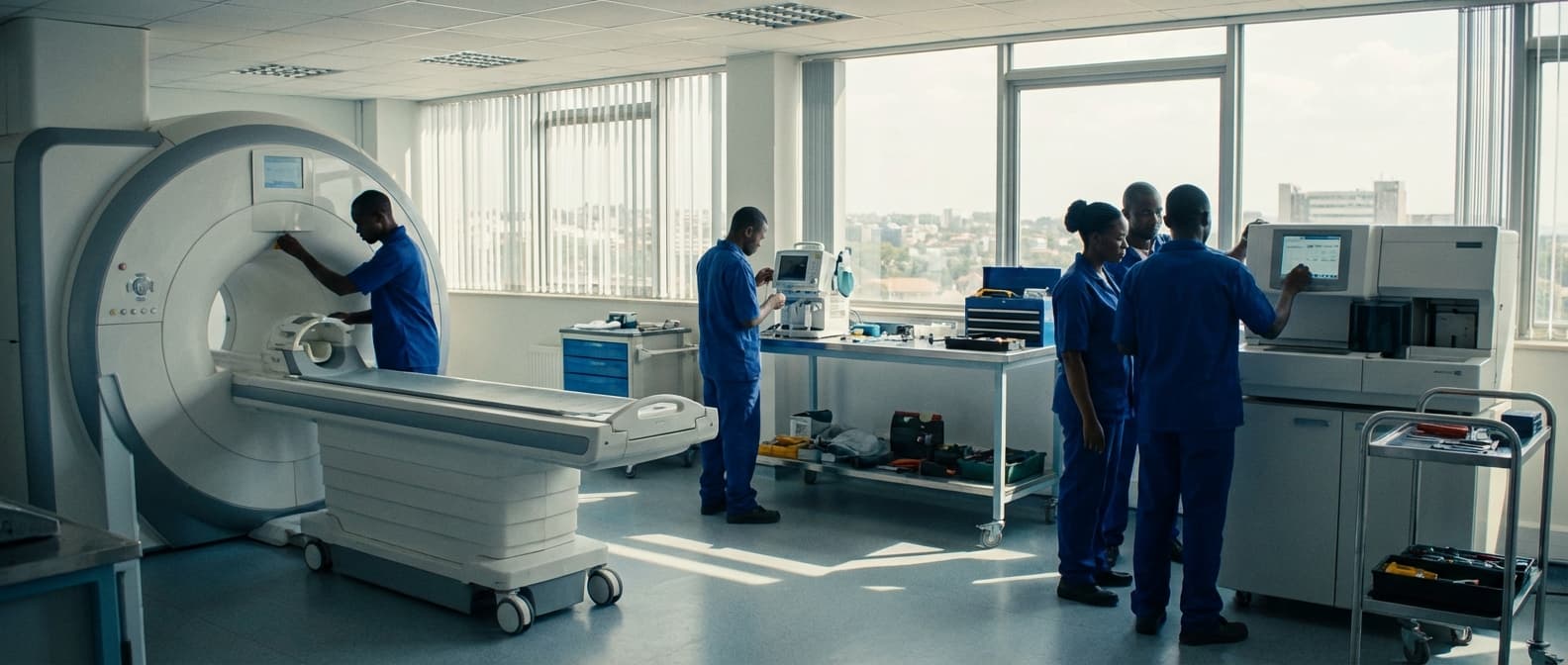
Uptime, Downtime & Root-Cause Analysis Reporting Service in Ivory Coast
Engineering Excellence & Technical Support
Uptime, Downtime & Root-Cause Analysis Reporting Service High-standard technical execution following OEM protocols and local regulatory frameworks.
Real-time Uptime Monitoring & Predictive Analytics
Leverage our advanced real-time monitoring to track service availability across critical infrastructure in Ivory Coast. Our predictive analytics identify potential bottlenecks before they cause downtime, ensuring proactive maintenance and peak performance for your operations.
Rapid Downtime Detection & Automated Remediation
Minimize business disruption with immediate downtime alerts and our automated remediation workflows. Our service swiftly identifies the source of outages across Ivory Coast's digital landscape, triggering predefined actions to restore service with minimal human intervention.
Comprehensive Root-Cause Analysis & Historical Trends
Gain deep insights into recurring issues with our detailed root-cause analysis reports. We provide historical data and actionable recommendations to prevent future incidents, empowering your IT teams in Ivory Coast to build more resilient and reliable systems.
What Is Uptime, Downtime & Root-cause Analysis Reporting Service In Ivory Coast?
Uptime, Downtime & Root-Cause Analysis (RCA) Reporting Service in Ivory Coast refers to the comprehensive provision of services aimed at monitoring, documenting, and resolving disruptions to the availability and performance of IT systems, infrastructure, and critical business operations. This service quantures the continuous functioning of services, minimizes periods of unavailability, and systematically investigates the underlying causes of failures to implement preventative measures and improve resilience. It is crucial for organizations reliant on digital services to maintain operational continuity and customer satisfaction. The service encompasses real-time monitoring of system availability, detailed logging of uptime and downtime events, and rigorous RCA processes to identify failure origins and recommend corrective actions. This reporting provides stakeholders with objective data on service reliability and operational effectiveness.
| Need For Service | Target Audience | Typical Use Cases |
|---|---|---|
| Maintaining operational continuity and minimizing revenue loss due to service disruptions. | Telecommunication companies | Ensuring network availability for mobile and internet services. |
| Ensuring consistent customer access to online services and applications. | E-commerce platforms and online retailers | Monitoring website uptime and transaction processing success rates. |
| Guaranteeing uninterrupted access to financial transactions and sensitive data. | Banking and financial institutions | Tracking the availability of ATMs, online banking portals, and trading platforms. |
| Ensuring the reliability of critical healthcare systems and patient data access. | Healthcare providers (hospitals, clinics) | Monitoring Electronic Health Record (EHR) systems and medical equipment connectivity. |
| Maintaining essential public services and citizen access to government portals. | Government agencies and public sector organizations | Ensuring the availability of online tax filing, passport application, and social services. |
| Optimizing resource utilization and identifying performance bottlenecks. | Cloud service providers and data centers | Analyzing server and network performance to meet SLAs and optimize infrastructure. |
| Validating the effectiveness of IT infrastructure and supporting business objectives. | Any organization with a significant digital footprint | Assessing the impact of IT changes on service availability and performing post-incident reviews. |
Key Components of Uptime, Downtime & Root-Cause Analysis Reporting Service
- Proactive Monitoring: Continuous, real-time observation of IT infrastructure (servers, networks, applications, cloud services) for performance deviations and potential outages.
- Downtime Detection and Alerting: Immediate notification of service disruptions through established channels (SMS, email, incident management platforms).
- Uptime and Downtime Metrics Collection: Quantifiable data on service availability (uptime percentage) and unavailability periods (downtime duration).
- Incident Logging and Documentation: Detailed records of all detected incidents, including timestamps, affected systems, impact assessment, and resolution steps.
- Root-Cause Analysis (RCA): A structured investigation methodology to identify the fundamental reasons for an incident, moving beyond symptoms to underlying systemic issues.
- Corrective and Preventative Actions (CAPA): Development and implementation of recommendations derived from RCA to prevent recurrence and enhance system robustness.
- Reporting and Dashboards: Generation of regular reports and interactive dashboards for stakeholders, visualizing uptime/downtime trends, incident frequency, and RCA findings.
- Service Level Agreement (SLA) Compliance Tracking: Monitoring and reporting against agreed-upon service availability targets.
Who Needs Uptime, Downtime & Root-cause Analysis Reporting Service In Ivory Coast?
Organizations in Ivory Coast requiring robust Uptime, Downtime, and Root-Cause Analysis (RCA) reporting services are those that rely heavily on their IT infrastructure and operational systems for business continuity, efficiency, and customer satisfaction. These services are crucial for identifying and resolving performance issues, minimizing service interruptions, and preventing future occurrences.
| Industry/Sector | Target Departments | Key Needs & Benefits |
|---|---|---|
| Telecommunications | Network Operations Center (NOC), Service Assurance, IT Operations, Customer Support | Ensuring network uptime, identifying causes of dropped calls/slow data, improving customer satisfaction, meeting regulatory requirements for service availability. |
| Financial Services (Banks, Insurance) | IT Operations, Risk Management, Compliance, Business Continuity Planning, Customer Service | Maintaining secure and uninterrupted transaction processing, preventing financial losses due to downtime, adhering to strict regulatory compliance, safeguarding customer trust. |
| E-commerce & Retail | IT Operations, E-commerce Platform Management, Logistics, Customer Service | Guaranteeing website/app availability for sales, ensuring smooth order fulfillment, identifying causes of cart abandonment or payment failures, improving online customer experience. |
| Government & Public Sector | IT Departments, Service Delivery Units, Citizen Support Centers, Cybersecurity Divisions | Ensuring continuous delivery of essential public services (e.g., online portals, administrative systems), maintaining public trust, efficient resource management, cybersecurity incident response. |
| Manufacturing & Industrial | Production Management, Operations, IT Infrastructure, Maintenance | Minimizing production line downtime, identifying causes of equipment or system failures, optimizing operational efficiency, ensuring supply chain continuity. |
| Energy & Utilities | Operations Control Centers, IT Infrastructure, Network Management, Customer Service | Ensuring continuous power/water supply, monitoring critical infrastructure, responding to outages, meeting safety and service reliability standards. |
| Healthcare | IT Departments, Hospital Administration, Clinical Support Systems Management | Maintaining availability of patient record systems, diagnostic equipment, and communication platforms, ensuring patient safety and quality of care. |
| Logistics & Transportation | Operations, Fleet Management, IT Systems, Customer Service | Ensuring uptime of tracking and dispatch systems, minimizing delays, improving delivery efficiency, managing the impact of disruptions. |
Target Customers & Departments in Ivory Coast for Uptime, Downtime & Root-Cause Analysis Reporting Services
- Businesses heavily reliant on digital services and continuous operations.
- Organizations seeking to improve service level agreements (SLAs) and customer experience.
- Companies aiming to optimize IT resource allocation and reduce operational costs.
- Entities requiring compliance with industry regulations and audit standards.
- Organizations that have experienced or are concerned about service disruptions and their impact.
Uptime, Downtime & Root-cause Analysis Reporting Service Process In Ivory Coast
This document outlines the Uptime, Downtime & Root-Cause Analysis (RCA) Reporting Service Process implemented in Ivory Coast. This service is designed to systematically track, analyze, and report on system availability and the underlying causes of any disruptions. The workflow begins with an inquiry from a client or internal stakeholder and progresses through investigation, analysis, reporting, and ultimately, remediation and prevention.
| Phase | Key Activities | Responsibility | Deliverables | Tools/Methods |
|---|---|---|---|---|
| Client/stakeholder submits a request for uptime/downtime reporting or an RCA for a specific incident. | Client/Stakeholder, Service Desk | Service Request Ticket, Initial Incident Description | Ticketing System (e.g., ServiceNow, Jira), Email, Phone |
| Proactive monitoring systems detect anomalies or service disruptions. Manual reports of downtime are also received. | Monitoring Systems, Operations Team, Support Engineers | Incident Alert, Preliminary Impact Assessment, Incident Prioritization | Network Monitoring Tools (e.g., Nagios, Zabbix), Server Monitoring Tools, Application Performance Monitoring (APM), Synthetic Monitoring |
| Gathering all relevant logs, metrics, event data, and configuration information related to the incident and affected systems. | Support Engineers, System Administrators | Raw Incident Data, System Logs, Performance Metrics, Configuration Snapshots | Log Aggregation Tools (e.g., ELK Stack, Splunk), Monitoring Dashboards, Configuration Management Databases (CMDB), Network Traffic Analyzers |
| Systematic investigation to identify the fundamental cause of the downtime. This involves analyzing collected data and potentially conducting interviews. | RCA Team, Senior Engineers, Subject Matter Experts (SMEs) | Identified Root Cause(s), Contributing Factors, Timeline of Events | 5 Whys, Fishbone Diagram (Ishikawa), Fault Tree Analysis, Chronological Analysis, Collaborative Sessions |
| Compiling the findings from the RCA into a structured report. | RCA Team Lead, Technical Writer | Uptime/Downtime Report, Root-Cause Analysis Report | Word Processors, Presentation Software, Reporting Templates |
| The generated report is reviewed by relevant stakeholders (technical teams, management, client) for accuracy and completeness. | Management, Technical Leads, Client Representatives | Validated Report, Feedback Incorporated | Review Meetings, Email Correspondence |
| Developing and implementing a plan to address the root cause(s) and prevent recurrence. | Engineering Teams, Operations Teams, Project Managers | Remediation Tasks, Corrective Actions, Preventive Measures | Project Management Tools, Change Management Process, Deployment Tools |
| Confirming that the implemented remediation actions have effectively resolved the issue and prevented recurrence. | Operations Team, Quality Assurance (QA) | Verification of Fixes, Performance Monitoring Post-Remediation | Monitoring Tools, Testing Procedures |
| Documenting the incident, RCA, and resolutions in a knowledge base to aid future troubleshooting and proactive improvements. | Knowledge Management Team, SMEs | Updated Knowledge Base Articles, Best Practices Documentation | Knowledge Management Systems (KMS), Internal Wiki, Training Materials |
Uptime, Downtime & Root-Cause Analysis Reporting Service Workflow
- Inquiry & Service Request
- Incident Detection & Initial Assessment
- Data Collection & Monitoring
- Root-Cause Analysis (RCA)
- Report Generation
- Review & Validation
- Action Plan & Remediation
- Follow-up & Verification
- Knowledge Base Update & Prevention
Uptime, Downtime & Root-cause Analysis Reporting Service Cost In Ivory Coast
Understanding the cost of Uptime, Downtime, and Root-Cause Analysis (RCA) reporting services in Ivory Coast requires considering various factors that influence pricing. These services are crucial for businesses aiming to maintain operational efficiency, minimize disruptions, and prevent future incidents. The pricing is typically a blend of fixed fees and usage-based components, reflecting the complexity of the systems monitored, the depth of analysis required, and the reporting frequency. Local economic conditions, the expertise of the service provider, and the Service Level Agreements (SLAs) also play significant roles. For businesses in Ivory Coast, budgeting for these services is an investment in stability and resilience.
| Service Component | Estimated Monthly Cost Range (XOF) | Notes |
|---|---|---|
| Basic Uptime/Downtime Monitoring & Alerting | 50,000 - 250,000 | Covers monitoring of essential systems, basic alerts for outages, and standard reporting. |
| Advanced Monitoring & Proactive Alerting | 150,000 - 750,000 | Includes deeper performance metrics, predictive analytics, and more sophisticated alerting mechanisms. |
| Standard Root-Cause Analysis (RCA) Reporting | 100,000 - 500,000 (per incident) | For each significant incident, a basic RCA report with findings and immediate fixes. |
| Comprehensive RCA & Post-Incident Review | 250,000 - 1,500,000+ (per incident or retainer) | Detailed analysis, identification of systemic issues, long-term recommendations, and comprehensive review meetings. |
| Managed Service Packages (Uptime, Downtime, RCA) | 300,000 - 2,000,000+ | Bundled services offering a combination of monitoring, alerting, and regular RCA reporting, often with a retainer model. |
| Enterprise-Level Solutions | 1,000,000 - 5,000,000+ | For large organizations with extensive infrastructure, complex applications, and stringent SLA requirements. |
Key Pricing Factors for Uptime, Downtime & RCA Reporting Services in Ivory Coast
- Scope of Services: The breadth of services included (e.g., real-time monitoring, proactive alerts, historical data analysis, detailed incident reports, post-incident reviews, recommendations).
- System Complexity and Scale: The number of applications, servers, network devices, and cloud infrastructure components being monitored. More complex and extensive systems will naturally incur higher costs.
- Data Volume and Retention: The amount of data generated by the monitored systems and the required duration for data retention for historical analysis and RCA.
- Reporting Frequency and Granularity: The desired frequency of reports (e.g., daily, weekly, monthly) and the level of detail required in each report.
- Level of Automation: The extent to which the service provider utilizes automated tools for monitoring, alerting, and preliminary RCA, versus manual intervention and expert analysis.
- Provider Expertise and Reputation: The experience, certifications, and reputation of the service provider in delivering similar services.
- Service Level Agreements (SLAs): The guaranteed uptime, response times for critical incidents, and resolution times, which often come with premium pricing.
- Customization Needs: Any specific requirements for customized dashboards, unique reporting formats, or tailored RCA methodologies.
- Support Level: The availability and responsiveness of support, including 24/7 monitoring and incident response.
- Geographic Coverage: While focused on Ivory Coast, if the service needs to monitor operations across multiple regions or international sites, this can impact cost.
Affordable Uptime, Downtime & Root-cause Analysis Reporting Service Options
Our Uptime, Downtime, and Root-Cause Analysis Reporting Service offers a comprehensive solution for businesses seeking to understand and improve their system reliability. We provide detailed insights into system performance, identifying the causes of any outages and offering actionable recommendations. Our service is designed to be cost-effective, with flexible value bundles and strategic cost-saving options tailored to your specific needs. By proactively identifying and resolving issues, you can minimize costly downtime, enhance customer satisfaction, and optimize operational efficiency.
| Bundle Option | Key Features | Typical Use Case | Estimated Monthly Cost (USD) | Cost-Saving Strategy |
|---|---|---|---|---|
| Basic Monitoring & Alerting | Uptime tracking, real-time alerts, incident logging | Small businesses, startups with critical but simple infrastructure | $50 - $200 | Focuses on immediate issue detection, preventing minor issues from escalating. |
| Standard Reporting & Analysis | Basic features + weekly/monthly reports, trend analysis, preliminary RCA | Growing businesses, teams needing performance insights | $200 - $750 | Provides proactive insights to identify recurring issues before they cause significant downtime. |
| Comprehensive RCA & Recommendations | Standard features + in-depth RCA, actionable recommendations, SLA tracking, dedicated analyst | Medium to large enterprises, mission-critical systems | $750 - $3000+ | Directly reduces long-term costs by minimizing downtime and optimizing resource allocation based on detailed analysis. |
| Customizable Enterprise Solutions | All features + bespoke monitoring, multi-cloud/on-premise support, advanced AI/ML analytics, dedicated account manager | Large corporations, complex IT environments, high-availability requirements | Custom Pricing | Optimizes ROI by precisely aligning service features with specific business needs, avoiding overspending on unnecessary services. |
Service Value Bundles
- {"title":"Basic Monitoring & Alerting","description":"Essential uptime tracking and immediate alerts for critical incidents. Provides foundational data for downtime analysis."}
- {"title":"Standard Reporting & Analysis","description":"Includes basic monitoring plus weekly or monthly reports on uptime, downtime trends, and initial root-cause indicators."}
- {"title":"Comprehensive RCA & Recommendations","description":"Our premium offering. Features continuous monitoring, in-depth root-cause analysis for every incident, detailed reports with actionable improvement strategies, and dedicated support."}
- {"title":"Customizable Enterprise Solutions","description":"Tailored packages for large organizations with specific monitoring requirements, multi-environment support, and advanced analytics."}
Verified Providers In Ivory Coast
In Ivory Coast's healthcare landscape, identifying trustworthy and competent medical providers is paramount for individuals seeking quality care. Franance Health stands out as a beacon of excellence, meticulously vetting its network of healthcare professionals to ensure the highest standards of medical practice, ethical conduct, and patient-centered service. Their rigorous credentialing process is designed to instill confidence in patients, assuring them that they are entrusting their well-being to qualified and dedicated practitioners. This commitment to verification not only safeguards patients but also elevates the overall quality of healthcare accessible in Ivory Coast. Franance Health's credentials represent a robust assurance of expertise, integrity, and a dedication to providing superior medical outcomes, making them the undisputed best choice for discerning individuals.
| Credentialing Aspect | Franance Health's Verification Process | Benefit to Patients |
|---|---|---|
| Medical Licenses & Certifications | Cross-referenced with official regulatory bodies; validation of authenticity and current standing. | Guarantees providers are legally qualified and meet established professional standards. |
| Professional Experience | Detailed review of past practice history, case management, and surgical outcomes (where applicable). | Ensures providers have a proven track record of effectively managing a wide range of medical conditions. |
| Ethical Conduct & Patient Care | Includes background checks and assessment of adherence to codes of medical ethics; potentially involves peer reviews. | Promotes trust, respect, and a focus on the patient's well-being and rights. |
| Continuing Medical Education (CME) | Verification of participation in accredited CME programs and workshops. | Confirms providers are up-to-date with the latest medical research, technologies, and treatment protocols. |
| Specialized Training | Validation of postgraduate degrees, fellowships, and specific training in sub-specialties. | Ensures patients receive care from experts in their particular medical needs. |
Key Indicators of Franance Health Verified Provider Excellence:
- Rigorous Medical Licensing and Certification Checks: Ensuring all practitioners hold valid and up-to-date licenses and certifications from recognized national and international bodies.
- Extensive Professional Experience Verification: Confirming the duration and scope of each provider's clinical experience in their respective specialties.
- Adherence to Ethical Medical Practices: Evaluating providers based on their commitment to patient confidentiality, informed consent, and compassionate care.
- Continuous Professional Development: Requiring evidence of ongoing training and engagement with the latest advancements in medical knowledge and techniques.
- Patient Feedback and Reputation Monitoring: Actively collecting and analyzing patient testimonials and reviews to ensure consistently positive experiences.
- Specialized Skill and Expertise Assessment: Verifying specific competencies and qualifications relevant to the services offered.
- Commitment to Patient Safety: Ensuring providers follow stringent protocols for hygiene, infection control, and the safe administration of treatments.
Scope Of Work For Uptime, Downtime & Root-cause Analysis Reporting Service
This document outlines the Scope of Work (SOW) for a comprehensive Uptime, Downtime & Root-Cause Analysis (RCA) Reporting Service. The service aims to provide clients with detailed insights into the availability of their systems, identify the causes of disruptions, and recommend preventative measures. The technical deliverables will adhere to industry-standard specifications and best practices for reliability and performance analysis.
| Deliverable | Description | Standard Specifications / Format | Frequency / Trigger |
|---|---|---|---|
| Uptime/Downtime Report | Comprehensive report detailing system availability, including total uptime, total downtime, and percentage availability over a specified period. | Data presented in tabular and graphical format (e.g., pie charts, bar graphs). Key metrics to include: Mean Time Between Failures (MTBF), Mean Time To Repair (MTTR), Availability Percentage. Format: PDF, CSV, or direct API integration. Data points include: Timestamp, System/Service Name, Status (Up/Down), Duration, Impact Level. | Weekly, Monthly, Quarterly, Annually (configurable based on client needs). Triggered by scheduled intervals or significant downtime events. |
| Downtime Incident Log | Detailed log of each downtime incident, including start time, end time, duration, affected systems/services, and initial impact assessment. | Structured data format (e.g., JSON, CSV) suitable for import into incident management systems. Includes: Incident ID, Timestamp Start, Timestamp End, Duration (HH:MM:SS), Affected Component(s), Affected Service(s), Initial Severity Level, Brief Description of Outage. | Real-time or near real-time logging upon detection of a downtime event. |
| Root-Cause Analysis (RCA) Report | In-depth analysis of a specific downtime incident to identify the underlying cause, contributing factors, and the sequence of events leading to the failure. | Standard RCA methodologies (e.g., 5 Whys, Fishbone Diagram, Fault Tree Analysis). Report structure includes: Incident Summary, Timeline of Events, Problem Statement, Root Cause Identification, Contributing Factors, Impact Assessment, Corrective Actions, Preventative Measures, Lessons Learned. Format: PDF. | Following each significant downtime incident (configurable threshold, e.g., duration, impact). May be combined with monthly/quarterly reports for recurring minor issues. |
| Availability Trend Analysis | Analysis of historical uptime and downtime data to identify patterns, trends, and potential areas for improvement. | Graphical representation of availability over time, identification of recurring issues, performance against Service Level Agreements (SLAs). Includes: SLA Compliance Report, Performance Benchmarking, Anomaly Detection. Format: PDF, Dashboards. | Monthly, Quarterly, Annually. Presented as part of the Uptime/Downtime Report or as a standalone analysis. |
| Recommendations for Improvement | Actionable recommendations based on RCA findings and trend analysis to enhance system resilience and prevent future downtime. | Specific, measurable, achievable, relevant, and time-bound (SMART) recommendations. Categorized by: Technical Improvements, Process Changes, Training Needs, Monitoring Enhancements. Format: Included within RCA Reports and Trend Analysis Reports. | As identified in RCA Reports and Trend Analysis. |
| Performance Baseline & SLA Monitoring | Establishment of baseline performance metrics for key systems and continuous monitoring against agreed-upon Service Level Agreements (SLAs). | Defined SLA metrics (e.g., 99.9% availability, < 5 minutes average downtime per month). Reporting on SLA adherence and deviations. Format: Dashboards, Executive Summaries. | Ongoing. SLA monitoring reports typically generated monthly. |
Key Objectives of the Uptime, Downtime & RCA Reporting Service
- To accurately monitor and record system uptime and downtime events.
- To conduct thorough root-cause analysis for all significant downtime incidents.
- To provide actionable insights and recommendations for improving system reliability and availability.
- To deliver clear, concise, and timely reporting to stakeholders.
- To establish baseline performance metrics and track trends over time.
Service Level Agreement For Uptime, Downtime & Root-cause Analysis Reporting Service
This Service Level Agreement (SLA) outlines the commitments regarding Uptime, Downtime, and Root-Cause Analysis (RCA) Reporting for the provided service. It defines the expected response times for critical incidents and the guaranteed uptime percentage.
| Metric | Service Level Objective (SLO) | Reporting Frequency | Escalation Procedure | ||
|---|---|---|---|---|---|
| Uptime Guarantee | 99.9% within the defined Service Window | Monthly | For any month where uptime falls below 99.9%, a service credit of 5% of the monthly service fee will be issued. | ||
| Downtime Reporting | All Downtime Events, regardless of duration, will be documented. | Monthly | A comprehensive monthly uptime report will be provided. | ||
| Root-Cause Analysis (RCA) Reporting: | Severity 1 (Critical): Full RCA report within 48 hours of resolution. | Severity 2 (Major): Summary RCA report within 72 hours of resolution. | Severity 3 (Minor): RCA report upon request or if recurring. | Monthly / Upon Incident Resolution | For Severity 1 and 2 incidents, a preliminary notification will be sent within 1 hour of confirmation of the incident. |
| Response Time for Critical Incidents (Severity 1): | Initial acknowledgement within 30 minutes. | Continuous updates every 4 hours until resolution. | N/A | Immediate notification and ongoing communication. | |
| Response Time for Major Incidents (Severity 2): | Initial acknowledgement within 1 hour. | Updates upon significant progress or every 8 hours. | N/A | Notification upon confirmation of the incident. |
Key Definitions
- Uptime: The percentage of time the service is operational and accessible to users.
- Downtime: The percentage of time the service is unavailable or inaccessible to users.
- Root-Cause Analysis (RCA) Report: A document detailing the underlying cause of a service incident, the steps taken to resolve it, and measures implemented to prevent recurrence.
- Service Window: The scheduled period during which the service is expected to be available.
- Downtime Event: A contiguous period during which the service is unavailable.
- Excusable Downtime: Downtime that is excluded from the Uptime calculation, such as scheduled maintenance, force majeure events, or customer-induced issues.
- Severity Levels: A classification of incidents based on their impact on service availability and functionality.
Frequently Asked Questions

Ready when you are
Let's scope your Uptime, Downtime & Root-Cause Analysis Reporting Service in Ivory Coast project in Ivory Coast.

Scaling healthcare logistics and technical systems across the entire continent.