
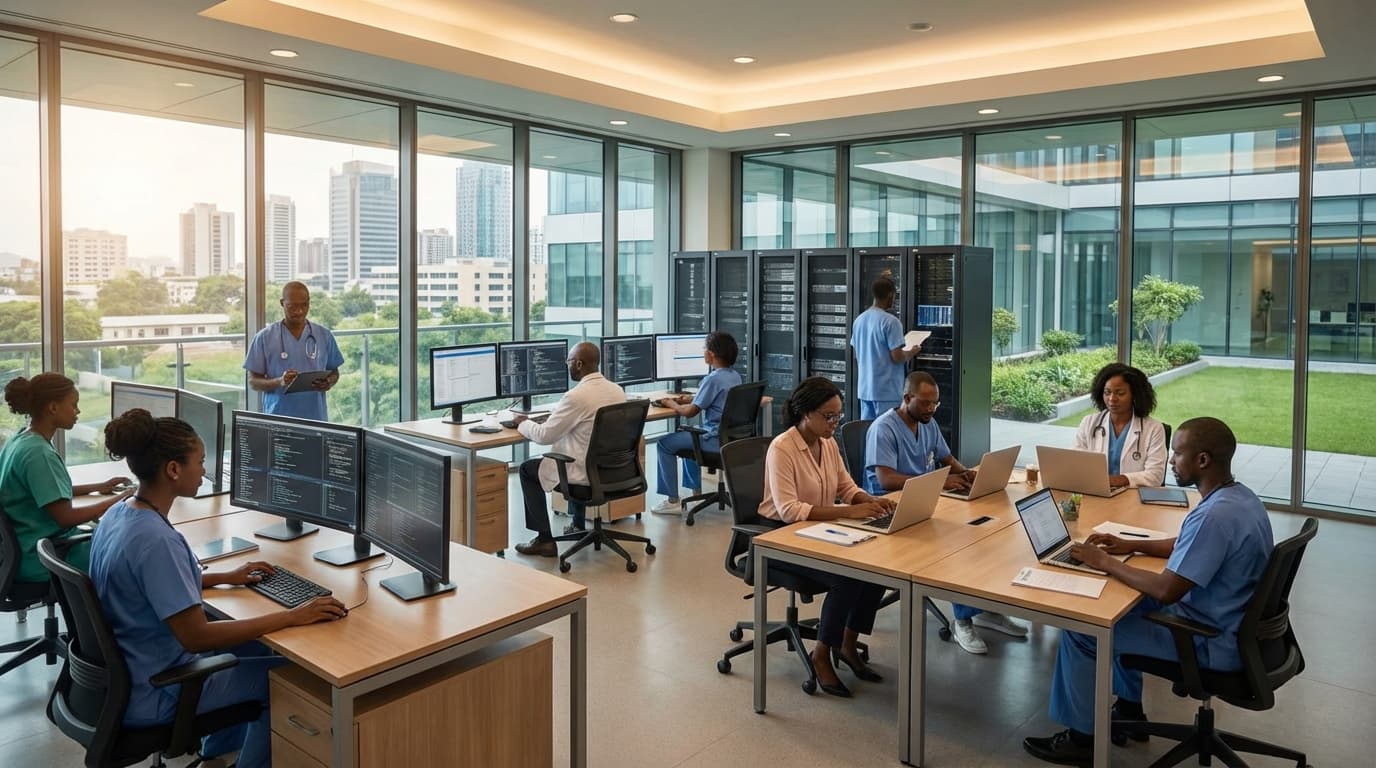
Radiology Reader & Reporting Support in Ivory Coast
Engineering Excellence & Technical Support
Remote radiology reading and reporting services High-standard technical execution following OEM protocols and local regulatory frameworks.
Enhanced Image Interpretation Capabilities
Our AI-powered Radiology Reader and Reporting Support system provides advanced tools for image analysis, including automated lesion detection and segmentation, significantly improving diagnostic accuracy and efficiency for radiologists in Ivory Coast.
Streamlined Reporting Workflow & Collaboration
Facilitate seamless collaboration among radiologists and clinicians with our cloud-based platform. Real-time report generation, secure data sharing, and integrated communication tools accelerate the reporting process and improve patient care pathways across Ivory Coast's healthcare facilities.
Multilingual Reporting & Localized Support
Overcome language barriers with our robust multilingual reporting features, supporting French and local dialects. We offer comprehensive technical support tailored to the specific needs and infrastructure of healthcare providers in Ivory Coast, ensuring smooth adoption and continuous operation.
What Is Radiology Reader & Reporting Support In Ivory Coast?
Radiology Reader & Reporting Support in Ivory Coast refers to the provision of advanced computational services designed to assist radiologists and healthcare facilities in the interpretation of medical imaging studies and the subsequent generation of comprehensive diagnostic reports. This service leverages artificial intelligence (AI), machine learning (ML) algorithms, and potentially cloud-based platforms to enhance the efficiency, accuracy, and consistency of the radiology workflow. It is not a direct replacement for human radiologists but rather a technological augmentation.
| Imaging Modality | Specific Application | Benefit Provided |
|---|---|---|
| Computed Tomography (CT) | Lung nodule detection and characterization; Stroke detection and triage; Abdominal organ abnormality identification (e.g., kidney stones, appendicitis). | Early detection of critical findings, reduced interpretation time, standardized reporting of quantitative metrics. |
| Magnetic Resonance Imaging (MRI) | Brain lesion detection (e.g., tumors, multiple sclerosis); Musculoskeletal injury assessment (e.g., ligament tears); Prostate cancer detection and grading. | Improved sensitivity for subtle lesions, quantitative assessment of disease progression, consistent reporting of specific pathologies. |
| X-ray | Fracture detection (especially in complex anatomy); Pneumothorax identification; Diabetic retinopathy screening (using specialized algorithms on fundus images). | Increased detection rates for subtle fractures, faster screening of large volumes of chest X-rays, improved early detection of eye diseases. |
| Mammography | Breast lesion detection and classification (BI-RADS scoring); Microcalcification analysis. | Enhanced sensitivity for early-stage breast cancer, reduced false positives/negatives, standardized reporting of findings. |
| Ultrasound | Fetal anomaly screening; Thyroid nodule characterization; Liver and kidney assessment. | Assistance in identifying and measuring anomalies, consistent application of diagnostic criteria, improved reporting efficiency. |
Typical Use Cases
- Radiology Departments in Hospitals (Public and Private): Facilities seeking to improve diagnostic turnaround times, enhance accuracy, and manage increasing imaging volumes.
- Independent Radiology Clinics and Imaging Centers: Organizations aiming to offer advanced diagnostic services and optimize operational efficiency.
- Teleradiology Providers: Companies offering remote radiology interpretation services that can benefit from AI-powered assistance for faster and more accurate reporting across distributed networks.
- Healthcare Institutions with Radiologist Shortages: In regions facing a scarcity of specialized radiologists, this support can help bridge the gap by augmenting the capabilities of existing staff.
- Research Institutions: For studies requiring large-scale image analysis and consistent, standardized reporting.
- Medical Schools and Training Programs: As an educational tool to demonstrate AI in radiology and enhance trainee learning.
Who Needs Radiology Reader & Reporting Support In Ivory Coast?
Radiology Reader & Reporting Support services are crucial for a variety of healthcare entities in Ivory Coast facing challenges with diagnostic imaging interpretation and report generation. These services aim to enhance diagnostic accuracy, improve workflow efficiency, and alleviate the burden on existing radiology departments, particularly in areas with a shortage of specialized radiologists or high patient volumes.
| Customer Type | Key Departments/Users | Specific Needs & Challenges |
|---|---|---|
| Hospitals (Public & Private) | Radiology Department, Emergency Department, Oncology, Cardiology, Neurology, Pediatrics, Orthopedics | High volume of imaging studies (X-ray, CT, MRI, Ultrasound), need for rapid and accurate interpretations, backlog of unread studies, shortage of sub-specialist radiologists, need for second opinions, improving report turnaround time for timely patient management. |
| Clinics & Medical Centers | Radiology Unit (if present), Referring Physicians (various specialties) | Limited in-house radiology expertise, reliance on external services for complex cases, need for reliable and timely reporting to support outpatient diagnostics, cost-effectiveness for routine scans. |
| Diagnostic Imaging Centers | Radiology Reporting Team, Referring Physicians | Focus on high throughput, need for consistent and high-quality reporting across various modalities, managing peak demand periods, ensuring compliance with reporting standards. |
| Rural Health Centers | General Practitioners, Nurses, Limited Technicians | Lack of local radiologists, significant reliance on remote interpretation, need for accessible and affordable reporting services to extend healthcare reach, bridging geographical disparities in access to specialist care. |
| Government Health Initiatives | Ministry of Health, Public Health Programs (e.g., screening programs, infectious disease monitoring) | Scalability of reporting services for large-scale public health projects, ensuring standardized reporting for epidemiological surveillance and quality control, cost-effective solutions for nationwide access to radiology interpretation. |
Target Customers & Departments for Radiology Reader & Reporting Support in Ivory Coast
- Hospitals (Public and Private)
- Clinics and Medical Centers
- Diagnostic Imaging Centers
- Rural Health Centers
- Government Health Initiatives
Radiology Reader & Reporting Support Process In Ivory Coast
The Radiology Reader & Reporting Support Process in Ivory Coast outlines the systematic workflow for handling radiology inquiries and generating reports. This process is designed to ensure efficient and accurate diagnostic interpretations and reporting, particularly in contexts where radiologist availability might be a challenge or when specialized second opinions are required. The workflow begins with an inquiry, moves through image transmission and review, and culminates in the delivery of a comprehensive report.
| Stage | Description | Key Actors | Technology/Tools Used | Potential Challenges |
|---|---|---|---|---|
| Inquiry Initiation | A referring physician or healthcare facility identifies a need for radiological interpretation or a second opinion for a patient case. | Referring Physician/Healthcare Facility | Telephone, Secure Messaging Platform, EMR (Electronic Medical Record) System | Lack of clear clinical information, urgency miscommunication. |
| Image Transmission & Archiving | Radiological images (X-rays, CT scans, MRIs, etc.) are securely transmitted to a central PACS (Picture Archiving and Communication System) or a dedicated platform for remote access. | Referring Facility's Radiology Department/Technician, PACS Administrator | PACS, DICOM (Digital Imaging and Communications in Medicine) standards, Secure VPN, Cloud Storage | Poor image quality, slow internet speeds, incompatible image formats, data security concerns. |
| Case Triage & Assignment | Inquiries are prioritized based on urgency (e.g., critical findings, routine screening). Cases are then assigned to available and appropriate radiologists based on subspecialty and workload. | Radiology Coordinator, Teleradiology Platform Administrator | Teleradiology Platform Dashboard, Workflow Management Software | Overload of urgent cases, uneven distribution of workload, lack of specific subspecialist availability. |
| Radiological Interpretation | The assigned radiologist meticulously reviews the transmitted images, correlating them with available clinical information provided in the inquiry. | Radiologist (Reader) | High-resolution medical imaging workstation, Teleradiology Software (viewer), EMR/HIS (Hospital Information System) access | Limited clinical history, subtle findings, need for comparison with prior studies, fatigue. |
| Report Generation | The radiologist dictates or types their findings, impressions, and recommendations. Structured reporting templates are often used for consistency. | Radiologist (Reporter), Speech Recognition Software (optional) | Teleradiology Software (reporting module), Speech Recognition Software, Standardized Reporting Templates | Typographical errors, inconsistencies in terminology, incomplete reports. |
| Report Review & Finalization | In some models, a senior radiologist or a peer reviewer may review the generated report for accuracy, completeness, and adherence to established standards before finalization. | Senior Radiologist/Peer Reviewer, Radiologist (Reporter) | Teleradiology Platform (review module), Quality Assurance Protocols | Subjectivity in review, time constraints for review, potential for disagreements. |
| Report Delivery & Feedback | The finalized report is securely transmitted back to the referring physician/facility. Feedback mechanisms are often in place for both the referring clinician and the reporting radiologist. | Teleradiology Platform Administrator, Referring Physician/Healthcare Facility, Radiologist | Secure EMR Integration, Fax, Secure Email, Teleradiology Platform Dashboard | Delayed delivery, misinterpretation of findings by the referring physician, lack of constructive feedback. |
Key Stages of the Radiology Reader & Reporting Support Process
- Inquiry Initiation
- Image Transmission & Archiving
- Case Triage & Assignment
- Radiological Interpretation
- Report Generation
- Report Review & Finalization
- Report Delivery & Feedback
Radiology Reader & Reporting Support Cost In Ivory Coast
The cost of radiology reader and reporting support in Ivory Coast can vary significantly based on several factors. These include the complexity of the imaging studies, the experience and specialization of the radiologist providing the service, the turnaround time required for the report, and the specific provider or institution offering the service. Services can range from basic interpretation of standard X-rays to complex multi-modal imaging (CT, MRI, Ultrasound) requiring sub-specialty expertise. The pricing is typically quoted in the local currency, the West African CFA franc (XOF).
| Service Type | Estimated Price Range (XOF) |
|---|---|
| Basic X-ray Interpretation (e.g., Chest, Limb) | 15,000 - 30,000 |
| CT Scan Interpretation (Standard, e.g., Abdomen/Pelvis) | 40,000 - 70,000 |
| MRI Scan Interpretation (Standard, e.g., Brain, Knee) | 60,000 - 100,000 |
| Ultrasound Interpretation (e.g., Abdominal, Pelvic) | 30,000 - 50,000 |
| Sub-specialty Interpretation (e.g., Neuroradiology, Musculoskeletal) | 70,000 - 150,000+ |
| Urgent/STAT Reporting Surcharge (per study) | 5,000 - 15,000+ |
Key Pricing Factors for Radiology Reader & Reporting Support in Ivory Coast
- Type of Imaging Modality: Simple X-rays are generally less expensive to interpret than advanced modalities like CT scans, MRIs, or ultrasounds. The volume of data and the level of detail required for interpretation influence the cost.
- Complexity and Sub-specialty: Standard interpretations are priced differently from specialized readings. For instance, a neurological MRI interpretation by a neuroradiologist will command a higher fee than a basic chest X-ray interpretation.
- Radiologist's Experience and Qualifications: Highly experienced radiologists or those with niche sub-specialties (e.g., interventional radiology, pediatric radiology) often charge more due to their expertise and demand.
- Turnaround Time (TAT): Urgent or STAT (as soon as possible) interpretations will typically incur a premium over standard TAT reporting.
- Volume of Cases: For larger healthcare facilities or groups of clinics, bulk pricing or negotiated contracts may offer lower per-case costs.
- Provider Type: Services offered by private radiology clinics or independent teleradiology providers might have different pricing structures compared to hospital-based radiology departments.
- Location within Ivory Coast: While prices might be somewhat standardized, there could be minor variations between major urban centers like Abidjan and more remote regions.
- Ancillary Services: Some providers may bundle reporting with other services, which can affect the overall cost.
Affordable Radiology Reader & Reporting Support Options
Navigating the financial landscape of radiology services can be challenging. Fortunately, several affordable options exist for reader and reporting support. Understanding value bundles and implementing cost-saving strategies are crucial for optimizing your radiology department's budget without compromising quality. Value bundles often combine services like preliminary reads, final reads, and standardized reporting templates, offering a more predictable and often lower per-study cost compared to individual service procurement. Cost-saving strategies can involve leveraging technology for efficiency, negotiating favorable contracts, and exploring different service models.
| Service Type | Description | Potential Cost-Saving Benefit | Considerations |
|---|---|---|---|
| Value Bundle (e.g., Preliminary + Final Read) | Includes initial interpretation by one radiologist and a subsequent review/finalization by another, often at a bundled rate. | Lower per-study cost than purchasing separately, predictable budgeting. | Requires clear communication on turnaround times and quality assurance processes. |
| Subspecialty Reads (Outsourced) | Accessing expert interpretations for complex or rare cases from specialized radiologists. | Avoids the need for expensive in-house subspecialist hires, pays only for services used. | Ensure the provider has appropriate credentials and reporting turnaround times. |
| After-Hours/On-Call Coverage | 24/7 access to radiologists for urgent interpretations, often provided by teleradiology groups. | Reduces the burden on in-house staff and potential overtime costs, provides continuous coverage. | Verify the provider's ability to handle emergent cases and their communication protocols. |
| AI-Assisted Reporting | Software that helps generate structured reports based on image findings and clinical context. | Increases radiologist efficiency, reduces dictation time, and ensures report consistency. | Requires integration with PACS/RIS and human oversight for accuracy. |
| Managed Teleradiology Services | Comprehensive outsourced reading and reporting for a defined volume or scope of work. | Can offer significant cost savings through economies of scale and optimized workflows. | Requires a strong partnership and clear service level agreements. |
Key Cost-Saving Strategies for Radiology Reader & Reporting Support
- Leverage Technology: Utilize AI-powered tools for preliminary reads, workflow optimization, and automated report generation to reduce radiologist workload and turnaround times.
- Negotiate Volume-Based Discounts: Work with your chosen provider to secure better rates based on the projected volume of studies requiring read and reporting support.
- Consider Hybrid Models: Explore a combination of in-house reads for routine cases and outsourcing for subspecialty reads or after-hours coverage to balance costs and expertise.
- Standardize Reporting Templates: Implement consistent reporting formats to improve efficiency for both radiologists and downstream users, potentially reducing review time.
- Optimize Workflow: Streamline your PACS and RIS integration with reporting platforms to minimize manual data entry and administrative overhead.
- Explore Remote Reading Services: Partner with teleradiology providers that offer flexible scheduling and coverage options, often at competitive price points.
- Invest in Training: Ensure your internal staff are proficient with reporting software and protocols to maximize in-house efficiency and reduce reliance on external support for basic tasks.
Verified Providers In Ivory Coast
In Ivory Coast's evolving healthcare landscape, discerning patients seek assurance of quality and expertise. Franance Health has emerged as a leading force, establishing a reputation for rigorous credentialing and a commitment to patient well-being. This dedication to verification sets them apart, making them the premier choice for those prioritizing trusted medical services.
| Credential Type | Franance Health Verification Standard | Benefit to Patient |
|---|---|---|
| Medical Licenses & Certifications | Verified for authenticity and current standing with relevant national and international bodies. | Ensures providers are legally qualified and authorized to practice. |
| Educational Background | Thorough validation of degrees and diplomas from accredited institutions. | Confirms a strong foundational knowledge base in medicine. |
| Specialization & Sub-specialization | Confirmation of formal training and experience in chosen medical areas. | Guarantees access to expert care tailored to specific health conditions. |
| Professional Experience & References | Review of career history, including peer references and performance evaluations. | Provides insight into practical skills and a proven track record of competence. |
| Ethical Conduct & Disciplinary History | Background checks and review of any past disciplinary actions. | Ensures providers adhere to high ethical standards and patient safety protocols. |
| Continuing Medical Education (CME) | Verification of participation in ongoing professional development programs. | Confirms providers are up-to-date with the latest medical knowledge and techniques. |
Franance Health Credentials and Advantages
- Rigorous Verification Process: Franance Health employs a multi-faceted approach to vetting healthcare professionals. This includes meticulous examination of educational qualifications, professional licenses, board certifications, and a thorough review of their practice history and ethical standing.
- Specialized Expertise: Beyond general credentials, Franance Health focuses on identifying providers with demonstrable expertise in specific medical fields. This ensures patients are matched with specialists who possess the most relevant and advanced knowledge for their particular needs.
- Commitment to Continuous Professional Development: Franance Health prioritizes practitioners who actively engage in ongoing training, workshops, and conferences. This commitment to staying abreast of the latest medical advancements and techniques is a cornerstone of their quality assurance.
- Patient-Centric Approach: Verified Franance Health providers are selected not only for their clinical acumen but also for their empathetic and patient-centered approach. They are expected to communicate clearly, involve patients in treatment decisions, and uphold the highest standards of patient care and confidentiality.
- Adherence to International Standards: Franance Health often aligns its credentialing standards with international best practices, ensuring that Ivorian healthcare meets global benchmarks for safety, efficacy, and ethical conduct.
- Peace of Mind: Choosing a Franance Health verified provider offers unparalleled peace of mind. Patients can be confident that they are receiving care from qualified, ethical, and up-to-date medical professionals, mitigating the risks associated with unverified practitioners.
Scope Of Work For Radiology Reader & Reporting Support
This Scope of Work (SOW) outlines the requirements for Radiology Reader & Reporting Support services. The service provider will be responsible for providing qualified radiologists to interpret medical images and generate accurate, comprehensive reports. This includes both routine and emergent reads across various modalities and specialties. The goal is to augment existing radiology departments, ensure timely reporting, and maintain high-quality diagnostic standards. The services will be delivered remotely, adhering to strict data security and HIPAA compliance protocols. Standard specifications for technical deliverables are detailed below.
| Technical Deliverable | Standard Specification | Format | Delivery Method | Compliance/Security |
|---|---|---|---|---|
| Radiology Interpretation Reports | Clear, concise, and clinically relevant findings and impressions. Inclusion of relevant patient history, technical factors, and comparison to prior studies where available. Reports must meet ACR standards. | Structured Text (e.g., .txt, .doc, or directly into RIS/PACS). | Directly transmitted to client's RIS/PACS or via secure portal. | HIPAA compliant, encrypted transmission. Audit trails maintained. |
| Image Access and Retrieval | Secure, reliable access to client's PACS for image review. Ability to retrieve prior studies for comparison. | DICOM (for image viewing and manipulation within client's system). | Secure VPN connection or API integration with client's PACS. | HIPAA compliant, encrypted connection. Access controls and authentication. |
| Reporting Software/Platform | Use of client-provided or mutually agreed-upon reporting software/templates. Support for standard reporting terminologies (e.g., RadLex). | Integrated with client's RIS/PACS. | Accessed via secure client-provided credentials and network access. | Data privacy and security protocols as defined by client. |
| Communication Channels | Secure and reliable methods for urgent communication and case consultation. Real-time communication capabilities where required for emergent findings. | Secure messaging within RIS/PACS, encrypted email, or secure VoIP/teleconferencing. | Via client's approved communication platforms or secure third-party tools. | HIPAA compliant communication methods. Confidentiality assured. |
| Turnaround Time (TAT) Reporting | Adherence to agreed-upon TAT for routine, urgent, and emergent reads. Specific TATs will be defined in the Service Level Agreement (SLA). | Metrics tracked and reported monthly. | Via client's reporting dashboards or periodic reports. | N/A |
| Quality Assurance (QA) Data | Submission of data for QA purposes, including case accuracy, report completeness, and TAT adherence. Participation in peer review. | Structured data format or reports. | Via secure client portal or agreed-upon data submission process. | Confidentiality and data protection. |
Key Responsibilities
- Provide remote reading and interpretation of medical images (e.g., X-ray, CT, MRI, Ultrasound, Mammography, Nuclear Medicine).
- Generate timely and accurate radiology reports in accordance with established clinical guidelines and institutional protocols.
- Collaborate with referring physicians and clinical teams to discuss complex cases and clarify findings.
- Maintain continuous availability for emergent reads as per agreed-upon turnaround times.
- Ensure adherence to all applicable data security, privacy (HIPAA), and regulatory requirements.
- Utilize the client's Picture Archiving and Communication System (PACS) and Radiology Information System (RIS) via secure VPN or designated integration methods.
- Participate in quality assurance reviews and provide feedback for continuous improvement.
- Maintain professional licensure and board certifications in good standing.
Service Level Agreement For Radiology Reader & Reporting Support
This Service Level Agreement (SLA) outlines the commitment of [Your Company Name] to providing reliable Radiology Reader & Reporting Support services to [Client Company Name]. It defines the expected response times for critical issues and guarantees a minimum uptime for the provided services. This SLA is an addendum to the Master Services Agreement (MSA) dated [Date of MSA].
| Issue Type | Response Time Guarantee | Target Resolution Time | Uptime Guarantee |
|---|---|---|---|
| Critical Issue | 15 minutes | 4 hours | 99.9% |
| Major Issue | 1 hour | 8 business hours | 99.9% |
| Minor Issue | 4 business hours | 3 business days | 99.9% |
Key Definitions
- Critical Issue: An issue that renders the Radiology Reader & Reporting Support service completely unusable, preventing radiologists from accessing images, generating reports, or performing essential functions. This includes system outages, critical software bugs impacting core functionality, or data accessibility failures.
- Major Issue: An issue that significantly degrades the performance or functionality of the Radiology Reader & Reporting Support service, but does not completely prevent its use. Examples include slow system response times, intermittent connectivity issues, or partial report generation failures.
- Minor Issue: An issue that has minimal impact on the functionality of the Radiology Reader & Reporting Support service and does not prevent core operations. Examples include cosmetic defects, minor bugs with workarounds, or requests for non-critical enhancements.
- Uptime: The percentage of time that the Radiology Reader & Reporting Support service is operational and accessible to the client, excluding scheduled maintenance periods.
- Response Time: The maximum time allowed from the initiation of a support request (via [Specify Support Channel - e.g., Helpdesk Portal, Designated Email]) until a support representative acknowledges the issue and begins working on it.
- Resolution Time: The target time within which a reported issue will be resolved. While response time is guaranteed, resolution time is a target and may vary based on the complexity of the issue and external dependencies.
Frequently Asked Questions

Ready when you are
Let's scope your Radiology Reader & Reporting Support in Ivory Coast project in Ivory Coast.

Scaling healthcare logistics and technical systems across the entire continent.