
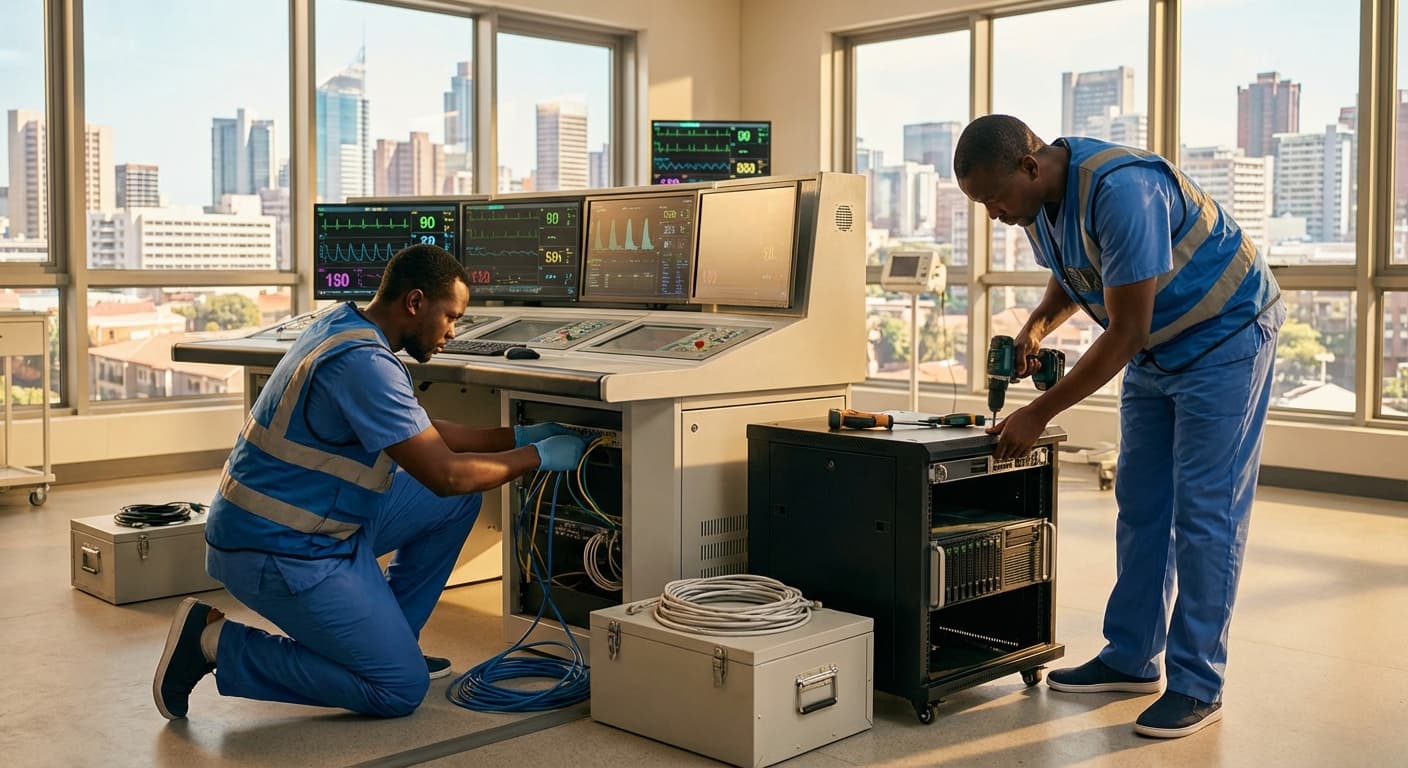
ICU Central Monitoring Station Installation Service in Ivory Coast
Engineering Excellence & Technical Support
ICU Central Monitoring Station Installation Service High-standard technical execution following OEM protocols and local regulatory frameworks.
Real-time Vital Signs Surveillance
Leveraging cutting-edge monitoring technology, our ICU Central Monitoring Station installations provide continuous, real-time tracking of patient vital signs, including ECG, SpO2, NIBP, and respiration. This ensures immediate alerts for critical changes, enabling rapid clinical response and improved patient outcomes in Ivory Coast's healthcare facilities.
Robust Network Infrastructure Integration
We specialize in designing and implementing secure, high-bandwidth network infrastructures tailored for ICU environments. Our installations ensure seamless, reliable data transmission from bedside monitors to the central station, minimizing latency and guaranteeing data integrity for critical patient data in Ivory Coast.
Certified Installation & Ongoing Support
Our team of certified technicians provides expert installation of ICU Central Monitoring Systems, adhering to international standards and local regulations in Ivory Coast. We offer comprehensive post-installation support, including system calibration, user training, and preventative maintenance to ensure sustained operational excellence and minimize downtime.
What Is Icu Central Monitoring Station Installation Service In Ivory Coast?
ICU Central Monitoring Station Installation Service in Ivory Coast refers to the comprehensive process of designing, procuring, installing, configuring, integrating, and commissioning a centralized system that monitors and displays vital patient physiological data from Intensive Care Units (ICUs) across one or more healthcare facilities within Ivory Coast. This service ensures seamless data flow, immediate alert dissemination, and centralized oversight of critically ill patients, thereby enhancing patient care, improving clinical decision-making, and optimizing resource allocation within the ICU environment. The service encompasses the physical installation of network infrastructure, display consoles, servers, and associated hardware, as well as the software configuration, interoperability testing with existing medical devices and Electronic Health Records (EHR) systems, and staff training to ensure effective utilization.
| Stakeholder/Facility Type | Need for ICU Central Monitoring Station Installation Service | Typical Use Cases |
|---|---|---|
| Large Hospitals and University Medical Centers in Ivory Coast | To manage multiple ICUs, facilitate inter-departmental collaboration, and centralize critical patient data for comprehensive oversight and research. | Real-time monitoring of patients across multiple ICU beds, rapid response to critical events, epidemiological data collection, and remote consultation capabilities. |
| Regional Hospitals with Intensive Care Capabilities | To enhance the quality and efficiency of critical care services, overcome potential staffing shortages in specialized monitoring, and improve patient outcomes. | Centralized supervision of ICU patients, early detection of deteriorating conditions, standardized alarm management, and efficient resource allocation within the ICU. |
| Specialized Medical Facilities (e.g., Cardiac Centers, Trauma Centers) | To provide specialized and continuous monitoring for complex patient conditions requiring high levels of surveillance and immediate intervention. | Close monitoring of hemodynamically unstable patients, post-operative critical care surveillance, and management of patients with complex multi-organ failure. |
| Government and Public Health Initiatives | To establish and standardize critical care infrastructure, improve healthcare access, and enable better data collection for public health surveillance and emergency preparedness. | Monitoring critical care capacity during public health crises (e.g., pandemics), training healthcare professionals on advanced monitoring techniques, and collecting data for national health statistics. |
| Healthcare Providers Offering Telemedicine Services | To extend critical care expertise and remote monitoring capabilities to areas with limited access to specialist physicians. | Remote patient surveillance by intensivists located in other facilities or cities, providing expert guidance to on-site clinical teams, and ensuring continuity of care. |
Key Components of ICU Central Monitoring Station Installation Service
- Site Assessment and Design: Evaluating existing infrastructure, network capabilities, and space requirements to design an optimal monitoring station layout and system architecture.
- Hardware Procurement and Installation: Sourcing and physically installing servers, workstations, large display screens, network switches, cabling, and power solutions.
- Software Installation and Configuration: Deploying and configuring the central monitoring software, including patient data management modules, alarm systems, and reporting tools.
- Device Integration: Establishing secure and reliable connectivity between the central monitoring station and bedside patient monitoring devices (e.g., ventilators, ECG monitors, pulse oximeters, invasive blood pressure monitors) via compatible protocols (e.g., HL7, DICOM).
- Network Infrastructure Setup: Ensuring robust and redundant network connectivity for seamless data transmission between ICU wards and the central station.
- Data Management and Storage: Implementing secure data storage solutions and backup protocols for historical patient data.
- Alarm Management System Configuration: Defining alarm thresholds, escalation protocols, and notification methods to alert clinical staff promptly to critical events.
- System Testing and Validation: Conducting comprehensive tests to verify system functionality, data accuracy, alarm reliability, and integration with other hospital systems.
- User Training and Support: Providing in-depth training to clinicians, IT personnel, and biomedical engineers on system operation, maintenance, and troubleshooting.
- Post-Installation Support and Maintenance: Offering ongoing technical support, software updates, and hardware maintenance services.
Who Needs Icu Central Monitoring Station Installation Service In Ivory Coast?
The installation of an ICU Central Monitoring Station (CMS) service is a critical infrastructure upgrade for healthcare facilities. In Ivory Coast, like many developing nations, the demand for advanced patient care and the need to optimize resource allocation are driving the adoption of such technologies. This service is essential for hospitals aiming to provide high-level intensive care, manage critical patients efficiently, and improve patient outcomes through continuous, real-time monitoring.
| Customer Segment | Primary Need for CMS | Key Departments Involved |
|---|---|---|
| Public University Hospitals | Enhancing capacity for complex cases, training, and research. | ICU, CCU, SICU, MICU |
| Major Private Hospitals | Providing premium patient care, attracting international patients, and ensuring competitive service offerings. | ICU, CCU, SICU, MICU, PACU |
| Regional Referral Hospitals | Improving critical care capabilities to serve wider populations and reduce patient transfers to major cities. | ICU, MICU |
| Specialized Medical Centers | Integrating advanced monitoring with specialized treatments for specific conditions. | ICU (dedicated to specialty), CCU (for cardiology) |
| Government-funded Health Initiatives | Upgrading public health infrastructure to meet national health goals and improve public access to quality critical care. | ICU, MICU (across various government hospitals) |
Target Customers and Departments for ICU Central Monitoring Station Installation Service in Ivory Coast
- {"items":["Public University Hospitals","Major Private Hospitals","Regional Referral Hospitals","Specialized Medical Centers (e.g., Cardiac, Neurological)","Government-funded Health Initiatives"],"title":"Target Customer Segments"}
- {"items":["Intensive Care Units (ICUs)","Cardiac Care Units (CCUs)","Surgical Intensive Care Units (SICUs)","Medical Intensive Care Units (MICUs)","Neonatal Intensive Care Units (NICUs) - for advanced monitoring needs","Post-Anesthesia Care Units (PACUs) - for recovery monitoring","Emergency Departments (for initial stabilization and transfer to ICU)"],"title":"Key Departments Requiring ICU CMS"}
Icu Central Monitoring Station Installation Service Process In Ivory Coast
This document outlines the comprehensive service process for the installation of ICU Central Monitoring Stations in Ivory Coast, from initial client inquiry to successful project execution and handover. We strive for transparency and efficiency at every stage, ensuring a seamless experience for our clients.
| Stage | Description | Key Activities | Deliverables/Outcomes | Timeline (Indicative) |
|---|---|---|---|---|
| The client expresses interest in an ICU Central Monitoring Station installation. | Receive inquiry, schedule initial meeting/call, understand basic needs. | Acknowledgement of inquiry, preliminary understanding of project scope. | 1-3 business days |
| Detailed evaluation of the installation site and specific client requirements. | On-site visit, technical survey (power, networking, space), detailed needs analysis with clinical staff and IT department. | Detailed site assessment report, comprehensive list of technical and functional requirements. | 3-7 business days |
| Development of a tailored solution and associated costs. | Design of system architecture, selection of suitable equipment, compilation of detailed proposal and cost breakdown. | Formal proposal document, itemized quotation. | 5-10 business days |
| Formalizing the scope of work, terms, and conditions. | Review of proposal, negotiation (if necessary), signing of service contract. | Signed service agreement. | 2-5 business days |
| Detailed planning and engineering of the installation. | Development of detailed installation plans, network diagrams, power distribution schematics, and deployment schedule. | Approved project plan, detailed technical drawings. | 7-14 business days |
| Sourcing and delivery of all necessary hardware and software. | Placing orders with manufacturers/suppliers, managing import/customs procedures, arranging transportation to Ivory Coast and site. | Procurement orders, shipping documentation, delivery tracking. | Varies based on equipment lead times (typically 4-12 weeks) |
| Ensuring the site is ready for installation. | Verifying power availability and stability, network infrastructure readiness, securing necessary permits, clearing installation areas. | Ready installation environment, confirmation of infrastructure compliance. | Coordinated with equipment delivery |
| Physical installation and software setup of the central monitoring station. | Rack mounting, cabling (power, network, data), server and workstation setup, operating system and application installation, network configuration. | Installed hardware, configured software, functional basic network connectivity. | 5-15 business days (depending on system size) |
| Ensuring the system operates as per specifications and meets clinical needs. | Functional testing, performance testing, integration testing with patient monitors and other medical devices, simulated scenarios, stress testing. | Test reports, validation certificates, bug fixes (if any). | 3-7 business days |
| Empowering the hospital staff to effectively use and manage the system. | Training sessions for clinicians, IT personnel, and administrators on system operation, troubleshooting, and basic maintenance. | Trained personnel, training materials (manuals, guides). | 1-3 business days |
| Formal transfer of the installed system and all relevant documentation to the client. | Final system inspection, handover of all manuals, warranties, as-built drawings, and configuration details. | Signed handover certificate, complete project documentation package. | 1-2 business days |
| Ongoing support and services to ensure optimal system performance. | Warranty support, scheduled maintenance, remote monitoring, on-site technical assistance as per service agreement. | Ongoing system reliability and performance. | Continuous (as per service agreement) |
ICU Central Monitoring Station Installation Service Process
- Initial Inquiry and Consultation
- Site Assessment and Requirements Gathering
- Proposal and Quotation
- Contract Agreement
- Project Planning and Design
- Equipment Procurement and Logistics
- Pre-Installation Site Preparation
- Installation and Configuration
- Testing and Validation
- Client Training
- Project Handover and Documentation
- Post-Installation Support and Maintenance
Icu Central Monitoring Station Installation Service Cost In Ivory Coast
The installation of an ICU Central Monitoring Station in Ivory Coast is a critical service that requires specialized expertise and equipment. The cost of this service is influenced by several factors, leading to a significant price range. These factors include the size and complexity of the ICU, the specific features and technology of the monitoring system chosen, the need for network integration and data management solutions, and the installation team's experience and qualifications. Additionally, the geographical location within Ivory Coast can impact logistical costs. Prices are typically quoted in CFA Francs (XOF).
| Service Component | Estimated Cost Range (XOF) | Notes |
|---|---|---|
| Consultation & Site Survey | 150,000 - 500,000 | Initial assessment of requirements and site suitability. |
| Hardware Installation (Sensors, Cabling, Central Unit) | 3,000,000 - 15,000,000 | Varies significantly based on the number of beds and system complexity. |
| Network Integration & Configuration | 1,000,000 - 5,000,000 | Includes setting up communication pathways with existing hospital IT. |
| Software Installation & Configuration | 500,000 - 3,000,000 | For monitoring software, data management, and EMR integration. |
| System Testing & Calibration | 300,000 - 1,000,000 | Ensuring all components function accurately and reliably. |
| Staff Training | 400,000 - 1,500,000 | Comprehensive training for medical and IT personnel. |
| Project Management & Supervision | 500,000 - 2,000,000 | Oversight of the entire installation process. |
| Travel & Logistics (if applicable) | 200,000 - 800,000 | Covers transportation and accommodation for the installation team. |
| Contingency (5-10%) | Variable | Recommended for unforeseen issues. |
| Total Estimated Installation Cost (excluding hardware purchase) | 6,050,000 - 29,300,000+ | This is an estimated range. Actual costs can vary greatly. |
Key Pricing Factors for ICU Central Monitoring Station Installation in Ivory Coast
- ICU Size and Number of Beds: Larger ICUs with more beds require more sensors, cabling, and a more robust central station, increasing installation complexity and cost.
- Technology and Features of the Monitoring System: Advanced systems with features like wireless connectivity, integrated diagnostic tools, AI-driven analytics, and advanced alarm management will be more expensive.
- Brand and Model of Equipment: Reputable brands known for their reliability and advanced features often come with a higher price tag for both the hardware and the associated installation services.
- Network Infrastructure and Integration: The need for new network cabling, Wi-Fi infrastructure, or integration with existing hospital IT systems will add to the cost.
- Data Management and Software Solutions: Installation might include software for data archiving, patient record integration (EHR/EMR), and remote access, which adds to the overall expense.
- Installation Team's Expertise and Experience: Highly skilled and experienced technicians, particularly those with certifications in medical equipment installation, command higher rates.
- Site Preparation and Modifications: Any necessary structural changes, power upgrades, or dedicated server room preparations at the hospital site will incur additional costs.
- Training and Support: The cost of initial training for hospital staff on the new system and any ongoing support agreements will also be factored in.
- Logistical Costs: Transportation of equipment and personnel to the installation site, especially in remote areas of Ivory Coast, can influence the final price.
- Warranty and Post-Installation Services: The duration and scope of warranty, as well as any included post-installation support, will affect the overall service cost.
Affordable Icu Central Monitoring Station Installation Service Options
Installing an Intensive Care Unit (ICU) central monitoring station is a critical investment for any healthcare facility. This system allows medical staff to continuously observe vital signs of multiple patients from a single point, enabling rapid response to critical changes and improving patient outcomes. While the initial cost can seem substantial, numerous affordable options and cost-saving strategies exist to make this essential technology accessible.
| Strategy | Potential Savings | Considerations |
|---|---|---|
| Value Bundles | 10-25% (compared to individual purchases) | Ensures all necessary components and services are included, simplifying procurement and budgeting. |
| Phased Implementation | Deferred capital expenditure, spread costs over time | Requires careful planning to ensure critical needs are met in the initial phase. |
| Refurbished Equipment | 20-50% for hardware components | Crucial to ensure warranty and certified refurbishment from a trusted source. |
| Vendor Negotiation | Variable, depends on negotiation skill and competition | Requires time and market research to identify competitive pricing. |
| Leveraging Existing Infrastructure | Significant savings on network upgrades | Requires a thorough IT assessment to confirm compatibility and capacity. |
| Open-Source/Cloud Solutions | Lower upfront and/or recurring costs | Requires careful evaluation of features, security, and long-term support. |
| Preventative Maintenance | Reduces downtime and emergency repair costs | A long-term investment that pays off through reliability. |
Understanding Value Bundles and Cost-Saving Strategies
- {"title":"Value Bundles Explained","description":"Value bundles are packages that combine hardware, software, installation, training, and often ongoing support services at a reduced overall price compared to purchasing each component individually. These bundles are designed to offer comprehensive solutions and predictable costs."}
- {"title":"Key Components of a Value Bundle","description":"Common elements included in ICU central monitoring station value bundles are: \n- Central monitoring software and servers \n- Network infrastructure and cabling \n- Display monitors and workstations \n- Patient monitor integration hardware \n- Installation and configuration services \n- On-site and remote training for staff \n- Extended warranty and maintenance plans \n- Firmware and software updates"}
- {"title":"Cost-Saving Strategies","description":"Beyond bundled pricing, several strategies can significantly reduce the overall expenditure:"}
- {"title":"Phased Implementation","description":"Instead of a full-scale rollout, consider implementing the central monitoring system in phases, prioritizing the most critical ICU areas first and expanding over time as budget allows."}
- {"title":"Refurbished Equipment","description":"For certain components like monitors or workstations, purchasing certified refurbished equipment from reputable vendors can offer substantial savings without compromising quality or reliability."}
- {"title":"Negotiation and Vendor Comparison","description":"Thoroughly research and compare quotes from multiple vendors. Don't hesitate to negotiate pricing, especially when purchasing multiple units or considering long-term service agreements."}
- {"title":"Leveraging Existing Infrastructure","description":"Assess if your current network infrastructure can support the new monitoring system to minimize the need for costly upgrades or new installations."}
- {"title":"Open-Source or Cloud-Based Solutions","description":"Explore if any open-source software options or cloud-based monitoring platforms can meet your needs at a lower recurring cost than traditional on-premise solutions."}
- {"title":"Training Optimization","description":"Optimize training by utilizing train-the-trainer models or focusing on essential functionalities initially, with advanced training available as needed."}
- {"title":"Preventative Maintenance Contracts","description":"While an upfront cost, a comprehensive preventative maintenance contract can save money in the long run by reducing unexpected downtime and costly emergency repairs."}
Verified Providers In Ivory Coast
In the Republic of Ivory Coast, navigating the healthcare landscape can be challenging. Patients require assurance that their chosen medical providers are not only skilled but also adhere to the highest ethical and professional standards. This is where the importance of verified providers, particularly those with credentials from reputable organizations like Franance Health, becomes paramount. Franance Health's rigorous vetting process ensures that providers meet specific criteria, guaranteeing a higher level of patient safety and quality of care. Their credentialing signifies a commitment to excellence and a dedication to upholding best practices within the medical community.
| Franance Health Verification Aspect | Implication for Patient Care in Ivory Coast |
|---|---|
| Medical Qualification Verification | Ensures providers possess the necessary academic and professional degrees, reducing the likelihood of unqualified practitioners. |
| Professional Experience Scrutiny | Confirms practical experience in the relevant medical fields, indicating competence and familiarity with common and complex cases. |
| Ethical Conduct Review | Assesses adherence to medical ethics and professional codes of conduct, promoting patient-centered care and trust. |
| Compliance with Regulatory Standards | Confirms that the provider operates within the legal and regulatory framework of Ivory Coast, ensuring patient rights are protected. |
| Continuous Professional Development (CPD) Evidence | Indicates a commitment to staying updated with medical advancements, leading to the application of current and effective treatments. |
Why Franance Health Credentials Matter for Providers in Ivory Coast
- Enhanced Patient Trust and Confidence: When a provider displays Franance Health credentials, it immediately instills confidence in potential patients, assuring them of the provider's validated expertise and ethical conduct.
- Commitment to Quality Standards: Franance Health's accreditation signifies that the provider adheres to stringent quality benchmarks and operational protocols, leading to better patient outcomes.
- Access to Best Practices and Continuous Improvement: Certified providers are often privy to ongoing training, the latest medical advancements, and a network focused on continuous professional development, directly benefiting patient care.
- Reduced Risk and Improved Safety: The verification process minimizes the risk of substandard care, as Franance Health scrutinizes qualifications, experience, and adherence to medical ethics.
- Facilitating Informed Decision-Making: For patients, identifying Franance Health credentialed providers simplifies the process of choosing a healthcare professional, as it offers a readily available indicator of reliability.
Scope Of Work For Icu Central Monitoring Station Installation Service
This Scope of Work (SOW) outlines the requirements for the installation of an Intensive Care Unit (ICU) Central Monitoring Station (CMS). The service includes the complete installation, configuration, and testing of all hardware and software components necessary for a functional CMS, ensuring seamless integration with existing ICU equipment and hospital IT infrastructure. This SOW defines the technical deliverables and standard specifications that will govern the project.
| Category | Specification / Standard | Description |
|---|---|---|
| Hardware | Server Specifications | Minimum dual-core Intel Xeon E5 processors, 64GB ECC RAM, 4TB RAID 1 storage, redundant power supplies. Compliance with HIPAA and relevant data security standards. |
| Hardware | Workstation Specifications | Minimum Intel Core i7 processor, 32GB RAM, 1TB SSD storage, dual 24-inch high-resolution (1920x1080 or higher) monitors. Ergonomic design considerations. |
| Hardware | Networking Equipment | Managed Gigabit Ethernet switches with sufficient port density, redundant network interfaces, VLAN support. Secure Wi-Fi access points for mobile devices (if applicable). |
| Software | Operating System | Latest stable version of a supported server operating system (e.g., Windows Server 2019/2022, Linux RHEL 8/9) and client OS (e.g., Windows 10/11 Pro). |
| Software | Patient Monitoring Software | Vendor-certified CMS software compatible with existing bedside monitors. Support for real-time data streaming, trend analysis, and historical data retrieval. HL7 and DICOM compliance. |
| Software | Data Security & Compliance | HIPAA, GDPR, and relevant local data privacy regulations. Encryption of data in transit and at rest. Role-based access control. |
| Integration | Bedside Monitor Compatibility | Compatibility with identified ICU bedside monitor models (list to be provided). Support for data protocols such as HL7, FHIR, DICOM, or proprietary vendor protocols. |
| Integration | EMR/EHR Integration | Bi-directional data exchange with the hospital's EMR/EHR system via HL7 v2.x or FHIR interfaces. Ability to pull patient demographics and push vital signs/alarms. |
| Integration | Alarm Management | Configurable alarm thresholds and prioritization. Audible and visual alarms at workstations. Optional integration with pager or mobile notification systems. |
| Installation | Cabling & Infrastructure | Installation of all necessary network cabling (Cat 6a or higher), power outlets, and cable management solutions. Adherence to electrical codes and hospital safety standards. |
| Installation | Environmental Requirements | Installation within a climate-controlled environment with adequate ventilation and power, as per hardware manufacturer specifications. |
| Testing | System Performance | Demonstrate real-time data acquisition latency below 1 second for critical parameters. System uptime of 99.9% during operational hours. |
| Testing | Alarm Functionality | All configured alarms trigger correctly and timely. Verification of notification delivery to designated personnel. |
| Testing | User Acceptance Testing (UAT) | Successful completion of UAT by designated clinical and IT staff, validating all core functionalities and workflows. |
| Documentation | Technical Manuals | Detailed installation, configuration, operation, and troubleshooting manuals for all hardware and software components. |
| Training | End-User Training | Comprehensive training sessions for ICU nurses, physicians, and IT support staff covering CMS operation, alarm management, and basic troubleshooting. |
Technical Deliverables
- Fully installed and operational ICU Central Monitoring Station (CMS) hardware, including servers, workstations, displays, and networking equipment.
- Installed and configured CMS software, including patient monitoring software, data acquisition modules, and alarm management systems.
- Integrated network infrastructure connecting the CMS to all ICU bedside monitors and relevant hospital IT systems (e.g., EMR/EHR, PACS).
- Calibrated and tested CMS workstations and displays for accurate data visualization.
- Configured alarm notification systems (audible, visual, and potentially mobile alerts).
- Comprehensive system documentation, including design documents, installation guides, user manuals, and maintenance procedures.
- Trained hospital IT and clinical staff on the operation and basic troubleshooting of the CMS.
- Post-installation testing and validation report, confirming adherence to all specified requirements and performance benchmarks.
- As-built drawings reflecting the final installation configuration.
- Completed handover of all project-related materials and access credentials.
Service Level Agreement For Icu Central Monitoring Station Installation Service
This Service Level Agreement (SLA) outlines the response times and uptime guarantees for the installation of the ICU Central Monitoring Station Service. This SLA is effective as of [Start Date] and remains in effect until [End Date], unless terminated earlier according to the terms of the Master Service Agreement (MSA).
| Incident Severity | Response Time (during Service Hours) | Resolution Time Target (during Service Hours) | Uptime Guarantee |
|---|---|---|---|
| Critical Incident | 15 minutes | 2 hours | 99.99% |
| Major Incident | 30 minutes | 4 hours | 99.9% |
| Minor Incident | 2 hours | 8 business hours | 99.5% |
Key Definitions
- Installation Service: Refers to the provision and setup of all hardware, software, and network components required for the ICU Central Monitoring Station.
- Critical Incident: An event that renders the ICU Central Monitoring Station completely inoperable, significantly impacting patient care within the ICU.
- Major Incident: An event that degrades the performance of the ICU Central Monitoring Station, affecting a significant number of functions or a large portion of the monitored patients, but not rendering it completely inoperable.
- Minor Incident: An event that affects a limited functionality of the ICU Central Monitoring Station or a small number of monitored patients, with no significant impact on overall patient care.
- Service Hours: 24 hours a day, 7 days a week, 365 days a year, excluding scheduled maintenance windows.
- Response Time: The maximum time allowed from the reporting of an incident to the commencement of troubleshooting and resolution efforts by the Service Provider.
- Resolution Time: The maximum time allowed from the reporting of an incident to the restoration of the agreed-upon service level.
- Uptime Guarantee: The percentage of time the ICU Central Monitoring Station is expected to be operational and available for use during Service Hours.
Frequently Asked Questions

Ready when you are
Let's scope your ICU Central Monitoring Station Installation Service in Ivory Coast project in Ivory Coast.

Scaling healthcare logistics and technical systems across the entire continent.