
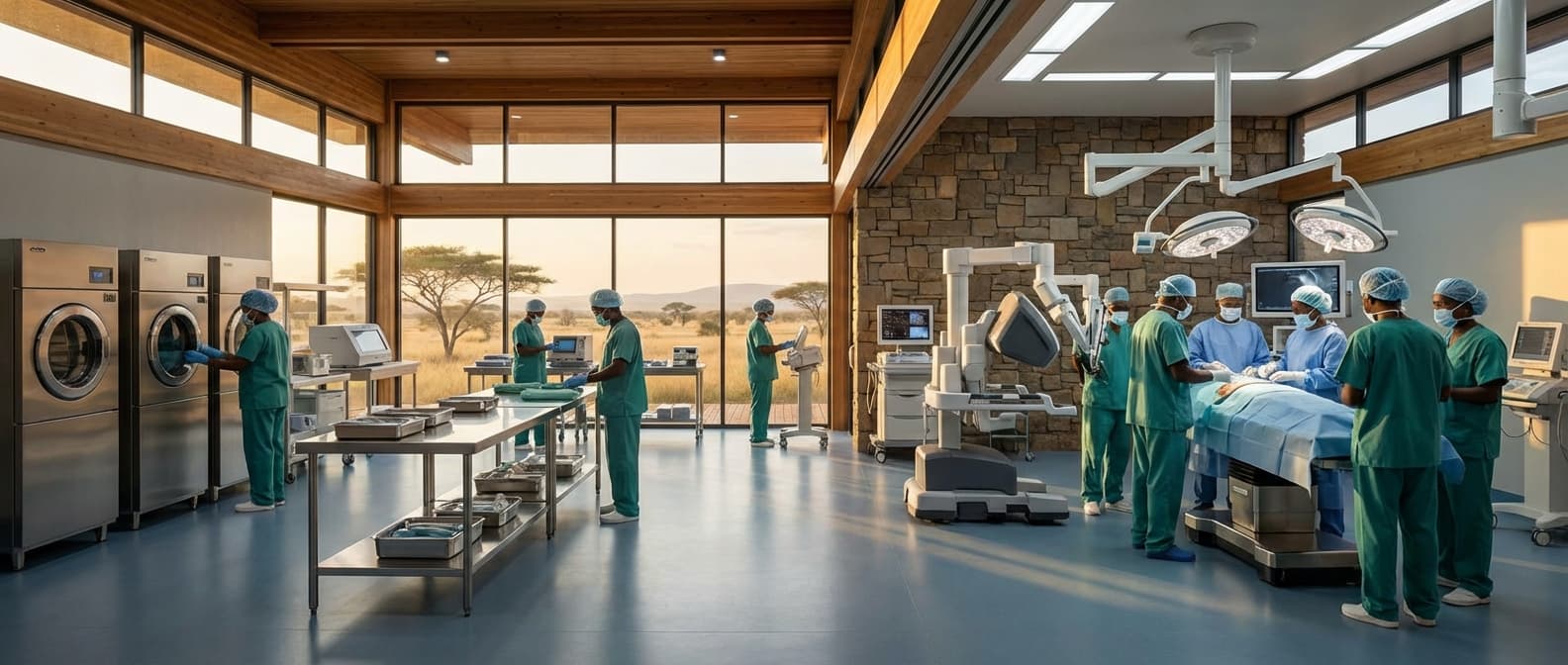
CSSD Design & Validation in Ivory Coast
Engineering Excellence & Technical Support
CSSD workflow design, validation and process development High-standard technical execution following OEM protocols and local regulatory frameworks.
Optimized Sterilization Workflow Design
Implemented advanced CSSD layout designs based on global best practices, ensuring a seamless and efficient flow of sterile processing. This included precise zone separation, optimized equipment placement, and material handling pathways to minimize cross-contamination risks and maximize throughput for healthcare facilities in Ivory Coast.
Rigorous Validation Protocol Development
Developed and executed comprehensive validation protocols for sterilization equipment and processes (e.g., autoclaves, washer-disinfectors) specific to the operational environment and regulatory landscape of Ivory Coast. This ensured consistent efficacy and compliance with international standards, guaranteeing the safety of medical instruments.
Quality Assurance Framework for Sterile Processing
Established robust quality assurance frameworks and continuous monitoring systems for CSSD operations in Ivory Coast. This involved implementing detailed SOPs, training programs for staff, and regular audits to maintain the highest standards of sterile processing, infection prevention, and patient safety.
What Is Cssd Design & Validation In Ivory Coast?
CSSD (Central Sterile Services Department) Design & Validation in Ivory Coast refers to the comprehensive process of planning, engineering, and verifying the functionality and compliance of a sterile processing facility within the Ivorian healthcare landscape. This involves meticulous architectural planning, equipment selection and integration, workflow optimization, and rigorous testing to ensure adherence to international sterilization standards (e.g., ISO 13485, AAMI ST standards) and local regulatory requirements. The service encompasses the entire lifecycle from conceptualization to operational readiness, focusing on creating an environment that guarantees the safety, efficacy, and traceability of sterilized medical devices. This includes considerations for infection control, ergonomics, material flow, environmental controls (HVAC, water quality), waste management, and data management systems.
| Stakeholder/Entity | Need for CSSD Design & Validation | Typical Use Cases |
|---|---|---|
| Hospitals (Public & Private) | To establish or upgrade sterile processing capabilities to meet patient safety standards, reduce healthcare-associated infections (HAIs), ensure regulatory compliance, and optimize operational efficiency. | Construction of new hospital wings, renovation of existing CSSDs, implementation of advanced sterilization technologies, expansion of surgical services. |
| Surgical Centers & Clinics | To ensure the safe and compliant reprocessing of surgical instruments, thereby supporting the delivery of high-quality surgical care and mitigating risks of infection transmission. | Establishment of standalone surgical facilities, modernization of existing surgical suites. |
| Specialized Medical Facilities (e.g., Dental Clinics, Ophthalmology Centers) | To guarantee the sterility of instruments used in specific procedures, adhering to specialized guidelines for their respective fields. | Setting up new specialized clinics, integrating advanced sterilization equipment for unique instrument sets. |
| Medical Device Manufacturers (for R&D or Training Centers) | To design and validate facilities that simulate real-world sterile processing environments for product testing, training, or demonstration purposes. | Establishing a certified training center for their sterilization equipment, conducting in-vitro performance testing of new devices. |
| Government Health Ministries & Regulatory Bodies | To ensure that healthcare facilities adhere to national and international standards for infection control and sterile processing, promoting public health and safety. | Developing and enforcing national guidelines for CSSD operations, conducting site inspections and audits, approving facility designs. |
| International Aid Organizations & NGOs | To support the development and improvement of healthcare infrastructure in underserved regions by establishing compliant and functional sterile processing departments. | Funding and overseeing the construction or renovation of hospitals and clinics, implementing standardized infection control protocols. |
Key Components of CSSD Design & Validation
- Needs Assessment and Feasibility Studies
- Architectural and Interior Design (including cleanroom classification and airflow management)
- Equipment Specification, Procurement, and Integration (autoclaves, washer-disinfectors, sterilizers, instrument tracking systems)
- Workflow Analysis and Optimization (from decontamination to sterile storage)
- Environmental Engineering (HVAC, water purification systems, lighting)
- Material and Personnel Flow Design to prevent cross-contamination
- Validation Protocols Development (IQ, OQ, PQ - Installation Qualification, Operational Qualification, Performance Qualification)
- Installation and Commissioning of Equipment
- Sterilization Process Validation and Verification
- Training of CSSD Personnel
- Development of Standard Operating Procedures (SOPs)
- Compliance Audits and Regulatory Submissions
Who Needs Cssd Design & Validation In Ivory Coast?
Central Sterile Supply Departments (CSSD) are critical hubs within any healthcare facility, responsible for the decontamination, sterilization, and supply of medical instruments. In Ivory Coast, as in many developing nations, ensuring the safety and efficacy of these processes is paramount to patient care and infection prevention. A well-designed and rigorously validated CSSD minimizes the risk of healthcare-associated infections (HAIs) and ensures that medical professionals have access to sterile, functional equipment when they need it most. This is not just a matter of operational efficiency; it's a fundamental requirement for providing high-quality healthcare.
| Target Customer | Key Departments Benefiting |
|---|---|
| Public Hospitals | Operating Theaters, Emergency Rooms, Outpatient Clinics, Intensive Care Units (ICUs), Maternity Wards, all departments requiring surgical instruments and sterile supplies. |
| Private Hospitals & Clinics | Similar to public hospitals, with a strong emphasis on patient safety and the reputation of the facility. Surgeons, nurses, and administrators are key stakeholders. |
| Surgical Centers | Primarily Operating Rooms and recovery areas. Focus is on rapid turnaround of sterile instruments for elective and specialized procedures. |
| Diagnostic Laboratories | Laboratories performing invasive or sterile procedures, such as pathology or microbiology labs, that require sterilized tools and equipment. |
| Government Health Ministries | Responsible for setting standards, ensuring compliance, and overseeing the quality of healthcare services across the nation. They need validation to benchmark and regulate. |
| International NGOs & Aid Organizations | Organizations involved in building or upgrading healthcare infrastructure. They require CSSD design and validation to ensure their investments are compliant with international standards and sustainable. |
Who Needs CSSD Design & Validation in Ivory Coast?
- Hospitals (public and private)
- Clinics and specialized medical centers
- Surgical centers
- Diagnostic laboratories requiring sterile equipment
- Government health ministries and regulatory bodies
- International NGOs and aid organizations involved in healthcare infrastructure
Cssd Design & Validation Process In Ivory Coast
The design and validation process for a Central Sterile Services Department (CSSD) in Ivory Coast is a multi-stage undertaking that begins with a client's inquiry and culminates in a fully operational and validated facility. This workflow ensures that the CSSD meets international standards for infection control, operational efficiency, and patient safety, while also adhering to local regulations and healthcare infrastructure realities. The process can be broadly divided into several key phases, each with its specific activities and deliverables.
| Phase | Description | Key Activities | Deliverables | Key Stakeholders |
|---|---|---|---|---|
| Initial engagement with the client to understand their requirements, existing infrastructure, and specific needs for the CSSD. | Site visit, stakeholder interviews (hospital management, clinical staff, existing CSSD personnel), review of patient load, types of procedures, and sterilization needs. Understanding of current workflows and pain points. | Needs assessment report, preliminary scope of work, initial budget estimation. | Client (Hospital Management, Project Manager), Consultants (CSSD Design Specialists, Infection Control Specialists). |
| Developing a high-level design concept and assessing its viability in terms of space, budget, technology, and regulatory compliance. | Developing layout options, defining functional zones (decontamination, preparation, sterile storage, etc.), identifying key equipment types, preliminary cost analysis, identifying potential challenges and risks. | Conceptual design drawings, preliminary equipment list, feasibility report, refined budget estimate. | Client, Consultants, Architects, Engineers. |
| Translating the conceptual design into detailed architectural, mechanical, electrical, and plumbing (MEP) plans. | Developing detailed drawings for all disciplines, specifying materials and finishes, designing ventilation and air filtration systems (HEPA filters), planning water supply and drainage, electrical load calculations, specifying safety features and workflow optimization. | Complete architectural, MEP, and structural drawings, detailed equipment specifications, bill of quantities, tender documents. | Architects, MEP Engineers, Structural Engineers, CSSD Consultants, Client. |
| Selecting contractors and suppliers, and overseeing the physical construction of the CSSD facility. | Tendering process for construction and equipment, contract negotiation, site preparation, construction of the facility according to detailed plans, quality control inspections, installation of building services. | Constructed CSSD facility, installed building services, progress reports, compliance with construction codes. | Contractors (Construction), Suppliers (Building Materials), Client, Consultants (Supervision). |
| Procuring, installing, and testing all CSSD equipment to ensure it functions as intended. | Procurement of sterilization equipment (autoclaves, washer-disinfectors), instrument tracking systems, sterile storage solutions, etc. Installation of equipment, initial testing (pre-commissioning checks), functional testing under simulated conditions. | Installed and functional CSSD equipment, commissioning reports, operator manuals. | Equipment Suppliers, Commissioning Engineers, CSSD Consultants, Client. |
| A rigorous process to ensure the CSSD and its equipment meet predefined standards and consistently produce sterile products. This typically follows the IQ/OQ/PQ framework. | Installation Qualification (IQ): Verifying correct installation. Operational Qualification (OQ): Verifying equipment operates within defined parameters. Performance Qualification (PQ): Verifying consistent performance under routine use. Biological and chemical indicator testing, documentation review, validation report generation. | IQ/OQ/PQ reports, validation certificates, documented evidence of process validation. | Validation Engineers, Microbiologists, Infection Control Specialists, CSSD Consultants, Client. |
| Ensuring CSSD staff are adequately trained to operate the facility and equipment effectively and safely. | Training on equipment operation, maintenance, sterile processing techniques, infection control protocols, waste management, and emergency procedures. Comprehensive handover of all documentation and systems. | Trained staff, training records, operational manuals, maintenance schedules, final handover documentation. | Trainers (Equipment Suppliers, Consultants), CSSD Staff, Client. |
| Ongoing support and monitoring after the CSSD becomes operational to ensure continued compliance and performance. | Periodic audits, troubleshooting, planned maintenance, updates to protocols, continuous improvement initiatives. | Performance monitoring reports, maintenance logs, updated SOPs, ongoing technical support. | Client, CSSD Consultants, Equipment Suppliers. |
Key Stages of the CSSD Design & Validation Process
- Inquiry & Needs Assessment
- Conceptual Design & Feasibility Study
- Detailed Design & Engineering
- Procurement & Construction
- Equipment Installation & Commissioning
- Validation & Qualification
- Training & Handover
- Post-Implementation Support
Cssd Design & Validation Cost In Ivory Coast
Designing and validating a Central Sterile Services Department (CSSD) in Ivory Coast involves a complex process with costs that can vary significantly. These costs are influenced by a multitude of factors, from the size and scope of the facility to the specific equipment chosen and the regulatory requirements. Understanding these pricing factors is crucial for accurate budgeting and successful project implementation. The overall cost can be broadly categorized into design and planning, equipment procurement, installation and commissioning, and validation and training. Local currency (West African CFA franc - XOF) is used for all transactions. Prices are approximations and can fluctuate based on market conditions, supplier negotiations, and the specific complexity of each project.
| Category | Estimated Cost Range (XOF) | Notes |
|---|---|---|
| Design & Planning Consultancy Fees | 5,000,000 - 25,000,000 | Based on the size and complexity of the facility, and the reputation of the consultants. |
| Minor Renovation/Adaptation of Existing Space | 10,000,000 - 50,000,000 | Includes basic upgrades to plumbing, electrical, ventilation, and flooring. |
| New Construction/Major Renovation for CSSD | 50,000,000 - 200,000,000+ | For dedicated new builds or extensive overhauls, depending on square footage and finishes. |
| Basic Equipment Package (Small to Medium Facility) | 30,000,000 - 100,000,000 | Includes essential items like washer-disinfectors, steam sterilizers (autoclaves), sealing machines, and basic carts. |
| Advanced Equipment Package (Larger Facility/Specialized Needs) | 100,000,000 - 300,000,000+ | Incorporates advanced sterilizers (e.g., low-temperature), automated washing systems, advanced monitoring, and larger capacity units. |
| Specialized Sterilization Equipment (e.g., EtO, H2O2 Plasma) | 20,000,000 - 80,000,000 per unit | Costs vary significantly based on technology and capacity. |
| Installation & Commissioning | 5,000,000 - 20,000,000 | Dependent on the number and complexity of installed equipment. |
| Validation & Testing (IQ/OQ/PQ) | 5,000,000 - 15,000,000 | Covers validation protocols and on-site testing by certified personnel. |
| Staff Training | 2,000,000 - 8,000,000 | For initial training on equipment and protocols. |
| Total Estimated Project Cost (Small Facility) | 50,000,000 - 150,000,000 | Excluding significant new construction. |
| Total Estimated Project Cost (Medium to Large Facility) | 150,000,000 - 500,000,000+ | Highly variable based on scope and choices. |
Key Pricing Factors for CSSD Design & Validation in Ivory Coast
- Facility Size and Capacity: Larger CSSDs requiring more workstations, storage, and higher throughput will naturally incur higher design and equipment costs.
- Scope of Services: The range of sterilization services offered (e.g., steam, low-temperature sterilization like EtO or H2O2 plasma, ultrasonic cleaning) will dictate the types and complexity of equipment needed.
- Level of Automation: The degree of automation in processes like instrument cleaning, packaging, and sterilization directly impacts initial investment in machinery and software.
- Quality of Equipment: Reputable international brands known for durability and advanced features generally command higher prices than local or less established manufacturers.
- Infrastructure Requirements: The existing building's suitability for a CSSD, including ventilation, water supply, drainage, and electrical capacity, can lead to significant renovation or new construction costs.
- Regulatory Compliance: Adherence to Ivorian health regulations and international standards (e.g., ISO, HTM) may necessitate specific design features, materials, and validation protocols, adding to the cost.
- Design and Consultancy Fees: Fees for architects, engineers, and CSSD specialists to plan the layout, workflows, and technical specifications.
- Installation and Commissioning: Costs associated with setting up equipment, connecting utilities, and ensuring everything functions as intended.
- Validation and Testing: Expenses for engineers and technicians to perform performance qualification (PQ) and operational qualification (OQ) to ensure efficacy and safety.
- Training: Costs for training CSSD staff on equipment operation, sterile processing techniques, and quality control procedures.
- Contingency: A crucial buffer for unforeseen expenses that may arise during the project lifecycle.
Affordable Cssd Design & Validation Options
Designing and validating a Central Sterile Services Department (CSSD) is a crucial undertaking for any healthcare facility, ensuring patient safety through effective sterilization processes. While often perceived as an expensive endeavor, there are numerous affordable design and validation options available. This document outlines value bundles and cost-saving strategies to make this essential investment more accessible.
| Strategy | Description | Cost-Saving Impact |
|---|---|---|
| Leverage Existing Infrastructure | Carefully assess and adapt existing spaces and utilities where feasible, rather than undertaking complete new construction. | Significantly reduces capital expenditure on building and infrastructure. |
| Modular & Scalable Design | Design the CSSD with flexibility in mind, allowing for easy expansion or modification of workstations and equipment as needs evolve. | Avoids costly retrofitting or complete overhauls in the future. |
| Standardized Equipment Selection | Opt for widely available and well-supported equipment from reputable manufacturers, potentially negotiating bulk discounts. | Reduces purchase price and simplifies maintenance and spare parts inventory. |
| Phased Validation Approach | Prioritize validation of essential sterilization cycles and critical equipment first, then expand validation as new processes or equipment are introduced. | Spreads validation costs and allows for immediate operational readiness. |
| In-house Training & Competency Development | Invest in robust training programs for CSSD staff to perform routine validation checks and basic troubleshooting. | Reduces the need for frequent external validation specialist visits for routine tasks. |
| Digital Documentation & Workflow Management | Implement digital systems for tracking instruments, managing sterilization cycles, and storing validation data. | Reduces paper costs, improves efficiency, and minimizes errors. |
| Consultant Collaboration for Design Optimization | Engage consultants for targeted design reviews and workflow analysis to identify inefficiencies early on. | Prevents costly design mistakes and optimizes space utilization, saving on renovation or construction costs. |
| Utilize Pre-validated Protocols (where applicable) | Where regulatory bodies or manufacturers provide standardized, pre-validated protocols for specific equipment or processes, leverage these. | Reduces the time and resources required for custom protocol development and validation. |
| Consider Refurbished Equipment (with caution) | For non-critical or supplementary equipment, explore high-quality refurbished options from trusted vendors. | Offers significant cost savings on capital equipment purchases. |
| Energy-Efficient Equipment & Design | Select energy-efficient autoclaves, washers, and dryers, and incorporate good insulation and lighting. | Reduces long-term operational costs through lower utility bills. |
Value Bundles for CSSD Design & Validation
- {"title":"Basic Design & Validation Package","description":"Ideal for smaller facilities or those with existing infrastructure. Includes essential design consultations for layout optimization, workflow analysis, and basic equipment placement. Validation covers essential sterilization cycles and critical equipment performance testing. This package prioritizes core compliance and functional efficiency at a lower entry cost."}
- {"title":"Standard Design & Validation Package","description":"Suitable for medium-sized facilities or those undergoing moderate renovations. Expands on the basic package with more detailed space planning, ergonomic considerations, and initial workflow optimization. Validation includes a broader range of sterilization cycles, equipment calibration, and basic documentation support."}
- {"title":"Comprehensive Design & Validation Package","description":"Tailored for larger facilities or new constructions requiring a fully optimized and compliant CSSD. Features in-depth space utilization studies, advanced workflow simulation, integration with other hospital departments, and selection of appropriate technologies. Validation is extensive, encompassing all sterilization methods, complex equipment performance, environmental monitoring, and robust documentation and training programs."}
- {"title":"Phased Implementation Bundle","description":"Allows facilities to spread the cost of design and validation over time. This bundle breaks down the project into manageable phases, starting with essential design elements and validation of critical processes, followed by subsequent phases for advanced features or equipment upgrades as budget allows."}
- {"title":"Consultative Support & Training Bundle","description":"Focuses on empowering in-house staff. This bundle includes expert guidance on design principles, workflow best practices, and validation protocols, combined with comprehensive training for CSSD personnel. This reduces reliance on external validation services in the long term."}
Verified Providers In Ivory Coast
In Ivory Coast's evolving healthcare landscape, access to verified and reputable providers is paramount. Franance Health stands out as a beacon of trust and quality, offering unparalleled credentials and a commitment to patient well-being. This makes them the best choice for individuals and families seeking reliable healthcare services.
| Provider Type | Franance Health Verification Standard | Benefits for Patients |
|---|---|---|
| Hospitals | Accredited by national and international health organizations (e.g., ISO certified, Joint Commission International equivalents) | Access to advanced facilities, emergency care, and specialized departments. |
| Clinics | Licensed by the Ministry of Health, with ongoing quality assurance checks | Convenient access to primary care, specialist consultations, and diagnostic services. |
| Specialist Doctors | Verified medical degrees, board certifications, and active licenses | Expert diagnosis and treatment for specific medical conditions. |
| Diagnostic Laboratories | Accredited by relevant regulatory bodies, ensuring accuracy and reliability of tests | Precise and timely diagnostic results for effective treatment planning. |
Key Franance Health Credentials and Benefits
- Rigorous Accreditation and Certification: Franance Health partners exclusively with healthcare facilities and professionals who undergo stringent accreditation processes, ensuring adherence to international quality standards.
- Experienced and Specialized Medical Professionals: Our network comprises highly qualified doctors, nurses, and specialists with extensive experience and expertise in their respective fields, guaranteeing advanced medical care.
- Commitment to Patient Safety and Ethical Practices: Franance Health prioritizes patient safety above all else. All partnered providers adhere to strict ethical guidelines and best practices in healthcare delivery.
- Advanced Diagnostic and Treatment Capabilities: We collaborate with facilities equipped with state-of-the-art medical technology, enabling accurate diagnoses and effective treatment plans.
- Patient-Centric Approach: Franance Health is dedicated to providing a seamless and supportive patient experience, focusing on clear communication, personalized care, and timely access to services.
- Comprehensive Range of Services: From general consultations to specialized treatments, Franance Health offers a wide spectrum of medical services to meet diverse healthcare needs.
- Transparency and Trust: We maintain full transparency regarding provider qualifications and service offerings, fostering a relationship of trust with our clients.
Scope Of Work For Cssd Design & Validation
This Scope of Work (SOW) outlines the design and validation requirements for a Central Sterile Supply Department (CSSD) to ensure optimal functionality, safety, and compliance with relevant standards. The project encompasses the detailed design of the CSSD layout, workflows, equipment selection, and the subsequent validation process to confirm that the designed system effectively meets its intended purpose.
| Technical Deliverable | Description | Standard Specifications / References |
|---|---|---|
| CSSD Master Plan & Layout Drawings | Detailed floor plans including all functional areas (decontamination, sterile storage, sterile packing, sterile storage, etc.), equipment placement, traffic flow, and ventilation zones. | ISO 13485, HTM 01-01 (UK), ASNZS 4187 (Australia/New Zealand), local building codes, infection control guidelines (e.g., CDC, WHO). |
| Equipment Specifications & Selection Report | Detailed technical specifications for all required equipment (washers, sterilizers, ultrasonic cleaners, drying cabinets, packaging machines, etc.), including performance requirements, capacity, and utility needs. Includes justification for selected models. | Manufacturer's specifications, CE marking, FDA approval (if applicable), relevant ISO standards for specific equipment (e.g., ISO 17665 for steam sterilizers, ISO 11140 series for chemical indicators). |
| Workflow Diagrams & Procedures | Comprehensive documentation of all CSSD processes, from soiled item reception to sterile item dispatch, including SOPs for decontamination, inspection, assembly, packaging, sterilization, storage, and distribution. | Infection control principles, quality management system requirements, staff competency and training matrices. |
| Utility Requirements & Integration Plan | Detailed specifications for water (quality, flow rates), electricity (voltage, power), steam (pressure, quality), and drainage systems required for CSSD operations. Plan for integration with existing building services. | Water quality standards (e.g., USP Purified Water), electrical safety standards, steam generation and distribution guidelines. |
| Ventilation & Environmental Control Design | Design for HVAC systems to ensure appropriate air changes, pressure differentials between zones, temperature, and humidity control for optimal sterile conditions and staff safety. | ASHRAE standards, local building codes, infection control guidelines for air handling in healthcare facilities. |
| Installation Qualification (IQ) Protocol & Report | Documented procedures to verify that all equipment and systems are installed correctly according to the design specifications and manufacturer's requirements. | ISPE guidelines, GAMP 5, specific equipment IQ protocols. |
| Operational Qualification (OQ) Protocol & Report | Documented procedures to verify that all equipment and systems operate as intended within their defined operating ranges and specifications. | ISPE guidelines, GAMP 5, specific equipment OQ protocols, manufacturer's operating manuals. |
| Performance Qualification (PQ) Protocol & Report | Documented procedures to verify that the CSSD, as a whole system, consistently produces sterile products that meet predefined quality attributes under normal operating conditions. | ISPE guidelines, GAMP 5, specific validation studies for sterilization cycles, challenge packs, biological indicators, chemical indicators. |
| Validation Master Plan (VMP) / Validation Strategy | An overarching document outlining the validation approach for the CSSD, including scope, responsibilities, timelines, and revalidation strategy. | Regulatory requirements (e.g., FDA, EMA), industry best practices. |
| Risk Assessment Report | Identification, analysis, and evaluation of potential risks to the quality and sterility of medical devices processed in the CSSD. Includes mitigation strategies. | ISO 14971, relevant quality management system standards. |
Key Project Phases
- Design Phase: Conceptualization, detailed design, equipment specification, and integration planning.
- Validation Phase: Installation Qualification (IQ), Operational Qualification (OQ), Performance Qualification (PQ), and ongoing validation/revalidation strategy.
Service Level Agreement For Cssd Design & Validation
This Service Level Agreement (SLA) outlines the performance standards and commitments for the design and validation of Central Sterile Supply Department (CSSD) facilities. It defines the expected response times for support requests and the guaranteed uptime for critical CSSD systems. The objective is to ensure the operational continuity and efficiency of sterile processing services.
| Service Component | Response Time Guarantee | Uptime Guarantee | Notes |
|---|---|---|---|
| CSSD Design Consultation & Review: Initial response to requests for design input or review. | 8 Business Hours | N/A | Applicable during standard business hours (e.g., Monday-Friday, 9 AM - 5 PM). |
| Validation Protocol Development Assistance: Response to requests for support in developing IQ, OQ, PQ protocols. | 1 Business Day | N/A | Assistance provided includes guidance and template review, not full protocol generation. |
| Validation Execution Support (On-site/Remote): Response to urgent requests for support during validation testing. | 4 Business Hours | N/A | On-site response time is subject to travel availability and agreed-upon logistical arrangements. |
| Critical System Malfunction (During Validation): Immediate response to critical system failures impacting ongoing validation. | 1 Business Hour | N/A | Focus on initial diagnosis and escalation. Resolution time will vary. |
| Sterilizers & Washer-Disinfectors (Post-Validation Uptime): Guaranteed operational availability. | N/A | 98% (excluding scheduled maintenance) | Applies to equipment that has successfully completed validation. Does not cover user error or consumables. |
| Environmental Monitoring Systems (Post-Validation Uptime): Guaranteed operational availability. | N/A | 99% (excluding scheduled maintenance) | Essential for maintaining sterile storage conditions. |
| Routine Design Review & Updates: Response to requests for non-urgent design clarifications or minor updates. | 2 Business Days | N/A | For ongoing projects or post-project support as defined in a separate support agreement. |
Key Definitions
- CSSD Design & Validation: The process of planning, specifying, and verifying the functionality and compliance of a CSSD facility, including equipment, workflow, and environmental controls.
- Critical CSSD Systems: Essential components of the CSSD that directly impact sterilization and patient safety, including sterilizers, washer-disinfectors, sterile storage areas, and associated monitoring and control systems.
- Service Request: Any formal communication from the client to the service provider requesting support, issue resolution, or modification related to CSSD design or validation.
- Downtime: The period during which a critical CSSD system is unavailable or not functioning as intended, preventing its use for its designed purpose.
- Uptime: The period during which a critical CSSD system is available and functioning correctly.
Frequently Asked Questions

Ready when you are
Let's scope your CSSD Design & Validation in Ivory Coast project in Ivory Coast.

Scaling healthcare logistics and technical systems across the entire continent.