
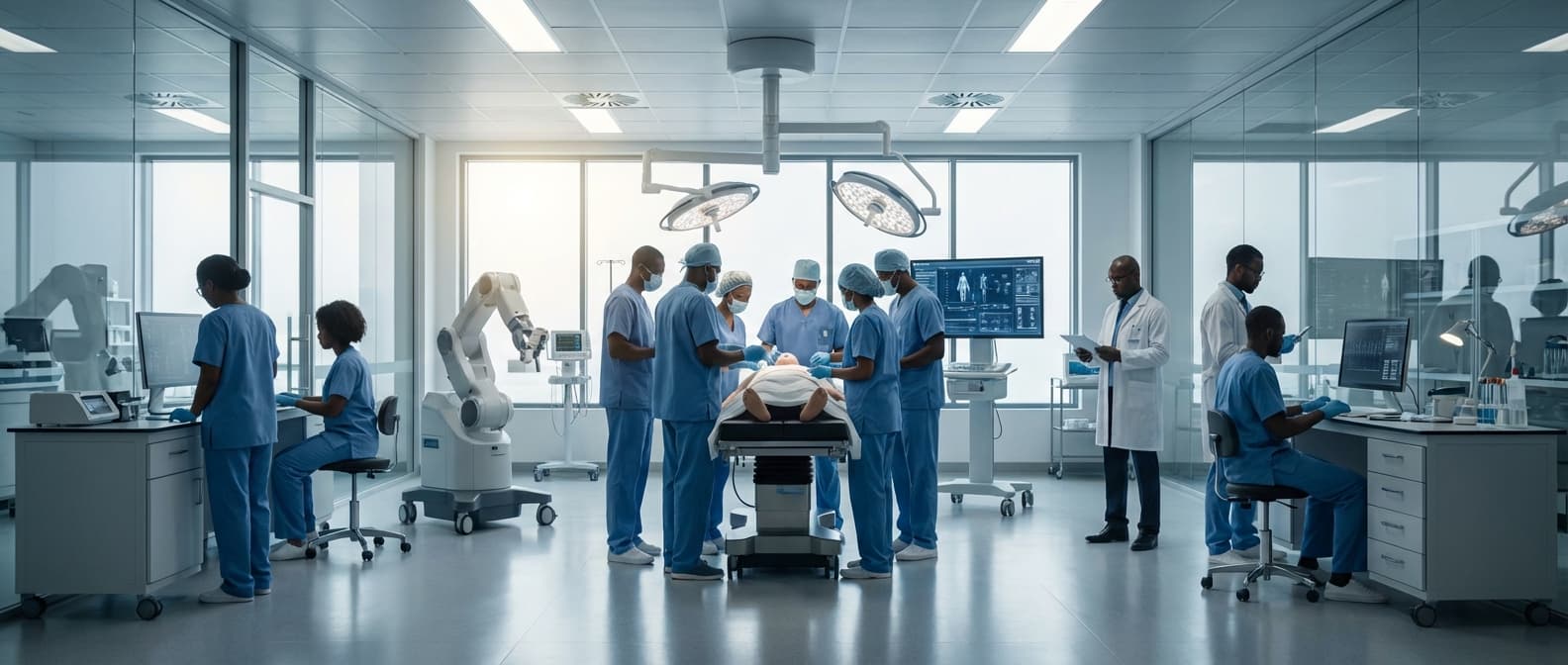
Biomedical Engineering Consulting in Ivory Coast
Engineering Excellence & Technical Support
Equipment selection, procurement and implementation consulting High-standard technical execution following OEM protocols and local regulatory frameworks.
Optimizing Medical Device Integration & Training
We specialize in the seamless integration of advanced medical devices into existing healthcare infrastructure across Ivory Coast. Our expert engineers provide comprehensive training programs for medical professionals, ensuring efficient operation, patient safety, and maximized ROI for hospitals and clinics.
Bridging Research Gaps with Localized Solutions
Leveraging global biomedical innovation, we tailor solutions to address Ivory Coast's unique healthcare challenges. Our consulting services facilitate the adaptation and implementation of cutting-edge research and technologies, improving diagnostic accuracy and treatment efficacy for local populations.
Healthcare Facility Design & Regulatory Compliance
We offer end-to-end consulting for the design and renovation of healthcare facilities, focusing on optimal workflow, infection control, and compliance with Ivorian health regulations. Our expertise ensures that new and existing facilities meet international standards for quality patient care.
What Is Biomedical Engineering Consulting In Ivory Coast?
Biomedical Engineering Consulting in Ivory Coast entails the provision of expert technical and scientific advice to organizations involved in the healthcare sector, medical device development, and life sciences research. This service bridges the gap between complex engineering principles and practical healthcare applications, addressing challenges related to medical equipment, healthcare infrastructure, regulatory compliance, and innovation within the Ivorian context.
| Who Needs Biomedical Engineering Consulting? | Typical Use Cases in Ivory Coast |
|---|---|
| Hospitals and Healthcare Providers: Public and private hospitals, clinics, diagnostic centers, and specialized medical facilities. | Hospital Planning and Modernization: Designing new medical facilities or upgrading existing ones with advanced medical equipment and infrastructure. Equipment Lifecycle Management: Developing strategies for procurement, installation, maintenance, and eventual replacement of medical devices. Improving Patient Care Quality: Implementing technologies and protocols that enhance diagnostic accuracy, treatment efficacy, and patient safety. |
| Medical Device Manufacturers and Distributors: Companies developing, producing, importing, or distributing medical equipment and consumables. | Market Entry and Regulatory Approval: Navigating Ivorian regulations for medical device registration and market authorization. Product Development and Localization: Adapting medical devices for the specific needs and environmental conditions of Ivory Coast. Quality Assurance and Compliance: Establishing and maintaining quality management systems to meet international standards. |
| Government and Regulatory Bodies: Ministries of Health, national drug regulatory agencies, and public health institutions. | Policy Development and Standardization: Informing policies related to medical technology adoption, safety, and efficacy. Procurement Oversight: Ensuring the acquisition of appropriate and high-quality medical equipment for public health programs. Capacity Building Initiatives: Developing training programs for healthcare personnel. |
| Research Institutions and Universities: Academic and research organizations involved in biomedical sciences and engineering. | Research Project Support: Providing technical expertise for research involving medical devices, diagnostics, and therapeutic technologies. Innovation and Technology Transfer: Facilitating the translation of research findings into practical healthcare solutions. Curriculum Development: Advising on educational programs for biomedical engineers and technicians. |
| Non-Governmental Organizations (NGOs) and International Development Agencies: Organizations focused on improving healthcare access and outcomes. | Project Implementation and Sustainability: Planning and executing healthcare infrastructure and equipment-related projects. Needs Assessments for Humanitarian Aid: Evaluating healthcare needs in underserved areas and recommending appropriate technological interventions. Training and Support for Local Healthcare Systems: Building the capacity of local healthcare providers. |
Key Aspects of Biomedical Engineering Consulting in Ivory Coast
- Needs Assessment and Technology Selection: Evaluating current healthcare infrastructure and identifying appropriate medical technologies, equipment, and systems to meet specific clinical and operational requirements.
- Equipment Planning and Procurement: Developing comprehensive plans for the acquisition, installation, and commissioning of medical devices, ensuring alignment with budgetary constraints and facility design.
- Medical Device Development Support: Assisting local and international companies in the design, prototyping, testing, and regulatory approval processes for new medical devices intended for the Ivorian market or for export.
- Healthcare Facility Design and Optimization: Providing engineering input for the design and renovation of hospitals, clinics, and laboratories, focusing on workflow efficiency, infection control, and technological integration.
- Regulatory Affairs and Compliance: Guiding clients through the complex landscape of Ivorian and international regulations governing medical devices, pharmaceuticals, and healthcare services, including quality management systems (e.g., ISO 13485).
- Training and Capacity Building: Developing and delivering training programs for healthcare professionals and technical staff on the operation, maintenance, and troubleshooting of medical equipment.
- Maintenance and Service Strategy: Establishing robust preventative and corrective maintenance programs for medical equipment to ensure optimal performance, longevity, and patient safety.
- Biocompatibility and Sterilization Consulting: Advising on material selection for medical devices to ensure biocompatibility and providing expertise on sterilization validation and processes.
- Biomedical Research and Development Support: Offering technical expertise to research institutions and universities for projects involving medical technology innovation and scientific advancement.
- Telemedicine and Digital Health Integration: Advising on the implementation and integration of telemedicine platforms, electronic health records, and other digital health solutions.
Who Needs Biomedical Engineering Consulting In Ivory Coast?
Biomedical Engineering (BME) consulting services are increasingly vital for healthcare institutions, research organizations, and medical device manufacturers in Ivory Coast. As the nation strives to improve healthcare access, quality, and technological integration, specialized BME expertise becomes indispensable. These consultants bridge the gap between advanced medical technology and its effective, safe, and efficient implementation within the Ivorian context. They help navigate regulatory landscapes, optimize equipment lifecycle management, and foster innovation in medical device development and adoption.
| Target Customer | Key Departments/Needs |
|---|---|
| Hospitals and Clinics (Public and Private) | Procurement and Inventory Management (equipment selection, purchasing) Biomedical Engineering Department (equipment maintenance, repair, calibration, risk management) Clinical Engineering (ensuring safe and effective use of medical devices) IT Department (integration of medical devices with hospital information systems) Infection Control Department (sterilization and disinfection protocols for equipment) Quality Assurance Department (compliance with medical device standards) Strategic Planning Department (facility design, technology roadmaps) |
| Medical Device Manufacturers and Distributors | Product Development and Design (local adaptation, regulatory compliance) Market Research and Entry Strategy (understanding local needs and regulations) Regulatory Affairs (navigating Ivorian medical device registration and approval) Sales and Marketing Support (technical expertise for sales teams) After-Sales Service and Technical Support (training local technicians, spare parts management) Quality Control and Assurance (ensuring product quality and safety) |
| Research and Development Institutions | Experimental Design and Protocol Development (equipment selection, data acquisition) Data Analysis and Interpretation (specialized software and hardware) Lab Management and Safety (equipment maintenance, biosafety protocols) Technology Transfer and Commercialization (assisting in bringing innovations to market) |
| Government Ministries and Regulatory Bodies | Policy Development and Healthcare Planning (standards, guidelines for medical technology) Regulatory Oversight and Enforcement (licensing of medical devices and facilities) Public Health Initiatives (technology assessment for national programs) Capacity Building and Training (developing local BME expertise) |
| Non-Governmental Organizations (NGOs) in Healthcare | Needs Assessment for Medical Equipment (determining appropriate technology for specific projects) Procurement and Logistics of Medical Devices (ensuring efficient and cost-effective acquisition) Equipment Installation and Training (setting up and training local staff on new equipment) Maintenance and Sustainability Planning (ensuring long-term functionality of donated or purchased equipment) |
Who Needs Biomedical Engineering Consulting in Ivory Coast?
- Hospitals and Clinics (Public and Private)
- Medical Device Manufacturers and Distributors
- Research and Development Institutions
- Government Ministries and Regulatory Bodies
- Non-Governmental Organizations (NGOs) in Healthcare
Biomedical Engineering Consulting Process In Ivory Coast
The Biomedical Engineering Consulting process in Ivory Coast follows a structured workflow designed to address the unique needs of healthcare facilities, manufacturers, and regulatory bodies. This process ensures that clients receive expert guidance and solutions for their biomedical engineering challenges, from initial contact to project completion and ongoing support.
| Phase | Description | Key Activities | Deliverables |
|---|---|---|---|
| Inquiry and Initial Consultation | The client initiates contact, expressing their need for biomedical engineering expertise. This phase focuses on understanding the broad nature of the client's requirement and establishing a foundation for collaboration. | Initial contact (email, phone, meeting), Understanding client's general needs, Preliminary discussion of potential solutions. | Understanding of client's problem statement, Initial assessment of feasibility. |
| Needs Assessment and Scope Definition | A detailed analysis of the client's specific situation is conducted to identify precise requirements, constraints, and objectives. This forms the basis for the project's scope. | On-site visits (if applicable), Interviews with stakeholders, Review of existing documentation (equipment inventory, facility layouts), Identifying technical and operational challenges. | Detailed needs assessment report, Defined project scope, List of project objectives and key performance indicators (KPIs). |
| Proposal Development and Agreement | Based on the needs assessment, a comprehensive proposal outlining the scope of work, methodology, timeline, budget, and expected outcomes is prepared and presented to the client. | Developing a tailored technical and commercial proposal, Defining deliverables and milestones, Negotiating terms and conditions, Finalizing contract/agreement. | Formal project proposal, Signed contract or service agreement. |
| Project Planning and Resource Allocation | Once the agreement is in place, a detailed project plan is created, including task breakdown, resource assignment, risk assessment, and communication protocols. | Developing a detailed project schedule, Identifying and assigning project team members, Allocating necessary equipment and tools, Establishing communication channels and reporting frequency. | Detailed project plan, Resource allocation matrix, Risk management plan. |
| Data Collection and Analysis | Relevant data is gathered through various methods depending on the project. This could involve surveys, equipment performance logs, user feedback, or regulatory requirements. | Collecting technical specifications, Performance data, User feedback, Regulatory compliance information, Analyzing collected data to identify trends and root causes. | Data analysis report, Identified key issues and opportunities. |
| Solution Development and Design | Creative and evidence-based solutions are developed and designed to address the identified needs and challenges. This may involve recommending equipment upgrades, implementing new protocols, or designing new systems. | Brainstorming and ideation, Designing technical solutions, Developing operational workflows, Considering local context and available resources, Simulating or modeling solutions. | Technical designs, Workflow diagrams, Recommended solutions, Design specifications. |
| Implementation and Execution | The approved solutions are put into practice. This is the phase where the consultant actively works with the client to bring the designed solutions to fruition. | Procurement support (if applicable), Installation and configuration of equipment, Training of personnel, Rollout of new procedures, System integration. | Implemented solutions, Trained personnel, Integrated systems. |
| Testing, Validation, and Quality Assurance | Rigorous testing and validation are conducted to ensure that the implemented solutions meet the defined objectives and quality standards. | Performing functional tests, Performance validation, User acceptance testing (UAT), Ensuring compliance with relevant standards and regulations. | Test reports, Validation certificates, Quality assurance documentation. |
| Training and Knowledge Transfer | Comprehensive training is provided to the client's staff to ensure they can effectively operate, maintain, and manage the new systems or processes. | Developing training materials, Conducting hands-on training sessions, Providing operational manuals, Q&A sessions. | Trained staff, User manuals, Training effectiveness report. |
| Project Completion and Handover | The project is formally concluded, and all deliverables are handed over to the client. This includes final documentation and a review of project outcomes. | Final project review meeting, Submission of all project documentation, Formal handover of implemented solutions, Project closure report. | Final project report, All project deliverables, Project sign-off. |
| Post-Implementation Support and Evaluation | Ongoing support is provided to address any unforeseen issues and to evaluate the long-term impact and success of the implemented solutions. | Troubleshooting and technical support, Performance monitoring, Periodic evaluations, Recommendations for continuous improvement. | Support logs, Performance evaluation reports, Recommendations for future enhancements. |
Biomedical Engineering Consulting Workflow in Ivory Coast
- Inquiry and Initial Consultation
- Needs Assessment and Scope Definition
- Proposal Development and Agreement
- Project Planning and Resource Allocation
- Data Collection and Analysis
- Solution Development and Design
- Implementation and Execution
- Testing, Validation, and Quality Assurance
- Training and Knowledge Transfer
- Project Completion and Handover
- Post-Implementation Support and Evaluation
Biomedical Engineering Consulting Cost In Ivory Coast
Biomedical engineering consulting in Ivory Coast, like in many developing economies, is influenced by a blend of global best practices and localized cost structures. The cost of engaging a biomedical engineering consultant can vary significantly depending on the scope of the project, the consultant's expertise and reputation, the duration of the engagement, and the specific services required. These services can range from facility planning and equipment selection to regulatory compliance, quality management systems, and technology implementation. Local economic conditions, overhead costs for consulting firms, and the complexity of the healthcare landscape in Ivory Coast also play a crucial role in determining pricing. Consultants often factor in their operational expenses, including research, travel within the country, and administrative support, when formulating their fees.
| Service Type / Engagement Level | Estimated Daily Rate Range (XOF) | Estimated Project Cost Range (XOF) |
|---|---|---|
| Junior Consultant / Basic Advisory (e.g., preliminary needs assessment, general equipment advice) | 100,000 - 200,000 | 500,000 - 2,000,000 |
| Mid-Level Consultant / Standard Project (e.g., equipment selection, facility layout planning, basic QM implementation) | 200,000 - 400,000 | 2,000,000 - 10,000,000 |
| Senior Consultant / Complex Project (e.g., strategic planning, full system implementation, regulatory approval assistance, technology roadmapping) | 400,000 - 700,000+ | 10,000,000 - 50,000,000+ |
| Specialized Expertise (e.g., niche medical technology, advanced diagnostics, specific regulatory pathways) | Varies significantly based on demand and expertise (often higher than senior rates) | Varies significantly based on scope and complexity |
| Hourly Rate (for short consultations or specific tasks) | 50,000 - 150,000 | N/A |
Key Pricing Factors for Biomedical Engineering Consulting in Ivory Coast
- Scope and Complexity of the Project: Larger, more intricate projects requiring extensive research, analysis, and detailed deliverables will naturally incur higher costs.
- Consultant's Experience and Specialization: Highly experienced consultants or those with niche specializations (e.g., medical imaging, radiotherapy, surgical equipment) command premium rates.
- Duration of Engagement: Projects requiring short-term, focused interventions will be priced differently than long-term strategic partnerships or ongoing advisory roles.
- Deliverables and Reporting Requirements: The depth and formality of reports, training materials, or implementation plans required will impact the time and resources allocated, and thus the cost.
- Geographic Location of the Project: While most consulting is conducted at the client's site, travel and accommodation costs within Ivory Coast can add to the overall expense.
- Regulatory Landscape: Navigating Ivory Coast's specific medical device and healthcare facility regulations can be time-consuming and require specialized knowledge, influencing consulting fees.
- Technology and Innovation Focus: Consulting on the adoption of advanced or novel biomedical technologies may involve higher costs due to the specialized expertise needed.
- Client's Budget and Negotiation: The client's financial capacity and the negotiation process can also influence the final agreed-upon fee.
Affordable Biomedical Engineering Consulting Options
Biomedical engineering consulting can be a crucial resource for medical device companies, startups, and research institutions, offering expertise in areas like product development, regulatory affairs, quality systems, and market access. However, the cost of specialized consulting can be a barrier, especially for smaller organizations or those with limited budgets. This guide explores affordable biomedical engineering consulting options, focusing on value bundles and cost-saving strategies. We will outline different engagement models and provide actionable advice to maximize your return on investment.
| Consulting Engagement Model | Description | Cost-Effectiveness Strategy |
|---|---|---|
| Project-Based Consulting | Defined scope, deliverables, and timeline for a specific project (e.g., developing a QMS for a new device). | Best for specific, well-defined problems. Get detailed proposals with clear deliverables and milestones. Negotiate fixed-price agreements where possible. |
| Retainer-Based Consulting | Ongoing access to expertise on a monthly or annual basis, often with a set number of hours or dedicated support. | Ideal for companies needing continuous guidance or facing evolving regulatory landscapes. Explore tiered retainers based on needs. Leverage proactive advice to prevent future issues. |
| Value-Based Pricing | Fees are tied to the successful outcome or value delivered to the client (e.g., successful regulatory submission, increased market share). | Less common but highly aligned with client success. Requires strong trust and clear metrics. Focus on consultants willing to share in the risk and reward. |
| Fractional Expertise | Hiring a consultant for a set number of hours per week/month to fill a specific skill gap without the overhead of a full-time employee. | Cost-effective for specialized roles (e.g., regulatory affairs manager, quality engineer) that are needed intermittently. Provides access to high-level expertise at a fraction of executive salaries. |
| Team Augmentation | Consultants work alongside your internal team to supplement capabilities or expedite projects. | Useful for boosting capacity during peak workloads or when internal skills are lacking. Clearly define roles and responsibilities to avoid duplication and ensure efficient integration. |
Understanding Value in Biomedical Engineering Consulting
- {"title":"Defining Value Beyond Hourly Rates","description":"Value in consulting isn't just about the lowest hourly fee. It encompasses the quality of expertise, the speed of problem-solving, the successful outcome of the project, and the long-term benefits gained. A higher initial investment might yield significantly better results and avoid costly mistakes down the line."}
- {"title":"Key Areas Where Consulting Adds Value","sublist":["Product Design & Development","Regulatory Strategy & Submissions (FDA, CE Mark)","Quality Management System (QMS) Implementation & Audits","Clinical Trial Design & Management","Market Access & Reimbursement Strategies","Intellectual Property (IP) Strategy","Manufacturing & Supply Chain Optimization","Risk Management & Post-Market Surveillance"],"description":"Consultants can provide critical insights and execute complex tasks in areas such as:"}
- {"title":"Identifying the Right Expertise","description":"The most valuable consulting is tailored to your specific needs. Clearly define your project scope, objectives, and desired outcomes to attract consultants with the most relevant experience and avoid paying for unnecessary services."}
Verified Providers In Ivory Coast
In the Ivory Coast's dynamic healthcare landscape, identifying trustworthy and qualified providers is paramount for ensuring quality medical care. Franance Health has established itself as a benchmark for excellence, meticulously vetting its network to guarantee patients receive the highest standard of service. This commitment to credential verification not only builds patient confidence but also fosters a more reliable and effective healthcare ecosystem.
| Credential Type | Franance Health Assurance | Benefit to Patient |
|---|---|---|
| Licensing & Accreditation | Verified Compliance with National Standards | Guaranteed lawful and safe practice. |
| Board Certification | Confirmation of Specialized Expertise | Access to highly skilled and recognized specialists. |
| Ongoing Training | Commitment to Latest Medical Knowledge | Receiving care informed by current research and techniques. |
| Performance Evaluation | Focus on Quality Outcomes & Patient Satisfaction | Higher likelihood of positive treatment results and a better overall patient experience. |
| Ethical Review | Adherence to Professional Integrity | Trustworthy and compassionate care from ethical practitioners. |
Key Franance Health Credentials & Why They Matter
- {"title":"Licensing and Accreditation Verification","description":"Franance Health rigorously checks that all affiliated healthcare professionals and facilities possess valid government licenses and relevant accreditations. This ensures they meet established national and international standards for practice and patient safety."}
- {"title":"Specialty Board Certification Review","description":"For specialists, Franance Health verifies board certifications in their respective fields. This confirms advanced training and expertise, assuring patients they are receiving care from genuinely qualified experts."}
- {"title":"Continuous Professional Development (CPD) Monitoring","description":"The organization actively monitors the ongoing education and training of its providers. This commitment to CPD ensures practitioners stay current with the latest medical advancements, techniques, and best practices."}
- {"title":"Peer Review and Performance Tracking","description":"Franance Health implements a system of peer review and performance tracking. This involves confidential assessments of clinical outcomes and patient feedback, identifying and rewarding high-performing providers while addressing areas for improvement."}
- {"title":"Background Checks and Ethical Standing","description":"Comprehensive background checks and a review of ethical standing are conducted to ensure all providers adhere to the highest professional integrity and ethical guidelines."}
Scope Of Work For Biomedical Engineering Consulting
This Scope of Work (SOW) outlines the services to be provided by the Biomedical Engineering Consulting firm (hereinafter referred to as "Consultant") to the Client (hereinafter referred to as "Client"). The objective of this engagement is to leverage the Consultant's expertise in biomedical engineering to address specific technical challenges and opportunities within the Client's organization. The project will encompass research, design, development, validation, and regulatory support related to biomedical devices, systems, or processes. This SOW details the technical deliverables and associated standard specifications to ensure the successful completion of the project.
| Deliverable | Standard Specification/Reference | Description | Acceptance Criteria |
|---|---|---|---|
| Needs Assessment Report | ISO 9000 series, Client's internal requirements | Comprehensive analysis of Client's requirements, problem statement, and project objectives. | Report is clear, concise, addresses all stated client needs, and is approved by Client's designated representative. |
| Feasibility Study Report | Industry best practices for R&D projects | Evaluates technical, market, and financial viability of the proposed solution, including preliminary risk assessment. | Report provides a clear go/no-go recommendation with supporting data and identifies key risks and mitigation strategies. |
| Conceptual Design Specifications | IEC 60601-1 (if applicable for medical devices), internal design standards | High-level description of the intended functionality, architecture, and key features of the device/system. | Specifications are complete, unambiguous, and agreed upon by both parties. |
| Detailed Design Specifications | Relevant standards (e.g., IEEE for software, ASTM for materials), client-specific engineering standards | Comprehensive documentation outlining all aspects of the design, including hardware, software, mechanical, and electrical components. | All design elements are fully defined, traceable to requirements, and reviewed by Client's technical team. |
| Verification Test Plan/Report | ISO 13485 (for medical devices), internal V&V protocols | Document outlining the plan to test that the design outputs meet the design inputs. The report details the results of these tests. | Test plan is approved by Client. Test reports demonstrate that all design inputs have been met through objective evidence. |
| Validation Test Plan/Report | ISO 13485 (for medical devices), FDA guidance documents, intended use case scenarios | Document outlining the plan to test that the device/system meets the user needs and intended uses. The report details the results of these tests. | Test plan is approved by Client. Test reports demonstrate that the device/system is suitable for its intended use in the target environment. |
| Technical File/Design Dossier (draft) | EU MDR 2017/745, FDA 21 CFR Part 820, relevant harmonized standards | A compilation of documentation demonstrating compliance with regulatory requirements for market access. | Documentation is comprehensive, well-organized, and aligns with the chosen regulatory pathway. Reviewed and approved by Client. |
| User Manuals | IEC 62366 (Usability Engineering for Medical Devices), client's brand guidelines | Clear and concise instructions for the safe and effective operation of the device/system. | Manuals are accurate, easy to understand, and cover all operational aspects. Approved by Client. |
Key Project Phases and Deliverables
- {"items":["Detailed Needs Assessment Report","Market Analysis and Competitive Landscape Report","Feasibility Study Report (including risk assessment and preliminary technical approach)","Project Plan and Timeline"],"title":"Phase 1: Discovery and Feasibility Study","description":"Initial assessment of the client's needs, market landscape, and technical viability of proposed solutions."}
- {"items":["Conceptual Design Specifications","System Architecture Diagrams","Proof-of-Concept Prototype (if applicable)","Initial User Interface/User Experience (UI/UX) Design"],"title":"Phase 2: Conceptual Design and Prototyping","description":"Development of preliminary design concepts and creation of functional prototypes."}
- {"items":["Detailed Design Specifications (Hardware, Software, Mechanical)","Bill of Materials (BOM)","Engineering Drawings (CAD models, schematics)","Software Design Documentation","Alpha Prototype"],"title":"Phase 3: Detailed Design and Development","description":"Refinement of the design, development of detailed engineering drawings, software, and hardware components."}
- {"items":["Verification Test Plan","Verification Test Reports","Validation Test Plan","Validation Test Reports","Beta Prototype"],"title":"Phase 4: Verification and Validation (V&V)","description":"Testing of the device/system to ensure it meets design specifications and intended use requirements."}
- {"items":["Regulatory Strategy Document","Technical File/Design Dossier (draft)","Pre-submission Meeting Support (if required)","Submission Documentation Review"],"title":"Phase 5: Regulatory Strategy and Submission Support","description":"Development of a regulatory pathway and preparation of documentation for submission to regulatory bodies."}
- {"items":["Final Project Report","User Manuals and Service Manuals","Training Materials","Intellectual Property Transfer Documentation"],"title":"Phase 6: Project Closeout and Knowledge Transfer","description":"Final documentation, handover of intellectual property, and project debrief."}
Service Level Agreement For Biomedical Engineering Consulting
This Service Level Agreement (SLA) outlines the guaranteed response times and uptime for biomedical engineering consulting services provided by [Consulting Company Name] to [Client Name]. This SLA is an addendum to the Master Service Agreement (MSA) dated [MSA Date].
| Issue Priority | Target Response Time (during Business Hours) | Target Resolution Time (during Business Hours) | Uptime Guarantee for Consulting Services |
|---|---|---|---|
| Critical Issue | 1 hour | 4 business hours | 99.9% uptime (for access to consulting support and platform, if applicable) |
| High Priority Issue | 2 business hours | 8 business hours | 99.8% uptime (for access to consulting support and platform, if applicable) |
| Medium Priority Issue | 4 business hours | 2 business days | 99.5% uptime (for access to consulting support and platform, if applicable) |
| Low Priority Issue | 1 business day | 5 business days | 99.0% uptime (for access to consulting support and platform, if applicable) |
Definitions
- Business Hours: Monday through Friday, 9:00 AM to 5:00 PM [Time Zone], excluding public holidays in [Client's Country/Region].
- Critical Issue: An issue that prevents the client from performing essential biomedical operations, posing a risk to patient safety, or causing significant financial loss.
- High Priority Issue: An issue that significantly degrades performance or functionality of critical biomedical systems but does not immediately halt operations or pose a direct patient safety risk.
- Medium Priority Issue: An issue that affects non-critical biomedical systems or causes minor inconveniences but does not impact essential operations.
- Low Priority Issue: A general inquiry, request for information, or a minor issue that does not affect system functionality.
- Response Time: The maximum time allowed for [Consulting Company Name] to acknowledge a reported issue and initiate troubleshooting. This does not guarantee immediate resolution.
- Uptime: The percentage of time that critical biomedical systems, for which consulting services are provided, are operational and accessible to the client's end-users. This SLA focuses on the availability of the consulting services themselves, not the uptime of the client's internal systems.
Frequently Asked Questions

Ready when you are
Let's scope your Biomedical Engineering Consulting in Ivory Coast project in Ivory Coast.

Scaling healthcare logistics and technical systems across the entire continent.