
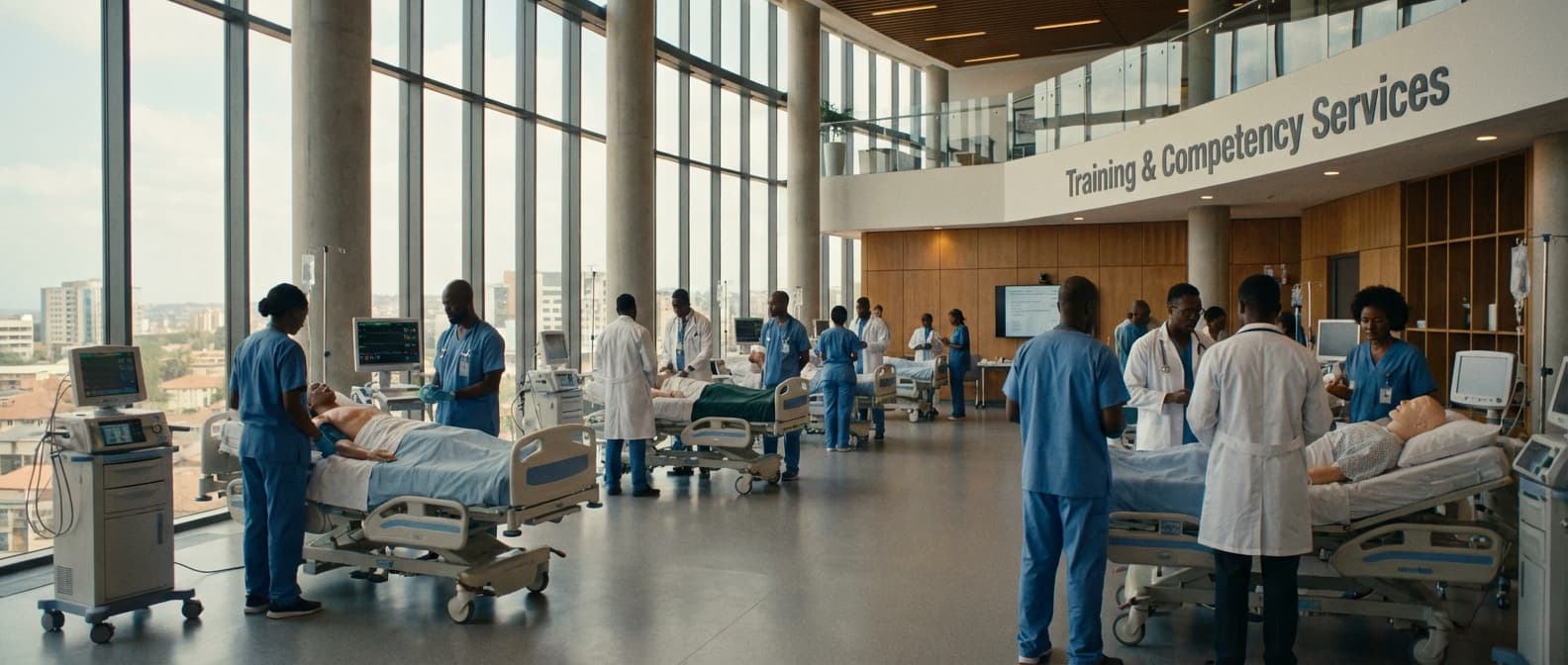
Ventilator User Training Service (Nurses) in Guinea
Engineering Excellence & Technical Support
Ventilator User Training Service (Nurses) High-standard technical execution following OEM protocols and local regulatory frameworks.
Mastering Ventilator Modes for Optimal Patient Support
Our training dives deep into essential ventilator modes (e.g., AC/VC, SIMV, PSV), empowering nurses to confidently select and adjust settings based on patient physiology, lung mechanics, and clinical goals. Learn to interpret waveforms and alarms for precise ventilation strategies, ensuring the best possible outcomes for critical patients.
Advanced Alarms & Troubleshooting: Proactive Patient Management
Become proficient in identifying, interpreting, and responding to critical ventilator alarms. This module equips nurses with practical troubleshooting skills to address common issues like disconnections, leaks, and high-pressure events, promoting timely interventions and patient safety in resource-limited settings.
Evidence-Based Weaning Protocols & Patient Mobilization
Understand and implement current, evidence-based protocols for ventilator weaning, focusing on patient readiness assessment, spontaneous breathing trials (SBTs), and safe de-escalation of support. Learn strategies to promote early mobilization and reduce ventilator-associated complications, enhancing patient recovery and reducing length of stay.
What Is Ventilator User Training Service (Nurses) In Guinea?
Ventilator User Training Service (Nurses) in Guinea refers to specialized educational programs designed to equip registered nurses and other qualified healthcare professionals in Guinea with the knowledge and practical skills necessary for the safe and effective operation of mechanical ventilators. This training addresses the critical need for competent personnel to manage patients requiring ventilatory support, a common requirement in intensive care units (ICUs), emergency departments, and operating rooms.
| Who Needs Ventilator User Training (Nurses)? | Typical Use Cases in Guinea |
|---|---|
| Registered Nurses (RNs) working in critical care settings (ICUs, CCUs). | Management of patients with Acute Respiratory Distress Syndrome (ARDS). |
| Registered Nurses (RNs) working in emergency departments. | Management of patients with severe exacerbations of Chronic Obstructive Pulmonary Disease (COPD) or asthma. |
| Registered Nurses (RNs) working in operating rooms. | Management of patients undergoing anesthesia and surgery requiring ventilatory support. |
| Nurses with a specialization in respiratory therapy or critical care. | Management of patients with sepsis and septic shock leading to respiratory failure. |
| Nurses involved in the transfer of critically ill patients. | Management of patients with neurological conditions leading to respiratory compromise (e.g., stroke, spinal cord injury). |
| Healthcare professionals tasked with ventilator maintenance and troubleshooting. | Management of patients post-cardiac arrest requiring mechanical ventilation. |
| Nurses working in facilities where advanced respiratory support is available. | Management of patients with severe pneumonia or other infectious respiratory illnesses. |
Key Components of Ventilator User Training for Nurses in Guinea:
- Understanding of respiratory physiology and pathophysiology relevant to mechanical ventilation.
- Principles of mechanical ventilation: types of ventilators, modes of ventilation (e.g., volume-controlled, pressure-controlled, assisted modes), and their physiological effects.
- Patient assessment for ventilatory support: indications for intubation and mechanical ventilation, contraindications, and patient readiness for liberation.
- Ventilator setup, circuit management, and alarm troubleshooting.
- Monitoring of ventilator parameters (e.g., tidal volume, respiratory rate, PEEP, FiO2) and interpretation of patient response.
- Management of common ventilator-associated complications (e.g., ventilator-associated pneumonia, barotrauma, volutrauma).
- Weaning from mechanical ventilation: assessment strategies and implementation.
- Principles of infection control and hygiene related to ventilator use.
- Ethical considerations and legal aspects of mechanical ventilation.
- Hands-on simulation and practical application of skills using actual or simulated ventilator equipment.
Who Needs Ventilator User Training Service (Nurses) In Guinea?
Ventilator user training services are crucial for ensuring the safe and effective operation of mechanical ventilators, particularly in critical care settings. In Guinea, these services are essential for a range of healthcare professionals who directly interact with patients requiring respiratory support. The training aims to equip users with the knowledge and skills to select appropriate ventilator modes, set parameters, monitor patient response, troubleshoot common issues, and manage emergencies.
| Target Customer Group | Primary Departments/Units | Key Responsibilities Related to Ventilator Use |
|---|---|---|
| Registered Nurses (RNs) | Intensive Care Unit (ICU), Surgical Wards, Emergency Department (ED), Neonatal Intensive Care Unit (NICU), Pediatric Intensive Care Unit (PICU) | Setting up and initiating ventilation, titrating ventilator settings, monitoring patient's respiratory status and physiological response, performing weaning protocols, responding to alarms and emergencies, documenting care. |
| Specialist Nurses (e.g., Critical Care Nurses) | ICU, PICU, NICU | Advanced ventilator management, complex patient monitoring, participation in rapid response teams, training junior nurses. |
| Physicians (Intensivists, Anesthesiologists, Pulmonologists) | ICU, Operating Room (OR), Pulmonology Departments | Determining the need for mechanical ventilation, selecting appropriate ventilator modes and initial settings, managing complex ventilation strategies, interpreting diagnostic data, leading critical care teams. |
| Respiratory Therapists (where available) | ICU, ED, Respiratory Care Departments | Direct patient assessment for respiratory needs, ventilator setup and management, pulmonary function testing, airway clearance techniques, patient education. |
| Biomedical Engineers/Technicians | Hospital Maintenance/Biomedical Engineering Department | Installation, routine maintenance, calibration, troubleshooting, and repair of ventilator equipment to ensure operational readiness and safety. |
Target Customers and Departments for Ventilator User Training Service in Guinea
- Nurses are the primary recipients of this training, as they are often on the front lines of patient care and are responsible for the continuous management of patients on ventilators.
- Physicians, especially intensivists and anesthesiologists, also benefit from specialized training to deepen their understanding of ventilator mechanics and advanced settings.
- Respiratory therapists, where available, are key personnel who would undergo comprehensive training.
- Biomedical engineers and technicians require training for maintenance, calibration, and troubleshooting of ventilator equipment.
Ventilator User Training Service (Nurses) Process In Guinea
This document outlines the workflow for the Ventilator User Training Service for Nurses in Guinea, detailing the process from initial inquiry to successful training execution. The service aims to equip nurses with the necessary knowledge and practical skills to safely and effectively operate mechanical ventilators. The process is designed to be standardized, efficient, and tailored to the specific needs of healthcare facilities and individual nurses.
| Phase | Step | Description | Key Activities | Responsible Party | Deliverables/Outcomes |
|---|---|---|---|---|---|
| Initial Contact | The healthcare facility or individual nurse expresses interest in ventilator user training. | Inquiry submission via designated channels (email, phone, web form). Initial contact for information gathering. | Healthcare Facility/Nurse, Training Provider | Confirmation of interest, preliminary understanding of training needs. |
| Needs Assessment | Detailed understanding of the facility's current ventilator stock, nurse experience levels, and specific training requirements. | On-site visit (if possible) or detailed questionnaire. Discussion of existing protocols and challenges. Identification of specific ventilator models to be covered. | Training Provider, Healthcare Facility Staff | Comprehensive needs assessment report, identification of training gaps and objectives. |
| Proposal Generation | Development of a tailored training proposal based on the needs assessment. | Outline of training modules, duration, methodology, trainers, and proposed dates. Costing and payment terms. | Training Provider | Formal training proposal document. |
| Contract Negotiation & Signing | Agreement on terms, scope of work, and pricing. | Review and negotiation of the proposal. Formal contract signing. | Training Provider, Healthcare Facility Administration | Signed training contract/agreement. |
| Curriculum Review | Review of existing standard training curriculum against assessed needs. | Identification of areas requiring customization or addition of specific content. | Training Provider | Identified curriculum adjustments. |
| Customization | Adapting the training material to the specific context, equipment, and protocols of the facility. | Inclusion of facility-specific procedures, common patient populations, and available ventilator models. Development of localized case studies and scenarios. | Training Provider | Customized training materials (presentations, handouts, practical guides). |
| Participant Identification | The healthcare facility identifies the nurses who will participate in the training. | Nomination of participants based on job roles and training eligibility. | Healthcare Facility Administration | List of registered participants. |
| Scheduling | Determining the optimal training dates and times that minimize disruption to clinical operations. | Coordination of schedules with the facility and trainers. Booking of training venues and equipment. | Training Provider, Healthcare Facility Administration | Confirmed training schedule and venue booking. |
| Resource Preparation | Ensuring all necessary training equipment, materials, and resources are available. | Preparation of ventilators for practical sessions (simulators or actual units). Printing of training manuals and assessment forms. Ensuring audiovisual equipment is functional. | Training Provider | Ready training environment and materials. |
| Theoretical Sessions | Delivery of foundational knowledge on mechanical ventilation principles, indications, contraindications, and monitoring. | Lectures, presentations, group discussions. Interactive Q&A sessions. | Certified Trainer | Enhanced theoretical understanding of ventilator operation. |
| Practical Sessions | Hands-on training with ventilators, focusing on setup, operation, troubleshooting, and parameter adjustments. | Demonstrations by trainers. Supervised practice by participants on simulators or actual ventilators. Simulated patient scenarios. | Certified Trainer, Participants | Proficiency in practical ventilator operation and management. |
| Case Study Analysis | Application of learned knowledge to real-world clinical scenarios. | Discussion of complex patient cases requiring ventilator support. Development of critical thinking skills in ventilator management. | Certified Trainer, Participants | Improved ability to apply knowledge to diverse patient situations. |
| Knowledge Assessment | Evaluating the theoretical understanding of the participants. | Written tests, quizzes, or oral examinations. | Certified Trainer | Quantifiable measure of theoretical knowledge. |
| Skills Assessment | Assessing the practical skills and competency of the participants. | Observation of participants performing ventilator setup, adjustments, and troubleshooting. Practical skills checklist. | Certified Trainer | Verification of practical competency in ventilator operation. |
| Participant Feedback | Gathering feedback from participants on the training program's effectiveness and delivery. | Anonymous feedback forms or surveys. | Participants | Insights for program improvement. |
| Training Effectiveness Evaluation | Assessing the overall success of the training program against its objectives. | Analysis of assessment results, participant feedback, and trainer observations. | Training Provider | Report on training effectiveness and areas for enhancement. |
| Certification | Issuance of certificates to participants who successfully complete the training and assessments. | Awarding of certificates upon meeting competency standards. | Training Provider | Official training certificates. |
| Post-Training Support | Providing ongoing support and resources to nurses after the training. | Access to online resources, refresher courses (if applicable), and technical support for urgent queries. | Training Provider | Sustained competence and confidence in ventilator use. |
| Reporting | Providing a comprehensive report to the healthcare facility on the training conducted. | Summary of participants, assessment results, feedback, and recommendations. Documentation of training completion. | Training Provider | Final training report for the facility's records. |
Ventilator User Training Service (Nurses) Workflow in Guinea
- Inquiry and Needs Assessment
- Proposal and Agreement
- Curriculum Development and Customization
- Logistics and Scheduling
- Training Delivery (Theoretical and Practical)
- Assessment and Evaluation
- Certification and Follow-up
Ventilator User Training Service (Nurses) Cost In Guinea
The cost of ventilator user training services for nurses in Guinea can vary significantly due to several factors. These include the training provider (e.g., hospital in-house programs, specialized medical training companies, international NGOs), the depth and duration of the training, the complexity of the ventilator models covered, and the location within Guinea where the training is conducted. Generally, these services are priced on a per-nurse or per-session basis. The local currency in Guinea is the Guinean Franc (GNF). Due to the specialized nature of this training and the need for qualified instructors and potentially specialized equipment for simulation, costs are not as readily available as for more common training. However, an estimated range can be provided based on market understanding and the factors influencing pricing.
| Training Type | Estimated Cost Range (GNF) | Notes |
|---|---|---|
| Basic Ventilator Operation & Monitoring (Per Nurse/Day) | 300,000 - 700,000 GNF | Covers fundamental settings, alarms, and basic patient management. |
| Advanced Ventilator Management & Troubleshooting (Per Nurse/Day) | 500,000 - 1,200,000 GNF | Includes complex modes, weaning strategies, and in-depth problem-solving. |
| Comprehensive Training Package (e.g., 3-5 Days, Multiple Nurses) | Negotiable, often project-based | Can include simulation, case studies, and potentially on-site support. Typically offered by specialized training firms or NGOs. |
| Refresher/Update Training (Per Nurse/Session) | 200,000 - 500,000 GNF | For nurses who have received prior training but need to refresh skills or learn about new features. |
Key Pricing Factors for Ventilator User Training in Guinea:
- Training Provider Reputation and Expertise
- Duration and Intensity of Training Program
- Number of Ventilator Models Covered
- Inclusion of Hands-on Simulation and Practical Sessions
- Trainer Qualifications and Experience
- Location of Training (e.g., Conakry vs. remote regions)
- Logistics and Material Costs (e.g., training manuals, consumables)
- Customization of Training to Specific Hospital Needs
- Accreditation or Certification offered (if any)
Affordable Ventilator User Training Service (Nurses) Options
This document outlines affordable ventilator user training services specifically designed for nurses. We understand the critical need for skilled healthcare professionals in operating and managing ventilators, and the financial constraints many institutions face. Our goal is to provide high-quality, accessible training that maximizes value and minimizes cost.
| Cost-Saving Strategy | Description | Potential Benefit |
|---|---|---|
| Group Training Discounts | Reduced per-participant cost when training multiple nurses from the same institution. | Significant savings for departments with several nurses requiring training. |
| Train-the-Trainer Programs | Empower select nurses within your institution to become internal trainers, reducing reliance on external services for ongoing training. | Long-term cost reduction and sustainability of in-house expertise. |
| Online/Blended Learning Options | Leverage pre-recorded lectures, interactive modules, and virtual Q&A sessions to reduce on-site training time and associated travel/facility costs. | Flexibility for nurses and lower overhead for the institution. |
| Partnerships with Medical Equipment Suppliers | Collaborate with ventilator manufacturers for potential bundled training packages or discounted rates when purchasing new equipment. | Streamlined training and potential cost reduction through equipment acquisition. |
| Focus on Essential Competencies | Prioritize training on the most frequently used ventilator modes and critical troubleshooting scenarios relevant to your patient population. | Avoids unnecessary training expenditure on less common or advanced features. |
| Subscription-Based Access | Access to a library of online training modules and updates for a recurring fee, allowing for continuous learning and skill maintenance. | Predictable budgeting and ongoing access to current information. |
| Grant and Funding Applications | Assistance in identifying and applying for grants or funding opportunities specifically for healthcare professional education and training. | Access to external funding to offset training costs. |
Value Bundles for Affordable Ventilator User Training (Nurses)
- {"items":["Introduction to Mechanical Ventilation Principles","Ventilator Modes (e.g., Volume Control, Pressure Control)","Setting Initial Ventilator Parameters","Monitoring Patient Response and Ventilator Waveforms","Basic Troubleshooting and Alarm Management","Ventilator Circuit and Humidification Management"],"title":"Core Competency Bundle","description":"Focuses on fundamental ventilator operation, monitoring, and basic troubleshooting. Ideal for nurses new to ventilator management or as a refresher course."}
- {"items":["Advanced Ventilator Modes (e.g., PSV, BiPAP, NAVA - depending on availability)","Weaning from Mechanical Ventilation","Ventilator-Associated Pneumonia (VAP) Prevention and Management","Management of ARDS and other Complex Respiratory Conditions","Non-invasive Ventilation (NIV) Principles and Application","Integration of Ventilator Data with Patient Assessment"],"title":"Advanced Ventilation Strategies Bundle","description":"Builds upon core competencies with in-depth coverage of advanced modes, weaning protocols, and complex patient scenarios. Suited for experienced nurses seeking to expand their expertise."}
- {"items":["Realistic patient scenarios for ventilator management","Practice with various ventilator models (if available)","Team-based learning and communication exercises","Skills assessment and personalized feedback","Debriefing sessions to reinforce learning"],"title":"On-Site Simulation & Skills Lab Bundle","description":"Combines theoretical knowledge with hands-on practice using high-fidelity simulators and real-world equipment. Enhances practical skills and confidence."}
- {"items":["Needs assessment to identify specific training gaps","Modular curriculum design","Flexible scheduling options"],"title":"Customizable Program","description":"Allows institutions to tailor training content and duration to their specific needs, patient populations, and available equipment."}
Verified Providers In Guinea
In Guinea, the healthcare landscape is evolving, and ensuring access to reliable and high-quality medical services is paramount. Verified providers are crucial for patient safety and effective treatment. Franance Health stands out as a leading entity in this space, offering a network of credentialed and vetted healthcare professionals and facilities. Their commitment to rigorous verification processes ensures that patients can trust the care they receive. This document outlines Franance Health's credentials and the compelling reasons why they represent the best choice for healthcare needs in Guinea.
| Why Franance Health is the Best Choice | Key Differentiators | Patient Benefits |
|---|---|---|
| Uncompromising Standards: Franance Health adheres to the highest benchmarks for provider verification, setting them apart from informal or unvetted networks. | Independent verification of licenses and certifications. | Assurance of receiving care from qualified and legitimate medical professionals. |
| Commitment to Quality Care: The focus is not just on credentials, but on the actual quality of care delivered, ensuring a positive patient experience. | Evaluation of clinical outcomes and patient feedback. | Higher likelihood of successful treatment and improved health. |
| Extensive and Accessible Network: Franance Health provides access to a broad spectrum of healthcare services, making it easier to find the right care when and where you need it. | Wide geographical coverage within Guinea. | Convenient access to a diverse range of medical specialists and facilities. |
| Ethical and Transparent Practices: Franance Health champions transparency and ethical conduct within its network, fostering trust between patients and providers. | Clear communication regarding provider qualifications and services. | Reduced risk of encountering fraudulent or substandard medical services. |
Franance Health's Verification Process & Benefits
- Rigorous Credentialing: Franance Health meticulously verifies the qualifications, licenses, and certifications of all affiliated healthcare providers. This includes checks against national and international standards.
- Experience and Expertise: Beyond formal qualifications, Franance Health assesses the practical experience and specialized expertise of their network, ensuring patients are connected with the most suitable professionals for their specific conditions.
- Patient Safety Focus: The verification process prioritizes patient safety, encompassing background checks and adherence to ethical medical practices.
- Quality Assurance: Franance Health implements ongoing quality assurance measures to monitor the performance and patient satisfaction levels of their providers.
- Comprehensive Network: Access to a wide range of specialists, general practitioners, hospitals, and clinics across Guinea.
- Streamlined Access: Facilitates easier and more reliable access to essential healthcare services for individuals and organizations.
- Trust and Peace of Mind: Knowing that your healthcare provider has been thoroughly vetted by a reputable organization like Franance Health offers significant peace of mind.
Scope Of Work For Ventilator User Training Service (Nurses)
This Scope of Work (SOW) outlines the requirements for providing comprehensive ventilator user training services specifically tailored for nursing staff. The training aims to equip nurses with the necessary knowledge and skills to safely and effectively operate, monitor, and troubleshoot ventilators in various clinical settings. The training will cover theoretical concepts, practical application, and emergency procedures. This SOW details the technical deliverables and standard specifications to ensure consistent quality and efficacy of the training program.
| Deliverable Type | Description | Standard Specification/Requirement | Format/Method |
|---|---|---|---|
| Training Curriculum Development | A comprehensive, modular curriculum covering all aspects of ventilator use for nurses. | Must be evidence-based, aligned with current clinical guidelines, and cover topics such as ventilator modes, settings, patient interface, monitoring, alarms, weaning, and emergency procedures. Tailored to the specific ventilator models used by the client. | Digital (PDF, Online Module) and/or Printed Manuals |
| Training Modules (Theoretical) | Didactic sessions covering the physiological principles, operational mechanics, and clinical applications of ventilators. | Modules should include clear learning objectives, relevant case studies, and assessment questions. Coverage of common pathologies requiring ventilation (e.g., ARDS, COPD exacerbation). | Interactive Online Modules, PowerPoint Presentations, Lectures |
| Hands-on Training Sessions | Practical sessions allowing nurses to interact directly with ventilator devices. | Includes simulator use and/or actual ventilator units. Focus on setup, parameter adjustment, troubleshooting, and alarm management. Low nurse-to-instructor ratio for personalized attention. | In-person practical sessions utilizing provided training ventilators/simulators |
| Competency Assessment Tools | Methods to evaluate nurses' understanding and practical skills post-training. | Includes written examinations, practical skills checklists, and scenario-based evaluations. Passing scores clearly defined. | Quizzes, Written Exams, Practical Skills Checklists, Simulation Scenarios |
| Training Materials (Participant) | Handouts, reference guides, and quick-reference cards for participants. | Concise, easy-to-understand materials summarizing key concepts and procedures. Model-specific information included. | Printed Handouts, Laminated Quick Reference Cards |
| Instructor Qualifications | Credentials and experience of the trainers delivering the service. | Instructors must be certified respiratory therapists, critical care nurses, or physicians with extensive experience in mechanical ventilation and adult education. | Resumes, Certifications, Letters of Recommendation |
| Training Schedule and Logistics Plan | Detailed plan outlining training dates, times, locations, and participant groups. | Flexible scheduling options to accommodate nursing shift patterns. Clear communication of requirements for training space and equipment. | Digital Document (e.g., Excel, PDF) |
| Post-Training Support | Resources or contact points for follow-up questions or troubleshooting after the training. | Dedicated helpline, email support, or access to online forums for a defined period. | Contact Information, Online Portal Access |
| Training Completion Certificates | Formal documentation issued to participants upon successful completion of the training. | Includes participant name, training topic, date of completion, and issuing organization's details. | Digital (PDF) and/or Printed Certificates |
Key Objectives of the Ventilator User Training Service
- Enhance nurses' understanding of fundamental principles of mechanical ventilation.
- Develop proficiency in setting up, operating, and adjusting ventilator parameters.
- Improve skills in patient monitoring and assessment during ventilation.
- Equip nurses to identify and respond to common ventilator alarms and troubleshoot issues.
- Ensure adherence to best practices and safety protocols for ventilator management.
- Provide hands-on experience with specific ventilator models relevant to the healthcare facility.
- Foster confidence and competence in managing ventilated patients.
Service Level Agreement For Ventilator User Training Service (Nurses)
This Service Level Agreement (SLA) outlines the agreed-upon service levels for the Ventilator User Training Service specifically designed for nurses. It details response times for support requests and guarantees the uptime of the training platform and resources.
| Service Component | Service Level Objective (SLO) | Measurement Metric | Reporting Frequency |
|---|---|---|---|
| Training Platform Availability | 99.5% Uptime | (Total Uptime / Total Time) * 100% | Monthly |
| Technical Support Response Time (Critical Issue) | Within 2 business hours | Time from submission of support request to initial response | Monthly |
| Technical Support Response Time (Non-Critical Issue) | Within 8 business hours | Time from submission of support request to initial response | Monthly |
| Content Update Availability | New/updated content available within 48 business hours of release | Time from notification of content release to availability on platform | As needed, reported quarterly |
Key Definitions
- Training Platform: The online portal and associated digital resources used for delivering ventilator training modules.
- Support Request: Any communication from a user (nurse) to the service provider seeking assistance with the training platform, content, or technical issues.
- Downtime: Any period during which the Training Platform is unavailable to users.
- Scheduled Downtime: Planned interruptions to the Training Platform for maintenance or upgrades, communicated in advance.
- Unscheduled Downtime: Unexpected interruptions to the Training Platform that were not planned.
Frequently Asked Questions

Ready when you are
Let's scope your Ventilator User Training Service (Nurses) in Guinea project in Guinea.

Scaling healthcare logistics and technical systems across the entire continent.