
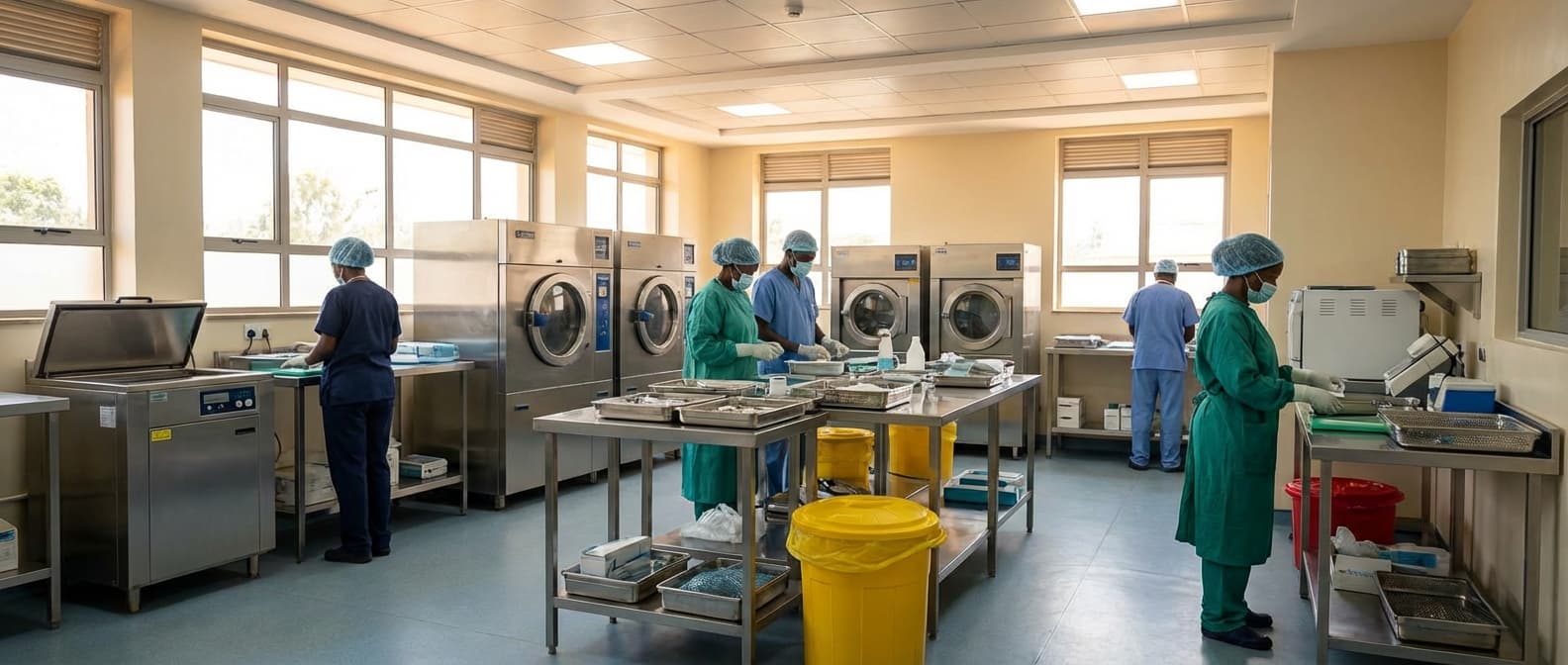
Infection-Control Readiness Support Service for Reusable Equipment in Guinea
Engineering Excellence & Technical Support
Infection-Control Readiness Support Service for Reusable Equipment High-standard technical execution following OEM protocols and local regulatory frameworks.
Advanced Autoclave Training & Maintenance
We provide hands-on training for local healthcare staff on the proper operation, calibration, and routine maintenance of steam sterilizers (autoclaves). This ensures critical reusable medical equipment is consistently sterilized to international standards, minimizing the risk of Healthcare-Associated Infections (HAIs).
Digital Traceability System Implementation
Our service integrates a robust digital traceability system for reusable equipment. This allows for real-time tracking of equipment lifecycle, from disinfection and sterilization cycles to usage and maintenance. This enhances accountability and enables rapid identification of any compromised equipment during outbreaks.
Optimized Cleaning & Disinfection Protocols
We develop and implement context-specific, evidence-based protocols for the manual cleaning and high-level disinfection of medical devices. This includes tailored guidance on appropriate disinfectants, contact times, and quality control measures to effectively eliminate pathogens and prevent cross-contamination in Guinean healthcare facilities.
What Is Infection-control Readiness Support Service For Reusable Equipment In Guinea?
Infection-Control Readiness Support Service for Reusable Equipment in Guinea refers to a specialized suite of technical assistance and capacity-building interventions designed to ensure that healthcare facilities in Guinea maintain the highest standards of infection prevention and control (IPC) practices specifically related to the reprocessing and safe utilization of reusable medical devices. This service addresses the critical need for robust systems and trained personnel to mitigate the risk of healthcare-associated infections (HAIs) transmitted through inadequately sterilized or disinfected equipment. The service encompasses a multi-faceted approach, including needs assessments, policy development, infrastructure evaluation, equipment procurement guidance, staff training, and ongoing monitoring and evaluation.
| Service Need | Target Beneficiary | Typical Use Cases |
|---|---|---|
| Lack of standardized IPC protocols for reusable equipment | Public and private healthcare facilities (hospitals, clinics, health centers) across all administrative regions in Guinea. | Introduction of new sterilization technologies, establishment of new surgical units, or response to observed increases in HAIs related to surgical instruments. |
| Inadequate training of healthcare personnel in reprocessing techniques | Healthcare facilities with limited access to specialized IPC training, particularly in rural or underserved areas. | Routine staff training programs, pre-service education for nursing and paramedical students, and refresher courses for existing staff. |
| Deterioration or obsolescence of sterilization and disinfection equipment | Facilities with aging or poorly maintained equipment, posing a risk to patient safety. | Support for the evaluation and replacement of non-functional autoclaves, washer-disinfectors, or other critical reprocessing machinery. |
| Insufficient or unreliable supply of reprocessing consumables | Facilities experiencing stock-outs of essential cleaning agents, disinfectants, sterilization wraps, or chemical indicators. | Assistance in developing robust supply chain management systems and identifying reliable local or international suppliers. |
| Suboptimal infrastructure for sterilization and disinfection units | Healthcare settings with inadequate physical space, poor ventilation, or unreliable utilities (water, electricity) affecting reprocessing effectiveness. | Renovation or refurbishment of CSSD (Central Sterile Supply Department) facilities, including upgrades to plumbing, electrical systems, and air handling. |
| Emergence of novel infectious agents or increased risk of transmission | Responding to public health emergencies or known outbreaks where contaminated reusable equipment is a potential vector. | Rapid deployment of support teams to assess and reinforce IPC measures during epidemic responses (e.g., Ebola, COVID-19). |
Key Components of Infection-Control Readiness Support Service for Reusable Equipment:
- Needs Assessment and Gap Analysis: Comprehensive evaluation of current IPC infrastructure, workflows, human resources, and equipment inventory related to reusable medical devices.
- Policy and Guideline Development/Adaptation: Assistance in formulating, updating, or adapting national and facility-level IPC policies and standard operating procedures (SOPs) for reprocessing reusable equipment, aligning with international best practices and national regulations.
- Infrastructure Evaluation and Optimization: Assessment of sterilization and disinfection units, including ventilation, water supply, waste management, and space allocation, with recommendations for improvement to ensure optimal performance and safety.
- Equipment Assessment and Procurement Support: Technical guidance on the selection, acquisition, maintenance, and validation of appropriate sterilization and disinfection equipment, consumables, and ancillary supplies.
- Staff Training and Capacity Building: Delivery of targeted training modules for healthcare professionals (nurses, technicians, environmental services personnel) on all aspects of reusable equipment reprocessing, including cleaning, disinfection, sterilization methods (e.g., autoclaving, chemical sterilization), packaging, storage, and handling.
- Quality Assurance and Monitoring Systems: Establishment and implementation of robust quality control measures, including biological and chemical indicators, process monitoring, record-keeping, and performance audits, to ensure the efficacy of reprocessing cycles.
- Waste Management Integration: Ensuring proper segregation, handling, and disposal of infectious waste generated during the reprocessing of reusable equipment.
- Sustainability Planning: Development of strategies for long-term maintenance of equipment, consistent supply chain management, and ongoing professional development for staff.
- Outbreak Investigation Support: Providing technical expertise during suspected HAIs linked to reusable equipment to identify root causes and implement corrective actions.
Who Needs Infection-control Readiness Support Service For Reusable Equipment In Guinea?
This document outlines the critical need for infection-control readiness support services specifically for reusable medical equipment in Guinea. These services are essential to prevent the transmission of healthcare-associated infections (HAAs) and ensure patient safety. Guinea, like many low-resource settings, faces challenges in maintaining robust infection control practices, particularly concerning the sterilization and reprocessing of reusable medical devices. Investing in specialized support can bridge these gaps.
| Customer Type | Key Needs | Relevant Departments |
|---|---|---|
| Public Hospitals | Training on sterilization protocols, equipment maintenance, quality assurance, supply chain management for reprocessing consumables | CSSD, Operating Rooms, Emergency Departments, Maternity Wards |
| Private Hospitals | Advanced training, regulatory compliance audits, technology upgrades for sterilization, infection prevention consultation | CSSD, Operating Rooms, ICUs, Outpatient Clinics |
| Clinics and Health Centers | Basic training on sterilization, acquisition of appropriate sterilization equipment, guidelines for reprocessing | General Care Areas, Minor Procedure Rooms |
| Surgical Centers | Specialized training for surgical instruments, immediate needs for sterile sets, validation of sterilization processes | Operating Rooms, CSSD |
| Dental Clinics | Specific training for dental instruments, access to appropriate autoclaves, adherence to dental-specific infection control guidelines | Dental Treatment Rooms, Sterilization Area |
| NGOs/Aid Organizations | Capacity building for local staff, establishment of standardized infection control programs, technical support for equipment | All departments within supported facilities |
| Ministry of Health | Development of national infection control guidelines, training curriculum development, monitoring and evaluation frameworks, support for policy implementation | National Policy Level, Regional Health Offices |
Target Customers and Departments for Infection-Control Readiness Support Service for Reusable Equipment in Guinea
- Target Customers:
- Hospitals (Public and Private): All facilities that utilize reusable medical equipment, from large national hospitals to smaller district and regional facilities.
- Clinics and Health Centers: Facilities that perform procedures requiring reusable instruments, even if on a smaller scale.
- Surgical Centers and Operating Theaters: High-risk areas where improper reprocessing of reusable instruments can have severe consequences.
- Dental Clinics: Often rely on reusable instruments that require meticulous sterilization.
- Maternal and Child Health Centers: Facilities performing deliveries and other procedures where sterile equipment is paramount.
- Non-Governmental Organizations (NGOs) and International Aid Organizations: Those involved in healthcare delivery and capacity building within Guinea.
- Government Health Ministries and Agencies: To oversee and mandate infection control standards and facilitate access to support services.
- Target Departments:
- Sterilization and Central Sterile Supply Department (CSSD): The primary department responsible for reprocessing reusable equipment.
- Operating Rooms/Theaters: Directly impacted by the availability and sterility of surgical instruments.
- Emergency Departments: Require rapid access to sterile equipment for immediate patient care.
- Maternity Wards: Where instruments for delivery and postpartum care are used.
- Intensive Care Units (ICUs): Patients are often critically ill and highly susceptible to infections.
- Outpatient Clinics: Where procedures requiring reusable instruments may be performed.
- Laboratory Departments: For reusable diagnostic equipment and instruments.
- Dental Departments: Responsible for sterilization of dental instruments.
Infection-control Readiness Support Service For Reusable Equipment Process In Guinea
This document outlines the workflow for the Infection-Control Readiness Support Service for Reusable Equipment Process in Guinea. The service aims to ensure that healthcare facilities in Guinea have the necessary knowledge, resources, and infrastructure to safely reprocess reusable medical equipment, thereby preventing healthcare-associated infections (HAIs). The workflow begins with an inquiry from a healthcare facility and culminates in the provision of comprehensive support and assessment.
| Stage | Description | Key Activities | Responsible Parties | Deliverables |
|---|---|---|---|---|
| Inquiry and Needs Assessment | Initial contact from a healthcare facility seeking support for their reusable equipment reprocessing practices. | Facility contacts the support service via email, phone, or referral. Initial discussion to understand the facility's current situation, challenges, and specific needs. | Healthcare Facility, Support Service Coordinator | Record of inquiry, preliminary understanding of needs |
| Service Proposal and Agreement | Formalization of the support engagement based on the identified needs. | Support service develops a detailed proposal outlining scope of work, objectives, timeline, and budget. Proposal review and negotiation with the facility. Signing of a Memorandum of Understanding (MOU) or service agreement. | Support Service Team, Healthcare Facility Management | Signed MOU/Service Agreement, Approved Proposal |
| On-site Readiness Assessment | Comprehensive evaluation of the facility's current infection control practices for reusable equipment. | Site visit by the support team. Review of existing protocols, Standard Operating Procedures (SOPs), and policies. Assessment of infrastructure (water supply, electricity, ventilation). Evaluation of equipment availability, functionality, and maintenance. Observation of staff practices. Interviews with relevant personnel (nurses, technicians, laundry staff). Assessment of waste management practices related to reprocessing. | Support Service Assessment Team, Healthcare Facility Staff | Detailed Assessment Report, Gap Analysis |
| Development of Customized Support Plan | Creation of a tailored strategy to address identified gaps and weaknesses. | Analysis of the assessment findings. Prioritization of key areas for intervention. Development of specific, measurable, achievable, relevant, and time-bound (SMART) objectives. Outline of recommended interventions, including training modules, equipment upgrades, and protocol revisions. | Support Service Technical Team, Facility Representatives | Customized Support Plan, Actionable Recommendations |
| Training and Capacity Building | Equipping healthcare staff with the knowledge and skills for safe reprocessing. | Development and delivery of training modules on:
| Support Service Trainers, Healthcare Facility Staff | Trained Staff, Training Materials, Assessment Records |
| Equipment and Infrastructure Support | Providing or facilitating access to necessary resources for effective reprocessing. | Recommendations for procurement of new equipment or replacement of faulty items. Guidance on maintenance and repair of existing equipment. Advising on necessary infrastructure improvements (e.g., dedicated reprocessing areas). Facilitating connections with suppliers or technical experts. | Support Service Logistics/Technical Team, Procurement Department (if applicable), Facility Management | Equipment Procurement Support, Infrastructure Improvement Recommendations |
| Supervision and Mentorship | Ongoing support and guidance to ensure sustained adherence to best practices. | Regular site visits for observation and feedback. Problem-solving support for challenges encountered during implementation. Mentoring key personnel to become IPC champions within the facility. Review of implemented changes and their impact. | Support Service Supervisors/Mentors, Facility IPC Focal Points | Supervision Reports, Mentorship Logs, Problem-Solving Assistance |
| Post-Intervention Monitoring and Evaluation | Assessing the effectiveness of the support provided and the impact on IPC practices. | Follow-up assessments (potentially using the same methodology as the initial assessment). Collection of data on HAI rates (if feasible). Review of adherence to updated protocols and SOPs. Feedback collection from facility staff and patients (if applicable). Analysis of performance indicators. | Support Service M&E Team, Facility Data Collectors | Impact Assessment Report, Performance Data |
| Reporting and Knowledge Sharing | Documenting outcomes and disseminating lessons learned. | Preparation of a comprehensive final report detailing activities, outcomes, and recommendations. Sharing of findings with the Ministry of Health, other relevant stakeholders, and the wider healthcare community. Contribution to national IPC guidelines and strategies. | Support Service Management, Ministry of Health | Final Project Report, Dissemination Materials, Lessons Learned Documentation |
Workflow Stages
- Inquiry and Needs Assessment
- Service Proposal and Agreement
- On-site Readiness Assessment
- Development of Customized Support Plan
- Training and Capacity Building
- Equipment and Infrastructure Support
- Supervision and Mentorship
- Post-Intervention Monitoring and Evaluation
- Reporting and Knowledge Sharing
Infection-control Readiness Support Service For Reusable Equipment Cost In Guinea
This document outlines the pricing factors and estimated cost ranges for an Infection-Control Readiness Support Service for Reusable Equipment in Guinea, focusing on local currency (Guinean Franc - GNF). The service aims to ensure that healthcare facilities have the necessary protocols, training, and resources to safely reprocess reusable medical equipment, thereby preventing healthcare-associated infections (HAIs). Pricing is dynamic and depends on several critical factors related to the facility's scale, the complexity of equipment, and the desired level of support.
| Service Component / Facility Size | Estimated Cost Range (GNF - Monthly/Per Facility) | Notes |
|---|---|---|
| Initial Assessment & Protocol Development (Small Clinic) | 500,000 - 1,500,000 | Covers site visit, equipment inventory, basic protocol review and development. |
| Initial Assessment & Protocol Development (Medium Hospital) | 1,000,000 - 3,000,000 | More extensive assessment, detailed SOP creation, consideration of multiple departments. |
| Initial Assessment & Protocol Development (Large Hospital) | 2,000,000 - 5,000,000+ | Comprehensive review, development of a full suite of infection control SOPs, potentially including advanced equipment. |
| Basic Training Module (Per Staff Member) | 50,000 - 150,000 | Focus on fundamental sterilization and disinfection principles for reusable items. |
| Specialized Training Module (Per Staff Member - e.g., Endoscopy) | 100,000 - 300,000 | In-depth training on specific equipment and high-level disinfection/sterilization techniques. |
| Ongoing Supervision & Monitoring (Small Facility) | 300,000 - 800,000 | Monthly or bi-monthly site visits, limited protocol checks. |
| Ongoing Supervision & Monitoring (Medium Facility) | 600,000 - 1,500,000 | Regular site visits, more detailed checks, basic performance feedback. |
| Ongoing Supervision & Monitoring (Large Facility) | 1,000,000 - 3,000,000+ | Frequent visits, comprehensive audits, data analysis, and improvement recommendations. |
| Supply Chain Advisory & Management (Variable) | 200,000 - 1,000,000+ | Consultation on sourcing quality disinfectants, sterilants, and indicators. May involve direct supply management at additional cost. |
| Comprehensive Readiness Package (Small Clinic - Monthly) | 800,000 - 2,500,000 | Includes ongoing support, regular training refreshers, and basic monitoring. |
| Comprehensive Readiness Package (Medium Hospital - Monthly) | 1,500,000 - 5,000,000 | Includes robust ongoing support, tailored training, and detailed performance tracking. |
| Comprehensive Readiness Package (Large Hospital - Monthly) | 3,000,000 - 10,000,000+ | Full-spectrum support, advanced training, regular audits, and strategic guidance. Costs can escalate significantly with complex equipment and high volumes. |
Key Pricing Factors
- Facility Size and Bed Count: Larger hospitals or those with more inpatient beds will generally incur higher costs due to a greater volume of equipment requiring processing and potentially more staff to train.
- Number and Type of Reusable Equipment: The diversity and quantity of reusable medical instruments (e.g., surgical instruments, endoscopes, respiratory therapy devices) directly influence the scope of training, supervision, and supplies needed. Specialized equipment often requires more intensive training and specific sterilization agents.
- Current State of Infection Control Practices: Facilities with existing, but potentially insufficient, infection control protocols will require different levels of support compared to those with minimal or no established practices. Assessments and the development of new Standard Operating Procedures (SOPs) are factored in.
- Training Needs and Staff Levels: The number of personnel requiring training in sterilization, disinfection, and handling procedures significantly impacts the service cost. The duration and depth of training modules are also key.
- Scope of Support Services: This can range from initial assessment and training to ongoing monitoring, supply chain management for disinfectants and sterilants, equipment maintenance advice, and data reporting.
- Geographic Location within Guinea: While not always a primary driver, accessibility and logistical challenges in remote areas might slightly influence costs due to travel and transportation of materials.
- Frequency of Audits and Supervision: The level of ongoing oversight and quality assurance provided by the support service will affect the overall price. More frequent audits and hands-on supervision command higher fees.
- Provision of Consumables and Supplies: If the service includes the supply of disinfectants, sterilizing agents, testing indicators, or protective equipment, this will be an additional cost component.
Affordable Infection-control Readiness Support Service For Reusable Equipment Options
Our Affordable Infection-Control Readiness Support Service is designed to empower healthcare facilities and other organizations that rely on reusable equipment to maintain the highest standards of infection prevention without breaking the bank. We understand the critical importance of proper cleaning, disinfection, and sterilization, and the significant investment required for effective programs. This service provides comprehensive, cost-effective solutions to ensure your reusable equipment is always safe and ready for use, minimizing risks of healthcare-associated infections (HAIs) and operational disruptions.
| Cost-Saving Strategy | Description | Potential Benefit |
|---|---|---|
| Optimized Reagent & Consumable Management | Utilizing bulk purchasing agreements and inventory management software to reduce waste and ensure you only pay for what you need for cleaning, disinfection, and sterilization processes. | Reduced operational costs, minimized stockouts, and decreased expiration of expensive chemicals. |
| Staff Training & Competency Development | Investing in standardized, effective training programs that reduce errors and re-processing cycles, leading to increased efficiency and less equipment downtime. | Lower labor costs due to fewer errors, reduced need for rework, and improved staff morale through clear procedures. |
| Preventative Maintenance Program Integration | Incorporating infection control readiness into your existing equipment maintenance schedules to identify and address potential issues before they impact reprocessing effectiveness or lead to costly repairs. | Extended equipment lifespan, reduced emergency repair costs, and minimized disruption to patient care due to equipment failure. |
| Technology Adoption & Automation | Advising on and supporting the implementation of cost-effective automation technologies for cleaning, disinfection, and tracking, where appropriate. | Increased throughput, improved consistency of reprocessing, and reduced manual labor costs. |
| Risk-Based Approach Implementation | Focusing resources and efforts on the highest-risk reusable equipment and processes, ensuring that your infection control investments are targeted for maximum impact. | Efficient allocation of budget, reduced investment in low-risk areas, and prioritized mitigation of significant infection risks. |
| Audit & Compliance Support | Proactive identification and correction of compliance gaps before they lead to regulatory fines or accreditation issues. | Avoidance of penalties, smoother accreditation processes, and enhanced organizational reputation. |
Value Bundles:
- Basic Readiness Package: Includes essential training modules for staff on standard infection control procedures for common reusable items, development of standardized operating procedures (SOPs) for cleaning and disinfection, and a foundational risk assessment of your current practices. This bundle is ideal for smaller facilities or those initiating their comprehensive infection control programs.
- Intermediate Preparedness Package: Builds upon the Basic package with advanced training on specialized equipment, implementation of an equipment tracking system (manual or digital), regular review and auditing of SOPs, and access to a curated library of best practice guidelines. This is suitable for facilities with a moderate volume of reusable equipment and a growing need for robust oversight.
- Advanced Compliance Package: Offers the most comprehensive support, including on-site audits by infection control specialists, development of customized validation and verification protocols for your sterilization processes, staff competency testing and ongoing professional development, and proactive consultation on emerging infection control trends and regulatory changes. This package is designed for high-volume facilities, those with complex reprocessing needs, or organizations seeking to achieve the highest levels of accreditation and patient safety.
- Customizable Solutions: We recognize that every facility is unique. We offer bespoke bundles tailored to your specific equipment types, patient populations, regulatory environment, and budget. Contact us for a personalized assessment and quote.
Verified Providers In Guinea
In Guinea, ensuring access to reliable and qualified healthcare providers is paramount. Franance Health stands out as a premier platform for identifying and engaging with verified healthcare professionals. Our rigorous vetting process guarantees that all listed providers meet the highest standards of expertise, ethical practice, and patient care. This commitment to quality makes Franance Health the definitive choice for anyone seeking trustworthy medical services in Guinea.
| Feature | Franance Health Advantage | Impact for Users in Guinea |
|---|---|---|
| Verification Process | Rigorous, multi-stage credentialing | Guarantees access to genuinely qualified and ethical professionals, minimizing risk. |
| Provider Specialization | Extensive coverage across medical fields | Enables users to find the precise specialist needed for their specific health concerns. |
| Trust and Reliability | Emphasis on patient safety and professional integrity | Builds confidence and reduces anxiety when seeking medical care. |
| User Experience | Intuitive platform design for easy searching and contact | Simplifies the process of connecting with healthcare providers, saving time and effort. |
| Healthcare Quality | Dedicated to promoting high standards of medical practice | Contributes to an overall improvement in the quality of healthcare services available. |
| Information Availability | Detailed provider profiles and qualifications | Empowers users to make informed choices based on provider expertise. |
Why Franance Health is the Best Choice for Verified Providers in Guinea:
- Unwavering Commitment to Verification: Franance Health employs a multi-stage verification process that includes checking medical licenses, professional certifications, educational background, and relevant experience. This meticulous approach ensures that only genuinely qualified professionals are listed on our platform.
- Comprehensive Provider Directory: Our platform offers a wide range of medical specialties, making it easy for users to find the exact type of healthcare provider they need, from general practitioners to specialized surgeons and therapists.
- Focus on Patient Safety and Trust: We prioritize patient safety above all else. By connecting individuals with verified providers, we mitigate the risks associated with unqualified practitioners, fostering an environment of trust and confidence in the healthcare system.
- Ease of Access and Convenience: Franance Health provides a user-friendly interface that simplifies the process of searching for and contacting verified healthcare professionals. This accessibility is crucial in a region where navigating the healthcare landscape can be challenging.
- Promoting Quality Healthcare: Our mission extends beyond mere listing; we aim to elevate the standard of healthcare in Guinea by promoting and supporting the work of credible and competent medical professionals.
- Transparency and Information: We provide detailed profiles for each provider, including their specialties, qualifications, and areas of expertise, allowing users to make informed decisions about their healthcare.
Scope Of Work For Infection-control Readiness Support Service For Reusable Equipment
This Scope of Work (SOW) outlines the requirements for Infection-Control Readiness Support Services for Reusable Equipment. The objective is to ensure healthcare facilities maintain robust infection prevention and control (IPC) practices for all reusable medical devices, thereby minimizing the risk of healthcare-associated infections (HAIs). The services will encompass assessment, development, implementation, and ongoing monitoring of policies, procedures, training, and infrastructure related to the cleaning, disinfection, and sterilization of reusable equipment.
| Aspect | Standard Specifications/Requirements | Verification Method |
|---|---|---|
| Policy & Procedure Development | SOPs shall align with current national and international guidelines (e.g., CDC, WHO, relevant professional organizations) and regulatory requirements. SOPs must be clear, concise, and specific to each equipment type and its intended use. Shall include detailed steps for pre-cleaning, cleaning, disinfection, sterilization, packaging, storage, and quality control. | Review of documented SOPs by a panel of IPC experts. Cross-referencing with current guidelines and regulations. |
| Staff Training | Training programs shall be role-specific and cover theoretical knowledge and practical skills. Competency assessments (e.g., written tests, practical demonstrations) must be conducted to verify understanding and proficiency. Training records shall be maintained. | Review of training materials and curriculum. Analysis of competency assessment results. Audit of training records. |
| Equipment Assessment | Assessment shall cover the current state of cleaning, disinfection, and sterilization equipment, including functionality, maintenance, and validation records. Recommendations for new equipment or upgrades shall consider efficacy, workflow, and cost-effectiveness. | On-site inspection of equipment. Review of maintenance logs, validation certificates, and manufacturer specifications. Interviews with staff. |
| Infrastructure Assessment | Assessment of dedicated reprocessing areas, including workflow, ventilation, water supply, and waste management. Recommendations shall address compliance with ventilation standards and separation of clean and dirty areas. | On-site inspection of reprocessing areas. Review of architectural plans (if available). Assessment of environmental controls. |
| Monitoring & Evaluation | A systematic process for ongoing monitoring of reprocessing practices shall be established, including regular audits and data collection. Findings from monitoring shall be used to identify areas for improvement and to reinforce best practices. | Review of audit tools and protocols. Analysis of monitoring data and reports. Evaluation of corrective action plans and their effectiveness. |
| Documentation Management | All IPC-related documentation (SOPs, training records, maintenance logs, validation certificates, audit reports) shall be organized, accessible, and retained according to facility policy and regulatory requirements. | Audit of documentation system. Verification of accessibility and retention periods. |
Technical Deliverables
- Comprehensive assessment report of current reusable equipment IPC practices.
- Developed and documented cleaning, disinfection, and sterilization Standard Operating Procedures (SOPs) for all relevant reusable equipment categories.
- Customized training materials (e.g., presentations, handouts, competency assessments) for different staff roles involved in reusable equipment reprocessing.
- Recommendations report for infrastructure and equipment upgrades or modifications to enhance IPC compliance.
- Developed checklist or audit tool for ongoing monitoring and evaluation of reprocessing practices.
- Training session records, including attendance and competency assessment results.
- Monthly progress reports detailing activities, findings, and recommendations.
- Final report summarizing project outcomes, achievements, and recommendations for sustained compliance.
Service Level Agreement For Infection-control Readiness Support Service For Reusable Equipment
This Service Level Agreement (SLA) outlines the response times and uptime guarantees for the Infection-Control Readiness Support Service for Reusable Equipment. This service ensures that all reusable equipment is maintained at the highest standards of cleanliness and sterility, minimizing the risk of healthcare-associated infections (HAIs).
| Service Component | Response Time Guarantee (Critical Issues) | Response Time Guarantee (Routine Inquiries) | Uptime Guarantee |
|---|---|---|---|
| Immediate Sterilization Support (e.g., equipment failure impacting patient care) | Within 30 minutes (for initial acknowledgement and assessment) | N/A | 100% during scheduled operating hours |
| Scheduled Sterilization/Maintenance | N/A | Within 4 business hours (for scheduling confirmation) | 99.5% availability of sterile equipment |
| Quality Assurance and Validation | N/A | Within 2 business days (for reporting and analysis) | N/A |
| Staff Training and Education Requests | N/A | Within 1 business day (for acknowledgement and scheduling) | N/A |
| General Inquiries and Support | N/A | Within 8 business hours (for acknowledgement) | N/A |
Key Service Components:
- Proactive maintenance and sterilization of all designated reusable equipment.
- On-demand support for immediate sterilization needs.
- Regular quality assurance checks and validation of sterilization processes.
- Training and education for staff on proper handling and sterilization protocols.
- Contingency planning for equipment failures or surges in demand.
Frequently Asked Questions

Ready when you are
Let's scope your Infection-Control Readiness Support Service for Reusable Equipment in Guinea project in Guinea.

Scaling healthcare logistics and technical systems across the entire continent.