
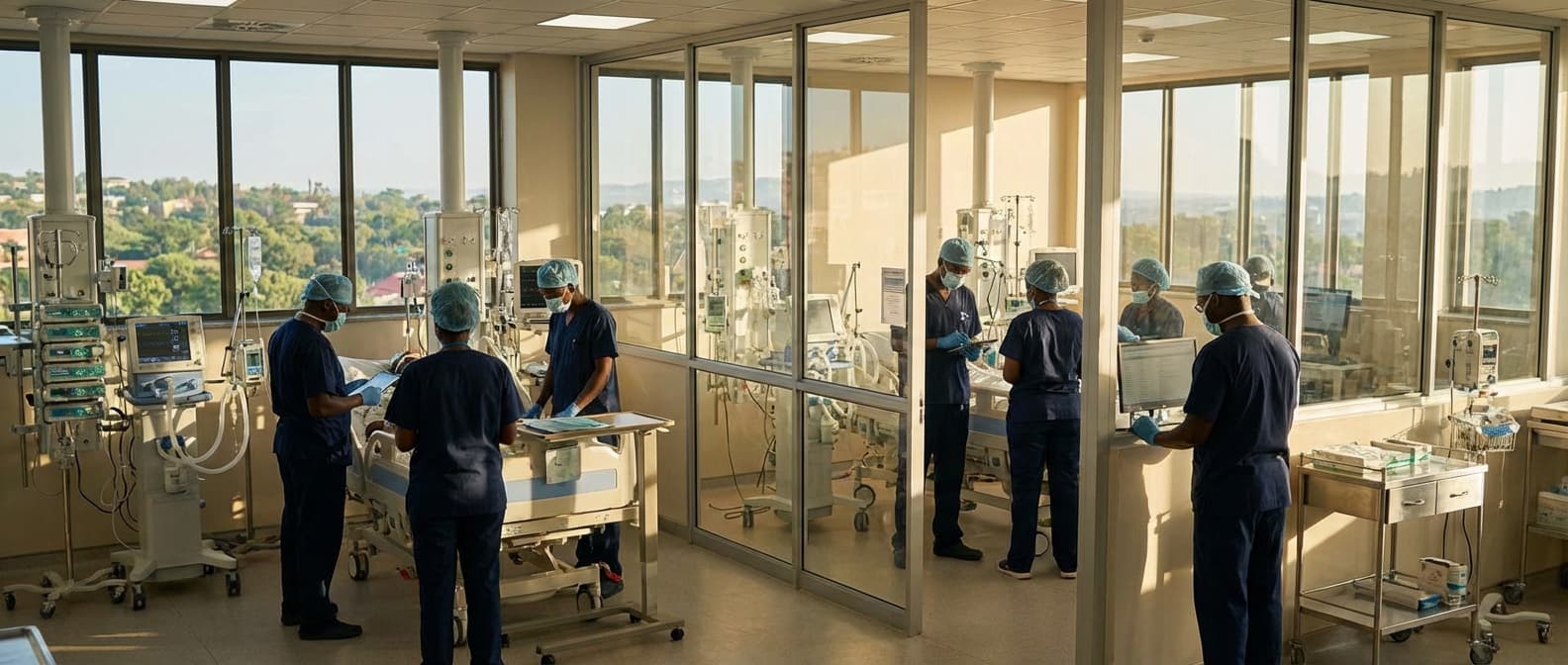
Ventilator Fleet Management & PM in Guinea
Engineering Excellence & Technical Support
Preventive maintenance and fleet management for ICU ventilators High-standard technical execution following OEM protocols and local regulatory frameworks.
Optimized Allocation & Deployment
Implementing a real-time ventilator tracking system to ensure optimal distribution and immediate deployment of critical respiratory support units across Guinea, prioritizing high-demand regions and facilities based on patient flow and outbreak predictions.
Proactive Predictive Maintenance
Leveraging IoT sensors and historical data to forecast potential ventilator malfunctions, enabling scheduled, preemptive maintenance interventions and minimizing unexpected downtime during critical patient care scenarios.
Mobile Maintenance Units
Establishing and equipping dedicated mobile maintenance units with skilled technicians and spare parts, capable of reaching remote healthcare facilities across Guinea to perform on-site repairs and essential servicing, thereby extending operational lifespan and ensuring readiness.
What Is Ventilator Fleet Management & Pm In Guinea?
Ventilator Fleet Management & Preventative Maintenance (PM) in Guinea refers to the comprehensive operational and technical support services dedicated to ensuring the optimal functionality, availability, and longevity of mechanical ventilation devices within healthcare facilities. This encompasses the entire lifecycle of ventilators, from initial deployment and calibration to routine servicing, repair, and eventual decommissioning. The objective is to mitigate critical equipment failure, particularly during periods of increased demand, and to uphold stringent patient care standards through reliable respiratory support.
| Who Needs Ventilator Fleet Management & PM? | Typical Use Cases | ||||
|---|---|---|---|---|---|
| Public and Private Hospitals: Particularly those with Intensive Care Units (ICUs), Neonatal ICUs (NICUs), Operating Rooms (ORs), and Emergency Departments. | Management of chronic respiratory diseases requiring long-term ventilation. | Management of acute respiratory distress syndrome (ARDS) in critical care settings. | Support during surgical procedures requiring mechanical ventilation. | Emergency response to public health crises (e.g., pandemics, natural disasters) necessitating a surge in ventilator availability. | Pediatric and neonatal intensive care, requiring specialized ventilator functionality and safety features. |
| Specialized Clinics and Long-Term Care Facilities: Facilities providing respiratory support to patients with chronic conditions. | Ensuring consistent availability of ventilators for patients undergoing mechanical ventilation for conditions like COPD, cystic fibrosis, or neuromuscular disorders. | Maintaining operational readiness of ventilators for planned or emergency patient transfers. | Facilitating predictable and reliable patient care pathways through consistent equipment performance. | Compliance with healthcare accreditation and quality assurance mandates. | |
| Government Health Ministries and Procurement Agencies: Responsible for national health infrastructure and equipment acquisition. | Establishing and overseeing national ventilator reserves for public health emergencies. | Standardizing equipment maintenance protocols across public healthcare facilities. | Evaluating the total cost of ownership (TCO) for different ventilator models, including maintenance and support. | Ensuring equitable distribution and accessibility of functional ventilators across the country. | |
| Non-Governmental Organizations (NGOs) and International Aid Organizations: Involved in healthcare delivery and infrastructure development in resource-limited settings. | Implementing and managing ventilator fleets in areas with limited local technical expertise. | Ensuring the sustainability of donated or procured medical equipment. | Training local healthcare professionals to manage and maintain essential respiratory equipment. | Responding to acute humanitarian crises with mobile or temporary healthcare facilities requiring ventilation support. |
Key Components of Ventilator Fleet Management & PM in Guinea:
- Inventory Management and Tracking: Establishing and maintaining an accurate, real-time database of all installed and available ventilators, including model, serial number, location, service history, and current operational status.
- Preventative Maintenance Scheduling and Execution: Developing and implementing a robust schedule for routine inspections, cleaning, calibration, battery checks, and replacement of consumables (e.g., filters, tubing) as per manufacturer specifications and established clinical protocols.
- Corrective Maintenance and Repair: Rapid response to equipment malfunctions, including diagnosis, troubleshooting, and repair of faulty components by trained biomedical technicians.
- Performance Verification and Calibration: Regular testing and calibration of ventilator parameters to ensure accuracy and adherence to prescribed settings, critical for patient safety and therapeutic efficacy.
- Asset Lifecycle Management: Planning for equipment upgrades, replacements, and responsible disposal or refurbishment, optimizing capital expenditure and ensuring access to modern technology.
- Training and Competency Assurance: Providing training for clinical staff on the proper use and basic troubleshooting of ventilators, and for biomedical technicians on advanced maintenance and repair procedures.
- Regulatory Compliance: Ensuring all maintenance and operational activities adhere to national health regulations, international standards (e.g., ISO 13485), and accreditation requirements.
- Data Analytics and Reporting: Collecting and analyzing data on equipment performance, failure rates, maintenance costs, and utilization patterns to inform strategic decision-making and resource allocation.
- Contingency Planning and Surge Capacity: Developing strategies for managing increased ventilator demand, including deployment of backup units, rapid deployment protocols, and inter-facility resource sharing.
Who Needs Ventilator Fleet Management & Pm In Guinea?
Ventilator fleet management and preventative maintenance (PM) are critical for ensuring the operational readiness and lifespan of these life-saving medical devices. In Guinea, a country with developing healthcare infrastructure and potentially limited resources, the need for such services is pronounced. Effective management of ventilator fleets minimizes downtime, reduces the likelihood of critical equipment failure during emergencies, and optimizes the use of scarce financial and human resources. This ensures that healthcare facilities can consistently provide advanced respiratory support when it's most needed.
| Customer Type | Key Departments Involved | Specific Needs & Benefits |
|---|---|---|
| Government Hospitals & National Health Agencies | Intensive Care Units (ICUs), Respiratory Therapy Departments, Biomedical Engineering Departments, Ministry of Health Procurement & Logistics | Ensuring consistent availability for critical care, compliance with national health standards, cost-effective equipment lifecycle management, strategic resource allocation across facilities, training for local technicians. |
| Private Hospitals & Clinics | ICUs, Anesthesiology Departments, Respiratory Therapy Services, Facilities Management | Maintaining high service standards for paying patients, minimizing patient care disruptions, maximizing return on investment for expensive equipment, proactive troubleshooting. |
| Non-Governmental Organizations (NGOs) with Healthcare Programs | Clinical Operations, Logistics & Supply Chain, Program Management, Technical Support Teams | Sustaining medical interventions in underserved areas, ensuring reliable equipment for mobile clinics or remote health posts, maximizing the impact of donated equipment, capacity building for local staff. |
| International Aid Organizations | Program Implementation Teams, Procurement & Logistics Departments, Monitoring & Evaluation | Ensuring the long-term sustainability of donated or procured medical equipment, facilitating knowledge transfer and training, supporting national health system strengthening efforts, demonstrating accountability for donor funds. |
| Medical Equipment Suppliers & Distributors | Sales & Service Departments, Technical Support, After-Sales Service Teams | Providing reliable maintenance services as a value-add to sales, building long-term customer relationships, managing warranty claims efficiently, developing local service expertise, offering rental or leasing options. |
| Training Institutions for Biomedical Engineers | Curriculum Development, Practical Training Departments, Continuing Education Units | Providing hands-on training for future biomedical engineers, developing standardized PM protocols, offering specialized courses in ventilator maintenance, fostering a skilled local workforce for equipment repair. |
Target Customers & Departments in Guinea for Ventilator Fleet Management & PM
- Government Hospitals & National Health Agencies
- Private Hospitals & Clinics
- Non-Governmental Organizations (NGOs) with Healthcare Programs
- International Aid Organizations
- Medical Equipment Suppliers & Distributors
- Training Institutions for Biomedical Engineers
Ventilator Fleet Management & Pm Process In Guinea
This document outlines the workflow for Ventilator Fleet Management and Preventive Maintenance (PM) processes in Guinea, from initial inquiry to final execution. It details the steps involved in managing the lifecycle of ventilators, ensuring their optimal functionality through proactive maintenance, and responding effectively to any emergent issues.
| Stage | Key Activities | Responsible Parties | Documentation/Tools |
|---|---|---|---|
| Identification of ventilator needs (new acquisitions, replacement, capacity expansion). Assessment of existing fleet status and performance. Budgetary planning and justification. | Ministry of Health (MoH) - Equipment Planning Unit, Hospital Biomedical Engineering Departments, Funding Agencies | Needs assessment forms, Inventory reports, Budget proposals, Stakeholder meeting minutes |
| Tendering process and vendor selection. Order placement and contract management. Logistics, customs clearance, and delivery. Site preparation and installation of new ventilators. Initial commissioning and testing. | MoH - Procurement Unit, Central Medical Stores, Biomedical Engineering Technicians, Vendors | Tender documents, Purchase orders, Delivery notes, Installation checklists, Commissioning reports |
| Development and implementation of a PM schedule based on manufacturer recommendations and usage patterns. Scheduled inspections, cleaning, calibration, and replacement of worn parts. Record keeping of all PM activities. | Hospital Biomedical Engineering Departments, Certified Technicians, MoH - Oversight Unit | PM checklists, Maintenance logs, Manufacturer's PM manuals, Calibration certificates, Asset management system |
| Identification and reporting of ventilator malfunctions or breakdowns. Troubleshooting and diagnosis of issues. Repair or replacement of faulty components. Post-repair testing and validation. | Hospital Biomedical Engineering Departments, Field Service Technicians, MoH - Emergency Support | Breakdown reports, Service requests, Repair logs, Parts inventory, Diagnostic tools, Service technician reports |
| Maintaining an up-to-date inventory of all ventilators in the fleet. Tracking location, status (operational, under repair, decommissioned), and maintenance history of each unit. Utilization tracking and demand forecasting. | Central Medical Stores, Hospital Biomedical Engineering Departments, MoH - Logistics Unit | Inventory database, Asset tags, Barcode scanners, Fleet management software, Location tracking systems |
| Regular generation of reports on fleet status, PM completion rates, repair costs, and equipment downtime. Analysis of data to identify trends, recurring issues, and areas for improvement. Performance evaluation and strategic planning. | MoH - Information Management Unit, Hospital Biomedical Engineering Departments, Ministry Leadership | Performance dashboards, Monthly/Quarterly reports, Annual fleet review, Data analysis tools, Trend charts |
| Identification of ventilators that are beyond repair or obsolete. Formal decommissioning process, including data removal. Environmentally sound disposal or recycling of equipment according to national regulations. | Hospital Biomedical Engineering Departments, MoH - Environmental Health Unit, Waste Management Services | Decommissioning forms, Disposal certificates, Environmental impact assessments |
Key Stages of Ventilator Fleet Management & PM Process
- Inquiry & Needs Assessment
- Procurement & Installation
- Routine Preventive Maintenance (PM)
- Corrective Maintenance & Repair
- Inventory Management & Tracking
- Reporting & Analysis
- Decommissioning & Disposal
Ventilator Fleet Management & Pm Cost In Guinea
Managing a ventilator fleet in Guinea presents unique challenges and opportunities, particularly concerning preventative maintenance (PM) costs. These costs are influenced by a combination of local economic factors, the availability of specialized technicians and spare parts, import duties, and the logistical complexities of reaching remote healthcare facilities. Understanding these pricing dynamics is crucial for effective budget allocation and ensuring the long-term operational readiness of vital medical equipment.
Key Pricing Factors for Ventilator Fleet Management & PM in Guinea:
- Labor Costs: The availability of skilled biomedical engineers and technicians trained on specific ventilator models directly impacts labor rates. Demand for these specialized skills can drive up hourly or contract-based pricing.
- Spare Parts Availability & Cost: The cost of genuine, manufacturer-approved spare parts is a significant driver. If parts need to be imported, this incurs international shipping costs, customs duties, and potential currency exchange fluctuations, all of which add to the final price. Local availability, even for common parts, can be limited, necessitating longer lead times and higher costs for special orders.
- Import Duties & Taxes: Guinea levies import duties and taxes on medical equipment and spare parts. These percentages can vary and significantly increase the overall cost of acquisition and maintenance. Understanding the current tariff structure is vital for accurate budgeting.
- Logistics & Transportation: The geographical distribution of healthcare facilities in Guinea, including remote or difficult-to-access areas, adds substantial logistical costs. Transportation of technicians, equipment, and spare parts to these locations, especially during challenging weather or road conditions, requires dedicated resources and increases the overall expense.
- Service Provider Model: The choice between in-house maintenance teams, local service providers, or international Original Equipment Manufacturer (OEM) service contracts will significantly influence pricing. OEM contracts often provide comprehensive coverage but can be more expensive. Local providers may offer more competitive pricing but might have limitations in expertise or access to specific parts.
- Volume & Contractual Agreements: Larger fleet sizes and longer-term service agreements can often lead to volume discounts from service providers, potentially reducing the per-unit PM cost. Negotiating favorable terms upfront is essential.
- Currency Fluctuations: The Guinean Franc (GNF) can be subject to fluctuations against major international currencies. When spare parts or specialized services are priced in USD or EUR, currency exchange rates play a critical role in the final GNF cost.
- Service Level Agreements (SLAs): The criticality of the ventilators and the required response times stipulated in SLAs will influence pricing. More stringent SLAs, demanding rapid deployment of technicians and parts, generally command higher service fees.
Estimated Pricing Ranges in Guinean Franc (GNF):
It's important to note that these are broad estimates and actual costs can vary significantly based on the specific ventilator model (e.g., ICU vs. portable, complexity), the service provider, and the factors mentioned above. Prices are per ventilator, per annum for comprehensive PM, and may exclude major part replacements not covered under standard PM.
- Basic Preventative Maintenance (e.g., cleaning, calibration checks, minor part replacements): 1,500,000 GNF - 3,000,000 GNF
- Comprehensive Preventative Maintenance (including more in-depth checks, potential software updates, and a buffer for minor part wear): 3,000,000 GNF - 6,000,000 GNF
- Full Service Contracts (potentially including response times, labor, and a defined list of parts): 5,000,000 GNF - 10,000,000 GNF (or more, depending on the scope and OEM)
Note: These figures represent estimated annual costs per ventilator for preventative maintenance and basic servicing. Unforeseen major repairs, replacement of expensive components (e.g., compressors, circuit boards), or emergency call-outs will incur additional, often substantial, costs beyond these estimates. It is highly recommended to obtain detailed quotes from multiple local and international service providers based on the specific fleet composition and operational requirements.
| Service Type | Estimated Annual Cost Range (GNF per ventilator) |
|---|---|
| Basic Preventative Maintenance | 1,500,000 - 3,000,000 |
| Comprehensive Preventative Maintenance | 3,000,000 - 6,000,000 |
| Full Service Contracts (Scope Dependent) | 5,000,000 - 10,000,000+ |
Factors Influencing Ventilator Fleet Management & PM Costs in Guinea
- Labor Costs for Skilled Technicians
- Availability and Cost of Spare Parts (including import-related expenses)
- Import Duties and Taxes on Equipment and Parts
- Logistical Challenges and Transportation Expenses
- Service Provider Model (In-house, Local, OEM)
- Fleet Size and Contractual Agreements (Volume Discounts)
- Currency Exchange Rate Fluctuations
- Service Level Agreement (SLA) Requirements
Affordable Ventilator Fleet Management & Pm Options
Effective fleet management for medical ventilators is crucial for ensuring patient safety and operational efficiency. This involves proactive maintenance (PM), timely repairs, and strategic asset utilization. Affordable options can be achieved through well-defined value bundles and by implementing smart cost-saving strategies.
| Value Bundle Option | Included Services | Targeted Savings | Key Benefits |
|---|---|---|---|
| Basic PM Package | Scheduled preventive maintenance checks & calibration, basic functional testing, reporting. | Reduced emergency repairs, extended equipment lifespan. | Ensures core functionality, compliance with manufacturer guidelines. |
| Comprehensive PM & Minor Repair | Includes Basic PM Package plus: minor part replacements (filters, batteries), software updates, basic troubleshooting. | Minimizes downtime, addresses common issues proactively, reduces need for costly on-site technician visits. | Higher equipment availability, improved patient care continuity. |
| Full-Service Fleet Management | Includes Comprehensive PM & Minor Repair plus: advanced diagnostics, major component repairs, loaner equipment provision, parts inventory management, asset tracking, remote monitoring capabilities. | Maximized uptime, reduced capital expenditure through extended lifespan & optimized utilization, predictable operational costs. | Strategic asset deployment, data-driven decision-making, reduced administrative burden. |
| On-Demand Repair Service (Ad-Hoc) | Per-incident repair calls with pre-negotiated rates, priority response times. | Controlled costs for unexpected failures, avoids long-term commitment for low-usage equipment. | Flexibility for unpredictable needs, quick resolution of critical failures. |
Key Components of Affordable Ventilator Fleet Management & PM
- Preventive Maintenance (PM) Programs
- On-Demand Repair Services
- Asset Tracking & Utilization Monitoring
- Parts Inventory Management
- Training & Skill Development for Biomedical Staff
- Refurbishment & Re-deployment Strategies
Verified Providers In Guinea
Ensuring the quality and reliability of healthcare services is paramount. In Guinea, identifying verified providers is crucial for making informed decisions about your health. Franance Health stands out as a premier choice due to its rigorous credentialing process and unwavering commitment to excellence in healthcare delivery. Their verified providers undergo a comprehensive evaluation, ensuring they meet the highest standards of medical expertise, ethical practice, and patient care. This meticulous approach provides patients with the confidence that they are receiving safe, effective, and compassionate medical attention.
| Verification Aspect | Franance Health Standard | Patient Benefit |
|---|---|---|
| Medical Education & Training | Confirms completion of accredited medical programs and specialized training. | Ensures providers have the foundational knowledge and expertise. |
| Licensing & Certifications | Verifies current and valid professional licenses and relevant certifications. | Guarantees adherence to regulatory requirements and specialized competencies. |
| Professional Experience | Evaluates the depth and breadth of a provider's practical experience in their field. | Provides confidence in the provider's ability to handle diverse medical situations. |
| Ethical Conduct & Reputation | Screens for any history of malpractice, disciplinary actions, or ethical violations. | Offers assurance of patient safety and trustworthy care. |
| Continuing Medical Education (CME) | Confirms active participation in ongoing learning and skill enhancement. | Ensures providers are up-to-date with the latest medical research and treatments. |
Why Franance Health Credentials Matter
- Rigorous Vetting Process: Franance Health employs a stringent verification system that goes beyond basic licensing, examining qualifications, experience, disciplinary records, and patient feedback.
- Commitment to Excellence: Verified providers demonstrate a dedication to continuous professional development and adhere to the latest medical advancements and best practices.
- Patient-Centric Approach: Credentials often reflect a provider's commitment to patient satisfaction, communication, and ethical treatment.
- Trust and Transparency: Franance Health's verification process fosters trust by providing a transparent overview of a provider's qualifications and standing.
- Access to Quality Care: By partnering with verified providers, Franance Health ensures you have access to a network of highly competent and reliable healthcare professionals in Guinea.
Scope Of Work For Ventilator Fleet Management & Pm
This Scope of Work (SOW) outlines the requirements for a comprehensive Ventilator Fleet Management and Preventive Maintenance (PM) program. The objective is to ensure the optimal performance, reliability, and regulatory compliance of the organization's ventilator fleet. This SOW details the technical deliverables and standard specifications expected from the service provider.
| Category | Technical Deliverable | Standard Specification/Requirement |
|---|---|---|
| Fleet Inventory & Tracking | Comprehensive Asset Register | Detailed list of all ventilators, including make, model, serial number, acquisition date, location, current status (in-service, PM due, repair), and service history. Must be maintained in an accessible digital format (e.g., CMMS). |
| Preventive Maintenance (PM) | Scheduled PM Services | PM procedures must adhere strictly to manufacturer's recommendations and industry best practices. Includes detailed checklists for each PM level (e.g., daily, weekly, monthly, annual). All PMs must be documented with date, technician, actions taken, and results. |
| Preventive Maintenance (PM) | PM Schedule Adherence | A minimum of 95% adherence to the scheduled PM dates. Deviations must be documented and justified. |
| Preventive Maintenance (PM) | PM Kits & Consumables | Provision of all necessary OEM-approved parts, filters, and consumables for PM procedures. All parts must be traceable and accompanied by certificates of authenticity if required. |
| Corrective Maintenance & Repair | 24/7 Emergency Support | On-call availability for emergency repairs 24 hours a day, 7 days a week. Response time to critical equipment failures within 2 hours. |
| Corrective Maintenance & Repair | Repair Turnaround Time | Standard repair turnaround time for non-critical failures not exceeding 48 hours from notification. Critical failures requiring immediate attention. |
| Corrective Maintenance & Repair | Qualified Technicians | All repair and maintenance activities performed by certified and trained technicians with specific experience on the organization's ventilator models. Proof of certification and training must be provided. |
| Corrective Maintenance & Repair | Use of OEM Parts | Exclusive use of OEM-approved or equivalent quality parts for all repairs. Documentation of parts used for each repair must be provided. |
| Calibration & Performance Verification | Regular Calibration | Scheduled calibration of all ventilators as per manufacturer recommendations and regulatory requirements. Calibration certificates must be provided. |
| Calibration & Performance Verification | Performance Testing | Post-repair and post-PM performance verification using calibrated test equipment to ensure all operational parameters are within manufacturer specifications. |
| Data Management & Reporting | Service History Log | Detailed and accurate record of all maintenance, repair, and calibration activities for each ventilator, accessible via the CMMS. |
| Data Management & Reporting | Monthly Performance Reports | Monthly reports summarizing fleet status, PM compliance rates, repair trends, critical equipment issues, and proposed improvements. Reports should include key performance indicators (KPIs). |
| Data Management & Reporting | Annual Fleet Review | An annual review meeting to discuss overall fleet performance, identify areas for optimization, and plan for future fleet management strategies. |
| Regulatory Compliance | Adherence to Standards | Full compliance with all relevant local, national, and international regulations, including but not limited to FDA requirements, manufacturer service manuals, and safety standards. |
| Regulatory Compliance | Documentation Audit Readiness | All records and documentation must be maintained in a manner that facilitates immediate audit by regulatory bodies or internal quality assurance. |
| Training & Competency | Technician Training Program | Provider shall offer ongoing training and professional development for their technicians to keep them abreast of the latest technologies and best practices in ventilator maintenance. |
Key Objectives of Ventilator Fleet Management & PM Program
- Maximize ventilator availability and uptime.
- Ensure patient safety through regular, high-quality maintenance.
- Extend the lifespan of the ventilator fleet.
- Maintain compliance with all relevant regulatory standards (e.g., FDA, manufacturer guidelines).
- Optimize operational efficiency and reduce emergency repair costs.
- Provide accurate and timely data for fleet performance analysis and decision-making.
Service Level Agreement For Ventilator Fleet Management & Pm
This Service Level Agreement (SLA) outlines the terms and conditions for the management and preventive maintenance (PM) of the Ventilator Fleet, ensuring optimal performance and availability. It defines response times for critical events and establishes uptime guarantees for the managed ventilator fleet.
| Service Level | Description | Target | Measurement Method | Remedy for Non-Compliance |
|---|---|---|---|---|
| Ventilator Fleet Uptime Guarantee | Percentage of time the serviced ventilators are operational and available for use. | 98.5% Monthly Uptime | Calculated as (Total Scheduled Operating Hours - Downtime Hours) / Total Scheduled Operating Hours, measured across the entire fleet. | 10% service credit applied to the monthly management fee for every 0.5% below the guaranteed uptime. |
| Response Time - Critical Incident | Time from notification of a critical equipment failure (e.g., ventilator shutdown, critical alarm) to the initiation of corrective action by the service provider. | 4 Hours (On-site Technician Dispatch) | Time logged upon receipt of critical incident notification via agreed-upon channels (e.g., dedicated hotline, portal) to the timestamp of technician's departure for the site. | Service credit of $250 per incident for each hour exceeding the 4-hour response time. |
| Response Time - High Priority Incident | Time from notification of a non-critical but significant equipment issue (e.g., performance degradation, minor alarm) to the initiation of diagnostic assessment. | 8 Business Hours (Remote Diagnosis/Scheduled On-site) | Time logged upon receipt of high priority incident notification to the timestamp of remote diagnostic commencement or scheduled on-site visit. | Service credit of $100 per incident for each 4-hour block exceeding the 8-hour response time. |
| Preventive Maintenance Schedule Adherence | Percentage of scheduled preventive maintenance tasks completed within the designated timeframe. | 95% Quarterly Adherence | Number of PM tasks completed on time / Total number of scheduled PM tasks, reviewed quarterly. | Root cause analysis required for missed PMs; additional 5% service credit for the next quarter if adherence drops below 90%. |
| Reporting | Timeliness and accuracy of monthly performance reports including uptime, incident logs, and PM status. | Within 5 Business Days of Month-End | Report submission date verified against month-end date. | Late submission of reports incurs a $50 penalty per day until submitted. |
Key Performance Indicators (KPIs)
- Ventilator Fleet Uptime Guarantee
- Response Times for Critical Incidents
- Preventive Maintenance Schedule Adherence
- Reporting Frequency and Accuracy
Frequently Asked Questions

Ready when you are
Let's scope your Ventilator Fleet Management & PM in Guinea project in Guinea.

Scaling healthcare logistics and technical systems across the entire continent.