
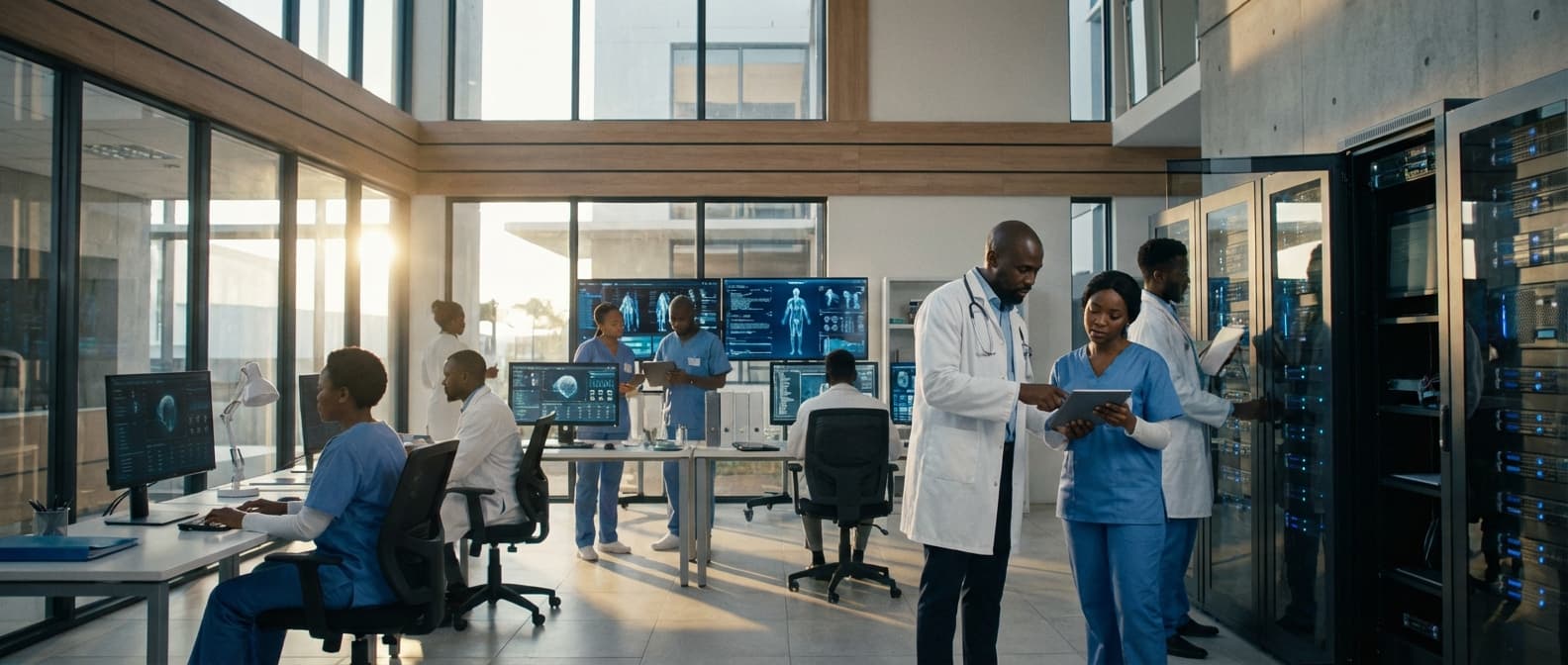
Medical IT Consultation in Guinea
Engineering Excellence & Technical Support
Strategic technology consulting to optimize healthcare operations, streamline workflows, and integrate cutting-edge medical information systems. High-standard technical execution following OEM protocols and local regulatory frameworks.
EHR Implementation & Optimization
We empower healthcare providers in Guinea with secure, scalable Electronic Health Record (EHR) systems. Our expertise spans from initial needs assessment and vendor selection to seamless data migration, user training, and ongoing optimization to enhance patient care, streamline workflows, and ensure data integrity.
Robust IT Infrastructure & Cybersecurity
Ensuring uninterrupted access to critical healthcare data is paramount. We design and implement resilient IT infrastructure, including secure networks, reliable hardware, and robust cloud solutions, fortified with advanced cybersecurity measures to protect sensitive patient information from evolving threats and ensure regulatory compliance.
Data Analytics & Performance Improvement
Leveraging data-driven insights, we help Guinean healthcare facilities identify trends, monitor key performance indicators (KPIs), and drive evidence-based improvements. Our services include data warehousing, custom reporting, and advanced analytics to optimize resource allocation, enhance patient outcomes, and support strategic decision-making.
What Is Medical It Consultation In Guinea?
Medical IT Consultation in Guinea refers to the provision of expert advisory services focused on the planning, implementation, optimization, and management of information technology infrastructure and systems within healthcare organizations operating in the Guinean context. This service leverages specialized knowledge of healthcare workflows, regulatory requirements (both national and international as applicable), and available technological solutions to enhance clinical operations, administrative efficiency, data security, and patient care delivery. It addresses the unique challenges and opportunities present in Guinea's healthcare IT landscape, which may include varying levels of infrastructure maturity, connectivity issues, and specific national health priorities.
| Who Needs Medical IT Consultation in Guinea? | Typical Use Cases | |||
|---|---|---|---|---|
| Hospitals and Clinics (Public & Private): Requiring modernization of IT infrastructure, implementation of EHRs, or optimization of existing systems to improve patient management, clinical decision support, and operational efficiency. | Implementing a new Electronic Health Record (EHR) system to digitize patient data and improve clinical workflow. | Upgrading network infrastructure to support real-time data access and telemedicine services. | Establishing a robust cybersecurity framework to protect patient data from breaches. | Integrating laboratory and radiology information systems for streamlined reporting and diagnosis. |
| Government Health Ministries and Agencies: Seeking to develop national health information strategies, establish health data registries, or improve the digital health infrastructure across the country. | Developing a national health information exchange (HIE) strategy. | Implementing a disease surveillance system leveraging IT for real-time data collection and analysis. | Assessing the readiness of public health facilities for digital transformation. | Designing and deploying digital solutions for public health campaigns and outreach. |
| Non-Governmental Organizations (NGOs) and International Aid Organizations: Working in the health sector and requiring IT support for project implementation, data management, and remote monitoring of health programs. | Setting up IT infrastructure for a new health project in a remote area. | Developing a database for tracking patient outcomes in a specific health program. | Implementing mobile health (mHealth) solutions for community health workers. | Ensuring data security and integrity for research or program evaluation purposes. |
| Medical Research Institutions: Needing specialized IT solutions for data analysis, research collaboration, and secure storage of sensitive research data. | Implementing a secure data repository for clinical trial data. | Setting up a high-performance computing environment for biomedical research. | Facilitating secure remote collaboration for research teams. | Ensuring compliance with data management plans for research grants. |
| Healthcare Startups and Technology Providers: Entering the Guinean market and requiring expertise on local IT landscape, regulatory environment, and specific healthcare needs. | Assessing the feasibility of introducing new health technology solutions in Guinea. | Tailoring software products to meet local regulatory and operational requirements. | Developing a go-to-market strategy for digital health products in Guinea. | Navigating the procurement processes for IT solutions within Guinean healthcare institutions. |
Key Components of Medical IT Consultation in Guinea
- Needs Assessment and Gap Analysis: Evaluating existing IT systems, infrastructure, and processes against organizational objectives and best practices to identify areas for improvement.
- Strategic IT Planning: Developing long-term technology roadmaps aligned with the healthcare organization's mission, vision, and financial resources, considering scalability and future technological advancements.
- System Design and Architecture: Designing robust and secure IT architectures, including electronic health record (EHR) systems, Picture Archiving and Communication Systems (PACS), laboratory information systems (LIS), and other clinical/administrative applications.
- Infrastructure Development and Optimization: Advising on the selection, deployment, and maintenance of hardware (servers, workstations, network devices), software, and telecommunications infrastructure, taking into account local environmental factors and power stability.
- Cybersecurity and Data Protection: Implementing and auditing security protocols, access controls, data encryption, and disaster recovery plans to safeguard sensitive patient information in compliance with relevant data privacy regulations.
- Interoperability and Data Integration: Facilitating the seamless exchange of data between different healthcare systems and stakeholders, potentially including national health information exchanges (HIEs) if present or under development.
- Telemedicine and Remote Care Solutions: Designing and implementing strategies for leveraging technology to deliver healthcare services remotely, addressing geographical barriers and resource limitations.
- Project Management and Implementation Support: Overseeing the successful deployment of new IT systems and solutions, ensuring adherence to timelines, budgets, and quality standards.
- Training and Capacity Building: Developing and delivering training programs for healthcare staff on the effective use of IT systems and technologies.
- Regulatory Compliance and Auditing: Ensuring that IT systems and practices comply with national healthcare regulations, international standards (e.g., HIPAA, GDPR where applicable for international patient data), and ethical guidelines.
Who Needs Medical It Consultation In Guinea?
Medical IT consultation is crucial for any healthcare organization looking to leverage technology for improved patient care, operational efficiency, and data security. In Guinea, this need is particularly pronounced as the healthcare sector increasingly adopts digital solutions.
| Department | Key IT Needs | Examples of Services |
|---|---|---|
| IT Department/Management | Infrastructure planning, network security, system upgrades, vendor management, IT policy development. | Network design and implementation, cybersecurity audits, cloud migration strategy, disaster recovery planning, software procurement advisory. |
| Clinical Departments (e.g., Radiology, Cardiology, Labs) | Integration of medical imaging systems (PACS), laboratory information systems (LIS), patient monitoring systems, data analysis tools. | PACS/LIS implementation and integration, DICOM compliance, data analytics for clinical insights, telehealth platform setup for remote consultations. |
| Administration & Operations | Patient registration systems, appointment scheduling, billing and revenue cycle management, human resources information systems (HRIS). | EHR/EMR selection and implementation, patient portal development, financial system integration, operational workflow optimization through IT. |
| Data Management & Analytics | Data warehousing, business intelligence, reporting, data security and privacy compliance. | Database design and management, custom report generation, data visualization tools, HIPAA/GDPR (or equivalent) compliance consulting. |
| Cybersecurity & Compliance | Risk assessment, vulnerability management, data breach prevention, regulatory compliance. | Security awareness training, penetration testing, incident response planning, compliance audits with national/international health regulations. |
| Telemedicine & Remote Care | Platform selection, bandwidth optimization, integration with existing systems, patient data security. | Telehealth platform setup and configuration, remote patient monitoring (RPM) solutions, secure video conferencing integration. |
Target Customers & Departments Requiring Medical IT Consultation in Guinea
- Hospitals and Clinics: Both public and private facilities, from large general hospitals to specialized clinics, require expert guidance in areas such as Electronic Health Records (EHR) implementation, network infrastructure, cybersecurity, telemedicine, and medical equipment integration.
- Public Health Agencies: Government bodies responsible for national health strategies, disease surveillance, and public health initiatives need IT solutions for data management, reporting, outbreak tracking, and communication across the healthcare system.
- Medical Research Institutions: Universities and research centers involved in medical studies and advancements require robust IT infrastructure for data analysis, secure storage of research data, and collaboration tools.
- Pharmaceutical and Medical Device Companies: Businesses operating within the healthcare supply chain need IT support for supply chain management, regulatory compliance, customer relationship management, and digital marketing.
- Non-Governmental Organizations (NGOs) & International Health Organizations: Entities working on health programs in Guinea often require IT support for project management, data collection, reporting to donors, and implementing health technology solutions in underserved areas.
- Healthcare Startups: Emerging companies in the health-tech space in Guinea will benefit from consultation to establish secure and scalable IT foundations for their innovative services.
- Government Ministries (Health, Technology, etc.): Ministries involved in policy-making, infrastructure development, and digital transformation within the health sector will need expert IT advice.
Medical It Consultation Process In Guinea
The Medical IT Consultation Process in Guinea outlines the systematic approach undertaken when a healthcare organization or individual seeks IT expertise for their medical operations. This workflow is designed to ensure that the consultation is efficient, effective, and leads to successful implementation of IT solutions that align with the specific needs and regulatory environment of Guinea.
| Stage | Description | Key Activities | Deliverables |
|---|---|---|---|
| Inquiry & Initial Contact | The client expresses interest in Medical IT consultation services. | Initial phone call, email, or website form submission. Brief overview of the client's general IT needs. | Acknowledgement of inquiry, scheduling of an initial meeting. |
| Needs Assessment & Scope Definition | Understanding the client's current IT infrastructure, challenges, and future goals. | On-site or remote meetings, stakeholder interviews, review of existing documentation, identification of pain points and objectives. | Detailed needs assessment report, agreed-upon scope of work (SoW). |
| Proposal & Quotation | Presenting a tailored solution and its associated costs. | Developing a comprehensive proposal outlining proposed IT solutions, methodology, timeline, and budget. Providing a detailed quotation. | Formal proposal document, cost breakdown, project timeline. |
| Contractual Agreement | Formalizing the engagement between the consultant and the client. | Review and negotiation of terms and conditions. Signing of a service agreement or contract. | Signed contract, payment schedule. |
| Information Gathering & Analysis | Deep dive into the client's specific environment and requirements. | System audits, data analysis, workflow mapping, identification of specific medical software and hardware needs, compliance requirements (e.g., data privacy in Guinea). | Comprehensive system analysis report, detailed requirement specifications. |
| Solution Design & Planning | Developing a strategic plan for implementing the IT solutions. | Designing the IT architecture, selecting appropriate software/hardware, planning data migration, developing implementation roadmaps, risk assessment and mitigation strategies. | Solution design document, implementation plan, technical specifications. |
| Implementation & Deployment | Putting the designed IT solutions into practice. | Hardware installation, software configuration, network setup, data migration, integration with existing systems. | Configured IT infrastructure, installed software, migrated data. |
| Training & Capacity Building | Equipping staff with the necessary skills to use the new IT systems. | Developing training materials, conducting user training sessions (on-site/remote), providing user manuals and guides. | Trained personnel, training manuals, user guides. |
| Testing & Quality Assurance | Ensuring the implemented solutions function as intended and meet requirements. | Unit testing, integration testing, user acceptance testing (UAT), performance testing, security testing. | Test reports, bug tracking logs, UAT sign-off. |
| Go-Live & Support | Transitioning to the new operational system and providing initial assistance. | Launching the new systems, providing immediate post-implementation support, troubleshooting any issues, establishing a helpdesk or support channel. | Operational IT systems, active support channels. |
| Post-Implementation Review & Optimization | Evaluating the success of the project and identifying areas for improvement. | Gathering feedback from users and stakeholders, performance monitoring, identifying opportunities for system optimization, providing ongoing maintenance and support recommendations. | Project evaluation report, recommendations for future enhancements, ongoing support plan. |
Workflow Stages of Medical IT Consultation in Guinea
- Inquiry & Initial Contact
- Needs Assessment & Scope Definition
- Proposal & Quotation
- Contractual Agreement
- Information Gathering & Analysis
- Solution Design & Planning
- Implementation & Deployment
- Training & Capacity Building
- Testing & Quality Assurance
- Go-Live & Support
- Post-Implementation Review & Optimization
Medical It Consultation Cost In Guinea
Consulting on medical IT in Guinea involves a range of costs influenced by several key factors. The complexity of the project, the specific services required (e.g., EMR implementation, network infrastructure upgrade, cybersecurity assessment, data analytics setup), the duration of the engagement, and the experience and reputation of the consulting firm or individual all play a significant role. Smaller clinics or individual practices with straightforward needs might require a few days of consultation, while larger hospitals or healthcare networks undertaking a comprehensive digital transformation could necessitate months of expert involvement. The pricing can be structured as a fixed project fee or an hourly/daily rate, with experienced consultants commanding higher rates. Given the current economic landscape and currency fluctuations in Guinea, pricing is typically discussed and agreed upon in Guinean Franc (GNF).
| Service Type/Complexity | Estimated Daily Rate (GNF) | Estimated Project Cost Range (GNF) |
|---|---|---|
| Basic IT Assessment/Recommendation (Small Clinic) | 500,000 - 800,000 | 2,500,000 - 8,000,000 |
| EMR/EHR System Consultation (Planning/Selection) | 700,000 - 1,200,000 | 7,000,000 - 25,000,000 |
| Network Infrastructure Upgrade Consultation (Medium Facility) | 800,000 - 1,500,000 | 10,000,000 - 40,000,000 |
| Cybersecurity Assessment and Strategy | 900,000 - 1,800,000 | 15,000,000 - 50,000,000 |
| Comprehensive Digital Transformation Strategy (Large Hospital/Network) | 1,200,000 - 2,500,000+ | 50,000,000 - 200,000,000+ |
| Specialized Data Analytics/BI Setup | 1,000,000 - 2,000,000 | 20,000,000 - 70,000,000 |
Key Pricing Factors for Medical IT Consultation in Guinea
- Project Complexity and Scope: The more intricate the IT requirements, the higher the cost.
- Specific Services Needed: EMR/EHR implementation, network setup, cybersecurity, data management, etc., each has its own pricing.
- Consultant Experience and Expertise: Senior consultants with specialized knowledge will charge more.
- Duration of the Project: Longer engagements naturally incur higher overall costs.
- Consulting Model: Fixed-price projects versus hourly/daily rates.
- Geographic Location within Guinea: While less impactful than other factors, some remote areas might incur travel costs.
- Urgency of the Project: Rush projects may attract premium pricing.
- Technology Stack Involved: Implementing or integrating with specific advanced technologies can increase costs.
Affordable Medical It Consultation Options
Navigating the complexities of Medical IT can be daunting for practices of all sizes. However, professional IT consultation doesn't have to break the bank. Affordable options exist, often built around flexible value bundles and strategic cost-saving measures. Understanding these approaches can empower healthcare organizations to optimize their technology infrastructure without compromising on quality or security.
| Strategy | Description | Benefit for Affordability |
|---|---|---|
| Leverage Cloud-Based Solutions | Utilize cloud hosting for EMRs, practice management software, and data storage. | Reduces upfront hardware costs, offers scalability, and often includes bundled maintenance and support from the provider. |
| Prioritize Open-Source Software (where applicable) | Explore open-source alternatives for certain IT tools, such as antivirus or basic network monitoring. | Eliminates licensing fees, though implementation and support may require internal expertise or specific consultation. |
| Phased Implementation | Break down large IT projects (e.g., EMR rollout) into smaller, manageable phases. | Allows for staggered budget allocation, reduces the risk of overspending on a single, massive project, and enables learning and adjustments along the way. |
| Bulk Purchasing and Long-Term Contracts | Negotiate discounts for purchasing software licenses, hardware, or services in larger quantities or committing to longer contract terms. | Secures lower per-unit costs and predictable expenses over time. |
| Remote Support and Monitoring | Emphasize IT consultation services that utilize remote access for troubleshooting and maintenance. | Significantly reduces travel costs and on-site visit charges for the consulting firm. |
| Consolidate Vendors | Streamline IT services by working with fewer, more comprehensive IT providers. | Often leads to better bundled pricing, simpler contract management, and stronger relationships for negotiation. |
| DIY with Expert Guidance | For practices with some in-house IT capacity, consult for strategic planning and critical tasks, while handling routine maintenance internally. | Leverages internal resources for cost savings on daily operations, focusing consultation budget on high-impact areas. |
Key Value Bundles for Affordable Medical IT Consultation
- Project-Based Consulting: Ideal for specific, well-defined needs like EMR implementation, network upgrades, or cybersecurity assessments. This offers predictability in cost and scope.
- Retainer Packages: Provides ongoing access to IT expertise for a fixed monthly fee. This is excellent for proactive maintenance, regular system checks, and immediate support, offering cost savings compared to hourly billing for frequent needs.
- Ad-Hoc Support: Pay-as-you-go services for unexpected issues or minor requests. While less predictable, it's a cost-effective solution for infrequent support needs.
- Managed IT Services (Partial or Full): Outsourcing a portion or all of your IT operations. This can be highly cost-effective by leveraging the expertise and infrastructure of a specialized provider, often at a lower cost than maintaining an in-house team.
- HIPAA Compliance Audits & Remediation Bundles: Focused services specifically addressing regulatory requirements, often packaged with clear deliverables and pricing.
Verified Providers In Guinea
In the dynamic landscape of healthcare in Guinea, identifying trustworthy and capable medical providers is paramount. Franance Health stands out as a leading credentialing body, rigorously vetting healthcare professionals and institutions. Their stringent accreditation process ensures that all "verified providers" possess the necessary expertise, adhere to ethical standards, and meet the highest quality of care benchmarks. Choosing a Franance Health verified provider means opting for competence, reliability, and a commitment to patient well-being. This verification offers peace of mind, assuring patients they are receiving care from qualified professionals who have demonstrated their proficiency and dedication to the Guinean healthcare sector.
| Credentialing Body | Key Benefit for Patients | Impact on Healthcare Quality |
|---|---|---|
| Franance Health | Guaranteed competence and adherence to best practices. | Elevates the overall standard of healthcare delivery in Guinea. |
| Franance Health | Assurance of ethical medical conduct and patient safety. | Fosters greater patient trust and confidence in the healthcare system. |
| Franance Health | Access to pre-qualified and highly skilled medical professionals. | Contributes to improved health outcomes and patient satisfaction. |
Why Franance Health Credentials Matter in Guinea
- Rigorous Vetting Process: Franance Health employs a comprehensive evaluation system to assess qualifications, experience, and adherence to medical best practices.
- Commitment to Quality: Verified providers demonstrate a dedication to delivering high-quality patient care, prioritizing safety and effectiveness.
- Ethical Standards: Accreditation by Franance Health signifies a commitment to ethical medical conduct and patient rights.
- Enhanced Patient Trust: The "verified provider" status builds confidence and assures patients they are choosing competent and reliable healthcare professionals.
- Improved Healthcare Access: By identifying and promoting qualified providers, Franance Health contributes to a stronger and more accessible healthcare system in Guinea.
Scope Of Work For Medical It Consultation
This Scope of Work (SOW) outlines the technical deliverables and standard specifications for Medical IT Consultation services. The objective of this consultation is to assess, recommend, and implement IT solutions that enhance efficiency, security, and compliance within a healthcare organization.
| Deliverable | Description | Standard Specifications / Key Considerations | Format | Acceptance Criteria |
|---|---|---|---|---|
| Current State IT Assessment Report | Detailed analysis of existing IT infrastructure, systems, software, hardware, network, and security posture. | Includes inventory of assets, performance metrics, user feedback, identified vulnerabilities, and existing workflow mapping. | PDF Document | Comprehensive and accurate representation of the current IT environment, clearly identifying strengths and weaknesses. |
| Future State IT Architecture Design | Conceptual and logical design for an optimized IT infrastructure that aligns with organizational goals. | Encompasses network topology, server infrastructure, cloud integration, data storage, and application architecture. Must be scalable and future-proof. | Diagrams (e.g., Visio, Lucidchart), Narrative Document (PDF) | Clear, actionable design that addresses identified gaps and supports future growth and technological advancements. |
| Technology Recommendations Document | Specific recommendations for hardware, software, cloud services, and IT solutions. | Includes justification for each recommendation, cost-benefit analysis, vendor comparisons, and integration feasibility. Recommendations must adhere to industry best practices and regulatory requirements. | PDF Document, Spreadsheet (for cost analysis) | Well-researched, cost-effective, and relevant recommendations that demonstrably improve the IT environment. |
| Implementation Plan and Project Timeline | Phased approach for deploying recommended technologies and solutions. | Details project phases, tasks, resource allocation, dependencies, milestones, risk mitigation strategies, and detailed timeline. Must be realistic and achievable. | Gantt Chart (e.g., MS Project), PDF Document | Clear, logical, and achievable plan with defined milestones and responsible parties. |
| Security Policy and Procedure Review/Update | Assessment and enhancement of existing IT security policies and procedures. | Covers access controls, data encryption, incident response, vulnerability management, and employee training. Must be aligned with current threats and regulatory mandates. | Updated Policy Documents (Word, PDF) | Policies are comprehensive, up-to-date, and address all critical security areas in accordance with relevant regulations. |
| Compliance Gap Analysis Report | Identification of discrepancies between current IT practices and regulatory requirements (e.g., HIPAA, HITECH). | Details specific areas of non-compliance, the associated risks, and recommended corrective actions. Prioritization of findings. | PDF Document | Accurate identification of all compliance gaps and actionable recommendations for remediation. |
| Data Migration Strategy | Plan for securely and efficiently transferring data between systems. | Outlines data mapping, cleansing, validation, backup procedures, downtime minimization, and rollback plans. Ensures data integrity and availability. | PDF Document | A robust and risk-averse strategy that guarantees successful and accurate data transfer. |
| Disaster Recovery and Business Continuity Plan | Strategy for maintaining essential IT operations during and after disruptive events. | Includes RTO/RPO objectives, backup strategies, recovery sites, communication plans, and testing procedures. Must be regularly reviewed and tested. | PDF Document | A comprehensive and actionable plan that minimizes downtime and ensures business continuity. |
| User Training Materials | Development of training resources for end-users on new systems and processes. | Includes user manuals, quick reference guides, video tutorials, and presentation slides. Tailored to different user roles and technical proficiencies. | PDF Documents, Video Files, Presentation Slides | Materials are clear, concise, and effectively enable users to perform their roles with new IT systems. |
| Post-Implementation Support Plan | Outline of support services to be provided after system deployment. | Defines support levels, escalation procedures, contact information, and service level agreements (SLAs). Includes plan for ongoing monitoring and maintenance. | PDF Document | A clearly defined support structure that ensures continued system stability and user satisfaction. |
Key Technical Deliverables
- Current State IT Assessment Report
- Future State IT Architecture Design
- Technology Recommendations Document
- Implementation Plan and Project Timeline
- Security Policy and Procedure Review/Update
- Compliance Gap Analysis Report (HIPAA, HITECH, etc.)
- Data Migration Strategy (if applicable)
- Disaster Recovery and Business Continuity Plan
- User Training Materials
- Post-Implementation Support Plan
Service Level Agreement For Medical It Consultation
This Service Level Agreement (SLA) outlines the guaranteed response times and uptime for Medical IT Consultation services provided by [Your Company Name] to [Client Name]. This SLA is an integral part of the Master Service Agreement (MSA) between the parties.
| Service Component | Response Time Guarantee (Business Hours) | Resolution Time Target (Business Hours) | Uptime Guarantee |
|---|---|---|---|
| Critical System Outage (e.g., EHR unavailable, critical network failure) | 15 minutes | 2 hours | 99.9% monthly |
| High-Priority Issue (e.g., patient portal login issues, imaging system slowness) | 30 minutes | 4 hours | 99.5% monthly |
| Medium-Priority Issue (e.g., printer malfunction, non-critical software bug) | 1 hour | 8 business hours | 99.0% monthly |
| Low-Priority Issue (e.g., general IT inquiry, minor configuration request) | 4 business hours | 2 business days | N/A (Best Effort) |
| Routine System Maintenance (Scheduled) | N/A | N/A | N/A (Requires prior notification) |
Key Service Objectives
- To ensure prompt and efficient resolution of IT issues impacting medical operations.
- To maintain high availability of critical IT systems and services.
- To provide clear expectations regarding support delivery and system performance.
Frequently Asked Questions

Ready when you are
Let's scope your Medical IT Consultation in Guinea project in Guinea.

Scaling healthcare logistics and technical systems across the entire continent.