
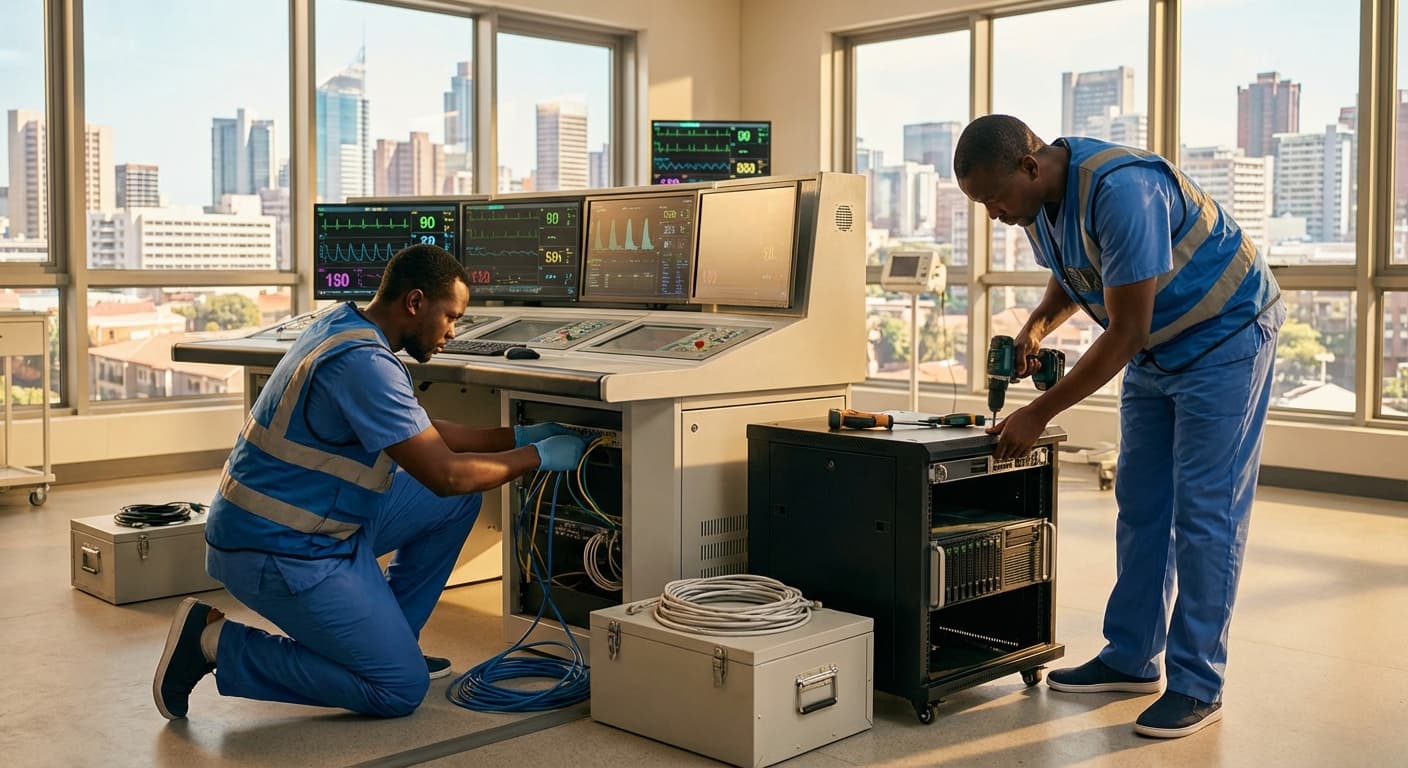
ICU Central Monitoring Station Installation Service in Guinea
Engineering Excellence & Technical Support
ICU Central Monitoring Station Installation Service High-standard technical execution following OEM protocols and local regulatory frameworks.
Advanced Network Architecture
We design and implement robust, high-bandwidth network infrastructure using state-of-the-art hardware and protocols, ensuring seamless, real-time data transmission from patient monitors to the central station for critical care decisions in Guinea's ICUs.
Redundant Power & Data Redundancy
Our installations incorporate critical redundancy for both power supply and data pathways, guaranteeing uninterrupted monitoring and data integrity, even during power outages or network disruptions, vital for patient safety in remote or challenging environments.
Scalable Server & Storage Solutions
We deploy scalable server and high-capacity storage solutions, capable of handling current and future data loads from numerous ICU beds, ensuring secure and accessible historical patient data for analysis, research, and regulatory compliance.
What Is Icu Central Monitoring Station Installation Service In Guinea?
ICU Central Monitoring Station Installation Service in Guinea refers to the comprehensive process of designing, procuring, installing, configuring, and commissioning a centralized system for real-time physiological data acquisition and display from multiple Intensive Care Unit (ICU) beds within healthcare facilities in Guinea. This service ensures continuous patient surveillance, early detection of critical events, and improved clinical decision-making by consolidating patient vital signs and alarms at a central nursing station or command center.
| Who Needs It? | Typical Use Cases | |||||
|---|---|---|---|---|---|---|
| Hospitals and Healthcare Facilities in Guinea: Primarily those with existing or planned Intensive Care Units (ICUs), Coronary Care Units (CCUs), Surgical Intensive Care Units (SICUs), or other critical care settings. | Continuous Patient Surveillance: Monitoring of vital signs (heart rate, blood pressure, SpO2, respiration rate, temperature) for multiple critically ill patients simultaneously. | Early Alarm Detection and Response: Prompt identification of physiological deteriorations and critical events through configurable alarm parameters, enabling timely clinical intervention. | Resource Optimization: Streamlining nursing workload by reducing the need for direct bedside monitoring of all parameters for every patient, allowing nurses to focus on more critical tasks. | Data Management and Analysis: Aggregating patient data for trend analysis, research, quality improvement initiatives, and potential integration with Electronic Medical Record (EMR) systems. | Enhanced Patient Safety: Minimizing the risk of missed alarms or delayed responses by providing a consolidated view of patient status. | Remote Monitoring Capabilities: Facilitating remote oversight by senior clinicians or specialists when required. |
| New Hospital Construction or Renovation Projects: Integrating central monitoring as a core component of critical care infrastructure. | Upgrades to Existing ICU Facilities: Modernizing outdated monitoring systems to improve efficiency, reliability, and advanced feature sets. | Facilities Experiencing High Patient Loads: Where effective patient management and resource allocation are paramount. | Government Health Initiatives: Supporting the development and enhancement of critical care services nationwide. |
Service Components and Considerations:
- System Design & Planning: Site assessment, network infrastructure evaluation, power redundancy planning, and determination of optimal monitoring station layout.
- Hardware Procurement & Integration: Acquisition of central monitoring units, network switches, servers, display consoles (monitors, workstations), and associated cabling.
- Software Installation & Configuration: Deployment of patient monitoring software, network configuration, data management system setup, and user access control.
- Network Infrastructure Setup: Establishing a robust and secure wired or wireless network to transmit data from bedside monitors to the central station.
- Power & Environmental Considerations: Ensuring adequate and reliable power supply with UPS backup, as well as appropriate environmental controls (temperature, humidity) for equipment longevity.
- Testing & Validation: Comprehensive testing of data flow, alarm functionality, system performance, and integration with existing hospital IT systems (e.g., EMR).
- User Training & Handover: Providing in-depth training to clinical staff and IT personnel on system operation, maintenance, and troubleshooting.
- Post-Installation Support & Maintenance: Offering ongoing technical support, software updates, and hardware maintenance agreements.
- Regulatory Compliance: Adherence to relevant national and international medical device and data security regulations applicable in Guinea.
Who Needs Icu Central Monitoring Station Installation Service In Guinea?
The installation of an ICU Central Monitoring Station is a critical infrastructural upgrade for healthcare facilities in Guinea. This service is essential for hospitals aiming to enhance their intensive care unit (ICU) capabilities, improve patient outcomes, and optimize resource allocation. The central monitoring station allows for real-time observation and analysis of multiple patient vital signs from a single location, empowering medical staff to respond more promptly and effectively to critical events. This significantly boosts patient safety and provides a more efficient workflow for the ICU team.
| Customer Type | Key Departments Benefiting | Reasons for Need |
|---|---|---|
| Public Hospitals | Intensive Care Unit (ICU), Emergency Department, Cardiology Department, Neurosurgery Department | Enhance patient monitoring in critical care, improve response times, standardize care protocols, and leverage limited resources efficiently. |
| Private Hospitals | Intensive Care Unit (ICU), Cardiac Care Unit (CCU), Surgical Intensive Care Unit (SICU), Medical Intensive Care Unit (MICU) | Provide state-of-the-art patient care, attract and retain top medical talent, improve patient safety, and gain a competitive advantage. |
| Tertiary Care Centers | ICU, Post-Anesthesia Care Unit (PACU), Neonatal Intensive Care Unit (NICU), Pediatric Intensive Care Unit (PICU) | Manage complex patient cases, facilitate interdisciplinary collaboration, support advanced medical procedures, and enable data-driven decision-making. |
| International Aid Projects | ICU, General Wards undergoing upgrades | Facilitate the implementation of modern healthcare standards, improve the quality of care in underserved areas, and ensure effective use of donated medical equipment. |
| University Hospitals | ICU, Departments involved in clinical research and training | Provide a platform for advanced patient monitoring for training medical professionals, conduct clinical research requiring continuous data acquisition, and ensure high standards of patient care during complex medical education. |
Target Customers and Departments for ICU Central Monitoring Station Installation Service in Guinea
- Hospitals (Public & Private): All hospitals in Guinea with existing or planned Intensive Care Units.
- Ministry of Health & Public Health Institutions: Government-funded hospitals and health facilities overseen by the Ministry of Health.
- Large Medical Centers & Tertiary Hospitals: Facilities offering specialized care and handling a high volume of critically ill patients.
- International Aid Organizations & NGOs: Organizations involved in developing and upgrading healthcare infrastructure in Guinea.
- Research and Teaching Hospitals: Institutions that require advanced monitoring for both patient care and medical education.
Icu Central Monitoring Station Installation Service Process In Guinea
This document outlines the comprehensive service process for the installation of an ICU Central Monitoring Station in Guinea, from the initial customer inquiry to the final execution and handover. The process is designed to ensure a smooth, efficient, and compliant installation that meets the highest standards of healthcare infrastructure.
| Phase | Step | Description | Key Activities | Deliverables/Outcomes | Responsible Party |
|---|---|---|---|---|---|
| Phase 1: Pre-Installation & Planning |
| The customer (hospital, clinic, or healthcare facility in Guinea) expresses interest in an ICU Central Monitoring Station. | Initial discussion to understand customer needs, project scope, desired features, budget, and timeline. Site assessment feasibility preliminary discussion. | Understanding of customer requirements, identification of potential challenges, initial proposal outline. | Customer, Service Provider Sales Team |
| Phase 1: Pre-Installation & Planning |
| A thorough on-site inspection of the intended installation location is conducted. | Assessment of power supply, network infrastructure (wired/wireless), space availability, environmental conditions (temperature, humidity), existing equipment, and building regulations. Detailed technical specifications defined. Bill of Materials (BOM) development. | Detailed site report, finalized technical specifications, confirmed BOM, refined project plan. | Service Provider Technical Team, Customer Representatives |
| Phase 1: Pre-Installation & Planning |
| A comprehensive proposal detailing the solution, timeline, and costs is prepared. | Based on site assessment and requirements, a formal proposal is created, including system design, equipment list, installation plan, training schedule, warranty information, and a detailed quotation. | Formal proposal document, detailed quotation, project timeline. | Service Provider Sales/Project Management Team |
| Phase 1: Pre-Installation & Planning |
| Agreement on terms and conditions between the customer and the service provider. | Review and negotiation of the proposal, terms of service, payment schedule, and any specific contractual clauses. Finalization and signing of the installation contract. | Signed contract, agreed payment schedule. | Customer Legal/Procurement Team, Service Provider Legal/Management Team |
| Phase 1: Pre-Installation & Planning |
| Detailed system design and engineering based on finalized specifications. | Creation of detailed schematics, network diagrams, power distribution plans, and installation blueprints. Ensuring compliance with local building codes and healthcare standards (e.g., WHO guidelines, local Ministry of Health regulations). | Approved design documents, engineering drawings, compliance verification. | Service Provider Engineering Team |
| Phase 1: Pre-Installation & Planning |
| Acquisition of all necessary equipment and materials. | Ordering of central monitoring station hardware, bedside monitors, network components, cabling, and any specialized tools. Coordination of shipping, customs clearance, and delivery to the site in Guinea. | All necessary equipment and materials delivered to the site. | Service Provider Procurement & Logistics Team |
| Phase 1: Pre-Installation & Planning |
| Preparation of the installation site before the arrival of the installation team. | Ensuring power, network points, and mounting areas are ready. Preliminary site preparation as per design. Obtaining necessary site access permits. | Site ready for installation, necessary permits secured. | Customer Facilities Management, Service Provider Project Manager |
| Phase 2: On-Site Execution |
| Deployment of the skilled installation team to Guinea. | Travel and accommodation arrangements for certified technicians and project managers. Briefing on site-specific requirements and safety protocols. | Installation team on-site and ready to commence work. | Service Provider Project Management Team |
| Phase 2: On-Site Execution |
| Physical installation of the central monitoring station and associated hardware. | Mounting of the central monitoring unit(s), installation of network switches, cabling (data and power), and any necessary patient bedside monitor integration hardware. | Physically installed hardware components. | Service Provider Installation Technicians |
| Phase 2: On-Site Execution |
| Configuration of the network and software for seamless data flow. | Setting up network connectivity, configuring IP addresses, installing and configuring the central monitoring software, defining user roles and permissions. Integration with existing hospital IT infrastructure (if applicable). | Functional network and configured monitoring software. | Service Provider Network/Software Engineers |
| Phase 2: On-Site Execution |
| Connecting bedside monitors and performing comprehensive system tests. | Connecting existing or newly installed bedside monitors to the central station. Conducting functional tests, performance tests, and stress tests to ensure accurate data acquisition, transmission, and display. Alarm testing. | Fully integrated and tested system, validated data flow and alarm functionality. | Service Provider Technical Team |
| Phase 2: On-Site Execution |
| Independent verification of the installation against specifications. | Review of installation quality, adherence to design, and test results. Identification and rectification of any issues or defects. | Quality assurance report, list of resolved issues. | Service Provider Quality Assurance Officer/Project Manager |
| Phase 3: Post-Installation & Handover |
| Comprehensive training for hospital staff on system operation. | Training sessions for doctors, nurses, and IT personnel on operating the central monitoring station, interpreting data, managing alarms, troubleshooting basic issues, and system maintenance. Training materials provided. | Trained hospital staff, user manuals and documentation. | Service Provider Training Specialist, Customer Staff |
| Phase 3: Post-Installation & Handover |
| Formal acceptance of the installed system by the customer. | Joint review of the installed system, test results, and training. Customer formally accepts the installation and the system is handed over. Sign-off on the project completion. | Customer acceptance form, signed project completion certificate. | Customer Project Lead, Service Provider Project Manager |
| Phase 3: Post-Installation & Handover |
| Initiation of warranty period and support services. | Formal commencement of the warranty period as per the contract. Establishment of ongoing technical support channels and service level agreements (SLAs). | Warranty period active, established support channels. | Service Provider Support Team, Customer IT/Biomedical Department |
| Phase 3: Post-Installation & Handover |
| Finalization of all project-related documentation and administrative closure. | Archiving of all project documentation, including as-built drawings, test reports, training records, and final invoices. Post-project review meeting. | Complete project documentation, closed project file. | Service Provider Project Manager |
ICU Central Monitoring Station Installation Service Process in Guinea
- Phase 1: Pre-Installation & Planning
- Phase 2: On-Site Execution
- Phase 3: Post-Installation & Handover
Icu Central Monitoring Station Installation Service Cost In Guinea
The installation of an ICU Central Monitoring Station (CMS) in Guinea is a complex project with costs that can vary significantly based on several key factors. These stations are critical for real-time patient data aggregation and analysis in intensive care units, requiring specialized equipment, skilled labor, and adherence to stringent healthcare standards. Understanding the pricing structure is essential for healthcare facilities planning such an investment. This discussion outlines the primary drivers of cost and provides estimated ranges in Guinean Francs (GNF).
| Cost Component | Estimated Range (GNF) |
|---|---|
| Basic ICU CMS (e.g., 4-6 beds, standard parameters) | 100,000,000 - 250,000,000 |
| Mid-Range ICU CMS (e.g., 8-12 beds, advanced parameters, basic integration) | 250,000,000 - 500,000,000 |
| High-End/Comprehensive ICU CMS (e.g., 12+ beds, all parameters, full HIS/EMR integration, advanced analytics) | 500,000,000 - 1,500,000,000+ |
| Installation Labor (per technician, per day) | 150,000 - 400,000 |
| Software Licensing (annual) | 20,000,000 - 100,000,000+ |
| Infrastructure Upgrades (if needed) | Varies widely (e.g., 5,000,000 - 50,000,000+ for cabling, power) |
| Training (per session/group) | 10,000,000 - 30,000,000 |
| Maintenance & Support (annual contract) | 10-20% of initial system cost |
Key Pricing Factors for ICU Central Monitoring Station Installation in Guinea:
- System Complexity and Scope: The number of patient beds to be monitored, the types of parameters required (e.g., ECG, SpO2, NIBP, temperature, respiration), and the integration of advanced features like data management software, trending capabilities, and remote access will directly influence the overall cost. A larger, more sophisticated system will naturally be more expensive.
- Equipment Quality and Brand: The selection of high-quality, reliable monitoring devices and central station hardware from reputable manufacturers is paramount. Premium brands often come with higher price tags but offer better accuracy, durability, and support. The choice between new, refurbished, or even leased equipment can also impact the initial investment.
- Installation Labor and Expertise: The installation requires specialized biomedical engineers and technicians with experience in healthcare IT and medical device integration. The availability of such skilled professionals in Guinea, their experience level, and the duration of the installation project will determine labor costs. Travel and accommodation for external specialists can add to this expense.
- Infrastructure Requirements: Existing hospital infrastructure plays a crucial role. This includes the availability and capacity of power supply, network cabling (Ethernet), server room space, and environmental controls (e.g., air conditioning for server rooms). If upgrades or new installations are needed for these, the cost will increase.
- Software Licensing and Integration: The central monitoring software itself, along with its licensing fees, is a significant component. Integration with existing hospital information systems (HIS) or electronic medical records (EMR) can also incur additional development and testing costs.
- Training and Support: Comprehensive training for clinical staff on operating the CMS and troubleshooting common issues is vital. Ongoing maintenance contracts, technical support, and warranty periods also contribute to the long-term cost of ownership and are often factored into the initial installation agreement.
- Regulatory Compliance and Certifications: Ensuring the installation meets local healthcare regulations and potentially international standards (if applicable) can involve additional costs for certifications, inspections, and documentation.
- Geographic Location within Guinea: While major cities like Conakry might have more readily available resources and established vendors, installation in remote areas could incur higher logistical costs for equipment delivery, personnel travel, and on-site setup.
- Contingency and unforeseen issues: It is prudent to include a contingency buffer in the budget to account for any unforeseen challenges that may arise during the installation process.
Affordable Icu Central Monitoring Station Installation Service Options
Installing an ICU central monitoring station is a critical investment for any healthcare facility aiming to provide optimal patient care. While the initial outlay can seem substantial, understanding the available service options, value bundles, and cost-saving strategies can make this essential upgrade more accessible and financially prudent. This guide explores affordable installation service options for ICU central monitoring stations, focusing on maximizing value and minimizing expenditure without compromising on quality or patient safety.
| Service Option | Description | Value Proposition | Potential Cost-Saving Strategies |
|---|---|---|---|
| Standard Installation Package | Includes hardware installation, basic software configuration, and initial system testing. May involve manufacturer-certified technicians. | Ensures proper setup and functionality of core monitoring systems. Reliable and professional deployment. | Negotiate package pricing, explore phased installations, leverage existing IT infrastructure where possible. |
| Value Bundle: Essential Monitoring | Combines standard installation with essential training for a defined number of staff and a basic post-installation support period (e.g., 90 days). | Provides a complete solution for immediate operational readiness. Cost-effective for facilities with moderate training needs. | Bundle discounts, extended training can be added later, choose shorter initial support periods and extend if needed. |
| Value Bundle: Comprehensive Care | Includes full installation, advanced software integration (e.g., with EMR), comprehensive staff training (clinical and IT), and a multi-year maintenance contract. | Offers end-to-end solution for seamless workflow integration and long-term operational efficiency. Peace of mind with proactive support. | Negotiate long-term maintenance discounts, inquire about bundled financing options, consider refurbished or certified pre-owned hardware for non-critical components. |
| Modular Installation Service | Allows for staged implementation of the central monitoring system, focusing on critical areas first and expanding over time. Installation is tailored to each phase. | Spreads the cost over time, allows for gradual adoption and learning, minimizes disruption to existing operations. | Focus on installing only essential modules initially, plan future expansion to leverage bulk purchasing discounts on later phases, rent equipment for temporary needs. |
| Third-Party Integrator Service | Specialized IT and biomedical engineering firms that offer installation, integration, and customization services, often independent of the hardware manufacturer. | Potentially more competitive pricing, greater flexibility in hardware choices, expertise in integrating diverse systems. | Obtain multiple quotes, look for integrators with strong track records and references, consider them for project management and procurement. |
Key Components of an ICU Central Monitoring Station Installation
- Central monitoring server and software
- Workstations for nurses and physicians
- Network infrastructure (cabling, switches)
- Physiological parameter modules (ECG, SpO2, NIBP, etc.)
- Integration with existing EMR/EHR systems
- Training for clinical and IT staff
- Ongoing maintenance and support contracts
Verified Providers In Guinea
Finding reliable and trustworthy healthcare providers is paramount in Guinea. Franance Health has established itself as a leading platform for verifying healthcare professionals, ensuring that patients receive the highest quality of care. Their rigorous credentialing process sets them apart, making them the best choice for anyone seeking medical services.
| Credential Type | Verification Method | Importance for Patients |
|---|---|---|
| Medical Degrees & Diplomas | Verification with issuing institutions (universities, medical schools) | Confirms foundational medical knowledge and training. |
| Professional Licenses | Cross-referencing with national medical boards and licensing authorities | Ensures legal authorization to practice medicine. |
| Specialty Certifications | Validation with relevant professional bodies and specialty boards | Confirms specialized expertise and advanced training. |
| Continuing Medical Education (CME) | Review of participation records and certificates | Demonstrates commitment to staying updated with the latest medical advancements. |
| Good Standing & Disciplinary Records | Checks with professional regulatory bodies | Confirms absence of malpractice or ethical violations. |
Why Franance Health Credentials Matter
- Rigorous Verification Process: Franance Health employs a multi-faceted approach to verify credentials, including academic qualifications, professional licenses, and any necessary certifications. This meticulous vetting process weeds out unqualified individuals.
- Commitment to Quality: By partnering with only the most qualified and ethical healthcare providers, Franance Health demonstrates a deep commitment to patient well-being and the advancement of healthcare standards in Guinea.
- Enhanced Patient Confidence: Knowing that a provider has been thoroughly vetted by a reputable organization like Franance Health instills confidence and peace of mind for patients when making crucial health decisions.
- Access to Expertise: Franance Health connects patients with a diverse range of specialists and general practitioners, ensuring access to the specific expertise needed for various medical conditions.
- Transparency and Accountability: The platform promotes transparency by clearly displaying verified credentials, allowing patients to make informed choices and holding providers accountable for their professional conduct.
Scope Of Work For Icu Central Monitoring Station Installation Service
This Scope of Work (SOW) outlines the requirements for the installation services of an Intensive Care Unit (ICU) Central Monitoring Station (CMS). The project encompasses the entire process from site preparation and cabling to the final setup, configuration, testing, and commissioning of the CMS hardware and software. The objective is to establish a robust and reliable central monitoring system that provides real-time patient data to critical care staff, enhancing patient safety and clinical decision-making. This SOW details the technical deliverables expected from the service provider and outlines the standard specifications that must be adhered to throughout the installation.
| Technical Deliverable | Description | Standard Specification/Reference |
|---|---|---|
| Detailed Site Survey Report | Comprehensive assessment of the ICU environment, including existing infrastructure, power requirements, network connectivity, and physical space constraints. | Must include floor plans, cable routing diagrams, and power outlet locations. |
| Cabling Infrastructure Plan | Detailed plan for the installation of all necessary data and power cabling for the CMS, including type, length, and routing for each cable. | Adherence to hospital IT and safety standards; use of plenum-rated cabling where required. |
| Network Connectivity Plan | Specification of network ports, IP addressing scheme, and required network bandwidth for seamless data transfer from patient monitors to the CMS. | Must comply with hospital network security policies and ensure adequate bandwidth (e.g., minimum 1 Gbps). DHCP or static IP assignment based on hospital policy. |
| Installed and Configured CMS Servers | Provision and installation of all server hardware required for the CMS, including operating system installation and initial configuration. | Servers to meet specified performance benchmarks for data processing and storage, based on manufacturer's recommendations and projected patient load. |
| Installed and Configured CMS Workstations | Setup and configuration of all operator workstations and physician review stations within the ICU. | Workstations to meet minimum hardware requirements for running CMS software smoothly; correct display resolution and ergonomic setup. |
| Cabled and Powered Patient Monitor Interfaces | Installation of all necessary interface modules, cables, and power connections to link patient monitoring devices to the CMS network. | Use of hospital-approved connectors and cables; adherence to electrical safety standards. |
| Installed and Configured CMS Software | Installation and configuration of the core CMS software, including database setup, user profiles, alarm management settings, and data archiving. | Version to be confirmed with hospital IT; all configuration parameters to be documented. |
| Integrated Data Flow Reports | Demonstration and documentation of seamless data flow from patient monitors through the network to the CMS and displayed on workstations. | End-to-end connectivity verified; latency measurements within acceptable limits (e.g., < 500ms for critical parameters). |
| Alarm Configuration and Testing Report | Verification of all critical and non-critical alarm settings, including audible and visual alerts, and their respective escalation protocols. | Alarms to be configured as per clinical protocols and tested with simulated patient data. |
| System Performance and Load Testing Report | Comprehensive testing of the CMS under peak load conditions to ensure stability, responsiveness, and data integrity. | Tests to simulate maximum number of connected patients and data streams; system must maintain performance targets. |
| User Training Materials and Sessions | Development of comprehensive training materials and delivery of hands-on training sessions for ICU nursing staff, physicians, and IT support. | Training to cover system operation, alarm management, troubleshooting, and data access; materials to be provided in digital and/or print format. |
| Commissioning Report and Sign-off | Formal documentation confirming successful installation, configuration, testing, and acceptance of the CMS system by the hospital. | Includes all test results, configuration details, and training completion records; signed by authorized hospital representatives. |
| As-Built Drawings and Documentation | Finalized drawings reflecting the actual installation, including cable pathways, device locations, and network connections, along with all system documentation. | Drawings to be in AutoCAD or equivalent format; documentation to be comprehensive and easy to follow. |
| Service Level Agreement (SLA) for Post-Installation Support | Definition of response times, uptime guarantees, and maintenance procedures for the CMS post-installation. | To be negotiated and agreed upon with the hospital; typically includes 24/7 technical support. |
Key Project Phases and Activities
- Site Assessment and Planning
- Infrastructure Preparation (Cabling, Power, Network)
- Hardware Installation and Configuration
- Software Installation and Configuration
- Integration with Existing Systems
- System Testing and Validation
- User Training
- Commissioning and Handover
Service Level Agreement For Icu Central Monitoring Station Installation Service
This Service Level Agreement (SLA) outlines the response times and uptime guarantees for the installation services provided by [Your Company Name] for the ICU Central Monitoring Station. This SLA is an addendum to the Master Service Agreement (MSA) between [Your Company Name] and [Client Name].
| Service Component | Response Time Target (Business Hours) | Uptime Guarantee (Post-Installation) |
|---|---|---|
| Initial Consultation & Planning | Within 2 Business Days of Request | N/A |
| On-Site Installation Scheduling | Within 3 Business Days of Agreement on Dates | N/A |
| Critical System Failure (Monitoring Station Unavailable) | 1 Hour (Remote Diagnosis & Escalation) | 99.9% (Monthly Average) |
| Non-Critical System Issue (e.g., minor bug, configuration anomaly) | 4 Business Hours (Remote Diagnosis & Escalation) | N/A |
| On-Site Technician Dispatch (for Critical Failures requiring physical presence) | Within 4 Business Hours of Remote Diagnosis Confirmation | N/A |
| Routine System Updates & Maintenance (scheduled) | As per agreed maintenance schedule | N/A |
| Post-Installation Support (excluding Critical Failures covered above) | Next Business Day (Remote Diagnosis & Escalation) | N/A |
Scope of Service
- On-site installation of the ICU Central Monitoring Station hardware and software.
- Configuration of the system to meet the client's specific ICU workflow requirements.
- Integration with existing hospital network infrastructure (as specified in the project scope).
- Initial system testing and validation.
- On-site training for designated hospital IT and clinical staff.
- Post-installation support during the warranty period.
Frequently Asked Questions

Ready when you are
Let's scope your ICU Central Monitoring Station Installation Service in Guinea project in Guinea.

Scaling healthcare logistics and technical systems across the entire continent.