
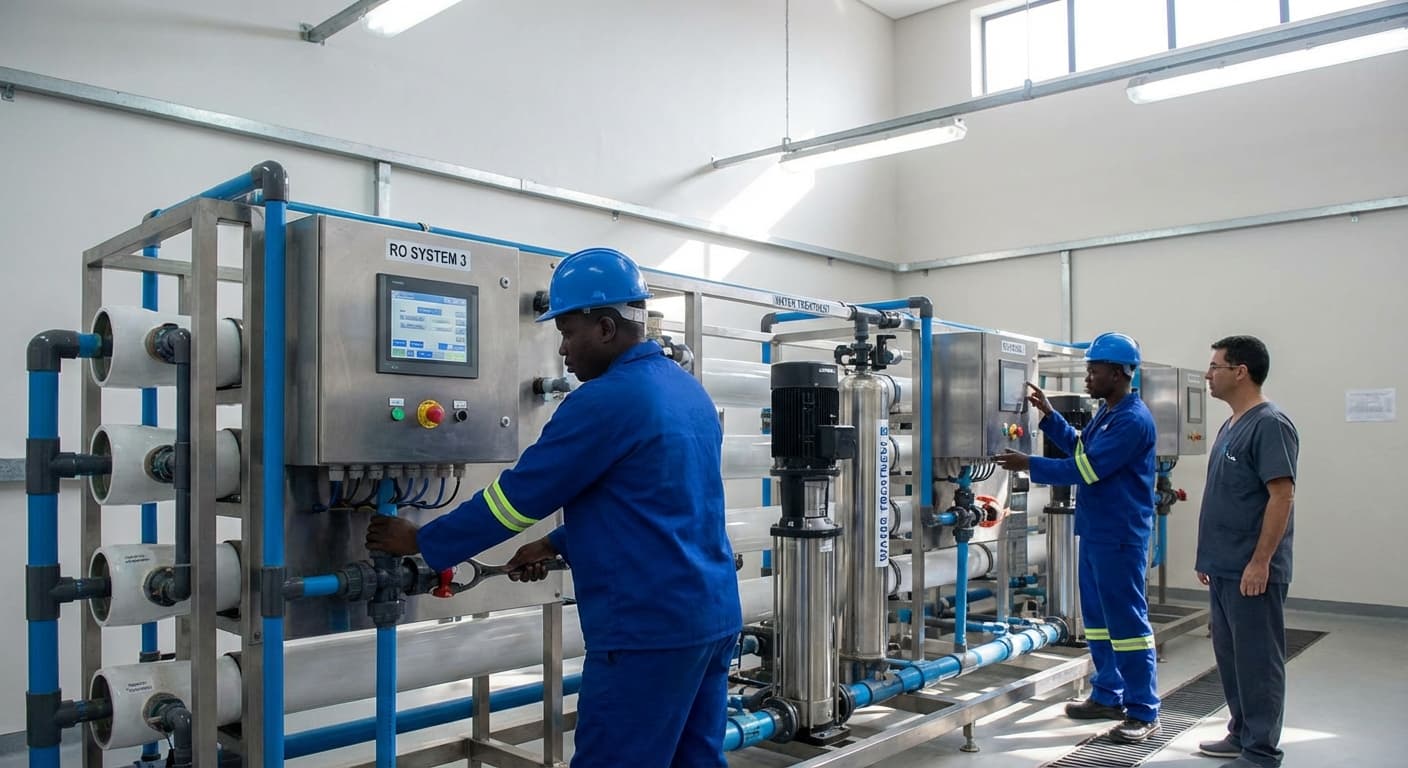
Dialysis RO/Water Treatment Plant Installation Service in Guinea
Engineering Excellence & Technical Support
Dialysis RO/Water Treatment Plant Installation Service High-standard technical execution following OEM protocols and local regulatory frameworks.
Expert Installation & Commissioning
Our highly skilled technicians provide comprehensive installation and commissioning services for your dialysis RO/water treatment plant in Guinea. We ensure seamless integration, optimal performance, and adherence to the highest international standards for water purity critical for patient safety.
Robust & Reliable Systems
We specialize in installing robust and reliable RO/water treatment systems designed to withstand the specific environmental and operational challenges in Guinea. Our installations focus on longevity, minimal downtime, and consistent delivery of ultrapure water to support your dialysis operations.
Turnkey Solutions & Local Support
Benefit from our turnkey installation service, encompassing everything from site assessment and system design to full installation and comprehensive training for your local staff. We offer ongoing local support and maintenance to guarantee the uninterrupted operation of your dialysis water treatment facility.
What Is Dialysis Ro/water Treatment Plant Installation Service In Guinea?
Dialysis RO/Water Treatment Plant Installation Service in Guinea refers to the comprehensive process of designing, procuring, installing, commissioning, and validating Reverse Osmosis (RO) and associated water purification systems specifically for medical dialysis facilities. These systems are critical for producing ultra-pure water, meeting stringent international hemodialysis water quality standards (e.g., AAMI, ISO), essential for patient safety and treatment efficacy. The service encompasses site assessment, system configuration, component integration, piping, electrical connections, water testing, and operator training. The primary objective is to ensure a reliable, consistent, and safe supply of medical-grade water for hemodialysis procedures, thereby mitigating risks of infection, pyrogenic reactions, and electrolyte imbalances.
| Requirement | Description | Typical Use Cases |
|---|---|---|
| Who Needs It? | Healthcare facilities in Guinea operating or planning to operate hemodialysis units, including public hospitals, private clinics, and specialized renal care centers. | Establishment of new dialysis centers, expansion of existing facilities, replacement of outdated or non-compliant water treatment systems, and ensuring regulatory compliance. |
| Purpose of the Service | To provide a safe, reliable, and compliant source of ultrapure water for hemodialysis, safeguarding patient health. | Facilitating life-saving renal replacement therapy for patients with end-stage renal disease (ESRD) in Guinea. |
| Key Performance Indicators (KPIs) | Water quality parameters meeting specific standards (e.g., total dissolved solids < 1 ppm, endotoxins < 0.25 EU/mL), system uptime, flow rate consistency, and energy efficiency. | Maintaining high standards of patient care, reducing treatment complications, and ensuring operational efficiency of dialysis machines. |
Service Components of Dialysis RO/Water Treatment Plant Installation
- Site Survey and Needs Assessment
- System Design and Engineering (Flow rates, contaminant removal, redundancy)
- Equipment Procurement and Supply Chain Management
- Pre-treatment System Installation (Sediment filters, carbon filters, water softeners)
- Reverse Osmosis (RO) Module Installation and Configuration
- Post-treatment System Installation (UV disinfection, ultrafilters, loop disinfection)
- Piping and Plumbing Integration (Medical-grade materials, sanitary design)
- Electrical and Control System Installation and Wiring
- System Testing and Water Quality Validation (Microbiological, chemical, endotoxin testing)
- Commissioning and Performance Verification
- Operator Training and Documentation
- Ongoing Maintenance and Support Planning
Who Needs Dialysis Ro/water Treatment Plant Installation Service In Guinea?
Access to reliable, high-purity water is paramount for numerous sectors in Guinea. Dialysis centers, hospitals, pharmaceutical manufacturers, and research laboratories all depend on stringent water quality standards to ensure patient safety, product integrity, and accurate experimental results. When existing water treatment systems fail or new facilities are established, the need for professional Dialysis RO/Water Treatment Plant Installation Services becomes critical. These specialized services ensure the correct design, installation, and commissioning of Reverse Osmosis (RO) and other water purification systems, meeting the unique demands of medical and scientific applications.
| Target Customer | Key Departments/Needs | Water Purity Requirements | Reasons for Installation Service |
|---|---|---|---|
| Dialysis Centers | Hemodialysis Unit | Ultra-pure Water (RO standards, specific resistivity) | Patient safety, prevention of dialysis-related infections and complications, regulatory compliance. |
| Hospitals and Clinics | Dialysis Unit, Central Sterile Supply Department (CSSD), Pathology/Laboratory, Pharmacy, Intensive Care Units (ICU) | Purified Water, RO Water, sterile water | Equipment sterilization, safe preparation of medications and IV fluids, accurate lab results, patient care. |
| Pharmaceutical Manufacturers | Production, Quality Control (QC), Research & Development (R&D) | Purified Water (PW), Water For Injection (WFI) standards | Product integrity, efficacy, safety, regulatory compliance (GMP), prevention of contamination. |
| Research and Development Laboratories | Analytical Chemistry Labs, Biology Labs, Clinical Diagnostics Labs, Academic Research Facilities | High-purity water (HPLC grade, Milli-Q equivalent), RO water | Accuracy of experimental results, prevention of interference from impurities, reliable data generation. |
| Medical Device Manufacturers | Manufacturing Floor, Cleaning and Sterilization Departments | Purified Water, RO Water | Ensuring device safety and efficacy, preventing contamination of manufactured devices. |
| Government Health Agencies / NGOs | Public Health Infrastructure Projects, Rural Health Clinics, Disaster Relief Efforts | Potable water to purified water standards, depending on application | Establishing or upgrading water supply for healthcare facilities, ensuring basic health standards. |
Target Customers for Dialysis RO/Water Treatment Plant Installation Service in Guinea:
- {"item":"Dialysis Centers:","description":"The primary and most critical customer. Dialysis patients are highly vulnerable, and impure water can lead to severe complications and fatalities. These centers require continuous, ultra-pure water for hemodialysis."}
- {"item":"Hospitals and Clinics:","description":"Beyond dialysis units, many hospital departments require purified water for various applications, including sterilizing equipment, preparing intravenous solutions, and in laboratory testing."}
- {"item":"Pharmaceutical Manufacturers:","description":"Production of medicines and other pharmaceutical products demands extremely high-purity water (e.g., Purified Water, Water for Injection) to prevent contamination and ensure product efficacy and safety."}
- {"item":"Research and Development Laboratories:","description":"Scientific research, clinical diagnostics, and academic institutions rely on pure water for experiments, analysis, and culture media preparation. Contaminants can invalidate research findings."}
- {"item":"Medical Device Manufacturers:","description":"Companies producing medical devices that come into contact with patients or bodily fluids require purified water for manufacturing and cleaning processes."}
- {"item":"Food and Beverage Industry (Specialized Applications):","description":"While not the primary focus, certain high-end food and beverage processing applications requiring ultra-pure water for specific product formulations or cleaning might also be potential clients."}
- {"item":"Government Health Agencies and Public Health Initiatives:","description":"Organizations involved in public health infrastructure development, especially in underserved areas, may require installation of water treatment systems for health facilities."}
Dialysis Ro/water Treatment Plant Installation Service Process In Guinea
This document outlines the comprehensive workflow for Dialysis RO/Water Treatment Plant Installation Services in Guinea, covering the process from initial client inquiry to successful project execution. Our aim is to provide clarity on each stage, ensuring a smooth and efficient installation experience for our valued clients.
| Stage | Description | Key Activities | Deliverables |
|---|---|---|---|
| The client expresses interest in our Dialysis RO/Water Treatment Plant installation services. | Receive client inquiry, understand their basic requirements (e.g., plant capacity, type of dialysis, existing infrastructure), schedule an initial meeting. | Understanding of client's preliminary needs, initial project scope definition. |
| A detailed evaluation of the client's facility and specific water treatment requirements. | Conduct on-site visit, analyze water sources (raw water quality testing), assess available space and utilities (power, drainage), gather detailed technical specifications from the client. | Comprehensive site report, detailed water quality analysis report, refined technical requirements. |
| Based on the assessment, a tailored solution and pricing are presented. | Develop a detailed technical proposal outlining the proposed RO/Water Treatment Plant system, system design, equipment specifications, installation plan, timeline, and a comprehensive cost quotation. | Formal proposal document, detailed quotation, estimated project timeline. |
| Formalizing the project scope, terms, and conditions. | Review and negotiate proposal terms, finalize contract details, secure client approval and signature on the service agreement. | Signed service agreement, legally binding contract. |
| Developing the precise technical blueprints for the installation. | Detailed engineering design of the RO/Water Treatment Plant system, P&IDs (Piping and Instrumentation Diagrams), electrical schematics, layout plans, equipment selection and customization. | Approved engineering drawings, detailed equipment list, system schematics. |
| Sourcing and delivering all necessary equipment and materials to Guinea. | Procure all required RO membranes, filters, pumps, tanks, piping, electrical components, and other ancillary equipment. Manage international shipping, customs clearance, and local transportation to the project site in Guinea. | All ordered equipment and materials delivered to the site, customs clearance documentation. |
| The physical setup and operational testing of the plant. | Unpacking and setting up equipment, plumbing and electrical connections, installation of control systems, pre-commissioning checks, system flushing, performance testing, water quality validation, and initial operational adjustments. | Fully installed and operational RO/Water Treatment Plant, initial performance test reports, certified water quality results. |
| Ensuring the client's team is proficient in operating and maintaining the system. | Conduct comprehensive training sessions for the client's technical staff on plant operation, routine maintenance, troubleshooting, and safety procedures. Provide all necessary operation and maintenance manuals. Formal handover of the installed plant. | Trained client personnel, comprehensive O&M manuals, official project handover certificate. |
| Ongoing assistance and services to ensure continued optimal performance. | Provide warranty support, offer scheduled preventive maintenance services, supply spare parts, and be available for emergency technical support and repairs as per the service agreement. | Ongoing operational efficiency, minimized downtime, continued compliance with water quality standards. |
Dialysis RO/Water Treatment Plant Installation Service Process in Guinea
- Inquiry and Initial Consultation
- Site Assessment and Needs Analysis
- Proposal and Quotation Development
- Contract Negotiation and Agreement
- Design and Engineering
- Procurement and Logistics
- On-Site Installation and Commissioning
- Training and Handover
- Post-Installation Support and Maintenance
Dialysis Ro/water Treatment Plant Installation Service Cost In Guinea
Installing a Reverse Osmosis (RO) and Water Treatment Plant for dialysis facilities in Guinea involves a complex process with several cost-determining factors. The price is not static and can vary significantly based on the scale of the operation, the required water purity standards, the specific technologies employed, and the logistical challenges within Guinea. Key considerations include the capacity of the plant (measured in liters per hour or day), the type and number of filtration stages (pre-filtration, RO membranes, post-treatment), the level of automation, energy efficiency, and the need for specialized materials resistant to local water conditions. Furthermore, the cost will be influenced by the sourcing of equipment (local versus imported), shipping and customs duties, the complexity of site preparation, installation labor, commissioning, and ongoing maintenance and training requirements. The fluctuating exchange rates of the Guinean Franc (GNF) against major currencies also play a crucial role in the final pricing, especially for imported components.
| Plant Capacity (LPH - Liters Per Hour) | Estimated Cost Range (GNF - Guinean Franc) | Notes |
|---|---|---|
| Small (e.g., 50-100 LPH, for a few dialysis stations) | 25,000,000 - 75,000,000 GNF | Includes basic pre-treatment, RO, and post-treatment. May involve less complex automation and fewer redundancies. |
| Medium (e.g., 100-250 LPH, for a moderate-sized dialysis center) | 75,000,000 - 150,000,000 GNF | Enhanced filtration, potentially with redundant RO membranes and a higher level of automation for continuous operation. |
| Large (e.g., 250+ LPH, for a large hospital or network) | 150,000,000 - 300,000,000+ GNF | Includes advanced multi-stage filtration, robust automation, high-efficiency components, and potentially specialized systems for water storage and distribution. May also factor in more extensive site preparation and engineering. |
Key Pricing Factors for Dialysis RO/Water Treatment Plant Installation in Guinea:
- Plant Capacity (Liters per hour/day): Larger capacity systems naturally incur higher costs.
- Water Quality Requirements: Dialysis necessitates extremely high purity water, often exceeding standard industrial needs, requiring more advanced filtration stages.
- Filtration Stages and Technologies: The number and type of filtration (e.g., sediment filters, activated carbon, RO membranes, UV sterilization, deionization) directly impact cost.
- Equipment Sourcing: Whether components are sourced locally or imported from international suppliers significantly affects the price due to shipping, duties, and currency fluctuations.
- Automation and Control Systems: Advanced automation for monitoring and control can increase initial investment.
- Site Preparation and Infrastructure: Costs associated with preparing the installation site, including plumbing, electrical connections, and structural modifications.
- Installation Labor Costs: The availability and cost of skilled labor for installation and assembly in Guinea.
- Commissioning and Testing: Rigorous testing and validation to ensure the plant meets dialysis water standards.
- Training and Support: Initial training for facility staff on operation and maintenance, and any ongoing support contracts.
- Logistics and Transportation: Costs associated with transporting heavy equipment to the installation site, especially in potentially remote areas.
- Customs Duties and Taxes: Import duties and local taxes applicable to imported water treatment equipment.
- Warranty and After-Sales Service: The terms of warranty and the availability of reliable after-sales service.
Affordable Dialysis Ro/water Treatment Plant Installation Service Options
Investing in a reliable Reverse Osmosis (RO) and water treatment plant for your dialysis center is crucial for patient safety and treatment efficacy. While the initial investment can seem significant, exploring affordable installation service options and understanding value bundles can make this essential infrastructure accessible. This guide outlines various cost-saving strategies and highlights the benefits of well-structured service packages.
| Value Bundle Type | Included Services/Components | Potential Cost Savings | Key Benefits for Dialysis Centers |
|---|---|---|---|
| 'All-Inclusive' Installation Package | RO/Water Treatment Plant, Installation, Initial Water Quality Testing, Basic Training | Up to 15-20% compared to separate procurement | Streamlined procurement, single point of contact, reduced administrative burden |
| 'Extended Warranty & Maintenance' Bundle | RO/Water Treatment Plant, Installation, Extended Warranty (2-3 years), Annual Preventive Maintenance Visits | 10-15% on maintenance costs over time | Predictable operating costs, minimized unexpected repair expenses, prolonged equipment life |
| 'Upgrade Ready' Basic System | Essential RO system, Installation, Capacity for future module additions (e.g., advanced polishing, UV sterilization) | Lower initial capital outlay | Flexibility to scale, avoids upfront cost of all future upgrades |
| 'Turnkey Solution' (Large Clinics/Hospitals) | Full RO/Water Treatment Plant, Custom Design & Engineering, Installation, Commissioning, Comprehensive Training, Ongoing Maintenance Contract | Volume discounts, optimized system design reducing operational inefficiencies | Maximized system efficiency, minimal disruption, peace of mind with end-to-end service |
Understanding Value Bundles and Cost-Saving Strategies
- Bundled Installation & Equipment Packages: Many suppliers offer integrated solutions that combine the RO/water treatment plant with installation services. This often translates to better pricing than procuring equipment and services separately.
- Phased Installation: For centers with budget constraints, consider a phased installation approach. This might involve installing the core RO system first and adding advanced purification stages or redundancy later.
- Refurbished or Certified Pre-Owned Systems: While new is always an option, thoroughly vetted and certified pre-owned RO/water treatment systems can offer substantial savings. Ensure they come with a warranty and are suitable for medical-grade water production.
- Local vs. National Installers: While national providers might have broader reach, local or regional specialists can sometimes offer more competitive installation rates due to lower overheads and travel costs.
- Preventive Maintenance Contracts: Negotiate comprehensive preventive maintenance contracts as part of the initial installation package. Regular, professional maintenance prevents costly breakdowns and extends the lifespan of your equipment.
- Water Usage Optimization: Implementing water-saving practices within your dialysis center can reduce the overall demand on the RO system, potentially allowing for a slightly smaller, more affordable initial unit and lower operational costs.
- Energy-Efficient Components: Inquire about energy-efficient pumps, motors, and filtration technologies. While the upfront cost might be marginally higher, long-term electricity savings can be significant.
- Financing and Leasing Options: Explore financing or leasing options offered by equipment vendors or third-party financial institutions. These can spread the cost over time, making it more manageable.
- Negotiate Service Level Agreements (SLAs): Clearly define response times, uptime guarantees, and spare parts availability in your SLA. This ensures timely support and minimizes potential downtime, which is critical for dialysis operations.
- Bulk Purchasing & Long-Term Contracts: If you are part of a larger healthcare network, explore the possibility of bulk purchasing or negotiating long-term service contracts for multiple facilities to secure volume discounts.
Verified Providers In Guinea
In Guinea, ensuring access to quality healthcare is paramount, and identifying 'Verified Providers' is a crucial step for individuals seeking reliable medical services. Franance Health stands out as a leading entity in this regard, offering a robust credentialing process that not only verifies the qualifications of healthcare professionals but also ensures adherence to stringent quality and ethical standards. This commitment to verification makes Franance Health credentials a strong indicator of competence, safety, and patient-centered care, representing the best choice for those seeking trusted medical assistance in Guinea.
| Franance Health Verification Component | What it Entails | Benefit to Patients |
|---|---|---|
| Academic & Professional Qualifications | Verification of medical degrees, specialized training, licenses, and certifications. | Ensures providers have the necessary theoretical knowledge and practical skills. |
| Clinical Experience | Assessment of practical experience in relevant medical fields and specialties. | Confirms hands-on expertise and familiarity with common and complex cases. |
| Regulatory Compliance | Confirmation that providers comply with Guinean medical regulations and standards. | Guarantees legal and ethical practice within the local healthcare framework. |
| Background Checks | Review of professional history and absence of disciplinary actions. | Provides assurance of a provider's integrity and trustworthiness. |
| Commitment to Continuing Education | Evidence of participation in ongoing professional development and training. | Indicates that providers stay updated with the latest medical advancements and techniques. |
Why Franance Health Credentials Matter in Guinea
- Rigorous Qualification Verification: Franance Health thoroughly assesses the educational background, licenses, and certifications of all healthcare providers.
- Commitment to Ethical Practice: The credentialing process includes an evaluation of a provider's adherence to ethical guidelines and professional conduct.
- Focus on Patient Safety: Verified providers have demonstrated a commitment to implementing best practices for patient safety and care.
- Enhanced Trust and Transparency: Franance Health's verification process offers patients greater confidence and transparency in the healthcare they receive.
- Access to Competent Professionals: By identifying Franance Health-verified providers, individuals can be assured of consulting with skilled and knowledgeable medical experts.
- Continuous Quality Monitoring: Franance Health often incorporates ongoing monitoring to ensure providers maintain their high standards.
Scope Of Work For Dialysis Ro/water Treatment Plant Installation Service
This Scope of Work (SOW) outlines the requirements for the installation services of a Dialysis Reverse Osmosis (RO) / Water Treatment Plant. It defines the technical deliverables, standard specifications, and responsibilities of the service provider to ensure a fully functional and compliant water treatment system for a dialysis facility. The objective is to provide purified water meeting the stringent standards required for hemodialysis treatments, ensuring patient safety and optimal equipment performance. This SOW covers all aspects from site preparation and equipment installation to system commissioning, testing, and final handover.
| Section | Description | Technical Deliverables | Standard Specifications / Requirements |
|---|---|---|---|
| Initial site visit to assess existing infrastructure, utilities (water supply, power, drainage), space availability, and any potential installation challenges. Development of a detailed project plan, including timelines, resource allocation, and risk assessment. | Detailed site survey report, Project implementation plan, Method statements for critical activities. | Compliance with facility's operating hours and safety protocols. Adherence to project timelines. Minimization of site disruption. |
| Procurement and delivery of all necessary components for the RO/Water Treatment Plant (as per the provided equipment specification). Site preparation including any necessary civil works, plumbing, and electrical modifications. | Delivery of all equipment and materials to site, Completed site preparation (civil, plumbing, electrical). | Equipment to be in original manufacturer's packaging. All modifications to conform to local building codes and electrical safety standards. Installation materials to be of industrial grade and suitable for potable water applications. |
| Installation of all major components of the RO/Water Treatment Plant, including pre-treatment filters, RO membranes, post-treatment systems (e.g., UV sterilizers, polishing filters), storage tanks, and distribution piping. | Fully assembled and connected RO/Water Treatment Plant unit, Installed storage tanks, Installed distribution piping network. | All piping to be of food-grade, non-corrosive material (e.g., SS 316L, PEX). Connections to be leak-proof and properly supported. System layout to comply with manufacturer's recommendations and ease of maintenance. Adherence to relevant plumbing and electrical codes. |
| Installation of all electrical wiring, control panels, sensors, and interlocks for the RO/Water Treatment Plant. Integration with the facility's existing electrical system and any required SCADA or monitoring systems. | Operational control panel, Connected sensors and interlocks, Properly wired electrical components. | All electrical work to be performed by licensed electricians. Compliance with relevant electrical safety standards (e.g., NEC, IEC). Control system to be user-friendly and robust. |
| Thorough sanitization of all installed piping, tanks, and system components to eliminate any microbial contamination before commissioning. | Sanitized system components, Sanitization logs and certificates. | Sanitization procedures to follow manufacturer's recommendations and relevant industry standards for medical water systems. Use of approved sanitizing agents. |
| Initial startup of the RO/Water Treatment Plant. Performance testing to verify flow rates, pressure, water quality parameters (TDS, conductivity, pH, TOC, bacterial counts, endotoxins), and alarm functions. Water quality testing by an independent accredited laboratory. | Successful system startup, Commissioning report with test results, Independent laboratory water quality test reports. | Water quality to meet AAMI RD52, ISO 13959, or equivalent standards for hemodialysis water. All test methods to be documented and traceable. Performance parameters to meet system design specifications. |
| Comprehensive training for facility staff on the operation, routine maintenance, troubleshooting, and emergency procedures for the RO/Water Treatment Plant. Provision of all necessary documentation, including operation and maintenance manuals, as-built drawings, and warranty information. | Trained facility staff, Complete set of O&M manuals and as-built drawings, Warranty certificates. | Training to be hands-on and tailored to the facility's staff expertise. Documentation to be in clear and understandable language. Handover to be formally acknowledged. |
| Provision of a warranty period for installed components and workmanship. Availability of technical support for troubleshooting and emergency repairs during the warranty period. | Defined warranty period, Technical support contact information. | Warranty period to be clearly defined in the contract. Response time for technical support to be specified. |
Key Objectives
- To ensure the installation of a high-quality Dialysis RO/Water Treatment Plant that meets all relevant regulatory and clinical standards.
- To provide purified water of the highest quality for hemodialysis treatments, free from contaminants, endotoxins, and pyrogens.
- To ensure the safe, efficient, and reliable operation of the installed water treatment system.
- To minimize disruption to the dialysis facility's operations during the installation process.
- To provide comprehensive training to the facility's staff on the operation and maintenance of the system.
- To achieve successful commissioning and handover of the fully functional system.
Service Level Agreement For Dialysis Ro/water Treatment Plant Installation Service
This Service Level Agreement (SLA) outlines the terms and conditions for the installation services of a Dialysis Reverse Osmosis (RO)/Water Treatment Plant, including guaranteed response times for technical issues and uptime performance of the installed system. This SLA is applicable from the date of system handover and commissioning. It is designed to ensure minimal disruption to dialysis operations and maintain the quality of water supplied.
| Service Component | Description | Service Level Target | Measurement Method | Remedy/Penalty |
|---|---|---|---|---|
| Initial Site Survey & Design Consultation | On-site assessment of existing infrastructure, water quality analysis, and collaborative design of the RO/Water Treatment Plant solution. | Within 5 business days of request submission. | Date of site visit confirmation. | N/A (Pre-installation service) |
| Plant Installation & Commissioning | Physical installation of the RO/Water Treatment Plant, including plumbing, electrical connections, and initial system testing and calibration. | As per agreed project timeline (detailed in installation contract). | Project completion date. | N/A (Pre-installation service) |
| Emergency Technical Support Response Time | Time taken for a qualified technician to acknowledge and begin troubleshooting a critical system failure reported by the client. | Critical Failure: Within 4 business hours. | Time stamp of issue report and first contact attempt. | For each unaddressed critical failure exceeding 4 business hours, a credit of 0.5% of the annual maintenance contract fee (if applicable) will be issued. |
| Routine Technical Support Response Time | Time taken for a qualified technician to acknowledge and begin troubleshooting a non-critical system issue reported by the client. | Routine Issue: Within 8 business hours. | Time stamp of issue report and first contact attempt. | For each unaddressed routine issue exceeding 8 business hours, a credit of 0.25% of the annual maintenance contract fee (if applicable) will be issued. |
| Installed System Uptime Guarantee | Percentage of time the RO/Water Treatment Plant is operational and producing water meeting specified quality standards during scheduled operating hours. | 98% uptime (averaged monthly). | System logs, water quality monitoring data, and client reporting. | If uptime falls below 98% for any given month, a credit of 1% of the monthly service fee (if applicable) will be issued. If uptime falls below 95% for two consecutive months, client may be eligible for termination of service contract without penalty. |
| Preventative Maintenance Visit Response | Scheduling and completion of planned preventative maintenance as per the manufacturer's recommendations and the service contract. | Scheduled within agreed intervals (e.g., quarterly, semi-annually). | Date of scheduled visit and completion report. | N/A (Preventative, not reactive) |
Key Service Components
- Scope of Installation Services
- Response Time Guarantees
- Uptime Guarantees for Installed System
- Exclusions and Limitations
- Reporting and Escalation Procedures
- Maintenance and Support Requirements
Frequently Asked Questions

Ready when you are
Let's scope your Dialysis RO/Water Treatment Plant Installation Service in Guinea project in Guinea.

Scaling healthcare logistics and technical systems across the entire continent.