
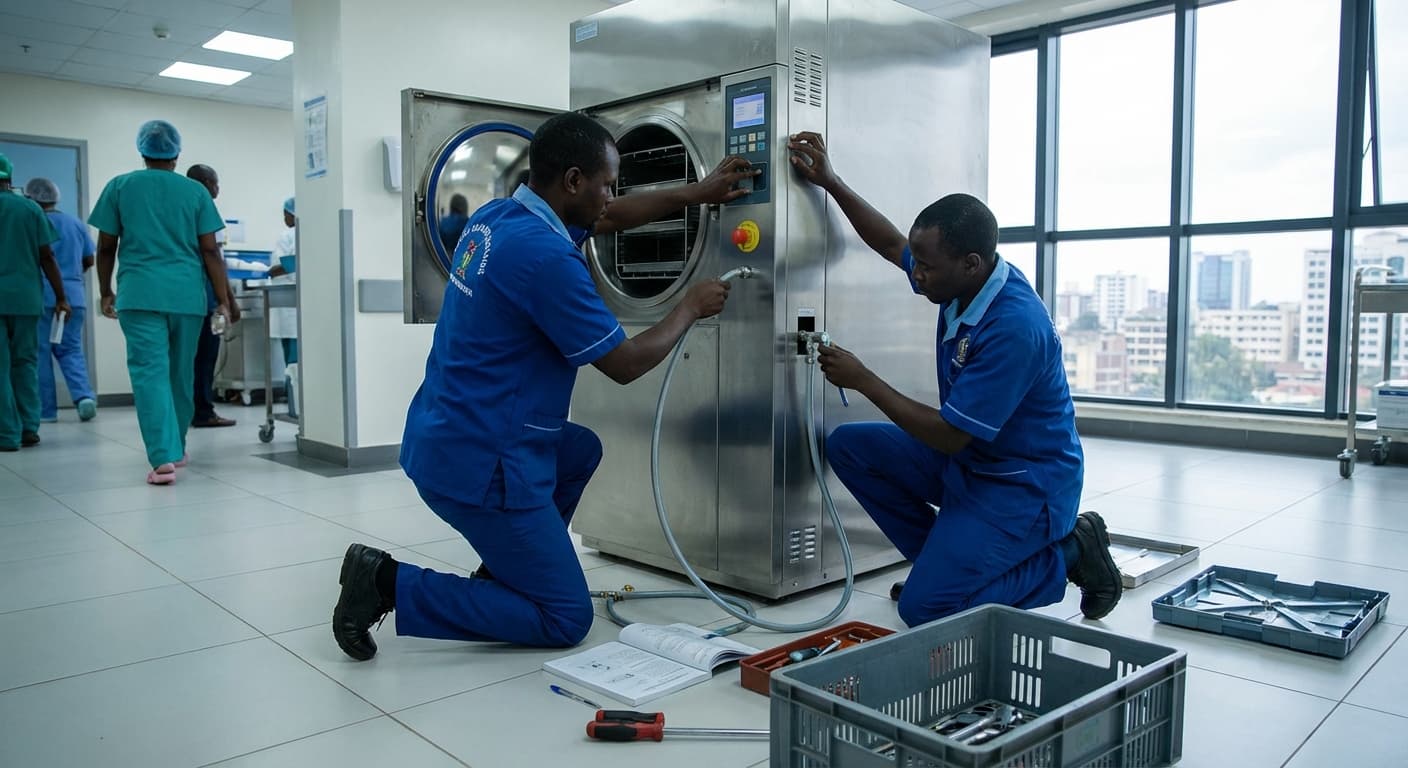
Autoclave & Sterilizer Installation Service in Guinea
Engineering Excellence & Technical Support
Autoclave & Sterilizer Installation Service High-standard technical execution following OEM protocols and local regulatory frameworks.
Precision Temperature Calibration
Ensuring optimal sterilization cycles through meticulous calibration of autoclave and sterilizer temperature controls, guaranteeing pathogen eradication according to international standards.
Advanced Pressure System Integrity
Expert installation and verification of pressure vessels and control systems to guarantee safe and effective steam sterilization, preventing leaks and maintaining consistent pressure for maximum efficacy.
Validation & Biological Monitoring
Comprehensive post-installation validation and ongoing biological monitoring services to confirm the effectiveness of sterilization processes, providing documented assurance of sterility for critical equipment.
What Is Autoclave & Sterilizer Installation Service In Guinea?
Autoclave & Sterilizer Installation Service in Guinea refers to the comprehensive process of setting up, commissioning, and validating autoclaves and various sterilizer units within healthcare facilities, laboratories, and other organizations in Guinea requiring high-level sterilization to ensure patient safety, prevent cross-contamination, and maintain the integrity of sensitive materials. This service is crucial for the effective operation of these critical pieces of equipment.
| Who Needs Autoclave & Sterilizer Installation Service? | Typical Use Cases | ||||
|---|---|---|---|---|---|
| Hospitals and Clinics: For sterilizing surgical instruments, medical devices, glassware, and laboratory equipment. | Sterilization of surgical tools, wound care supplies, textiles, and reusable medical equipment. | Operating Rooms | Intensive Care Units (ICUs) | Dental Practices | Sterilization of dental instruments, impression materials, and prosthetic components. |
| Laboratories (Research, Diagnostic, Industrial): For sterilizing glassware, media, equipment, and waste. | Sterilization of laboratory consumables (e.g., petri dishes, pipettes), culture media, and biological waste. | Microbiology Laboratories | Biotechnology Facilities | Pharmaceutical Manufacturing | Sterilization of production equipment, filtration components, and packaging materials. |
| Veterinary Clinics and Animal Hospitals: For sterilizing surgical instruments and equipment. | Sterilization of veterinary surgical instruments, bandages, and medical supplies. | ||||
| Cosmetic and Tattoo/Piercing Studios: For sterilizing instruments to prevent infection. | Sterilization of tattooing needles, piercing jewelry, and related instruments. | ||||
| Government and Military Facilities: For medical and research applications. | Sterilization of medical equipment for field hospitals, research facilities, and defense applications. |
Key Components of Autoclave & Sterilizer Installation Service:
- Site Assessment and Planning: Evaluating the proposed installation location for space, power supply, water and drainage connections, ventilation requirements, and adherence to local building codes and safety regulations.
- Equipment Delivery and Unpacking: Safely transporting the autoclave or sterilizer to the installation site and carefully unpacking the unit, inspecting for any transit damage.
- Mechanical and Electrical Connections: Connecting the sterilizer to the required utilities, including power, water (inlet and outlet), steam (if applicable), and compressed air. This often involves specialized plumbing and electrical work.
- Structural Mounting and Anchoring: Securely mounting and anchoring the sterilizer, especially for larger or heavier units, to prevent movement and ensure stability.
- Initial System Configuration and Calibration: Setting up the control systems, programming sterilization cycles, and performing initial calibration of temperature, pressure, and time parameters to meet manufacturer specifications and regulatory standards.
- Leak Testing and Safety Checks: Conducting thorough leak tests of all connections and verifying the functionality of safety features, such as pressure relief valves and interlocks.
- Operational Testing and Validation: Running test cycles to confirm proper operation, efficacy, and consistency. This may involve biological and chemical indicator testing to validate sterilization performance.
- Operator Training: Providing comprehensive training to end-users on the safe and efficient operation, routine maintenance, and troubleshooting of the installed equipment.
- Documentation and Handover: Providing all necessary technical documentation, user manuals, warranty information, and validation reports to the client.
Who Needs Autoclave & Sterilizer Installation Service In Guinea?
Ensuring the highest standards of hygiene and safety is paramount in numerous sectors across Guinea. This necessitates the reliable installation and maintenance of autoclaves and sterilizers, critical equipment for preventing the spread of infections and ensuring the sterility of instruments and materials. Who needs these professional installation services? The answer spans a wide range of institutions and professionals dedicated to public health, research, and specialized services.
| Customer Type | Key Departments/Services Requiring Sterilization | Specific Needs Addressed by Installation Service |
|---|---|---|
| Hospitals and Medical Centers | Surgical Suites, Intensive Care Units (ICU), Emergency Rooms, Central Sterile Supply Department (CSSD), Maternity Wards, Dialysis Centers, Outpatient Clinics | Installation of large-capacity autoclaves for surgical instruments, laboratory equipment, and specialized medical devices; ensuring proper ventilation and power supply; compliance with healthcare regulations. |
| Clinics and Doctor's Offices | Examination Rooms, Minor Procedure Areas | Installation of smaller, benchtop autoclaves for sterilizing medical instruments, ensuring patient safety and efficient turnaround of equipment. |
| Dental Practices | Operatory Rooms, Sterilization Areas | Installation of dental autoclaves for sterilizing handpieces, instruments, and other reusable dental tools, crucial for preventing cross-contamination. |
| Veterinary Clinics and Animal Hospitals | Surgical Suites, Treatment Rooms, Diagnostic Labs | Installation of autoclaves for sterilizing surgical instruments, diagnostic tools, and patient care items to maintain a sterile environment for animals. |
| Laboratories (Medical, Research, and Industrial) | Microbiology Labs, Pathology Labs, Chemistry Labs, Quality Control Labs | Installation of laboratory autoclaves for sterilizing glassware, media, and biohazardous waste; ensuring sterile conditions for experiments and preventing contamination. |
| Pharmacies | Compounding Areas, Quality Control Labs | Installation of autoclaves for sterilizing compounding equipment and materials when required for sterile preparations; sterility testing. |
| Beauty Salons and Spas | Treatment Rooms, Sterilization Stations | Installation of small autoclaves for sterilizing tools like scissors, tweezers, and other implements used on clients to prevent the transmission of infections. |
| Tattoo and Piercing Studios | Sterilization Areas | Installation of autoclaves to ensure the absolute sterility of needles, tubes, and other equipment used in tattooing and piercing, a critical safety measure. |
| Research Institutions and Universities | Biological Sciences Departments, Medical Schools, Chemistry Departments | Installation of laboratory-grade autoclaves for research purposes, sterilization of experimental materials, and waste management within a controlled scientific environment. |
| Manufacturing Facilities (Pharmaceuticals, Cosmetics, Medical Devices) | Production Lines, Quality Assurance Labs, Packaging Areas | Installation of industrial-scale autoclaves for sterilization of finished products, packaging materials, and production equipment to meet stringent regulatory requirements. |
| Public Health Agencies and Government Facilities | Disease Control Centers, Diagnostic Labs, Outreach Programs | Installation of autoclaves for sterilizing equipment used in public health initiatives, outbreak response, and diagnostic testing to safeguard community health. |
Target Customers and Departments in Guinea Requiring Autoclave & Sterilizer Installation Service:
- Hospitals and Medical Centers
- Clinics and Doctor's Offices
- Dental Practices
- Veterinary Clinics and Animal Hospitals
- Laboratories (Medical, Research, and Industrial)
- Pharmacies (for compounding and sterility testing)
- Beauty Salons and Spas (for sterilization of tools)
- Tattoo and Piercing Studios
- Research Institutions and Universities
- Manufacturing Facilities (Pharmaceuticals, Cosmetics, Medical Devices)
- Public Health Agencies and Government Facilities
Autoclave & Sterilizer Installation Service Process In Guinea
This document outlines the detailed workflow for Autoclave & Sterilizer Installation Services in Guinea, from the initial customer inquiry to the final execution of the installation. The process is designed to ensure clarity, efficiency, and customer satisfaction.
| Phase | Key Activities | Responsible Party | Typical Duration |
|---|---|---|---|
| Inquiry & Consultation | Initial contact, needs assessment, preliminary info, site survey scheduling | Customer, Service Provider | 1-3 Business Days |
| Site Assessment & Quotation | On-site survey, technical assessment, quotation preparation | Service Provider | 2-5 Business Days |
| Agreement & Scheduling | Quotation approval, contract signing, scheduling installation | Customer, Service Provider | 1-3 Business Days |
| Pre-Installation Preparation | Equipment delivery, site preparation, utility verification | Service Provider, Customer (for site access) | 1-2 Business Days |
| Installation Execution | Equipment setup, connections, initial checks | Service Provider | 1-5 Business Days (depending on complexity) |
| Testing, Commissioning & Training | Performance testing, calibration, user training | Service Provider | 1-3 Business Days |
| Post-Installation & Handover | Final inspection, documentation, invoicing, feedback | Service Provider, Customer | 1-2 Business Days |
Autoclave & Sterilizer Installation Service Workflow in Guinea
- {"items":["Customer submits an inquiry (phone, email, website form) for autoclave/sterilizer installation.","Initial contact and information gathering: understand customer needs, type of equipment, location, and any specific requirements.","Provide preliminary information on services, pricing structures, and typical timelines.","Schedule a preliminary site survey (if necessary for complex installations or remote locations).","Answer initial questions and clarify any doubts."],"title":"Phase 1: Inquiry & Consultation"}
- {"items":["On-site visit by a qualified technician or project manager.","Detailed assessment of the installation site: space availability, power supply (voltage, amperage), water supply and drainage, ventilation requirements, and any structural modifications needed.","Review equipment specifications provided by the customer (or manufacturer if known).","Identify potential challenges and develop mitigation strategies.","Prepare a detailed, itemized quotation including equipment, materials, labor, travel, and any required certifications.","Present the quotation to the customer and discuss any necessary adjustments."],"title":"Phase 2: Site Assessment & Quotation"}
- {"items":["Customer reviews and approves the quotation.","Formal agreement/contract is signed, outlining scope of work, payment terms, and installation timeline.","Customer provides necessary permits or approvals if required by local regulations (assistance may be provided).","Secure necessary spare parts, consumables, and specialized tools.","Schedule the installation date and time in coordination with the customer's operations.","Confirm availability of access to the site and any required personnel from the customer's end."],"title":"Phase 3: Agreement & Scheduling"}
- {"items":["Delivery of the autoclave/sterilizer to the site (if not already present).","Prepare the installation area, ensuring it is clean, accessible, and safe.","Verify all necessary utilities (power, water, drainage) are available and meet specifications.","Gather all installation tools, materials, and safety equipment."],"title":"Phase 4: Pre-Installation Preparation"}
- {"items":["Unpacking and inspection of the autoclave/sterilizer.","Positioning and mounting of the equipment.","Connection to electrical, water, and drainage systems.","Installation of any required ventilation or exhaust systems.","Integration with any existing laboratory or medical infrastructure.","Initial power-up and functional checks.","Calibration and initial testing of key functions.","Troubleshooting any immediate issues identified during installation."],"title":"Phase 5: Installation Execution"}
- {"items":["Comprehensive testing of all operational cycles and safety features.","Performance validation against manufacturer specifications and customer requirements.","Commissioning of the equipment, ensuring it is ready for regular use.","Provide hands-on training to the customer's personnel on operation, basic maintenance, and safety procedures.","Handover of operation manuals and relevant documentation.","Address any questions or concerns from the trained personnel."],"title":"Phase 6: Testing, Commissioning & Training"}
- {"items":["Final inspection of the installation and surrounding area.","Formal handover of the installed and commissioned autoclave/sterilizer to the customer.","Final invoicing and payment processing as per the agreement.","Provide contact information for ongoing support and maintenance services.","Gather customer feedback on the installation process.","Schedule any necessary follow-up or warranty checks."],"title":"Phase 7: Post-Installation & Handover"}
Autoclave & Sterilizer Installation Service Cost In Guinea
The cost of autoclave and sterilizer installation services in Guinea can vary significantly based on several factors. These include the complexity of the installation, the type and size of the equipment, the location of the installation site within Guinea (e.g., Conakry vs. more remote regions), and the specific technician or company performing the service. It's crucial to obtain detailed quotes from multiple reputable service providers to ensure competitive pricing and quality of work.
Key pricing factors include:
- Equipment Type and Size: Larger and more sophisticated autoclaves (e.g., medical-grade, high-capacity) will generally incur higher installation costs than smaller, simpler sterilizers.
- Site Preparation: If the installation site requires significant modifications, such as electrical upgrades, plumbing adjustments, or structural reinforcement, these will add to the overall cost.
- Accessibility: Difficult-to-access locations or sites requiring specialized transport for the equipment can increase labor and logistical expenses.
- Technical Expertise Required: Installations involving complex electrical connections, steam generation systems, or specialized ventilation may demand highly skilled technicians, leading to higher labor rates.
- Warranty and Support: Some installation services may include a warranty on the workmanship, which can influence the price.
- Geographic Location within Guinea: Installation costs can be higher in major cities like Conakry due to higher operating costs for service providers. Remote areas might also incur additional travel expenses.
- Brand and Model Specifics: The specific make and model of the autoclave or sterilizer can sometimes dictate installation requirements and, therefore, costs.
Pricing Ranges (Estimated in Guinean Francs - GNF):
It is important to note that these are broad estimates and actual costs can fluctuate. It is highly recommended to get precise quotations.
- Simple Sterilizer Installation (e.g., basic benchtop models): Expect a range from 300,000 GNF to 800,000 GNF.
- Standard Autoclave Installation (e.g., medium-sized medical or laboratory units): Costs typically range from 800,000 GNF to 2,500,000 GNF.
- Complex/Large Autoclave Installation (e.g., high-capacity, industrial, or specialized systems): Prices can range from 2,500,000 GNF and upwards, potentially reaching 5,000,000 GNF or more depending on the aforementioned factors.
These figures generally cover the labor involved in unpacking, positioning, connecting utilities (water, power, drainage), initial testing, and basic user orientation. They may not include the cost of any required auxiliary equipment or materials not supplied with the sterilizer itself.
| Sterilizer Type/Complexity | Estimated Cost Range (GNF) |
|---|---|
| Simple Sterilizer (e.g., benchtop models) | 300,000 - 800,000 |
| Standard Autoclave (e.g., medium-sized medical/lab units) | 800,000 - 2,500,000 |
| Complex/Large Autoclave (e.g., high-capacity, industrial) | 2,500,000 and upwards |
Factors Influencing Autoclave & Sterilizer Installation Service Costs in Guinea
- Type and Size of Equipment
- Site Preparation Requirements
- Accessibility of Installation Location
- Required Technical Expertise
- Warranty and After-Sales Support
- Geographic Location within Guinea
- Specific Brand and Model of the Sterilizer
Affordable Autoclave & Sterilizer Installation Service Options
Our affordable autoclave and sterilizer installation service offers a range of flexible options designed to meet your budget and needs. We understand that investing in proper sterilization equipment is crucial for your practice, and we're committed to making the installation process as cost-effective and seamless as possible. This includes providing transparent pricing, offering value bundles that combine essential services, and advising on strategies to maximize your savings without compromising quality or safety. We focus on efficient installation to minimize downtime and ensure your equipment is operational quickly.
| Cost-Saving Strategy | Description | Potential Benefit |
|---|---|---|
| Bundle Services: | Combine installation with essential accessories or maintenance packages for a discounted overall price. | Reduced total cost compared to purchasing services individually. Streamlined procurement. |
| Off-Peak Scheduling: | Schedule installation during less busy periods (e.g., weekdays, non-holiday seasons) which may offer lower rates. | Potential for reduced labor costs and faster service availability. |
| Pre-Installation Site Assessment: | Thoroughly assess your site's utility readiness (water quality, power capacity, drainage) before installation to avoid unexpected issues and delays. | Minimizes on-site workarounds and emergency material purchases, leading to a more efficient and cost-effective installation. |
| DIY Utility Preparation (Where Permitted): | If local regulations and your comfort level allow, pre-running basic electrical or plumbing lines under professional guidance can save on labor costs. | Significant reduction in specialized labor hours, provided it's done safely and to code. |
| Compare Quotes: | Obtain detailed quotes from multiple reputable installation providers for the same scope of work. | Ensures you're getting competitive pricing and the best value for your investment. |
| Negotiate Service Agreements: | Discuss potential discounts for longer-term maintenance contracts bundled with installation or for repeat business. | Secures ongoing support at a potentially reduced rate and fosters a good working relationship. |
| Consider Refurbished Equipment with Professional Installation: | If budget is a major constraint, explore certified refurbished autoclaves/sterilizers paired with our expert installation service. | Significant upfront equipment cost savings while still ensuring professional and reliable installation. |
Value Bundles for Autoclave & Sterilizer Installation
- Basic Installation Package: Includes standard setup, connection to existing utilities (water, power), initial operational check, and basic user orientation. Ideal for straightforward installations where minimal customization is needed.
- Standard Installation Package: Builds upon the basic package with extended operational testing, calibration verification, and a more in-depth user training session. Also includes basic site assessment.
- Premium Installation Package: Encompasses the standard package with advanced site preparation (if required), integration with existing facility systems (e.g., data logging), comprehensive post-installation support, and extended warranty options. Best for complex setups or when comprehensive training is a priority.
- Add-on Services: Consider bundling essential accessories like water treatment systems, exhaust ventilation kits, or specialized mounting hardware with your installation for a discounted price.
Verified Providers In Guinea
In Guinea's evolving healthcare landscape, identifying reliable and accredited healthcare providers is paramount. Franance Health stands out as a beacon of quality and trust, offering a comprehensive network of verified professionals and facilities. Their rigorous credentialing process ensures that every provider associated with Franance Health meets the highest standards of medical expertise, ethical practice, and patient care. This commitment to verification provides patients with peace of mind, knowing they are receiving treatment from qualified and dependable healthcare professionals.
| Provider Type | Franance Health Verification Includes | Benefits for Patients |
|---|---|---|
| Hospitals & Clinics | Facility licensing, compliance with health regulations, quality of infrastructure, availability of essential medical equipment, adherence to safety standards. | Access to well-equipped facilities, adherence to international safety and hygiene standards, comprehensive medical services. |
| Doctors & Specialists | Medical license validation, postgraduate qualifications, board certifications, professional practice history, peer reviews (where applicable). | Consultation with highly qualified and experienced medical professionals, access to specialized care, assurance of ethical practice. |
| Medical Laboratories | Accreditation from relevant health authorities, quality control measures for testing accuracy, adherence to laboratory safety protocols. | Reliable and accurate diagnostic test results, ensuring appropriate treatment plans. |
| Pharmacies | Pharmacy licensing, proper storage of medications, dispensing of authentic and quality-assured drugs, adherence to dispensing regulations. | Access to safe and effective medications, assurance of drug authenticity and proper dosage. |
Why Franance Health Credentials Matter:
- Rigorous Vetting Process: Franance Health employs a multi-stage credentialing process that scrutinizes medical licenses, qualifications, experience, and professional conduct of all affiliated providers.
- Commitment to Quality Care: Accreditation signifies a provider's adherence to established best practices and a dedication to delivering high-quality medical services.
- Patient Safety: Verified providers have demonstrated a commitment to patient safety protocols and ethical medical procedures, minimizing risks and ensuring optimal outcomes.
- Trust and Reliability: Choosing a Franance Health-verified provider means opting for a healthcare professional or institution that has undergone independent validation, fostering trust and confidence.
- Access to Specialized Expertise: The network includes specialists across various medical disciplines, ensuring patients can find the right expert for their specific health needs.
Scope Of Work For Autoclave & Sterilizer Installation Service
This Scope of Work (SOW) outlines the requirements for the professional installation of new autoclave and sterilizer units at [Client Facility Name] located at [Client Facility Address]. The objective is to ensure a safe, efficient, and compliant installation that meets all manufacturer specifications and relevant industry standards. This document details the technical deliverables and standard specifications expected from the selected service provider.
| Section | Description | Technical Deliverables | Standard Specifications | |
|---|---|---|---|---|
| Overall coordination, communication, and scheduling of the installation process. | Project plan with timelines, resource allocation, and communication protocols. Weekly progress reports. Designated project manager. | Adherence to client-defined communication channels and reporting frequency. Timely issue resolution. | |
| Assessment and modification of the installation location to accommodate the new equipment. Includes power, water, drainage, and ventilation requirements. | Site readiness report. Electrical outlet and circuit installation/modification. Plumbing connections for water supply and drainage. Ventilation system assessment/installation/modification. Structural integrity assessment if required. | Compliance with local building codes and electrical/plumbing codes. Manufacturer's recommended power, water, and drainage specifications. Appropriate ventilation flow rates and material specifications. | |
| Safe and timely delivery of autoclave/sterilizer units to the installation site and their precise placement. | Confirmation of delivery schedule. Secure transportation and unloading of equipment. Careful maneuvering to final placement location. Pre-installation inspection of equipment for damage. | Use of appropriate lifting and moving equipment. Protection of client property during transport and placement. Manufacturer's recommended handling procedures. | |
| Physical installation of the autoclave/sterilizer, including all necessary electrical, plumbing, and gas connections. | Secure mounting of the unit. Connection to dedicated power supply. Connection to water inlet and drain lines. Installation of any required gas lines (if applicable). Installation of exhaust/ventilation ducting. | Adherence to manufacturer's installation manual. Use of approved materials for all connections. Electrical wiring to code (NEC or local equivalent). Plumbing to code (local plumbing codes). Gas lines installed by certified technicians. | Correct sizing and type of electrical conduits, wiring, and breakers. Appropriate pipe materials and diameters for water and drainage. Leak-free connections. |
| Verification of all connections and initial power-up to ensure proper operation and performance. | Pre-commissioning checks. Controlled power-up. Basic functional tests (e.g., door operation, cycle initiation). Initial leak testing for water and gas lines. | Manufacturer's recommended commissioning procedures. Verification of control panel functionality. Basic safety feature checks. | |
| Full testing of the autoclave/sterilizer to ensure it meets all performance parameters and is accurately calibrated. | Execution of multiple test cycles (e.g., standard sterilization cycles). Recording of temperature, pressure, and time parameters for each cycle. Calibration of sensors and gauges. Verification of validation cycle results against manufacturer specifications. | Manufacturer's specified cycle parameters for validation. Use of calibrated monitoring devices (e.g., data loggers, thermocouples). Calibration traceable to national standards (e.g., NIST). Compliance with relevant industry standards (e.g., ISO 13485, AAMI ST standards if applicable). | Documentation of all test cycle results. Calibration certificates for monitoring equipment. |
| Client walk-through and formal handover of the installed and validated equipment. | Joint walk-through with client representative. Demonstration of full functionality. Provision of all completed documentation. Sign-off on completion. | Client satisfaction with installation and performance. All required documentation provided in a clear and organized manner. | |
| Provision of all necessary documentation and training to client personnel. | Operation and Maintenance (O&M) manuals. Installation records. Calibration certificates. Validation reports. As-built drawings (if applicable). Training session for designated client staff on operation, basic maintenance, and troubleshooting. | Manufacturer's official documentation. Training to a level sufficient for safe and effective daily operation. Clear and concise training materials. | |
| Information on warranty coverage and post-installation support. | Provision of warranty documentation for the equipment and installation services. Details of manufacturer's warranty period and coverage. Information on available service and support agreements. | Standard manufacturer's warranty terms and conditions. Clearly defined installation warranty period and coverage. |
Key Objectives
- Successful and safe installation of the specified autoclave/sterilizer units.
- Verification of functionality and performance according to manufacturer guidelines.
- Compliance with all applicable building codes, electrical, plumbing, and safety regulations.
- Minimization of disruption to client operations.
- Provision of comprehensive documentation and training.
Service Level Agreement For Autoclave & Sterilizer Installation Service
This Service Level Agreement (SLA) outlines the terms and conditions for the installation services of Autoclaves and Sterilizers provided by [Your Company Name] (hereinafter referred to as 'Provider'). It defines the expected response times for service requests and guarantees a minimum uptime for the installed equipment following successful commissioning. This SLA aims to ensure the reliability and efficiency of the installed systems for the client (hereinafter referred to as 'Client').
| Service Level | Response Time (Business Hours) | Uptime Guarantee |
|---|---|---|
| Standard Installation Support | 4 Business Hours | N/A (focus on initial successful installation) |
| Post-Installation Support (within warranty period) | 8 Business Hours for Standard Requests, 2 Business Hours for Emergency Requests | 99.5% (for issues directly attributable to the installation and covered under warranty) |
Key Definitions
- Autoclave & Sterilizer Installation Service: The process of setting up, connecting, testing, and commissioning an autoclave or sterilizer unit at the Client's premises.
- Service Request: A formal notification from the Client to the Provider regarding an issue or inquiry related to the installed equipment or installation process.
- Response Time: The maximum time within which the Provider will acknowledge and begin addressing a Service Request.
- Uptime Guarantee: The percentage of time the installed Autoclave or Sterilizer is expected to be operational and available for use after successful installation and commissioning.
- Downtime: The period during which the installed Autoclave or Sterilizer is not operational or available for use due to issues related to the installation or the equipment itself, as determined by the Provider.
- Business Hours: Monday to Friday, 9:00 AM to 5:00 PM local time, excluding public holidays.
- Emergency Service Request: A Service Request that poses an immediate threat to patient safety, clinical operations, or significant financial loss. The definition of an 'emergency' will be mutually agreed upon at the time of contract signing.
- Standard Service Request: Any Service Request that does not meet the criteria for an Emergency Service Request.
Frequently Asked Questions

Ready when you are
Let's scope your Autoclave & Sterilizer Installation Service in Guinea project in Guinea.

Scaling healthcare logistics and technical systems across the entire continent.