
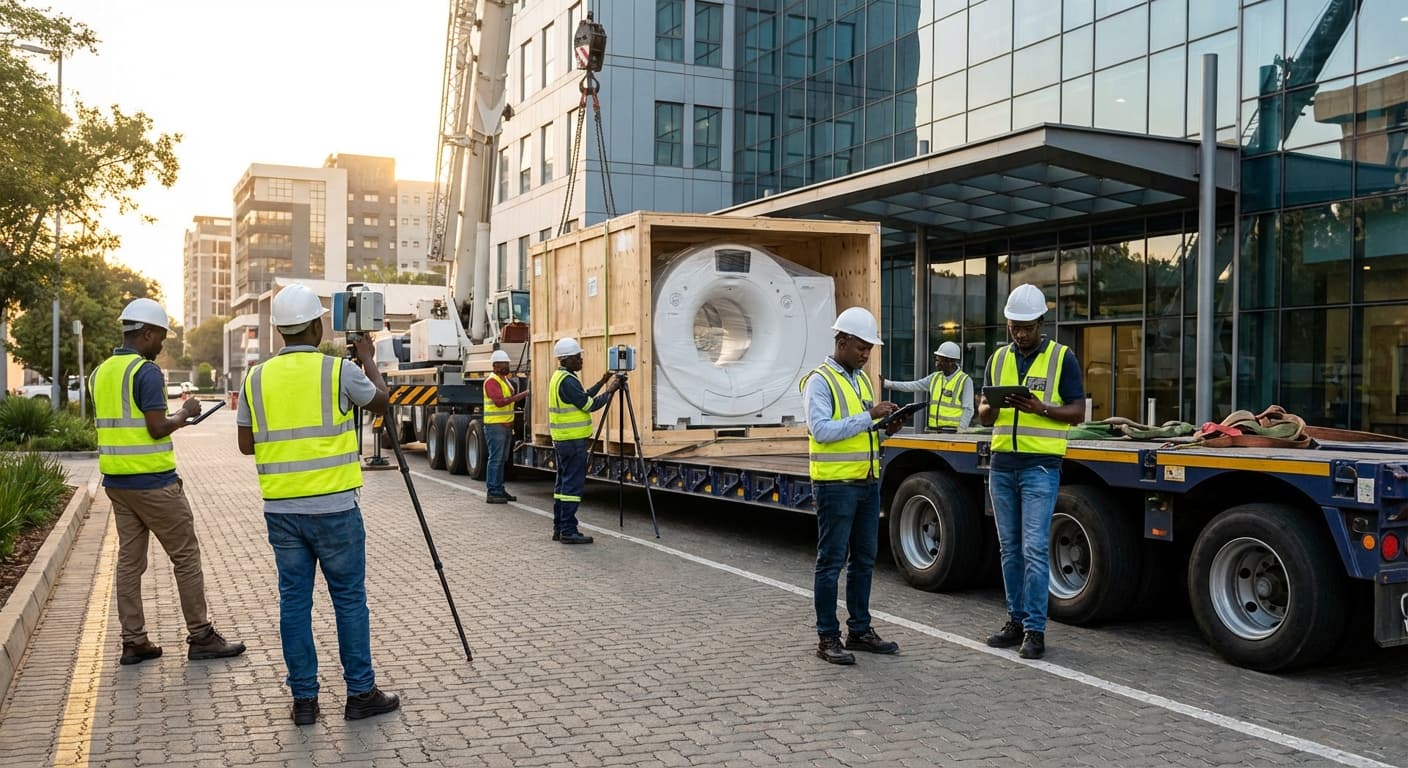
Route Survey & Rigging Plan Service for Heavy Medical Equipment in Guinea
Engineering Excellence & Technical Support
Route Survey & Rigging Plan Service for Heavy Medical Equipment High-standard technical execution following OEM protocols and local regulatory frameworks.
Precision Route Survey & Obstacle Mapping
Leveraging advanced GPS and LiDAR technologies, our service meticulously maps potential transport routes within Guinea, identifying all static and dynamic obstacles. This includes real-time data on road gradients, load-bearing capacities, overhead clearances (bridges, power lines), and potential ground instability, ensuring a comprehensive understanding of the logistical landscape.
Customized Rigging & Specialized Lifting Solutions
We engineer bespoke rigging plans tailored to the unique weight, dimensions, and delicate nature of heavy medical equipment. Our expertise covers the selection and deployment of specialized lifting gear, including heavy-duty cranes, gantries, and hydraulic jacks, guaranteeing safe and controlled movement in diverse operational environments, from port facilities to confined hospital sites.
Risk Mitigation & Contingency Planning
Our service prioritizes proactive risk identification and mitigation throughout the route survey and rigging process. We develop detailed contingency plans addressing potential challenges such as extreme weather, unforeseen infrastructure issues, or equipment malfunction. This includes pre-defined emergency response protocols and backup resource allocation, ensuring minimal downtime and maximum safety for critical medical equipment transport.
What Is Route Survey & Rigging Plan Service For Heavy Medical Equipment In Guinea?
Route Survey & Rigging Plan Service for Heavy Medical Equipment in Guinea is a specialized engineering and logistics operation. It encompasses the detailed assessment of transportation routes and the precise planning of lifting, handling, and securing procedures for oversized, overweight, or fragile medical apparatus. This service is critical for ensuring the safe, efficient, and compliant delivery and installation of such equipment within Guinea's infrastructure, considering its unique geographical and logistical challenges. The objective is to mitigate risks associated with transit damage, personnel injury, environmental impact, and operational delays.
| Who Needs This Service? | Typical Use Cases in Guinea | |||
|---|---|---|---|---|
| Hospitals & Healthcare Facilities: Both public and private institutions requiring advanced diagnostic and therapeutic equipment. | Medical Equipment Manufacturers & Suppliers: Companies delivering and installing their products in Guinean healthcare settings. | Government Health Ministries & Agencies: Overseeing the procurement and deployment of critical medical infrastructure. | International Aid Organizations & NGOs: Involved in supplying and installing medical equipment for humanitarian projects. | Construction & Engineering Firms: Partnering with healthcare providers for new hospital builds or expansions. |
| Installation of MRI/CT Scanners: Large, heavy, and sensitive diagnostic imaging machines requiring precise positioning and vibration-free transit. | Delivery of Linear Accelerators: High-radiation therapy equipment demanding meticulous planning due to weight, shielding, and installation requirements. | Transport of Large-Scale Sterilization Units: Industrial-grade autoclaves and sterilizers that are bulky and require specialized lifting. | Deployment of Modular Operating Theaters: Prefabricated units that need careful navigation and placement within existing structures. | Relocation of Existing Heavy Medical Equipment: Moving complex machinery within or between facilities in Guinea. |
Key Components of the Service
- Route Survey & Assessment:
- Infrastructure Evaluation: Detailed inspection of road conditions (pavement integrity, width, overhead clearances for bridges, power lines, and other obstructions).
- Traffic Analysis: Assessment of traffic density, peak hours, and potential congestion points impacting transit time and safety.
- Permitting & Legal Compliance: Identification and acquisition of all necessary permits, road closures, and escorts required by Guinean authorities.
- Environmental Considerations: Evaluation of potential environmental impacts and implementation of mitigation strategies.
- GPS Mapping & Documentation: Creation of detailed route maps, photographic evidence, and written reports.
- Rigging Plan Development:
- Equipment Characterization: Precise measurement of equipment dimensions, weight distribution, center of gravity, and structural integrity.
- Lifting & Handling Strategy: Design of appropriate lifting points, selection of specialized lifting gear (cranes, jacks, slings, spreader bars), and determination of safe working loads.
- Securing & Stabilization: Development of methods to secure the equipment during transit, preventing movement and damage.
- Method Statements & Risk Assessments: Generation of detailed step-by-step procedures for each phase of the operation, including comprehensive risk assessments and contingency plans.
- Personnel & Equipment Requirements: Identification of qualified personnel (riggers, engineers, crane operators) and specialized equipment needed.
- Execution Oversight (Optional but Recommended):
- Supervision: On-site supervision of rigging and transportation operations to ensure adherence to the plan.
- Quality Control: Verification of all safety checks and adherence to specified procedures.
- Problem Resolution: On-the-spot management of unforeseen issues or deviations from the plan.
Who Needs Route Survey & Rigging Plan Service For Heavy Medical Equipment In Guinea?
Ensuring the safe and efficient transportation and installation of heavy medical equipment in Guinea is a critical undertaking. Route Survey & Rigging Plan services are indispensable for any entity involved in acquiring, deploying, or maintaining such specialized and often high-value assets. These services minimize risks, prevent damage, and guarantee operational readiness.
| Target Customer Type | Key Departments/Personnel Involved | Specific Needs/Responsibilities |
|---|---|---|
| Hospitals and Healthcare Facilities | Procurement Department, Facilities Management, Biomedical Engineering Department, Clinical Department Heads | Acquiring new equipment, planning for space and access, ensuring seamless integration into existing infrastructure, minimizing downtime during installation. |
| Ministry of Health | Procurement Unit, Project Management Office, Planning and Infrastructure Department | Nationwide equipment deployment, standardization of safety protocols, oversight of large-scale projects, ensuring public healthcare access. |
| International Aid Organizations and NGOs | Logistics and Operations Department, Program Managers, Technical Specialists | Delivery to remote sites, overcoming infrastructure challenges, ensuring equipment functionality for humanitarian purposes, donor compliance. |
| Medical Equipment Manufacturers and Suppliers | Logistics Department, Project Managers, Installation and Service Teams | Ensuring safe delivery and unpacking, fulfilling warranty obligations, providing technical expertise for installation, protecting brand reputation. |
| Construction and Engineering Firms | Project Managers, Site Engineers, Health & Safety Officers | Integrating equipment installation into construction schedules, ensuring structural integrity for placement, coordinating access and utility connections. |
| Logistics and Transportation Companies | Operations Managers, Logistics Coordinators, Rigging Specialists | Developing detailed transport plans, selecting appropriate vehicles and lifting equipment, managing road surveys and permits, ensuring compliance with transport regulations. |
| Research Institutions and Universities | Research Directors, Procurement Officers, Laboratory Managers, IT/Technical Support | Sourcing specialized equipment, ensuring proper environmental conditions for sensitive instruments, planning for power and data connectivity. |
Target Customers and Departments for Route Survey & Rigging Plan Services in Guinea:
- {"title":"Hospitals and Healthcare Facilities","description":"Both public and private healthcare institutions are primary beneficiaries, especially those undergoing renovations, expansions, or acquiring new, advanced medical technologies."}
- {"title":"Ministry of Health (and equivalent governmental bodies)","description":"Responsible for national healthcare infrastructure development, procurement of large-scale medical equipment for public hospitals, and ensuring compliance with safety standards."}
- {"title":"International Aid Organizations and NGOs","description":"Organizations involved in providing medical equipment and establishing healthcare infrastructure in Guinea, often working in remote or challenging locations."}
- {"title":"Medical Equipment Manufacturers and Suppliers","description":"Companies that sell and deliver heavy medical equipment to Guinea. They need these services to ensure their products reach their destination intact and are properly installed, fulfilling their contractual obligations."}
- {"title":"Construction and Engineering Firms","description":"Companies involved in building or renovating healthcare facilities. They need to integrate the installation of heavy medical equipment into their overall project plans, requiring expert route and rigging assessments."}
- {"title":"Logistics and Transportation Companies","description":"Specialized movers and freight forwarders who handle the import and transport of oversized and sensitive medical equipment. They require detailed plans to execute the moves safely."}
- {"title":"Research Institutions and Universities with Medical Programs","description":"Facilities that acquire sophisticated diagnostic or research-oriented medical equipment which may require specialized handling and installation."}
Route Survey & Rigging Plan Service For Heavy Medical Equipment Process In Guinea
This document outlines the comprehensive workflow for our Route Survey and Rigging Plan Service, specifically tailored for the transportation and installation of heavy medical equipment in Guinea. Our service ensures the safe, efficient, and compliant movement of critical medical infrastructure from port of arrival to its final destination within healthcare facilities.
| Stage | Description | Key Activities | Deliverables | Timeline (Est.) |
|---|---|---|---|---|
| Understanding client needs and project scope. | Receiving inquiry, initial project briefing, understanding equipment specifications (weight, dimensions, sensitivity), site location, and desired timelines. Discussing regulatory requirements in Guinea. | Project brief, preliminary scope of work, initial quotation. | 1-3 Days |
| On-site evaluation of the route and destination. | Physical survey of the proposed transport route (roads, bridges, tunnels, turning radii, overhead clearances). Assessing the destination site (installation area, access points, power/utility availability, existing infrastructure). Measuring critical dimensions and identifying potential obstacles. Gathering geotechnical data where necessary. | Detailed site survey report, photographic evidence, site maps, obstacle log. | 3-7 Days |
| Developing the safest and most efficient transport path. | Analyzing collected data to identify the optimal route. Determining necessary road modifications (temporary closures, reinforcement, signage). Planning convoy formations and escort requirements. Identifying staging points and rest areas. Considering weather patterns and local traffic conditions. | Optimized route plan, route maps with critical points marked, preliminary transport strategy. | 2-4 Days |
| Engineering precise lifting and placement procedures. | Detailed analysis of equipment's center of gravity, lifting points, and weight distribution. Selecting appropriate lifting equipment (cranes, forklifts, jacks). Designing rigging configurations (slings, shackles, spreader bars). Developing step-by-step lifting and placement procedures, including sequences and tolerances. Specifying required personnel and their roles. | Comprehensive rigging and lifting plan (including CAD drawings), equipment specifications, personnel allocation. | 5-10 Days |
| Identifying and addressing potential hazards. | Conducting a thorough risk assessment for both transport and rigging operations. Identifying potential hazards (equipment failure, environmental factors, human error, site-specific challenges). Developing detailed mitigation strategies and contingency plans. Defining safety protocols and emergency procedures. | Risk assessment report, mitigation strategies, emergency response plan. | 1-2 Days |
| Securing necessary approvals and engaging relevant parties. | Liaising with Guinean authorities (transportation, police, local government) to obtain necessary permits and clearances for route access and road closures. Coordinating with utility companies (power, telecommunications) if any disruptions are anticipated. Engaging with the client's site personnel and facility management. | All required permits and approvals, documented stakeholder communication records. | Variable (dependent on local authorities, typically 7-21 Days) |
| Implementing the planned operations. | Mobilizing all necessary equipment and personnel. Executing the transport of the medical equipment along the approved route. Conducting the rigging, lifting, and precise placement of the equipment at the installation site. Adhering strictly to the developed plans and safety protocols. Real-time monitoring and adjustments as needed. | Successfully transported and rigged medical equipment, on-site progress reports. | Variable (dependent on project scale, typically 3-14 Days) |
| Finalizing the project and documenting completion. | Conducting a post-operation review with the client to ensure satisfaction. Documenting the entire process with photos and reports. Handing over all relevant documentation, including completed permits, survey reports, rigging plans, and incident logs (if any). Providing a final project report. | Final project report, photographic documentation, signed handover certificate. | 1-3 Days |
Workflow Stages
- Inquiry & Initial Consultation
- Site Assessment & Data Collection
- Route Planning & Optimization
- Rigging & Lifting Plan Development
- Risk Assessment & Mitigation
- Permitting & Stakeholder Coordination
- Execution: Transport & Rigging
- Post-Execution Review & Handover
Route Survey & Rigging Plan Service For Heavy Medical Equipment Cost In Guinea
Estimating the cost for Route Survey & Rigging Plan Services for heavy medical equipment in Guinea involves a complex interplay of factors, as specialized skills and precise planning are paramount for successful installation. The pricing is not a fixed figure but rather a dynamic estimation based on several critical considerations. These include the specific type and weight of the medical equipment, the complexity of the route from port/arrival point to the final installation site, the accessibility of the installation location, the required rigging techniques, and the project's timeline. Furthermore, local labor rates, transportation logistics within Guinea, potential need for specialized equipment rental (cranes, forklifts, etc.), and the expertise of the survey and rigging team all contribute to the overall cost. Given these variables, providing a precise cost without detailed project specifics is challenging, but an indicative range can be established.
| Service Component | Indicative Price Range (GNF) | Notes |
|---|---|---|
| Route Survey & Assessment | 1,500,000 - 5,000,000 | Covers initial site visits, mapping, obstacle identification, and basic plan development. Varies by distance and complexity. |
| Detailed Rigging Plan Development | 2,000,000 - 7,000,000 | Includes detailed engineering drawings, load calculations, lift plans, and risk assessments. Equipment-specific and complex maneuvers increase cost. |
| Local Labor (Skilled Riggers) | 300,000 - 800,000 per person per day | Rates depend on experience, expertise, and the specific tasks involved. Higher for specialized roles. |
| Local Labor (Support Staff) | 100,000 - 300,000 per person per day | Includes general laborers, flaggers, and site assistants. |
| Equipment Rental (Per day) | 200,000 - 2,000,000+ | Highly variable. Small dollies are cheaper than large mobile cranes. Depends on the type and duration of rental. |
| Transportation & Logistics | 1,000,000 - 10,000,000+ | Includes fuel, vehicle hire, permits, and potential escorts. Long distances and challenging terrain significantly increase this. |
| Project Management & Supervision | 500,000 - 2,500,000 per day | Covers the oversight of the entire operation, ensuring safety and adherence to the plan. |
| Total Estimated Project Cost (Excluding Equipment Purchase) | 8,000,000 - 50,000,000+ | This is a very broad range. A simple installation of a moderately heavy piece of equipment on a straightforward route might be at the lower end, while complex, multi-stage lifts of extremely heavy and sensitive equipment in remote locations will be at the higher end or exceed this. |
Key Pricing Factors for Route Survey & Rigging Plan Services in Guinea:
- Equipment Specifications: Type, weight, dimensions, and any special handling requirements of the medical equipment.
- Route Complexity & Distance: Travel distance, terrain (urban, rural, unpaved roads), road conditions, and any potential obstacles (bridges, tunnels, power lines).
- Site Accessibility: Ease of access to the final installation location, including narrow corridors, multi-story buildings, or remote areas.
- Rigging Techniques Required: The complexity of lifting, maneuvering, and securing the equipment, including specialized jacking, skidding, or crane operations.
- Labor Costs: Local skilled and unskilled labor rates for survey, rigging, and support staff.
- Transportation & Logistics: Costs associated with moving equipment, tools, and personnel within Guinea, including fuel, permits, and potential security escorts.
- Equipment Rental: Need for specialized machinery such as cranes, forklifts, hydraulic jacks, specialized dollies, and measurement tools.
- Project Timeline: Urgency of the project can influence costs, with expedited services often commanding higher prices.
- Survey & Planning Detail: The depth of the route survey, site assessment, and the level of detail required in the rigging plan.
- Risk Assessment & Mitigation: Costs associated with identifying and planning for potential risks and developing contingency plans.
- Permits & Approvals: Any required permits for road closures, special transport, or site access.
- Insurance: Professional liability and insurance for the operations.
- Contingency: An allocation for unforeseen circumstances.
Affordable Route Survey & Rigging Plan Service For Heavy Medical Equipment Options
Navigating the logistics of heavy medical equipment installation requires meticulous planning. Our affordable Route Survey & Rigging Plan service provides the essential groundwork to ensure a smooth, safe, and cost-effective process. We specialize in understanding the unique challenges associated with transporting and placing large, sensitive medical devices, from MRI machines to CT scanners and surgical robots. Our service not only identifies potential obstacles and devises optimal movement paths but also creates detailed rigging plans that minimize risk and prevent costly damage. By leveraging our expertise, you gain peace of mind and avoid unexpected expenses often incurred due to improper planning.
| Cost-Saving Strategy | Description | Benefit |
|---|---|---|
| Early Planning Engagement | Booking our route survey and rigging plan well in advance of equipment delivery and installation. | Prevents last-minute rush fees, allows for proactive identification and resolution of potential issues, and secures optimal scheduling. |
| Bundled Service Options | Choosing one of our value bundles over individual services. | Offers a more economical price point per component, ensuring you have all necessary planning elements covered at a reduced overall cost. |
| Accurate Equipment Specifications | Providing precise dimensions, weight, and center of gravity for all medical equipment. | Enables a more accurate and efficient rigging plan, reducing the need for over-engineering and unnecessary specialized equipment. |
| Clear Communication & Site Access | Ensuring clear communication with our team and unobstructed access to the installation site during the survey. | Speeds up the survey process, minimizing your consultant's time on-site and thus reducing costs. |
| Proactive Risk Mitigation | Leveraging our survey to identify and address potential hazards (e.g., tight corners, low ceilings, floor load capacity) before they become costly problems. | Avoids expensive damage to equipment, facility infrastructure, and potential injury, saving significant repair and downtime costs. |
Our Value Bundles: Maximizing Your Investment
- {"title":"Basic Route Survey & Rigging Plan","description":"This foundational package includes a comprehensive site assessment of your installation location, identification of all ingress/egress points, and a preliminary rigging strategy. Ideal for standard equipment and straightforward installations."}
- {"title":"Standard Equipment Package","description":"This bundle encompasses the Basic package plus detailed route mapping within the facility, specific equipment handling recommendations, and basic load calculation for standard rigging components. Suitable for moderate-sized and common medical equipment."}
- {"title":"Complex Installation Bundle","description":"Designed for the most challenging scenarios, this package includes in-depth route analysis (including structural considerations if applicable), advanced rigging methodologies, detailed weight distribution analysis, and contingency planning for unforeseen issues. Perfect for oversized, extremely heavy, or technically sensitive equipment like large MRI scanners or linear accelerators."}
- {"title":"Multi-Unit Coordination","description":"For facilities installing multiple pieces of heavy medical equipment, this bundle offers integrated route surveys and rigging plans, optimizing workflow and minimizing disruption across different installation sites within your facility."}
Verified Providers In Guinea
Finding reliable healthcare providers is paramount for anyone seeking quality medical services in Guinea. Franance Health stands out as a leading platform dedicated to connecting individuals with verified and reputable medical professionals across the country. Their rigorous credentialing process ensures that every provider listed on their platform meets high standards of expertise, experience, and ethical practice. This commitment to verification is what sets Franance Health apart and makes them the best choice for your healthcare needs in Guinea. By choosing Franance Health, you gain access to a curated network of trusted doctors, specialists, and clinics, offering peace of mind and confidence in the care you receive.
| Provider Type | Franance Health Verification Criteria | Benefit for Patients |
|---|---|---|
| General Practitioner | Valid medical license, recognized medical degree, at least 2 years of practical experience. | Access to reliable primary care for everyday health concerns. |
| Specialist (e.g., Cardiologist, Dermatologist) | Valid medical license, recognized specialist degree/certification, relevant fellowship training, documented successful patient outcomes. | Expert care for specific and complex medical conditions. |
| Surgeon | Valid medical license, recognized surgical degree, board certification in their specialty, extensive surgical experience, positive peer reviews. | Confidence in receiving safe and effective surgical procedures. |
| Dentist | Valid dental license, recognized dental degree, specialization if applicable (e.g., orthodontics, periodontics). | Quality dental care for oral health and cosmetic procedures. |
| Diagnostic Laboratories | Accreditation from recognized health authorities, adherence to quality control standards, certified technicians. | Accurate and reliable diagnostic testing for informed medical decisions. |
Why Franance Health is Your Best Choice for Verified Providers in Guinea:
- Rigorous Verification Process: Franance Health meticulously vets all healthcare providers, confirming their licenses, certifications, and educational backgrounds.
- Focus on Quality and Expertise: They prioritize practitioners with proven track records and specialized knowledge in various medical fields.
- Patient-Centric Approach: The platform is designed to simplify your search for healthcare, making it easy to find the right provider for your specific needs.
- Transparency and Trust: Franance Health provides clear information about provider qualifications, fostering trust and informed decision-making.
- Comprehensive Network: Access a wide range of medical professionals, from general practitioners to highly specialized surgeons.
- Enhanced Patient Safety: By exclusively listing verified providers, Franance Health significantly reduces the risk of encountering unqualified individuals.
Scope Of Work For Route Survey & Rigging Plan Service For Heavy Medical Equipment
This Scope of Work (SOW) outlines the services required for the Route Survey and Rigging Plan for the transportation and installation of heavy medical equipment. The objective is to ensure safe, efficient, and compliant movement of the equipment from its origin to its final installation point. This document specifies the technical deliverables and standard specifications to be adhered to by the service provider.
| Section | Description | Technical Deliverables | Standard Specifications |
|---|---|---|---|
| Comprehensive assessment of the proposed transportation route from origin to the final installation site. |
|
|
| Detailed plan for the lifting, maneuvering, and positioning of the heavy medical equipment. |
|
|
| Submission of all relevant documentation and reports throughout the project lifecycle. |
|
|
| Assistance in preparing the site and supporting the execution of the rigging and transportation plan. |
|
|
Key Objectives
- To identify and mitigate all potential risks associated with the transportation and rigging of heavy medical equipment.
- To develop a detailed and feasible rigging and transportation plan, ensuring compliance with all relevant safety standards and regulations.
- To accurately assess the route, including any constraints or obstacles, and propose appropriate solutions.
- To provide clear and comprehensive technical documentation for all stages of the operation.
Service Level Agreement For Route Survey & Rigging Plan Service For Heavy Medical Equipment
This Service Level Agreement (SLA) outlines the response times and uptime guarantees for the Route Survey & Rigging Plan Service for Heavy Medical Equipment provided by [Your Company Name] to [Client Company Name].
| Service Component | Response Time | Uptime Guarantee |
|---|---|---|
| Initial Consultation & Scope Confirmation | Within 4 business hours of request acknowledgement | N/A (Service is reactive) |
| Preliminary Route Survey Report Submission | Within 3 business days of site access and confirmed survey parameters | N/A (Service is reactive) |
| Final Route Survey Report & Rigging Plan Submission | Within 5 business days of preliminary report acceptance and provision of all necessary equipment specifications | N/A (Service is reactive) |
| Availability of Technical Support (for queries related to submitted plans) | Within 2 business hours during standard business hours (9 AM - 5 PM [Client's Time Zone]) | 99.5% during standard business hours |
| On-site Supervision (if included in service order) | As per agreed schedule in the service order | 100% during scheduled on-site supervision period |
Scope of Service
- Comprehensive route surveys for the transportation of heavy medical equipment, including assessment of road conditions, bridge clearances, overhead obstructions, and potential traffic management needs.
- Development of detailed rigging plans, including equipment selection, lifting procedures, securing methods, and personnel safety protocols, tailored to the specific heavy medical equipment.
- On-site supervision during rigging and placement operations (as specified in individual service orders).
Frequently Asked Questions

Ready when you are
Let's scope your Route Survey & Rigging Plan Service for Heavy Medical Equipment in Guinea project in Guinea.

Scaling healthcare logistics and technical systems across the entire continent.