
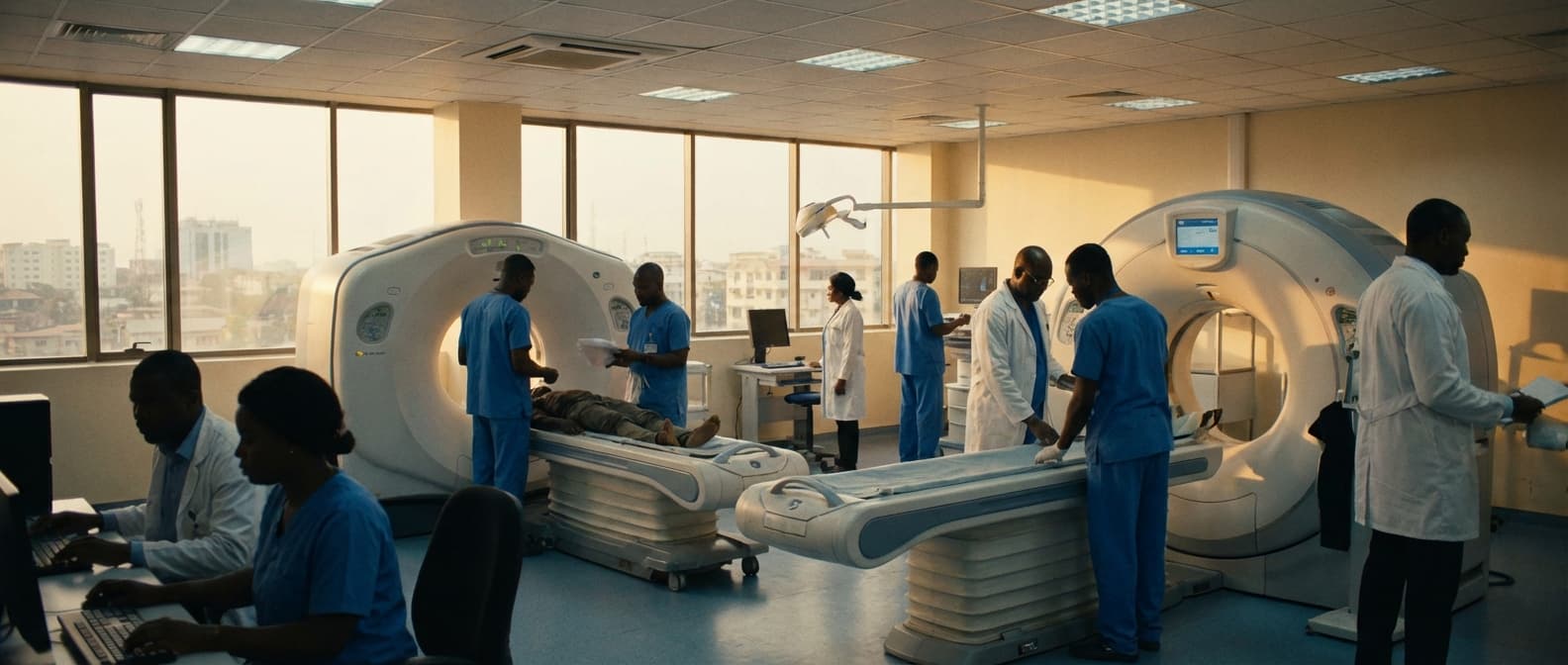
Radiology Room Design & Shielding Calculation in Guinea
Engineering Excellence & Technical Support
Turnkey room planning, shielding drawings and approvals for imaging suites. High-standard technical execution following OEM protocols and local regulatory frameworks.
Optimized Radiology Suite Layout for Workflow & Safety
Designed a functional and efficient radiology room layout in Guinea, meticulously considering patient and staff workflow, equipment placement, and adherence to international radiation safety standards. This includes strategic positioning of imaging modalities, control areas, and patient holding spaces to minimize dose and maximize throughput.
Precise Radiation Shielding Calculations for CT & X-ray Rooms
Conducted detailed radiation shielding calculations for new CT and X-ray suites in Guinea, ensuring compliance with local and international regulations. This involved analyzing X-ray tube output, workload, distance, and occupancy factors to determine optimal lead shielding thickness for walls, doors, and viewing windows, guaranteeing protection for all personnel and the public.
Integrated Radiation Protection Design for Enhanced Patient Care
Developed integrated radiation protection strategies for radiology facilities in Guinea, encompassing not only structural shielding but also the careful selection of protective apparel, workflow optimization to reduce exposure time, and the implementation of ALARA (As Low As Reasonably Achievable) principles. This holistic approach prioritizes patient safety and diagnostic image quality.
What Is Radiology Room Design & Shielding Calculation In Guinea?
Radiology room design and shielding calculations in Guinea refer to the specialized engineering and architectural process of planning, constructing, and outfitting medical imaging facilities, particularly those housing X-ray, CT, MRI, and other radiation-producing equipment. This service is critical for ensuring the safety of patients, medical staff, and the public from ionizing radiation while optimizing the functional workflow of the imaging department. The process involves detailed analysis of radiation output from the equipment, attenuation properties of various building materials, and room layout to prevent occupational and public exposure above regulatory limits.
This service is fundamentally required by any healthcare institution or private clinic in Guinea that intends to install, renovate, or upgrade diagnostic imaging suites. It is also a crucial consideration for building developers and architects undertaking the construction of new healthcare facilities. The primary objective is to comply with national radiation safety regulations and international best practices, thereby mitigating the risks associated with medical radiation exposure.
| Who Needs This Service | Typical Use Cases |
|---|---|
| Hospitals (Public and Private) | New construction or renovation of diagnostic imaging departments (X-ray, CT, Fluoroscopy, Mammography, Interventional Radiology). Installation of new radiation-producing equipment. |
| Specialized Clinics (e.g., Orthopedic, Cardiology) | Establishment of dedicated diagnostic imaging facilities within specialized medical centers. Upgrading existing imaging capabilities. |
| Medical Imaging Centers | Private entities offering a range of diagnostic imaging services. Ensuring compliance for multi-modality imaging suites. |
| Architects and Construction Companies | Inclusion of radiology suite design specifications in new healthcare building projects. Ensuring structural and functional integrity for medical imaging facilities. |
| Regulatory Bodies and Health Authorities | Review and approval of design plans and shielding calculations to ensure public and occupational safety. Setting and enforcing radiation protection standards. |
Key Components of Radiology Room Design & Shielding Calculation Service
- Radiation Safety Assessment: Determining the type, energy, and intensity of radiation emitted by the imaging equipment.
- Shielding Material Selection: Identifying appropriate materials (e.g., lead, concrete, drywall with specific densities) to attenuate radiation.
- Shielding Thickness Calculation: Quantifying the precise thickness of selected materials required for walls, floors, ceilings, doors, and viewing windows based on regulatory dose limits.
- Room Layout and Workflow Optimization: Designing the physical space to facilitate efficient patient throughput, staff movement, and equipment placement, while minimizing radiation scatter.
- Equipment Placement and Configuration: Determining optimal positioning of imaging equipment to maximize diagnostic quality and minimize exposure to non-target areas.
- Control Booth Design: Ensuring adequate shielding and visibility for the operator during procedures.
- Ventilation and Electrical Requirements: Integrating necessary systems for equipment operation and environmental control.
- Compliance Verification: Ensuring the design adheres to national radiation protection standards and guidelines set by the relevant authorities in Guinea (e.g., Ministry of Health, National Radiation Protection Agency if established).
- Documentation and Reporting: Providing detailed design plans, shielding calculations, and compliance reports for regulatory review and approval.
Who Needs Radiology Room Design & Shielding Calculation In Guinea?
Radiology room design and shielding calculations are essential for any facility in Guinea that utilizes X-ray, CT, MRI, or other radiation-producing imaging equipment. The primary goal is to ensure the safety of patients, staff, and the public from ionizing radiation, while also optimizing the functionality and efficiency of the radiology department.
| Target Customer Type | Relevant Departments | Key Needs for Radiology Room Design & Shielding |
|---|---|---|
| Hospitals (Public & Private) | Radiology/Medical Imaging Department, Nuclear Medicine, Radiation Oncology, Cardiology (for interventional radiology), Neurosurgery, Orthopedics, Pediatrics, Emergency Department | Ensuring compliance with radiation safety standards, protecting staff from occupational exposure, creating optimized workflows for various imaging modalities, providing comfortable and efficient patient environments, implementing effective radiation containment for diagnostic and therapeutic procedures. |
| Specialized Diagnostic Imaging Centers | Radiology, Mammography, CT, MRI, Ultrasound (for specialized applications), X-ray | Maximizing space utilization for advanced equipment, minimizing patient waiting times, adhering to strict radiation protection regulations for high-volume imaging, creating specialized rooms for MRI and CT to manage magnetic fields and radiation. |
| Clinics & Polyclinics | Radiology/Imaging Suite, General Practice (for basic X-ray needs) | Cost-effective solutions for basic X-ray room design and shielding, ensuring patient safety in smaller facilities, optimizing space for limited equipment, providing clear separation of radiation sources from occupied areas. |
| Research Institutions & Universities | Medical Imaging Research Labs, Anatomy and Physiology Departments (for imaging studies), Biomedical Engineering | Designing flexible lab spaces for research involving imaging, implementing shielding for experimental setups, ensuring safety during research involving radioactive isotopes or high-energy imaging, accommodating specialized imaging equipment for scientific purposes. |
| Government Health Agencies & Ministries of Health | Regulatory Bodies for Radiation Protection, Public Health Infrastructure Planning Departments | Establishing and enforcing national radiation safety standards and guidelines, developing protocols for licensing and inspection of imaging facilities, planning for the safe and effective deployment of diagnostic imaging services across the country, ensuring adequate shielding for public health facilities. |
Target Customers and Departments in Guinea Requiring Radiology Room Design & Shielding Calculation
- Hospitals (Public and Private)
- Specialized Diagnostic Imaging Centers
- Clinics and Polyclinics with Diagnostic Imaging Services
- Research Institutions and Universities with Medical Imaging Facilities
- Government Health Agencies and Ministries of Health (for regulatory oversight and public health infrastructure development)
Radiology Room Design & Shielding Calculation Process In Guinea
Designing and calculating shielding for radiology rooms in Guinea involves a structured workflow, ensuring patient and staff safety from radiation. This process typically begins with an inquiry from a healthcare facility and culminates in the successful shielding and commissioning of the radiology suite. The workflow is iterative and requires close collaboration between the client, architects, radiation physicists, and construction teams.
| Phase | Stage | Key Activities | Responsible Parties | Deliverables |
|---|---|---|---|---|
| Phase 1 | Initial Inquiry & Needs Assessment | Client submits inquiry, outlining room requirements (type of modality, intended use, existing building constraints). Preliminary site visit to assess space, structure, and potential challenges. Discussion of regulatory requirements in Guinea. | Healthcare Facility, Consultant/Designer, Radiation Physicist | Project brief, preliminary site assessment report, understanding of client's needs. |
| Phase 2 | Conceptual Design & Layout | Develop room layout considering workflow, patient access, equipment placement, and infection control. Define room dimensions, door and window locations, and control room design. Incorporate architectural and structural considerations. | Architect, Consultant/Designer, Radiation Physicist, Equipment Vendor | Conceptual drawings, preliminary room layout, architectural sketches. |
| Phase 2 | Technical Specification Development | Detailed specifications for walls, floors, ceilings, doors, windows (e.g., leaded glass), and any necessary ventilation or electrical services. Selection of radiation-attenuating materials. | Radiation Physicist, Consultant/Designer, Structural Engineer | Detailed architectural and technical drawings, material specifications. |
| Phase 3 | Shielding Calculation | Determine the required thickness of shielding materials (lead, concrete, etc.) based on the type and energy of radiation produced by the imaging equipment, workload, and occupancy factors of adjacent areas. Utilize established international standards and local regulations (if applicable). | Radiation Physicist | Shielding calculation report, detailed specifications for shielding materials and dimensions. |
| Phase 3 | Shielding Design Integration | Integrate the calculated shielding requirements into the architectural and structural designs. Ensure continuity of shielding at junctions, openings, and penetrations. | Radiation Physicist, Architect, Structural Engineer | Revised architectural and structural drawings with integrated shielding details. |
| Phase 3 | Verification & Review | Review of shielding calculations and designs by independent qualified professionals. Consultation with relevant authorities for approval. | Radiation Physicist, Independent Expert, Regulatory Bodies | Verified shielding design, approval documentation. |
| Phase 4 | Construction Documentation | Preparation of comprehensive construction documents including detailed drawings, specifications, and schedules for all trades involved. | Consultant/Designer, Architect, Structural Engineer, Radiation Physicist | Full set of construction drawings and specifications. |
| Phase 4 | Site Preparation & Construction | Execution of civil works, installation of structural elements, and application of shielding materials according to the approved designs. This includes lead lining, concrete pouring, and installation of specialized doors and windows. | General Contractor, Subcontractors (e.g., lead installers), Site Supervisor | Physically constructed and shielded radiology room. |
| Phase 4 | Quality Control & Site Inspections | Regular inspections during construction to ensure adherence to specifications, material quality, and proper installation techniques. Verification of shielding integrity. | Site Supervisor, Consultant/Designer, Radiation Physicist | Inspection reports, quality control documentation. |
| Phase 5 | Shielding Verification Testing | Post-construction measurement of radiation levels within and outside the shielded room using calibrated radiation survey meters to confirm the effectiveness of the shielding. This is often done before equipment installation. | Radiation Physicist | Radiation survey report confirming adequate shielding. |
| Phase 5 | Equipment Installation & Calibration | Installation and calibration of the radiology imaging equipment by the vendor. | Equipment Vendor, Healthcare Facility Staff | Installed and calibrated radiology equipment. |
| Phase 5 | Final Radiation Safety Survey & Commissioning | Comprehensive radiation safety survey after equipment installation to assess compliance with safety standards and operational parameters. Final commissioning of the room and equipment. | Radiation Physicist, Regulatory Bodies, Healthcare Facility Staff | Commissioning report, operational license/approval, final handover documentation. |
Radiology Room Design & Shielding Calculation Process in Guinea
- Phase 1: Inquiry & Preliminary Assessment
- Phase 2: Design & Specification Development
- Phase 3: Shielding Calculation & Verification
- Phase 4: Construction & Implementation
- Phase 5: Commissioning & Handover
Radiology Room Design & Shielding Calculation Cost In Guinea
Designing and equipping a radiology room with adequate shielding is a critical and often substantial investment for healthcare facilities in Guinea. The cost is influenced by several factors, including the complexity of the room, the type and energy of the diagnostic equipment, the specific shielding materials chosen, and the prevailing market conditions in Guinea. Accurate shielding calculations are paramount to ensure patient and staff safety and to comply with national radiation protection regulations, which are often guided by international standards. The pricing can vary significantly, and obtaining detailed quotes from specialized vendors and installers is essential for accurate budgeting. This discussion outlines the key pricing factors and provides estimated cost ranges in Guinean Francs (GNF).
| Service/Component | Estimated Cost Range (GNF) | Notes |
|---|---|---|
| Radiation Shielding Calculations & Design Consultation | 5,000,000 - 20,000,000 | Varies based on complexity and the firm's expertise. |
| Lead Shielding (Lead-lined drywall/panels) | 150,000 - 500,000 per square meter (installed) | Dependent on lead thickness and installation complexity. |
| Concrete Shielding (Thickened walls/floors) | 80,000 - 250,000 per cubic meter (installed) | Includes cost of materials, formwork, and labor. Thickness is crucial. |
| Lead-lined Doors (Standard size) | 2,000,000 - 7,000,000 | Varies with lead thickness and door quality. |
| Leaded Glass Viewing Windows | 500,000 - 2,000,000 per square meter | Depends on glass thickness and frame material. |
| Installation Labor (General) | 20-30% of material costs | Can be higher for specialized shielding installation. |
| Ancillary Items (e.g., warning signs, interlocks) | 500,000 - 2,000,000 (total) | Depends on the number and type of accessories. |
| Regulatory Fees & Inspections | 1,000,000 - 5,000,000 | Variable based on local government charges. |
| Total Estimated Cost (Small to Medium Room) | 25,000,000 - 100,000,000+ | This is a broad estimate and can vary significantly. Excludes the cost of imaging equipment itself. |
Key Pricing Factors for Radiology Room Design & Shielding in Guinea:
- Room Size and Layout: Larger rooms, rooms with complex layouts (e.g., requiring separate control rooms and patient waiting areas), or those needing to accommodate multiple imaging modalities will incur higher design and construction costs.
- Type and Power of Imaging Equipment: The type of X-ray, CT scanner, or other radiology equipment dictates the required shielding. Higher-energy machines and those with higher tube current (mA) will necessitate more robust and expensive shielding solutions.
- Shielding Material Selection: The primary shielding materials are lead (Pb) and concrete. Lead shielding is common for X-ray rooms, while thicker concrete walls are often used for higher-energy CT scanners or fluoroscopy rooms. The thickness and quality of these materials directly impact cost.
- Complexity of Shielding Calculations: The depth of the radiation protection analysis, including detailed dose calculations for various scenarios (patient, staff, public), influences the consulting fees. Utilizing specialized software and experienced radiation physicists adds to the cost.
- Installation Labor and Expertise: The cost of skilled labor for installing shielding materials (e.g., hanging lead-lined drywall, pouring concrete, fitting lead-lined doors and windows) is a significant component. Specialized contractors experienced in radiation shielding are often required.
- Ancillary Components: This includes lead-lined doors, leaded glass viewing windows, light fixtures designed for radiation environments, and any necessary ventilation or structural modifications.
- Regulatory Compliance and Inspection Fees: Costs associated with obtaining permits, ensuring compliance with local radiation safety regulations, and undergoing mandatory inspections by the relevant authorities in Guinea.
- Vendor and Supplier Costs: Fluctuations in the global and local prices of lead, concrete, and other construction materials, as well as the profit margins of suppliers and installers, play a role.
- Geographic Location within Guinea: While less of a primary driver than the technical aspects, logistical challenges and transportation costs for materials to more remote regions could marginally impact overall pricing.
Affordable Radiology Room Design & Shielding Calculation Options
Designing an affordable radiology room while ensuring adequate radiation shielding is a critical balance for any healthcare facility. This involves careful planning, material selection, and leveraging efficient design principles. Understanding 'value bundles' and implementing cost-saving strategies can significantly reduce the overall project expense without compromising safety or functionality. Value bundles often group services or materials together at a discounted rate, while cost-saving strategies focus on optimizing resources and avoiding unnecessary expenditures.
| Value Bundle/Cost-Saving Strategy | Description | Potential Benefit |
|---|---|---|
| Integrated Design-Build Services | Combining architectural design, engineering, and construction under a single contract, often with pre-negotiated pricing for shielding materials and installation. | Streamlined process, reduced coordination issues, potential for bulk material discounts, faster project completion. |
| Shielding Material Packages | Purchasing shielding materials (e.g., lead-lined drywall, concrete blocks) as a bundled package from a single supplier, potentially with volume discounts. | Lower per-unit material cost, reduced shipping and handling expenses. |
| Off-the-Shelf Shielding Components | Utilizing standard-sized, pre-manufactured shielding panels or doors instead of custom-built solutions. | Reduced fabrication time and cost, quicker installation. |
| Phased Construction/Renovation | Implementing the radiology room design in stages, prioritizing essential shielding and equipment first, with future expansions or upgrades planned for later. | Spreads capital expenditure over time, allows for adjustment based on immediate needs and budget constraints. |
| Value Engineering Workshops | Collaborative sessions with stakeholders (architects, engineers, physicists, contractors) to identify cost-saving alternatives without sacrificing quality or safety. | Innovative solutions, identification of redundancies, optimized material usage. |
| Bulk Purchasing of General Construction Materials | Consolidating the purchase of common construction materials (e.g., concrete, lumber, drywall) with other facility projects to leverage higher volume discounts. | Reduced overall material costs for the project. |
| Standardized Room Configurations | Developing a set of standardized radiology room layouts and shielding specifications that can be replicated across multiple facilities or expansions. | Economies of scale in design and procurement, simplified installation processes. |
| Reclaimed or Recycled Materials (where appropriate) | Investigating the use of high-quality reclaimed lead or other sustainable building materials that meet shielding requirements and cost objectives. | Reduced material cost, environmental benefits. |
Key Considerations for Affordable Radiology Room Design & Shielding
- {"title":"Room Layout and Workflow Optimization","description":"A well-designed layout minimizes travel distances for staff and patients, improving efficiency and potentially reducing the required size of the room. Consider natural barriers and equipment placement to reduce shielding needs."}
- {"title":"Shielding Material Selection","description":"While lead is traditional, alternative materials like concrete, drywall with lead lining, or specialized composites can offer cost-effective shielding solutions depending on the specific radiation levels and room requirements."}
- {"title":"Shielding Calculation Expertise","description":"Accurate calculations are paramount to avoid over-shielding (costly) or under-shielding (unsafe). Engaging experienced medical physicists or specialized design firms can prevent costly mistakes."}
- {"title":"Modular and Prefabricated Solutions","description":"Consider pre-fabricated shielding panels or modular room components, which can expedite installation and potentially reduce labor costs."}
- {"title":"Multi-Purpose Room Design","description":"Where feasible, designing rooms that can accommodate multiple imaging modalities or functions can reduce the overall number of rooms and associated construction costs."}
- {"title":"Energy-Efficient Design","description":"Incorporating energy-efficient lighting and HVAC systems can lead to long-term operational cost savings."}
Verified Providers In Guinea
In Guinea, accessing reliable healthcare services is paramount. 'Verified Providers' are those who have met stringent criteria, ensuring they offer quality, safe, and ethical medical care. Among these, Franance Health stands out due to its comprehensive credentials, commitment to international standards, and patient-centric approach. Choosing Franance Health means partnering with a healthcare provider that prioritizes your well-being through rigorous vetting processes and a dedication to excellence.
| Credential Type | Franance Health's Compliance | Benefit to Patients |
|---|---|---|
| National Licensing | Fully compliant with all Guinean Ministry of Health regulations. | Ensures legal and ethical operation, providing a secure healthcare environment. |
| Professional Certifications | All medical staff hold recognized board certifications and licenses. | Guarantees that practitioners possess the necessary expertise and qualifications. |
| Technology & Equipment | Utilizes advanced diagnostic and treatment technologies. | Leads to more accurate diagnoses and improved treatment outcomes. |
| Patient Safety Protocols | Strict adherence to international patient safety guidelines. | Minimizes risks of errors and infections, prioritizing patient well-being. |
| Continuous Training | Regular professional development for all staff. | Ensures patients receive care informed by the latest medical knowledge and techniques. |
Franance Health Credentials and Why They Represent the Best Choice
- Accreditation and Licensing: Franance Health facilities and practitioners hold all necessary national licenses and are accredited by recognized health organizations. This demonstrates compliance with Guinean healthcare regulations.
- Qualified Medical Professionals: All doctors, nurses, and specialists at Franance Health are board-certified, possess extensive experience, and undergo continuous professional development to stay abreast of the latest medical advancements.
- State-of-the-Art Facilities and Equipment: Franance Health invests in modern medical technology and maintains up-to-date facilities, ensuring accurate diagnoses and effective treatments.
- Adherence to International Standards: Franance Health aligns its practices with international healthcare best practices, including patient safety protocols, infection control measures, and ethical medical conduct.
- Patient-Centric Care Model: The organization is dedicated to providing compassionate, personalized care, focusing on patient education, clear communication, and respecting individual needs and preferences.
- Robust Quality Assurance Programs: Franance Health implements continuous quality improvement initiatives, regularly reviewing patient outcomes, satisfaction surveys, and operational efficiency to maintain the highest standards.
- Commitment to Accessibility and Affordability: While maintaining quality, Franance Health strives to make its services accessible and reasonably priced for the Guinean population.
- Strong Reputation and Patient Testimonials: A proven track record of positive patient experiences and a strong reputation within the community further underscore Franance Health's reliability and effectiveness.
Scope Of Work For Radiology Room Design & Shielding Calculation
This Scope of Work (SOW) outlines the requirements for the design and shielding calculations for a new radiology room. The objective is to ensure the facility meets all regulatory requirements for radiation safety and provides an optimal environment for diagnostic imaging procedures.
| Task Description | Deliverables | Standard Specifications / References |
|---|---|---|
| 1. Site Assessment & Requirements Gathering | Site survey report, equipment specifications, workflow analysis, spatial requirements documentation. | Facility architectural plans, imaging equipment manufacturer's specifications, user input documentation, local building codes. |
| 2. Conceptual Design Development | Preliminary room layout drawings (floor plans, elevations), equipment placement diagrams, preliminary shielding materials identification. | Radiology best practice guidelines, equipment footprint requirements, staff and patient traffic flow diagrams. |
| 3. Detailed Design Development | Finalized architectural drawings (including room dimensions, door/window locations, control console area), mechanical, electrical, and plumbing (MEP) integration plans, detailed equipment mounting plans, cable management strategies. | Architectural Standards (e.g., AIA Guidelines), HVAC standards, electrical codes (e.g., NEC), plumbing codes, fire safety regulations. |
| 4. Radiation Shielding Calculations | Detailed shielding calculations report (including material thickness, type, and extent of shielding for walls, floor, ceiling, doors, and windows), shielding design drawings. | National Council on Radiation Protection and Measurements (NCRP) Reports (e.g., NCRP 147, NCRP 151), International Commission on Radiological Protection (ICRP) Publications, local/state radiation safety regulations, equipment manufacturer's shielding recommendations. |
| 5. Door & Window Specification | Specifications for radiation shielding doors (e.g., lead-lined, interlocked), viewing windows (e.g., leaded glass specifications). | Lead equivalency ratings as determined by shielding calculations, door hardware specifications, safety interlock requirements. |
| 6. Electrical & Mechanical Design Considerations | Recommendations for power requirements, ventilation, and HVAC systems to support imaging equipment and maintain a safe environment. | Equipment power consumption data, ASHRAE standards for HVAC in healthcare facilities, infection control guidelines. |
| 7. Final Report & Documentation | Consolidated design package including all drawings, calculations, specifications, and reports. | Project management standards, quality assurance protocols. |
Key Objectives
- Develop a comprehensive radiology room design that accommodates specified imaging equipment and operational workflows.
- Perform detailed radiation shielding calculations to ensure compliance with all relevant national and local radiation safety standards.
- Produce technical deliverables that clearly define the design and shielding specifications for construction and implementation.
- Ensure the design promotes patient comfort, staff safety, and efficient workflow.
Service Level Agreement For Radiology Room Design & Shielding Calculation
This Service Level Agreement (SLA) outlines the terms and conditions for the design and shielding calculation services provided by [Your Company Name] for radiology rooms. It defines the expected response times for client inquiries and the uptime guarantees for any cloud-based or hosted tools utilized in the service delivery. This agreement aims to ensure client satisfaction and predictable service performance.
| Service Component | Response Time Target | Uptime Guarantee |
|---|---|---|
| Initial Inquiry Acknowledgement | 2 business hours | N/A |
| Request for Information (RFI) Response | 8 business hours | N/A |
| Delivery of Conceptual Design Draft | 5 business days (post-requirements gathering) | N/A |
| Delivery of Detailed Design & Shielding Calculation Report Draft | 10 business days (post-conceptual design approval) | N/A |
| Technical Support for Design Software/Platform (if applicable) | 4 business hours | 99.5% during business hours (9 AM - 5 PM [Timezone]) |
| Availability of Cloud-Based Design Tools (if applicable) | N/A | 99.8% (24/7) |
Scope of Service
- Initial consultation and requirements gathering for radiology room design.
- Development of conceptual and detailed design layouts for radiology rooms.
- Radiation shielding calculations for walls, doors, windows, and other protective elements.
- Production of design documentation, including drawings and specifications.
- Review and approval processes with the client.
- Provision of materials lists for shielding and design elements.
- Support during the construction and implementation phases (as specified in contract).
- *Exclusions: Site surveys (unless explicitly included), architectural approvals, structural engineering, electrical and mechanical system design, and any construction or installation work.
Frequently Asked Questions

Ready when you are
Let's scope your Radiology Room Design & Shielding Calculation in Guinea project in Guinea.

Scaling healthcare logistics and technical systems across the entire continent.