
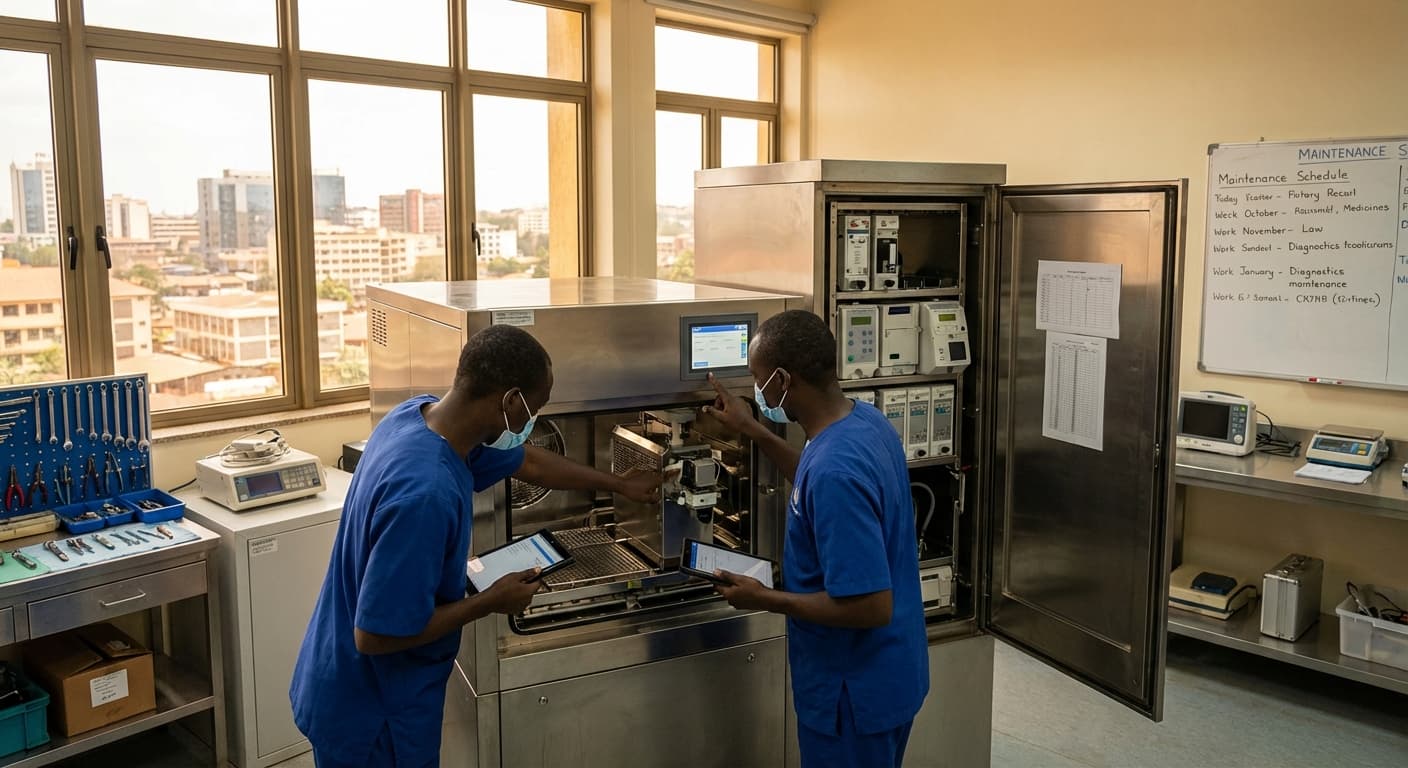
Total Cost of Ownership (TCO) & Lifecycle Budgeting Service in Guinea
Engineering Excellence & Technical Support
Total Cost of Ownership (TCO) & Lifecycle Budgeting Service High-standard technical execution following OEM protocols and local regulatory frameworks.
Optimized Asset Performance & Longevity
Leverage advanced analytical models to forecast and manage the total cost of ownership for critical infrastructure and equipment in Guinea. Our service identifies optimal maintenance schedules, proactive replacement strategies, and performance enhancement opportunities, significantly extending asset lifecycles and reducing operational expenditures.
Strategic Procurement & Vendor Cost Reduction
Through comprehensive lifecycle cost analysis of procurement options and supplier performance tracking, we help Guinean businesses achieve substantial savings. Our expertise extends to negotiating favorable terms, identifying total cost drivers beyond initial purchase price (e.g., energy consumption, maintenance, disposal), and fostering long-term, cost-effective vendor relationships.
Predictive Budgeting & Risk Mitigation
Gain unparalleled visibility into future capital and operational expenses. Our TCO and lifecycle budgeting services empower Guinean organizations with accurate, data-driven forecasts, enabling proactive financial planning, capital allocation optimization, and effective risk mitigation against unforeseen costs associated with asset lifecycle management.
What Is Total Cost Of Ownership (Tco) & Lifecycle Budgeting Service In Guinea?
Total Cost of Ownership (TCO) and Lifecycle Budgeting (LCB) services in Guinea represent a strategic financial and operational framework for evaluating and managing the complete costs associated with an asset or project from its inception through its disposal. TCO encompasses all direct and indirect expenditures, including acquisition, operation, maintenance, upgrade, and eventual decommissioning costs, over the entire lifespan of the asset. LCB, intrinsically linked to TCO, provides a structured budgeting methodology to anticipate and allocate funds for these costs across the asset's lifecycle. These services are critical for organizations seeking to make informed investment decisions, optimize resource allocation, and mitigate financial risks associated with long-term commitments within the Guinean economic and regulatory landscape.
| Who Needs TCO & LCB Services in Guinea? | Typical Use Cases in Guinea | ||||||
|---|---|---|---|---|---|---|---|
| Government Agencies & Public Sector Entities: For infrastructure projects (roads, utilities, public buildings), fleet management, IT systems procurement, and managing public assets. | Mining & Extractive Industries: Evaluating the TCO of exploration equipment, processing plants, transportation infrastructure, and environmental remediation efforts. Managing long-term operational costs in remote Guinean locations. | Energy & Utilities Companies: Assessing the lifecycle costs of power generation facilities, transmission networks, renewable energy installations, and water treatment plants. Considering the regulatory environment and long-term sustainability. | Telecommunications Providers: Analyzing the TCO of network infrastructure, mobile towers, data centers, and spectrum licenses. Budgeting for technology upgrades and network expansion. | Manufacturing & Industrial Companies: Determining the lifecycle costs of production machinery, factory expansions, logistics, and supply chain optimization within the Guinean industrial sector. | Financial Institutions: Evaluating TCO for IT infrastructure, branch networks, ATM deployment, and software systems. Managing operational expenditures and technology refresh cycles. | Large-Scale Project Developers: For any significant capital investment requiring long-term financial planning and risk management of associated operational and maintenance costs. | |
| Procurement of Major Capital Assets: e.g., acquiring new mining excavators, power generation turbines, or telecommunications base stations. | Development of New Infrastructure: e.g., building a new port facility, highway, or public transportation system. | IT System Implementation & Upgrades: e.g., deploying a new enterprise resource planning (ERP) system or upgrading a national digital infrastructure. | Fleet Management Optimization: e.g., analyzing the TCO of a government vehicle fleet or a private logistics operation. | Real Estate & Facility Management: e.g., budgeting for the lifecycle costs of office buildings, industrial complexes, or residential developments. | Energy Project Investment Decisions: e.g., comparing the TCO of various renewable energy sources against traditional power generation. | Risk Management for Long-Term Contracts: e.g., assessing the full lifecycle cost implications of outsourcing critical operational functions. | Budgetary Planning for State-Owned Enterprises: Ensuring accurate financial foresight for public assets and services. |
Key Components of TCO & LCB Services
- Cost Identification & Categorization: Delineating all relevant costs across acquisition, operation, maintenance, support, and disposal phases.
- Lifecycle Stage Analysis: Mapping costs to specific phases: planning, acquisition/procurement, deployment/implementation, operation, maintenance/support, upgrade/renewal, and disposal/decommissioning.
- Financial Modeling & Forecasting: Developing robust models to project future expenditures, incorporating inflation, depreciation, and technological obsolescence.
- Risk Assessment & Mitigation: Identifying potential cost overruns and developing strategies to mitigate financial and operational risks.
- Performance Benchmarking: Comparing TCO/LCB against industry standards and alternative solutions.
- Optimization Strategies: Recommending strategies to reduce TCO, such as predictive maintenance, energy efficiency improvements, or vendor renegotiations.
- Reporting & Documentation: Providing comprehensive reports detailing TCO/LCB analyses, assumptions, and recommendations for decision-making.
- Scenario Planning: Analyzing the impact of different operational and economic scenarios on the overall lifecycle cost.
Who Needs Total Cost Of Ownership (Tco) & Lifecycle Budgeting Service In Guinea?
Total Cost of Ownership (TCO) and Lifecycle Budgeting (LCB) services are crucial for optimizing financial decisions and long-term asset management. In Guinea, these services are particularly valuable for organizations aiming for sustainable growth, efficient resource allocation, and robust financial planning. They help in making informed procurement decisions, predicting future expenses, and avoiding unexpected costs, thereby enhancing profitability and operational stability. These services are not just for large corporations but also for government agencies, development organizations, and any entity making significant capital investments.
| Target Customer | Relevant Departments | Why TCO/LCB is Crucial |
|---|---|---|
| Large Corporations (Mining, Telecommunications, Energy, Manufacturing) | Finance/Accounting, Procurement, Operations, Asset Management, Engineering, Strategic Planning | Optimizing large capital expenditures, long-term operational cost prediction, competitive advantage, risk mitigation. |
| Government Ministries (Infrastructure, Transport, Energy, Finance, Defense) | Public Procurement Units, Budget Offices, Engineering Departments, Project Management Offices | Efficient use of public funds, long-term infrastructure sustainability, transparent budgeting, planning for national development projects. |
| International Development Agencies & NGOs | Procurement, Finance, Project Management, Monitoring & Evaluation | Ensuring project sustainability, maximizing donor fund impact, responsible asset deployment in developing contexts, long-term project viability. |
| Public-Private Partnerships (PPPs) | Finance, Legal, Project Development, Operations | Accurate financial modeling for long-term partnerships, risk allocation, ensuring project profitability and public benefit over the asset's lifespan. |
| Financial Institutions (Banks, Leasing Companies) | Credit Risk, Asset Valuation, Portfolio Management, Business Development | Accurate risk assessment for asset-backed loans, predicting residual values, structuring competitive leasing agreements. |
| State-Owned Enterprises (SOEs) | Finance, Procurement, Operations, Strategic Planning | Improving efficiency and profitability, ensuring long-term operational viability, optimizing investment decisions, meeting government mandates. |
| Medium-Sized Businesses with Significant Asset Investment | Finance, Operations, Procurement | Preventing budget overruns, optimizing operational efficiency, making informed choices about fleet or equipment upgrades, ensuring return on investment. |
Who Needs TCO & Lifecycle Budgeting Service in Guinea?
- Organizations investing in significant capital assets (e.g., infrastructure, machinery, vehicles, IT systems).
- Entities with long-term operational goals and a need for predictable budgeting.
- Companies seeking to improve procurement strategies and negotiate better terms.
- Government agencies responsible for public infrastructure and services.
- International development organizations funding projects in Guinea.
- Businesses aiming to enhance sustainability and reduce environmental impact through informed asset choices.
- Financial institutions involved in asset financing and leasing.
- Organizations facing complex procurement processes or those with multiple stakeholders.
Total Cost Of Ownership (Tco) & Lifecycle Budgeting Service Process In Guinea
This document outlines the workflow for our Total Cost of Ownership (TCO) & Lifecycle Budgeting services in Guinea, from initial inquiry to final execution. Our process is designed to be thorough, collaborative, and ultimately deliver a comprehensive understanding of the long-term financial implications of assets and projects for our clients.
| Phase | Description | Key Activities | Deliverables | Timeline (Indicative) |
|---|---|---|---|---|
| The client expresses interest in TCO & Lifecycle Budgeting services. | Discuss client's objectives, current challenges, and potential scope of work. Understand the specific assets or projects in question. Initial discussion on data availability. | Understanding of client needs, preliminary assessment of project feasibility. | 1-3 Business Days |
| Formalizing the project parameters and outlining the service offering. | Detailed discussion to precisely define the scope (e.g., specific assets, project phases, duration). Identify key stakeholders. Prepare a comprehensive proposal including objectives, methodology, deliverables, timelines, and pricing. | Formal Proposal Document, Statement of Work (SOW). | 3-7 Business Days |
| Collecting all relevant financial and operational data for accurate TCO calculation. | Collaborate with client teams to collect historical data (purchase costs, operating expenses, maintenance records, disposal costs), projected costs, usage patterns, and relevant market data. Perform initial data validation and cleaning. | Cleaned and validated dataset for TCO analysis, initial data insights. | 1-4 Weeks (depending on data complexity and availability) |
| Applying established methodologies to calculate TCO and forecast lifecycle costs. | Develop TCO models incorporating all lifecycle stages: acquisition, operation, maintenance, repair, upgrades, decommissioning, and disposal. Incorporate discount rates and inflation for present value calculations. Perform sensitivity analysis and scenario planning. | Detailed TCO models, lifecycle cost projections, identification of key cost drivers. | 2-4 Weeks |
| Presenting findings and recommendations in a clear, actionable format. | Prepare a comprehensive TCO and Lifecycle Budgeting report detailing methodology, findings, cost breakdowns, risk assessments, and strategic recommendations. Present the report to key stakeholders, facilitating discussion and answering questions. | Comprehensive TCO & Lifecycle Budgeting Report, Executive Summary, Presentation Slides. | 1-2 Weeks |
| Assisting clients in leveraging the insights for decision-making and ongoing monitoring. | Provide guidance on implementing cost-saving strategies identified in the report. Assist in integrating TCO principles into procurement and asset management processes. Offer periodic review and updates to TCO models as needed. | Actionable recommendations for cost optimization, improved budgeting processes, ongoing TCO tracking mechanisms. | Ongoing (as per client agreement) |
Total Cost of Ownership (TCO) & Lifecycle Budgeting Service Process in Guinea
- Inquiry & Initial Consultation
- Scope Definition & Proposal Development
- Data Gathering & Analysis
- TCO & Lifecycle Cost Modeling
- Report Generation & Presentation
- Implementation Support & Review
Total Cost Of Ownership (Tco) & Lifecycle Budgeting Service Cost In Guinea
Understanding the Total Cost of Ownership (TCO) and Lifecycle Budgeting for services in Guinea involves a comprehensive assessment of all costs incurred over the entire lifespan of a service. This goes beyond the initial purchase or implementation price, encompassing ongoing operational expenses, maintenance, support, potential upgrades, and eventual decommissioning or disposal. For service providers and clients in Guinea, accurately budgeting for TCO is crucial for financial planning, risk mitigation, and making informed investment decisions. Pricing factors in Guinea for these services are influenced by a combination of local economic conditions, global market trends, and the specific nature of the service being procured.
| Service Type | Typical Scope of TCO Analysis | Estimated Pricing Range (GNF) | Notes |
|---|---|---|---|
| Basic TCO Assessment (e.g., for a single IT system) | Initial purchase, installation, basic operational costs, one year of maintenance. | 2,500,000 - 10,000,000 GNF | Suitable for smaller projects or initial evaluations. Relies heavily on available documentation. |
| Standard TCO & Lifecycle Budgeting (e.g., for a mid-sized project or service) | Includes initial investment, operational costs (labor, energy, consumables), maintenance, support, minor upgrades over 3-5 years. | 10,000,000 - 50,000,000 GNF | Covers most common business service scenarios. Requires more data collection and analysis. |
| Comprehensive TCO & Lifecycle Budgeting (e.g., for large infrastructure, fleet, or complex IT solutions) | Extensive analysis including all direct and indirect costs, risk assessment, depreciation, potential obsolescence, end-of-life costs, over 5-10+ years. | 50,000,000 - 250,000,000+ GNF | Involves in-depth industry research, expert interviews, detailed financial modeling, and scenario planning. Often requires specialized consulting firms. |
| Ongoing Lifecycle Cost Management & Review | Periodic (e.g., annual) updates to TCO models, performance tracking against budget, recommendations for optimization. | 5,000,000 - 30,000,000 GNF per year | A retainer-based service for continuous improvement and cost control. |
Key Pricing Factors for TCO & Lifecycle Budgeting Services in Guinea:
- Service Complexity and Scope: The more intricate and extensive the service, the higher the TCO. This includes the depth of analysis, the number of service components considered, and the granularity of data collection.
- Data Availability and Quality: The ease of access to reliable historical cost data, performance metrics, and future cost projections significantly impacts the effort and cost of the TCO analysis. Poor data quality necessitates more intensive research and validation.
- Provider Expertise and Reputation: Specialist TCO consultants or firms with a proven track record in Guinea or similar African markets may command higher fees due to their specialized knowledge, methodologies, and established networks.
- Geographic Scope of Service: If the service spans multiple regions within Guinea or has international components impacting logistics or compliance, costs will increase.
- Technology and Software Used: The tools and software employed for TCO modeling and analysis can influence pricing. Proprietary or advanced platforms might incur licensing fees.
- Duration of Lifecycle: Longer service lifecycles inherently mean higher cumulative costs, and the TCO analysis will reflect this extended period. Forecasting costs over 10, 20, or more years requires more sophisticated modeling.
- Regulatory and Compliance Requirements: Adhering to Guinean regulations, tax laws, and industry-specific compliance standards can add complexity and cost to the TCO assessment.
- Level of Detail and Customization: The degree of customization required for the TCO model, specific reporting needs, and the depth of breakdown of cost categories will affect the service price.
- Market Dynamics and Competition: The presence of multiple TCO service providers in Guinea can lead to competitive pricing, while a lack of local expertise might result in higher costs due to the need for international consultants.
- Currency Exchange Rates and Inflation: Fluctuations in the Guinean Franc (GNF) against major currencies and local inflation rates can impact the projected costs, especially for services with imported components or international labor.
Affordable Total Cost Of Ownership (Tco) & Lifecycle Budgeting Service Options
Our Affordable Total Cost of Ownership (TCO) & Lifecycle Budgeting service is designed to empower organizations by providing comprehensive financial planning and cost optimization across the entire lifespan of their assets and projects. We go beyond initial purchase prices to reveal the true economic impact, enabling smarter investments and proactive cost management. Our services are structured to be accessible, offering flexible options that cater to diverse organizational needs and budgets.
| Value Bundle Name | Description | Included Services | Target Audience | Cost-Saving Strategies Focus |
|---|---|---|---|---|
| Foundation TCO Essentials | Our entry-level package providing core TCO analysis and foundational lifecycle budgeting. | Initial TCO assessment, basic lifecycle cost projection, report generation. | Small to medium-sized businesses, startups, project teams with limited budgets. | Identifying major cost drivers, basic operational efficiency improvements. |
| Growth TCO Accelerator | A comprehensive package for organizations seeking to deepen their understanding and proactively manage lifecycle costs. | In-depth TCO modeling, multi-scenario lifecycle budgeting, risk identification, initial cost-saving recommendations. | Growing businesses, departments with significant asset portfolios, organizations entering new markets. | Optimizing procurement, improving maintenance schedules, energy efficiency initiatives. |
| Enterprise Lifecycle Mastery | Our premium, fully customizable service for large organizations requiring strategic, end-to-end lifecycle financial management. | Full TCO and lifecycle cost optimization, advanced financial modeling, strategic risk mitigation planning, implementation support for cost-saving initiatives, ongoing performance monitoring. | Large corporations, government agencies, organizations with complex asset management needs, multinational enterprises. | Strategic sourcing, innovative financing models, technology lifecycle management, waste reduction and sustainability initiatives. |
| Custom Solutions | Tailored packages designed to meet unique organizational requirements and specific project needs. | As per client's specific requirements, can include any combination of services. | Organizations with unique operational environments or specialized project demands. | Highly specific to the custom needs and identified opportunities. |
Key Service Components
- TCO Analysis & Modeling: We meticulously analyze all direct and indirect costs associated with an asset or project from acquisition to disposal, including purchase, installation, operation, maintenance, upgrades, and decommissioning.
- Lifecycle Budgeting: We develop detailed budgets that account for all anticipated costs and potential savings over the entire lifecycle, facilitating long-term financial planning and resource allocation.
- Value Bundle Options: We offer curated service packages designed to address specific organizational challenges and deliver maximum value at competitive price points.
- Cost-Saving Strategy Development: Our experts identify and recommend actionable strategies to reduce costs at various stages of the lifecycle, maximizing ROI and operational efficiency.
- Risk Assessment & Mitigation: We identify potential financial risks associated with lifecycle costs and propose strategies to mitigate them, ensuring budget predictability.
- Benchmarking & Best Practices: We compare your TCO and lifecycle costs against industry benchmarks to identify areas for improvement and implement best practices.
Verified Providers In Guinea
Navigating the healthcare landscape in Guinea can be challenging. Identifying trustworthy and competent medical providers is paramount to ensuring quality care. Franance Health has emerged as a leading entity dedicated to vetting and promoting verified healthcare professionals and facilities across Guinea. This commitment to rigorous credential verification sets Franance Health apart, making them a trusted resource for individuals seeking the best possible medical services.
| Credential Verification Aspect | Franance Health's Approach | Benefit to Patients |
|---|---|---|
| Academic & Professional Qualifications | Thorough review of degrees, certifications, and specialized training from accredited institutions. | Ensures providers possess the necessary knowledge and skills for effective treatment. |
| Clinical Experience & Specialization | Verification of practical experience in relevant medical fields and specialties. | Connects patients with practitioners who have proven expertise in their specific medical needs. |
| Licensing & Regulatory Compliance | Confirmation of active and valid licenses with relevant Guinean medical boards. | Guarantees providers operate within legal and ethical frameworks. |
| Reputation & Ethical Conduct | Background checks and, where possible, peer or patient feedback evaluation. | Minimizes the risk of encountering providers with questionable ethical practices. |
| Continuing Medical Education (CME) | Encourages and verifies participation in ongoing professional development. | Ensures providers stay updated with the latest medical advancements and techniques. |
Why Franance Health Credentials Represent the Best Choice:
- Rigorous Vetting Process: Franance Health employs a comprehensive and multi-faceted verification process. This goes beyond simple licensing, delving into the educational background, professional experience, and ethical standing of each provider. They ensure that practitioners meet stringent standards of competence and adherence to best practices.
- Focus on Quality and Safety: The core mission of Franance Health is to enhance the quality and safety of healthcare delivery in Guinea. By endorsing only verified providers, they actively reduce the risk of patients encountering unqualified or unethical practitioners, thereby prioritizing patient well-being.
- Transparency and Accessibility: Franance Health champions transparency in the healthcare sector. Their verified provider directory provides clear and accessible information, empowering patients to make informed decisions about their healthcare providers. This accessibility fosters trust and confidence.
- Continuous Monitoring and Re-evaluation: The commitment of Franance Health doesn't end with initial verification. They engage in continuous monitoring and re-evaluation of their listed providers to ensure ongoing compliance with their standards. This dynamic approach guarantees that the quality of care remains consistently high.
- Promoting Excellence: By highlighting and endorsing verified providers, Franance Health actively promotes a culture of excellence within the Guinean healthcare system. This encourages other providers to strive for higher standards and contributes to the overall improvement of medical services available to the population.
- Bridging the Information Gap: For many, the challenge lies in knowing where to find reliable medical help. Franance Health effectively bridges this information gap by curating a trusted network of verified professionals, simplifying the search for quality healthcare.
Scope Of Work For Total Cost Of Ownership (Tco) & Lifecycle Budgeting Service
This document outlines the Scope of Work (SOW) for a Total Cost of Ownership (TCO) and Lifecycle Budgeting service. The objective is to provide a comprehensive analysis and framework for understanding and managing the full financial implications of an asset, system, or project throughout its entire lifespan. This includes initial acquisition costs, operational expenses, maintenance, upgrades, and eventual disposal. The service aims to equip the client with data-driven insights to optimize financial planning, improve decision-making regarding investments, and mitigate unforeseen costs.
| Phase | Description | Key Activities | Deliverables |
|---|---|---|---|
| Define the scope, objectives, and key parameters of the TCO and lifecycle budgeting exercise. Identify the specific asset(s), system(s), or project(s) to be analyzed. Gather initial high-level information. | Conduct stakeholder interviews; Define analysis boundaries; Identify key cost categories; Establish project timelines and communication protocols. | Project Charter; Stakeholder Register; Initial Project Plan. |
| Gather detailed cost data across all lifecycle phases. This includes both tangible and intangible costs, historical data, and industry benchmarks. | Collect capital expenditure (CapEx) data; Collect operational expenditure (OpEx) data; Collect maintenance and support costs; Gather disposal/decommissioning cost estimates; Identify relevant assumptions and data sources. | Comprehensive Data Repository; Baseline Cost Data Report. |
| Develop and apply the TCO model. This involves quantifying all identified costs and projecting them over the defined lifecycle, incorporating factors like inflation, discount rates, and potential risk events. | Develop/Adapt TCO calculation methodology; Apply financial modeling techniques; Perform sensitivity analysis; Conduct scenario planning; Calculate Net Present Value (NPV) and other relevant financial metrics. | Detailed TCO Model; TCO Analysis Report; Sensitivity & Scenario Analysis Results. |
| Translate the TCO analysis into a practical lifecycle budgeting framework. This includes defining budget categories, forecasting future expenditures, and identifying budgeting cycles. | Define budget structure and granularity; Develop multi-year budget forecasts; Integrate TCO findings into budgeting processes; Establish variance analysis procedures. | Lifecycle Budgeting Framework Document; Multi-Year Budget Forecasts. |
| Identify potential cost risks and develop mitigation strategies to minimize their impact on the overall TCO and budget. | Identify cost overrun risks; Assess probability and impact of risks; Develop mitigation plans; Quantify potential cost of risks. | Risk Register; Risk Mitigation Strategy Report. |
| Synthesize findings and provide actionable recommendations to optimize costs, improve financial planning, and inform strategic decisions. | Formulate cost-optimization recommendations; Propose strategic investment/divestment options; Present findings and recommendations to stakeholders; Develop final TCO and Lifecycle Budgeting report. | Executive Summary Report; Detailed TCO & Lifecycle Budgeting Report; Presentation Deck; Action Plan for Implementation. |
| Ensure the client's team is equipped to utilize the developed TCO models and lifecycle budgeting framework effectively. | Conduct training sessions; Provide user manuals and documentation; Facilitate Q&A sessions. | Training Materials; User Guides; Post-implementation Support Plan. |
Key Objectives of the TCO & Lifecycle Budgeting Service
- Establish a clear understanding of all cost drivers associated with an asset/system/project over its lifecycle.
- Develop a robust methodology for TCO calculation and lifecycle budgeting.
- Identify cost-saving opportunities and risk mitigation strategies.
- Provide actionable recommendations for financial planning and investment decisions.
- Enhance budget accuracy and predictability.
- Facilitate informed comparisons between different options or solutions.
- Support long-term strategic financial management.
Service Level Agreement For Total Cost Of Ownership (Tco) & Lifecycle Budgeting Service
This Service Level Agreement (SLA) outlines the guaranteed response times and uptime for the Total Cost of Ownership (TCO) & Lifecycle Budgeting Service. It defines the commitments made by the service provider to the client regarding the availability and performance of the TCO & Lifecycle Budgeting tools and support.
| Service Component | Uptime Guarantee | Response Time (Standard Support) | Response Time (Critical Support) |
|---|---|---|---|
| Core TCO Calculation Engine | 99.9% | 4 Business Hours | 1 Business Hour |
| Lifecycle Budgeting Module | 99.8% | 6 Business Hours | 2 Business Hours |
| Data Integration & Import Tools | 99.7% | 8 Business Hours | 4 Business Hours |
| Reporting & Analytics Dashboard | 99.9% | 4 Business Hours | 1 Business Hour |
| General Technical Support & Inquiries | N/A (Support availability defined separately) | 8 Business Hours | 4 Business Hours |
Key Definitions
- TCO & Lifecycle Budgeting Service: Refers to the suite of tools, platforms, and associated support provided for calculating, analyzing, and managing Total Cost of Ownership and Lifecycle Budgeting.
- Downtime: Any period during which the TCO & Lifecycle Budgeting Service is unavailable to the client, measured from the time of notification to the service provider until the service is restored.
- Scheduled Downtime: Planned maintenance or upgrades to the TCO & Lifecycle Budgeting Service, communicated in advance to the client.
- Unscheduled Downtime: Any Downtime that is not Scheduled Downtime.
- Response Time: The maximum time within which the service provider will acknowledge a reported issue or request.
- Resolution Time: The maximum time within which the service provider will aim to resolve a reported issue, depending on its severity.
Frequently Asked Questions

Ready when you are
Let's scope your Total Cost of Ownership (TCO) & Lifecycle Budgeting Service in Guinea project in Guinea.

Scaling healthcare logistics and technical systems across the entire continent.