
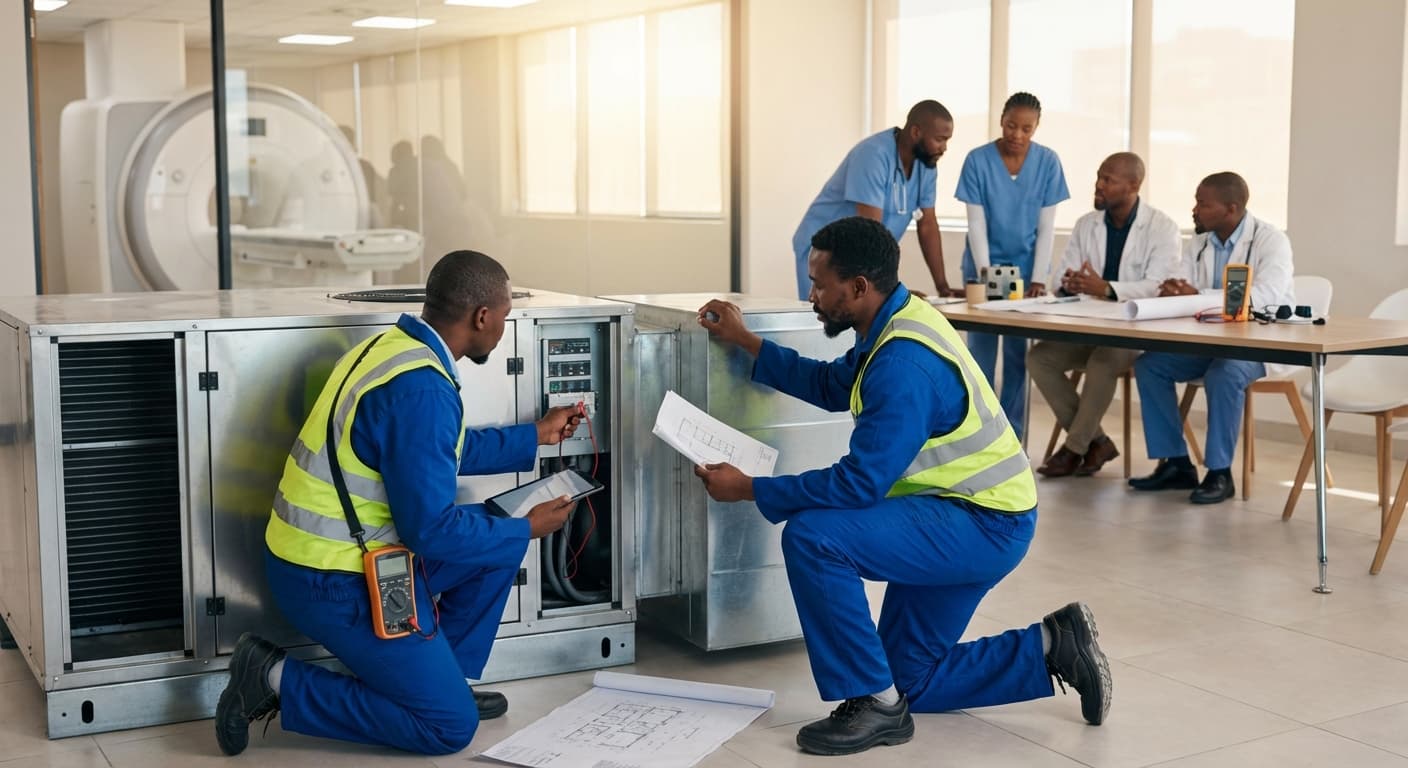
Site Readiness Assessment Service (Space/Access/HVAC/Power/Shielding) in Guinea
Engineering Excellence & Technical Support
Site Readiness Assessment Service (Space/Access/HVAC/Power/Shielding) High-standard technical execution following OEM protocols and local regulatory frameworks.
Strategic Space Optimization for Telecommunication Hubs
Leveraging our expertise in site readiness, we ensure optimal spatial allocation for critical telecommunication infrastructure in Guinea. This includes meticulous analysis of antenna footprints, equipment housing, and future expansion zones, guaranteeing efficient use of available space while adhering to international standards and local regulations for secure and reliable operations.
HVAC Resilience for Guinea's Tropical Climate
Our service guarantees robust HVAC solutions tailored to Guinea's unique tropical climate. We conduct in-depth assessments of thermal loads, humidity control requirements, and redundant cooling systems to ensure consistent and optimal operating temperatures for sensitive electronic equipment, mitigating risks of overheating and performance degradation.
Power Grid Stability and Redundancy for Critical Infrastructure
We provide comprehensive power readiness assessments, evaluating grid stability, load capacities, and the integration of redundant power sources such as generators and UPS systems. Our focus is on ensuring uninterrupted and stable power supply for essential services across Guinea, minimizing downtime and safeguarding against power fluctuations.
What Is Site Readiness Assessment Service (Space/access/hvac/power/shielding) In Guinea?
The Site Readiness Assessment Service (Space/Access/HVAC/Power/Shielding) in Guinea is a comprehensive technical evaluation designed to determine the suitability and preparedness of a proposed or existing physical location for the deployment of specific infrastructure, equipment, or operations. This service is critical for ensuring that a site can reliably support the intended application without compromising performance, safety, or longevity. The assessment systematically examines key infrastructural domains:
- Space: Evaluates the available physical footprint, including dimensions, ceiling heights, floor loading capacity, and spatial clearances required for equipment installation, maintenance access, and personnel movement.
- Access: Assesses the logistical feasibility of transporting equipment and personnel to and within the site. This includes evaluating entry points, corridor widths, elevator capacities, road access, and any site-specific restrictions.
- HVAC (Heating, Ventilation, and Air Conditioning): Determines the adequacy of existing or planned environmental control systems to maintain specified temperature, humidity, and air quality parameters. This is crucial for the operational integrity of sensitive electronic equipment and for personnel comfort and safety.
- Power: Analyzes the capacity, reliability, and quality of the electrical power supply. This includes assessing available voltage, amperage, phase configuration, redundancy (e.g., UPS, generators), grounding, and protection mechanisms to meet the demands of the intended load.
- Shielding: Evaluates the site's susceptibility to and generation of electromagnetic interference (EMI), radio frequency interference (RFI), and other forms of radiation. This is vital for applications requiring signal integrity, data security, or compliance with regulatory standards (e.g., data centers, broadcasting facilities, medical imaging labs, sensitive research environments).
| Use Case | Key Assessment Focus Areas |
|---|---|
| Deployment of a new telecommunications base station | Space for equipment, Power (stable supply, redundant backup), Access for installation and maintenance, HVAC (cooling for electronics), Shielding (from external RF interference) |
| Establishment of a new enterprise data center | Significant Space allocation, robust Power infrastructure (high capacity, redundancy, UPS/generators), sophisticated HVAC (precise climate control), stringent Access controls, robust Shielding (against EMI/RFI for data integrity) |
| Installation of sensitive medical imaging equipment (e.g., MRI, CT scanner) | Adequate Space with specific dimensional requirements, vibration isolation, Power (clean and stable, appropriate voltage), Access for heavy equipment, comprehensive Shielding (to prevent external RF interference and contain internal magnetic fields) |
| Upgrade or expansion of existing IT infrastructure | Sufficient Space for new racks/servers, increased Power demands, HVAC capacity assessment, Access routes for new equipment |
| Deployment of broadcast transmission equipment | Space for antennas and transmission hardware, Power requirements, Access for maintenance, Shielding considerations for RF emissions |
Who Needs Site Readiness Assessment Service in Guinea?
- Data Center Operators
- Telecommunications Companies
- Cloud Service Providers
- Financial Institutions
- Healthcare Facilities
- Research and Development Institutions
- Manufacturing Plants
- Broadcasting and Media Companies
- Government Agencies
- Any organization planning the deployment of mission-critical or sensitive infrastructure.
Who Needs Site Readiness Assessment Service (Space/access/hvac/power/shielding) In Guinea?
A Site Readiness Assessment Service is crucial for organizations planning to establish or upgrade infrastructure in Guinea, particularly for projects involving specialized environments like data centers, laboratories, manufacturing facilities, or research and development centers. This service evaluates the feasibility and preparedness of a site concerning critical infrastructure elements, ensuring a smooth and successful deployment. Key areas assessed include space availability and suitability, access for equipment and personnel, HVAC (Heating, Ventilation, and Air Conditioning) capacity and design, power infrastructure (availability, reliability, and capacity), and shielding requirements (e.g., electromagnetic shielding, radiation shielding). Without this assessment, projects risk significant delays, cost overruns, and operational failures due to unforeseen site limitations.
| Industry/Sector | Potential Departments Requiring Assessment | Specific Needs/Concerns |
|---|---|---|
| Technology Companies | IT Infrastructure, Operations, Facilities Management | Data center space, power redundancy, cooling capacity, physical security (shielding) |
| Telecommunications Providers | Network Operations, Engineering, Facilities | Tower sites, data hall space, power backup, environmental controls |
| Manufacturing Companies | Operations, Engineering, Plant Management, HSE (Health, Safety, Environment) | Factory floor space, specialized HVAC for cleanrooms/sensitive processes, robust power, dust/vibration control (shielding if applicable) |
| Pharmaceutical & Biotechnology Companies | R&D, Quality Control, Manufacturing, Facilities | Laboratory space, controlled environments (HVAC), specialized power, containment (shielding for certain biological agents or radiation) |
| Research & Development Institutions | Research Teams, Facilities Management, IT | Specialized lab spaces, precise environmental controls, stable power, potential for experimental shielding |
| Healthcare Facilities | Radiology, IT, Biomedical Engineering, Facilities Management | Medical imaging suites (MRI, CT scan shielding), data center space, reliable power for life support systems |
| Government Agencies | IT Departments, Defense Procurement, Scientific Divisions, Public Works | Secure facilities, mission-critical infrastructure, specialized power and cooling, potential for electromagnetic or radiation shielding |
Target Customers for Site Readiness Assessment in Guinea
- Technology Companies (Data Centers, Cloud Providers)
- Telecommunications Providers
- Manufacturing Companies (especially those with high-tech or sensitive production)
- Pharmaceutical and Biotechnology Companies
- Research and Development Institutions
- Healthcare Facilities (hospitals, diagnostic centers)
- Government Agencies (defense, scientific research, public infrastructure)
- Mining and Extractive Industries (for administrative or specialized operational facilities)
- Energy Sector Companies (for control rooms or specialized infrastructure)
Site Readiness Assessment Service (Space/access/hvac/power/shielding) Process In Guinea
The Site Readiness Assessment Service in Guinea is a crucial process ensuring that a proposed location is adequately prepared to host a new facility, such as a data center, telecommunications tower, or other infrastructure requiring specific environmental and utility conditions. This service meticulously evaluates key aspects including physical space, accessibility, Heating, Ventilation, and Air Conditioning (HVAC) capabilities, power supply, and electromagnetic shielding. The workflow from initial inquiry to final execution is a structured, multi-stage process designed to provide a comprehensive understanding of a site's suitability and identify any necessary improvements.
| Stage | Description | Key Activities | Deliverables | Responsible Party(ies) |
|---|---|---|---|---|
| The process begins when a client expresses interest in the Site Readiness Assessment service for a specific location in Guinea. This stage involves understanding the client's project needs and the specific requirements for the site. | Client contacts service provider, Project requirements discussion, Site location identified, Preliminary site assessment needs defined, Proposal generation. | Service proposal, Agreement on scope of work, Contract. | Client, Service Provider (Sales/Consulting Team) |
| A specialized team visits the proposed site to gather detailed information across all assessment areas. This is a hands-on phase involving inspections and measurements. | Physical space assessment (dimensions, layout, structural integrity), Accessibility evaluation (road access, transport logistics, security), HVAC system review (existing capacity, age, condition), Power supply assessment (availability, capacity, grid stability, backup options), Shielding evaluation (existing RF/EMI shielding, potential interference sources). | Detailed site survey report, Measurement data (e.g., power load, temperature readings), Photographic evidence, Interview notes with local authorities/utility providers. | Service Provider (Assessment Team: Engineers, Technicians) |
| The collected data is meticulously analyzed to identify strengths, weaknesses, and potential risks associated with the site's readiness. A comprehensive report is then compiled. | Data compilation and cross-referencing, Gap analysis against project requirements, Risk assessment, Identification of compliance issues, Development of preliminary findings. | Comprehensive Site Readiness Assessment Report (detailing findings for Space, Access, HVAC, Power, Shielding), Executive summary. | Service Provider (Assessment Team, Project Manager) |
| Based on the analysis, the service provider formulates actionable recommendations to address any identified deficiencies and develops a plan for necessary upgrades or modifications. | Developing remediation strategies, Estimating costs and timelines for improvements, Presenting findings and recommendations to the client, Collaborative planning for execution. | Detailed recommendations report, Remediation plan (including budget and timeline), Go/No-Go recommendation. | Service Provider (Assessment Team, Project Manager), Client |
| If the assessment reveals that the site is not fully ready, this stage involves implementing the agreed-upon corrective actions, often in coordination with local contractors and utility providers. | Procurement of materials and equipment, Implementation of civil works (e.g., improving access roads), HVAC system upgrades or installations, Power infrastructure enhancements, Shielding modifications, Coordination with local authorities and utility companies. | Completed remediation works, Updated site documentation. | Service Provider (Project Manager, Contractors), Client, Local Utility Providers, Local Authorities |
| Once remediation is complete (or if the site was deemed ready from the outset), a final assessment is conducted to ensure all requirements are met. This leads to the formal conclusion of the service. | Re-assessment of remediated areas, Verification of compliance with all specified criteria, Final site inspection, Client acceptance and sign-off. | Final verification report, Certificate of Site Readiness, Project closure. | Service Provider (Assessment Team, Project Manager), Client |
Site Readiness Assessment Service Workflow
- Initial Inquiry and Scope Definition
- Site Visit and Data Collection
- Analysis and Reporting
- Recommendations and Planning
- Execution of Remediation (if required)
- Final Verification and Sign-off
Site Readiness Assessment Service (Space/access/hvac/power/shielding) Cost In Guinea
Assessing site readiness for a project in Guinea, particularly for specialized needs like Space, Access, HVAC, Power, and Shielding, involves a complex interplay of factors that influence the final cost. These costs are typically quoted in local currency, the Guinean Franc (GNF). The pricing can vary significantly based on the scale of the project, the remoteness of the location within Guinea, the specific technical requirements of each component, and the chosen service provider's experience and reputation. A thorough assessment is crucial for accurate budgeting and project planning.
| Service Component | Potential Cost Range (GNF) | Notes |
|---|---|---|
| Space Assessment | 2,000,000 - 15,000,000+ | Covers structural integrity, dimensions, zoning compliance, and suitability for intended use. Higher end for complex industrial or data center-type spaces. |
| Access Assessment | 1,000,000 - 8,000,000+ | Evaluates road access, proximity to transport hubs, site entry points, and any required modifications for heavy equipment. Remote locations or challenging terrain increase costs. |
| HVAC Assessment | 3,000,000 - 25,000,000+ | Includes evaluation of existing systems, environmental control needs (temperature, humidity, air quality), load calculations, and system design recommendations. Critical for sensitive equipment or cleanroom environments. |
| Power Assessment | 3,000,000 - 20,000,000+ | Assesses grid availability, load capacity, need for backup generators, power quality, and distribution infrastructure. High-demand or mission-critical facilities will incur higher costs. |
| Shielding Assessment | 5,000,000 - 50,000,000+ | Crucial for specific industries (e.g., medical imaging, research labs). Involves evaluating needs for electromagnetic interference (EMI) shielding, radio frequency (RF) shielding, or radiation shielding. Requires specialized expertise and equipment. |
| Overall Site Readiness Assessment (Combined) | 10,000,000 - 100,000,000+ | This is a consolidated cost for a comprehensive assessment covering all mentioned components. The final price is heavily dependent on the project's overall complexity and the specific requirements for each element. |
Key Pricing Factors for Site Readiness Assessment in Guinea
- Scope and Complexity: The sheer size and technical intricacy of the required space, the difficulty of access, the demands of the HVAC system (e.g., climate control, air purity), the power requirements (e.g., capacity, redundancy, generator needs), and the specific shielding specifications (e.g., electromagnetic, radiation) will directly impact the assessment effort and thus the cost.
- Location: Guinea's diverse geography means that accessibility to remote or undeveloped areas can significantly increase logistical costs for assessors. Travel time, accommodation, and local transportation for the assessment team are factored in.
- Personnel and Expertise: The qualifications and experience of the assessment team are paramount. Specialists in HVAC engineering, electrical engineering, structural assessment, and radiation physics, for instance, command higher fees. The number of experts involved also affects the total cost.
- Time Sensitivity: Urgent assessments or those requiring expedited reporting will generally incur higher charges due to the need for rapid resource allocation and potentially overtime work.
- Equipment and Tools: The assessment may require specialized diagnostic equipment for HVAC performance, power load analysis, or shielding integrity testing. The cost of deploying and utilizing this equipment is incorporated into the service fee.
- Reporting and Documentation: The level of detail and format of the final assessment report can influence the cost. Comprehensive reports with detailed schematics, recommendations, and risk assessments will be more expensive than a high-level overview.
- Service Provider Reputation and Overhead: Established firms with a proven track record and higher operational overheads might charge more than smaller, less experienced local consultancies. However, they often offer greater reliability and a deeper pool of expertise.
- Regulatory Compliance: If specific Guinean or international standards need to be verified or assessed for compliance, this can add complexity and cost to the evaluation process.
- Security Considerations: In certain regions or for sensitive projects, security measures for the assessment team might be an additional cost component.
Affordable Site Readiness Assessment Service (Space/access/hvac/power/shielding) Options
Our Affordable Site Readiness Assessment Service provides a comprehensive evaluation of your facility's infrastructure, ensuring it meets the demanding requirements for your technology deployment. We focus on critical areas including Space, Access, HVAC, Power, and Shielding, delivering clear, actionable insights to prevent costly delays and overruns. Our goal is to offer flexible, cost-effective solutions tailored to your specific needs, empowering you to make informed decisions with confidence.
| Value Bundle | Description | Key Benefits | Estimated Price Range (USD) | Cost-Saving Strategies Integrated |
|---|---|---|---|---|
| Essential Readiness Check | A focused assessment of the most critical elements (e.g., Power and Space) to identify major showstoppers. | Quick identification of high-priority risks, faster go/no-go decisions. | $1,500 - $3,000 | Prioritized focus on high-impact areas to avoid unnecessary detailed analysis in low-risk zones. |
| Standard Readiness Package | Comprehensive assessment covering Space, Access, HVAC, and Power. | Holistic understanding of infrastructure, identification of potential bottlenecks across key systems. | $3,000 - $6,000 | Bundled services offer a discount over individual assessments; identification of shared infrastructure upgrade needs. |
| Premium Readiness Solution | Full assessment including Space, Access, HVAC, Power, and Shielding, with detailed reporting and recommendations. | In-depth analysis for mission-critical or sensitive deployments, proactive mitigation strategies, detailed cost estimates for remediation. | $5,000 - $10,000+ | Advanced analysis to prevent costly future issues; recommendations for phased upgrades, leveraging existing infrastructure where possible. |
| Customized Assessment | Tailored assessment based on your specific project scope and priorities. | Maximum flexibility, only pay for what you need, ensures relevance to your unique requirements. | Priced per scope | Directly addresses your identified risks, avoiding over-analysis in areas already deemed sufficient. |
Our Site Readiness Assessment Covers:
- Space: Verifying adequate physical space for equipment, clear pathways, and future expansion.
- Access: Assessing security, entry/exit points, and the feasibility of equipment installation and maintenance.
- HVAC (Heating, Ventilation, and Air Conditioning): Evaluating existing climate control systems for capacity, redundancy, and environmental stability.
- Power: Analyzing electrical capacity, distribution, UPS/generator readiness, and potential upgrade requirements.
- Shielding: Assessing electromagnetic (EMI), radio frequency (RFI), and physical shielding needs for sensitive equipment.
Verified Providers In Guinea
When seeking healthcare in Guinea, entrusting your well-being to verified providers is paramount. Franance Health stands out as a leading organization committed to ensuring the highest standards of medical care. This commitment is reflected in their rigorous credentialing process, which meticulously vets healthcare professionals and facilities. By choosing Franance Health-credentialed providers, patients gain the assurance of receiving care from qualified, ethical, and competent medical practitioners. These providers are not only licensed and experienced but also adhere to strict protocols and ethical guidelines, offering a superior healthcare experience.
| Credentialing Aspect | Franance Health's Assurance | Benefit for Patients |
|---|---|---|
| Licensure and Certification | Mandatory verification of all relevant medical licenses and certifications. | Ensures providers meet legal and professional requirements. |
| Professional Experience | Thorough review of clinical experience and specialization. | Guarantees practitioners have the necessary practical skills. |
| Continuing Education | Emphasis on ongoing professional development and training. | Ensures providers are up-to-date with the latest medical advancements. |
| Reputation and References | Scrutiny of professional conduct and peer/patient feedback. | Provides confidence in the provider's ethical practice and patient rapport. |
| Facility Standards (for institutions) | Assessment of infrastructure, equipment, and hygiene protocols. | Confirms a safe and well-equipped environment for treatment. |
Why Franance Health Credentials Matter:
- Rigorous Vetting Process: Franance Health employs a comprehensive evaluation of medical expertise, educational background, and practical experience.
- Adherence to Ethical Standards: Certified providers are committed to patient-centered care, transparency, and maintaining professional integrity.
- Quality Assurance: Continuous monitoring and evaluation ensure ongoing compliance with best practices in healthcare delivery.
- Patient Safety First: Credentials signify a commitment to upholding the highest safety protocols for all patients.
- Access to Excellence: Partnering with Franance Health grants access to a network of distinguished healthcare professionals.
Scope Of Work For Site Readiness Assessment Service (Space/access/hvac/power/shielding)
This document outlines the Scope of Work (SOW) for a Site Readiness Assessment Service, focusing on critical infrastructure elements required for the successful deployment and operation of specialized equipment. The assessment will evaluate the existing site conditions related to Space, Access, HVAC, Power, and Shielding, ensuring they meet the necessary technical specifications and standards. The objective is to identify any deficiencies and provide recommendations for remediation to guarantee a fully prepared and operational environment.
| Area | Key Assessment Activities | Technical Deliverables | Standard Specifications / Considerations |
|---|---|---|---|
| Space | Verify available floor space, ceiling height, and layout. Assess proximity to other equipment and environmental considerations (e.g., dust, vibration). | Site layout diagrams with proposed equipment footprint. Floor loading capacity report. Environmental survey report. | Minimum clear floor space requirements (e.g., m²). Minimum ceiling height (e.g., meters). Maximum floor loading capacity (e.g., kg/m²). Vibration isolation requirements. Cleanliness class requirements (e.g., ISO class). |
| Access | Evaluate ingress/egress routes for equipment delivery (door sizes, corridor widths, elevator capacity). Assess accessibility for personnel and maintenance activities. | Equipment ingress/egress route analysis. Obstruction identification report. Accessibility checklist. | Minimum door width (e.g., meters). Minimum corridor width (e.g., meters). Maximum elevator load capacity (e.g., kg) and dimensions. Clearance for maneuvering large equipment. Access points for cabling and utilities. |
| HVAC | Measure and verify temperature and humidity control capabilities. Assess air change rates, filtration levels, and redundancy of cooling systems. Identify potential for thermal stratification. | Temperature and humidity monitoring report. Airflow and air change rate measurements. HVAC system capacity and redundancy assessment. Filtration efficiency report. | Target temperature range (e.g., °C ± °C). Target humidity range (e.g., % RH ± % RH). Air change rates per hour (e.g., ACH). Filtration standards (e.g., MERV rating). N+1 redundancy for critical cooling units. |
| Power | Verify available power capacity, voltage, and phase. Assess UPS and generator backup capabilities, power distribution units (PDUs), and grounding. Review power quality metrics. | Power capacity and availability report. UPS and generator system assessment. Power distribution diagram. Power quality analysis report. Grounding resistance test results. | Required power capacity (e.g., kVA). Voltage stability (e.g., ± 5%). Phase configuration (e.g., 3-phase). UPS runtime (e.g., minutes/hours). Generator standby time. Electrical code compliance (e.g., NEC, IEC). |
| Shielding | Assess existing shielding effectiveness against electromagnetic interference (EMI) and radio frequency interference (RFI) as per project requirements. Evaluate requirements for acoustic or radiation shielding if applicable. | EMI/RFI shielding effectiveness test report. Shielding material specification review. Acoustic or radiation shielding assessment report (if applicable). | Required shielding attenuation (e.g., dB) across specific frequency ranges. Compliance with relevant shielding standards (e.g., MIL-STD, FCC). Material certifications for shielding components. |
Key Assessment Areas
- Space suitability and availability for equipment installation and operation.
- Physical and logistical access for equipment delivery, installation, and maintenance.
- HVAC capacity, redundancy, and environmental control capabilities.
- Power availability, capacity, redundancy, and distribution infrastructure.
- Electromagnetic shielding effectiveness and compliance with environmental requirements.
Service Level Agreement For Site Readiness Assessment Service (Space/access/hvac/power/shielding)
This Service Level Agreement (SLA) outlines the performance commitments for the Site Readiness Assessment Service, covering Space, Access, HVAC, Power, and Shielding. It defines response times for critical issues and uptime guarantees for the assessment process.
| Service Component | Response Time (Business Hours) | Uptime Guarantee |
|---|---|---|
| Site Readiness Assessment (Overall) | 4 Business Hours for Initial Assessment Report | 99.5% Availability for Scheduled Assessment Windows |
| Critical Issue Identification (e.g., immediate safety hazard, major system failure) | 1 Business Hour for Acknowledgment and Initial Action Plan | N/A (Focus is on immediate response) |
| Space - Significant Discrepancy | 8 Business Hours for Re-evaluation and Report Update | N/A |
| Access - Critical Obstruction Identified | 4 Business Hours for Re-verification and Mitigation Recommendation | N/A |
| HVAC - Insufficient Capacity Identified | 12 Business Hours for Detailed Analysis and Mitigation Options | N/A |
| Power - Critical Redundancy Failure Identified | 6 Business Hours for Root Cause Analysis and Short-Term Mitigation | N/A |
| Shielding - Unacceptable Leakage Identified | 24 Business Hours for Detailed Investigation and Remediation Plan | N/A |
Scope of Service:
- Space Assessment: Verifying physical dimensions, floor load capacity, and environmental conditions.
- Access Assessment: Evaluating entry/exit points, security, and accessibility for equipment and personnel.
- HVAC Assessment: Analyzing heating, ventilation, and air conditioning capacity, redundancy, and control systems.
- Power Assessment: Determining electrical capacity, redundancy, UPS, and generator availability.
- Shielding Assessment: Evaluating electromagnetic, RF, and radiation shielding effectiveness where applicable.
Frequently Asked Questions

Ready when you are
Let's scope your Site Readiness Assessment Service (Space/Access/HVAC/Power/Shielding) in Guinea project in Guinea.

Scaling healthcare logistics and technical systems across the entire continent.