
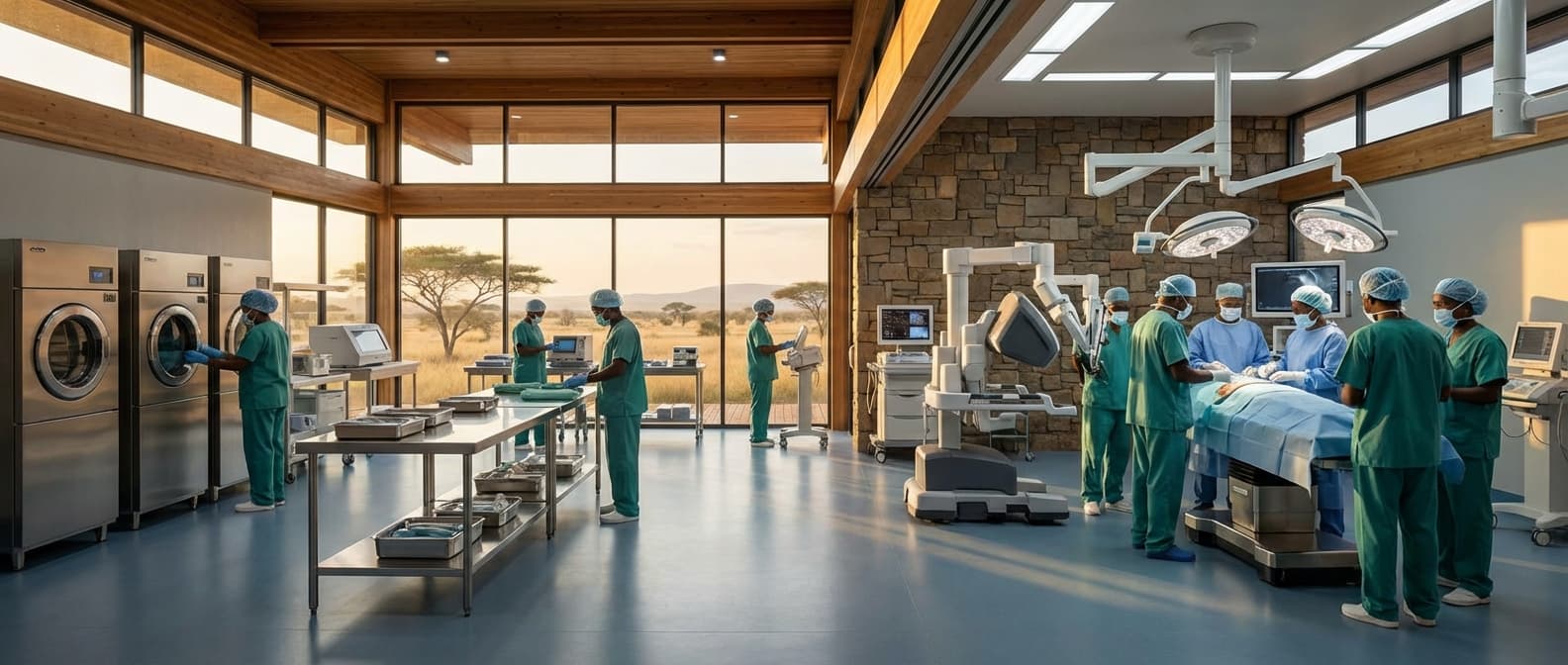
Operating Theatre Turnkey Build in Guinea
Engineering Excellence & Technical Support
Complete OR design, equipment integration and commissioning High-standard technical execution following OEM protocols and local regulatory frameworks.
Precision Engineering & Customization for Guinea's Healthcare Needs
Leveraging advanced BIM modeling and ISO-certified construction methodologies, we deliver highly customized operating theatre turnkey solutions in Guinea, precisely tailored to meet the unique clinical requirements and environmental conditions of the region. Our expertise ensures optimal workflow, infection control, and patient safety.
Integrated Technology & Sustainable Infrastructure
We seamlessly integrate state-of-the-art medical equipment, HVAC systems with HEPA filtration, and specialized lighting into a robust and sustainable infrastructure. Our turnkey approach guarantees seamless connectivity, energy efficiency, and compliance with international healthcare standards for operating theatres in Guinea.
Resilient Supply Chain & Local Capacity Building
Navigating Guinea's logistical landscape, we implement a resilient supply chain strategy and prioritize local sourcing and skilled labor training. Our project management excellence ensures timely and cost-effective turnkey operating theatre builds, fostering long-term healthcare capacity development within the country.
What Is Operating Theatre Turnkey Build In Guinea?
An Operating Theatre Turnkey Build in Guinea refers to a comprehensive, end-to-end service for the design, construction, equipping, and commissioning of a fully functional operating theatre (OT) facility. This service eliminates the need for the client to manage multiple contractors and suppliers by providing a single point of accountability for the entire project lifecycle. The objective is to deliver a state-of-the-art, compliant, and ready-to-operate surgical suite.
| Who Needs It? | Typical Use Cases | ||||
|---|---|---|---|---|---|
| Hospitals (Public & Private): Seeking to upgrade existing facilities, expand surgical capacity, or establish new specialized surgical units. | Medical Centers & Clinics: Requiring dedicated operating rooms for specific procedures or to enhance service offerings. | Government Healthcare Initiatives: Implementing projects to improve healthcare infrastructure and access to surgical care in underserved regions. | International Aid Organizations & NGOs: Developing surgical facilities as part of humanitarian or development programs. | Specialized Surgical Institutions: Establishing centers of excellence for complex procedures like cardiac surgery, neurosurgery, or orthopedics. | New Healthcare Developments: Incorporating state-of-the-art surgical suites from the initial planning stages of a new hospital or medical complex. |
| Development of New Hospitals or Medical Centers: Establishing a foundational surgical capability for a nascent healthcare institution. | Expansion and Modernization of Existing Surgical Departments: Upgrading outdated operating theatres to meet contemporary standards in terms of technology, safety, and infection control. | Creation of Specialized Surgical Suites: Designing and building dedicated facilities for specific surgical disciplines (e.g., Laparoscopic Suite, Cardiac Catheterization Lab with surgical capabilities, Trauma Operating Room). | Disaster Relief or Emergency Response Facilities: Rapidly deploying modular or prefabricated operating theatre solutions in response to public health crises or natural disasters. | Establishment of Training and Simulation Centers: Incorporating advanced OT environments for medical education and skill development. | Projects Aimed at Improving Surgical Outcomes: Implementing advanced technologies and workflows to reduce complications and enhance patient recovery. |
Key Components of an Operating Theatre Turnkey Build:
- Needs Assessment & Feasibility Study: Detailed analysis of the client's surgical specialties, patient volume, and budget to define project scope and requirements.
- Architectural & Engineering Design: Development of detailed blueprints and technical specifications, encompassing layout, space planning, HVAC (Heating, Ventilation, and Air Conditioning) systems, medical gas pipelines, electrical infrastructure, lighting, and infection control measures.
- Civil Works & Construction: Site preparation, foundation, structural building, interior finishing (including specialized wall and floor materials), and exterior construction.
- Specialized Systems Integration: Installation and commissioning of critical OT systems such as ultra-clean ventilation (UCV), medical gas supply (oxygen, nitrous oxide, vacuum, medical air), emergency power, nurse call systems, and integrated audio-visual solutions for training and remote consultation.
- Medical Equipment Procurement & Installation: Sourcing, purchasing, and installation of all necessary surgical equipment, including operating tables, surgical lights, anesthesia machines, patient monitors, electro-surgical units, endoscopes, and sterilization equipment.
- Ancillary Services Integration: Design and installation of supporting areas like sterile processing departments (SPD), recovery rooms, staff changing rooms, and pre-operative holding areas.
- Regulatory Compliance & Certification: Ensuring adherence to national and international healthcare building codes, safety standards (e.g., ISO, local Ministry of Health regulations), and obtaining all necessary permits and certifications for operation.
- Commissioning & Training: Rigorous testing and validation of all installed systems and equipment, followed by comprehensive training for clinical and technical staff on their operation and maintenance.
- Post-Completion Support & Maintenance: Offering ongoing maintenance contracts, spare parts management, and technical support to ensure sustained optimal performance of the OT facility.
Who Needs Operating Theatre Turnkey Build In Guinea?
Turnkey operating theatre construction offers a comprehensive solution for establishing state-of-the-art surgical facilities. This integrated approach manages the entire project lifecycle, from initial design and planning to construction, equipment installation, and commissioning. For Guinea, a nation actively developing its healthcare infrastructure, these services are crucial for improving patient care and surgical outcomes. The demand for such specialized builds is driven by the need to upgrade existing facilities, establish new hospitals, or expand surgical capacity to meet the growing healthcare demands of the population. This approach significantly reduces the burden on local healthcare providers by entrusting the complex process to experienced professionals, ensuring compliance with international standards and the integration of the latest medical technologies.
| Target Customer Segment | Key Departments Requiring Operating Theatre Services |
|---|---|
| Government Ministry of Health and Public Hospitals | General Surgery, Obstetrics & Gynecology, Orthopedics, Urology, Pediatrics, Emergency Medicine |
| Private Hospital Chains and Investors | All surgical specialties, including minimally invasive surgery, cardiology, neurosurgery, plastic surgery, and advanced diagnostics |
| International NGOs and Humanitarian Organizations | Emergency surgery, trauma care, maternal and child health services, specialized surgical interventions based on program focus |
| New Hospital Development Projects | Comprehensive surgical suite covering a wide range of specialties to establish a full-service hospital |
| Existing Hospitals Undergoing Renovation/Expansion | Modernization of existing operating rooms, addition of specialized surgical suites (e.g., hybrid ORs, sterile processing departments) |
Target Customers for Operating Theatre Turnkey Builds in Guinea
- Government Ministry of Health and Public Hospitals
- Private Hospital Chains and Investors
- International NGOs and Humanitarian Organizations with Healthcare Initiatives
- New Hospital Development Projects
- Existing Hospitals Undergoing Major Renovation or Expansion
Operating Theatre Turnkey Build Process In Guinea
The successful execution of an operating theatre turnkey build process in Guinea involves a structured workflow, starting from the initial client inquiry and culminating in the handover of a fully functional surgical suite. This process is critical for ensuring quality, compliance with international standards, and timely project completion within the Guinean context. The workflow can be broadly categorized into several key phases: Pre-Construction, Construction, and Post-Construction.
Each phase is characterized by specific activities, stakeholder engagement, and documentation requirements. Effective project management, a deep understanding of local regulations and logistical challenges, and strong communication are paramount throughout the entire process. The turnkey nature implies that the contractor assumes full responsibility for all aspects of the project, from design to final commissioning.
| Phase | Key Activities | Deliverables/Milestones | Key Considerations (Guinea Context) |
|---|---|---|---|
| Pre-Construction | Initial client meeting to understand requirements, scope, and budget. Site visit and assessment of existing infrastructure, utilities, and accessibility. Feasibility study including regulatory compliance checks. Development of conceptual design and preliminary budget. Preparation and submission of a detailed proposal and quotation. | Project brief, site assessment report, feasibility study, conceptual design, detailed proposal. | Understanding local building codes, land ownership, environmental regulations. Potential import duties and customs procedures for materials and equipment. Availability of local skilled labor for specialized tasks. Security considerations for personnel and materials. |
| Design & Planning | Detailed architectural, structural, mechanical, electrical, and plumbing (MEP) design. Integration of specialized medical equipment requirements into the design. Development of detailed construction plans, schedules, and Bills of Quantities (BOQ). Obtaining necessary permits and approvals from relevant Guinean authorities. | Approved detailed design drawings, construction schedule, BOQ, project execution plan, permits. | Navigating the bureaucracy for permit applications and approvals. Potential language barriers. Ensuring designs meet international healthcare standards (e.g., HTM, AIA). Planning for power reliability and backup systems (generators). |
| Procurement & Logistics | Sourcing and procurement of all materials, equipment, and finishes. Establishing robust supply chain and logistics for timely delivery to Guinea. Managing import/export processes, customs clearance, and transportation to the site. | Procured materials and equipment, logistics plan, customs clearance documentation. | Challenges with transportation infrastructure (roads, ports). Managing potential delays due to customs. Sourcing reliable local suppliers where possible. Currency fluctuations and payment terms. |
| Construction | Site preparation, excavation, and foundation work. Structural erection. Installation of MEP systems (HVAC, electrical, plumbing, medical gases). Installation of specialized operating theatre equipment (lights, tables, imaging systems). Finishing works including wall cladding, flooring, ceilings, and doors. Painting and decoration. | Completed building shell, installed MEP systems, installed major medical equipment, completed interior finishes. | Adherence to safety standards on site. Managing weather impacts (rainy season). Quality control of workmanship. Coordination with local subcontractors and labor. Waste management and environmental considerations. |
| Post-Construction | Rigorous testing and commissioning of all systems and equipment. Calibration of medical devices. Comprehensive training for hospital staff on operation and maintenance. Final inspections and snagging. Obtaining occupancy certificates. Formal handover of the turnkey facility to the client. | Commissioning reports, training manuals, snagging list closure, handover certificate, as-built drawings. | Ensuring effective knowledge transfer to local staff. Availability of spare parts and technical support. Establishing a long-term maintenance agreement. Understanding warranty periods and procedures. |
| Operations & Maintenance | Ongoing support, maintenance, and troubleshooting as per the contract. Provision of spare parts and consumables. Potential for upgrades and future expansions. | Service level agreements, maintenance logs, support contracts. | Ensuring continuity of service and support post-handover. Developing local capacity for maintenance where feasible. |
Operating Theatre Turnkey Build Process Workflow in Guinea
- Initial Inquiry & Consultation
- Feasibility Study & Site Assessment
- Conceptual Design & Proposal Development
- Detailed Design & Engineering
- Procurement & Logistics
- Site Preparation & Civil Works
- Mechanical, Electrical, and Plumbing (MEP) Installation
- Specialized Medical Equipment Installation
- Finishing & Interior Works
- Testing, Commissioning & Training
- Handover & Documentation
- Post-Handover Support & Maintenance
Operating Theatre Turnkey Build Cost In Guinea
The cost of constructing a turnkey operating theatre in Guinea is a complex calculation influenced by numerous factors. A "turnkey" solution implies that the contractor handles all aspects of the project from design and procurement to construction, equipment installation, and commissioning, delivering a fully operational facility. Pricing is highly variable and depends on the size of the theatre, the level of sophistication of the medical equipment, the quality of materials used, and the specific location within Guinea. Local currency is the Guinean Franc (GNF).
| Facility Type/Size | Estimated Range (GNF) |
|---|---|
| Small, basic operating theatre (e.g., 20-30 sqm) with essential equipment | 500,000,000 - 1,500,000,000 |
| Medium-sized, well-equipped operating theatre (e.g., 30-50 sqm) with advanced features | 1,500,000,000 - 4,000,000,000 |
| Large, state-of-the-art operating theatre complex (e.g., 50+ sqm) with multiple theatres and cutting-edge technology | 4,000,000,000 - 10,000,000,000+ |
Key Pricing Factors for Turnkey Operating Theatre Builds in Guinea:
- Size and Complexity: The square footage of the operating theatre suite, including the surgical room, scrub areas, recovery bays, sterilization rooms, and associated support spaces, directly impacts material and labor costs. More complex layouts with specialized workflow requirements will also increase costs.
- Medical Equipment Specifications: This is often the most significant cost driver. The type and brand of surgical lights, anesthesia machines, operating tables, imaging equipment (e.g., C-arms), surgical instruments, patient monitors, and sterilization units will dictate a large portion of the budget. High-end, state-of-the-art equipment will significantly increase the overall price.
- Finishing and Materials: The quality of interior finishes, including wall cladding (e.g., anti-bacterial panels), flooring (e.g., seamless vinyl or epoxy), ceiling systems, and door types, influences cost. Infection control requirements will necessitate specific, often more expensive, materials.
- HVAC and Air Filtration Systems: Advanced HVAC systems with HEPA filtration and controlled air pressure differentials are crucial for operating theatres to maintain sterile environments. The complexity and capacity of these systems will impact pricing.
- Lighting Systems: Specialized surgical lighting, including overhead surgical lights and possibly supplementary lighting, is a significant investment. Consideration for ambient and task lighting is also required.
- Electrical and Plumbing Infrastructure: Robust electrical systems capable of powering sophisticated medical equipment and reliable plumbing for sterilization and waste management are essential. Backup power generation (generators) is often a mandatory requirement and adds considerable cost.
- Ancillary Services and Utilities: The cost of connecting to and installing internal systems for medical gases (oxygen, nitrous oxide, vacuum), nurse call systems, data and communication networks, and waste disposal systems are all factored in.
- Architectural and Engineering Design: Professional design services for the operating theatre layout, structural integrity, and all engineering systems are necessary and contribute to the overall cost.
- Permits and Approvals: Obtaining necessary building permits and regulatory approvals from Guinean authorities will involve associated fees.
- Labor Costs and Availability: The cost and availability of skilled construction labor and specialized technicians for equipment installation in Guinea will play a role. This can be subject to local market conditions and the need for expatriate expertise.
- Logistics and Importation: Importing specialized medical equipment and construction materials not readily available locally will incur shipping, customs duties, and taxes, which can be substantial.
- Contractor's Overhead and Profit: The contractor's operational costs, management fees, and profit margin are integral to the turnkey price.
- Contingency: It is prudent to include a contingency fund for unforeseen issues that may arise during the construction process.
Affordable Operating Theatre Turnkey Build Options
Building an operating theatre can be a significant undertaking, often associated with substantial costs. However, for facilities seeking to expand or establish surgical capabilities without an astronomical budget, affordable operating theatre turnkey build options are increasingly available. These options focus on providing comprehensive solutions that streamline the process and offer significant value, often through pre-designed packages and strategic cost-saving measures. Turnkey solutions typically encompass everything from initial design and planning to construction, equipment installation, and final commissioning, offering a hassle-free experience for the client. The key to affordability lies in understanding and leveraging 'value bundles' and implementing smart 'cost-saving strategies'.
| Cost-Saving Strategy | Explanation | Potential Savings Impact |
|---|---|---|
| Optimized Space Utilization: | Focusing on efficient layouts that maximize usable space and minimize wasted areas reduces overall square footage requirements, leading to lower construction and operational costs. | Significant reduction in construction materials and land costs. |
| Standardized Equipment Selection: | Choosing from a curated list of reliable and cost-effective equipment brands and models that are proven in the market, rather than highly specialized or niche items, can lead to substantial savings. | Reduced equipment purchase prices through bulk agreements and avoiding custom orders. |
| Bulk Material Procurement: | Turnkey providers often leverage their buying power to source construction materials, medical gases, and other consumables in bulk, securing better prices than individual clients could achieve. | Lower material and supply costs for the entire project. |
| Efficient Project Management: | Minimizing delays, rework, and unforeseen issues through experienced project management reduces labor costs, extended rental periods, and potential penalties. | Reduced labor costs, shorter project timelines, and avoidance of costly overruns. |
| Phased Renovation/Construction: | If renovating an existing space, prioritizing essential upgrades and deferring less critical cosmetic or non-essential features can spread the cost over time. | Lower initial capital expenditure and manageable cash flow. |
| Focus on Essential Functionality: | Prioritizing core surgical needs and deferring highly advanced, specialized, or 'luxury' features that may not be immediately necessary can significantly reduce initial investment. | Lower upfront equipment and infrastructure costs. |
| Energy-Efficient Design: | Incorporating energy-efficient lighting, HVAC systems, and insulation can lead to lower long-term operational costs, even if the initial investment is slightly higher. | Reduced utility bills and lower operational expenses over the lifespan of the facility. |
Value Bundles Explained
- Standardized Design Packages: These bundles offer pre-engineered and optimized layouts for common surgical specialties, reducing the need for bespoke architectural fees and accelerating the design phase. They often incorporate best practices for workflow, infection control, and patient safety.
- Equipment & Technology Integration: Bundles frequently include essential surgical equipment, lighting, anesthesia machines, and monitoring systems, sourced as a package deal. This often results in bulk purchasing discounts and ensures seamless integration between different components.
- Modular Construction Components: Some turnkey providers utilize pre-fabricated modular units for walls, ceilings, and even complete room sections. This minimizes on-site construction time, reduces waste, and can lead to cost savings through standardized manufacturing processes.
- Comprehensive Service & Support: Affordable bundles often include extended warranties, preventative maintenance packages, and training for staff, providing long-term value and preventing costly unexpected repairs.
- Phased Development Options: For organizations with limited upfront capital, some turnkey providers offer phased build-outs, allowing for the initial establishment of a core operating theatre with the option to expand or upgrade in the future.
Verified Providers In Guinea
In Guinea, ensuring access to quality healthcare is paramount. When seeking medical services, it's crucial to identify 'Verified Providers.' These are healthcare professionals and institutions that have undergone rigorous vetting processes, confirming their qualifications, adherence to ethical standards, and commitment to patient well-being. Franance Health stands out as a leading example of a credentials verification service that rigorously assesses providers. Their meticulous approach ensures that only the most competent and trustworthy individuals and facilities are recognized, offering patients peace of mind and confidence in the care they receive. Choosing Franance Health-verified providers means opting for a standard of excellence, backed by thorough due diligence and a dedication to upholding the highest healthcare benchmarks in Guinea.
| Provider Type | Verification Focus Areas | Benefits for Patients |
|---|---|---|
| Individual Clinicians (Doctors, Nurses, Specialists) | Medical School Diplomas, Board Certifications, Specialty Licenses, Continuing Education Credits, Past Performance Reviews | Confidence in diagnostic accuracy, treatment effectiveness, and patient-centered care. |
| Hospitals & Clinics | Facility Licenses, Accreditation Status, Equipment Calibration Records, Infection Control Protocols, Staff-to-Patient Ratios | Access to safe and well-equipped facilities, reliable emergency services, and consistent quality of care. |
| Diagnostic Laboratories | Laboratory Licenses, Quality Assurance Certifications, Equipment Maintenance Logs, Staff Competency Assessments | Accuracy and reliability of diagnostic test results, crucial for effective treatment planning. |
| Pharmacies | Pharmacy Licenses, Drug Sourcing Policies, Storage and Handling Procedures, Pharmacist Registration | Access to genuine medications, proper drug dispensing, and expert pharmaceutical advice. |
Why Franance Health-Verified Providers are the Best Choice in Guinea:
- Rigorous Qualification Assessment: Franance Health thoroughly scrutinizes the academic achievements, specialized training, and professional licenses of all providers.
- Adherence to Ethical Standards: Verified providers demonstrate a commitment to patient privacy, informed consent, and professional conduct.
- Proof of Experience: Franance Health verifies the practical experience of healthcare professionals, ensuring they have a proven track record of successful patient care.
- Facility Compliance: For institutions, Franance Health assesses compliance with safety regulations, hygiene standards, and the availability of essential medical equipment.
- Continuous Monitoring: The verification process isn't a one-time event. Franance Health often implements ongoing monitoring to ensure providers maintain their high standards.
- Enhanced Patient Safety: By choosing verified providers, patients significantly reduce the risk of encountering unqualified or substandard medical practitioners.
- Improved Healthcare Outcomes: The assurance of competent and ethical care directly contributes to better health outcomes for individuals and the community.
- Trust and Transparency: Franance Health's verification process fosters trust between patients and providers by offering a transparent and reliable source of information.
Scope Of Work For Operating Theatre Turnkey Build
This Scope of Work (SOW) outlines the requirements for a turnkey build of an operating theatre, encompassing design, construction, equipment installation, commissioning, and handover. It details the technical deliverables and standard specifications to ensure a fully functional, safe, and compliant operating theatre environment. The project aims to deliver a state-of-the-art facility meeting international healthcare standards.
| Category | Technical Deliverable / Specification | Description / Requirements | Standard / Reference |
|---|---|---|---|
| Design & Planning | Architectural Drawings | Detailed layout, room dimensions, traffic flow, infection control zoning, ceiling heights, finishes. | HTM 03-01 (UK), FGI Guidelines (US), local building codes. |
| Design & Planning | Structural Engineering Drawings | Load-bearing capacity for heavy equipment, seismic considerations. | Local building codes, relevant structural design standards. |
| Design & Planning | MEP Schematics | HVAC, electrical, medical gas, plumbing, IT, fire suppression system layouts. | HTM 03-01 (UK), ASHRAE standards (HVAC), NFPA standards (Electrical, Fire), ISO 7396 (Medical Gases). |
| Design & Planning | Equipment Specification List | Detailed specifications for all required surgical equipment, imaging, anesthesia, monitoring, etc. | Manufacturer datasheets, relevant international standards (IEC, ISO). |
| Construction | Civil Works & Finishes | Wall construction, flooring (seamless, anti-bacterial), ceiling installation, door installation (hermetic sealing), window specifications. | BS 6399 (Loadings), EN 13813 (Flooring), ISO 14644 (Cleanrooms - if applicable). |
| MEP Systems | HVAC System | Positive pressure, HEPA filtration, temperature and humidity control, air changes per hour (ACH), pressure differentials between rooms. | HTM 03-01 (UK), ASHRAE 170 (Ventilation of Health Care Facilities). |
| MEP Systems | Electrical System | Redundant power supply (UPS, generator), emergency lighting, isolated power systems, grounding, dedicated circuits for medical equipment. | IEC 60364-7-710 (Electrical Installations of Buildings - Healthcare Premises), NFPA 99 (Health Care Facilities Code). |
| MEP Systems | Medical Gas Systems | Oxygen, medical air, vacuum, nitrous oxide outlets and piping, alarms, pressure regulators. | ISO 7396-1 (Medical Gas Pipeline Systems), HTM 02-01 (Medical Gases). |
| MEP Systems | Plumbing Systems | Clean water supply, waste disposal, specialized sinks (scrub sinks), sterile water systems (if required). | Local plumbing codes, BS 6700 (Design and Installation of Installations for Water Services). |
| OT Specifics | Operating Theatre Lights | Surgical light fixtures with adjustable intensity, color temperature, and focus, shadowless illumination. | IEC 60601-2-41 (Particular Requirements for the Basic Safety and Essential Performance of Surgical Luminaires). |
| OT Specifics | Surgical Pendants / Booms | Ceiling-mounted arms for medical equipment, gas outlets, power, and data connections, articulated for easy positioning. | Manufacturer specifications, relevant safety standards. |
| OT Specifics | Laminar Flow System / Air Purification | HEPA filtered air supply to create a sterile field over the patient, minimizing airborne contaminants. | ISO 14644-1 (Classification of air cleanliness). |
| OT Specifics | Integration and Control Systems | Centralized control for lighting, AV, HVAC, and other systems, touch-screen interface. | Manufacturer specifications. |
| Equipment | Surgical Workstations | Operating tables with adjustable positions and features, anesthesia machines, patient monitors, electrosurgical units. | Manufacturer datasheets, IEC 60601 series standards. |
| Equipment | Imaging Equipment | Mobile X-ray, C-arm, endoscopes (if applicable). | IEC 60601 series standards, radiation safety regulations. |
| Commissioning | System Performance Testing | Verification of HVAC, electrical, medical gas, and other systems against design specifications. | HTM 03-01 (UK), FGI Guidelines (US), manufacturer test protocols. |
| Commissioning | Equipment Functionality Testing | Testing of all installed equipment to ensure proper operation and integration. | Manufacturer test protocols, user acceptance testing (UAT) protocols. |
| Commissioning | Validation and Certification | Formal validation of the entire operating theatre environment to confirm it meets all specified performance and safety requirements. | HTM 03-01 (UK), FGI Guidelines (US), local regulatory requirements, infection control audits. |
| Documentation | As-Built Drawings | Finalized drawings reflecting the actual constructed facility and installed systems. | As per design and construction standards. |
| Documentation | Operation & Maintenance Manuals | Comprehensive manuals for all installed systems and equipment, including troubleshooting and maintenance procedures. | Manufacturer manuals, project-specific O&M manual template. |
| Documentation | Training Materials | User guides and training presentations for the healthcare staff. | Project-specific template. |
| Documentation | Commissioning Reports | Detailed reports of all tests performed during the commissioning phase. | Project-specific template. |
Key Stages of the Turnkey Operating Theatre Build
- Design and Planning
- Construction and Civil Works
- MEP (Mechanical, Electrical, and Plumbing) Systems Installation
- Operating Theatre Specific Systems Installation
- Equipment Procurement and Installation
- Testing, Commissioning, and Validation
- Training and Handover
- Documentation
Service Level Agreement For Operating Theatre Turnkey Build
This Service Level Agreement (SLA) outlines the guaranteed response times and uptime for the Operating Theatre Turnkey Build project. It is designed to ensure the timely and efficient execution of all project phases and the continuous operational readiness of the completed facility.
| Service Component | Phase/System | Response Time Guarantee | Uptime Guarantee (Post-Handover) |
|---|---|---|---|
| Project Management & Planning | All Phases | 24 business hours for critical queries; 48 business hours for general inquiries | N/A (Project phase) |
| Design & Engineering | Initial Design Review | 3 business days for feedback | N/A (Project phase) |
| Design & Engineering | RFI (Request for Information) Response | 5 business days | N/A (Project phase) |
| Procurement & Logistics | Material/Equipment Delivery Delays Notification | Immediate notification upon identification of potential delays | N/A (Project phase) |
| Construction & Installation | On-site Issue Resolution (Critical - impacting schedule/safety) | 4 business hours on-site presence | N/A (Project phase) |
| Construction & Installation | On-site Issue Resolution (Non-Critical) | 2 business days | N/A (Project phase) |
| Commissioning & Testing | System Malfunction during Testing | 8 business hours for diagnosis and repair commencement | N/A (Project phase) |
| Medical Gas Systems | Post-Handover Operational Status | N/A | 99.5% |
| HVAC & Environmental Control | Post-Handover Operational Status | N/A | 99.0% |
| Electrical & Lighting Systems | Post-Handover Operational Status | N/A | 99.5% |
| Integrated Theatre Control Systems | Post-Handover Operational Status | N/A | 98.0% |
| Post-Handover Support | Emergency System Failure (e.g., primary power loss) | 4 hours for on-site technical response | N/A |
| Post-Handover Support | Non-Emergency System Issue | 24 business hours for on-site technical response | N/A |
Key Performance Indicators (KPIs) for Operating Theatre Turnkey Build
- Response Time: The maximum allowable time from the initiation of a request or notification of an issue to the commencement of a response from the project team.
- Uptime Guarantee: The minimum percentage of time the operating theatre facility and its supporting systems are expected to be fully operational and available for use, post-handover.
Frequently Asked Questions

Ready when you are
Let's scope your Operating Theatre Turnkey Build in Guinea project in Guinea.

Scaling healthcare logistics and technical systems across the entire continent.