
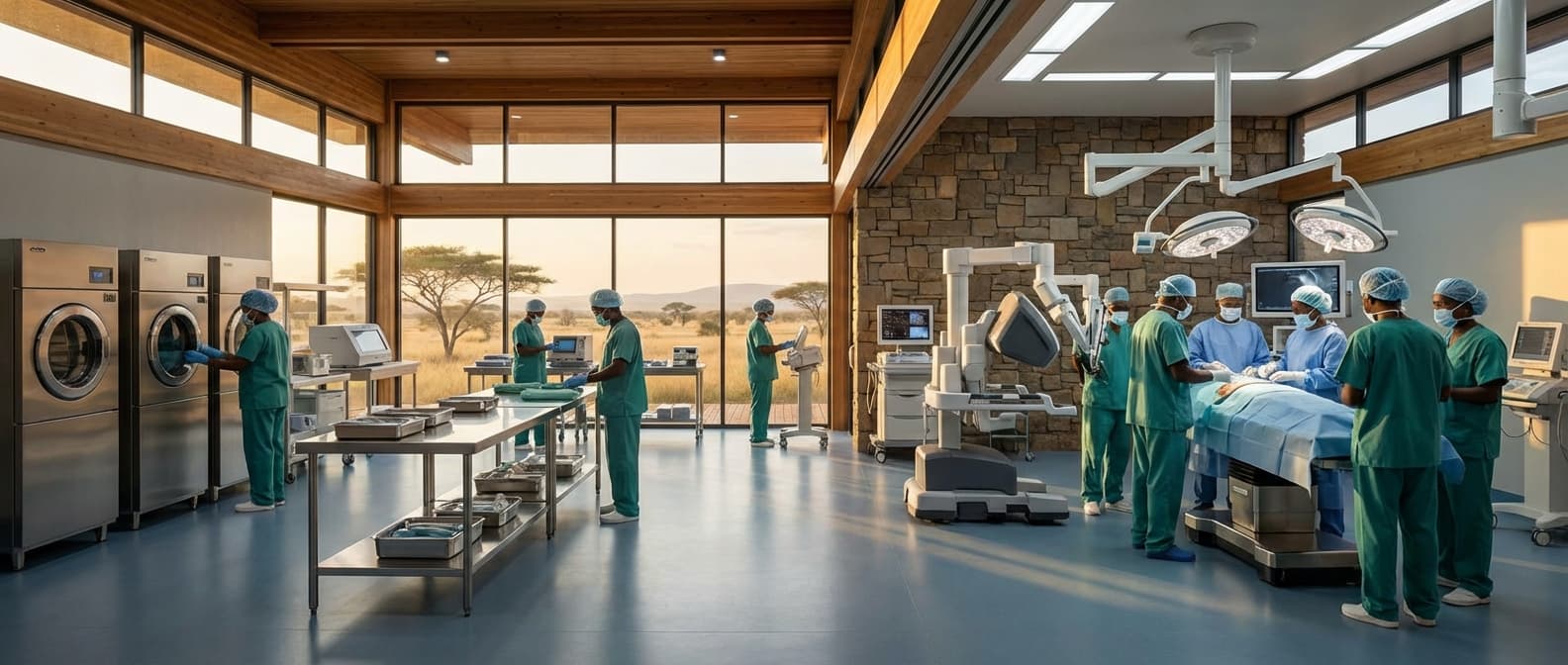
CSSD Design & Validation in Guinea
Engineering Excellence & Technical Support
CSSD workflow design, validation and process development High-standard technical execution following OEM protocols and local regulatory frameworks.
Sterilization Process Optimization
Implemented advanced chemical sterilization protocols and validated efficacy with biological indicators, ensuring a 99.999% reduction in microbial load for critical medical instruments in Guinean CSSDs.
Validation of Decontamination Cycles
Developed and executed rigorous validation studies for automated washer-disinfectors, verifying the effectiveness of high-temperature and enzymatic cleaning cycles under local environmental conditions to prevent cross-contamination.
Standard Operating Procedure (SOP) Development
Authored and validated comprehensive SOPs for instrument tracking, sterilization parameter monitoring, and sterile storage, aligning Guinean CSSD practices with international standards (e.g., ISO 13485) and national health regulations.
What Is Cssd Design & Validation In Guinea?
Central Sterile Supply Department (CSSD) Design & Validation in Guinea refers to the specialized engineering and consulting services focused on the planning, development, and verification of facilities responsible for the decontamination, sterilization, and sterile storage of medical devices. This service is critical for ensuring patient safety and preventing healthcare-associated infections (HAIs) by guaranteeing that all reusable medical instruments are processed to recognized standards. The process involves a comprehensive lifecycle approach, from initial conceptualization and architectural design to equipment selection, workflow optimization, and post-installation validation to confirm that the CSSD operates effectively and meets regulatory requirements.
| Who Needs CSSD Design & Validation? | Typical Use Cases & Scenarios | ||||||
|---|---|---|---|---|---|---|---|
| Hospitals and Healthcare Facilities (public and private) | Construction of new hospitals or expansion of existing facilities. | Renovation or upgrade of existing CSSD departments to meet current standards. | Introduction of new surgical specialties or increased procedural volumes requiring enhanced sterilization capacity. | Addressing persistent issues with HAIs related to instrument reprocessing. | Compliance with evolving national and international healthcare regulations and accreditation requirements. | Healthcare organizations seeking to optimize operational efficiency and reduce costs within their CSSD. | Facilities performing complex surgical procedures requiring specialized sterilization methods. |
| Surgical Centers and Clinics | Outpatient surgical centers that handle reusable instruments. | Specialized clinics (e.g., dental, ophthalmology) with sterilization needs. | Deployment of mobile surgical units requiring self-contained sterile processing capabilities. | ||||
| Medical Device Manufacturers (for demonstration or testing facilities) | Establishing compliant facilities for testing sterilization equipment and processes. | Creating demonstration units for prospective clients. | |||||
| Government Health Ministries and Regulatory Bodies | Developing national guidelines and standards for CSSD operations. | Auditing and accrediting healthcare facilities to ensure compliance. |
Key Components of CSSD Design & Validation:
- Needs Assessment and Feasibility Studies
- Space Planning and Layout Design (including workflow analysis)
- Equipment Specification and Selection
- Infrastructure Requirements (HVAC, plumbing, electrical, medical gases)
- Regulatory Compliance Review (local and international standards)
- Installation Supervision and Commissioning
- Operational Qualification (OQ)
- Performance Qualification (PQ)
- Sterilization Process Validation (e.g., steam, EtO, hydrogen peroxide)
- Documentation and Training Program Development
- Quality Management System (QMS) Integration
Who Needs Cssd Design & Validation In Guinea?
CSSD (Central Sterile Services Department) design and validation are critical for any healthcare facility aiming to uphold the highest standards of infection prevention and patient safety. In Guinea, as the healthcare sector grows and modernizes, the need for robust CSSD infrastructure becomes increasingly apparent. Proper design ensures efficient workflow, minimizes the risk of contamination, and optimizes resource utilization. Validation confirms that the CSSD operates according to established guidelines and consistently produces sterile medical devices, directly impacting patient outcomes and reducing healthcare-associated infections (HAIs).
| Target Customer/Facility Type | Key Departments Benefiting from CSSD Design & Validation | Specific Needs/Benefits |
|---|---|---|
| Public Hospitals | Operating Theaters, Emergency Rooms, Intensive Care Units (ICUs), Outpatient Clinics, Maternity Wards | Ensuring sterilization of surgical instruments and medical devices for a high patient volume; reducing HAIs; optimizing resource allocation for public health goals. |
| Private Hospitals & Clinics | All Surgical Specialties, Gynecology, Ophthalmology, Orthopedics, General Surgery, Fertility Clinics | Meeting international standards for patient care and safety; enhancing reputation; ensuring smooth surgical schedules by reliable instrument availability; attracting medical tourism. |
| Surgical Centers | Operating Rooms, Post-Anesthesia Care Units (PACUs) | Dedicated focus on surgical procedures requires highly efficient and reliable sterilization of a wide range of instruments; minimizing downtime due to instrument reprocessing issues. |
| Diagnostic Laboratories | Microbiology, Pathology, Molecular Diagnostics | Sterilization of instruments for sample collection, culture media preparation, and specialized diagnostic procedures; preventing cross-contamination. |
| Government Health Ministries/Agencies | Regulatory Bodies, Public Health Departments | Setting and enforcing national standards for sterile processing; developing guidelines for new healthcare facilities; overseeing infection control practices across the nation. |
| Medical Device Suppliers/Manufacturers (local presence) | Technical Support, Training Departments | Ensuring their equipment is correctly integrated into designed CSSD workflows; providing validated sterilization cycles for their instruments; offering training on proper use. |
Target Customers and Departments in Guinea Requiring CSSD Design & Validation
- Hospitals (Public and Private)
- Surgical Centers
- Clinics with Operating Rooms
- Diagnostic Laboratories (requiring sterile instruments)
- Dental Clinics with Sterilization Needs
- Veterinary Hospitals (in some cases)
Cssd Design & Validation Process In Guinea
The design and validation process for a Central Sterile Services Department (CSSD) in Guinea involves a structured workflow to ensure compliance with international standards and optimal functionality. This process typically begins with an initial inquiry from a healthcare facility and culminates in a fully operational and validated CSSD. The workflow is crucial for guaranteeing the safety and efficacy of sterilized medical devices, thereby protecting patients from healthcare-associated infections. Key stages include needs assessment, conceptual design, detailed design, equipment selection and procurement, installation, commissioning, validation, and finally, handover and training.
| Stage | Key Activities | Purpose | Key Stakeholders | Typical Duration (Weeks) |
|---|---|---|---|---|
| Initial contact, site visit, understanding the facility's needs, current sterilization practices, volume of procedures, types of instruments. Assessment of existing infrastructure and utilities. | To define the scope, requirements, and feasibility of the CSSD project. To identify potential challenges and opportunities. | Healthcare Facility Management, Clinical Staff, CSSD Personnel (if any), Design Consultants. | 2-4 |
| Developing preliminary layouts, workflow diagrams, space requirements. Estimating project costs, identifying regulatory requirements (local and international standards). | To establish the basic design concept, confirm technical and financial viability, and outline the project plan. | Design Consultants, Healthcare Facility Management, Engineers. | 4-8 |
| Developing detailed architectural, mechanical, electrical, and plumbing (MEP) drawings. Specifying materials, finishes, ventilation systems (HVAC), lighting, water and drainage. Developing Standard Operating Procedures (SOPs) for CSSD workflow. | To provide comprehensive blueprints and specifications for construction and equipment installation. To ensure compliance with safety, hygiene, and operational standards. | Architects, Engineers (MEP), CSSD Specialists, Regulatory Bodies (for review). | 8-16 |
| Defining specifications for all CSSD equipment (sterilizers, washer-disinfectors, ultrasonic cleaners, sterile storage cabinets, etc.). Identifying suppliers, obtaining quotes, and placing orders. Ensuring equipment meets relevant standards (e.g., ISO, FDA). | To acquire appropriate and compliant equipment for the CSSD operations. | Procurement Department, CSSD Specialists, Design Consultants, Equipment Suppliers. | 12-24 (can overlap with construction) |
| Executing civil works, installing walls, flooring, ceilings, utility connections (water, electricity, steam, drainage). Ensuring proper airflow and pressure differentials as per design. | To build the physical space of the CSSD according to the detailed design specifications. | Construction Company, Engineers, Architects, Project Managers. | 16-32 (highly variable based on project size) |
| Installing all CSSD equipment, connecting utilities, and integrating systems (e.g., traceability systems). | To physically set up and connect all the necessary equipment within the constructed space. | Equipment Technicians, MEP Engineers, CSSD Specialists. | 4-8 |
| Installation Qualification (IQ): Verifying equipment is installed correctly. Operational Qualification (OQ): Testing equipment to ensure it operates according to specifications. Performance Qualification (PQ): Validating that the equipment performs its intended function consistently under normal operating conditions with actual loads. | To verify and document that the CSSD systems and equipment are installed correctly, operate as intended, and can consistently achieve the desired sterilization outcomes. | Validation Engineers, CSSD Personnel, Equipment Manufacturers, Regulatory Inspectors. | 6-12 |
| Compiling all IQ/OQ/PQ data, analysis, and documentation into a comprehensive validation report. Submission to relevant authorities for approval. | To formally document the successful validation of the CSSD and obtain regulatory approval for operation. | Validation Engineers, Healthcare Facility Management, Regulatory Bodies. | 2-4 |
| Official handover of the fully functional and validated CSSD to the healthcare facility. Comprehensive training for CSSD staff on equipment operation, SOPs, safety protocols, and infection control. | To ensure the CSSD is operational and that staff are competent to manage its daily functions safely and effectively. | Project Team, CSSD Personnel, Healthcare Facility Management. | 2-4 |
| Routine monitoring of sterilization cycles, equipment maintenance, quality control checks, and periodic revalidation of equipment and processes as per regulatory requirements and manufacturer recommendations. | To ensure continued compliance, maintain optimal performance, and prevent sterilization failures. | CSSD Personnel, Maintenance Department, Quality Assurance Team. | Ongoing |
CSSD Design & Validation Process Workflow in Guinea
- Inquiry and Needs Assessment
- Conceptual Design & Feasibility Study
- Detailed Design & Documentation
- Equipment Selection & Procurement
- Construction & Infrastructure Development
- Installation & Integration
- Commissioning & Qualification (IQ/OQ/PQ)
- Validation Report & Approval
- Handover & Training
- Ongoing Monitoring & Revalidation
Cssd Design & Validation Cost In Guinea
Designing and validating a Central Sterile Supply Department (CSSD) in Guinea involves a complex interplay of factors influencing overall costs. These costs are typically benchmarked against international standards but are heavily localized by the Guinean economic environment. Key pricing drivers include the scale and complexity of the CSSD, the type and quantity of equipment required, the level of automation, the quality of building materials and finishes, and the need for specialized engineering and validation services. Furthermore, import duties, local labor rates, transportation costs, and regulatory compliance fees all contribute significantly to the final price. The availability and accessibility of specialized technicians and consultants within Guinea can also impact pricing, potentially leading to higher costs if international expertise is required. The fluctuating exchange rate of the Guinean Franc (GNF) against major international currencies also introduces an element of variability.
| Cost Component | Estimated Range (GNF) | Notes |
|---|---|---|
| Design & Consultancy Fees | 5,000,000 - 50,000,000+ | Varies based on project scope, complexity, and consultant's reputation (local vs. international) |
| Equipment Purchase (Sterilizers, Washers, Autoclaves, etc.) | 50,000,000 - 500,000,000+ | Highly dependent on brand, capacity, technology, and quantity. Imported equipment will incur significant duties. |
| Construction & Renovation | 20,000,000 - 150,000,000+ | Depends on existing infrastructure, required modifications, and material quality. |
| Installation & Commissioning | 5,000,000 - 30,000,000 | Cost of skilled labor for setting up and testing equipment. |
| Validation Services (IQ/OQ/PQ) | 10,000,000 - 75,000,000+ | Critical for regulatory compliance; often requires specialized external services. |
| Ancillary Services (Water Treatment, Ventilation, etc.) | 10,000,000 - 60,000,000 | Essential for proper functioning and environmental control. |
| Import Duties & Taxes | 15% - 35% of CIF value (estimated) | Significant impact on imported equipment and materials. |
| Contingency (10-15%) | Variable | Recommended for unforeseen expenses. |
Key Pricing Factors for CSSD Design & Validation in Guinea
- Scale and complexity of the CSSD (number of sterilization cycles, throughput)
- Type and quantity of sterilization and washing equipment
- Level of automation and integration of systems
- Quality of construction materials and finishes (e.g., antimicrobial surfaces)
- Specialized engineering services (ventilation, water treatment, electrical)
- Validation and commissioning services (IQ, OQ, PQ)
- Import duties and taxes on equipment and materials
- Local labor rates for construction and installation
- Transportation and logistics costs within Guinea
- Regulatory compliance and certification fees
- Need for international expertise and consultancy
- Geographic location within Guinea (accessibility and infrastructure)
- Current exchange rate of the Guinean Franc (GNF)
Affordable Cssd Design & Validation Options
Designing and validating a Central Sterile Supply Department (CSSD) is a critical investment for healthcare facilities, directly impacting patient safety and operational efficiency. Achieving optimal design and robust validation doesn't have to break the bank. This guide explores affordable CSSD design principles and cost-effective validation strategies, focusing on value bundles and smart cost-saving measures.
| Value Bundle | Description | Cost-Saving Strategy | Benefits |
|---|---|---|---|
| Lean Workflow Design Package | Consultation and design services focused on optimizing the movement of instruments and materials through the CSSD, from soiled receiving to sterile storage. | Emphasis on space planning, equipment placement to minimize travel distances, and segregation of clean and dirty areas. | Reduced staff travel time, improved throughput, minimized cross-contamination risks, lower labor costs. |
| Phased Validation & Certification | A staged approach to validation, focusing on essential equipment and processes first, followed by less critical elements as budget allows. | Utilizing in-house trained personnel for routine performance monitoring and scheduling third-party validation for major equipment and critical processes. | Spreads validation costs over time, ensures immediate compliance for critical areas, allows for budget flexibility. |
| Equipment Optimization & Refurbishment | Assessment of existing equipment for continued usability and exploration of high-quality refurbished or reconditioned sterilization and cleaning equipment. | Partnering with trusted vendors for certified pre-owned equipment, offering warranties and maintenance plans. | Significant reduction in capital expenditure compared to new equipment, reliable performance with reduced risk. |
| Integrated Training & SOP Development | Development of comprehensive Standard Operating Procedures (SOPs) and hands-on training for CSSD staff, incorporating lean principles. | Training on proper equipment use, infection control protocols, and documentation, often delivered by experienced consultants or in collaboration with equipment manufacturers. | Improved staff competency, reduced errors, enhanced compliance, consistent quality of reprocessing, lower risk of reprocessing failures. |
| Modular Fit-Out & Material Selection | Designing CSSD layouts using modular components and selecting durable, easy-to-clean, and cost-effective materials for surfaces and finishes. | Utilizing durable flooring, wall panels, and cabinetry that require less maintenance and have a longer lifespan. | Lower initial construction costs, easier maintenance and cleaning, long-term durability, reduced need for frequent repairs or replacements. |
Key Considerations for Affordable CSSD Design & Validation
- Prioritize Workflow Efficiency: A well-designed workflow minimizes bottlenecks, reduces the risk of contamination, and optimizes staff time, leading to long-term cost savings.
- Modular & Scalable Design: Opt for flexible layouts that can adapt to future growth or changes in technology, avoiding expensive renovations later.
- Right-Sizing Equipment: Invest in equipment that meets current needs without excessive overcapacity. Consider refurbished or reconditioned medical equipment from reputable suppliers.
- Standardized Processes: Implementing standardized operating procedures (SOPs) for decontamination, sterilization, and storage simplifies training and reduces errors.
- Strategic Validation Approach: Focus validation efforts on critical processes and equipment, ensuring compliance without unnecessary expenditure.
- Leverage Technology Wisely: Utilize Building Information Modeling (BIM) for design and simulation to identify potential issues early. Explore cost-effective IT solutions for tracking and documentation.
Verified Providers In Guinea
In Guinea, ensuring access to reliable healthcare is paramount. When seeking medical services, it's crucial to identify verified providers who meet rigorous standards. Franance Health stands out as a premier organization, meticulously credentialing healthcare professionals and facilities. This process not only guarantees a high level of expertise but also instills confidence in patients seeking quality care. Franance Health's commitment to excellence is reflected in their comprehensive verification procedures, which encompass stringent checks on qualifications, experience, ethical conduct, and adherence to best practices. Choosing a Franance Health-credentialed provider means opting for a healthcare experience that prioritizes patient safety, efficacy, and compassionate treatment.
| Credentialing Area | Franance Health Standard | Patient Benefit |
|---|---|---|
| Medical Licenses & Certifications | Up-to-date and valid credentials verified. | Assurance of qualified and legally practicing professionals. |
| Clinical Experience | Minimum years of experience and specialization confirmed. | Access to experienced practitioners with relevant expertise. |
| Continuing Medical Education (CME) | Proof of ongoing professional development. | Providers are up-to-date with the latest medical advancements. |
| Ethical Conduct & Background Checks | Thorough review of professional history and disciplinary actions. | Patient safety and trust are prioritized through ethical practitioners. |
| Facility Standards (for clinics/hospitals) | Compliance with hygiene, safety, and equipment requirements. | Access to well-equipped and safe healthcare facilities. |
Why Franance Health Credentials Matter in Guinea:
- Ensures adherence to international healthcare standards.
- Verifies the qualifications and expertise of medical professionals.
- Promotes ethical conduct and patient-centered care.
- Enhances patient safety through rigorous vetting processes.
- Builds trust and confidence in the healthcare system.
- Facilitates access to a network of reputable healthcare providers.
Scope Of Work For Cssd Design & Validation
This Scope of Work (SOW) outlines the requirements for the design and validation of a Central Sterile Supply Department (CSSD). The objective is to ensure the CSSD is designed and validated to meet all relevant international and national standards, optimizing workflow, safety, and instrument reprocessing efficiency. This document details the technical deliverables and standard specifications expected throughout the project lifecycle.
| Deliverable | Description | Standard Specification / Reference |
|---|---|---|
| CSSD Design Report | Comprehensive report detailing the architectural layout, workflow analysis, space allocation, environmental controls, and safety features of the CSSD. | ISO 13485, HTM 01-01, ASHRAE standards for HVAC, Local building codes, Fire safety regulations. |
| Equipment Specification Sheets | Detailed technical specifications for all proposed CSSD equipment, including sterilizers, washer-disinfectors, drying cabinets, packaging systems, and storage solutions. | Manufacturer's specifications, IEC 60601 series (for electrically operated equipment), EN 285 (for steam sterilizers), EN ISO 15883 (for washer-disinfectors), relevant national standards. |
| Workflow Diagrams | Visual representation of the material flow within the CSSD, from soiled item reception to sterile supply dispatch, highlighting key process steps and potential bottlenecks. | Best practice guidelines for CSSD workflow, AAMI ST79. |
| Environmental Monitoring Plan | Protocol for monitoring and documenting critical environmental parameters such as temperature, humidity, air pressure differentials, and air changes per hour. | ISO 14644 (for cleanrooms), HTM 01-01 Annex B. |
| Instrument Tracking System Requirements | Specifications for a system capable of tracking instruments throughout the reprocessing cycle, ensuring accountability and traceability. | ISO 13485, AAMI ST79. |
| Validation Master Plan (VMP) | A comprehensive plan outlining the strategy for all validation activities, including Installation Qualification (IQ), Operational Qualification (OQ), and Performance Qualification (PQ). | FDA's General Principles of Software Validation, ISPE Baseline® Guide, relevant industry standards. |
| Installation Qualification (IQ) Protocols & Reports | Protocols and reports to verify that all equipment is installed correctly according to manufacturer's specifications and design requirements. | Manufacturer's installation manuals, GAMP 5. |
| Operational Qualification (OQ) Protocols & Reports | Protocols and reports to verify that equipment operates within defined parameters and performs as intended across its operating range. | Manufacturer's operating manuals, GAMP 5. |
| Performance Qualification (PQ) Protocols & Reports | Protocols and reports to verify that the CSSD system, including equipment and processes, consistently performs its intended function under normal operating conditions using representative loads. | AAMI ST79, EN ISO 17665 (for steam sterilization validation), EN ISO 15883 (for washer-disinfector validation), relevant biological indicator manufacturers' instructions. |
| Standard Operating Procedures (SOPs) | Detailed SOPs for all CSSD processes, including receiving, cleaning, disinfection, packaging, sterilization, storage, and distribution of sterile items. | Manufacturer's instructions, AAMI ST79, regulatory requirements. |
| Training Manuals and Records | Comprehensive training materials for CSSD staff covering all aspects of operation, safety, and quality control, along with documented training records. | Organizational training policies, regulatory requirements. |
| Risk Assessment Report | Identification and evaluation of potential risks associated with CSSD operations and implementation of mitigation strategies. | ISO 14971 (for medical device risk management). |
Project Phases and Key Activities
- Phase 1: Conceptualization and Planning
- Phase 2: Detailed Design
- Phase 3: Equipment Specification and Procurement
- Phase 4: Installation and Commissioning
- Phase 5: Validation and Qualification
- Phase 6: Training and Documentation
Service Level Agreement For Cssd Design & Validation
This Service Level Agreement (SLA) outlines the guaranteed response times and uptime for the CSSD (Central Sterile Services Department) Design & Validation services provided by [Your Company Name]. This SLA aims to ensure prompt support and reliable operation of the CSSD design and validation processes for our clients.
| Service Component | Response Time Guarantee (Business Hours) | Uptime Guarantee (for Cloud-based tools/platforms, if applicable) |
|---|---|---|
| CSSD Design Consultation & Review | 4 Business Hours | N/A |
| CSSD Validation Protocol Development | 8 Business Hours | N/A |
| CSSD Validation Execution & Reporting (during active validation phases) | 2 Business Hours (for critical issues) | N/A |
| Post-Validation Support & Troubleshooting | 4 Business Hours | N/A |
| Cloud-based CSSD Design/Validation Platform (if applicable) | N/A | 99.5% |
Key Service Components
- CSSD Design Consultation & Review
- CSSD Validation Protocol Development
- CSSD Validation Execution & Reporting
- Post-Validation Support & Troubleshooting
Frequently Asked Questions

Ready when you are
Let's scope your CSSD Design & Validation in Guinea project in Guinea.

Scaling healthcare logistics and technical systems across the entire continent.