
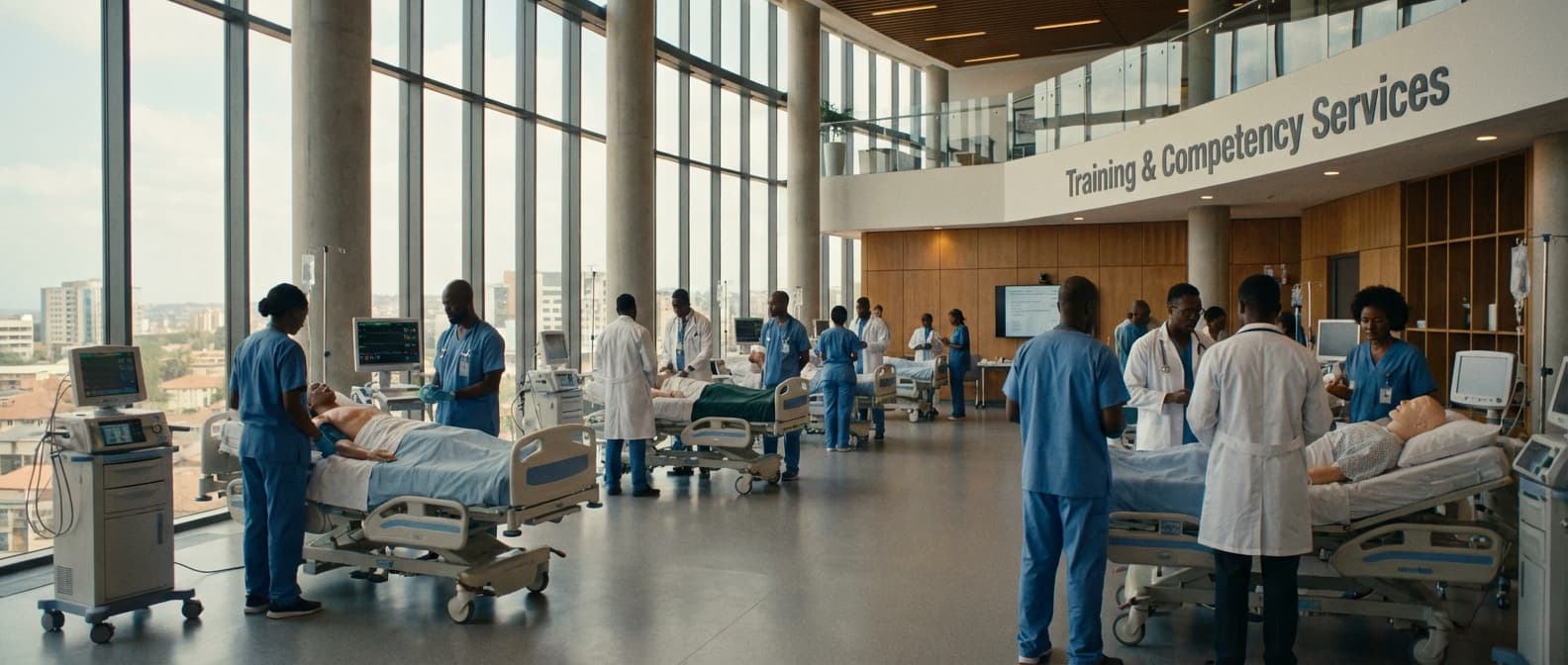
Ventilator User Training Service (Nurses) in Guinea-Bissau
Engineering Excellence & Technical Support
Ventilator User Training Service (Nurses) High-standard technical execution following OEM protocols and local regulatory frameworks.
Ventilator Modes Mastery
Gain expertise in essential ventilation modes (e.g., AC/VC, SIMV, PSV) for precise patient respiratory support tailored to their clinical needs. Understand parameter settings, trigger sensitivity, and flow patterns for optimal patient outcomes.
Real-time Waveform Interpretation
Develop advanced skills in analyzing pressure, flow, and volume waveforms to identify subtle changes in patient respiratory mechanics. Recognize common waveform abnormalities and troubleshoot effectively in critical situations.
Safe Circuit Management & Hygiene
Learn best practices for ventilator circuit management, including sterile technique, humidification, and suctioning protocols, to minimize the risk of ventilator-associated pneumonia (VAP) and ensure patient safety.
What Is Ventilator User Training Service (Nurses) In Guinea-bissau?
Ventilator User Training Service (Nurses) in Guinea-Bissau refers to specialized educational programs designed to equip registered nurses with the necessary knowledge and practical skills to safely and effectively operate mechanical ventilators in clinical settings within the Republic of Guinea-Bissau. This service addresses the critical need for skilled healthcare professionals to manage patients requiring ventilatory support, particularly in resource-limited environments where specialized training opportunities may be scarce. The training aims to standardize ventilator use, optimize patient outcomes, reduce the incidence of ventilator-associated complications, and enhance the overall capacity of the healthcare system to manage acute respiratory failure.
| Target Audience | Needs Addressed | Typical Use Cases | ||
|---|---|---|---|---|
| Registered Nurses working in intensive care units (ICUs) and critical care settings. | Lack of standardized training in mechanical ventilation. | Management of patients with severe pneumonia, Acute Respiratory Distress Syndrome (ARDS), sepsis-induced respiratory failure, and other critical conditions requiring mechanical ventilation. | Post-operative patients with respiratory compromise. | Patients during the management of respiratory infections (e.g., COVID-19 surges). |
| Registered Nurses in emergency departments and operating rooms who may encounter patients requiring immediate ventilatory support. | Need for basic proficiency in initiating and managing ventilation in emergent situations. | Stabilization of critically ill patients prior to transfer to an ICU. | Management of patients during anesthesia and surgery requiring controlled ventilation. | |
| Registered Nurses in general hospital wards who may be responsible for monitoring patients on non-invasive ventilation or patients deteriorating and requiring escalation to mechanical ventilation. | Understanding of basic ventilatory support principles and recognition of signs of respiratory failure. | Monitoring patients receiving non-invasive positive pressure ventilation (NIPPV). | Early recognition of respiratory deterioration requiring mechanical ventilation and prompt communication with the critical care team. | |
| Healthcare professionals involved in training or supervising junior nurses. | Development of in-house training capacity and mentorship programs. | Role-modeling best practices in ventilator management. | Ensuring consistent quality of care across different healthcare facilities. |
Components of Ventilator User Training Service for Nurses
- Foundational principles of respiratory physiology and pathophysiology of acute respiratory failure.
- Understanding of different types of mechanical ventilators and their components.
- Modes of mechanical ventilation (e.g., volume-controlled, pressure-controlled, assisted modes).
- Setting ventilator parameters (tidal volume, respiratory rate, PEEP, FiO2) based on patient condition.
- Initiation and management of mechanical ventilation.
- Monitoring patient response to ventilation, including physiological parameters and ventilator waveforms.
- Troubleshooting common ventilator alarms and technical issues.
- Strategies for ventilator weaning and extubation.
- Prevention and management of ventilator-associated pneumonia (VAP) and other complications.
- Ethical considerations and legal aspects of mechanical ventilation.
- Practical hands-on sessions with various ventilator models common in Guinea-Bissau.
- Simulation exercises and case-based scenarios.
- Post-training competency assessment and ongoing support.
Who Needs Ventilator User Training Service (Nurses) In Guinea-bissau?
This document outlines the critical need for Ventilator User Training Services specifically tailored for nurses in Guinea-Bissau. Effective and safe operation of mechanical ventilators is paramount for patient care, especially in critical settings. Nurses, as frontline healthcare providers, require comprehensive training to confidently and competently manage patients requiring mechanical ventilation.
| Target Customer Group | Specific Departments/Units | Reason for Need | Training Focus Areas |
|---|---|---|---|
| Registered Nurses | Intensive Care Units (ICUs) | Direct patient management of ventilated patients, requiring advanced knowledge of ventilator settings, modes, and troubleshooting. | Ventilator principles, modes of ventilation (SIMV, A/C, CPAP, PEEP), patient monitoring, weaning strategies, troubleshooting alarms, infection control. |
| Registered Nurses | Emergency Departments | Initial management of patients requiring urgent mechanical ventilation, rapid assessment and initiation of support. | Emergency airway management, rapid ventilator setup, basic ventilation principles, recognizing respiratory distress, troubleshooting common issues. |
| Registered Nurses | Operating Rooms | Intraoperative management of patients requiring mechanical ventilation, ensuring physiological stability during surgery. | Anesthesia support, intraoperative ventilation management, understanding anesthetic agents' impact, responding to surgical complications. |
| Registered Nurses | Neonatal/Pediatric Units | Specialized ventilation for neonates and children, requiring specific knowledge of pediatric physiology and equipment. | Neonatal and pediatric ventilation modes, lung protective strategies, fluid balance, thermoregulation, specific equipment for small patients. |
| Registered Nurses | General Wards/Maternity Wards (with critical care capacity) | Management of patients who may require short-term ventilation or transfer from critical care areas, ensuring continuity of care. | Basic ventilation principles, monitoring of stable ventilated patients, recognizing signs of deterioration, safe transition of care. |
| Nursing Supervisors/Charge Nurses | All relevant departments | Oversight of nursing staff, ensuring competency and safe practice, participating in quality improvement initiatives. | Training coordination, competency assessment, advanced troubleshooting, team leadership in critical events. |
Target Customers and Departments
- Hospitals (Public and Private)
- Intensive Care Units (ICUs)
- Emergency Departments
- Operating Rooms
- Maternity Wards (for neonatal ventilation)
- Regional Health Centers with critical care capabilities
Ventilator User Training Service (Nurses) Process In Guinea-bissau
This document outlines the workflow for the Ventilator User Training Service specifically for nurses in Guinea-Bissau, covering the process from initial inquiry to the successful execution of the training. The service aims to equip nurses with the necessary knowledge and skills to safely and effectively operate ventilators in various clinical settings.
| Stage | Description | Key Activities | Responsible Parties |
|---|---|---|---|
| Inquiry & Needs Assessment | Initial contact and understanding of training needs. | Receiving inquiry, conducting site visits, interviewing stakeholders, identifying skill gaps and equipment availability. | Healthcare Facility/Nurses, Training Provider |
| Proposal & Agreement | Formalizing the training offer and commitment. | Developing training proposal (curriculum, duration, cost), negotiating terms, signing training agreement. | Training Provider, Healthcare Facility |
| Pre-Training Preparations | Setting up the logistical and material foundation for training. | Scheduling dates, booking venue, preparing training materials, confirming equipment availability, participant communication. | Training Provider, Healthcare Facility |
| Training Delivery | The actual execution of the training program. | Conducting theoretical lectures, practical demonstrations, hands-on exercises, scenario-based simulations. | Training Provider (Trainers), Nurses (Trainees) |
| Assessment & Evaluation | Measuring trainee learning and program effectiveness. | Administering written/practical tests, skill competency checks, collecting participant feedback. | Training Provider (Assessors), Nurses (Trainees) |
| Certification & Follow-up | Recognizing successful completion and providing ongoing support. | Issuing certificates, offering post-training support, scheduling refresher courses. | Training Provider, Nurses |
| Reporting & Feedback | Documenting and communicating training outcomes. | Compiling training report, sharing with facility, analyzing feedback for improvement. | Training Provider |
Ventilator User Training Service (Nurses) Workflow in Guinea-Bissau
- Inquiry & Needs Assessment: The process begins with an inquiry from a healthcare facility or individual nurses expressing interest in ventilator training. This is followed by a thorough needs assessment to understand the current skill level, the types of ventilators available, and the specific training requirements of the facility.
- Proposal & Agreement: Based on the needs assessment, a detailed training proposal is developed. This proposal includes curriculum, training duration, methodologies, trainers, location, and associated costs. Once agreed upon by both parties, a formal training agreement is signed.
- Pre-Training Preparations: This phase involves logistical arrangements, including scheduling training dates, booking training venues (if external), preparing training materials (presentations, manuals, case studies), and ensuring the availability of functional ventilators for hands-on practice. Communication with participants regarding pre-reading materials and expectations is also crucial.
- Training Delivery: The core of the service involves the delivery of the training program. This typically includes theoretical sessions covering ventilator principles, modes of ventilation, patient monitoring, troubleshooting, and infection control, followed by extensive practical sessions. Practical training emphasizes hands-on experience with different ventilator models, scenario-based exercises, and simulated patient management.
- Assessment & Evaluation: Trainees undergo both theoretical and practical assessments to evaluate their comprehension and skill acquisition. This may include written tests, practical skill demonstrations, and case study analysis. Participant feedback on the training program is also collected to identify areas for improvement.
- Certification & Follow-up: Upon successful completion of the training and assessments, participants receive a certificate of completion. A follow-up mechanism, such as post-training support or refresher courses, may be offered to ensure continued competence and address any emerging challenges.
- Reporting & Feedback: The training provider prepares a comprehensive report detailing the training activities, participant performance, and outcomes. This report is shared with the requesting healthcare facility and may be used for internal quality improvement and future planning.
Ventilator User Training Service (Nurses) Cost In Guinea-bissau
Determining the exact cost for ventilator user training services for nurses in Guinea-Bissau is complex, as it's not a standardized, widely advertised service with fixed pricing. Costs are highly variable and depend on several factors, often negotiated on a case-by-case basis. This means there isn't a readily available price list. However, we can discuss the key pricing factors and provide estimated ranges in the local currency, the West African CFA franc (XOF).
| Training Scope/Level | Estimated Range (XOF per nurse) | Notes |
|---|---|---|
| Basic Ventilator Awareness & Introduction | 15,000 - 40,000 | Covers fundamental principles, types of ventilators, and basic settings. May be a half-day or full-day session. |
| Intermediate Ventilator Management | 40,000 - 100,000 | Includes hands-on practice, common modes of ventilation, initial setup, and basic troubleshooting. Typically 1-3 days. |
| Advanced Ventilator Management & Critical Care | 100,000 - 250,000+ | In-depth coverage of complex modes, weaning strategies, advanced troubleshooting, ventilator graphics interpretation, and integration with other critical care equipment. Can be 3-5 days or longer, with potential for simulator use. |
| Customized/On-site Training (per day, excluding trainer travel) | 50,000 - 150,000+ | This is a broad range, highly dependent on the number of participants and the complexity of the customization. Trainer travel and accommodation costs are additional and can significantly increase the total. |
Key Pricing Factors for Ventilator User Training in Guinea-Bissau:
- {"item":"Training Provider Expertise and Reputation","description":"Training delivered by highly experienced intensivists, respiratory therapists, or specialized medical training organizations will generally command higher fees due to their credibility and proven track record."}
- {"item":"Scope and Duration of Training","description":"A comprehensive program covering basic to advanced ventilator management, troubleshooting, and emergency protocols will be more expensive than a shorter, introductory session. The number of training days or hours directly impacts the cost."}
- {"item":"Number of Participants","description":"Larger groups of nurses may benefit from economies of scale, potentially leading to a lower per-nurse cost. However, the overall cost will increase with more attendees."}
- {"item":"Training Location and Logistics","description":"If training is conducted on-site at a healthcare facility, travel, accommodation, and per diem expenses for trainers need to be factored in. If nurses are required to travel to a training center, their associated costs will also influence the overall budget."}
- {"item":"Training Materials and Equipment","description":"The provision of high-quality training manuals, simulation equipment (mannequins, simulated ventilators), and access to real (but non-critical) ventilators for hands-on practice will add to the cost."}
- {"item":"Curriculum Customization","description":"Tailoring the training content to specific hospital protocols, types of ventilators used, and the existing skill level of the nurses will require additional development time and expertise, increasing the price."}
- {"item":"Certification and Assessment","description":"If the training includes formal assessments, examinations, and the issuance of certificates, these elements will contribute to the overall cost."}
- {"item":"Urgency and Demand","description":"In situations of high demand for trained personnel (e.g., during a health crisis), training providers may be able to charge a premium."}
Affordable Ventilator User Training Service (Nurses) Options
This document outlines affordable ventilator user training service options specifically designed for nurses. We understand the critical need for skilled personnel in managing ventilators and the importance of cost-effectiveness in healthcare. This guide details value bundles, which combine multiple training modules for enhanced learning and cost savings, and explores various cost-saving strategies to make essential ventilator training accessible to nursing teams.
| Training Package | Included Modules | Value Proposition | Estimated Cost Range (per nurse) |
|---|---|---|---|
| Essential Ventilator Proficiency | Core Principles, Patient Assessment, Alarm Troubleshooting, Circuit Management | Foundation for safe and effective ventilator use, ideal for new hires or refreshers. | $250 - $500 |
| Advanced Ventilator Care | Essential Proficiency + Weaning Protocols, Special Populations (select) | Comprehensive training for nurses managing complex cases and contributing to weaning decisions. | $450 - $800 |
| Simulation-Focused Training | Essential Proficiency + Dedicated Simulation Sessions | Hands-on, practical experience in a controlled environment to build confidence and skill. | $600 - $1100 |
| On-Demand Micro-Learning Modules | Individual modules (e.g., 'Understanding PEEP', 'Troubleshooting Apnea Alarms') | Targeted learning for specific skill gaps or quick refreshers, highly flexible. | $50 - $150 per module |
Key Components of Affordable Ventilator User Training
- Core Ventilator Principles and Modes
- Patient Assessment and Monitoring
- Troubleshooting Common Alarms
- Ventilator Circuit Management
- Weaning Protocols
- Special Populations (Pediatrics, Geriatrics - optional add-on)
- Simulation-Based Practice (virtual or in-person)
- Post-Training Competency Assessments
Verified Providers In Guinea-bissau
In Guinea-Bissau, accessing reliable and verified healthcare providers is paramount for ensuring quality medical care. Franance Health stands out as a leading organization committed to upholding the highest standards in healthcare. Their rigorous credentialing process ensures that all affiliated providers meet stringent qualifications, offering patients peace of mind and confidence in the services they receive.
| Provider Type | Franance Health Verification Criteria | Benefits for Patients |
|---|---|---|
| General Practitioners | Valid medical license, proof of residency, background check, patient satisfaction scores. | Access to primary care with trusted, qualified doctors. |
| Specialist Physicians (e.g., Cardiologists, Pediatricians) | Board certification in their specialty, advanced training, peer reviews, hospital affiliations. | Expert diagnosis and treatment for specific medical conditions. |
| Nurses and Allied Health Professionals | Accredited training programs, professional registration, competency assessments. | Skilled and compassionate care for a wide range of health needs. |
| Hospitals and Clinics | Accreditation from recognized bodies, adherence to safety and quality standards, functional infrastructure. | Safe and well-equipped facilities for inpatient and outpatient services. |
Why Franance Health Credentials Matter:
- Ensured Competence and Expertise: Franance Health verifies the academic background, professional licenses, and practical experience of all its providers.
- Commitment to Ethical Practices: Providers undergo background checks and are held to a strict code of conduct and ethical standards.
- Continuous Professional Development: Franance Health encourages and often requires ongoing training to keep providers updated on the latest medical advancements.
- Patient Safety Focus: All credentialed providers adhere to strict safety protocols and best practices.
- Access to Specialized Care: Franance Health's network includes specialists across various medical disciplines, ensuring comprehensive care.
Scope Of Work For Ventilator User Training Service (Nurses)
This document outlines the Scope of Work (SOW) for providing comprehensive ventilator user training services specifically designed for nurses. The training will cover theoretical knowledge, practical skills, and competency assessment to ensure safe and effective ventilator management. This SOW details the technical deliverables and standard specifications required for the successful execution of this training program.
| Deliverable | Description | Standard Specifications / Requirements | Format / Medium |
|---|---|---|---|
| Training Curriculum Development | Creation of a comprehensive training program tailored for nursing staff, covering all aspects of ventilator use. | Modular design with clear learning objectives, content aligned with current clinical guidelines (e.g., ATS, SCCM), and inclusion of case studies. Must cover theoretical basis, practical application, and troubleshooting. | Digital document (PDF), printable |
| Training Materials | Development of all necessary learning materials for participants. | Includes presentation slides, participant workbooks, quick reference guides, and pre-reading materials. Content should be clear, concise, and visually engaging. | Digital (PPT, DOCX, PDF), printable |
| Practical Training Sessions | Hands-on training sessions utilizing actual ventilator equipment and simulation models. | Minimum trainer-to-participant ratio of 1:8. Sessions must include ventilator setup, patient connection, parameter adjustment, alarm management, and emergency procedures. Adequate simulated patient scenarios for practice. | In-person, on-site at healthcare facility |
| Competency Assessment Tools | Development and administration of tools to evaluate nurse competency in ventilator management. | Includes written pre- and post-tests, practical skills checklists, and simulated patient scenario assessments. Passing score for all assessments to be defined. | Digital (online platform or scannable forms), printable checklists |
| Trainer Qualification and Experience | Provision of qualified and experienced trainers to deliver the training. | Trainers must possess current nursing licensure, advanced clinical experience in critical care/respiratory therapy, and demonstrable experience in delivering mechanical ventilation training. Certification in advanced life support (e.g., ACLS) preferred. | Trainer CVs, certification documents |
| Ventilator Equipment and Simulators | Use of appropriate ventilator models and simulation equipment for practical training. | Provision of at least one functional ventilator unit per 4-8 participants during practical sessions, mirroring the units used in the clinical setting. Availability of high-fidelity patient simulators for realistic scenarios. | On-site provision by the service provider or utilization of facility's existing equipment if specified. |
| Post-Training Support | Provision of ongoing support to nurses after the initial training. | Includes a defined period of access to trainers for Q&A, provision of electronic resource library, and potentially follow-up observation or mentorship. Specific duration and scope of support to be agreed upon. | Email, phone support, access to online portal/resources |
| Training Report | A comprehensive report detailing the training conducted, participant performance, and recommendations. | Includes participant attendance records, assessment results (aggregated and individual where appropriate), trainer feedback, and any identified areas for further training or improvement. Report to be submitted within a specified timeframe post-training. | Digital document (PDF) |
| Compliance with Safety Protocols | Adherence to all relevant healthcare facility safety and infection control protocols during training. | All trainers and participants must comply with facility's PPE requirements, hygiene practices, and any other safety regulations. Training setup must not disrupt patient care or hospital operations. | On-site adherence and documented understanding of facility policies |
| Adaptability to Specific Ventilator Models | Training tailored to the specific ventilator models deployed by the healthcare facility. | Training content must cover the unique features, settings, and user interface of the designated ventilator models (e.g., [Specify Ventilator Brand/Model 1], [Specify Ventilator Brand/Model 2]). | Training curriculum, presentation materials, practical demonstration |
Training Objectives
- To equip nurses with a thorough understanding of ventilator principles and modes of operation.
- To develop proficiency in the setup, initiation, and management of mechanical ventilation.
- To enable nurses to identify and respond to common ventilator alarms and complications.
- To ensure competency in ventilator weaning protocols and patient liberation.
- To foster a culture of patient safety and best practices in mechanical ventilation.
- To familiarize nurses with the specific features and functionalities of the provided ventilator models.
Service Level Agreement For Ventilator User Training Service (Nurses)
This Service Level Agreement (SLA) outlines the guaranteed response times and uptime for the Ventilator User Training Service specifically designed for nurses. This ensures timely and effective training delivery to support patient care.
| Service Element | Response Time Guarantee | Uptime Guarantee |
|---|---|---|
| Initial Support Ticket Response (Non-Critical Issues) | Within 4 business hours | N/A |
| Initial Support Ticket Response (Critical Issues - e.g., training platform inaccessible for scheduled session) | Within 1 business hour | N/A |
| Resolution of Technical Issues with Online Modules | Within 8 business hours | N/A |
| Availability of Live Virtual Training Sessions | N/A | 99.5% scheduled session uptime |
| Availability of On-Demand Training Content (Online Modules) | N/A | 99.8% platform uptime |
| Escalation of Urgent Training Content Access Issues | Within 2 business hours | N/A |
Key Service Components
- Target Audience: Registered Nurses, Licensed Practical Nurses, and Nurse Practitioners requiring ventilator operation and management training.
- Training Modalities: Blended learning approach including online modules, live virtual sessions, and in-person practical demonstrations (where applicable).
- Training Content: Covers ventilator modes, patient setup, alarm management, troubleshooting, and basic maintenance.
Frequently Asked Questions

Ready when you are
Let's scope your Ventilator User Training Service (Nurses) in Guinea-Bissau project in Guinea-Bissau.

Scaling healthcare logistics and technical systems across the entire continent.