
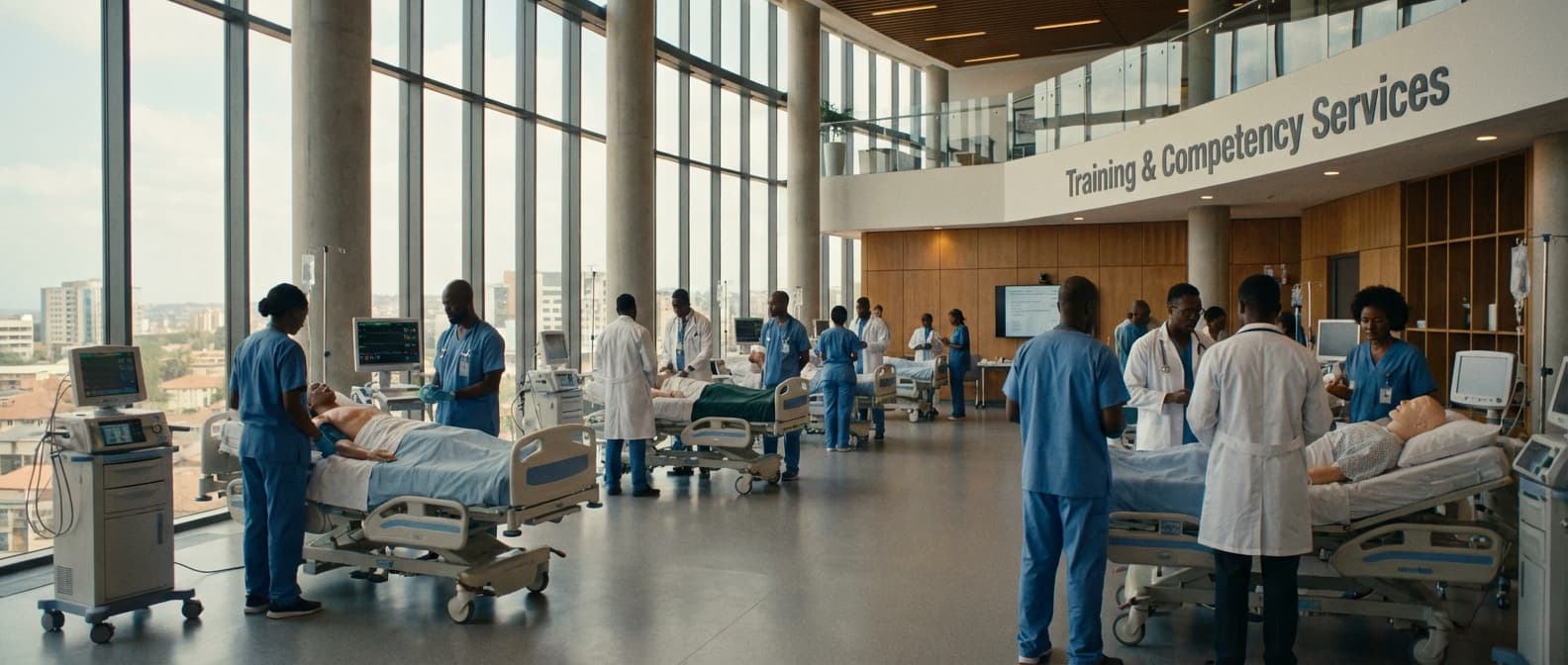
CT Operator Training Service (Radiographers) in Guinea-Bissau
Engineering Excellence & Technical Support
CT Operator Training Service (Radiographers) High-standard technical execution following OEM protocols and local regulatory frameworks.
Advanced Imaging Techniques Mastery
Empowering Guinean radiographers with specialized training in cutting-edge CT imaging protocols, including dual-energy CT, perfusion imaging, and advanced 3D reconstruction, ensuring accurate and comprehensive diagnostic capabilities for complex cases.
Optimized Radiation Safety & Dose Management
Comprehensive curriculum focused on ALARA principles and advanced dose reduction strategies specific to CT. Trainees will gain expertise in optimizing scan parameters, utilizing iterative reconstruction techniques, and implementing quality assurance programs to minimize patient and staff radiation exposure.
Clinical Integration & Protocol Development
Bridging theoretical knowledge with practical application. Our service facilitates the development and implementation of site-specific CT imaging protocols tailored to the common pathologies and available equipment in Guinean healthcare facilities, ensuring seamless integration into daily clinical workflows.
What Is Ct Operator Training Service (Radiographers) In Guinea-bissau?
CT Operator Training Service (Radiographers) in Guinea-Bissau refers to specialized educational programs designed to equip qualified radiographers with the necessary theoretical knowledge and practical skills to competently operate Computed Tomography (CT) scanners. This service is crucial for enhancing diagnostic imaging capabilities within the healthcare system of Guinea-Bissau, ensuring patient safety, and optimizing image quality for accurate diagnosis and treatment planning.
| Who Needs CT Operator Training Service? | Typical Use Cases | ||||||||||
|---|---|---|---|---|---|---|---|---|---|---|---|
| Radiographers: Individuals holding a recognized diploma or degree in radiography seeking to specialize in CT imaging or upskill their existing knowledge and practical abilities. | Medical Institutions: Hospitals, diagnostic imaging centers, and clinics in Guinea-Bissau that have acquired or plan to acquire CT scanning equipment and require trained personnel to operate it. | Healthcare Administrators: Ministry of Health officials and healthcare facility managers responsible for ensuring the availability of qualified personnel for advanced diagnostic imaging services. | New CT Technology Implementations: Institutions introducing new CT scanner models or advanced imaging techniques. | Addressing Skill Gaps: Training to overcome shortages of experienced CT operators. | Enhancing Diagnostic Accuracy: Improving the interpretation of complex imaging data by providing high-quality CT scans. | Trauma and Emergency Medicine: Rapid CT imaging for diagnosing injuries in critical care settings. | Oncology: Staging, treatment planning, and monitoring of cancer through CT scans. | Neurology: Diagnosis of stroke, tumors, and other neurological conditions. | Abdominal and Pelvic Imaging: Evaluating organs and identifying pathologies in these regions. | Thoracic Imaging: Assessing lung conditions and cardiovascular health. | Interventional CT Procedures: Guiding biopsies or drainages under CT fluoroscopy. |
Key Components of CT Operator Training Service:
- Anatomy and Physiology relevant to CT imaging
- Principles of CT physics and technology
- CT scanner operation, including patient positioning and gantry manipulation
- Image acquisition protocols for various anatomical regions
- Image processing, reconstruction, and manipulation techniques
- Contrast media administration guidelines and safety protocols
- Radiation protection principles and dose optimization strategies
- Quality assurance and quality control procedures for CT equipment
- Artifact identification and reduction methods
- Common CT pathologies and their imaging appearance
- Ethical considerations and patient communication
Who Needs Ct Operator Training Service (Radiographers) In Guinea-bissau?
CT operator training services are crucial for enhancing the quality and accessibility of diagnostic imaging in Guinea-Bissau. These services equip radiographers with the specialized skills and knowledge required to operate CT scanners effectively and safely. The primary goal is to ensure accurate diagnoses, optimize patient care, and minimize radiation exposure. The demand for such training stems from the need to build local capacity, overcome shortages of skilled personnel, and keep pace with advancements in medical technology.
| Customer Segment | Relevant Departments/Roles | Key Needs Addressed by Training |
|---|---|---|
| Public Hospitals | Radiology Department, Diagnostic Imaging Unit | Improving diagnostic accuracy, reducing referral times, increasing scan volume, ensuring patient safety, operating new/existing equipment |
| Private Clinics & Diagnostic Centers | Radiology Unit, Imaging Services | Enhancing service offerings, competing with other providers, efficient equipment utilization, quality assurance |
| Regional/District Health Centers | Radiology Technologists, Imaging Staff | Expanding access to CT services, basic operation and maintenance, emergency imaging capabilities |
| Ministry of Health (MoH) | Healthcare Planning & Policy Department, Human Resources Development | Building national capacity, standardizing training, improving health outcomes, efficient resource allocation |
| Academic/Training Institutions | Radiography Programs, Continuing Education Units | Developing curriculum, training future radiographers, upskilling existing professionals, faculty development |
| Medical Equipment Suppliers/Service Providers | Technical Support, Sales and Marketing, Training Departments | Ensuring proper equipment use, client satisfaction, reduced technical issues, promoting advanced features |
Target Customers and Departments for CT Operator Training in Guinea-Bissau:
- Public Hospitals: These are the cornerstone of healthcare in Guinea-Bissau and often face the greatest need for advanced diagnostic capabilities. Radiographers working in these institutions will benefit immensely from specialized CT training.
- Private Clinics and Diagnostic Centers: As the private healthcare sector grows, so does the demand for sophisticated imaging services. Training radiographers in these facilities ensures they can offer competitive and high-quality CT scans.
- Regional and District Health Centers: While major hospitals may have existing CT equipment, the goal is to expand access to these services. Training radiographers at higher-level health centers can facilitate the deployment and effective use of CT scanners in more remote areas.
- Ministry of Health (MoH): The MoH is a key stakeholder, responsible for setting healthcare standards and allocating resources. Training initiatives can be directly supported or mandated by the MoH to address national health priorities.
- Academic and Training Institutions: To build a sustainable future for diagnostic imaging, training the trainers and integrating CT operation into radiography curricula at local educational institutions is vital.
- Medical Equipment Suppliers and Service Providers: Companies that supply and maintain CT equipment in Guinea-Bissau can partner with training providers to ensure their clients' staff are adequately trained, leading to better equipment utilization and reduced service calls.
Ct Operator Training Service (Radiographers) Process In Guinea-bissau
This document outlines the workflow for CT Operator Training Services for Radiographers in Guinea-Bissau. It details the process from the initial inquiry to the successful execution of the training program. The service aims to equip radiographers with the necessary skills and knowledge to operate CT scanners effectively and safely, adhering to international standards and local regulations.
| Phase | Stage | Key Activities | Responsible Party | Deliverables/Outcomes | Timeline (Indicative) |
|---|---|---|---|---|---|
| Inquiry & Planning |
| Healthcare institution/individual expresses interest in CT operator training. | Prospective Client (e.g., hospital, clinic) | Formal or informal request for information/service. | 1-2 Business Days |
| Inquiry & Planning |
| Detailed discussion to understand training requirements, number of participants, existing skill levels, specific CT equipment, and desired learning outcomes. | Training Provider & Prospective Client | Documented training needs, target audience profile, equipment specifications. | 3-5 Business Days |
| Proposal & Agreement |
| Preparation of a comprehensive training proposal including curriculum outline, methodology, trainer profiles, duration, location, and cost breakdown. | Training Provider | Formal training proposal document. | 5-7 Business Days |
| Proposal & Agreement |
| Submission of quotation based on the proposal. Negotiation of terms, scope, and pricing. | Training Provider & Prospective Client | Agreed-upon quotation, terms and conditions. | 2-4 Business Days |
| Proposal & Agreement |
| Formal agreement outlining the scope of work, responsibilities, payment schedule, and legal clauses. | Training Provider & Prospective Client | Signed training contract. | 3-5 Business Days |
| Execution |
| Development or refinement of the training curriculum, tailored to the specific needs, CT equipment, and regulatory environment of Guinea-Bissau. | Training Provider | Finalized training syllabus and materials. | 7-10 Business Days (Pre-training) |
| Execution |
| Collection of participant details, scheduling of training dates and times, arrangement of training venue, equipment access, and any necessary travel/accommodation for trainers. | Training Provider & Client Coordinator | Registered participant list, confirmed training schedule and logistics plan. | 2-3 Weeks (Pre-training) |
| Execution |
| Classroom-based sessions covering CT physics, anatomy, image acquisition principles, radiation safety, protocols, and quality assurance. | Certified Trainer(s) | Knowledge acquisition by participants (observed through participation and quizzes). | Varies based on module (e.g., 1-3 Days) |
| Execution |
| Supervised training on actual CT scanners, focusing on patient positioning, protocol selection, image acquisition, artifact reduction, and basic troubleshooting. | Certified Trainer(s) & Participants | Development of practical skills and competency in CT operation. | Varies based on module and equipment (e.g., 3-7 Days) |
| Execution |
| Evaluation of participant learning through theoretical tests, practical demonstrations, case study analysis, and trainer observation. | Trainer(s) & Training Coordinator | Assessment results, performance feedback. | Throughout training and at the end. |
| Completion & Follow-up |
| Issuance of certificates to participants who successfully complete the training and meet the assessment criteria. | Training Provider | Training certificates. | 2-3 Business Days (Post-training) |
| Completion & Follow-up |
| Optional follow-up support, refresher courses, or consultation as agreed in the contract. | Training Provider | Ongoing support for skill reinforcement and problem-solving. | As per contract. |
CT Operator Training Service Workflow for Radiographers in Guinea-Bissau
- Inquiry & Needs Assessment
- Proposal Development & Quotation
- Contract Negotiation & Agreement
- Training Program Design & Customization
- Logistics & Participant Management
- Training Delivery (Theoretical & Practical)
- Assessment & Evaluation
- Certification & Post-Training Support
Ct Operator Training Service (Radiographers) Cost In Guinea-bissau
Providing accurate cost estimates for CT Operator Training Services (Radiographers) in Guinea-Bissau is challenging due to several influencing factors. These services are typically offered by specialized training providers, hospitals with training departments, or sometimes by international organizations. The pricing is not standardized and can vary significantly based on the scope, duration, and provider of the training.
| Training Type/Duration (Indicative) | Estimated Cost Range (XOF) - Per Trainee | Notes |
|---|---|---|
| Basic CT Operator Workshop (2-3 days) | 50,000 - 150,000 | Focus on fundamental principles, safety, basic image acquisition. Likely conducted by local practitioners or NGOs. |
| Intermediate CT Operator Course (1-2 weeks) | 150,000 - 400,000 | Broader coverage of protocols, common pathologies, basic troubleshooting. May involve more dedicated instructors. |
| Comprehensive CT Operator Program (4-8 weeks) | 400,000 - 1,200,000+ | In-depth theoretical and practical training, including hands-on experience with various protocols. May include international trainers or advanced simulation. |
| Specialized CT Modality Training (e.g., Cardiac, Interventional) - per module | 200,000 - 600,000+ | Advanced, niche training. Cost dependent on the specific modality and trainer expertise. |
Key Pricing Factors for CT Operator Training in Guinea-Bissau:
- Training Provider: Costs will differ between dedicated training institutions, hospital-based programs, and international NGOs. Local providers might be more cost-effective, while international programs may include higher overheads but potentially more advanced curricula.
- Course Duration and Intensity: The length of the training program, from a few days of focused workshops to several weeks or months of comprehensive education, directly impacts the overall cost. More intensive and longer programs will naturally be more expensive.
- Curriculum Content and Specialization: Basic CT operator training will be less expensive than specialized courses focusing on specific CT applications (e.g., cardiac CT, interventional CT) or advanced techniques. The depth of theoretical knowledge and practical hands-on experience included also plays a role.
- Trainer Expertise and Qualifications: Training delivered by highly experienced, certified radiographers or international experts will command higher fees than training by less experienced local instructors.
- Training Location and Logistics: Whether the training is conducted on-site at a healthcare facility, at a dedicated training center, or requires travel for trainers and trainees will influence costs. This includes potential accommodation and per diem expenses.
- Equipment Access and Simulation: The availability of functional CT scanners for hands-on practice is crucial. Training that includes access to advanced simulation equipment or a high volume of real patient scans will likely be more expensive.
- Certification and Assessment: Costs associated with formal examinations, assessments, and the issuance of recognized certifications will be factored into the overall price.
- Materials and Resources: The provision of training manuals, textbooks, online resources, and other learning materials will contribute to the total cost.
- Group Size and Discounts: Larger groups of trainees might qualify for per-person discounts, whereas individual or small-group training will likely have a higher per-person rate.
- Government/NGO Subsidies: In some instances, government initiatives or NGO partnerships might subsidize training costs, making them more accessible.
Affordable Ct Operator Training Service (Radiographers) Options
This document outlines affordable CT operator training service options specifically for radiographers. We understand the importance of specialized CT skills and the need for cost-effective training solutions. Below, we explore value bundles and practical cost-saving strategies to help your facility invest wisely in your radiographers' professional development.
| Strategy | Description | Potential Savings | Implementation Notes |
|---|---|---|---|
| Group Discounts | Enroll multiple radiographers from your facility in the same training program. Training providers often offer tiered discounts based on the number of participants. | 10-30% or more, depending on group size. | Coordinate training schedules with department managers and identify key personnel for training. Inquire about corporate training packages. |
| Online & Blended Learning | Utilize online modules and virtual training sessions which reduce travel, accommodation, and time away from the workplace costs. Blended approaches combine online theory with in-person practical sessions. | Significant reduction in travel and logistical expenses. Potentially lower tuition fees for online components. | Ensure the online platform is robust and offers interactive elements. Schedule practical sessions efficiently. |
| Bundled Course Packages | Opt for comprehensive bundles that cover multiple aspects of CT training. These are often priced more attractively than purchasing individual modules separately. | 5-15% compared to individual module costs. | Carefully assess your radiographers' current skill sets to select bundles that provide the most value without unnecessary overlap. |
| Early Bird Registration | Take advantage of discounts offered for registering and paying for training well in advance of the course start date. | 5-10% reduction in course fees. | Stay informed about training schedules and deadlines. Plan training needs for the upcoming year. |
| Partnerships with Training Providers | Establish long-term relationships with preferred training providers. Negotiate custom packages or preferential rates for ongoing training needs. | Potential for ongoing discounts and tailored training solutions. | Build a strong rapport with providers. Clearly define your facility's training objectives and volume. |
| Internal 'Train the Trainer' Programs | Invest in training a select group of your most experienced radiographers to become internal trainers. They can then train other staff, reducing the need for external courses for basic competency. | Long-term significant cost savings by reducing external dependency. Enhanced internal expertise. | Requires careful selection of internal trainers and development of a standardized training curriculum. This is a more significant upfront investment. |
| Utilize Manufacturer Training | Many CT scanner manufacturers offer basic operator training as part of equipment purchase or through service contracts. Inquire about these included training opportunities. | Can be included at no additional cost or at a reduced rate. | Verify the scope and quality of manufacturer training. Supplement with specialized courses if needed. |
Value Bundles for CT Operator Training
- {"title":"Foundational CT Bundle","description":"Covers the essential principles of CT imaging, patient positioning, image acquisition protocols, and basic artifact identification. Ideal for radiographers new to CT or those needing a refresher on core concepts."}
- {"title":"Advanced CT Protocol Bundle","description":"Focuses on optimizing scan parameters for specific anatomies and pathologies (e.g., neuro, cardiac, abdominal). Includes advanced reconstruction techniques and understanding of dose reduction strategies."}
- {"title":"CT Safety & Compliance Bundle","description":"Emphasizes radiation safety principles for both patients and operators, regulatory compliance (e.g., ALARA), emergency procedures, and quality assurance in CT imaging."}
- {"title":"Comprehensive CT Suite Bundle","description":"A complete package integrating foundational, advanced, and safety modules. Offers the most thorough training for radiographers to become proficient CT operators across various applications."}
- {"title":"On-Demand Learning Subscription","description":"Provides access to a library of CT training modules, webinars, and resources for a set period. Allows radiographers to learn at their own pace and focus on areas of specific interest or need."}
Verified Providers In Guinea-bissau
In Guinea-Bissau, access to reliable and verified healthcare providers is paramount. Franance Health stands out as a leading organization committed to ensuring the highest standards of medical care through its rigorous credentialing process. This dedication to quality assurance makes them the optimal choice for individuals seeking trustworthy healthcare services within the country.
| Franance Health Credentialing Aspect | What it Entails | Why it Matters for Patients in Guinea-Bissau |
|---|---|---|
| Medical License Verification | Confirmation that practitioners hold valid and current licenses to practice medicine in Guinea-Bissau. | Guarantees that providers have met the basic legal and regulatory requirements to offer healthcare services. |
| Educational Background Checks | Validation of academic qualifications from recognized medical institutions. | Ensures that healthcare professionals have received appropriate formal training and education. |
| Professional Experience Assessment | Review of past work experience, including residencies, fellowships, and previous practice history. | Confirms practical application of knowledge and skills, indicating a level of hands-on competence. |
| Continuing Medical Education (CME) Compliance | Verification that practitioners are actively engaged in ongoing learning and professional development. | Ensures providers stay updated with the latest medical advancements, treatments, and best practices. |
| Reputation and Disciplinary Record Review | Assessment of professional conduct and absence of any disciplinary actions or malpractice suits. | Provides an indication of ethical practice and patient trust, fostering a safe and reliable healthcare environment. |
| Facility Accreditation (where applicable) | Evaluation of healthcare facilities for compliance with safety, hygiene, and operational standards. | Confirms that the environment where treatment is provided is safe, well-equipped, and adheres to quality protocols. |
Key Benefits of Choosing Verified Providers like Franance Health in Guinea-Bissau:
- Ensured Professional Competence: Franance Health meticulously vets healthcare professionals to confirm their qualifications, licenses, and experience.
- Enhanced Patient Safety: Verification minimizes the risk of receiving substandard or unqualified medical treatment.
- Access to Reputable Facilities: Beyond individual practitioners, Franance Health also accredits and recognizes healthcare institutions that meet their stringent operational standards.
- Peace of Mind: Knowing you are engaging with a credentialed and reputable provider offers significant reassurance.
- Streamlined Healthcare Navigation: Franance Health's directory simplifies the process of finding trusted medical assistance.
Scope Of Work For Ct Operator Training Service (Radiographers)
This Scope of Work (SOW) outlines the requirements for providing CT Operator Training Services specifically tailored for Radiographers. The objective is to equip certified radiographers with the advanced knowledge and practical skills necessary to operate Computed Tomography (CT) scanners efficiently and safely, adhering to best practices and standard specifications. This training will cover theoretical aspects, hands-on practical sessions, quality assurance, and patient care in the CT environment.
| Category | Deliverable/Specification | Description | Standard/Requirement |
|---|---|---|---|
| Curriculum Development | CT Physics and Principles Module | Covers X-ray generation, beam filtration, detector technology, image reconstruction algorithms (e.g., filtered back-projection, iterative reconstruction), CT number scale, contrast agents, and artifacts. | Aligned with current understanding of CT physics and relevant industry guidelines. |
| Curriculum Development | CT Imaging Protocols Module | Details on standard protocols for various anatomical regions (head, chest, abdomen, pelvis, extremities), including scan parameters (kVp, mAs, slice thickness, pitch, reconstruction kernel), contrast administration protocols, and dose optimization techniques. | Includes protocols for routine and advanced CT procedures, emphasizing ALARA (As Low As Reasonably Achievable) principles. |
| Curriculum Development | CT Scanner Operation Module | Hands-on training on specific CT scanner models, including console operation, patient positioning, data acquisition, image manipulation, archival, and basic troubleshooting. | Covers at least two major CT scanner manufacturers commonly used in the facility. |
| Curriculum Development | Image Quality and Artifact Management Module | Principles of optimal image quality, identification and mitigation of common CT artifacts (e.g., beam hardening, metallic artifacts, motion artifacts, partial volume artifacts). | Focuses on practical strategies for artifact reduction and image enhancement. |
| Curriculum Development | Radiation Safety and Patient Care Module | Radiation protection principles for operators and patients, dose monitoring and reporting, patient preparation, screening for contraindications (e.g., pregnancy, contrast allergies), and management of patient anxiety. | Adheres to national and international radiation safety standards (e.g., ICRP, NCRP). |
| Curriculum Development | Advanced CT Applications Module (Optional) | Introduction to specialized CT techniques such as dual-energy CT, CT angiography, interventional CT, and spectral imaging. | Tailored based on facility needs and available technology. |
| Training Materials | Operator Manuals | Comprehensive, detailed manuals covering all curriculum modules with clear diagrams and step-by-step instructions. | Digital (PDF) and/or printed copies provided for each participant. |
| Training Materials | Presentation Slides | Visually engaging slides for theoretical sessions, summarizing key concepts. | Provided to participants for review. |
| Training Materials | Case Studies and Quizzes | Realistic case scenarios for problem-solving and short quizzes to reinforce learning after each module. | Designed to assess comprehension of theoretical concepts. |
| On-site Training Delivery | Theoretical Sessions | Interactive lectures and discussions led by experienced CT instructors. | Minimum of 20 hours of theoretical instruction. |
| On-site Training Delivery | Practical/Hands-on Sessions | Supervised operation of CT scanners on phantoms and/or consenting patients (under strict supervision). | Minimum of 40 hours of hands-on practical training, including protocol execution and image review. |
| Competency Assessment | Written Examination | Comprehensive exam covering all theoretical aspects of the curriculum. | Pass rate of 80% or higher required. |
| Competency Assessment | Practical Skills Assessment | Evaluation of the radiographer's ability to perform routine CT scans, manage protocols, and operate the scanner effectively. | Demonstration of proficiency in key operational tasks. |
| Competency Assessment | Image Quality Review | Assessment of the quality of images produced by the trainee, including adherence to protocols and artifact management. | Images evaluated against established quality benchmarks. |
| Post-Training Support | Remote Consultation | Access to instructors for questions and clarification for a specified period post-training. | Available via email or phone for 30 days after completion. |
| Post-Training Support | Follow-up Site Visit (Optional) | A brief on-site visit to address any emergent operational challenges or provide additional guidance. | To be scheduled within 90 days of training completion. |
| Training Certification | Certificate of Completion | Issued to radiographers who successfully complete all training modules and assessments. | Includes trainee name, course title, dates of training, and instructor signature. |
Technical Deliverables and Standard Specifications
- Comprehensive Training Curriculum Development
- On-site Training Delivery (Theory and Practical)
- Training Materials (Manuals, Presentations, Handouts)
- Competency Assessment Tools (Quizzes, Practical Exams)
- Post-Training Support and Consultation
- Training Certification for Participants
Service Level Agreement For Ct Operator Training Service (Radiographers)
This Service Level Agreement (SLA) outlines the response times and uptime guarantees for the CT Operator Training Service (Radiographers) provided by [Your Company Name] to [Client Name]. This SLA is an integral part of the Master Service Agreement (MSA) between both parties.
| Service Component | Response Time Guarantee | Uptime Guarantee | Notes |
|---|---|---|---|
| Access to Online Training Modules | 99.5% availability | For scheduled maintenance windows, [Client Name] will be notified at least 48 hours in advance. Downtime will be scheduled during non-peak hours where possible. | Platform accessibility is dependent on the client's internet connectivity and the operational status of their devices. |
| Access to Simulated CT Scanning Environments | 99.0% availability | Downtime during scheduled maintenance windows will be communicated at least 48 hours in advance. Priority will be given to resolving critical issues impacting training simulations. | Availability of advanced simulation features may depend on hardware/software compatibility on the client's end. |
| Technical Support (Helpdesk) | Within 4 business hours for critical issues (e.g., inability to access platform/modules), within 8 business hours for non-critical issues (e.g., questions about module content). | Not directly applicable as uptime, but represents the responsiveness of the support team. | Business hours are defined as [Start Time] to [End Time], [Time Zone], Monday through Friday, excluding public holidays. |
| Content Updates & New Course Releases | Not applicable to response time or uptime. Content release schedule will be communicated separately. | Not applicable. | New content will be rolled out in a phased manner and will not typically require platform downtime. |
Scope of Service
- Provision of online CT operator training modules for radiographers.
- Access to simulated CT scanning environments.
- Technical support for accessing and navigating the training platform.
- Regular content updates and new course releases.
- Performance reporting on trainee progress (as per separate agreement).
Frequently Asked Questions

Ready when you are
Let's scope your CT Operator Training Service (Radiographers) in Guinea-Bissau project in Guinea-Bissau.

Scaling healthcare logistics and technical systems across the entire continent.