
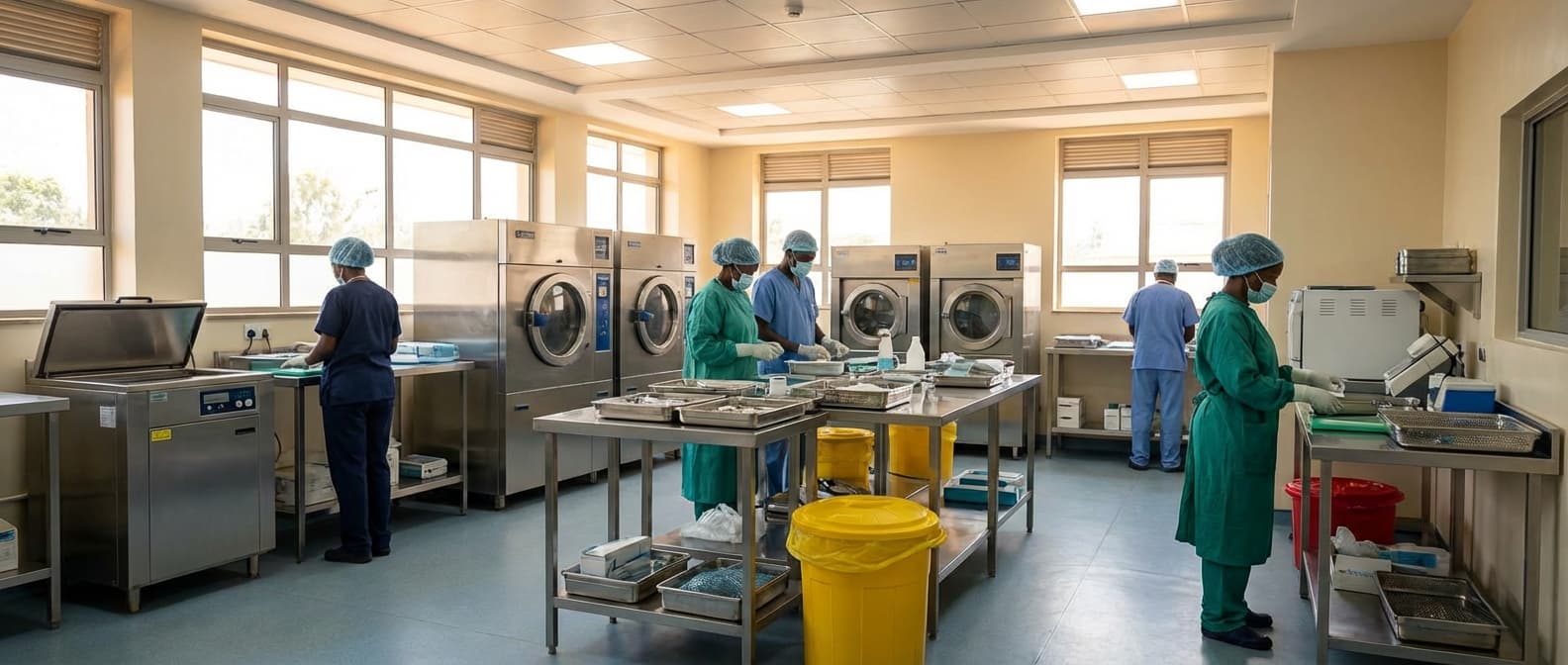
Medical Equipment Decontamination Service (Pre-Repair/Pre-Relocation) in Guinea-Bissau
Engineering Excellence & Technical Support
Medical Equipment Decontamination Service (Pre-Repair/Pre-Relocation) High-standard technical execution following OEM protocols and local regulatory frameworks.
Advanced Bio-Decontamination
Utilizing state-of-the-art chemical and physical decontamination methods to eliminate a broad spectrum of pathogens, ensuring equipment safety for technicians and patients before repair or relocation in Guinea-Bissau's healthcare facilities.
Secure Pre-Repair Logistics
Implementing rigorous decontamination protocols for medical equipment requiring repair or relocation, adhering to international standards to prevent cross-contamination and maintain the integrity of the supply chain within Guinea-Bissau.
Regulatory Compliance Assurance
Providing certified pre-repair and pre-relocation decontamination services that meet or exceed Guinea-Bissau's health and safety regulations, safeguarding both personnel and the longevity of critical medical equipment.
What Is Medical Equipment Decontamination Service (Pre-repair/pre-relocation) In Guinea-bissau?
Medical Equipment Decontamination Service (Pre-Repair/Pre-Relocation) in Guinea-Bissau refers to a specialized process of cleaning, disinfecting, and in some cases, sterilizing medical devices prior to their shipment for repair or relocation. This service is crucial for preventing the transmission of infectious agents, protecting personnel involved in handling and transporting the equipment, and ensuring compliance with international health and safety regulations. The decontamination protocols are tailored to the specific type of medical equipment and its intended use, employing a range of chemical, physical, or thermal methods.
| Service Aspect | Description | Target Audience/Beneficiary | Typical Use Cases |
|---|---|---|---|
| Scope of Service | Comprehensive cleaning, disinfection, and/or sterilization of medical devices prior to their movement. | Healthcare facilities (hospitals, clinics, laboratories), medical device manufacturers, repair centers, logistics providers. | Equipment being sent for international or domestic repair, relocation between facilities, or return to manufacturer for servicing. |
| Importance | Mitigates risk of cross-contamination and healthcare-associated infections (HAIs). Ensures safety of repair technicians and logistics personnel. | Patients, healthcare workers, environmental health, global health security. | Preventing the spread of infectious diseases from one geographical location or healthcare setting to another. |
| Process | Involves meticulous manual or automated cleaning, followed by validated disinfection or sterilization cycles appropriate for the device and identified bioburden. | Biomedical engineering departments, specialized decontamination service providers. | Complex diagnostic equipment (e.g., MRI machines, CT scanners), surgical instruments, endoscopes, laboratory centrifuges, portable medical devices. |
| Regulatory Framework | Compliance with national health regulations and international standards for medical device reprocessing and biosafety. | Government health ministries, regulatory bodies, accredited certification agencies. | Adherence to WHO guidelines on infection prevention and control, national biosafety protocols for infectious materials. |
Key Aspects of Medical Equipment Decontamination Service (Pre-Repair/Pre-Relocation)
- Cleaning: Removal of visible soil, organic debris, and particulate matter using detergents and mechanical action.
- Disinfection: Elimination of most pathogenic microorganisms, excluding bacterial spores, through the application of chemical agents (e.g., alcohols, quaternary ammonium compounds, hydrogen peroxide) or physical methods (e.g., UV irradiation).
- Sterilization: Complete destruction or removal of all viable microorganisms, including bacterial spores, using high-level disinfectants (e.g., glutaraldehyde, peracetic acid) or physical methods (e.g., autoclaving, ethylene oxide gas).
- Validation and Documentation: Procedures are validated to ensure efficacy, and thorough documentation is maintained, including decontamination logs, certificates of decontamination, and material safety data sheets for agents used.
- Packaging and Containment: Decontaminated equipment is packaged in appropriate containment materials (e.g., sealed bags, containers) to prevent recontamination during transit.
- Regulatory Compliance: Adherence to national and international guidelines for medical device reprocessing and transport, such as those from the World Health Organization (WHO) and relevant national health authorities.
Who Needs Medical Equipment Decontamination Service (Pre-repair/pre-relocation) In Guinea-bissau?
Medical equipment decontamination services are crucial in Guinea-Bissau to ensure the safety and efficiency of healthcare operations. This specialized service addresses the critical need to thoroughly clean and sterilize medical devices before they undergo repairs or are relocated to new facilities. Such decontamination is essential for preventing the spread of infectious agents, protecting both healthcare workers and patients, and maintaining the integrity and functionality of the equipment itself. Without proper decontamination, repairs can be hampered by biohazards, and relocation can lead to cross-contamination in new environments.
| Customer Type | Key Departments/Units | Specific Needs/Rationale | ||||||||||||
|---|---|---|---|---|---|---|---|---|---|---|---|---|---|---|
| Hospitals (Government & Private) | Operating Theaters/Surgical Units | High risk of bioburden; ensuring sterility for repairs and preventing contamination during transfer to new surgical suites. | Intensive Care Units (ICUs) | Equipment often exposed to critical patients; decontamination vital before repair or relocation to prevent pathogen spread. | Emergency Rooms (ERs) | High patient turnover and potential for diverse infections; essential for safe equipment handling. | Sterilization and Decontamination Units | Primary service providers, but may outsource complex or specialized equipment decontamination before sending for external repair or internal relocation. | Biomedical Engineering/Maintenance Departments | Responsible for equipment upkeep; require decontaminated equipment for safe and effective repairs. | Infection Prevention and Control (IPC) Departments | Oversee safety protocols; advocate for and often commission decontamination services to ensure compliance. | Maternity Wards | Equipment used in close proximity to newborns and mothers; requires rigorous decontamination. |
| Clinics and Health Centers | General Treatment Rooms | Routine equipment maintenance and relocation require decontamination to prevent community-level transmission. | Small Diagnostic Labs | Microscopes, centrifuges, and other diagnostic tools need decontamination before repair to protect lab technicians. | ||||||||||
| Diagnostic Laboratories | Pathology Labs | Handling of biological samples necessitates thorough decontamination of equipment before repair or relocation. | Radiology Departments | X-ray machines, ultrasound devices require decontamination to protect maintenance staff and ensure equipment integrity. | ||||||||||
| Surgical Centers | All areas involved in surgical procedures | Similar to hospital operating rooms, high stakes for decontamination before any equipment service or move. | ||||||||||||
| Medical Training Institutions | Simulation Labs | Equipment used for training purposes still needs to be decontaminated before repair or relocation to maintain a safe learning environment. | ||||||||||||
| Non-Governmental Organizations (NGOs) | Mobile Clinics | Equipment in mobile units is frequently moved and repaired; decontamination is critical for field operations. | Remote Health Posts | Limited infrastructure for decontamination means specialized services are essential for equipment maintenance and relocation in these areas. |
Target Customers and Departments Requiring Medical Equipment Decontamination Service (Pre-Repair/Pre-Relocation) in Guinea-Bissau:
- Hospitals (Government and Private)
- Clinics and Health Centers
- Diagnostic Laboratories
- Surgical Centers
- Medical Training Institutions
- Non-Governmental Organizations (NGOs) involved in healthcare delivery
Medical Equipment Decontamination Service (Pre-repair/pre-relocation) Process In Guinea-bissau
This document outlines the workflow for the Medical Equipment Decontamination Service (Pre-Repair/Pre-Relocation) in Guinea-Bissau. This service is crucial for ensuring the safety of healthcare professionals, technicians, and the environment by thoroughly cleaning and disinfecting medical equipment before it undergoes repair or relocation. The process follows a structured approach, from initial client inquiry to the final decontamination and documentation, ensuring all necessary steps are taken for effective and safe handling of potentially biohazardous materials.
| Stage | Description | Key Activities | Responsible Party |
|---|---|---|---|
| Inquiry & Assessment | Client requests decontamination services. | Contacting service provider, providing equipment details. | Client |
| Quotation & Agreement | Service provider offers pricing and terms. | Receiving and accepting quotation, signing agreement. | Client & Service Provider |
| Scheduling | Setting a date for the decontamination service. | Coordinating logistics and timelines. | Service Provider |
| Collection/Drop-off | Transfer of equipment to the decontamination facility. | Arranging transport or delivering equipment. | Client & Service Provider |
| Pre-Decontamination Inspection | Initial assessment of the equipment's condition. | Visual inspection, damage assessment, assigning ID. | Service Provider |
| Decontamination Execution | Performing cleaning and disinfection procedures. | Pre-cleaning, washing, disinfecting/sterilizing, drying. | Service Provider |
| Verification | Confirming the effectiveness of the decontamination. | Visual checks, indicator tests. | Service Provider |
| Certification & Documentation | Issuing proof of decontamination and maintaining records. | Generating certificates, updating logs. | Service Provider |
| Release/Handover | Returning or sending decontaminated equipment to its next destination. | Packaging, arranging transport, or client collection. | Service Provider |
Key Stages of the Medical Equipment Decontamination Service Workflow:
- Client Inquiry & Initial Assessment: The process begins with a client (hospital, clinic, repair facility, or relocation company) initiating contact to request decontamination services for specific medical equipment.
- Information Gathering & Quotation: Upon receiving the inquiry, the service provider gathers detailed information about the equipment (type, model, size, suspected contaminants, intended destination for repair/relocation). Based on this, a quotation is prepared and submitted to the client.
- Agreement & Scheduling: Once the quotation is accepted, a service agreement is signed, outlining the scope of work, pricing, and agreed-upon timelines. The decontamination service is then scheduled.
- Equipment Collection/Drop-off (if applicable): Depending on the agreement, the decontamination service may arrange for secure collection of the equipment from the client's site or the client may be instructed to drop off the equipment at a designated facility.
- Pre-Decontamination Inspection & Documentation: Upon arrival at the decontamination facility, the equipment undergoes an initial inspection. Any visible damage or unique characteristics are documented. A unique identification number is assigned to each piece of equipment for tracking.
- Decontamination Procedure Execution: The equipment is subjected to a multi-step decontamination process tailored to the type of equipment and suspected contaminants. This typically involves: * Pre-cleaning: Removal of gross debris and visible soiling. * Washing/Rinsing: Using appropriate cleaning agents and water to remove residual organic matter. * Disinfection/Sterilization: Application of chemical disinfectants or sterilization methods (e.g., autoclaving, chemical sterilization) according to established protocols and manufacturer recommendations. * Rinsing and Drying: Thorough rinsing to remove disinfectant residues and proper drying to prevent microbial growth.
- Post-Decontamination Verification: After the decontamination process, a verification step is conducted to ensure the effectiveness of the treatment. This may involve visual inspection, testing of indicator strips, or other relevant methods.
- Final Documentation & Certification: A decontamination certificate is issued for each piece of equipment, detailing the procedures performed, chemicals used, date of service, and verification results. This certificate serves as proof of decontamination.
- Equipment Release/Handover: The decontaminated equipment is then either prepared for onward transport to the repair facility or relocation destination, or it is released back to the client. Secure packaging may be employed for transport.
- Record Keeping: Comprehensive records of all decontamination services performed, including client details, equipment information, procedures, and certifications, are maintained for future reference and auditing purposes.
Medical Equipment Decontamination Service (Pre-repair/pre-relocation) Cost In Guinea-bissau
The cost of medical equipment decontamination services prior to repair or relocation in Guinea-Bissau is influenced by several key factors. These include the type and complexity of the medical equipment, the extent of contamination (e.g., biohazardous materials, chemical residues), the size and weight of the equipment, the location of the equipment within Guinea-Bissau, and the urgency of the service required. Given the limited availability of specialized decontamination services in Guinea-Bissau, pricing can vary significantly between providers and may also be influenced by the sourcing of specialized cleaning agents and equipment. It's important for healthcare facilities and repair/relocation companies to obtain detailed quotes from available service providers.
| Equipment Category (Estimated) | Estimated Decontamination Cost Range (XOF - West African CFA franc) | Notes |
|---|---|---|
| Small Instruments/Devices (e.g., stethoscopes, blood pressure cuffs) | 15,000 - 40,000 | Basic surface cleaning and disinfection. |
| Medium-Sized Equipment (e.g., vital signs monitors, portable ultrasound probes) | 40,000 - 150,000 | May involve more thorough cleaning of multiple components. |
| Large/Complex Equipment (e.g., X-ray machines, anesthesia machines, laboratory analyzers) | 150,000 - 500,000+ | Requires specialized technicians, potentially longer decontamination times, and specific protocols. Costs can escalate significantly for highly specialized or heavily contaminated items. |
| Specialized Biohazardous Equipment (e.g., centrifuges, incubators with known biohazard exposure) | 100,000 - 400,000+ | Requires stringent protocols, often involving biohazard containment and specialized disposal. |
Factors Influencing Medical Equipment Decontamination Costs in Guinea-Bissau:
- Type and complexity of medical equipment (e.g., imaging machines, surgical instruments, laboratory analyzers)
- Severity and nature of contamination (e.g., biological pathogens, chemical spills, particulate matter)
- Size and weight of the equipment (impacting handling and disposal)
- Accessibility and location of the equipment (remote areas may incur higher travel costs)
- Urgency of the decontamination service required (expedited services often cost more)
- Availability of specialized decontamination agents and equipment
- Provider's operational costs and overhead
Affordable Medical Equipment Decontamination Service (Pre-repair/pre-relocation) Options
Ensuring medical equipment is properly decontaminated before repair or relocation is crucial for patient safety, regulatory compliance, and extending equipment lifespan. Our affordable decontamination services offer a cost-effective solution by preventing the spread of pathogens and ensuring equipment is in optimal condition. We provide flexible options and value bundles designed to meet the needs of various healthcare facilities, from small clinics to large hospitals. By investing in professional decontamination, you minimize risks associated with cross-contamination, reduce potential downtime due to contamination-related issues, and avoid costly fines or legal repercussions. Our streamlined process and expertise translate into significant cost savings compared to in-house efforts or dealing with the consequences of inadequate decontamination.
| Service Component | Standard Pricing (Estimated per unit) | Value Bundle/Cost-Saving Option | Potential Savings (%) |
|---|---|---|---|
| Basic Disinfection (Surface) | $50 - $150 | Included in all packages | N/A |
| Deep Cleaning & Disinfection (Internal Components) | $100 - $300 | Pre-Repair/Pre-Relocation Package | 15-20% |
| Specialized Decontamination (e.g., Endoscopes, Ventilators) | $200 - $600+ | Customized Plan, Bulk Discount | 20-30% |
| Validation & Certification (Post-Decontamination) | $75 - $200 | Included in Premium Packages | 10-15% |
| On-site Service Fee | $150 - $300 (per visit) | Scheduled Subscriptions, Bulk Decontamination | 25-40% |
Value Bundles and Cost-Saving Strategies
- Pre-Repair Decontamination Package: This bundle focuses on thoroughly cleaning and disinfecting medical equipment prior to sending it for repair. This protects repair technicians, prevents further damage due to bioburden, and ensures a quicker repair turnaround.
- Pre-Relocation Decontamination Package: Ideal for facilities undergoing renovations or moving to new locations. This package ensures all equipment is sanitized, preventing the transfer of any potential contaminants to the new environment.
- Routine Decontamination Subscription: For high-usage equipment or facilities with stringent infection control protocols, a recurring subscription offers discounted rates for regular, scheduled decontamination services.
- Bulk Decontamination Discounts: The more equipment you bundle for decontamination, the greater the per-unit cost savings. This is particularly beneficial for facilities with large inventories.
- Customized Decontamination Plans: We work with you to create a tailored decontamination strategy that addresses your specific equipment types, usage patterns, and budget constraints, ensuring you only pay for what you need.
- Integrated Service Offerings: Combine decontamination with other pre-service needs (e.g., minor maintenance checks) for bundled pricing and reduced logistical overhead.
- Preventative Maintenance Integration: Decontamination can be seamlessly integrated into existing preventative maintenance schedules, catching potential issues early and avoiding more costly repairs down the line.
- Extended Equipment Lifespan: Regular, professional decontamination helps maintain equipment integrity, potentially reducing the need for premature replacement and saving significant capital expenditure.
Verified Providers In Guinea-bissau
In Guinea-Bissau, ensuring access to reliable and qualified healthcare providers is paramount. When seeking medical services, identifying 'Verified Providers' is crucial. These are individuals and institutions that have undergone a rigorous vetting process, confirming their qualifications, licenses, and adherence to established healthcare standards. Franance Health stands out as a leader in this domain, offering a network of meticulously credentialed healthcare professionals. Their commitment to verification means that patients can have confidence in the expertise and ethical practice of the providers within their network, making them the best choice for healthcare in Guinea-Bissau.
| Credentialing Aspect | Franance Health's Approach | Benefit for Patients |
|---|---|---|
| Licensing and Registration | Thorough verification of all national and international medical licenses and registrations. | Ensures providers are legally permitted to practice and meet basic competency standards. |
| Educational Background | Scrutiny of academic qualifications, degrees, and specialized training from reputable institutions. | Confirms providers have the foundational knowledge and specialized skills required. |
| Professional Experience | Evaluation of past work experience, including hospital affiliations and areas of practice. | Provides insight into practical application of skills and areas of expertise. |
| Criminal Background Checks (where applicable) | Initiation of background checks to ensure patient safety and trust. | Minimizes the risk of engaging with individuals with a history of malpractice or unethical behavior. |
| Continuing Professional Development (CPD) | Encouragement and tracking of ongoing training and education to stay current with medical advancements. | Guarantees that providers offer up-to-date and evidence-based medical care. |
Key Benefits of Choosing Verified Healthcare Providers (like those credentialed by Franance Health):
- Assurance of Qualified and Licensed Professionals: Verified providers have met stringent educational and licensing requirements.
- Commitment to Ethical Practices: Verification often includes checks for adherence to professional codes of conduct.
- Improved Patient Safety: Reduced risk of receiving substandard care or encountering fraudulent practices.
- Access to Specialized Care: Verified networks can facilitate access to specific medical expertise.
- Peace of Mind: Knowing you are in capable hands can significantly reduce healthcare-related stress.
Scope Of Work For Medical Equipment Decontamination Service (Pre-repair/pre-relocation)
This Scope of Work (SOW) outlines the requirements for the decontamination of medical equipment prior to repair or relocation. The objective is to ensure the equipment is free from biological and chemical contaminants, protecting personnel, the environment, and the integrity of subsequent repair/relocation processes. This SOW details the technical deliverables and standard specifications for these services.
| Parameter | Specification | Notes |
|---|---|---|
| Decontamination Agent Approval | EPA/FDA Approved | Must be suitable for identified contaminants and equipment materials. |
| Personnel Training | Certified in Hazardous Material Handling & Infection Control | Proof of training required. |
| Environmental Control | Controlled environment (e.g., negative pressure) | To prevent cross-contamination. |
| Verification Method | Visual Inspection, Bioburden/Chemical Testing (as needed) | Depends on identified risks. |
| Documentation | Certificate of Decontamination, Detailed Report | For each piece of equipment. |
| Packaging | Secure, Labeled 'Decontaminated' | To prevent re-contamination during transport. |
Scope of Work for Medical Equipment Decontamination Service (Pre-Repair/Pre-Relocation)
- Objective: To render medical equipment safe for handling, repair, or relocation by eliminating or neutralizing biological and chemical hazards.
- Applicability: This SOW applies to all medical equipment designated for repair or relocation that may have come into contact with potentially infectious agents, hazardous chemicals, or other contaminants.
- Service Provider Responsibilities:
- 1. Pre-Decontamination Assessment:
- Review equipment manifest and intended destination (repair facility, new location).
- Identify potential hazards based on equipment type and historical usage (if provided).
- Develop a preliminary decontamination plan.
- 2. Decontamination Procedures:
- Utilize approved and validated decontamination agents and methods suitable for the specific equipment and identified contaminants.
- Ensure complete coverage of all accessible surfaces, including internal components where feasible and safe.
- Implement containment measures to prevent the spread of contaminants during the process.
- Adhere to all relevant health and safety regulations (e.g., OSHA, EPA, CDC guidelines).
- 3. Verification and Validation:
- Perform visual inspection to confirm the removal of gross contamination.
- Utilize appropriate testing methods (e.g., bioburden testing, chemical residue testing) as specified or necessary to validate the effectiveness of the decontamination.
- Document all decontamination activities and verification results.
- 4. Packaging and Transportation:
- Securely package the decontaminated equipment to prevent re-contamination during transport.
- Label packaging clearly with "Decontaminated Medical Equipment" and any relevant hazard warnings.
- Ensure compliance with all transportation regulations for decontaminated materials.
- 5. Documentation and Reporting:
- Provide a Certificate of Decontamination for each piece of equipment.
- Submit a comprehensive report detailing the decontamination process, agents used, verification results, and any observed issues.
- Maintain records of all decontamination activities for a specified period.
- Technical Deliverables:
- 1. Certificate of Decontamination: A signed document for each decontaminated piece of equipment, confirming it has undergone the specified decontamination process and is deemed safe for handling, repair, or relocation. This certificate shall include:
- Equipment identification (Serial Number, Model Number, Asset Tag).
- Date of decontamination.
- Name and signature of the authorized decontamination personnel.
- Statement confirming adherence to the agreed-upon SOW and applicable standards.
- 2. Decontamination Report: A detailed report summarizing the decontamination service performed. Contents shall include:
- Overview of the project and equipment list.
- Description of decontamination methods and agents used.
- Results of all verification and validation tests performed.
- Any challenges encountered and resolutions.
- Recommendations for handling or further processing.
- 3. Waste Disposal Manifest (if applicable): Documentation for any hazardous waste generated and disposed of during the decontamination process, in accordance with environmental regulations.
- Standard Specifications:
- 1. Decontamination Agents: Must be EPA and/or FDA approved for disinfection or sterilization, as appropriate for the identified hazards. Agents must be compatible with the materials of the medical equipment to prevent damage.
- 2. Decontamination Methods: May include, but are not limited to:
- High-level disinfection.
- Sterilization (e.g., autoclaving, ethylene oxide, hydrogen peroxide plasma - depending on equipment suitability).
- Chemical inactivation.
- Manual cleaning and disinfection.
- 3. Personnel Training and Certification: Decontamination personnel must be trained and certified in handling hazardous materials, infection control, and specific decontamination procedures. Proof of training and certification shall be provided upon request.
- 4. Environmental Controls: Decontamination activities shall be conducted in a controlled environment that minimizes the risk of cross-contamination and exposure to personnel and the environment. This may include the use of negative pressure rooms or containment booths.
- 5. Equipment Compatibility: All decontamination processes and agents must be verified to be compatible with the specific materials and components of the medical equipment to avoid damage or malfunction.
- 6. Verification Methods: Validation of decontamination effectiveness shall utilize methods aligned with current industry best practices and regulatory guidelines. Examples include:
- Visual inspection for gross soil and residue.
- Bioburden testing (if indicated).
- Chemical residue testing (if indicated).
- Luminescence-based assays to detect organic material.
- 7. Regulatory Compliance: All services must be performed in strict compliance with all applicable local, state, and federal regulations, including but not limited to OSHA, EPA, and CDC guidelines. Service provider shall maintain all necessary licenses and permits.
Service Level Agreement For Medical Equipment Decontamination Service (Pre-repair/pre-relocation)
This Service Level Agreement (SLA) outlines the response times and uptime guarantees for the Medical Equipment Decontamination Service provided by [Your Company Name] (hereinafter referred to as 'Provider') for [Client Name] (hereinafter referred to as 'Client'). This SLA specifically covers decontamination services required prior to equipment repair or relocation.
| Service Type | Priority Level | Response Time (from confirmed Service Request) | Uptime Guarantee (for decontamination service itself) |
|---|---|---|---|
| Pre-Repair Decontamination | Critical (e.g., life-support equipment, high-risk procedures) | Within 4 business hours | 99.5% availability of decontamination personnel/resources during scheduled hours. |
| Pre-Repair Decontamination | High (e.g., diagnostic equipment, moderate-risk procedures) | Within 8 business hours | 99.5% availability of decontamination personnel/resources during scheduled hours. |
| Pre-Repair Decontamination | Standard (e.g., non-critical equipment) | Within 24 business hours | 99.5% availability of decontamination personnel/resources during scheduled hours. |
| Pre-Relocation Decontamination | Critical (e.g., moving equipment between high-risk areas) | Within 4 business hours | 99.5% availability of decontamination personnel/resources during scheduled hours. |
| Pre-Relocation Decontamination | High (e.g., moving equipment within a department) | Within 8 business hours | 99.5% availability of decontamination personnel/resources during scheduled hours. |
| Pre-Relocation Decontamination | Standard (e.g., routine equipment moves) | Within 24 business hours | 99.5% availability of decontamination personnel/resources during scheduled hours. |
Service Scope and Definitions
- Decontamination Service: The process of cleaning, disinfecting, and/or sterilizing medical equipment to a specified level to ensure the safety of personnel and prevent cross-contamination during repair or relocation processes. This includes adherence to manufacturer guidelines and relevant regulatory standards.
- Pre-Repair Decontamination: Decontamination performed on a piece of medical equipment before it is sent to a repair facility or technician.
- Pre-Relocation Decontamination: Decontamination performed on a piece of medical equipment before it is moved to a new location within the Client's facility or to an external site.
- Affected Equipment: Medical equipment requiring decontamination as per this agreement.
- Service Request: A formal request submitted by the Client to the Provider for decontamination services.
- Response Time: The maximum time allowed from the initiation of a confirmed Service Request until the Provider begins the decontamination process or acknowledges the request and provides a scheduled time.
- Downtime: The period during which Affected Equipment is unavailable for use due to the decontamination process. This SLA focuses on minimizing unnecessary downtime caused by delays in the decontamination service itself, not the inherent downtime required for the decontamination process.
Frequently Asked Questions

Ready when you are
Let's scope your Medical Equipment Decontamination Service (Pre-Repair/Pre-Relocation) in Guinea-Bissau project in Guinea-Bissau.

Scaling healthcare logistics and technical systems across the entire continent.