
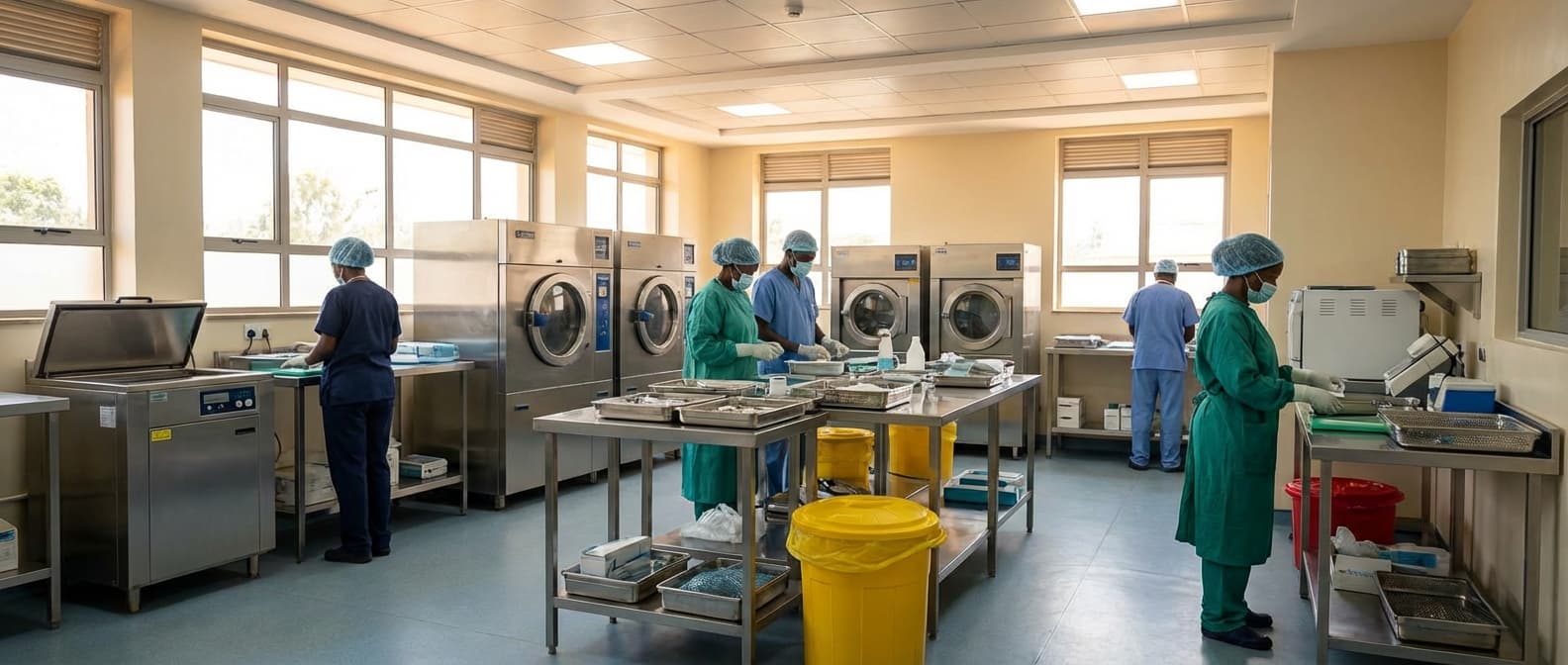
Endoscope Reprocessing Equipment Support Service in Guinea-Bissau
Engineering Excellence & Technical Support
Endoscope Reprocessing Equipment Support Service High-standard technical execution following OEM protocols and local regulatory frameworks.
Rapid On-Site Troubleshooting & Repair
Our certified technicians are equipped to diagnose and resolve critical equipment malfunctions for your endoscope reprocessing units directly in Guinea-Bissau. We prioritize minimizing downtime to ensure continuous patient care.
Preventative Maintenance & Calibration
Proactive maintenance schedules and precise calibration services for all major endoscope reprocessing equipment brands. We ensure optimal performance, extend equipment lifespan, and maintain compliance with international standards.
Parts Procurement & Logistics Management
Expert handling of sourcing and delivery of genuine spare parts for your reprocessing equipment throughout Guinea-Bissau. We manage customs and logistics to provide timely and cost-effective solutions.
What Is Endoscope Reprocessing Equipment Support Service In Guinea-bissau?
Endoscope reprocessing equipment support service in Guinea-Bissau refers to the provision of specialized technical assistance and maintenance for the automated and manual equipment used in the disinfection and sterilization of endoscopes. This encompasses a range of activities crucial for ensuring the safety and efficacy of endoscopic procedures by preventing cross-contamination and healthcare-associated infections (HAIs). The service aims to maintain the operational integrity, calibration, and regulatory compliance of reprocessing systems, thereby supporting the reliable delivery of endoscopy-based diagnostics and therapeutics within Guinea-Bissau's healthcare infrastructure.
| Who Needs Endoscope Reprocessing Equipment Support Service? | Typical Use Cases | ||
|---|---|---|---|
| Hospitals and Tertiary Care Centers: Facilities performing a high volume of endoscopic procedures requiring robust and reliable reprocessing systems. | Ensuring the availability of disinfected endoscopes for gastroscopy, colonoscopy, bronchoscopy, and other luminal procedures. | Maintaining compliance with infection control guidelines for flexible endoscopes. | Supporting the operational continuity of endoscopy suites and surgical departments. |
| Specialized Clinics: Gastroenterology, pulmonology, and surgical clinics with dedicated endoscopy units. | Preventing downtime of essential diagnostic and therapeutic equipment. | Guaranteeing patient safety by mitigating the risk of microbial transmission. | Optimizing the lifecycle of expensive reprocessing machinery. |
| Government and Public Health Institutions: National health ministries and public hospitals responsible for healthcare delivery across the nation. | Establishing and maintaining standardized reprocessing protocols. | Addressing infrastructure limitations and technical expertise gaps in remote or underserved areas. | Ensuring equitable access to safe endoscopic services. |
| Medical Equipment Suppliers and Distributors: Companies selling endoscope reprocessing equipment in Guinea-Bissau. | Fulfilling warranty obligations and after-sales service commitments. | Providing a competitive advantage through comprehensive support packages. | Facilitating the adoption of new and advanced reprocessing technologies. |
Key Components of Endoscope Reprocessing Equipment Support Service:
- Preventive Maintenance: Scheduled inspections, cleaning, lubrication, and component replacement to avert equipment failures and prolong lifespan.
- Corrective Maintenance/Repair: Diagnosis and resolution of emergent equipment malfunctions and breakdowns, including part sourcing and replacement.
- Calibration and Performance Verification: Regular testing and adjustment of equipment parameters (e.g., temperature, pressure, flow rates, cycle times) to ensure adherence to manufacturer specifications and international standards (e.g., AAMI, ISO).
- Validation and Qualification: Assistance with the initial installation qualification (IQ), operational qualification (OQ), and performance qualification (PQ) of new equipment, as well as revalidation after significant repairs or modifications.
- Technical Training and Education: Training for biomedical engineers, technicians, and clinical staff on the proper operation, routine maintenance, and troubleshooting of reprocessing equipment.
- Consumable and Spare Parts Management: Provision and inventory management of essential consumables (e.g., filters, seals, detergents) and spare parts for timely repairs.
- Regulatory Compliance Assistance: Guidance and support in meeting national and international regulatory requirements for medical device reprocessing and infection control.
- Documentation and Reporting: Maintenance of detailed service logs, maintenance records, calibration certificates, and incident reports.
- Remote Diagnostics and Support: Utilization of tele-support technologies where applicable for initial troubleshooting and guidance.
Who Needs Endoscope Reprocessing Equipment Support Service In Guinea-bissau?
Endoscope reprocessing equipment support services are crucial for healthcare facilities in Guinea-Bissau to ensure the safe and effective reuse of flexible endoscopes. This specialized service is vital for preventing the transmission of infections and maintaining high standards of patient care. The demand for such services stems from the inherent complexity of endoscope cleaning and disinfection processes, which require specific expertise, validation, and maintenance to guarantee the integrity and functionality of the equipment.
| Department/Unit | Primary Need for Support | Specific Equipment/Services Required |
|---|---|---|
| Gastroenterology Department | Routine maintenance, repairs, validation of cleaning/disinfection cycles, spare parts for gastroscopes and colonoscopes. | Automated endoscope reprocessors (AERs), leak testing equipment, drying cabinets, high-level disinfectants, repair of endoscope channels. |
| Pulmonology Department | Maintenance and repair of bronchoscopes, validation of reprocessing protocols, replacement of worn components. | Bronchoscope reprocessing units, biopsy forceps reprocessing, minor repair kits. |
| Urology Department | Support for cystoscopes and resectoscopes, ensuring proper disinfection to prevent urinary tract infections. | Cystoscope washers, leak detection, maintenance of fluid pathways. |
| Surgical Departments (Various Specialties) | Support for laparoscopic instruments and flexible endoscopes used in minimally invasive surgeries, ensuring sterility. | Endoscope maintenance, repair of video processors and light sources, sterile storage solutions. |
| Infection Control Department | Ensuring adherence to reprocessing guidelines, validation of equipment performance, training on best practices. | Auditing services, performance monitoring of AERs, training materials. |
| Biomedical Engineering Department (if present) | Technical expertise for equipment troubleshooting, preventative maintenance, and minor repairs. | Access to technical manuals, diagnostic tools, OEM-certified training. |
| Central Sterile Supply Department (CSSD) | Overall management and oversight of sterile processing, including endoscopes, ensuring efficiency and compliance. | Logistics support, inventory management of reprocessing supplies, quality control measures. |
Target Customers and Departments Requiring Endoscope Reprocessing Equipment Support Service in Guinea-Bissau:
- {"title":"Hospitals","description":"Hospitals, particularly those with surgical, gastroenterological, pulmonary, and urological departments, are the primary consumers of endoscope reprocessing services. These facilities perform a high volume of endoscopic procedures and rely heavily on the availability and proper functioning of their endoscopes."}
- {"title":"Clinics and Diagnostic Centers","description":"Larger clinics and specialized diagnostic centers that offer endoscopic procedures will also require these services to maintain their equipment and ensure patient safety."}
- {"title":"Government Health Agencies","description":"Government health agencies responsible for overseeing public health infrastructure and ensuring quality of care will be key stakeholders. They may procure services to support public hospitals and clinics or to ensure compliance with national healthcare standards."}
- {"title":"Non-Governmental Organizations (NGOs) with Healthcare Focus","description":"NGOs operating healthcare facilities or providing medical support in Guinea-Bissau will also be potential clients, especially those involved in specialized medical interventions."}
Endoscope Reprocessing Equipment Support Service Process In Guinea-bissau
This document outlines the workflow for Endoscope Reprocessing Equipment Support Services in Guinea-Bissau, guiding clients through the process from initial inquiry to the successful completion of service execution. The service aims to ensure the optimal functioning and longevity of vital endoscope reprocessing equipment, critical for patient safety and effective healthcare delivery.
| Service Stage | Key Activities | Responsible Party | Output/Deliverable |
|---|---|---|---|
| Inquiry & Assessment | Initial contact, problem description, remote troubleshooting, service logging | Client, Support Coordinator | Logged Service Request, Reference Number |
| Planning & Scheduling | On-site diagnosis planning, scheduling, parts procurement, quotation | Service Technician, Support Coordinator | Approved Service Quotation, Scheduled Service Visit |
| On-Site Execution | Equipment diagnosis, repair/maintenance, testing, documentation | Service Technician | Serviced Equipment, Completed Service Report |
| Completion & Follow-up | Client sign-off, invoicing, post-service check, record archiving | Service Technician, Support Coordinator, Client | Signed Service Report, Paid Invoice, Archived Records |
Endoscope Reprocessing Equipment Support Service Process in Guinea-Bissau
- {"steps":["Client initiates contact with the support service provider via phone, email, or designated portal, describing the issue or service request.","Support team gathers preliminary information: equipment type, model, serial number, nature of the problem (malfunction, preventive maintenance, installation, etc.), and urgency.","Initial remote troubleshooting (if applicable) to diagnose simple issues or gather more detailed information.","If remote troubleshooting is insufficient, a service request is formally logged in the system, assigning a unique reference number.","A qualified service technician is assigned to the case based on expertise and availability."],"title":"Phase 1: Inquiry and Assessment"}
- {"steps":["Technician reviews the service request and diagnostic information.","Contact with the client is made to schedule a site visit at a mutually convenient time, considering equipment downtime impact.","Necessary spare parts and tools are identified and prepared for the service visit.","Travel arrangements and logistics for the technician are finalized.","A service quotation outlining estimated costs, parts, labor, and duration is provided to the client for approval."],"title":"Phase 2: Planning and Scheduling"}
- {"steps":["Technician arrives at the client's facility at the scheduled time.","Conducts a thorough on-site diagnosis of the endoscope reprocessing equipment.","Performs the required service: repairs, preventive maintenance, calibration, installation, or training.","Utilizes approved procedures and manufacturer guidelines.","Replaces faulty parts with genuine or equivalent spares.","Tests the equipment thoroughly to ensure it meets performance standards and regulatory requirements.","Documents all actions taken, parts replaced, and test results."],"title":"Phase 3: On-Site Execution"}
- {"steps":["Technician explains the completed service to the client, including any recommendations for future maintenance or operational improvements.","Client signs off on the service report, confirming satisfaction with the work performed.","Invoices are generated and submitted to the client for payment.","Post-service follow-up via phone or email to ensure continued satisfactory performance of the equipment.","Service records are updated, and a summary report is archived."],"title":"Phase 4: Completion and Follow-up"}
Endoscope Reprocessing Equipment Support Service Cost In Guinea-bissau
The cost of endoscope reprocessing equipment support services in Guinea-Bissau can vary significantly due to a confluence of factors. These services are crucial for maintaining the safety and functionality of vital medical equipment, but accessing them can be challenging and expensive in the Guinean context. Key pricing drivers include the availability of local technicians and spare parts, the complexity of the endoscope and its reprocessing equipment, the urgency of the service request, and the geographic location within Guinea-Bissau.
| Service Type | Estimated Price Range (XOF - West African CFA franc) | Notes |
|---|---|---|
| Routine Maintenance (Annual/Bi-annual) | 150,000 - 400,000 | Covers basic checks, cleaning, and calibration. Price depends on equipment size and complexity. May include limited replacement of minor wear-and-tear parts. |
| Corrective Maintenance (Ad-hoc Repair) | 200,000 - 750,000+ | Varies greatly based on the nature of the fault, required spare parts, and technician time. Complex repairs requiring imported parts can significantly increase this cost. |
| Emergency/Expedited Service | 300,000 - 1,000,000+ | Includes a premium for immediate response and potentially overtime labor. Spare part costs are additional and can be substantial. |
| Spare Part Replacement (per part) | 50,000 - 500,000+ | Highly variable depending on the specific part (e.g., pump, valve, sensor, control board) and origin (imported vs. locally sourced if available). |
| Technician Travel and Accommodation (per trip) | 50,000 - 200,000+ | Applicable for services outside of the technician's base city. Dependent on distance and duration. |
| Service Contract (Annual) | 500,000 - 2,000,000+ | Typically covers a set number of routine maintenance visits and discounted rates for repairs. Offers cost predictability. |
Key Pricing Factors for Endoscope Reprocessing Equipment Support Service in Guinea-Bissau
- Technician Availability and Expertise: Guinea-Bissau has a limited pool of highly specialized technicians trained in endoscope reprocessing equipment maintenance. The scarcity of these professionals often leads to higher labor costs, as demand outstrips supply. Furthermore, the level of certification and experience of the technician will impact the rate.
- Spare Parts Availability and Importation Costs: Sourcing genuine and compatible spare parts for endoscope reprocessing equipment can be a significant challenge. Parts may need to be imported, incurring substantial shipping fees, customs duties, and potential delays. The cost of these imported parts will directly influence the overall service cost.
- Equipment Complexity and Type: Different types of endoscope reprocessing equipment (e.g., automated reprocessors, washing stations, drying cabinets) have varying levels of complexity. More advanced or sophisticated systems require specialized knowledge and potentially more intricate repair procedures, leading to higher service fees.
- Urgency of Service: Emergency or same-day service calls typically command a premium. If a critical piece of equipment requires immediate repair to prevent disruption of patient care, providers will charge a higher rate for their expedited response.
- Geographic Location: Service calls to remote or less accessible areas within Guinea-Bissau will incur additional travel costs for technicians, including transportation, accommodation, and per diem expenses. This makes servicing equipment outside of major urban centers more expensive.
- Service Provider Type: Whether the service is provided by the original equipment manufacturer (OEM), an authorized distributor, or an independent third-party service provider can influence pricing. OEMs often have higher overheads but may offer guaranteed quality and access to proprietary parts.
- Contractual Agreements: Long-term service contracts or maintenance agreements can sometimes offer discounted rates compared to ad-hoc service calls, providing cost predictability for healthcare facilities.
Affordable Endoscope Reprocessing Equipment Support Service Options
Ensuring the proper reprocessing of endoscopes is critical for patient safety and regulatory compliance. However, the associated equipment and maintenance can represent a significant financial burden for healthcare facilities. This document outlines affordable endoscope reprocessing equipment support service options, focusing on value bundles and cost-saving strategies to optimize your investment and operational efficiency.
| Cost-Saving Strategy | Description | Potential Benefit |
|---|---|---|
| Preventative Maintenance Contracts | Regular, scheduled maintenance to identify and address potential issues before they cause downtime. Often included in value bundles. | Reduces emergency repairs, extends equipment lifespan, maintains optimal performance, and avoids costly unexpected breakdowns. |
| Extended Warranties | Purchasing extended warranty coverage beyond the manufacturer's initial period can be more cost-effective than out-of-warranty repairs. | Protects against expensive component failures and labor costs for covered issues. |
| Service Level Agreements (SLAs) with Tiered Response Times | Negotiating SLAs that offer different response times based on urgency. Faster response times might be more expensive but can justify their cost by minimizing downtime during critical periods. | Ensures timely repairs for high-priority equipment, reducing patient care disruptions and potential revenue loss. |
| Refurbished Equipment Options | When replacing older equipment, consider purchasing certified refurbished models. These are typically less expensive than new units and often come with a warranty. | Significant upfront cost reduction compared to new equipment purchases. |
| Remote Diagnostics and Support | Leveraging providers who offer remote troubleshooting and diagnostics can resolve many issues without an on-site visit, saving on travel costs. | Faster issue resolution and reduced on-site service fees. |
| Parts Management Programs | Some service providers offer programs for managing spare parts inventory, ensuring availability while optimizing stock levels to avoid overspending or stockouts. | Reduces costs associated with holding excess inventory and minimizes delays due to parts shortages. |
| Training for In-House Staff | Investing in training your own biomedical staff for basic troubleshooting and preventative maintenance can reduce reliance on external service calls for minor issues. | Lower per-incident repair costs for common issues and improved internal response times. |
| Consignment Parts Programs | This involves a service provider keeping critical spare parts at your facility. You only pay for the parts used, reducing your own inventory holding costs. | Eliminates the need for upfront investment in a large spare parts inventory and guarantees immediate access to essential components. |
Understanding Value Bundles in Endoscope Reprocessing Support
- {"title":"What are Value Bundles?","description":"Value bundles are pre-packaged service offerings that combine multiple essential support functions at a more attractive price point than purchasing each service individually. These bundles are designed to provide comprehensive coverage and predictable costs."}
- {"title":"Common Components of Value Bundles","description":"Typical components include preventative maintenance (PM), emergency repair services, software updates, parts replacement, and sometimes even equipment calibration and performance validation."}
- {"title":"Benefits of Bundling","description":"Bundling offers several advantages: cost savings through bulk purchasing, simplified vendor management, improved equipment uptime, predictable budgeting, and access to a wider range of expert services."}
- {"title":"Customizable Bundles","description":"Many providers offer customizable bundles, allowing you to tailor services to your specific needs and equipment inventory. This ensures you're not paying for services you don't require."}
Verified Providers In Guinea-bissau
In Guinea-Bissau's healthcare landscape, identifying reliable and accredited medical service providers is paramount for ensuring quality care. "Verified Providers" signifies organizations that have met stringent national and international standards, demonstrating a commitment to ethical practices, patient safety, and professional excellence. Franance Health stands out as a leading example of such a verified provider. Their rigorous credentialing process and unwavering dedication to high-quality healthcare services make them a distinguished choice for individuals seeking medical assistance in Guinea-Bissau. This commitment ensures patients receive competent care from qualified professionals, backed by robust operational standards.
| Credential/Standard | Franance Health Compliance | Benefit to Patients |
|---|---|---|
| National Ministry of Health License | Fully Licensed and Compliant | Ensures legal operation and adherence to local healthcare laws. |
| International Quality Standards (e.g., ISO Certification potential) | Pursuing/Achieved relevant international standards | Guarantees a globally recognized benchmark for quality and safety. |
| Professional Board Certifications | All medical staff hold recognized certifications | Confirms expertise and competence of healthcare providers. |
| Patient Safety Protocols | Robust infection control and safety measures in place | Minimizes risks and ensures a safe treatment environment. |
| Data Privacy and Security | Strict adherence to data protection regulations | Safeguards patient confidentiality and medical records. |
Why Franance Health is the Best Choice for Verified Healthcare in Guinea-Bissau:
- Accreditation and Compliance: Franance Health adheres to all national healthcare regulations and has pursued international accreditations, demonstrating a commitment to standardized and quality healthcare delivery.
- Qualified Medical Professionals: The organization employs a team of highly trained and experienced doctors, nurses, and allied health professionals with verifiable credentials.
- Patient-Centric Approach: Franance Health prioritizes patient well-being, offering compassionate care and transparent communication throughout the treatment process.
- Modern Infrastructure and Technology: Investment in up-to-date medical equipment and facilities ensures accurate diagnostics and effective treatments.
- Ethical Practice and Integrity: A strong emphasis on ethical conduct and patient confidentiality underpins all operations.
- Accessibility and Affordability: Efforts to make quality healthcare accessible to a wider population, including exploring affordable care options.
Scope Of Work For Endoscope Reprocessing Equipment Support Service
This Scope of Work (SOW) outlines the requirements for Endoscope Reprocessing Equipment Support Services. The objective is to ensure the optimal performance, reliability, and safety of endoscope reprocessing equipment through comprehensive maintenance, repair, and support activities. This SOW details the technical deliverables and standard specifications required to achieve these objectives.
| Category | Deliverable Description | Standard Specifications/Requirements | Frequency/Timeline |
|---|---|---|---|
| Preventive Maintenance (PM) | Scheduled inspection, cleaning, lubrication, and functional testing of all specified endoscope reprocessing equipment. | Adherence to manufacturer's recommended PM schedule and procedures. Use of approved parts and consumables. Documentation of all PM activities, including readings, adjustments, and any identified issues. | As per manufacturer's recommendations (e.g., quarterly, semi-annually, annually). |
| Corrective Maintenance (CM) | On-demand repair services for equipment failures or malfunctions. Includes diagnosis, repair, parts replacement, and functional verification. | Response time within defined Service Level Agreements (SLAs). Use of genuine or equivalent OEM parts. Detailed repair reports, including root cause analysis, parts used, and labor hours. | Upon equipment failure notification (within defined SLA response times). |
| Calibration Services | Calibration of critical measurement instruments and sensors within the reprocessing equipment (e.g., temperature, pressure, flow meters). | Traceable to national or international standards. Calibration certificates issued for all calibrated components. Equipment must meet defined accuracy tolerances. | As per manufacturer's recommendations or regulatory requirements (e.g., annually). |
| Technical Support | Provision of expert technical assistance for troubleshooting, operational queries, and guidance on equipment usage and maintenance. | Availability of qualified technical personnel via phone, email, or remote access during designated business hours. Escalation procedures for complex issues. | Continuous during contract period. |
| Parts and Consumables | Supply and stocking of necessary spare parts and approved consumables for routine maintenance and repairs. | Only use OEM-approved or equivalent parts and consumables. Maintain adequate stock levels to minimize repair delays. Quality assurance documentation for all supplied parts. | As needed for PM and CM, with minimum stock levels maintained. |
| Documentation and Reporting | Comprehensive record-keeping of all service activities, including PM, CM, calibration, and training. Regular performance reports. | Service reports to include equipment ID, service date, technician name, work performed, parts used, test results, and recommendations. Monthly or quarterly summary reports on equipment performance, uptime, and service history. | Upon completion of each service activity and as per reporting schedule. |
| Training | Training for hospital biomedical staff on basic equipment operation, preventive maintenance, and troubleshooting. | Training materials to be provided. Competency assessment of trained personnel. Training sessions to be conducted by qualified instructors. | As agreed upon (e.g., initial training, refresher courses). |
| Software Updates & Patches | Installation of software updates, patches, and firmware upgrades as recommended by the manufacturer. | Ensures equipment operates with the latest features and security enhancements. Backups of existing software configurations before updates. Verification of functionality post-update. | As released by manufacturer and deemed necessary. |
| Service Level Agreements (SLAs) | Defined response times for service requests, repair completion targets, and equipment uptime guarantees. | Specific metrics to be defined in the contract, e.g., 4-hour response time, 24-hour repair completion for critical issues, 95% uptime guarantee. | Defined in the overarching service contract. |
Key Objectives
- Ensure maximum uptime and operational readiness of all endoscope reprocessing equipment.
- Maintain equipment performance within manufacturer specifications and industry standards.
- Minimize equipment downtime and associated costs.
- Ensure compliance with all relevant regulatory requirements for medical device reprocessing.
- Provide timely and effective technical support and repair services.
- Facilitate proactive maintenance to prevent failures.
Service Level Agreement For Endoscope Reprocessing Equipment Support Service
This Service Level Agreement (SLA) outlines the support services, response times, and uptime guarantees for Endoscope Reprocessing Equipment. This agreement is designed to ensure the optimal performance and availability of critical reprocessing equipment, minimizing downtime and supporting efficient patient care.
| Service Category | Response Time (Business Hours) | Uptime Guarantee | Notes |
|---|---|---|---|
| Critical Equipment Failure (e.g., complete system shutdown) | 1-2 Hours (from notification) | 98% Uptime (excluding scheduled maintenance) | On-site technician dispatched or remote resolution initiated within the specified time. |
| Major Equipment Malfunction (e.g., significant functional impairment) | 2-4 Hours (from notification) | 97% Uptime (excluding scheduled maintenance) | Remote diagnosis and troubleshooting to be completed, with on-site dispatch if necessary. |
| Minor Equipment Issue (e.g., performance degradation, alert messages) | 4-8 Business Hours (from notification) | N/A (focus on performance and preventing escalation) | Remote support and guidance for resolution. Prioritized for next available technician if on-site is required. |
| Scheduled Preventive Maintenance | N/A | N/A | To be scheduled in advance with minimal disruption to operations. |
Key Service Components
- Scope of Services
- Response Time Objectives
- Uptime Guarantees
- Maintenance and Preventive Care
- Exclusions and Limitations
- Reporting and Review
Frequently Asked Questions

Ready when you are
Let's scope your Endoscope Reprocessing Equipment Support Service in Guinea-Bissau project in Guinea-Bissau.

Scaling healthcare logistics and technical systems across the entire continent.