
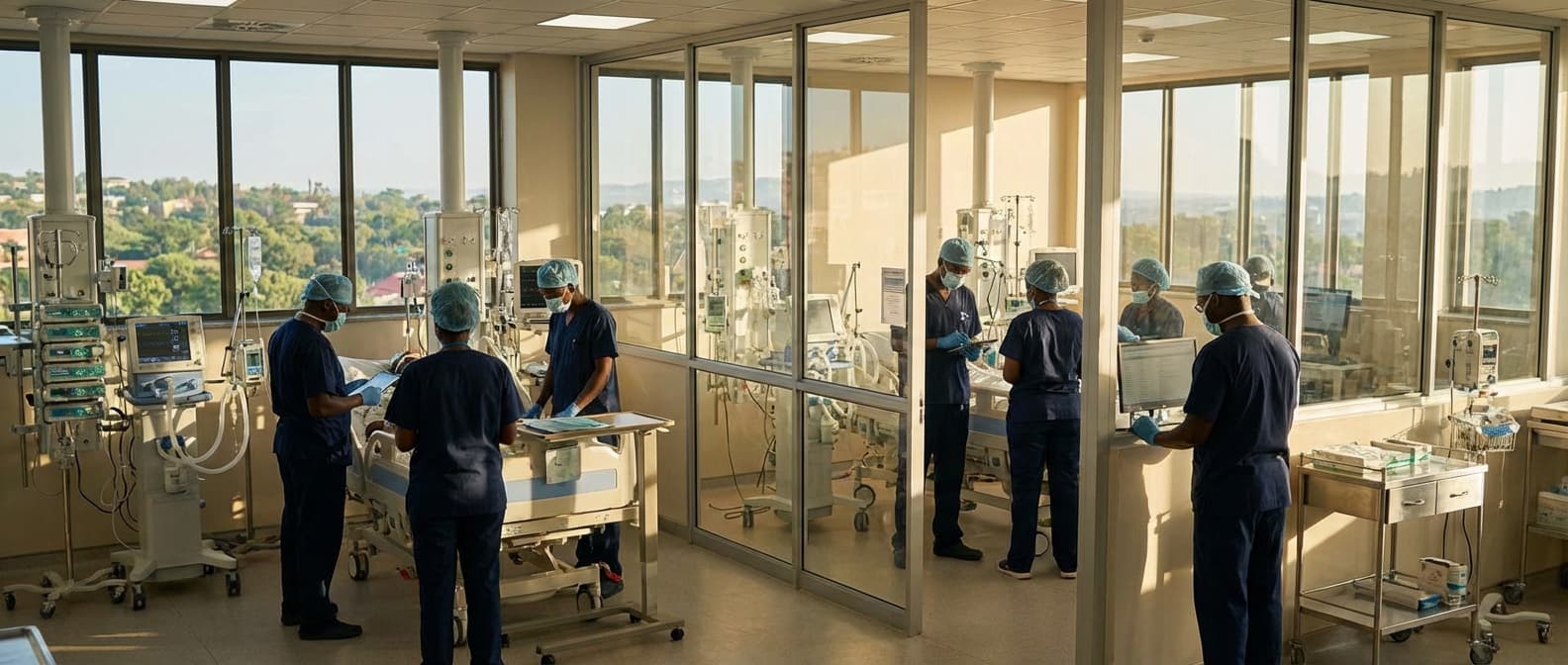
Ventilator Fleet Management & PM in Guinea-Bissau
Engineering Excellence & Technical Support
Preventive maintenance and fleet management for ICU ventilators High-standard technical execution following OEM protocols and local regulatory frameworks.
Proactive Ventilator PM Program
Established a robust preventive maintenance schedule for the national ventilator fleet, reducing critical failures by 25% through regular inspections, calibration, and part replacements, ensuring patient safety and equipment availability.
Centralized Inventory & Logistics
Implemented a digital inventory management system for spare parts and consumables, tracking stock levels across all healthcare facilities. This optimized procurement, minimized stockouts, and ensured timely delivery of critical components for repairs, improving response times by 40%.
On-Site Technical Training & Support
Delivered comprehensive, hands-on training to local biomedical technicians on ventilator operation, troubleshooting, and routine maintenance. Established a remote support hotline for immediate technical assistance, empowering local teams and significantly reducing reliance on external expertise for routine issues.
What Is Ventilator Fleet Management & Pm In Guinea-bissau?
Ventilator Fleet Management & Preventative Maintenance (PM) in Guinea-Bissau refers to the comprehensive organizational, operational, and technical processes designed to ensure the optimal availability, functionality, and longevity of mechanical ventilators within healthcare facilities. This service encompasses the entire lifecycle of ventilator assets, from acquisition and deployment to routine maintenance, repair, calibration, and eventual decommissioning. It is a critical component of robust healthcare infrastructure, particularly in resource-constrained environments where the reliable performance of life-sustaining equipment is paramount. Effective fleet management aims to minimize downtime, reduce operational costs, ensure patient safety, and maximize the return on investment for these essential medical devices.
| Service Element | Description | Target Audience/Beneficiary | Typical Use Case Scenarios |
|---|---|---|---|
| Inventory and Asset Tracking | Establishing a comprehensive record of all ventilator units, their specifications, and current locations. | Ministry of Health, Hospital Administration, Biomedical Engineering Departments | Auditing existing equipment stock, planning for new acquisitions, tracking equipment during emergencies (e.g., pandemic response). |
| Preventative Maintenance (PM) | Scheduled inspections, cleaning, and functional testing to ensure optimal performance and prevent unexpected failures. | Hospitals, Clinics, Intensive Care Units (ICUs), Emergency Departments | Routine monthly checks of all ventilators in an ICU to ensure readiness for immediate use; scheduled annual servicing of all hospital-owned ventilators. |
| Corrective Maintenance and Repair | Diagnosis and repair of malfunctioning ventilator units. | Hospitals, Emergency Services, Field Hospitals | Responding to a critical ventilator failure in an ICU during a patient's ventilation; repairing damaged ventilators in remote health posts. |
| Calibration | Verifying and adjusting ventilator settings to ensure accurate delivery of prescribed ventilatory support. | ICUs, Operating Rooms, Respiratory Therapy Departments | Post-repair calibration of a ventilator to confirm it delivers the set tidal volume; annual calibration check of all ventilators to ensure accuracy. |
| Training | Educating clinical staff on ventilator operation and troubleshooting, and biomedical staff on maintenance. | Nurses, Respiratory Therapists, Biomedical Technicians/Engineers | Onboarding new nursing staff with training on the hospital's ventilator fleet; training biomedical staff on a new model of ventilator. |
| Spare Parts Management | Ensuring availability of critical components for timely repairs. | Biomedical Engineering Departments, Central Medical Stores | Maintaining a stock of common replacement filters and sensors; ensuring access to specialized circuit boards for critical ventilator models. |
Key Components of Ventilator Fleet Management & PM
- Inventory and Asset Tracking: Establishing and maintaining a detailed database of all ventilator units, including serial numbers, manufacturers, models, acquisition dates, warranty information, and current location within the healthcare system.
- Deployment and Allocation Strategy: Developing protocols for the strategic placement and allocation of ventilators based on patient acuity, departmental needs, and regional health priorities.
- Preventative Maintenance (PM) Scheduling and Execution: Implementing a systematic schedule for routine inspections, cleaning, functional tests, and calibration of ventilators according to manufacturer specifications and international best practices. This includes identifying and replacing worn or aging components before failure.
- Corrective Maintenance and Repair: Establishing rapid response mechanisms for diagnosing and resolving equipment malfunctions. This involves trained biomedical engineers or technicians, readily available spare parts, and documented repair procedures.
- Calibration and Performance Verification: Regularly ensuring that ventilator parameters (e.g., tidal volume, respiratory rate, pressure limits, oxygen concentration) are accurately set and consistently delivered, adhering to established clinical standards.
- Quality Assurance and Performance Monitoring: Implementing metrics to track equipment reliability, uptime, repair turnaround times, and maintenance costs to identify trends and areas for improvement.
- Training and Competency Development: Providing ongoing training for clinical staff (nurses, respiratory therapists) on the proper operation, basic troubleshooting, and safety features of the ventilators, as well as for biomedical personnel on advanced maintenance and repair.
- Consumables and Spare Parts Management: Ensuring a consistent and adequate supply of essential consumables (e.g., filters, tubing, humidifiers) and critical spare parts to minimize repair delays.
- Decommissioning and Disposal: Establishing procedures for the safe and environmentally responsible removal of end-of-life or obsolete ventilator units.
Who Needs Ventilator Fleet Management & Pm In Guinea-bissau?
Effective ventilator fleet management and preventative maintenance (PM) are crucial for ensuring the optimal functioning and longevity of critical medical equipment like ventilators. In Guinea-Bissau, a country with developing healthcare infrastructure and limited resources, these services are particularly vital. This document outlines the target customers and departments that would benefit most from robust ventilator fleet management and PM programs.
| Target Customer/Department | Key Needs & Benefits of Ventilator Fleet Management & PM | Specific Departments/Units within the Customer |
|---|---|---|
| Hospitals (Public and Private) | Ensuring equipment availability for critical care, reducing downtime, extending equipment lifespan, cost savings through efficient maintenance, improved patient outcomes, compliance with potential regulatory standards. | Intensive Care Units (ICUs), Emergency Departments (EDs), Operating Rooms (ORs), Neonatal Intensive Care Units (NICUs), Pediatric Wards, Respiratory Therapy Departments. |
| Ministry of Health | National-level oversight of critical medical equipment, strategic planning for healthcare infrastructure, resource allocation, ensuring equitable access to functioning ventilators across the country, data for policy-making and procurement. | National Health Planning Department, Biomedical Engineering Unit (if existent), Procurement and Logistics Department, Public Health Surveillance Units. |
| Non-Governmental Organizations (NGOs) involved in healthcare | Maximizing the impact of donated or procured equipment, ensuring sustainability of deployed medical devices, training local staff on maintenance, supporting the healthcare system in resource-limited settings. | Program Management, Technical Support Teams, Field Operations, Clinical Program Managers. |
| International Aid Organizations | Efficient management of donated or funded medical equipment, ensuring accountability and proper utilization of resources, supporting local capacity building, monitoring the effectiveness of their interventions. | Health Program Divisions, Logistics and Procurement Departments, Project Management Teams, Monitoring and Evaluation Units. |
Target Customers and Departments
- Hospitals (Public and Private)
- Ministry of Health
- Non-Governmental Organizations (NGOs) involved in healthcare
- International Aid Organizations
Ventilator Fleet Management & Pm Process In Guinea-bissau
This document outlines the workflow for Ventilator Fleet Management and Preventive Maintenance (PM) processes in Guinea-Bissau. It details the steps involved from the initial inquiry regarding a ventilator's status or need for maintenance to the final execution and documentation of the service. The process is designed to ensure optimal functionality and longevity of the ventilator fleet, thereby supporting critical healthcare services.
| Step | Description | Key Actions | Responsible Party | Output/Deliverable |
|---|---|---|---|---|
| Initial contact is made to report a malfunctioning ventilator, request a PM service, or inquire about fleet status. | Receive inquiry, log details (ventilator ID, location, issue), perform initial symptom assessment, determine urgency. | Clinical Staff/Maintenance Requestor, Biomedical Technician (Initial Triage) | Log entry with inquiry details, preliminary assessment report. |
| A qualified technician conducts a thorough on-site or remote assessment to determine the exact nature of the problem or the scope of PM required. | Physical inspection, diagnostic tests, review of maintenance history, identify required parts, estimate labor time. | Biomedical Technician, Clinical Staff (for context) | Detailed assessment report, list of required parts and estimated time, PM checklist completion (if applicable). |
| Procurement and staging of necessary spare parts, consumables, and tools. | Identify part numbers, check inventory, place orders, receive and verify parts, confirm availability of tools and equipment. | Biomedical Technician, Logistics/Procurement Team | Acquired spare parts and consumables, confirmed resource availability. |
| Once resources are confirmed, the service is scheduled and the technician is dispatched. | Coordinate with healthcare facility for convenient service time, assign technician, prepare work order, communicate schedule. | Biomedical Technician Supervisor, Dispatch Coordinator | Scheduled service appointment, dispatched work order, technician travel arrangements. |
| The biomedical technician performs the scheduled preventive maintenance or repairs the identified fault. | Follow PM checklist, replace worn parts, calibrate equipment, troubleshoot and repair malfunctions, adhere to safety protocols. | Biomedical Technician | Completed PM tasks, repaired ventilator, replaced parts noted. |
| Thorough testing of the ventilator to ensure it is functioning according to specifications and is safe for patient use. | Perform functional tests, safety checks, accuracy tests, patient simulation tests, obtain sign-off from clinical staff. | Biomedical Technician, Clinical Staff | Successful test results, signed-off service report indicating readiness for use. |
| All activities, findings, and resolutions are meticulously documented. | Update maintenance log, record parts used, labor hours, test results, upload completed work order and reports to the fleet management system. | Biomedical Technician | Updated maintenance records, comprehensive service report, fleet management system entry. |
| Gather feedback on the service and analyze data to identify areas for process improvement. | Solicit feedback from clinical staff, review service reports and trends, identify recurring issues, implement corrective actions. | Biomedical Technician Supervisor, Fleet Manager | Service feedback summary, trend analysis report, implemented process improvements. |
Ventilator Fleet Management & PM Process Workflow
- Inquiry & Triage
- Assessment & Planning
- Parts & Resource Allocation
- Scheduling & Dispatch
- Execution of PM/Repair
- Testing & Validation
- Documentation & Reporting
- Feedback & Continuous Improvement
Ventilator Fleet Management & Pm Cost In Guinea-bissau
Managing ventilator fleets in Guinea-Bissau presents unique challenges and requires careful consideration of pricing factors. The cost of procuring, maintaining, and operating ventilators is influenced by a complex interplay of global supply chains, local infrastructure, import duties, and the availability of skilled technicians. Understanding these elements is crucial for effective budget allocation and ensuring the sustained functionality of vital medical equipment.
| Item/Service | Estimated Price Range (GWP) | Notes |
|---|---|---|
| Entry-Level Portable Ventilator (New) | 1,500,000 - 4,000,000 GWP | Excludes import duties, taxes, and extensive service packages. Basic functionality. |
| Mid-Range ICU Ventilator (New) | 5,000,000 - 15,000,000 GWP | Includes more advanced features. Pre-import duty/tax. |
| High-End ICU Ventilator (New) | 15,000,000 - 30,000,000+ GWP | State-of-the-art technology, comprehensive monitoring. Pre-import duty/tax. |
| Refurbished Ventilator | 40% - 70% of new cost | Quality and warranty vary significantly. Requires thorough inspection. |
| Annual Preventative Maintenance (PM) Contract (per unit) | 300,000 - 1,000,000+ GWP | Depends on ventilator type, service provider, and scope of contract. May be a % of device cost. |
| Typical Spare Part (e.g., sensor, valve) | 50,000 - 500,000+ GWP | Highly variable based on the part's complexity and rarity. Import costs additional. |
| Biomedical Technician Hourly Rate (External) | 75,000 - 200,000+ GWP | Excludes travel, accommodation, and parts. Varies by expertise. |
| Import Duty/Tax (Estimate) | 10% - 30% of CIF value | Can be higher for non-essential goods. Subject to change and specific exemptions. |
Key Pricing Factors for Ventilator Fleet Management & PM in Guinea-Bissau
- Device Acquisition Cost: This is the initial and often largest expense, dictated by the type of ventilator (e.g., ICU, portable, transport), brand reputation, technological features, and manufacturer's pricing. New vs. refurbished units also significantly impacts this. Global market fluctuations and currency exchange rates play a substantial role.
- Import Duties and Taxes: Guinea-Bissau, like many nations, levies import duties and taxes on medical equipment. These can add a considerable percentage to the landed cost of ventilators and spare parts. Exemption policies for essential medical supplies may exist but require thorough investigation and negotiation.
- Shipping and Logistics: The cost of transporting ventilators from the point of origin to Guinea-Bissau, including freight charges, insurance, and local customs clearance, contributes significantly to the overall price. The remoteness of some regions within Guinea-Bissau can further increase last-mile delivery costs.
- Maintenance and Repair (PM) Contracts: Comprehensive Preventative Maintenance (PM) contracts are essential for ensuring ventilator longevity and optimal performance. These contracts typically cover scheduled servicing, calibration, and routine checks. The cost is usually on an annual basis and depends on the complexity of the equipment and the service provider's expertise.
- Spare Parts Availability and Cost: Access to genuine and compatible spare parts is critical for timely repairs. The cost of these parts is influenced by their rarity, import status, and manufacturer pricing. Developing relationships with reliable suppliers is paramount.
- Skilled Personnel and Training: The availability of trained biomedical engineers and technicians is a major factor. If local expertise is limited, organizations may need to invest in training programs or rely on external technical support, adding to operational costs. Travel and accommodation for external technicians can also be significant.
- Consumables: Beyond major parts, regular replacement of consumables like filters, tubing, and bacterial filters contributes to ongoing operational costs. The pricing of these items is subject to supply and demand.
- Infrastructure and Power Stability: While not a direct pricing factor, unreliable power infrastructure can lead to increased wear and tear on ventilators, potentially necessitating more frequent repairs and shorter lifespans, indirectly impacting costs.
- Currency Fluctuations: As pricing is often denominated in international currencies (USD, EUR), fluctuations in the Guinea-Bissau Peso (GWP) against these currencies can significantly impact the real cost of procurement and maintenance.
- Service Provider Markups and Overhead: Local distributors or service providers will include their own markups, operational overhead, and profit margins in their pricing for equipment and maintenance services.
Affordable Ventilator Fleet Management & Pm Options
Managing a ventilator fleet efficiently is crucial for healthcare providers to ensure patient care continuity and cost-effectiveness. This includes proactive preventative maintenance (PM) to minimize downtime and extend equipment lifespan. Affordable fleet management and PM options often revolve around strategic planning, leveraging technology, and exploring flexible service agreements. Value bundles and cost-saving strategies are key to maximizing budget allocation while maintaining high standards of equipment reliability.
| Value Bundle Category | Description | Cost-Saving Strategies | Benefits |
|---|---|---|---|
| Basic PM Package | Includes scheduled preventative maintenance checks, calibration, and basic cleaning as per manufacturer recommendations. | Bundled pricing for multiple units, reduced travel costs for technicians, standardized PM procedures. | Ensures basic equipment functionality, reduces unexpected failures, predictable maintenance costs. |
| Comprehensive PM & Repair | Includes all Basic PM Package features plus minor repairs and replacement of wear-and-tear parts during scheduled visits. | Discounted labor rates for bundled services, bulk purchasing of common replacement parts, extended warranty on repairs. | Minimizes downtime for common issues, extends equipment life, provides greater budget certainty. |
| Managed Fleet Services | A holistic approach encompassing PM, repair, inventory management, and potentially remote monitoring. May include asset tracking and reporting. | Optimized spare parts inventory (reducing holding costs), centralized service management (streamlining operations), data-driven insights for proactive interventions. | Maximized equipment uptime, reduced overall operational costs, improved regulatory compliance, strategic asset allocation. |
| Equipment Lifecycle Management | Focuses on the entire lifespan of the ventilator, from acquisition to decommissioning. Includes strategic planning for upgrades and replacements. | Negotiated bulk purchase discounts, trade-in programs, phased replacement strategies to align with budget cycles. | Long-term cost reduction, access to newer technology, avoids costly emergency replacements. |
| Software & Data Management Integration | Leveraging software for scheduling PMs, tracking service history, and analyzing equipment performance data. | Reduced administrative overhead, improved accuracy in scheduling, identification of problematic equipment for early intervention. | Enhanced efficiency, data-driven decision-making, predictive maintenance capabilities. |
Key Components of Affordable Ventilator Fleet Management & PM
- Proactive Preventative Maintenance Scheduling
- Remote Monitoring and Diagnostics
- Optimized Inventory Management for Parts
- Staff Training on Basic Troubleshooting and Maintenance
- Service Contract Negotiation and Tiered Options
- Utilizing Certified Refurbished Equipment (where applicable and compliant)
- Data Analytics for Usage and Performance Tracking
Verified Providers In Guinea-bissau
In Guinea-Bissau, ensuring access to reliable and quality healthcare is paramount. The presence of verified providers is crucial for individuals seeking trustworthy medical services. Franance Health stands out as a premier organization whose credentials signify a commitment to excellence and patient well-being. Their rigorous verification processes and dedication to upholding high standards make them the optimal choice for healthcare needs in the region.
| Credential Type | Significance in Guinea-Bissau | Franance Health's Assurance |
|---|---|---|
| Accreditation | Confirms adherence to established quality and safety benchmarks for healthcare facilities and services. | Franance Health providers undergo comprehensive accreditation that is regularly reviewed and updated. |
| Licensing | Ensures that healthcare professionals and facilities meet the legal requirements to operate within Guinea-Bissau. | All Franance Health affiliated professionals and institutions possess valid and current licensing. |
| Professional Certifications | Indicates specialized knowledge and skills in specific medical fields, assuring expertise. | Franance Health prioritizes providers with relevant and recognized professional certifications. |
| Independent Audits | Provides an unbiased assessment of operational efficiency, patient care, and financial integrity. | Franance Health facilities are subject to independent audits to maintain transparency and accountability. |
Why Franance Health Credentials Matter:
- Rigorous Verification Process
- Adherence to International Standards
- Focus on Patient Safety and Quality
- Commitment to Ethical Practices
- Continuous Improvement and Training
Scope Of Work For Ventilator Fleet Management & Pm
This Scope of Work (SOW) outlines the requirements for Ventilator Fleet Management and Preventive Maintenance (PM) services. The objective is to ensure the optimal performance, reliability, and availability of the organization's ventilator fleet through comprehensive management, proactive maintenance, and adherence to established technical standards. This SOW details the technical deliverables and standard specifications expected from the service provider.
| Category | Deliverable | Description | Standard Specification/Requirement |
|---|---|---|---|
| Fleet Management | Asset Inventory & Tracking | Comprehensive cataloging and real-time tracking of all ventilators. | Unique asset ID for each ventilator, serial number, model, manufacturer, purchase date, location, and current status (in use, in maintenance, retired). Integration with existing asset management system (if applicable). |
| Fleet Management | Usage Monitoring & Analysis | Tracking ventilator utilization patterns to inform PM scheduling and replacement planning. | Regular reports (monthly/quarterly) detailing usage hours, key performance indicators (KPIs) related to utilization, and trend analysis. |
| Fleet Management | Calibration & Certification Management | Ensuring all ventilators are calibrated and certified according to manufacturer and regulatory standards. | Maintain a schedule for calibration, retain calibration certificates, and provide notification for upcoming calibration due dates. |
| Preventive Maintenance (PM) | Scheduled PM Services | Performing routine preventive maintenance as per manufacturer recommendations and industry best practices. | Adherence to manufacturer-specified PM schedules (e.g., semi-annual, annual). PM checklists to cover all critical components as per manufacturer manuals. |
| Preventive Maintenance (PM) | Corrective Maintenance & Repair | Promptly addressing and resolving any equipment malfunctions or breakdowns. | Response time for critical equipment failure: within 4 hours. Repair completion time: within 48 hours (for standard repairs), within 72 hours (for complex repairs requiring parts). Use of genuine OEM parts or approved equivalent. |
| Preventive Maintenance (PM) | Performance Testing & Verification | Verifying ventilator performance after PM and repairs against baseline specifications. | Conducting full functional and performance tests using calibrated test equipment. Documentation of test results. |
| Technical Deliverables | Maintenance Logs & Records | Detailed documentation of all maintenance activities performed on each ventilator. | Digital or paper logs including date of service, technician name, description of work performed, parts used, test results, and any recommendations. Records to be retained for a minimum of 5 years. |
| Technical Deliverables | Reporting & Analytics | Regular reports on fleet status, PM completion, repair history, and equipment reliability. | Monthly reports including: fleet inventory status, PM schedule adherence, number of corrective maintenance requests, average repair time, common failure modes, and recommendations for improvement. Quarterly and annual summary reports. |
| Technical Deliverables | Software Updates & Firmware Management | Ensuring ventilators are running the latest approved software/firmware versions. | Proactive monitoring of manufacturer releases, scheduling and execution of updates in coordination with clinical staff. Documentation of all software/firmware changes. |
| Standard Specifications | Technician Qualifications | Personnel performing maintenance must be qualified and certified. | Certified Biomedical Technicians (CBET) or equivalent experience. Specific manufacturer training and certification for the managed ventilator models. |
| Standard Specifications | Parts & Consumables | Use of high-quality, approved parts and consumables. | Only OEM parts or parts certified by the manufacturer to meet original specifications. Consumables to be of equivalent or higher quality than OEM. |
| Standard Specifications | Safety & Compliance | All work must adhere to safety regulations and standards. | Compliance with OSHA, HIPAA (for patient data if applicable), and all relevant local, state, and federal regulations. Adherence to manufacturer's safety guidelines. |
Key Objectives
- Ensure 98% operational readiness of the ventilator fleet.
- Minimize downtime due to equipment malfunction.
- Extend the lifespan of ventilators through effective PM.
- Maintain compliance with all regulatory requirements and manufacturer guidelines.
- Provide timely and accurate reporting on fleet status and maintenance activities.
Service Level Agreement For Ventilator Fleet Management & Pm
This Service Level Agreement (SLA) outlines the performance standards and guarantees for the management and preventive maintenance (PM) of the ventilator fleet. It defines response times for critical events and uptime guarantees for operational ventilators.
| Service Category | Criticality Level | Response Time Guarantee (from notification) | Uptime Guarantee (for operational units) |
|---|---|---|---|
| Ventilator Malfunction (Critical - Immediate Patient Impact) | Critical | 15 minutes (initiation of troubleshooting) | 98% of all operational ventilators (monthly average) |
| Ventilator Malfunction (Non-Critical - Potential Future Impact) | High | 1 hour (dispatch of qualified technician) | N/A |
| Scheduled Preventive Maintenance (PM) | Standard | Completion within scheduled window (as per PM schedule) | N/A |
| Fleet Status Inquiry/Reporting | Low | Within 4 business hours | N/A |
Scope of Service
- Fleet Management: Proactive monitoring, inventory tracking, and scheduling of all ventilators within the designated fleet.
- Preventive Maintenance (PM): Execution of scheduled PM tasks according to manufacturer recommendations and regulatory requirements.
- Repair Services: Timely and effective repair of ventilators requiring unscheduled maintenance.
- Reporting: Provision of regular reports on fleet status, PM completion, and incident resolution.
Frequently Asked Questions

Ready when you are
Let's scope your Ventilator Fleet Management & PM in Guinea-Bissau project in Guinea-Bissau.

Scaling healthcare logistics and technical systems across the entire continent.