
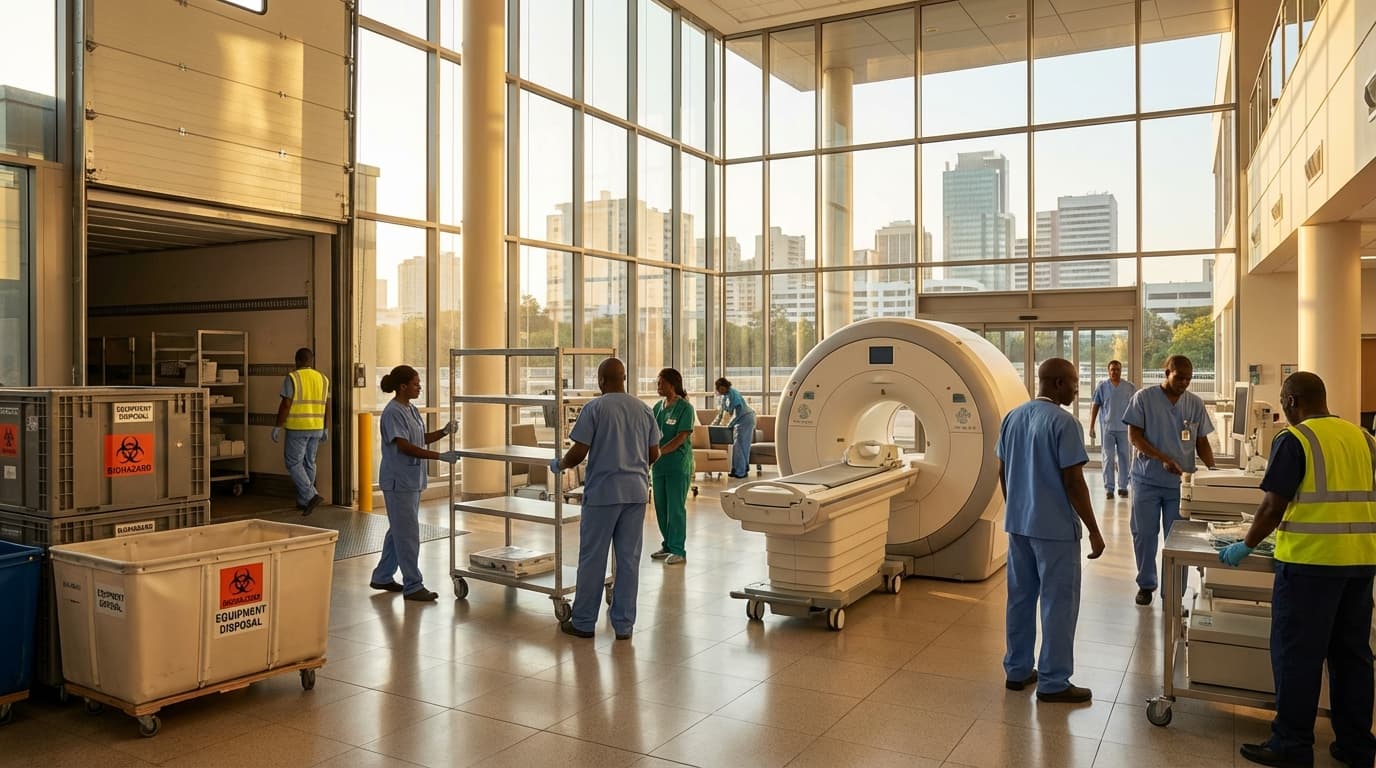
Heavy Medical Equipment De-Installation Service (MRI/CT/Cath Lab) in Guinea-Bissau
Engineering Excellence & Technical Support
Heavy Medical Equipment De-Installation Service (MRI/CT/Cath Lab) High-standard technical execution following OEM protocols and local regulatory frameworks.
Radiation Shielding Expertise
Our certified technicians possess specialized knowledge in the safe and compliant de-installation of radiation-emitting equipment like CT scanners and MRI machines. We meticulously manage all aspects of shielding disassembly and disposal, adhering to international safety standards to protect personnel and the environment.
Precision Cryogenic Handling (MRI)
De-installing MRI systems requires expert handling of cryogenic coolants (liquid helium). Our team is trained in the safe venting, recovery, and transportation of these specialized materials, ensuring no environmental release and maintaining system integrity for potential relocation or resale.
Cath Lab System Integrity Assurance
We specialize in the delicate de-installation of Cath Lab equipment, understanding the critical nature of imaging systems, radiation generators, and patient monitoring components. Our process prioritizes preserving the operational integrity of each subsystem for seamless reinstallation or responsible decommissioning.
What Is Heavy Medical Equipment De-installation Service (Mri/ct/cath Lab) In Guinea-bissau?
Heavy Medical Equipment De-Installation Service (MRI/CT/Cath Lab) in Guinea-Bissau refers to the specialized process of safely and systematically dismantling complex, high-value medical imaging and interventional diagnostic/therapeutic equipment, such as Magnetic Resonance Imaging (MRI) scanners, Computed Tomography (CT) scanners, and Cardiac Catheterization (Cath Lab) systems, within healthcare facilities in Guinea-Bissau. This service is critical for various scenarios, including equipment relocation, upgrades, replacements, facility renovations, or decommissioning. It necessitates a highly skilled, trained, and certified team equipped with specialized tools and adherence to strict safety protocols to prevent damage to the equipment, infrastructure, and personnel, while ensuring compliance with local and international regulations.
| Who Needs This Service? | Typical Use Cases |
|---|---|
| Hospitals and Tertiary Care Centers in Guinea-Bissau | Relocation of a functional MRI scanner to a new wing or a different facility. |
| Specialized Diagnostic Imaging Clinics | Decommissioning an outdated CT scanner to make space for a newer, more advanced model. |
| Interventional Cardiology Departments | Removing a Cath Lab system due to an upgrade or replacement with a state-of-the-art system. |
| Healthcare Infrastructure Development Projects | Preparing a space within a newly constructed or renovated medical facility for the installation of new imaging equipment. |
| Medical Equipment Vendors and Distributors | Facilitating the removal of old equipment prior to the delivery and installation of newly purchased systems for their clients. |
| Government Health Ministries and Agencies | Managing the phased retirement or consolidation of medical imaging assets across public healthcare facilities. |
Key Components of Heavy Medical Equipment De-Installation Service:
- Site Assessment and Planning: Pre-installation survey to evaluate access routes, power requirements, structural integrity, and environmental conditions. Development of a detailed de-installation plan.
- Disconnection of Utilities: Safely isolating and disconnecting all power, cooling, water, and data lines.
- Systematic Disassembly: Gradual dismantling of major components (e.g., gantry, magnet, console, patient table, X-ray tube, detector arrays) following manufacturer-specific procedures.
- Component Handling and Packaging: Utilizing appropriate lifting equipment (cranes, forklifts, specialized dollies) and secure packaging to protect components during transport.
- Hazardous Material Management: Identification, containment, and disposal of any hazardous materials (e.g., refrigerants, heavy metals) according to regulatory standards.
- Documentation: Comprehensive record-keeping of the de-installation process, including photographs, checklists, and component inventories.
- Safety and Compliance: Strict adherence to occupational health and safety regulations (e.g., OSHA, local labor laws) and environmental protection guidelines.
Who Needs Heavy Medical Equipment De-installation Service (Mri/ct/cath Lab) In Guinea-bissau?
Heavy medical equipment de-installation services, particularly for specialized imaging and interventional systems like MRI, CT scanners, and Cath Labs, are crucial for healthcare facilities undergoing significant upgrades, relocations, or closure of specific departments. These services are essential to ensure the safe, compliant, and efficient dismantling, packaging, and transport of these complex and sensitive machines, minimizing downtime and safeguarding valuable assets. The primary need arises when facilities are:
- Upgrading or Replacing Existing Equipment: When older MRI, CT, or Cath Lab systems are being replaced with newer models, the old equipment needs professional de-installation before removal.
- Relocating to New Facilities: Healthcare institutions moving to new buildings or expanding their current premises will require de-installation of existing heavy medical equipment from their old location and potential re-installation at the new site.
- Departmental Restructuring or Closure: If a hospital decides to reconfigure its services, close down a radiology department, or consolidate its interventional cardiology services, the associated equipment will need to be de-installed.
- Equipment Undergoing Major Servicing or Refurbishment Off-Site: In some rare cases, particularly for extensive refurbishment or recalibration, the equipment might need to be temporarily de-installed and moved to a specialized facility.
- Dealing with Obsolete or Non-Functional Equipment: When equipment reaches the end of its lifespan or becomes irreparable, professional de-installation is necessary for its responsible removal and disposal or sale.
| Target Customer Type | Key Departments Requiring De-Installation |
|---|---|
| Public Hospitals | Radiology Department (MRI, CT) Cardiology Department (Cath Lab) Neurology Department (MRI) Oncology Department (CT for treatment planning) |
| Private Hospitals | Radiology Department (MRI, CT) Cardiology Department (Cath Lab) Surgical Departments (for imaging support) Emergency Departments (for rapid diagnostics) |
| Specialized Medical Centers | Dedicated Radiology Centers (MRI, CT) Cardiovascular Centers (Cath Lab) Neurological Centers (MRI) |
| Diagnostic Imaging Centers | Centers solely focused on providing MRI, CT, and Cath Lab services |
| Research and Teaching Hospitals | Radiology Departments (for advanced research imaging) Clinical Research Facilities (utilizing imaging for studies) Medical Training Facilities (requiring equipment for hands-on practice or demonstration) |
Target Customers and Departments for Heavy Medical Equipment De-Installation Services in Guinea-Bissau
- Hospitals (Public and Private)
- Specialized Medical Centers (e.g., Cardiology Centers, Radiology Clinics)
- Diagnostic Imaging Centers
- Research and Teaching Hospitals
Heavy Medical Equipment De-installation Service (Mri/ct/cath Lab) Process In Guinea-bissau
This document outlines the comprehensive workflow for the heavy medical equipment de-installation service, specifically for MRI, CT, and Cath Lab systems, within Guinea-Bissau. The process is designed to be thorough, efficient, and compliant with all relevant safety and logistical considerations. From initial inquiry to the final completion of the de-installation, each stage is carefully managed to ensure minimal disruption and optimal project execution.
| Stage | Description | Key Activities | Responsible Party/Parties | Deliverables/Outcomes |
|---|---|---|---|---|
| The process begins with a client's request for de-installation services. | Receive and acknowledge inquiry, understand basic scope, identify equipment type and location, initial discussion on timeline and objectives. | Client, Service Provider's Sales/Inquiry Team | Confirmation of inquiry, preliminary understanding of project requirements. |
| A detailed on-site inspection to gather crucial information for planning. | Physical inspection of equipment, assessment of room dimensions, access routes (internal and external), power availability, structural considerations, environmental factors, potential hazards, existing infrastructure. | Service Provider's Technical Team, Client Representative | Detailed site survey report, identification of potential challenges and requirements. |
| Based on the site survey, a comprehensive proposal is developed. | Develop a detailed scope of work, identify necessary resources (personnel, specialized tools, equipment), outline safety protocols, provide a cost estimate, and propose a preliminary timeline. | Service Provider's Technical and Sales Teams | Formal proposal document including scope, methodology, safety plan, timeline, and detailed quotation. |
| Formalization of the service agreement between the client and the service provider. | Review and negotiation of the proposal, finalization of terms and conditions, signing of the contract, payment schedule agreement. | Client, Service Provider's Legal and Management Teams | Signed and executed service contract. |
| Detailed planning and arrangement of all necessary resources and logistics. | Develop a detailed de-installation plan, schedule personnel and specialized equipment, arrange transportation (internal and potentially external), secure necessary permits and authorizations, coordinate with facility management and stakeholders, confirm power down procedures, prepare safety documentation. | Service Provider's Project Manager and Logistics Team, Client | Approved de-installation plan, confirmed logistics, secured permits, scheduled resources. |
| Safely preparing the equipment for dismantling. | Final confirmation of power down, draining of fluids (if applicable, e.g., cooling systems), disconnecting power and data cables, initial internal component removal as per manufacturer guidelines. | Service Provider's Certified Technicians | Equipment safely isolated from power and ancillary systems. |
| The physical process of taking the equipment apart. | Systematic dismantling of the equipment in accordance with manufacturer specifications and safety protocols, handling of delicate components with care, disassembly of major modules. | Service Provider's Certified Technicians and Riggers | Equipment disassembled into manageable components. |
| Ensuring the safe protection of dismantled components. | Proper packaging of each component using appropriate materials (e.g., custom crates, protective wrapping, anti-static materials), securing components within packaging to prevent movement and damage during transit. | Service Provider's Packaging Specialists | All dismantled components securely packaged and ready for transport. |
| Moving packaged equipment within the facility to a designated staging area. | Utilizing appropriate lifting and moving equipment (e.g., forklifts, pallet jacks, cranes), careful maneuvering through access routes, placement in a secure and organized staging area. | Service Provider's Riggers and Logistics Team | Packaged equipment safely staged and organized. |
| Responsible handling of any waste generated during the de-installation. | Identification and segregation of waste materials (e.g., packaging waste, minor component waste), adherence to local environmental regulations for disposal or recycling. | Service Provider's Waste Management Team, Client | All waste managed and disposed of according to regulations. |
| Finalizing the de-installation and providing necessary documentation. | Inspection of the de-installed area by the client, completion of a de-installation checklist, provision of a de-installation report, transfer of ownership of de-installed equipment if applicable (as per contract). | Service Provider's Project Manager, Client Representative | Signed site handover form, comprehensive de-installation report, client sign-off. |
| Providing support and addressing any post-project queries. | Answering any follow-up questions, providing clarification on documentation, addressing any unforeseen issues that may arise shortly after the completion of the service. | Service Provider's Project Manager and Customer Support | Client satisfaction and resolution of any immediate post-project concerns. |
De-Installation Service Workflow (Guinea-Bissau)
- Inquiry and Initial Consultation
- Site Survey and Assessment
- Proposal and Quotation
- Contract and Agreement
- Pre-De-installation Planning and Logistics
- Equipment Preparation and Disconnection
- De-installation and Dismantling
- Packaging and Securing Equipment
- Internal Transportation and Staging
- Waste Management and Disposal
- Site Handover and Documentation
- Post-De-installation Support
Heavy Medical Equipment De-installation Service (Mri/ct/cath Lab) Cost In Guinea-bissau
De-installing heavy medical equipment such as MRI, CT scanners, and Cath Labs in Guinea-Bissau is a complex and specialized service. The cost is influenced by a variety of factors, making it difficult to provide a single definitive price. These factors range from the logistical challenges of the location to the specific technical requirements of the equipment. Understanding these elements is crucial for budgeting and planning such operations.
| Equipment Type | Estimated Cost Range (Local Currency - XOF) | Notes |
|---|---|---|
| CT Scanner | 15,000,000 - 30,000,000 XOF | This is a broad estimate. Factors like site accessibility and equipment age significantly influence the price. Includes basic dismantling and preparation for transport. |
| MRI Scanner (excluding magnet removal) | 20,000,000 - 45,000,000 XOF | The magnet is the most critical and expensive part to handle. This estimate might cover the peripheral components and initial stabilization. |
| MRI Scanner (including magnet removal) | 40,000,000 - 80,000,000+ XOF | Magnet removal is highly specialized and involves significant safety precautions and specialized equipment. Costs can escalate rapidly based on magnet weight and site logistics. |
| Cath Lab (Angiography Suite) | 25,000,000 - 50,000,000 XOF | Includes dismantling of C-arm, patient table, generator, and associated consoles. Requires careful handling of sensitive components. |
| Ancillary Equipment (e.g., Ultrasound, X-ray machines) | 5,000,000 - 15,000,000 XOF | Generally less complex, but still requires trained personnel. Costs vary based on size and specific features. |
Key Pricing Factors for Heavy Medical Equipment De-installation in Guinea-Bissau:
- Equipment Type and Complexity: Different machines (MRI, CT, Cath Lab) have varying sizes, weights, and intricate components. MRI magnets, for instance, are particularly challenging due to their weight and magnetic field. The complexity of the de-installation process directly correlates with the cost.
- Accessibility and Location: Guinea-Bissau's infrastructure can present challenges. Difficult-to-reach hospitals, remote clinics, or areas with poor road conditions will incur higher transportation and logistical costs for specialized teams and equipment.
- Dismantling and Packing Requirements: The level of disassembly needed, the specialized tools and materials for safe packing, and the need for shockproof or climate-controlled packaging all contribute to the overall expense.
- Specialized Personnel: De-installation requires highly skilled technicians with expertise in medical imaging and cardiovascular systems. Their travel, accommodation, per diems, and professional fees are significant cost drivers.
- Rigging and Lifting Equipment: Moving extremely heavy components necessitates specialized cranes, forklifts, or other heavy-duty lifting equipment, which need to be sourced and operated. Rental costs for this equipment are a major factor.
- Transportation: Moving the de-installed equipment from its original location to a designated storage or transport point, and potentially to a port for international shipping, involves specialized vehicles and logistics, especially for large and heavy items.
- Insurance: Comprehensive insurance coverage for the de-installation process, including transit and potential damage, is essential and adds to the cost.
- Permits and Customs (if applicable): While primarily a de-installation service within the country, if the equipment is being exported, customs duties, export permits, and associated paperwork will add to the expense.
- Downtime and Scheduling: The need to minimize disruption to hospital operations might require de-installation during off-peak hours or expedited services, which can command a premium.
- Contingency Planning: Unforeseen issues during the de-installation process, such as discovering unexpected structural issues or equipment complications, can lead to increased labor and material costs.
- Service Provider's Overhead and Profit Margin: Like any business, de-installation service providers will factor in their operational overheads, administrative costs, and desired profit margin.
Affordable Heavy Medical Equipment De-installation Service (Mri/ct/cath Lab) Options
Navigating the de-installation of heavy medical equipment like MRI, CT scanners, and Cath Labs is a complex and costly undertaking. This service is essential for facility renovations, relocations, or equipment upgrades. Finding an affordable provider that prioritizes safety, efficiency, and minimizes downtime is crucial. We explore options, value bundles, and cost-saving strategies to help healthcare facilities manage these projects effectively. The process typically involves careful disassembly, rigging, packaging, and transportation, demanding specialized expertise and equipment. Understanding the nuances of these services can lead to significant savings without compromising on quality or safety.
| Service Component | Standard Cost Range (Illustrative) | Value Bundle Options | Cost-Saving Strategies |
|---|---|---|---|
| De-Installation & Disassembly | $5,000 - $25,000+ | Bundle with site preparation, basic packaging, and preliminary rigging. | Schedule during off-peak hours; pre-disassembly site assessment to optimize workflow. |
| Rigging & Hoisting | $3,000 - $15,000+ | Includes specialized cranes, lifts, and skilled rigging personnel as part of a comprehensive package. | Leverage existing site infrastructure where possible; consider phased rigging for larger components. |
| Packaging & Crating | $2,000 - $8,000+ | Custom-built crates, shock-absorbing materials, and climate-controlled packaging. | Utilize reusable or standardized packaging if equipment is being stored; inquire about packaging for local transport vs. long-distance shipping. |
| Transportation & Logistics | $4,000 - $20,000+ | Dedicated specialized transport vehicles, route planning, and expedited shipping options. | Coordinate de-installation with shipping schedules to avoid storage costs; explore consolidation of multiple equipment moves. |
| Site Preparation & Restoration | $1,000 - $5,000+ | Includes minor structural modifications, floor protection, and post-de-installation cleanup. | Perform preparatory work in-house where feasible; negotiate for minimal site disruption. |
| Environmental Handling (e.g., Helium Recovery) | $2,000 - $10,000+ | Integrated service with certified helium recovery and disposal/re-purposing. | Research local regulations for refrigerant disposal; inquire about credits for recovered helium. |
| Project Management & Consultation | $1,500 - $6,000+ | Dedicated project manager overseeing all phases, risk assessment, and compliance. | Clearly define project scope to avoid scope creep; maintain open communication with the provider. |
Key Considerations for Affordable De-Installation
- Specialized Expertise: Ensure the provider has proven experience with the specific type of equipment being de-installed (MRI, CT, Cath Lab).
- Safety Compliance: Verify adherence to all safety regulations (OSHA, environmental) and proper handling procedures.
- Logistics and Planning: A well-defined plan for disassembly, rigging, and transportation is critical for efficiency.
- Equipment Condition: The de-installation team should be equipped to handle the weight and fragility of medical devices.
- Insurance and Liability: Confirm adequate insurance coverage from the de-installation provider.
- Downtime Minimization: Efficient de-installation can reduce the impact on patient care and facility operations.
- Environmental Disposal: Proper handling and disposal of refrigerants (e.g., helium in MRI) or other hazardous materials.
Verified Providers In Guinea-bissau
Ensuring access to quality healthcare is paramount, and in Guinea-Bissau, identifying verified healthcare providers is crucial for public trust and well-being. This document outlines the importance of verified providers and highlights why Franance Health's credentials stand out as representing the best choice for comprehensive and reliable healthcare services in the region.
| Credential | Significance for Patients | Franance Health's Commitment |
|---|---|---|
| Accreditation by National Health Authority | Confirms adherence to Guinea-Bissau's national healthcare regulations and standards. Ensures services are officially recognized and compliant. | Franance Health actively maintains accreditation with the Ministry of Public Health of Guinea-Bissau, demonstrating unwavering commitment to national healthcare protocols and quality assurance. |
| International Quality Standards (e.g., ISO Certifications) | Indicates a commitment to internationally recognized best practices in quality management, patient safety, and operational efficiency. | Where applicable and relevant to healthcare services, Franance Health strives for and adheres to internationally recognized quality management principles, ensuring global standards are met. |
| Professional Licenses and Certifications of Medical Staff | Guarantees that all healthcare professionals are properly qualified, licensed, and have undergone continuous professional development. | Franance Health rigorously verifies and maintains up-to-date professional licenses and certifications for all its medical and administrative staff, ensuring they possess the highest levels of expertise. |
| Partnerships with Reputable International Health Organizations | Suggests a network of support, access to advanced medical knowledge, and adherence to global health initiatives. | Franance Health actively collaborates with recognized international health bodies and organizations, leveraging their expertise and resources to enhance service delivery and patient care in Guinea-Bissau. |
| Patient Feedback and Satisfaction Metrics | Provides insight into the patient experience and highlights a commitment to continuous improvement based on user feedback. | Franance Health places a strong emphasis on patient feedback, consistently monitoring satisfaction levels to identify areas for enhancement and ensure a patient-centric approach. |
Why Verified Providers Matter in Guinea-Bissau
- Patient Safety and Quality of Care: Verification processes ensure that healthcare professionals meet established standards of training, competence, and ethical practice. This directly translates to safer procedures and higher quality care for patients.
- Trust and Confidence: Knowing that a provider has undergone rigorous verification instills confidence in patients, empowering them to make informed decisions about their health.
- Accountability and Professionalism: Verified providers adhere to professional codes of conduct and are subject to oversight, promoting accountability and a higher standard of service.
- Access to Legitimate Services: Verification helps differentiate legitimate healthcare services from potentially fraudulent or substandard operations, protecting individuals from exploitation.
- Improved Health Outcomes: By consistently delivering quality care, verified providers contribute to better overall health outcomes for the population of Guinea-Bissau.
Scope Of Work For Heavy Medical Equipment De-installation Service (Mri/ct/cath Lab)
This Scope of Work (SOW) outlines the requirements for the professional de-installation of heavy medical imaging equipment, specifically Magnetic Resonance Imaging (MRI), Computed Tomography (CT), and Cardiac Catheterization (Cath Lab) systems. The service includes the safe, efficient, and compliant disconnection, dismantling, and preparation of the equipment for transport. This SOW details the technical deliverables and standard specifications to ensure a successful de-installation process.
| Equipment Type | Key De-installation Considerations | Standard Specifications/Notes |
|---|---|---|
| MRI (Magnetic Resonance Imaging) | RF shielding removal/disassembly, cryogen venting (if applicable and safe), superconducting magnet handling, gradient coil disconnection, patient table removal, console disconnection. | Requires specialized knowledge of magnetic fields and cryogenic systems. Site access for heavy lifting equipment must be verified. Power down sequence and coil quenching procedures (if applicable) to be strictly followed. |
| CT (Computed Tomography) | Gantry disassembly, X-ray tube and detector array handling, patient table retraction/removal, console disconnection, power supply unit disconnection. | Radiation safety protocols must be observed. Specialized tools for gantry manipulation are often required. Coolant system disconnection may be necessary. |
| Cath Lab (Cardiac Catheterization) | C-arm disassembly, imaging detector/tube handling, patient table removal, generator disconnection, console and workstation disconnection, ancillary equipment disconnection (e.g., injector, ultrasound). | Requires careful handling of imaging components. Understanding of hydraulic and pneumatic systems may be needed. Cable management during disassembly is crucial to prevent damage. |
Technical Deliverables
- Comprehensive site assessment prior to de-installation to identify potential challenges and required resources.
- Development and execution of a detailed de-installation plan tailored to each specific equipment type and site.
- Safe and compliant disconnection of all power, data, cooling, and any other associated utilities.
- Dismantling of the equipment into transportable modules according to manufacturer specifications or industry best practices.
- Proper containment and protection of sensitive components during dismantling.
- Secure packaging and labeling of all dismantled components for safe transit.
- Removal of ancillary equipment and supporting infrastructure directly related to the de-installed system (e.g., power conditioning units, RF shielding removal if specified).
- Final site cleanup of the de-installation area to a condition agreed upon prior to commencement.
- Provision of a comprehensive de-installation report detailing the process, any encountered issues, and confirmation of equipment readiness for transport.
- Adherence to all relevant safety regulations, environmental standards, and manufacturer guidelines throughout the process.
Service Level Agreement For Heavy Medical Equipment De-installation Service (Mri/ct/cath Lab)
This Service Level Agreement (SLA) outlines the terms and conditions governing the de-installation of heavy medical equipment, specifically MRI, CT, and Cath Lab systems. It defines the expected response times for service requests and guarantees a certain level of uptime for the services provided during the de-installation process. This agreement aims to ensure a smooth and efficient transition for the client.
| Service Type | Response Time (Business Hours) | Uptime Guarantee (During Scheduled De-installation) |
|---|---|---|
| MRI De-installation | 12 Hours | 98% |
| CT Scanner De-installation | 12 Hours | 98% |
| Cath Lab De-installation | 24 Hours | 98% |
| Urgent Service Request (Critical Issue during De-installation) | 4 Hours | N/A (Focus on resolution) |
Key Service Elements
- Scope of Service: De-installation of specified heavy medical equipment (MRI, CT, Cath Lab) including disconnection, dismantling, and preparation for transport.
- Service Provider Responsibilities: To provide qualified technicians, appropriate tools and equipment, adherence to safety protocols, and timely completion within agreed-upon schedules.
- Client Responsibilities: To provide access to the equipment, necessary site preparation (if applicable), and timely approvals.
- Definitions: Clear definitions of terms such as 'Service Request', 'Downtime', 'Response Time', and 'Uptime'.
Frequently Asked Questions

Ready when you are
Let's scope your Heavy Medical Equipment De-Installation Service (MRI/CT/Cath Lab) in Guinea-Bissau project in Guinea-Bissau.

Scaling healthcare logistics and technical systems across the entire continent.