
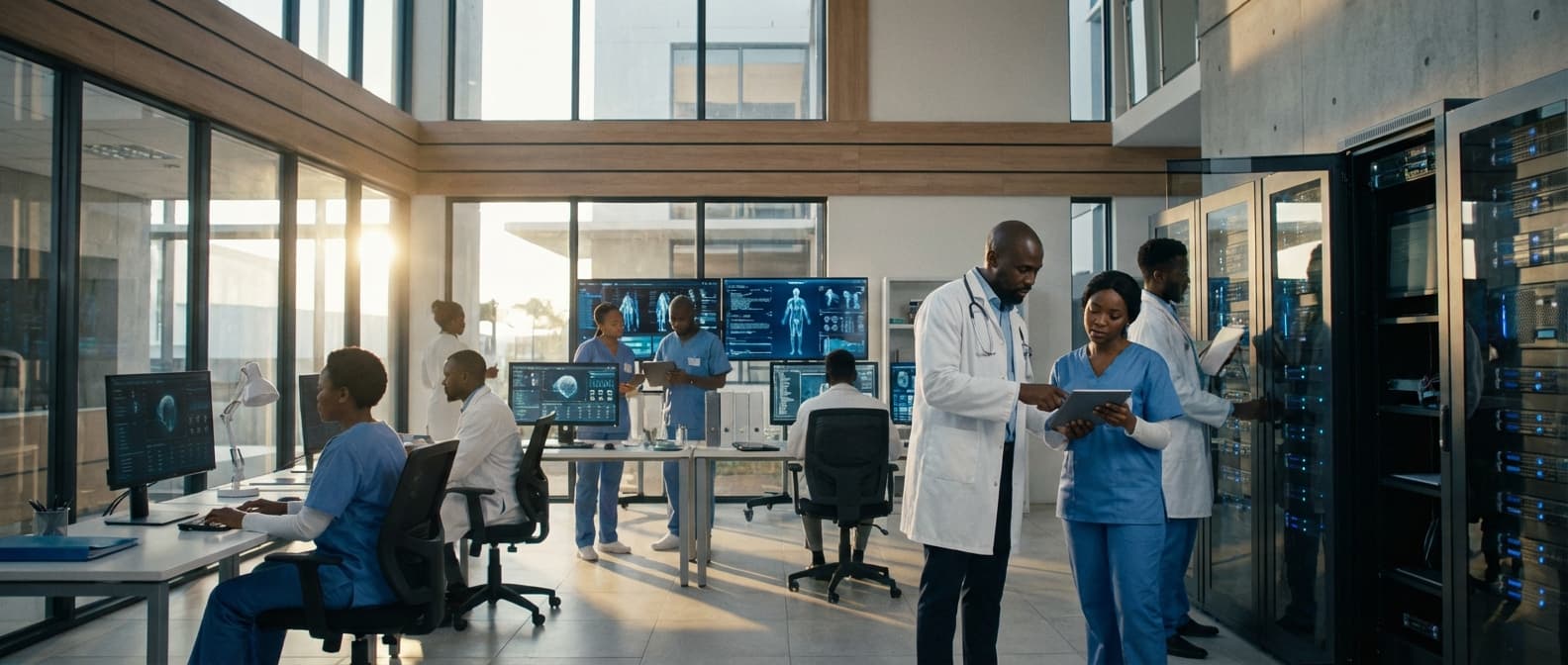
Tele-Radiology in Guinea-Bissau
Engineering Excellence & Technical Support
24/7 access to certified radiologists providing rapid, accurate remote interpretation of diagnostic imaging studies. High-standard technical execution following OEM protocols and local regulatory frameworks.
Satellite Connectivity for Remote Access
Leveraging robust satellite internet solutions to overcome Guinea-Bissau's limited terrestrial network infrastructure, enabling reliable real-time transmission of radiological images to and from international expert radiologists.
Secure Cloud-Based PACS Integration
Implementing a secure, cloud-based Picture Archiving and Communication System (PACS) that ensures data integrity, accessibility, and compliance with privacy regulations, allowing for seamless storage, retrieval, and sharing of patient scans across distributed locations.
AI-Powered Diagnostic Support Tools
Integrating advanced Artificial Intelligence (AI) algorithms for automated image analysis, anomaly detection, and preliminary report generation, augmenting the diagnostic capabilities of local healthcare professionals and expediting crucial decision-making for patient care.
What Is Tele-radiology In Guinea-bissau?
Tele-radiology in Guinea-Bissau refers to the practice of transmitting radiological images (such as X-rays, CT scans, and MRIs) from one location to another for the interpretation and diagnosis by a radiologist. This technology bridges geographical barriers, enabling remote access to specialized radiological expertise, which is particularly critical in regions with a scarcity of qualified radiologists and advanced imaging equipment. The service involves the secure digital capture of medical images, their transmission over telecommunication networks, and their review and reporting by radiologists located elsewhere, often in different cities or even countries. This facilitates timely and accurate diagnoses, contributing to improved patient management and outcomes, especially in underserved areas.
| Who Needs Tele-radiology? | Typical Use Cases | ||||||
|---|---|---|---|---|---|---|---|
| Patients in remote or underserved areas of Guinea-Bissau lacking local radiological expertise. | Emergency department consultations for suspected fractures or acute conditions requiring rapid interpretation. | Patients in district hospitals or health posts with limited diagnostic capabilities. | Management of chronic diseases requiring regular imaging follow-up (e.g., tuberculosis, certain cancers). | Facilities with imaging equipment but a deficit of trained radiologists. | Screening programs for conditions like tuberculosis or obstetric ultrasound assessments. | Situations where specialized radiological subspecialties are unavailable locally (e.g., neuro-radiology, pediatric radiology). | Assisting general practitioners or medical officers with image interpretation in primary care settings. |
Key Components and Stakeholders of Tele-radiology in Guinea-Bissau
- Image Acquisition: Utilizing existing or newly installed radiological equipment (e.g., X-ray machines, portable ultrasound devices) to generate digital images.
- Image Transmission: Employing secure and reliable digital networks (internet, satellite) to transfer image files to a remote reading center.
- Image Interpretation: Radiologists at a remote site analyze the images and generate diagnostic reports.
- Reporting and Communication: Transmitting the finalized reports back to the referring physician in Guinea-Bissau for patient management.
- Technical Infrastructure: Essential for data storage, security, and the smooth operation of the tele-radiology platform.
Who Needs Tele-radiology In Guinea-bissau?
Tele-radiology, the practice of interpreting medical images remotely, holds significant potential for enhancing diagnostic capabilities in resource-limited settings like Guinea-Bissau. This technology can bridge the gap caused by a shortage of specialized radiologists, improve access to timely and accurate diagnoses, and ultimately lead to better patient outcomes. The target customers and departments for tele-radiology in Guinea-Bissau are multifaceted, encompassing public and private healthcare facilities, and focusing on departments where imaging is critical for diagnosis and treatment planning.
| Customer Type | Key Needs Addressed by Tele-Radiology | Example Scenarios |
|---|---|---|
| Public Hospitals (National & Regional) | Overcoming radiologist shortages, reducing diagnostic delays, access to subspecialty expertise, continuous service provision. | A trauma patient arrives at a regional hospital late at night with a suspected fracture. A radiologist can interpret the X-ray remotely, allowing for timely surgical intervention. |
| District Hospitals & Health Centers | Providing basic diagnostic imaging interpretation where no local radiologist is available, supporting primary healthcare delivery. | A health center in a remote area performs an ultrasound for a pregnant woman. The images are sent to a central hospital for interpretation by a radiologist, identifying potential complications. |
| Private Clinics & Diagnostic Centers | Expanding service offerings, improving diagnostic accuracy, catering to a growing demand for advanced imaging. | A private clinic acquires an MRI machine but lacks a full-time radiologist. Tele-radiology allows them to offer MRI interpretations to their patients. |
| NGO Healthcare Initiatives | Delivering specialized diagnostic services in underserved areas, supporting mobile clinics and outreach programs. | An NGO operating a mobile clinic in a rural area performs chest X-rays for TB screening. Images are transmitted for interpretation, facilitating early diagnosis and treatment. |
| Medical Schools & Training Institutions | Providing remote learning opportunities for radiology residents and technicians, facilitating case-based learning and skill development. | Radiology residents at a teaching hospital can access a diverse range of anonymized cases from various facilities for interpretation practice and feedback from experienced tele-radiologists. |
Target Customers and Departments for Tele-Radiology in Guinea-Bissau
- {"items":["Public Hospitals (National and Regional)","District Hospitals and Health Centers","Private Clinics and Diagnostic Centers","Non-Governmental Organization (NGO) Healthcare Initiatives","Medical Schools and Training Institutions"],"title":"Target Customers"}
- {"items":["Radiology/Imaging Departments (for remote interpretation)","Emergency Departments (for rapid assessment of trauma, stroke, etc.)","Internal Medicine (for diagnosis of various conditions affecting organs)","Surgery (for pre-operative planning and post-operative monitoring)","Pediatrics (for diagnosis of congenital anomalies and childhood illnesses)","Obstetrics and Gynecology (for pregnancy complications and gynecological issues)","Neurology (for stroke, head injuries, and other neurological conditions)","Oncology (for cancer staging, treatment response monitoring)","Infectious Disease Units (for pulmonary infections like TB, pneumonia)"],"title":"Key Departments Requiring Tele-Radiology"}
Tele-radiology Process In Guinea-bissau
Tele-radiology in Guinea-Bissau aims to bridge the gap in access to diagnostic imaging services, particularly in remote or underserved areas. The process typically involves a series of steps, from the initial request for a radiologist's interpretation to the final delivery of the report. This workflow is designed to facilitate remote consultation and diagnosis, leveraging available technology to improve patient care.
| Stage | Description | Key Actors | Technology/Tools | Challenges/Considerations |
|---|---|---|---|---|
| Initial Imaging Acquisition | A patient presenting with symptoms requiring diagnostic imaging has an X-ray, CT, or MRI performed at a local health facility. The quality of the acquisition is crucial for accurate interpretation. | Radiographer/Technician, Physician (requesting) | X-ray machine, CT scanner, MRI scanner | Availability of functional equipment, trained personnel, consistent power supply, quality control of image acquisition. |
| Image Transmission | The acquired digital images are securely transmitted from the local health facility to a central teleradiology hub or directly to the interpreting radiologist. | Radiographer/Technician, IT personnel | PACS (Picture Archiving and Communication System), DICOM standards, secure internet connection (e.g., VPN, satellite), data compression techniques. | Reliable and high-speed internet connectivity, data security protocols, bandwidth limitations, compatibility issues between different PACS systems. |
| Teleradiology Platform & Triage | Received images are uploaded to a teleradiology platform. A system or designated personnel may triage the cases based on urgency or complexity. | Teleradiology platform administrator, IT support, designated medical staff | Teleradiology software platform, secure server, dictation software. | Platform accessibility and ease of use, efficient queuing and prioritization system, data storage and backup. |
| Radiologist Interpretation | A qualified radiologist, located remotely, reviews the transmitted images and provides a diagnostic interpretation. | Radiologist | Workstation with high-resolution monitors, teleradiology software, advanced image viewing tools (e.g., multiplanar reconstruction). | Availability of qualified radiologists, workload management, need for remote access to patient history, potential for communication delays. |
| Report Generation & Delivery | The radiologist dictates or types a comprehensive report based on their interpretation. This report is then finalized and securely transmitted back to the requesting physician. | Radiologist, transcriptionist (if applicable), teleradiology platform. | Dictation software, reporting templates, secure email or platform-based report delivery. | Timeliness of report generation, accuracy and clarity of the report, secure delivery mechanisms, integration with Electronic Health Records (EHRs). |
| Follow-up & Integration | The requesting physician receives the report and integrates it into the patient's overall care plan. This may involve further diagnostic tests, treatment, or referral. | Physician (requesting), referring physician (if applicable). | EHR system, communication channels. | Effective communication between radiologists and referring physicians, patient follow-up mechanisms, ongoing training and quality assurance. |
Tele-Radiology Workflow in Guinea-Bissau
- Initial Imaging Acquisition
- Image Transmission
- Teleradiology Platform & Triage
- Radiologist Interpretation
- Report Generation & Delivery
- Follow-up & Integration
Tele-radiology Cost In Guinea-bissau
Tele-radiology, the practice of interpreting medical images remotely, offers a crucial solution for healthcare access in regions like Guinea-Bissau, which often face shortages of specialized radiologists. However, understanding the cost of these services in the local currency, the West African CFA franc (XOF), is essential for planning and implementation. The pricing of tele-radiology services in Guinea-Bissau is influenced by a combination of factors, leading to a range of potential costs.
| Service Type (Typical Imaging) | Estimated Cost Range (XOF per study) |
|---|---|
| Basic X-ray Interpretation (e.g., chest, bone) | 15,000 - 30,000 XOF |
| More Complex X-ray Interpretation (e.g., orthopedic trauma) | 20,000 - 40,000 XOF |
| CT Scan Interpretation (e.g., head, abdomen) | 50,000 - 100,000 XOF |
| MRI Scan Interpretation (e.g., brain, spine) | 70,000 - 150,000 XOF |
| Specialized Interpretations (e.g., neuroradiology, musculoskeletal) | 60,000 - 180,000+ XOF |
| Rush/Emergency Interpretation Surcharge | +25% - 50% of standard fee |
Key Pricing Factors for Tele-Radiology in Guinea-Bissau
- {"item":"Volume of Studies:","description":"The number of X-rays, CT scans, MRIs, or other imaging studies that need to be interpreted significantly impacts the overall cost. Higher volumes often lead to per-study discounts."}
- {"item":"Specialty and Complexity:","description":"Interpreting general X-rays is typically less expensive than complex neurological MRIs or advanced cardiac CTs, which require highly specialized radiologists and more time for analysis."}
- {"item":"Turnaround Time (TAT) Requirements:","description":"Rush or emergency interpretations, requiring immediate attention and often prioritizing them over scheduled work, come at a premium compared to standard TATs."}
- {"item":"Technology and Infrastructure:","description":"The cost of setting up and maintaining the tele-radiology platform, including software, secure data transmission, and potentially hardware at the local clinic, will be factored into pricing. Providers who already have robust infrastructure may offer more competitive rates."}
- {"item":"Radiologist's Experience and Credentials:","description":"Highly experienced radiologists with specialized training and certifications will command higher fees."}
- {"item":"Provider's Business Model:","description":"Whether the service is provided by a local entity, an international company, or a non-profit organization can influence pricing. International providers might have higher overheads but also potentially broader access to specialists."}
- {"item":"Contractual Agreements:","description":"Long-term contracts or service level agreements (SLAs) can often secure more favorable pricing compared to ad-hoc arrangements."}
- {"item":"Currency Exchange Rates:","description":"While the XOF is the local currency, international providers may price services in USD or EUR and convert them. Fluctuations in exchange rates can indirectly affect the final cost in XOF."}
Affordable Tele-radiology Options
Tele-radiology offers a cost-effective solution for medical imaging interpretation, especially for smaller practices, rural hospitals, and facilities facing radiologist shortages. By leveraging remote expertise, organizations can reduce overhead associated with in-house staffing, recruitment, and facility space. This section explores affordable tele-radiology options, emphasizing value bundles and practical cost-saving strategies to make these services accessible and beneficial.
| Value Bundle Type | Description | Cost-Saving Potential | Ideal For |
|---|---|---|---|
| Volume-Based Pricing: | A per-study or per-imaging-modality fee, often with tiered pricing for higher volumes. | Predictable costs, economies of scale as volume increases. | Facilities with consistent, measurable imaging throughput. |
| Subscription/Retainer Model: | A fixed monthly fee for a guaranteed level of service or access to a pool of radiologists. | Budget certainty, ensures availability of services, can include dedicated support. | Smaller practices needing consistent, but not necessarily high, daily coverage; those prioritizing guaranteed access. |
| Hybrid Models: | A combination of fixed fees for base coverage and per-study fees for overflow or specialized reads. | Flexibility to manage variable workloads efficiently. | Facilities with fluctuating patient volumes or occasional needs for subspecialty reads. |
| Managed Service Agreements: | Comprehensive packages including technology, IT support, and interpretation services. | Reduces IT burden and procurement costs, single point of contact for all needs. | Organizations seeking a complete, integrated tele-radiology solution. |
Key Components of Affordable Tele-Radiology
- On-Demand Interpretation: Access to radiologists when needed, avoiding the costs of full-time, idle staff.
- Subspecialty Expertise: Access to specialists without the expense of hiring multiple in-house subspecialists.
- Reduced Infrastructure Costs: Elimination of the need for dedicated imaging reading rooms and associated utilities.
- Improved Turnaround Times: Faster report generation can lead to quicker patient treatment and reduced length of stay, indirectly saving costs.
- Scalability: Ability to scale services up or down based on patient volume, optimizing resource allocation.
Verified Providers In Guinea-bissau
In Guinea-Bissau's evolving healthcare landscape, identifying trusted and skilled medical professionals is paramount for ensuring quality patient care. Franance Health stands out as a premier organization, dedicated to credentialing and vetting healthcare providers. Their rigorous verification process ensures that all affiliated practitioners meet the highest standards of medical competence, ethical practice, and professional integrity. This commitment to excellence makes Franance Health-verified providers the best choice for individuals seeking reliable and effective medical services in Guinea-Bissau.
| Provider Type | Franance Health Verification Key Indicators | Benefits for Patients |
|---|---|---|
| General Practitioners | Valid medical license, proof of ongoing medical education, positive patient feedback. | Accurate diagnosis, comprehensive primary care, and effective management of common health issues. |
| Specialist Physicians (e.g., Cardiologists, Pediatricians, Surgeons) | Board certification in their specialty, extensive clinical experience, adherence to ethical guidelines. | Access to specialized knowledge and advanced treatment options for complex conditions. |
| Nurses and Midwives | Registered nurse/midwife status, relevant certifications (e.g., BLS, ACLS), demonstrated patient care skills. | High-quality nursing care, safe childbirth practices, and compassionate support throughout treatment. |
| Pharmacists | Licensed pharmacist, knowledge of drug interactions and safe dispensing practices. | Reliable prescription fulfillment, accurate medication advice, and awareness of potential side effects. |
Why Choose Franance Health-Verified Providers?
- Unwavering Commitment to Quality: Franance Health implements stringent criteria for provider selection, focusing on education, experience, and continuous professional development.
- Enhanced Patient Safety: Thorough background checks and credential verification minimize risks and ensure that patients are treated by qualified and ethical professionals.
- Access to Expertise: The network comprises specialists across various medical disciplines, offering a comprehensive range of healthcare solutions.
- Trust and Reliability: Partnering with Franance Health signifies a commitment to transparency and accountability, building patient confidence.
- Improved Healthcare Outcomes: By ensuring providers adhere to best practices, Franance Health contributes to better health outcomes for the population of Guinea-Bissau.
Scope Of Work For Tele-radiology
This Scope of Work (SOW) outlines the requirements for tele-radiology services. It details the technical deliverables and standard specifications necessary for the successful implementation and operation of a tele-radiology solution. The goal is to ensure high-quality diagnostic imaging services are delivered remotely, efficiently, and securely.
| Category | Technical Deliverable | Standard Specification / Requirement |
|---|---|---|
| Platform & Software | Tele-Radiology Platform | Web-based, cloud-hosted or on-premise solution with secure login, user management, reporting module, and integration capabilities. |
| Platform & Software | Image Viewer | High-resolution, DICOM-compliant viewer with advanced visualization tools (e.g., zoom, pan, window/level, measurements, MPR, 3D rendering). Must be compatible with multiple operating systems and web browsers. |
| Platform & Software | Reporting Module | Structured reporting capabilities with customizable templates, auto-population of patient data, voice recognition integration (optional), and digital signature functionality. |
| Platform & Software | Integration with PACS/EHR | HL7 and DICOM compatibility for seamless data exchange. Ability to pull patient demographics, orders, and push final reports to PACS/EHR. |
| Infrastructure & Connectivity | Image Transmission | Secure and reliable transfer of DICOM images. Support for various transmission protocols (e.g., DICOM over TLS, SFTP). Bandwidth requirements to be defined based on imaging modality and volume. |
| Infrastructure & Connectivity | Network Security | End-to-end encryption (TLS 1.2+), firewall protection, intrusion detection/prevention systems, and secure VPN access for remote radiologists. |
| Infrastructure & Connectivity | Data Storage | Secure, compliant, and scalable storage for DICOM images and reports. Adherence to data residency requirements and HIPAA/GDPR regulations. |
| Services & Support | Radiologist Access | 24/7 availability of qualified and licensed radiologists. Defined turnaround times (TAT) for routine, urgent, and STAT reads. |
| Services & Support | Quality Assurance | Regular peer review, audit trails, and continuous quality improvement processes for all interpretations. |
| Services & Support | Technical Support | On-call technical support for platform issues, connectivity problems, and image access. Response times and escalation procedures to be clearly defined. |
| Services & Support | Training | Training for referring physicians, technologists, and administrative staff on platform usage, workflow, and best practices. |
| Compliance & Security | Data Privacy & Security | Strict adherence to HIPAA, GDPR, and other relevant data privacy and security regulations. Business Associate Agreements (BAAs) required. |
| Compliance & Security | Audit Trails | Comprehensive logging of all user activities, image access, report generation, and system changes for security and compliance auditing. |
| Compliance & Security | Disaster Recovery & Business Continuity | Robust disaster recovery plan and business continuity procedures to ensure service availability in case of unforeseen events. |
Key Objectives of Tele-Radiology Services
- Provide timely and accurate radiological interpretations to referring physicians and facilities.
- Improve access to specialized radiological expertise, especially in underserved areas.
- Enhance workflow efficiency and reduce turnaround times for diagnostic reports.
- Ensure secure and compliant transmission and storage of patient imaging data.
- Facilitate seamless integration with existing Picture Archiving and Communication Systems (PACS) and Electronic Health Records (EHRs).
Service Level Agreement For Tele-radiology
This Service Level Agreement (SLA) outlines the performance standards and guarantees for the Tele-Radiology services provided by [Provider Name] to [Client Name]. It defines the expected response times for critical requests and the guaranteed uptime for the platform. This SLA is an integral part of the Master Service Agreement (MSA) between the parties.
| Service Level | Target Performance | Guaranteed Performance | Remedy for Failure |
|---|---|---|---|
| Critical Request Response Time | Within 15 minutes of receipt | 99.5% of Critical Requests within 15 minutes | For each Critical Request exceeding 15 minutes, a Service Credit of [X]% of the monthly fee for that study will be applied. |
| Routine Request Turnaround Time (Report Generation) | Within 24 hours of study completion | 98% of Routine Requests within 24 hours | For each Routine Request exceeding 24 hours, a Service Credit of [Y]% of the monthly fee for that study will be applied. |
| Platform Uptime | 99.9% Availability | 99.7% Guaranteed Uptime (excluding Scheduled Downtime) | For every hour the Guaranteed Uptime falls below 99.7%, a Service Credit of [Z]% of the monthly platform access fee will be applied. |
| Image Data Accessibility | 99.9% Availability | 99.8% Guaranteed Availability (excluding Scheduled Downtime) | For every hour the Guaranteed Availability falls below 99.8%, a Service Credit of [A]% of the monthly platform access fee will be applied. |
Key Definitions
- Critical Request: A request for urgent interpretation of diagnostic imaging studies (e.g., stroke, trauma, acute chest pain) requiring immediate attention.
- Routine Request: A request for interpretation of diagnostic imaging studies that are not time-sensitive.
- Guaranteed Uptime: The percentage of time the Tele-Radiology platform is accessible and operational for report generation and image access.
- Response Time: The time elapsed from when a request is successfully submitted to the Tele-Radiology platform until a radiologist begins the interpretation process.
- Service Credit: A financial credit provided to the Client in the event the Provider fails to meet the guaranteed service levels.
- Scheduled Downtime: Planned maintenance periods for the Tele-Radiology platform, which will be communicated to the Client at least [Number] days in advance.
Frequently Asked Questions

Ready when you are
Let's scope your Tele-Radiology in Guinea-Bissau project in Guinea-Bissau.

Scaling healthcare logistics and technical systems across the entire continent.