
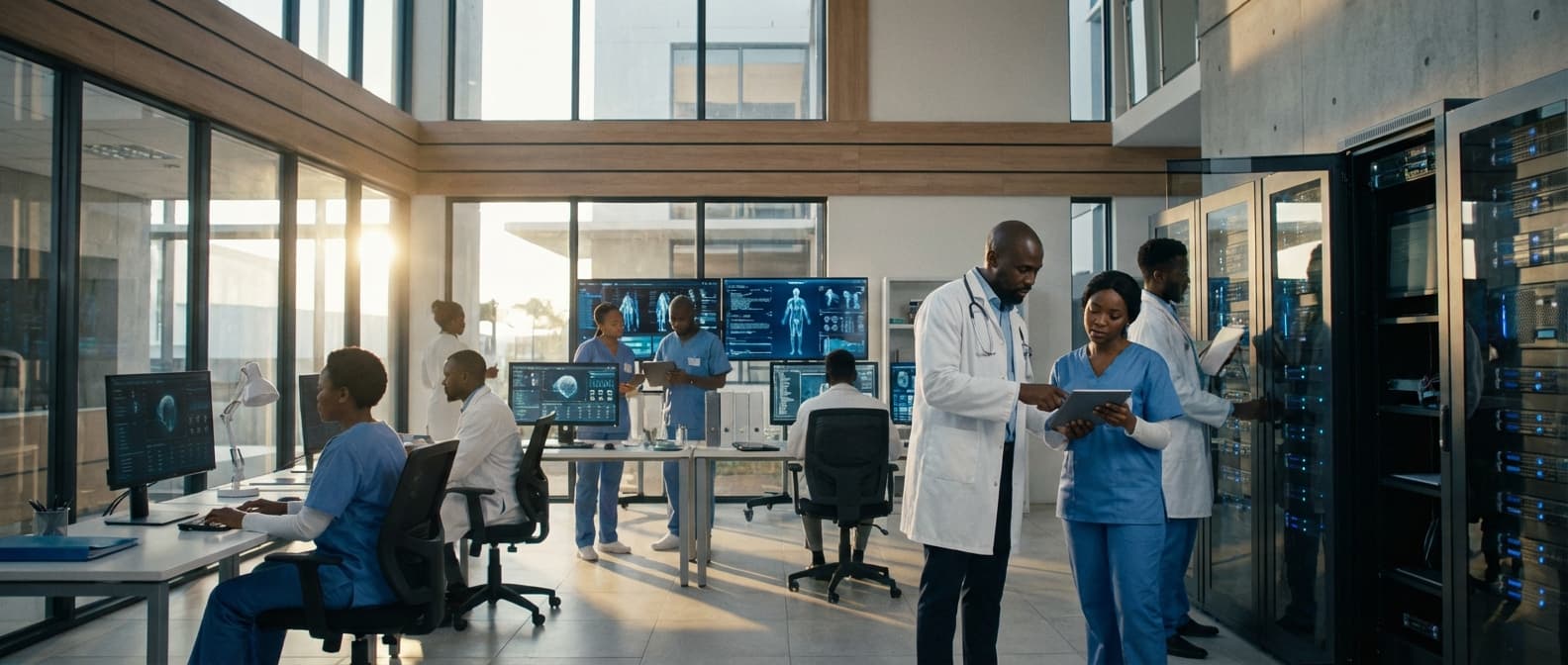
Medical IT Consultation in Guinea-Bissau
Engineering Excellence & Technical Support
Strategic technology consulting to optimize healthcare operations, streamline workflows, and integrate cutting-edge medical information systems. High-standard technical execution following OEM protocols and local regulatory frameworks.
Robust Cloud Infrastructure for Health Data
Implemented secure, scalable cloud-based solutions for managing electronic health records (EHRs) and patient data, ensuring accessibility and compliance within Guinea-Bissau's unique environmental and connectivity challenges.
Interoperable Health Information Exchange (HIE) Systems
Designed and deployed interoperable HIE platforms, enabling seamless data sharing between disparate healthcare facilities and improving diagnostic accuracy and treatment coordination across the nation.
Cybersecurity Resilience for Healthcare Networks
Developed and enforced comprehensive cybersecurity protocols, including data encryption and access controls, to protect sensitive patient information from evolving cyber threats and ensure the integrity of critical healthcare IT systems.
What Is Medical It Consultation In Guinea-bissau?
Medical IT Consultation in Guinea-Bissau refers to the provision of expert advice and technical services to healthcare organizations and professionals regarding the planning, implementation, optimization, and management of information technology (IT) systems within the medical domain. This service is crucial for enhancing operational efficiency, improving patient care outcomes, ensuring data security, and facilitating compliance with evolving healthcare regulations and standards. It encompasses a broad spectrum of IT-related needs, from foundational infrastructure to advanced clinical informatics solutions, tailored to the specific context and resource availability in Guinea-Bissau's healthcare sector.
| Who Needs Medical IT Consultation? | Typical Use Cases |
|---|---|
| Public Health Ministries and Agencies: To manage national health data, coordinate public health initiatives, and implement health information exchange platforms. | Hospitals and Clinics (Public & Private): For optimizing patient record management, improving diagnostic imaging workflows, streamlining administrative processes, and enhancing patient safety through IT integration. |
| Primary Healthcare Centers: To implement basic EHR systems, improve inventory management, and connect to referral networks, particularly in rural areas. | Research Institutions and Universities: For managing research data, facilitating collaboration, and supporting digital learning environments for medical professionals. |
| Non-Governmental Organizations (NGOs) involved in Healthcare: To establish and manage IT systems for health programs, aid delivery, and data collection in project areas. | International Health Organizations: To support the deployment of health IT solutions, capacity building, and data management initiatives within the country. |
| Individual Medical Practitioners: To select and implement appropriate IT solutions for their practice, ensuring efficient patient management and data security. | Emerging Health-Tech Startups: To gain expert advice on building scalable and compliant health IT solutions relevant to the Guinean market. |
Key Aspects of Medical IT Consultation in Guinea-Bissau
- Needs Assessment and Strategy Development: Evaluating existing IT infrastructure, identifying gaps, and formulating strategic IT roadmaps aligned with organizational goals and public health priorities.
- System Selection and Procurement: Advising on the selection and acquisition of appropriate medical hardware, software (e.g., Electronic Health Records - EHRs, Picture Archiving and Communication Systems - PACS), and networking components.
- Implementation and Integration: Overseeing the installation, configuration, and integration of new IT systems with existing workflows and legacy systems.
- Data Management and Analytics: Establishing robust data governance policies, implementing data warehousing solutions, and enabling advanced analytics for public health surveillance, research, and clinical decision support.
- Cybersecurity and Data Privacy: Developing and implementing comprehensive cybersecurity strategies, ensuring compliance with data protection regulations, and safeguarding sensitive patient information.
- Network Infrastructure and Connectivity: Designing, deploying, and managing reliable and secure network infrastructure to support medical applications and communication, often addressing challenges related to remote or underserved areas.
- Training and Capacity Building: Providing technical training to healthcare staff on the use of new IT systems and fostering digital literacy to maximize adoption and utilization.
- Maintenance and Support: Establishing proactive maintenance schedules, providing ongoing technical support, and ensuring the continuous operation and optimal performance of medical IT systems.
- Interoperability and Standards: Facilitating the exchange of health information between different healthcare providers and systems through adherence to relevant interoperability standards (e.g., HL7, FHIR).
- Telemedicine and Remote Care Solutions: Advising on and implementing technologies to support remote patient monitoring, virtual consultations, and the delivery of healthcare services to geographically dispersed populations.
Who Needs Medical It Consultation In Guinea-bissau?
Medical IT consultation is crucial for a range of healthcare stakeholders in Guinea-Bissau looking to leverage technology for improved patient care, operational efficiency, and data security. The unique challenges and opportunities within the country's healthcare landscape make specialized IT guidance indispensable.
| Customer Type | Key Needs & Challenges Addressed by IT Consultation | Relevant Departments/Roles |
|---|---|---|
| Public Hospitals and Clinics | Establishing/upgrading Electronic Health Records (EHRs), improving data management for disease surveillance, implementing telemedicine for remote areas, ensuring data security and privacy, network infrastructure development, medical equipment integration with IT systems, optimizing patient flow and appointment scheduling. | IT Department, Administration, Clinical Departments (e.g., Cardiology, Pediatrics), Pharmacy, Laboratory, Radiology, Records Management |
| Private Healthcare Facilities | Implementing advanced practice management software, enhancing patient engagement platforms, cybersecurity for sensitive patient data, cloud migration for scalability, ensuring regulatory compliance, optimizing billing and revenue cycle management. | Management, IT Department, Billing & Finance, Clinical Staff, Patient Services |
| NGOs providing health services | Developing and managing data collection tools for program evaluation, implementing mobile health (mHealth) solutions for field operations, improving communication and coordination among field staff, setting up secure data storage for beneficiary information, training staff on IT usage. | Program Management, M&E (Monitoring & Evaluation) Teams, Field Operations, IT Support |
| Ministry of Public Health (MSPS) | Developing national health information systems, supporting public health surveillance and outbreak response through data analytics, improving healthcare policy implementation via IT, facilitating e-learning for healthcare professionals, ensuring interoperability between different health facilities, cybersecurity for national health data. | Planning & Statistics Department, Disease Surveillance Unit, Information Systems Department, Human Resources for Health, Policy & Planning Units |
| Medical Training Institutions | Implementing e-learning platforms, developing digital libraries and research databases, managing student information systems, integrating simulation technologies with IT infrastructure, providing secure access to learning resources. | IT Department, Academic Affairs, Library Services, Administration, Faculty |
| Pharmaceutical Companies and Distributors | Supply chain management software for inventory and distribution, track-and-trace systems for drug authenticity, secure communication channels for sales and marketing, CRM systems for customer management, data analytics for market insights. | Logistics & Supply Chain, Sales & Marketing, IT Department, Operations |
| Biotechnology and Medical Device Companies | Integrating medical devices with hospital IT systems, ensuring data integrity from device usage, cybersecurity for connected medical devices, remote monitoring solutions, technical support for IT-enabled medical equipment. | Research & Development, Technical Support, Sales & Marketing, IT Department |
Target Customers for Medical IT Consultation in Guinea-Bissau
- Public Hospitals and Clinics
- Private Healthcare Facilities
- Non-Governmental Organizations (NGOs) providing health services
- Ministry of Public Health (MSPS)
- Medical Training Institutions
- Pharmaceutical Companies and Distributors
- Biotechnology and Medical Device Companies operating in Guinea-Bissau
Medical It Consultation Process In Guinea-bissau
The Medical IT Consultation Process in Guinea-Bissau typically involves a structured workflow to address the technology needs of healthcare facilities. This process begins with an initial inquiry and progresses through assessment, proposal, implementation, and ongoing support. Due to varying levels of infrastructure and technical expertise, the process is often tailored to the specific context of each healthcare institution.
| Stage | Description | Key Activities | Potential Challenges in Guinea-Bissau |
|---|---|---|---|
| Initial Inquiry & Needs Assessment | The process starts when a healthcare facility expresses a need for IT solutions or support. | Receive and log inquiry, initial discussion of needs, identify key stakeholders. | Limited awareness of IT capabilities, language barriers, inconsistent communication channels. |
| Site Visit & Technical Evaluation | Consultants visit the facility to understand the current IT infrastructure and operational environment. | Assess existing hardware, software, network connectivity, power supply, and user technical proficiency. | Unreliable power, lack of existing IT infrastructure, limited internet access, security concerns. |
| Gap Analysis & Requirements Definition | Identify the discrepancies between current capabilities and desired IT solutions, and define specific requirements. | Document current IT gaps, define functional and non-functional requirements, prioritize needs. | Difficulty in quantifying needs, unrealistic expectations, evolving regulatory landscape. |
| Solution Design & Proposal Development | Develop a tailored IT solution, including hardware, software, and services, and create a formal proposal. | Research and select appropriate technologies, design system architecture, estimate costs, draft proposal. | Limited availability of suitable technologies, high import costs, lack of local technical expertise for specific solutions. |
| Client Review & Approval | The proposed solution and budget are presented to the healthcare facility for review and approval. | Present proposal, address questions and concerns, negotiate terms, obtain formal approval. | Bureaucratic approval processes, funding constraints, internal disagreements within the facility. |
| Procurement & Logistics | Acquire the necessary hardware and software and arrange for their delivery to Guinea-Bissau. | Place orders, manage customs clearance, arrange transportation, inventory management. | Import duties and taxes, logistical challenges in remote areas, potential delays in shipping, counterfeit components. |
| Installation & Configuration | Install and configure the procured IT systems at the healthcare facility. | Physical installation of hardware, software installation and setup, network configuration, security hardening. | Inadequate physical space for equipment, insufficient skilled personnel for installation, power instability during installation. |
| Training & Capacity Building | Train healthcare staff on the usage and maintenance of the new IT systems. | Develop training materials, conduct user training sessions, provide administrator training, create support documentation. | Low literacy rates among some staff, resistance to change, limited availability of trainers, long-term training retention. |
| Testing & Validation | Thoroughly test the implemented systems to ensure they meet the defined requirements and function correctly. | System testing, user acceptance testing (UAT), performance testing, security testing. | Lack of standardized testing procedures, difficulty in simulating real-world conditions, reliance on manual testing. |
| Go-Live & Deployment | Officially launch the new IT systems into operational use. | Phased or full deployment, final user orientation, initial user support. | Disruption to existing workflows, potential for unexpected issues during live operation. |
| Post-Implementation Support & Maintenance | Provide ongoing technical support and maintenance for the deployed systems. | Helpdesk support, remote troubleshooting, on-site support, regular system updates and patching. | Limited availability of local technical support, long response times for issues, difficulty in obtaining spare parts. |
| Performance Monitoring & Optimization | Continuously monitor the performance of the IT systems and make adjustments for optimal efficiency. | Collect performance data, analyze logs, identify bottlenecks, implement optimizations, plan for future upgrades. | Lack of sophisticated monitoring tools, difficulty in establishing baseline performance metrics, limited budget for upgrades. |
Medical IT Consultation Workflow in Guinea-Bissau
- Initial Inquiry & Needs Assessment
- Site Visit & Technical Evaluation
- Gap Analysis & Requirements Definition
- Solution Design & Proposal Development
- Client Review & Approval
- Procurement & Logistics
- Installation & Configuration
- Training & Capacity Building
- Testing & Validation
- Go-Live & Deployment
- Post-Implementation Support & Maintenance
- Performance Monitoring & Optimization
Medical It Consultation Cost In Guinea-bissau
Medical IT consultation costs in Guinea-Bissau can vary significantly depending on several key factors. These include the complexity of the IT issue, the experience and specialization of the consultant, the duration of the consultation, and the specific services required. For instance, a simple network troubleshooting session will likely cost less than a comprehensive system implementation or data security audit. The consultant's reputation and the demand for their services also play a role in pricing. While there isn't a standardized pricing structure, understanding these influences helps in estimating potential expenses. It's also crucial to consider if the consultation is remote or on-site, as travel expenses and time will impact the overall cost. Local currency (the West African CFA franc, XOF) is used for all transactions.
| Service Type | Estimated Range (XOF per hour) | Estimated Range (XOF per day) |
|---|---|---|
| Basic IT Support & Troubleshooting | 20,000 - 40,000 | 80,000 - 160,000 |
| Network Setup & Maintenance | 25,000 - 50,000 | 100,000 - 200,000 |
| Software Implementation (e.g., EMR/EHR basics) | 35,000 - 70,000 | 140,000 - 280,000 |
| Cybersecurity Assessment & Solutions | 50,000 - 100,000+ | 200,000 - 400,000+ |
| Specialized Medical IT Systems Consultation | 60,000 - 150,000+ | 240,000 - 600,000+ |
| Project Management for IT Upgrades | 40,000 - 80,000 | 160,000 - 320,000 |
Key Pricing Factors for Medical IT Consultations in Guinea-Bissau
- Complexity of the IT issue (e.g., software installation vs. cybersecurity breach response).
- Consultant's experience and specialization (e.g., general IT support vs. medical record system expert).
- Duration of the consultation (hourly, daily, or project-based rates).
- Scope of services required (e.g., needs assessment, system design, implementation, training, ongoing support).
- On-site vs. remote consultation (affecting travel costs and time).
- Consultant's reputation and demand.
- Urgency of the service required (emergency calls may incur higher fees).
- Specific software or hardware involved (specialized systems may require specialized expertise).
Affordable Medical It Consultation Options
Navigating the complex world of medical IT can be daunting, especially for smaller practices or those with budget constraints. Fortunately, there are several affordable medical IT consultation options available. These often come in the form of value bundles, designed to provide comprehensive support without breaking the bank, and can be further enhanced by adopting smart cost-saving strategies.
| Bundle Type | Typical Services Included | Benefits | Target Audience | Estimated Cost Range (Monthly) | Cost-Saving Strategy Examples |
|---|---|---|---|---|---|
| Basic Support Bundle | Helpdesk support (remote), basic network monitoring, software updates, security patch management, hardware troubleshooting (remote). | Cost-effective for essential day-to-day IT issues. Predictable monthly fee. | Small practices, solo practitioners, limited IT staff. | $100 - $300 | Leverage cloud-based solutions for scalability and reduced hardware costs. Automate routine tasks where possible. |
| Comprehensive Care Bundle | Includes Basic Support services plus proactive system maintenance, cybersecurity monitoring (antivirus, firewall management), data backup and recovery, IT policy development guidance, and limited onsite support. | Provides a more robust IT infrastructure and enhanced security. Reduces risk of downtime. | Small to medium-sized practices, those handling sensitive patient data. | $300 - $800 | Negotiate longer-term contracts for potential discounts. Consider BYOD (Bring Your Own Device) policies where appropriate and secure. |
| Specialized Compliance Bundle (e.g., HIPAA) | Focuses on IT aspects of regulatory compliance, including risk assessments, HIPAA training support, secure data storage solutions, audit preparedness, and policy implementation specific to healthcare regulations. | Ensures compliance, avoids costly fines, and builds patient trust. | Practices with strict regulatory requirements, those undergoing audits. | $500 - $1500+ | Utilize open-source security tools where feasible. Standardize hardware and software to simplify management and support. |
| Project-Based Consultation | One-time or short-term engagements for specific IT needs such as EMR/EHR implementation, network upgrades, cloud migration, or cybersecurity assessments. | Addresses specific needs without ongoing commitment. Expertise for critical projects. | Practices undertaking significant IT changes or facing unique challenges. | Varies greatly based on project scope ($500 - $10,000+) | Clearly define project scope and deliverables to avoid scope creep. Seek proposals from multiple vendors to compare pricing. |
| Managed Services Provider (MSP) Partnership | Outsourced IT management, often on a retainer basis, covering all aspects of IT infrastructure, support, and strategic planning. Often includes elements of all bundle types. | Provides dedicated IT expertise and strategic guidance. Allows practice staff to focus on patient care. | Practices of all sizes looking for a complete IT solution and strategic partnership. | $500 - $5000+ (depending on size and services) | Prioritize cloud-based services for agility and scalability. Regularly review IT needs to ensure you're not over-provisioned. |
Affordable Medical IT Consultation Options
- {"title":"Value Bundles Explained","description":"Value bundles are pre-packaged sets of IT services offered at a discounted rate compared to purchasing each service individually. They are designed to address common IT needs within a medical practice, offering a predictable cost structure and comprehensive coverage."}
- {"title":"Common Bundle Components","description":"These bundles typically include a combination of essential IT services tailored for healthcare environments."}
- {"title":"Cost-Saving Strategies","description":"Beyond bundles, specific strategies can further reduce the overall cost of IT consultation and management."}
Verified Providers In Guinea-bissau
In Guinea-Bissau, ensuring access to quality healthcare is paramount. This involves relying on healthcare providers who have demonstrated a commitment to excellence and adhere to rigorous standards. Franance Health stands out as a beacon of trust, offering a network of verified providers whose credentials signify a dedication to patient well-being and professional integrity. Choosing Franance Health means opting for a healthcare experience characterized by expertise, reliability, and a patient-centric approach.
| Provider Type | Franance Health Verification Focus | Key Credentials to Look For | Benefits of Verified Providers |
|---|---|---|---|
| General Practitioners | Medical Degree, Licensing Board Registration, Continuing Professional Development | MD, National Medical Council License, Board Certification | Accurate diagnosis, comprehensive primary care, referrals to specialists. |
| Specialist Physicians (e.g., Cardiologists, Pediatricians) | Specialty Board Certification, Fellowship Training, Hospital Affiliations | Board Certified in Specialty, Fellowship Certificates, Hospital Privileges | Expertise in specific conditions, advanced treatment options, specialized care. |
| Surgeons | Surgical Board Certification, Extensive Surgical Experience, Surgical Residency Completion | Board Certified Surgeon, Residency/Fellowship Certificates, Case Log Review | Safe and effective surgical procedures, post-operative care management. |
| Dentists | Dental Degree, Dental Board Registration, Specialization (if applicable) | DDS/DMD, National Dental Council License, Specialization Certificates | Oral health expertise, preventive and restorative dental treatments. |
| Pharmacists | Pharmacy Degree, Pharmacy Board Registration, Continuing Education | B.Pharm/M.Pharm, National Pharmacy Council License | Safe medication dispensing, drug interaction checks, patient counseling on medications. |
Why Franance Health Credentials Matter
- Rigorous Verification Process: Franance Health implements a stringent vetting process for all affiliated healthcare providers, ensuring they meet established medical and ethical standards.
- Qualified Professionals: Providers within the Franance Health network possess recognized medical qualifications, specialized training, and a proven track record in their respective fields.
- Commitment to Patient Safety: Verification includes checks on licensing, certifications, and adherence to best practices in patient care and safety protocols.
- Ethical Standards: Franance Health partners with professionals who uphold the highest ethical principles, prioritizing patient confidentiality and informed consent.
- Continuously Updated Credentials: The verification process is ongoing, ensuring that providers maintain their qualifications and stay abreast of the latest medical advancements.
Scope Of Work For Medical It Consultation
This Scope of Work (SOW) outlines the technical deliverables and standard specifications for a Medical IT Consultation. The consultation aims to assess, advise on, and recommend improvements for the client's existing or planned IT infrastructure, focusing on compliance, security, efficiency, and patient care enhancement within a healthcare setting. This document defines the expected outcomes and the technical benchmarks against which success will be measured.
| Deliverable | Description | Standard Specifications/Metrics | Format | Timeline (Estimated) |
|---|---|---|---|---|
| IT Infrastructure Assessment Report | Detailed evaluation of current hardware, software, network, and security posture. | Includes asset inventory, performance metrics (uptime, latency), capacity utilization, age of equipment, software version compatibility. | PDF, DOCX | 1-2 Weeks |
| Gap Analysis Report | Identifies discrepancies between current IT practices and relevant regulations (e.g., HIPAA, HITECH) and industry best practices. | Lists specific non-compliance areas, potential risks, and their severity. Benchmarked against NIST CSF, ISO 27001. | PDF, DOCX | 1 Week |
| Recommendations Report | Actionable proposals for hardware upgrades, software solutions, network enhancements, and cloud adoption. | Each recommendation includes justification, estimated costs, potential ROI, implementation complexity, and vendor considerations. | PDF, DOCX | 1-2 Weeks |
| Security Best Practices & Implementation Plan | Outline of security controls, policies, and procedures to mitigate identified risks. | Covers access control, encryption, vulnerability management, incident response, user awareness training. Adherence to OWASP, CIS Benchmarks. | PDF, DOCX | 1 Week |
| Data Backup & Disaster Recovery Strategy | Design of a robust system for data protection and business continuity. | Defines RPO (Recovery Point Objective) and RTO (Recovery Time Objective) targets, backup frequency, storage solutions (on-prem, cloud), testing procedures. Aligned with HIPAA requirements. | PDF, DOCX | 1 Week |
| Interoperability & Integration Roadmap | Plan for seamless data exchange between disparate healthcare systems. | Focus on HL7, FHIR standards, API strategies, and middleware solutions. Measurable improvements in data flow efficiency. | PDF, DOCX | 1-2 Weeks |
| Cloud Migration Strategy (if applicable) | Guidance on migrating on-premises IT resources to a cloud environment. | Includes cloud provider evaluation, security considerations (HIPAA compliance in cloud), cost optimization, migration phases. Follows cloud provider best practices (AWS, Azure, GCP). | PDF, DOCX | 1-2 Weeks |
| EHR/EMR System Optimization Recommendations | Suggestions for improving the performance, usability, and security of the Electronic Health Record system. | Identifies areas for workflow streamlining, feature utilization, data integrity checks, and security hardening. | PDF, DOCX | 1 Week |
| Telehealth Infrastructure Assessment & Recommendations | Evaluation of current or proposed telehealth platform and supporting infrastructure. | Assesses network bandwidth, device compatibility, security of video conferencing, data privacy. Compliance with telehealth regulations. | PDF, DOCX | 1 Week |
| IT Governance Framework Proposal | Outline of policies and procedures for managing IT resources and ensuring alignment with organizational goals. | Includes roles and responsibilities, decision-making processes, risk management framework. Based on ITIL or COBIT principles. | PDF, DOCX | 1 Week |
| Cost-Benefit Analysis | Financial assessment of recommended IT solutions. | Quantifies potential savings, revenue increases, and cost reductions. Includes TCO (Total Cost of Ownership) calculations. | XLSX, PDF | 1 Week |
| Training Needs Assessment & Curriculum Outline | Identifies training requirements for IT staff and end-users on new systems or processes. | Specifies learning objectives, content areas, delivery methods, and evaluation strategies. | PDF, DOCX | 3-5 Days |
Key Technical Deliverables
- Comprehensive IT Infrastructure Assessment Report
- Gap Analysis Report (Compliance & Security)
- Recommendations Report (Hardware, Software, Network, Cloud)
- Security Best Practices & Implementation Plan
- Data Backup & Disaster Recovery Strategy
- Interoperability & Integration Roadmap
- Cloud Migration Strategy (if applicable)
- EHR/EMR System Optimization Recommendations
- Telehealth Infrastructure Assessment & Recommendations
- IT Governance Framework Proposal
- Cost-Benefit Analysis for Recommended Solutions
- Training Needs Assessment & Curriculum Outline
Service Level Agreement For Medical It Consultation
This Service Level Agreement (SLA) outlines the commitment of [Consulting Company Name] (hereinafter referred to as "Provider") to [Client Organization Name] (hereinafter referred to as "Client") regarding IT consultation services for medical facilities. This SLA defines response times for support requests and uptime guarantees for critical IT systems managed by the Provider.
| Service Category | Severity Level | Response Time Target (Business Hours) | Resolution Time Target (Business Hours) | Uptime Guarantee (Critical Systems) |
|---|---|---|---|---|
| Medical IT Consultation | Critical System Failure (Impacts Patient Care) | 15 minutes | 2 hours | 99.9% (monthly) |
| Medical IT Consultation | Critical System Degraded Performance (Potential Patient Impact) | 30 minutes | 4 hours | 99.9% (monthly) |
| Medical IT Consultation | Routine System Failure | 2 Business Hours | 8 Business Hours | N/A |
| Medical IT Consultation | Routine System Degraded Performance | 4 Business Hours | 16 Business Hours | N/A |
| Medical IT Consultation | General IT Inquiry/Consultation Request | 1 Business Day | 3 Business Days | N/A |
Key Definitions
- Critical System: Any IT system essential for patient care, operations, or regulatory compliance, as mutually agreed upon by Provider and Client. Examples include Electronic Health Records (EHR), Picture Archiving and Communication Systems (PACS), and patient monitoring systems.
- Routine System: Any IT system not classified as Critical and whose failure does not immediately impact patient care or core operations. Examples include administrative software, general office IT, and non-clinical databases.
- Business Hours: Monday through Friday, 9:00 AM to 5:00 PM local time for the Client, excluding national holidays.
- Downtime: The period during which a Critical System is unavailable to the Client due to a failure, malfunction, or planned maintenance initiated by the Provider.
- Response Time: The maximum elapsed time from the initiation of a support request to the Provider's initial acknowledgment and engagement in addressing the issue.
- Resolution Time: The maximum elapsed time from the initiation of a support request to the restoration of service for the affected system.
- Uptime: The percentage of time a Critical System is available and operational, calculated on a monthly basis.
Frequently Asked Questions

Ready when you are
Let's scope your Medical IT Consultation in Guinea-Bissau project in Guinea-Bissau.

Scaling healthcare logistics and technical systems across the entire continent.