
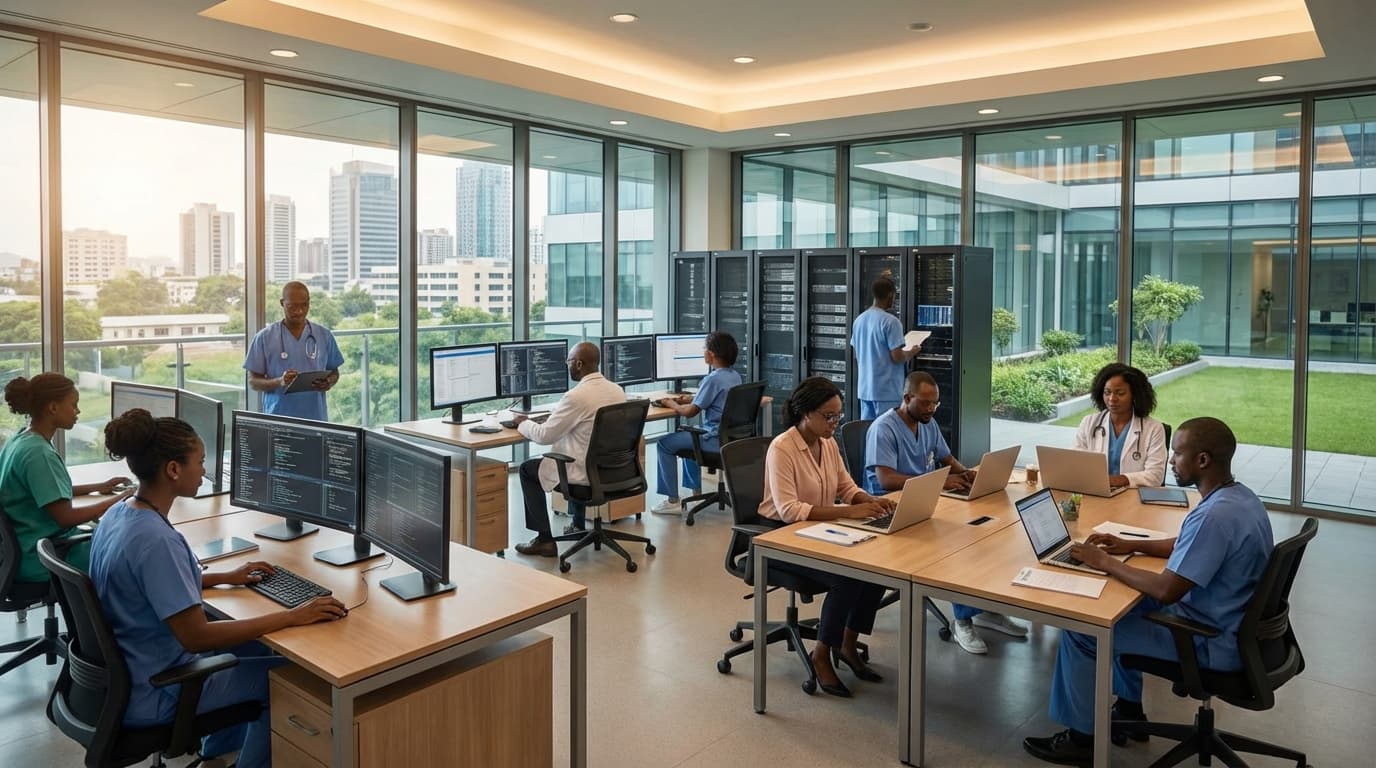
Radiology Reader & Reporting Support in Guinea-Bissau
Engineering Excellence & Technical Support
Remote radiology reading and reporting services High-standard technical execution following OEM protocols and local regulatory frameworks.
Remote Diagnostic Assistance
Provides real-time expert interpretation support for radiology images from remote locations, bridging the gap in specialized radiologists within Guinea-Bissau and enabling timely diagnoses for critical patient cases.
AI-Powered Learning Modules
Offers interactive, AI-driven training modules for local healthcare professionals, enhancing their understanding of radiological findings and improving image quality assessment, thereby upskilling the existing workforce.
Streamlined Reporting Workflow
Implements a user-friendly interface and intelligent dictation tools to accelerate the radiology reporting process, reducing turnaround times and improving the efficiency of radiology departments across the country.
What Is Radiology Reader & Reporting Support In Guinea-bissau?
Radiology Reader & Reporting Support in Guinea-Bissau refers to the provision of expert interpretation and diagnostic reporting for medical imaging studies (e.g., X-ray, CT, MRI, Ultrasound) in a context where local radiologist expertise may be limited or unavailable. This service leverages remote access to medical images and advanced communication technologies to enable qualified radiologists, often located internationally, to analyze imaging data and generate comprehensive diagnostic reports. These reports are crucial for informing clinical decision-making, guiding treatment plans, and improving patient outcomes within Guinea-Bissau's healthcare system. The service addresses disparities in access to specialized radiological services, augmenting existing capabilities and facilitating timely and accurate diagnoses.
| Who Needs Radiology Reader & Reporting Support? | Typical Use Cases | |||||
|---|---|---|---|---|---|---|
| Hospitals and Clinics in Guinea-Bissau: Particularly those lacking in-house radiologists or subspecialists. | Emergency Departments: For rapid interpretation of critical imaging studies (e.g., trauma, stroke, acute abdomen). | Surgical Departments: For pre-operative planning and post-operative assessment of imaging findings. | Oncologists and Oncological Centers: For staging, treatment monitoring, and response assessment of neoplastic conditions. | Primary Healthcare Providers: To obtain expert interpretations for complex or ambiguous imaging studies. | Public Health Initiatives: For screening programs or epidemiological studies requiring large-scale image analysis. | Training and Education Programs: To provide case examples and expert review for local medical trainees. |
| Fracture Identification and Management: Interpretation of X-rays for bone injuries. | Diagnosis of Infectious Diseases: Identifying pulmonary pathologies (e.g., tuberculosis, pneumonia) on chest X-rays or CT scans. | Detection of Malignancies: Characterizing masses or lesions identified on CT, MRI, or ultrasound scans. | Evaluation of Neurological Conditions: Interpreting CT or MRI scans for stroke, tumors, or degenerative diseases of the brain. | Assessment of Abdominal and Pelvic Pathology: Analyzing CT or ultrasound for conditions like appendicitis, cholecystitis, or gynecological issues. | Cardiac and Vascular Imaging: Interpretation of CT angiography or echocardiograms for cardiovascular disease. | Fetal Imaging Assessment: Providing expert review of obstetric ultrasounds for prenatal diagnosis. |
Key Components of Radiology Reader & Reporting Support:
- Image Acquisition and Transmission: Secure, high-speed transfer of DICOM (Digital Imaging and Communications in Medicine) compliant medical images from imaging modalities within Guinea-Bissau to a remote reading center.
- Remote Image Interpretation: Analysis of transmitted images by board-certified radiologists with relevant subspecialty expertise.
- Report Generation: Creation of detailed, structured diagnostic reports that include findings, impressions, and recommendations, adhering to international reporting standards.
- Secure Communication Platform: Utilization of encrypted and HIPAA-compliant (or equivalent) platforms for image sharing, report distribution, and communication between referring physicians and remote readers.
- Quality Assurance and Peer Review: Implementation of robust QA protocols to ensure accuracy, consistency, and adherence to best practices in radiological interpretation.
- Integration with PACS/RIS: Potential integration with existing Picture Archiving and Communication Systems (PACS) and Radiology Information Systems (RIS) to streamline workflow and data management.
Who Needs Radiology Reader & Reporting Support In Guinea-bissau?
Radiology reader and reporting support is crucial for enhancing diagnostic accuracy, improving turnaround times, and providing specialized expertise in regions where access to highly trained radiologists is limited. In Guinea-Bissau, such services are particularly vital for healthcare facilities aiming to deliver better patient care despite resource constraints.
| Customer Type | Relevant Departments | Specific Needs/Benefits |
|---|---|---|
| Public Hospitals | Radiology, Emergency Medicine, Surgery, Internal Medicine, Pediatrics, Oncology | Overcoming radiologist shortages, improving diagnostic accuracy for a high volume of patients, enabling timely reporting for critical cases, supporting training of local staff. |
| Private Hospitals/Clinics | Radiology, General Practice, Specialty Clinics (e.g., Cardiology, Neurology) | Ensuring consistent quality of reports, access to subspecialty interpretations, efficient workflow for busy outpatient services, competitive advantage through advanced diagnostic support. |
| Diagnostic Imaging Centers | Radiology Department Management | Augmenting existing reporting capacity, handling overflow, providing second opinions, offering specialized interpretations not available locally, quality assurance. |
| Maternal and Child Health Programs | Obstetrics & Gynecology, Pediatrics, Radiology | Specialized interpretation of obstetric ultrasounds (prenatal imaging), pediatric radiology (e.g., skeletal surveys, chest X-rays), improving detection of congenital anomalies and childhood diseases. |
| Emergency Departments | Emergency Medicine, Radiology, Trauma Surgery | Rapid interpretation of urgent imaging studies (e.g., head CTs for trauma, chest X-rays for acute respiratory distress), reducing diagnostic delays in critical situations. |
| Oncology Units | Oncology, Radiology, Surgery | Monitoring treatment response, staging of cancers, detecting recurrence, providing detailed reporting for oncological management. |
| Infectious Disease Control Centers | Infectious Diseases, Radiology | Interpreting chest X-rays for suspected tuberculosis, identifying other infectious pathologies impacting the lungs or other organs, supporting epidemiological surveillance. |
Target Customers and Departments in Guinea-Bissau Needing Radiology Reader & Reporting Support
- Hospitals (Public and Private)
- Clinics and Health Centers (especially those with imaging capabilities)
- Diagnostic Imaging Centers
- Maternal and Child Health Programs
- Emergency Departments
- Oncology Units
- Infectious Disease Control Centers
Radiology Reader & Reporting Support Process In Guinea-bissau
This document outlines the standard workflow for the Radiology Reader & Reporting Support Process in Guinea-Bissau, detailing the steps from the initial inquiry to the final execution of radiologic interpretation and reporting. This process is crucial for ensuring timely and accurate diagnostic information for patient care.
| Step | Description | Key Actors Involved | Tools/Systems Used | Potential Challenges |
|---|---|---|---|---|
| A clinician identifies the need for a radiological examination for a patient. The examination is ordered, and the imaging is performed by a radiographer/technician. | Clinician, Radiographer/Technician, Patient | Electronic Health Record (EHR) or Paper Request Forms, Imaging Equipment (X-ray, Ultrasound, CT, MRI) | Lack of necessary imaging equipment, power outages, equipment malfunction, insufficient trained personnel. |
| Acquired digital images are uploaded to a Picture Archiving and Communication System (PACS) or a secure cloud storage solution. For non-digital or older systems, images might be scanned or transmitted via secure means. | Radiographer/Technician, IT Support (if available) | PACS, Secure Cloud Storage, Scanners, Secure File Transfer Protocols | Slow internet connectivity, insufficient storage capacity, compatibility issues between imaging equipment and PACS, lack of IT infrastructure. |
| Images are triaged based on urgency (e.g., emergency cases) and complexity. A radiologist or a qualified reader is assigned to interpret the case. | Triage Officer/Radiologist Supervisor, PACS Administrator | PACS Dashboard, Workflow Management System | Overload of cases, lack of available radiologists, misprioritization of studies. |
| The assigned radiologist meticulously reviews the acquired images, looking for abnormalities and potential diagnoses. | Radiologist/Reader | PACS Workstation, DICOM Viewer Software | Image quality issues, difficulty in identifying subtle findings, lack of clinical information for context. |
| Based on the interpretation, the radiologist dictates or types a preliminary report outlining their findings and diagnostic impression. | Radiologist/Reader | Voice Recognition Software, Reporting Software, Word Processor | Typing errors, dictation inaccuracies, time constraints, difficulty in articulating complex findings. |
| In some settings, a senior radiologist or a peer may review the preliminary report for accuracy and completeness before finalization. | Senior Radiologist, Peer Reviewer | Reporting Software, PACS | Availability of senior reviewers, time pressure, potential for subjective interpretation differences. |
| The report is finalized, incorporating any revisions from the QA process. The report and images are securely archived in the PACS or relevant medical record system. | Radiologist/Reader, Administrative Staff | PACS, Electronic Health Record (EHR) System, Reporting Software | System downtime, data integrity issues, inadequate archiving protocols. |
| The final report is sent to the requesting clinician and integrated into the patient's medical record. This is often done electronically, but paper copies may still be used. | Radiology Department, Clinician, Medical Records Department | EHR System, Secure Email, Fax (if necessary) | Delays in report transmission, misfiled reports, lack of integration between different healthcare systems. |
Radiology Reader & Reporting Support Process Workflow
- Patient Examination Request & Imaging Acquisition
- Image Upload & Transmission
- Triage & Assignment to Reader
- Image Review & Interpretation
- Drafting of Preliminary Report
- Quality Assurance & Review (if applicable)
- Final Report Generation & Archiving
- Report Dissemination & Integration into Patient Records
Radiology Reader & Reporting Support Cost In Guinea-bissau
Estimating the cost of radiology reader and reporting support in Guinea-Bissau is complex due to the nascent state of advanced diagnostic imaging services and the limited availability of specialized radiologists. The pricing is heavily influenced by factors such as the type and volume of imaging studies, the level of expertise required (e.g., general radiology vs. subspecialty interpretation), the technological infrastructure available, and the contractual model (in-house vs. outsourced/tele-radiology). Currently, there isn't a standardized or widely published price list for these services in the local currency (West African CFA Franc - XOF). However, we can outline the key pricing factors and provide an estimated range based on the general economic landscape and the scarcity of specialized services. The dominant model for specialized radiology interpretation is likely to be outsourced, either through regional partnerships or increasingly, via tele-radiology platforms connecting to international experts. This international element will heavily influence pricing, with costs potentially being benchmarked against international rates but adjusted for local market conditions and perceived value. The demand is growing, driven by increasing investments in healthcare infrastructure, but the supply of qualified personnel and advanced equipment remains a significant constraint.
| Service Component | Estimated Price Range (XOF) | Notes on Estimation |
|---|---|---|
| Basic X-ray Interpretation (Per Study) | 15,000 - 40,000 | Assumes routine interpretation by a general radiologist. High end for more complex views or initial setup. |
| Ultrasound Interpretation (Per Study) | 25,000 - 75,000 | Includes abdominal, pelvic, or musculoskeletal ultrasounds. Higher end for specialized scans (e.g., Doppler). |
| CT Scan Interpretation (Per Study) | 75,000 - 250,000+ | Significant variation based on scan area (head, chest, abdomen). Likely sourced internationally, leading to higher costs. Includes basic contrast studies. |
| MRI Scan Interpretation (Per Study) | 150,000 - 500,000+ | Highest cost modality. Very specialized, and highly likely to be interpreted remotely by international subspecialists. Costs can escalate with complex sequences or contrast agents. |
| Tele-radiology Subscriptions/Service Fees (Monthly/Annual) | Negotiable, potentially starting from 1,000,000 - 5,000,000+ per month | This is a broad estimate for a service agreement covering a certain volume or range of studies. Highly dependent on the provider, volume commitment, and TAT guarantees. Could be significantly higher for comprehensive coverage. |
| Radiologist Training/Capacity Building (Per Day/Hour) | Negotiable, potentially 100,000 - 300,000+ per day | Costs for bringing in external trainers or experts for knowledge transfer. Highly variable based on trainer's expertise and duration. |
Key Pricing Factors for Radiology Reader & Reporting Support in Guinea-Bissau
- Type and Modality of Imaging Study (e.g., X-ray, Ultrasound, CT, MRI): More complex modalities like CT and MRI require higher levels of expertise and thus incur higher reporting costs.
- Volume of Studies: Higher volumes can sometimes lead to economies of scale or discounted rates, especially in outsourcing agreements.
- Turnaround Time (TAT) Requirements: Expedited reporting (e.g., for emergency cases) will typically command a premium.
- Radiologist's Specialization and Experience: Reporting by subspecialists (e.g., neuroradiology, interventional radiology) will be more expensive than general radiology reports.
- Level of Detail and Report Complexity: Comprehensive reports with detailed findings and recommendations will be priced higher than brief summaries.
- Technology and Infrastructure: The cost can be influenced by whether the reporting service utilizes advanced PACS (Picture Archiving and Communication System) and AI-assisted tools.
- Contractual Model: In-house recruitment of radiologists is extremely challenging and expensive. Outsourced services, including tele-radiology, are more prevalent but pricing will vary based on the provider (local, regional, or international).
- Currency Exchange Rates and Inflation: As the XOF is the local currency, fluctuations in exchange rates and inflation can impact the effective cost, especially for services procured internationally.
- Regulatory and Administrative Costs: Local licensing, compliance, and administrative overhead can be factored into pricing.
- Geographic Location and Accessibility: Remote locations might incur additional logistical costs if on-site support is ever required, though tele-radiology mitigates this significantly.
Affordable Radiology Reader & Reporting Support Options
Radiology practices and healthcare facilities can significantly reduce costs associated with image interpretation and reporting through strategic adoption of affordable reader and reporting support options. These solutions not only enhance efficiency but also provide access to specialized expertise without the overhead of full-time hiring. Understanding value bundles and implementing cost-saving strategies are key to maximizing the benefits of these services.
| Strategy/Bundle | Description | Cost-Saving Benefit | Value Proposition |
|---|---|---|---|
| On-Demand Teleradiology | Accessing radiologists for specific studies or during peak hours. | Reduces need for full-time hires, avoids idle capacity. | Flexibility, cost-efficiency, access to expertise. |
| Subspecialty Coverage | Outsourcing complex or niche radiology reads to specialists. | Avoids high salaries for in-house subspecialists, improves diagnostic accuracy. | Enhanced diagnostic quality, broader service offering. |
| Night & Weekend Coverage | Utilizing off-site radiologists for urgent reads outside of business hours. | Significantly cheaper than staffing local night shifts. | 24/7 service availability, faster turnaround for critical cases. |
| AI-Powered Assistance | Using AI tools to pre-process images or flag abnormalities, followed by human radiologist review. | Increases radiologist efficiency, potentially reducing per-study read time. | Faster reporting, improved accuracy, augmented workflow. |
| Workload Management Solutions | Balancing read volume across internal staff and external teleradiology providers. | Prevents burnout, maintains report turnaround times, avoids overtime costs. | Sustainable workload, improved staff satisfaction. |
| Bundled Service Packages | Combining multiple services (e.g., general reads, subspecialty, peer review) into a single contract. | Potential for volume discounts, simplified billing, predictable budgeting. | Integrated solution, enhanced value for money. |
Key Value Bundles and Cost-Saving Strategies
- Teleradiology Subspecialty Reads: Accessing expert subspecialists (e.g., neuroradiology, musculoskeletal, pediatric) on-demand or for overflow cases. This avoids the need for expensive in-house subspecialists who may not be utilized full-time.
- Second Opinions/Peer Review: Engaging external radiologists for critical case reviews or quality assurance. This can be bundled as a subscription service for a set number of reads or a per-case fee.
- Workload Balancing: Utilizing teleradiology services to manage fluctuating workloads, peak demand, or staff shortages. This prevents burnout and ensures timely reporting.
- Emerging Markets & Night Coverage: Outsourcing reads for off-peak hours or in regions with limited local radiologist availability. This is often more cost-effective than staffing 24/7 locally.
- Technology Integration & Workflow Optimization: Choosing providers that integrate seamlessly with existing PACS and RIS systems. This reduces IT overhead and training time.
- Flexible Service Models: Opting for per-study fees, block-hour contracts, or retainer agreements based on anticipated volume and budget. This allows for scalability.
- Dedicated Radiologist Pools: Contracting with teleradiology groups that offer dedicated radiologists or teams for specific sites or modalities, fostering familiarity and consistent quality.
- AI-Assisted Reporting Enhancement: Partnering with services that integrate AI for initial reads or flagging, with a human radiologist performing the final interpretation. This can speed up turnaround and reduce costs per study.
- Training and Quality Assurance Programs: Selecting partners who actively participate in your QA programs or offer their own robust QA processes. This ensures high-quality reporting and reduces error-related costs.
- Negotiating Volume Discounts: For larger practices or facilities with consistent high volumes, negotiating tiered pricing structures based on the number of studies interpreted per month or year.
Verified Providers In Guinea-bissau
Ensuring access to quality healthcare is paramount, especially in regions like Guinea-Bissau. When seeking medical services, verifying the credentials of healthcare providers is a critical step. Franance Health stands out as a leading organization committed to upholding the highest standards of medical practice and patient care within Guinea-Bissau. Their rigorous verification process and dedication to excellence make them the premier choice for individuals and organizations seeking reliable and trustworthy healthcare partners.
| Credential Type | Verification Process | Franance Health Assurance | Benefit to Patients |
|---|---|---|---|
| Medical Licenses & Certifications | Verification of official licenses and board certifications with relevant national and international bodies. | Franance Health confirms the authenticity and current validity of all practitioner licenses. | Ensures providers are legally qualified and competent to practice. |
| Educational Background | Review of academic records and degrees from accredited institutions. | Franance Health scrutinizes educational qualifications for accuracy and relevance. | Guarantees a solid foundation of medical knowledge. |
| Professional Experience | Background checks and reference verifications for previous work history and practice areas. | Franance Health assesses the depth and breadth of a provider's experience. | Provides confidence in practical skills and specialized expertise. |
| Reputation & Ethics | Inquiry into professional conduct and ethical standing within the medical community. | Franance Health considers patient feedback and professional endorsements. | Promotes a safe and ethical patient experience. |
| Facility Accreditation | Assessment of healthcare facilities for compliance with safety, hygiene, and equipment standards. | Franance Health ensures facilities meet or exceed regulatory requirements. | Contributes to a secure and effective treatment environment. |
Why Franance Health Credentials Matter in Guinea-Bissau:
- Rigorous vetting of medical professionals and facilities.
- Adherence to international best practices and ethical guidelines.
- Commitment to ongoing professional development and training.
- Enhanced patient safety and trust.
- Facilitation of seamless access to specialized medical services.
Scope Of Work For Radiology Reader & Reporting Support
This Scope of Work (SOW) outlines the requirements for Radiology Reader & Reporting Support services. The objective is to provide qualified radiologists to read and report on medical imaging studies, ensuring timely, accurate, and comprehensive diagnostic interpretations. This SOW specifies the technical deliverables and standard specifications expected from the service provider.
| Category | Technical Deliverable | Standard Specification | Acceptance Criteria |
|---|---|---|---|
| Radiology Reading | Image interpretation of various modalities (X-ray, CT, MRI, Ultrasound, Nuclear Medicine, etc.). | Radiologists must be board-certified or eligible, with specific subspecialty expertise as required. Compliance with ACR appropriateness criteria and relevant clinical guidelines. | All studies read within agreed-upon turnaround times (TAT). Accuracy validated through peer review or audits. No significant discrepancies found in >95% of reviewed cases. |
| Reporting | Generation of comprehensive radiology reports. | Reports must be clear, concise, and structured (e.g., Findings, Impression). Inclusion of relevant clinical history, measurements, and comparison with prior studies. Reports must be dictation-ready or directly entered into the RIS. | Reports delivered within specified TAT for routine, urgent, and emergent cases. Reports free from grammatical errors and typos. Clarity and conciseness evaluated through user feedback. |
| Turnaround Time (TAT) | Timely delivery of reports. | Standard TAT: X-ray (24 hrs), CT/MRI (12-24 hrs), Ultrasound (24 hrs). Urgent/Emergent TAT: CT/MRI (1-4 hrs), X-ray (1-6 hrs). Specific TATs to be defined in Service Level Agreement (SLA). | Achieve >98% compliance with agreed-upon TAT for all report categories. |
| Quality Assurance (QA) | Internal quality control and peer review processes. | Provider must implement a robust QA program including peer review of a statistically significant sample of reports, case conferences, and ongoing professional development for radiologists. | Demonstrable QA program with documented review processes and corrective action plans. Improvement in accuracy and report quality metrics over time. |
| Data Security & Privacy | Secure handling of patient data and compliance with regulations. | Full compliance with HIPAA, GDPR, or other applicable data protection regulations. Secure data transmission and storage protocols. Access controls and audit trails. | No breaches of patient data. Successful completion of security audits. All data handled in accordance with agreed-upon security policies. |
| System Integration | Integration with client's PACS and RIS. | Seamless integration for image retrieval, report upload, and communication. Support for HL7, DICOM, and other relevant standards. Minimal disruption to existing workflows. | Successful integration confirmed by IT department. Smooth data flow and report accessibility. Minimal user-reported issues post-integration. |
| Communication | Clear and timely communication channels. | Establish designated points of contact. Provision of emergency contact information. Regular reporting on service performance and any identified issues. Ability to communicate critical findings promptly. | Responsive communication within defined timeframes. Proactive notification of any service disruptions or significant findings. Satisfaction with communication responsiveness. |
Key Objectives
- Provide expert radiology reading and reporting services.
- Ensure adherence to all clinical guidelines and best practices.
- Maintain high levels of accuracy and turnaround times.
- Facilitate seamless integration with existing PACS and RIS systems.
- Deliver clear, concise, and actionable reports.
Service Level Agreement For Radiology Reader & Reporting Support
This Service Level Agreement (SLA) outlines the performance standards and guarantees for the Radiology Reader & Reporting Support services provided. It defines the responsibilities of both the service provider and the client, focusing on response times for critical issues and system uptime. This agreement is designed to ensure timely and reliable access to essential radiology reading and reporting functionalities.
| Service Component | Uptime Guarantee | Response Time (Critical Issues) | Response Time (Major Issues) | Response Time (Minor Issues) | Target Resolution Time (Critical Issues) |
|---|---|---|---|---|---|
| Radiology Reader Platform Availability | 99.9% per calendar month | 15 minutes | 1 hour | 4 business hours | 2 hours |
| Reporting Tool Availability | 99.9% per calendar month | 15 minutes | 1 hour | 4 business hours | 2 hours |
| Integration with PACS/RIS | 99.8% per calendar month | 30 minutes | 2 hours | 8 business hours | 4 hours |
| Technical Support Availability | 24x7x365 | 15 minutes (for critical incidents reported via agreed channels) | 1 hour | 4 business hours | N/A (focus on initial response) |
Key Service Definitions
- Service Provider: The entity responsible for delivering the Radiology Reader & Reporting Support.
- Client: The entity receiving the Radiology Reader & Reporting Support.
- System Downtime: Any period during which the Radiology Reader & Reporting Support system is unavailable to the Client due to scheduled maintenance or unplanned outages.
- Response Time: The maximum time allowed for the Service Provider to acknowledge and begin addressing a reported issue.
- Resolution Time: The maximum time allowed for the Service Provider to resolve a reported issue, although full resolution may depend on client cooperation and the complexity of the issue.
- Critical Issue: A problem that renders the core functionality of the Radiology Reader & Reporting Support system unusable or significantly impairs its operation, preventing the completion of essential radiology reading and reporting tasks.
- Major Issue: A problem that impacts significant functionality or performance of the Radiology Reader & Reporting Support system but does not prevent essential tasks from being completed, albeit with reduced efficiency.
- Minor Issue: A problem that has minimal impact on functionality or performance, such as cosmetic defects or issues with non-critical features.
Frequently Asked Questions

Ready when you are
Let's scope your Radiology Reader & Reporting Support in Guinea-Bissau project in Guinea-Bissau.

Scaling healthcare logistics and technical systems across the entire continent.