
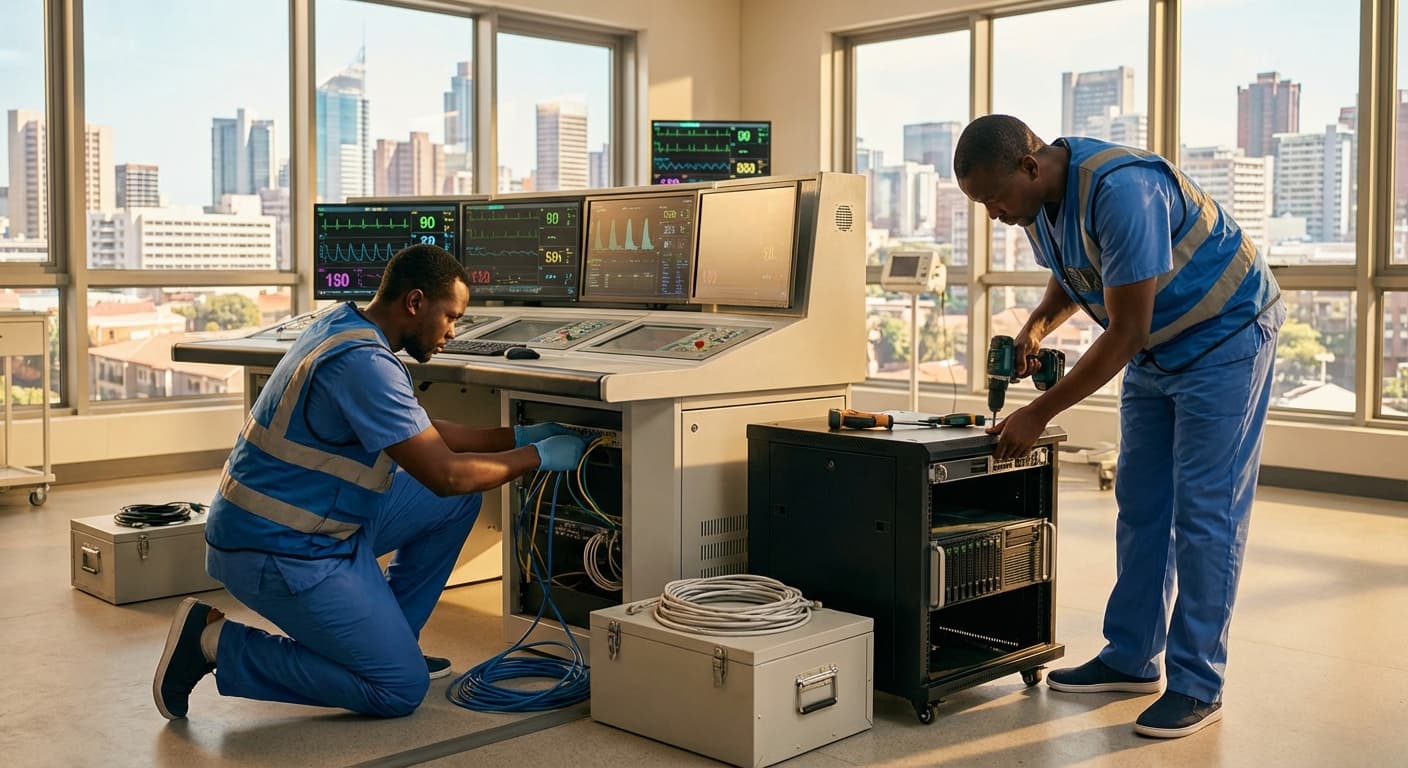
ICU Central Monitoring Station Installation Service in Guinea-Bissau
Engineering Excellence & Technical Support
ICU Central Monitoring Station Installation Service High-standard technical execution following OEM protocols and local regulatory frameworks.
Robust Network Infrastructure
We design and implement secure, high-bandwidth network architectures optimized for real-time data transmission, ensuring reliable connectivity between patient monitors, central consoles, and any integrated hospital information systems, even in challenging environments.
Seamless System Integration
Our expertise extends to integrating diverse monitoring devices (e.g., ECG, SpO2, NIBP) and vital sign modules with a centralized platform, providing a unified view of patient data and enabling seamless workflow for clinical staff.
Resilient Power & Data Redundancy
We implement redundant power supplies, uninterruptible power sources (UPS), and data backup solutions to guarantee continuous operation and data integrity of the central monitoring station, critical for life-saving decisions in the ICU.
What Is Icu Central Monitoring Station Installation Service In Guinea-bissau?
ICU Central Monitoring Station Installation Service in Guinea-Bissau refers to the comprehensive process of deploying and integrating a centralized system designed to remotely monitor vital patient parameters from Intensive Care Units (ICUs) and potentially other critical care areas within healthcare facilities in Guinea-Bissau. This service ensures that healthcare providers can observe and manage multiple patients' physiological data concurrently from a dedicated station, enhancing patient safety, improving response times to critical events, and optimizing resource allocation.
| Who Needs This Service | Typical Use Cases | ||||||
|---|---|---|---|---|---|---|---|
| Hospitals with Intensive Care Units (ICUs) in Guinea-Bissau. | Monitoring of multiple critically ill patients simultaneously from a single location. | Facilitating early detection of patient deterioration through real-time data visualization and alarm systems. | Improving interdisciplinary communication and collaboration among critical care teams. | Enabling remote oversight of ICU patients by senior physicians or specialists. | Streamlining workflow for nursing staff by reducing the need for constant physical checks at each bedside. | Supporting medical education and research by providing access to aggregated patient data. | Ensuring continuous patient monitoring during power outages through integrated UPS systems. |
What ICU Central Monitoring Station Installation Service Involves
- Site Assessment and Planning: Evaluating the existing infrastructure, power supply stability, network connectivity, and physical space requirements at the healthcare facility.
- Hardware Procurement and Installation: Sourcing and setting up central monitoring workstations, servers, network switches, cabling, and potentially uninterruptible power supplies (UPS).
- Patient Monitor Integration: Connecting existing or newly installed ICU patient monitors (e.g., ventilators, defibrillators, anesthesia machines, ECGs, pulse oximeters) to the central monitoring system.
- Network Configuration and Security: Establishing a robust and secure network for data transmission, including IP addressing, firewall configuration, and data encryption protocols.
- Software Deployment and Configuration: Installing and configuring the central monitoring software, including patient database management, alarm settings, trend analysis tools, and data archiving functionalities.
- System Testing and Calibration: Rigorous testing of all components to ensure accurate data acquisition, reliable alarm generation, and seamless data flow. Calibration of sensors and devices is critical.
- User Training and Support: Providing comprehensive training to clinical staff (nurses, physicians, technicians) on the operation, maintenance, and troubleshooting of the central monitoring system. Ongoing technical support is also a key component.
- Documentation and Handover: Delivering detailed system documentation, including network diagrams, user manuals, and maintenance schedules. Formal handover of the operational system to the facility.
Who Needs Icu Central Monitoring Station Installation Service In Guinea-bissau?
ICU Central Monitoring Station Installation Services are critical for healthcare facilities that aim to provide advanced, real-time patient care in intensive care units. These systems allow for the continuous and simultaneous monitoring of multiple patients' vital signs and other physiological data from a centralized location, enabling faster response to critical changes and improved patient outcomes. The installation of such systems requires specialized expertise to ensure seamless integration with existing infrastructure, proper calibration, and comprehensive training for medical staff.
| Department | Specific Needs Addressed | Key Personnel Involved |
|---|---|---|
| Intensive Care Unit (ICU) | Real-time, continuous monitoring of multiple critically ill patients; early detection of patient deterioration; improved team communication and response times; remote monitoring capabilities. | Intensivists, ICU Nurses, Biomedical Engineers, IT Support Staff, Installation Technicians |
| Cardiology Department | Monitoring of patients with severe cardiac conditions (e.g., post-MI, heart failure); continuous ECG monitoring; early identification of arrhythmias. | Cardiologists, Cardiac ICU Nurses, Biomedical Engineers, IT Support Staff |
| Neurosurgery/Neurology Department | Monitoring of patients with severe brain injuries, stroke, or post-neurosurgical procedures; intracranial pressure monitoring; neurological vital signs. | Neurosurgeons, Neurologists, ICU Nurses specializing in neurology, Biomedical Engineers, IT Support Staff |
| Anesthesiology Department | Peri-operative monitoring support; ensuring stable patient conditions during critical procedures. | Anesthesiologists, Critical Care Nurses, Biomedical Engineers |
| Hospital Administration/Management | Enhancing overall patient safety and quality of care; optimizing resource allocation; meeting international healthcare standards. | Hospital Administrators, Chief Medical Officers, IT Directors, Procurement Managers |
| Biomedical Engineering Department | Ensuring the proper functioning, maintenance, and integration of medical equipment; system troubleshooting; calibration and validation. | Biomedical Engineers, Clinical Engineers, IT Support Staff, Installation Technicians |
Target Customers for ICU Central Monitoring Station Installation Services in Guinea-Bissau
- Government Hospitals
- Private Hospitals
- Non-Governmental Organization (NGO) Healthcare Facilities
- University Teaching Hospitals
- Specialized Cardiac and Neurological Centers
Icu Central Monitoring Station Installation Service Process In Guinea-bissau
This document outlines the typical workflow for an ICU Central Monitoring Station Installation Service process in Guinea-Bissau, from the initial customer inquiry to the final execution and handover. The process is designed to be comprehensive, ensuring a smooth and efficient installation that meets the specific needs of healthcare facilities in the region.
| Stage | Description | Key Activities | Deliverables | Responsibility |
|---|---|---|---|---|
| Inquiry & Initial Consultation | The process begins when a healthcare facility in Guinea-Bissau expresses interest in installing an ICU Central Monitoring Station. | Receive inquiry, understand basic requirements, schedule initial meeting. | Confirmation of interest, understanding of primary needs. | Client, Service Provider |
| Needs Assessment & Site Survey | A detailed assessment of the facility's current infrastructure, existing equipment, and specific requirements for the ICU monitoring system. | On-site visit, technical evaluation of existing network, power, and space. Discussion of desired features and patient capacity. | Detailed site survey report, list of requirements, identification of potential challenges. | Service Provider (Technical Team) |
| Proposal & Quotation | Based on the needs assessment, a tailored proposal outlining the proposed solution, system components, timeline, and costs is prepared. | Develop technical proposal, create detailed quotation, present to client. | Formal proposal document, detailed quotation with breakdown of costs. | Service Provider (Sales & Technical Team) |
| Contract Negotiation & Signing | Review and agreement on the terms and conditions of the installation service contract. | Negotiate contract terms, finalize pricing, secure formal agreement. | Signed service contract. | Client, Service Provider |
| System Design & Configuration | Detailed design of the central monitoring system, including network topology, software configuration, and integration with existing devices. | Create system architecture diagrams, configure monitoring software, define data flow and alarms. | System design documentation, configuration files. | Service Provider (Engineering Team) |
| Procurement & Logistics | Sourcing and delivery of all necessary hardware, software, and accessories to the installation site in Guinea-Bissau. | Order equipment, manage import/customs procedures, arrange transportation. | All procured system components delivered to the site. | Service Provider (Procurement & Logistics Team) |
| Pre-installation Preparation | Ensuring the installation site is ready for the equipment, including necessary power, network, and structural modifications. | Prepare server room/control center, install network cabling, ensure power supply adequacy. | Ready installation environment. | Client (Infrastructure), Service Provider (Coordination) |
| Installation & Setup | Physical installation of the central monitoring station hardware, including servers, workstations, and network devices. | Mount servers and workstations, connect network cables, install and connect bedside monitors. | Physically installed monitoring system hardware. | Service Provider (Installation Technicians) |
| Testing & Calibration | Thorough testing of all system components and functionalities to ensure proper operation and data accuracy. | Network connectivity tests, software functionality checks, sensor calibration, alarm system verification. | System performance reports, calibration certificates. | Service Provider (Testing & Commissioning Team) |
| Training | Providing comprehensive training to the hospital's medical and technical staff on the operation and maintenance of the central monitoring system. | Develop training materials, conduct hands-on training sessions for nurses, doctors, and IT personnel. | Trained staff, training manuals and documentation. | Service Provider (Training Specialists) |
| Commissioning & Handover | Formal acceptance of the installed system by the client after all tests are successfully completed and training is provided. | Final system verification, client sign-off on installation and performance. | System operational confirmation, handover documentation. | Client, Service Provider |
| Post-installation Support & Maintenance | Ongoing technical support, troubleshooting, and maintenance services to ensure the long-term reliability of the monitoring system. | Remote and on-site support, software updates, preventative maintenance. | Service Level Agreement (SLA), ongoing support. | Service Provider (Support Team) |
ICU Central Monitoring Station Installation Service Workflow in Guinea-Bissau
- Inquiry & Initial Consultation
- Needs Assessment & Site Survey
- Proposal & Quotation
- Contract Negotiation & Signing
- System Design & Configuration
- Procurement & Logistics
- Pre-installation Preparation
- Installation & Setup
- Testing & Calibration
- Training
- Commissioning & Handover
- Post-installation Support & Maintenance
Icu Central Monitoring Station Installation Service Cost In Guinea-bissau
The installation of an ICU Central Monitoring Station in Guinea-Bissau involves a complex process that can vary significantly in cost. Several factors influence the final price, making it essential for healthcare facilities to obtain detailed quotes based on their specific requirements. These factors include the scope of the project, the technology chosen, the size and complexity of the ICU, the existing infrastructure, and the installation team's expertise. Local economic conditions and import duties on specialized medical equipment also play a crucial role in the overall expenditure. It is advisable to consult with multiple reputable medical equipment suppliers and installation service providers in Guinea-Bissau or those with experience operating in the region to get the most accurate pricing.
| Component/Service | Estimated Cost Range (XOF - Guinea-Bissau Pesos) | Notes |
|---|---|---|
| Central Monitoring System (Software & Servers) | 20,000,000 - 80,000,000+ | Varies significantly based on features, scalability, and brand reputation. |
| Patient Monitoring Units (per bed) | 5,000,000 - 15,000,000+ | Depends on the sophistication of the monitor and the parameters it offers. |
| Central Workstations (Monitors, PCs) | 2,000,000 - 6,000,000 | Cost per workstation for the central nursing station. |
| Networking Equipment & Cabling | 3,000,000 - 10,000,000 | Includes switches, routers, and installation of new network infrastructure if needed. |
| Installation Labor & Project Management | 5,000,000 - 15,000,000 | Covers the technical team's time, travel, and on-site work. |
| Site Preparation & Electrical Work | 1,000,000 - 5,000,000 | Potential costs for room modifications or electrical upgrades. |
| Training for Staff | 1,000,000 - 3,000,000 | Comprehensive training on system operation and software. |
| Import Duties & Taxes (Estimated) | 15% - 30% of CIF value | This is an estimate and can vary based on specific equipment classification. |
| Total Estimated Project Cost (for a moderately sized ICU) | 60,000,000 - 200,000,000+ XOF | This is a broad estimate. A detailed site assessment and specific quotes are essential. |
Key Factors Influencing ICU Central Monitoring Station Installation Cost in Guinea-Bissau
- System Scope and Features: The number of patient monitoring beds to be integrated, the type of parameters monitored (e.g., ECG, SpO2, NIBP, invasive pressures, respiration, temperature), and advanced features like waveform averaging, trend analysis, and data archiving all impact cost.
- Equipment Quality and Brand: High-end, globally recognized brands generally come with a higher price tag due to their reputation for reliability, advanced features, and extensive support. Mid-range or local options might offer cost savings.
- Number of Workstations: The installation cost will be influenced by the number of central monitoring workstations required for the nursing staff, physicians, and potentially other specialized areas.
- Networking Infrastructure: The need for new network cabling, switches, routers, and potential upgrades to the hospital's existing IT infrastructure to support real-time data transmission can add to the overall cost.
- Installation Labor and Expertise: The complexity of the installation, the duration of the project, and the skill level of the installation technicians (local vs. international) will affect labor costs.
- Site Preparation: Any necessary modifications to the ICU rooms, electrical upgrades, or mounting solutions for monitors and workstations will contribute to the installation expenses.
- Training: Comprehensive training for medical staff on operating the central monitoring system and its software is a vital component that is often bundled into installation services.
- After-Sales Support and Maintenance: The cost of initial warranties, service level agreements (SLAs), and ongoing maintenance contracts should be considered as part of the long-term investment.
- Import Duties and Taxes: Guinea-Bissau's import regulations and applicable duties on medical equipment can significantly impact the landed cost of the system.
- Geographical Location within Guinea-Bissau: While not a primary driver for the equipment itself, the accessibility of the hospital's location can influence transportation and logistical costs for the installation team and equipment.
Affordable Icu Central Monitoring Station Installation Service Options
Installing an ICU Central Monitoring Station (CMS) is a critical investment for any healthcare facility, ensuring continuous patient surveillance and rapid response to critical events. This guide outlines affordable installation service options, focusing on value bundles and cost-saving strategies to make this essential technology accessible.
| Cost-Saving Strategy | Description | Potential Impact |
|---|---|---|
| Phased Implementation | Instead of a full hospital-wide rollout, implement the CMS in phases, starting with a pilot ICU. This allows for learning and adjustments before scaling up, managing upfront costs. | Reduces immediate capital expenditure, allows for iterative improvements, and minimizes disruption. |
| Leverage Existing Infrastructure | Assess if existing network cabling, power, and server capacity can be utilized. This avoids unnecessary new infrastructure costs. | Significantly reduces hardware and installation costs for network and power upgrades. |
| Negotiate Bulk Purchasing Discounts | When purchasing monitors, servers, and software, inquire about discounts for purchasing in larger quantities, especially if other departments can benefit from similar solutions. | Lower per-unit hardware and software licensing costs. |
| Explore Refurbished or Certified Pre-Owned Equipment | For non-critical components or for facilities with budget constraints, consider high-quality refurbished or certified pre-owned monitors and servers from reputable vendors. | Can offer substantial savings on hardware costs, provided they meet clinical standards and come with warranties. |
| Vendor Negotiation and Comparison | Obtain quotes from multiple vendors and don't hesitate to negotiate on pricing, bundled services, and contract terms. Clearly define your requirements to ensure apples-to-apples comparisons. | Competitive pricing and tailored solutions that better fit your budget. |
| Off-Peak Installation Scheduling | If possible, schedule installation during less busy periods for your IT and clinical staff to minimize disruption and potential overtime costs. | Potentially lower labor costs and smoother integration with less impact on daily operations. |
| Training Optimization | Instead of extensive on-site training for all staff, consider train-the-trainer programs or online modular training to reduce travel and instructor costs. | Reduced training expenses and flexibility for staff learning schedules. |
| Managed Services Agreements (MSA) | While seemingly an ongoing cost, a well-structured MSA can include proactive maintenance and remote support, potentially preventing costly emergency repairs and downtime. | Predictable operational expenses, reduced risk of costly breakdowns, and extended equipment lifespan. |
Understanding Value Bundles
- {"title":"What are Value Bundles?","description":"Value bundles are service packages that combine multiple components of an ICU CMS installation into a single, often discounted, offering. These typically include hardware, software, installation labor, training, and sometimes initial maintenance or support."}
- {"title":"Benefits of Value Bundles","description":"Bundles simplify procurement by providing a comprehensive solution from a single vendor, often at a lower overall cost than purchasing components individually. They ensure compatibility and streamline project management."}
- {"title":"Common Bundle Components","description":"Typical components include: bedside monitors, central station hardware/software, network infrastructure integration, installation and configuration, user training sessions, and initial technical support."}
Verified Providers In Guinea-bissau
Navigating healthcare in any country can be a challenge, and Guinea-Bissau is no exception. When seeking medical assistance, it is paramount to ensure you are being treated by verified and reputable providers. Franance Health stands out as a beacon of quality and trustworthiness in Guinea-Bissau's healthcare landscape. Their commitment to stringent credentialing processes and patient-centered care makes them the premier choice for individuals and families seeking reliable medical services.
| Category | Franance Health Advantage | Importance for Patients |
|---|---|---|
| Provider Verification | Franance Health conducts thorough background checks, verifies licenses, and assesses qualifications of all partner providers. | Ensures access to legitimate and competent healthcare professionals, minimizing risks of unqualified practitioners. |
| Specialist Network | A curated list of specialists in various fields, from general medicine to surgery and pediatrics. | Provides access to specialized care when needed, without the uncertainty of finding qualified specialists. |
| Quality Assurance | Ongoing monitoring and feedback mechanisms to maintain high service standards among their network. | Guarantees a consistently high level of medical care and patient satisfaction. |
| Accessibility | Facilitates easier appointment booking and navigation within the healthcare system. | Reduces barriers to accessing essential medical services and improves patient convenience. |
| Reputation and Trust | Built on a foundation of integrity and a proven track record of reliable healthcare provision. | Offers peace of mind and confidence in the medical services received. |
Why Franance Health is the Best Choice:
- Rigorous Vetting Process: Franance Health employs a meticulous verification system for all its partner providers, ensuring they meet the highest standards of medical practice, ethics, and licensing. This eliminates the guesswork for patients.
- Exceptional Quality of Care: Providers associated with Franance Health are known for their expertise, up-to-date medical knowledge, and compassionate approach. They prioritize patient well-being and aim for optimal health outcomes.
- Comprehensive Network: Franance Health offers access to a diverse network of specialists and general practitioners across various medical disciplines, catering to a wide range of healthcare needs.
- Transparency and Trust: Their commitment to transparency in credentialing and service delivery builds a foundation of trust with their patients, making healthcare decisions more straightforward and secure.
- Patient-Centric Approach: Beyond medical expertise, Franance Health focuses on the patient experience, ensuring accessible appointments, clear communication, and a supportive environment.
Scope Of Work For Icu Central Monitoring Station Installation Service
This Scope of Work (SOW) outlines the requirements for the installation of an ICU Central Monitoring Station (CMS) service. It details the technical deliverables and standard specifications necessary for a successful and integrated system. The objective is to provide a robust and reliable monitoring solution that enhances patient care and operational efficiency within the Intensive Care Unit.
| Category | Specification/Requirement | Details/Notes |
|---|---|---|
| CMS Hardware | Server(s) | High-availability, redundant configuration recommended. Minimum specifications to be agreed upon based on patient load and data retention policies. |
| CMS Hardware | Workstations/Displays | High-resolution, multi-display capability for optimal visualization. Ergonomic design for extended use. |
| CMS Hardware | Network Switches | Managed, high-throughput switches with Quality of Service (QoS) support for real-time data. Redundant connections. |
| CMS Software | Operating System | Latest stable version of a supported enterprise-grade OS (e.g., Windows Server, Linux). |
| CMS Software | Database | Robust, scalable database system (e.g., SQL Server, Oracle) with appropriate licensing and backup strategy. |
| CMS Software | Monitoring Application | Vendor-specific or integrated application with secure remote access capabilities, customizable dashboards, and trend analysis. |
| Network Connectivity | Cabling Standard | Category 6A or higher Ethernet cabling, adhering to TIA/EIA standards. Fiber optics for backbone connections. |
| Network Connectivity | IP Addressing | Static IP addressing for all CMS components and connected devices. DHCP for temporary guest access if required. |
| Network Connectivity | Security | Firewall configuration, VLAN segmentation, and encrypted data transmission (e.g., TLS/SSL) where applicable. |
| Integration | Protocol Compatibility | Support for industry-standard protocols such as HL7, DICOM, FHIR, and proprietary device-specific protocols. Interface engines may be required. |
| Integration | Device Compatibility | Confirmation of compatibility with all existing ICU bedside monitors, ventilators, infusion pumps, and other critical care devices. Drivers or middleware may be needed. |
| Alarm Management | Customization | Configurable alarm thresholds, priority levels, and audible/visual notification methods. Integration with pager or mobile alert systems. |
| Alarm Management | Testing | Simulated alarm scenarios to validate functionality and response times. |
| Data Archiving | Storage | Sufficient storage capacity for historical patient data, based on hospital policy and regulatory requirements. Secure, off-site backup solution. |
| Data Archiving | Retrieval | Fast and efficient retrieval of archived patient data for clinical review and reporting. |
| User Training | Content | Role-based training for clinical staff (monitoring, alarm response) and IT staff (system administration, troubleshooting). |
| User Training | Format | Hands-on sessions, workshops, and provision of training materials. |
| System Testing | Validation | Comprehensive testing plan to ensure all functionalities operate as per specifications. User Acceptance Testing (UAT) is mandatory. |
| System Testing | Performance Benchmarking | Stress testing to ensure system stability and responsiveness under peak load conditions. |
| System Testing | Security Audit | Vulnerability assessment and penetration testing to ensure data integrity and patient privacy. |
| Documentation | Content | As-built diagrams, configuration details, troubleshooting guides, and user manuals. All documentation to be delivered in electronic format. |
| Support & Warranty | Service Level Agreement (SLA) | Definition of response times, resolution times, and escalation procedures for critical issues. 24/7 support availability. |
| Support & Warranty | Warranty Period | Minimum of one (1) year warranty on hardware and software, with options for extended support contracts. |
Technical Deliverables
- Central Monitoring Station Hardware Installation
- Central Monitoring Station Software Installation and Configuration
- Network Cabling and Connectivity for Monitoring Devices
- Integration with Existing Patient Monitoring Devices (Bedside Monitors, Ventilators, etc.)
- User Interface (UI) and User Experience (UX) Customization
- Alarm Management System Configuration and Testing
- Data Archiving and Retrieval System Setup
- User Training Sessions (Clinical and Technical Staff)
- System Documentation (Installation Guides, User Manuals, Troubleshooting Guides)
- System Testing and Validation (Functional, Performance, Security)
- Post-Installation Support and Warranty Information
Service Level Agreement For Icu Central Monitoring Station Installation Service
This Service Level Agreement (SLA) outlines the response times and uptime guarantees for the installation service of the ICU Central Monitoring Station. This SLA applies to all approved installation projects commencing on or after the effective date and covers the period from the confirmed installation commencement date until the final sign-off by the client.
| Incident Severity | Response Time (during business hours) | Uptime Guarantee (during installation & validation) |
|---|---|---|
| Critical Incident | 1 Hour | 99.5% (for the core monitoring functionality required for patient care) |
| Major Incident | 2 Business Hours | N/A (Focus is on rapid response to restore full functionality) |
| Minor Incident | 4 Business Hours | N/A (Focus is on resolution within agreed timelines) |
Definitions
- Installation Service: The end-to-end process of setting up, configuring, and testing the ICU Central Monitoring Station hardware and software at the client's facility.
- Critical Incident: An event that renders the ICU Central Monitoring Station inoperable, significantly impairs its functionality, or poses an immediate risk to patient safety. This includes complete system failure, loss of vital patient data transmission, or critical alarm malfunctions.
- Major Incident: An event that degrades the performance of the ICU Central Monitoring Station but does not render it completely inoperable. This includes intermittent data loss, slow system response, or partial alarm functionality issues.
- Minor Incident: An issue that affects non-critical functionality or performance, or a cosmetic defect that does not impact the primary operation of the ICU Central Monitoring Station.
- Response Time: The maximum time allowed from the initial notification of an incident to the initiation of troubleshooting by the service provider's qualified technical personnel.
- Uptime Guarantee: The percentage of time the ICU Central Monitoring Station is operational and performing its intended functions during the installation and initial post-installation validation period.
- Installation Commencement Date: The date agreed upon by both parties for the physical commencement of the installation work at the client's site.
- Final Sign-off: The formal written acceptance of the completed installation service by the client, signifying the successful completion of the project.
Frequently Asked Questions

Ready when you are
Let's scope your ICU Central Monitoring Station Installation Service in Guinea-Bissau project in Guinea-Bissau.

Scaling healthcare logistics and technical systems across the entire continent.