
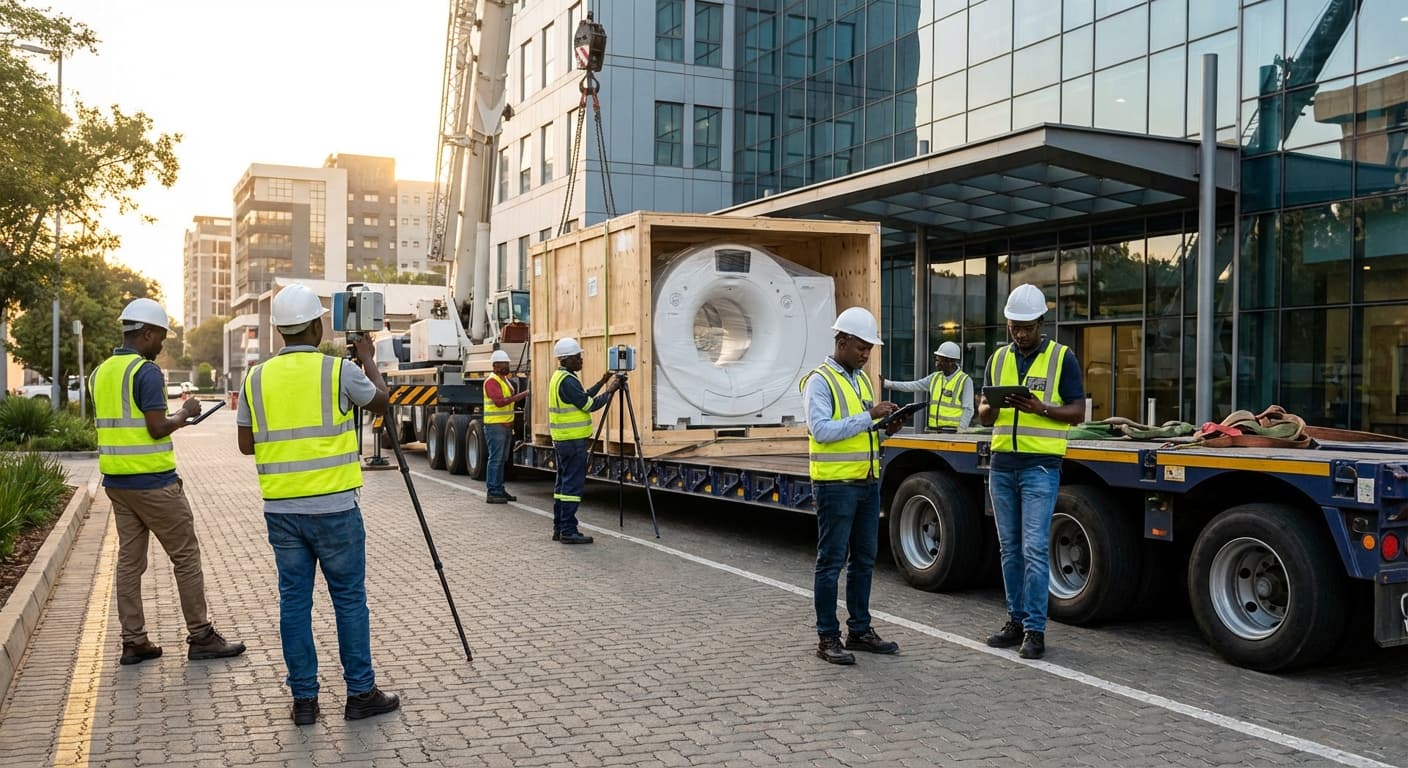
Route Survey & Rigging Plan Service for Heavy Medical Equipment in Guinea-Bissau
Engineering Excellence & Technical Support
Route Survey & Rigging Plan Service for Heavy Medical Equipment High-standard technical execution following OEM protocols and local regulatory frameworks.
Precision Route Planning
Leveraging advanced GIS mapping and on-site reconnaissance, we meticulously map optimal routes for heavy medical equipment transport across Guinea-Bissau's diverse terrain, considering road conditions, bridge load capacities, and potential obstacles. This ensures safe and efficient delivery to the intended healthcare facility.
Tailored Rigging Strategies
Our expert rigging engineers develop bespoke plans for the safe lifting, loading, and unloading of sensitive and oversized medical equipment. This includes detailed structural assessments, specialized equipment selection (cranes, heavy-duty dollies, etc.), and comprehensive risk mitigation strategies, all adapted to the specific logistical challenges in Guinea-Bissau.
Comprehensive Documentation & Compliance
We provide thorough documentation, including detailed route surveys, rigging schematics, risk assessments, and equipment specifications, ensuring full compliance with international safety standards and local regulations in Guinea-Bissau. This guarantees transparency and accountability throughout the entire project lifecycle.
What Is Route Survey & Rigging Plan Service For Heavy Medical Equipment In Guinea-bissau?
Route Survey & Rigging Plan Service for Heavy Medical Equipment in Guinea-Bissau refers to the specialized technical process of meticulously evaluating and documenting the entire logistical pathway and the precise methodologies required for the safe and efficient transportation and installation of oversized and high-weight medical apparatus within Guinea-Bissau. This encompasses a comprehensive assessment of the physical environment, infrastructure, and the development of detailed engineering plans for lifting, securing, and maneuvering the equipment from its point of origin to its final operational site. The service is critical for ensuring the integrity of the equipment, minimizing risks to personnel and infrastructure, and adhering to international safety standards in a region that may present unique logistical challenges.
| Who Needs This Service? | Typical Use Cases in Guinea-Bissau |
|---|---|
| Hospitals and Healthcare Facilities (public and private) requiring new installations or upgrades. | Installation of advanced imaging equipment (e.g., MRI, CT scanners, X-ray machines) in medical centers. |
| Government Ministries of Health responsible for public health infrastructure development. | Deployment of large-scale laboratory equipment for diagnostic services. |
| International Aid Organizations and NGOs involved in healthcare projects. | Relocation and installation of existing heavy medical equipment within or between facilities. |
| Manufacturers and Suppliers of heavy medical equipment overseeing delivery and installation. | Setting up specialized surgical suites or intensive care units with integrated heavy machinery. |
| Construction and Engineering firms contracted for medical facility development or renovation. | Installation of large sterilization units or medical gas systems requiring precise placement. |
Key Components of the Service:
- Route Assessment: Detailed analysis of all potential transportation routes, including road condition surveys, bridge load capacity assessments, clearance checks (height, width), traffic management evaluation, and identification of any potential obstructions or hazards.
- Site Survey: Comprehensive inspection of the destination site, including ingress/egress points, floor loading capacities, spatial constraints for maneuvering, and proximity to utilities or other sensitive equipment.
- Equipment Specification Analysis: Thorough understanding of the medical equipment's dimensions, weight, center of gravity, lifting points, and fragility. This often involves reviewing manufacturer's specifications and potentially conducting on-site measurements.
- Risk Assessment and Mitigation: Identification of potential risks associated with transportation and rigging (e.g., equipment damage, structural failure, personnel injury, environmental impact) and the development of detailed mitigation strategies.
- Rigging Methodology Design: Engineering of precise lifting, lashing, and securing techniques, including the selection of appropriate lifting equipment (cranes, forklifts, gantries), rigging gear (slings, shackles, spreaders), and stabilization methods.
- Transportation Planning: Development of a detailed logistics plan outlining the type of transport vehicle, optimal loading and unloading procedures, escort requirements, and staging areas.
- Documentation and Reporting: Creation of comprehensive reports, including survey findings, risk assessments, engineering drawings, method statements, and pre-lift checklists, to ensure transparency and compliance.
- On-Site Supervision: Provision of experienced personnel to oversee the rigging and installation process, ensuring adherence to the developed plan and making real-time adjustments as necessary.
Who Needs Route Survey & Rigging Plan Service For Heavy Medical Equipment In Guinea-bissau?
When relocating or installing heavy medical equipment in Guinea-Bissau, a meticulous Route Survey and Rigging Plan Service is not just a recommendation, but a critical necessity. This specialized service ensures the safe, efficient, and compliant movement and placement of these vital, often delicate, and extremely heavy assets. Without it, facilities risk significant damage to equipment, infrastructure, and personnel, leading to costly delays, operational downtime, and potential safety hazards.
| Customer Type | Relevant Departments / Stakeholders |
|---|---|
| Hospitals (Public and Private) | Facilities Management, Biomedical Engineering Department, Procurement Department, Operations Management, Senior Leadership |
| Specialized Medical Centers and Clinics | Clinic Administrators, Lead Technicians, Equipment Managers |
| Diagnostic Imaging Centers | Radiology Department Managers, Imaging Technologists, Facility Managers |
| Research Institutions with Medical Facilities | Lab Managers, Principal Investigators, Facilities and Safety Officers |
| Government Health Ministries and Agencies | Procurement and Logistics Divisions, Infrastructure Planning Units, National Health Services Management |
| Non-Governmental Organizations (NGOs) involved in healthcare | Logistics Coordinators, Project Managers, Program Directors, Procurement Officers |
| International Aid Organizations | Country Directors, Logistics and Supply Chain Managers, Project Implementation Teams |
| Medical Equipment Manufacturers and Suppliers | Installation and Commissioning Teams, Project Managers, Logistics and Sales Support |
| Logistics and Heavy Haulage Companies serving the healthcare sector | Operations Managers, Project Planners, Specialized Rigging Teams |
| Construction and Renovation Companies working on healthcare infrastructure | Project Managers, Site Supervisors, Health and Safety Officers |
Target Customers for Route Survey & Rigging Plan Service for Heavy Medical Equipment in Guinea-Bissau:
- Hospitals (Public and Private)
- Specialized Medical Centers and Clinics
- Diagnostic Imaging Centers
- Research Institutions with Medical Facilities
- Government Health Ministries and Agencies
- Non-Governmental Organizations (NGOs) involved in healthcare
- International Aid Organizations
- Medical Equipment Manufacturers and Suppliers
- Logistics and Heavy Haulage Companies serving the healthcare sector
- Construction and Renovation Companies working on healthcare infrastructure
Route Survey & Rigging Plan Service For Heavy Medical Equipment Process In Guinea-bissau
This document outlines the comprehensive workflow for our Route Survey & Rigging Plan Service, specifically tailored for the complex process of delivering and installing heavy medical equipment in Guinea-Bissau. Our service ensures a safe, efficient, and compliant journey for your critical assets from port of entry to final destination, navigating the unique logistical challenges of the region.
| Phase | Key Activities | Deliverables | Responsible Party | Timeline (Indicative) |
|---|---|---|---|---|
| Phase 1: Inquiry & Initial Assessment | Client submits inquiry with details of medical equipment (weight, dimensions, specific handling requirements), origin, and intended destination in Guinea-Bissau. | Initial feasibility assessment and preliminary quotation. | Client, Service Provider | 1-2 Business Days |
| Phase 2: Information Gathering & Preliminary Planning | Detailed equipment specifications and drawings. Information on existing site conditions at the destination. Potential port of entry and onward transportation options. | Comprehensive equipment data sheet. Identification of preliminary route corridors and potential challenges. | Client, Service Provider | 2-3 Business Days |
| Phase 3: Detailed Route Survey & Risk Assessment | On-site inspection of the proposed route: road conditions, bridge load capacities, tunnel clearances, turning radii, overhead obstructions, soil conditions (for temporary support). Identification of potential hazards and logistical bottlenecks. GPS data collection and photographic documentation. | Detailed route survey report with maps, critical path analysis, identified obstacles, and risk assessment matrix. | Service Provider (Specialized Survey Team) | 5-10 Business Days (depending on route complexity and accessibility) |
| Phase 4: Rigging Plan Development & Engineering | Based on equipment specifications and route survey findings, develop a detailed lifting and rigging plan. Selection of appropriate lifting equipment (cranes, jacks, etc.), rigging gear, and anchorage points. Engineering calculations for load distribution and safety margins. Method statements for all lifting operations. | Comprehensive rigging plan, engineering drawings, method statements, and equipment specifications. | Service Provider (Rigging Engineers & Specialists) | 7-14 Business Days |
| Phase 5: Permitting & Stakeholder Coordination | Liaise with relevant Guinean authorities for necessary permits and approvals (road usage, transport permits, port authorities, local police escorts). Coordinate with local logistics partners, customs agents, and port operators. | All required permits and authorizations. Confirmed stakeholder commitments and operational schedules. | Service Provider (Local Agents & Legal Counsel) | Variable (depending on regulatory processes, 10-30 Business Days) |
| Phase 6: Execution - Transportation & Rigging | Supervised loading of equipment onto transport. Planned convoy movement along the surveyed route, including necessary road modifications or traffic management. On-site supervision of all lifting and positioning operations at the destination. | Safe and efficient transportation of equipment. Successful rigging and placement of medical equipment. | Service Provider (Project Management, Rigging Crew, Transport Team) | Variable (depending on transport distance and complexity of rigging) |
| Phase 7: Post-Execution & Reporting | Post-operation site inspection. Debriefing with client and stakeholders. Final project report detailing all activities, challenges encountered, and lessons learned. Documentation of handover. | Final project report, incident logs (if any), and client sign-off. Photographic and video evidence of the operation. | Service Provider | 3-5 Business Days |
Service Workflow: Route Survey & Rigging Plan for Heavy Medical Equipment in Guinea-Bissau
- Phase 1: Inquiry & Initial Assessment
- Phase 2: Information Gathering & Preliminary Planning
- Phase 3: Detailed Route Survey & Risk Assessment
- Phase 4: Rigging Plan Development & Engineering
- Phase 5: Permitting & Stakeholder Coordination
- Phase 6: Execution - Transportation & Rigging
- Phase 7: Post-Execution & Reporting
Route Survey & Rigging Plan Service For Heavy Medical Equipment Cost In Guinea-bissau
Estimating the cost for Route Survey & Rigging Plan services for heavy medical equipment in Guinea-Bissau requires a careful consideration of various factors that influence pricing. These services are crucial for ensuring the safe and efficient transportation and installation of specialized, often oversized and delicate, medical machinery. The pricing will be influenced by the complexity of the route, the weight and dimensions of the equipment, the required rigging techniques, logistical challenges specific to Guinea-Bissau's infrastructure, and the expertise of the service provider.
| Service Component | Estimated Cost Range (GNF) | Notes |
|---|---|---|
| Initial Route Assessment & Consultation | 150,000 - 400,000 | Includes preliminary evaluation of route feasibility and initial client consultation. |
| Detailed Route Survey (including GPS, measurements, obstacle identification) | 300,000 - 800,000 | Varies based on route length and complexity. May involve multiple site visits. |
| Rigging Plan Development (technical drawings, equipment selection, safety protocols) | 400,000 - 1,200,000 | Dependent on equipment weight, dimensions, and installation site complexity. |
| Site Survey & Accessibility Assessment (installation location) | 200,000 - 600,000 | Focuses on the final placement area, access for lifting equipment, and potential structural needs. |
| Permit Application & Liaison (if required) | 50,000 - 200,000 | Costs associated with obtaining necessary permits for oversized loads or road closures. |
| Contingency & Risk Assessment | 100,000 - 300,000 | Buffer for unforeseen issues and development of mitigation strategies. |
| Total Service Package (Estimate) | 1,000,000 - 3,500,000+ | This is a broad estimate. Highly complex or exceptionally large equipment can significantly increase costs. Currency: Guinean Franc (GNF) |
Key Pricing Factors for Route Survey & Rigging Plan Services in Guinea-Bissau:
- {"title":"Equipment Specifications:","description":"The weight, dimensions (length, width, height), and fragility of the medical equipment are primary determinants. Heavier and larger items will require more robust rigging, specialized transport, and potentially more extensive route planning. Sensitive equipment may necessitate careful handling protocols, adding to the cost."}
- {"title":"Route Complexity & Distance:","description":"The distance between the delivery point and the installation site, as well as the nature of the route, significantly impacts costs. This includes assessing road conditions (paved, unpaved, potential for damage), bridges (load capacity), tunnels (height and width restrictions), and any potential obstacles such as power lines, narrow streets, or traffic congestion. Longer and more challenging routes will incur higher survey and planning fees."}
- {"title":"Rigging Requirements:","description":"The type and complexity of rigging operations needed (e.g., cranes, forklifts, dollies, manual lifting) directly influence the cost. This also includes assessing the installation site for access, space, and the need for temporary structural reinforcements or specialized equipment. The number of rigging points and the precision required for placement will also be factored in."}
- {"title":"Logistical Challenges in Guinea-Bissau:","description":"Infrastructure limitations in Guinea-Bissau (e.g., road quality, port facilities, availability of specialized equipment, skilled labor) can present unique challenges. This may necessitate extended planning, the importation of specialized tools, or longer transit times, all of which can increase costs. Customs clearance and regulatory compliance for heavy equipment also add to the overall expense."}
- {"title":"Site Assessment & Survey:","description":"The thoroughness of the route survey and site assessment contributes to the cost. This includes detailed mapping, obstacle identification, GPS data collection, and photographic/video documentation. The more comprehensive the survey, the better the plan, but also the higher the initial cost."}
- {"title":"Expertise and Experience of Service Provider:","description":"Reputable companies with a proven track record in heavy lifting and specialized equipment transport will often charge a premium for their expertise, safety protocols, and reliable execution. Their knowledge of local conditions and regulations is invaluable."}
- {"title":"Time Sensitivity & Urgency:","description":"Expedited services or projects with tight deadlines may incur additional charges due to the need for rapid mobilization of resources and potential overtime for personnel."}
- {"title":"Insurance and Risk Mitigation:","description":"Adequate insurance coverage for the valuable medical equipment and the rigging operations is a crucial component of the overall cost. The provider's risk assessment and mitigation strategies also play a role."}
Affordable Route Survey & Rigging Plan Service For Heavy Medical Equipment Options
Navigating the complex logistics of installing heavy medical equipment requires a precise and cost-effective approach. Our Affordable Route Survey & Rigging Plan Service is designed to provide you with expert planning at a fraction of the cost of traditional methods. We understand that budget constraints are critical for healthcare facilities, and our services are tailored to maximize your savings without compromising safety or efficiency. We offer flexible value bundles and implement strategic cost-saving measures to ensure you receive the best possible outcome for your investment.
| Service Component | Basic Bundle | Comprehensive Bundle | Project Management Bundle | Cost-Saving Impact |
|---|---|---|---|---|
| Initial Site Visit & Assessment | ✓ | ✓ | ✓ | Identifies potential issues early, preventing costly surprises. |
| Route Mapping & Obstruction Identification | ✓ | ✓ | ✓ | Minimizes need for structural modifications. |
| Preliminary Rigging Concept | ✓ | ✓ | ✓ | Provides a foundational plan to avoid inefficient methods. |
| Detailed Rigging Calculations & Analysis | X | ✓ | ✓ | Ensures appropriate equipment use, reducing rental costs and risks. |
| 3D Route Modeling (if applicable) | X | ✓ | ✓ | Visualizes challenges, improving planning accuracy and reducing unforeseen costs. |
| Equipment Handling & Safety Protocols | X | ✓ | ✓ | Minimizes risk of damage to expensive equipment. |
| Detailed Written Report & Recommendations | ✓ | ✓ | ✓ | Provides a clear roadmap for installation, reducing ambiguity and potential errors. |
| Dedicated Project Coordination | X | X | ✓ | Streamlines communication and decision-making, preventing delays. |
| On-site Supervision (Critical Phases) | X | X | ✓ | Ensures adherence to plan and immediate problem-solving, preventing costly rework. |
| Vendor & Manufacturer Liaison | X | X | ✓ | Ensures seamless integration and avoids conflicting plans. |
Our Value Bundles & Cost-Saving Strategies:
- Bundle 1: Basic Route & Rigging Assessment: Ideal for smaller or less complex equipment. Includes initial site visit, basic route mapping, identification of potential obstructions, and a preliminary rigging concept. This bundle provides essential planning to avoid unexpected costs during installation.
- Bundle 2: Comprehensive Route Survey & Rigging Plan: Our most popular option, suitable for a wide range of heavy medical equipment. This bundle incorporates detailed site surveys, precise route planning with 3D modeling (where applicable), comprehensive rigging calculations, equipment handling strategies, and a detailed written report. This ensures a smooth and predictable installation process.
- Bundle 3: Project Management Integration: For larger projects or facilities with multiple installations. This premium bundle includes all features of Bundle 2, plus dedicated project coordination, on-site supervision during critical rigging phases, and real-time communication updates. This offers maximum peace of mind and streamlined execution.
- Cost-Saving Strategy: Pre-Fabrication & Modular Design Consultation: We can advise on equipment that utilizes pre-fabricated components or modular designs, reducing on-site assembly time and the need for specialized, expensive on-site rigging equipment.
- Cost-Saving Strategy: Optimized Route Selection: By meticulously surveying multiple potential routes, we identify the most efficient and least disruptive path, minimizing the need for structural modifications or temporary barriers.
- Cost-Saving Strategy: Accurate Load & Force Calculations: Our precise calculations prevent over-engineering rigging solutions, avoiding the rental of unnecessarily powerful or specialized equipment, and reducing the risk of equipment damage.
- Cost-Saving Strategy: Early Identification of Challenges: Proactive identification of potential issues like tight corners, low doorways, or floor load limits allows for early mitigation strategies, preventing costly delays and rework.
- Cost-Saving Strategy: Vendor Coordination & Integration: We work closely with equipment manufacturers and installation teams to ensure our rigging plans align perfectly with their requirements, preventing conflicts and ensuring a seamless workflow.
Verified Providers In Guinea-bissau
In Guinea-Bissau's evolving healthcare landscape, identifying trusted and qualified medical professionals is paramount. Verified providers offer a level of assurance that goes beyond basic qualifications, ensuring patients receive the highest standard of care. Franance Health stands out as a premier organization dedicated to upholding these rigorous verification standards, making them the optimal choice for individuals seeking reliable healthcare services in the nation.
| Provider Type | Franance Health Verification Criteria Examples | Benefits for Patients |
|---|---|---|
| Doctors | Valid medical degree from accredited institution, successful completion of post-graduate training (residency/fellowship), current and unencumbered medical license, peer reviews, criminal background check. | Assurance of proper diagnosis and treatment, reduced risk of medical errors, access to qualified specialists. |
| Nurses | Registered Nurse (RN) or Licensed Practical Nurse (LPN) certification, verification of nursing education, good standing with the nursing board, proof of continuing education, background checks. | Competent and compassionate patient care, adherence to safety protocols, reliable administration of medication and treatments. |
| Specialists (e.g., Surgeons, Cardiologists, Pediatricians) | All standard doctor criteria PLUS board certification in their specialty, documented surgical outcomes (if applicable), membership in professional medical societies. | Access to highly specialized knowledge and advanced medical procedures, improved outcomes for complex conditions. |
| Healthcare Facilities (e.g., Clinics, Hospitals) | Accreditation by recognized health bodies, adherence to infection control standards, availability of essential medical equipment, qualified and sufficient staffing levels, patient satisfaction surveys. | Safe and hygienic environment, access to necessary medical technology, comprehensive range of services, improved patient experience. |
Why Franance Health Credentials Represent the Best Choice:
- Rigorous Vetting Process: Franance Health employs an extensive vetting procedure that scrutinizes educational background, professional experience, licensure, and ethical conduct of all healthcare providers seeking their verification. This multi-faceted approach ensures only the most competent and trustworthy individuals are accredited.
- Commitment to Quality and Safety: The core mission of Franance Health is to elevate the quality of healthcare and prioritize patient safety. Their verification process directly contributes to this by endorsing providers who demonstrate a consistent commitment to best practices and patient well-being.
- Transparency and Accountability: Franance Health's verified providers are held to a higher standard of accountability. Their accreditation signifies adherence to a code of conduct and makes them more accessible for patient feedback and issue resolution.
- Access to Specialized Expertise: Through their network, Franance Health helps connect patients with a diverse range of specialists who have met their stringent criteria, ensuring access to the right expertise for specific medical needs.
- International Standards Alignment: Franance Health strives to align its verification processes with international best practices in healthcare provider credentialing, offering a benchmark of quality recognized beyond national borders.
Scope Of Work For Route Survey & Rigging Plan Service For Heavy Medical Equipment
This Scope of Work (SOW) outlines the services required for the detailed route survey and comprehensive rigging plan for the safe and efficient transport and installation of heavy medical equipment. The objective is to identify and mitigate all potential risks associated with the movement of the equipment from its delivery point to its final installed location within the healthcare facility.
| Task Area | Description | Deliverables | Standard Specifications / Considerations |
|---|---|---|---|
| 1. Site Reconnaissance & Data Collection | Initial site visit to understand the facility layout, access points, and existing infrastructure relevant to the equipment's path. | Site assessment report, preliminary route maps, photographic and video documentation. | Compliance with facility access protocols, identification of potential obstructions (doorways, hallways, elevators, stairs, ceiling clearances, floor load capacity, utility lines). Review of building blueprints and structural integrity reports. |
| 2. Route Identification & Evaluation | Detailed mapping of all feasible transport routes, considering the equipment's dimensions, weight, and maneuverability. | Detailed route diagrams, alternative route analysis, identified critical path. | Consideration of turning radii, aisle widths, floor gradients, elevator capacity (dimensions, weight limit, operational procedures), stairwell feasibility, exterior access points, and potential for temporary modifications (e.g., door removal, ramp installation). |
| 3. Rigging & Lifting Requirements Analysis | Assessment of the specific rigging and lifting needs based on the equipment's weight, center of gravity, lifting points, and final placement. | Weight and center of gravity report, lifting point analysis, required lifting capacity calculation. | Adherence to manufacturer's specifications, load charts for lifting equipment, sling angles, rigging hardware ratings, and certified lifting personnel requirements. |
| 4. Rigging Plan Development | Creation of a comprehensive, step-by-step plan for safely lifting and moving the equipment. | Detailed rigging plan document, including diagrams, equipment list, sequence of operations, personnel roles, and safety procedures. | Inclusion of lift plans, detailed rigging schematics, selection of appropriate cranes, forklifts, gantry systems, dollies, and other specialized equipment. Fall protection measures where applicable. Emergency response procedures. |
| 5. Risk Assessment & Mitigation Plan | Identification of all potential hazards during the transport and installation process and development of preventive and corrective actions. | Comprehensive risk assessment report, mitigation strategies, contingency plans. | Identification of risks such as equipment damage, facility damage, personnel injury, power outages, structural issues, weather impacts. Development of safety checklists, pre-lift inspections, communication protocols, and emergency contact lists. |
| 6. Documentation & Reporting | Compilation and submission of all technical documents related to the survey and rigging plan. | Final Route Survey Report, Final Rigging Plan, Risk Assessment Report, Equipment Specifications Review. | All reports to be in clear, concise language with supporting visual aids. Compliance with relevant industry standards (e.g., ASME, OSHA) and local regulations. All documentation to be provided in electronic format (PDF) and hard copy as required. |
Key Service Areas
- Route Survey: Comprehensive assessment of all potential routes from the point of equipment delivery to the final installation site.
- Rigging Plan Development: Detailed engineering plan outlining the methods, equipment, and procedures for lifting, moving, and setting the heavy medical equipment.
- Risk Assessment & Mitigation: Identification of potential hazards and development of strategies to minimize risks during the entire operation.
- Coordination & Communication: Establishing clear communication channels with all relevant stakeholders.
- Documentation & Reporting: Provision of all necessary technical documentation and reports.
Service Level Agreement For Route Survey & Rigging Plan Service For Heavy Medical Equipment
This Service Level Agreement (SLA) outlines the response times and uptime guarantees for the Route Survey & Rigging Plan Service provided for the installation of heavy medical equipment. It is designed to ensure timely and reliable support throughout the planning and execution phases of equipment placement.
| Service Item | Priority Level | Response Time Target | Resolution Target (for planning issues) |
|---|---|---|---|
| Route Survey & Rigging Plan Service Availability | N/A | 99.5% Service Availability (during business hours) | N/A |
| Initial Consultation & Planning Meeting | High | Within 2 business hours | N/A |
| Request for Survey Revisions (Minor) | Medium | Within 4 business hours | N/A |
| Request for Rigging Plan Modifications (Minor) | Medium | Within 8 business hours | N/A |
| Delivery of Draft Route Survey Report | High | Within 2 business days of site visit | N/A |
| Delivery of Draft Rigging Plan | High | Within 3 business days of survey report approval | N/A |
| Response to Urgent Planning Clarifications (Client initiated) | Critical | Within 1 business hour | N/A |
| Routine Inquiries (Non-critical) | Low | Within 1 business day | N/A |
Service Level Objectives
- Response Times: Refer to the defined response tiers for critical incidents and routine requests.
- Uptime Guarantees: While direct uptime is not applicable to a planning service, the guarantee focuses on the availability of the service and timely delivery of deliverables as per agreed project timelines.
Frequently Asked Questions

Ready when you are
Let's scope your Route Survey & Rigging Plan Service for Heavy Medical Equipment in Guinea-Bissau project in Guinea-Bissau.

Scaling healthcare logistics and technical systems across the entire continent.