
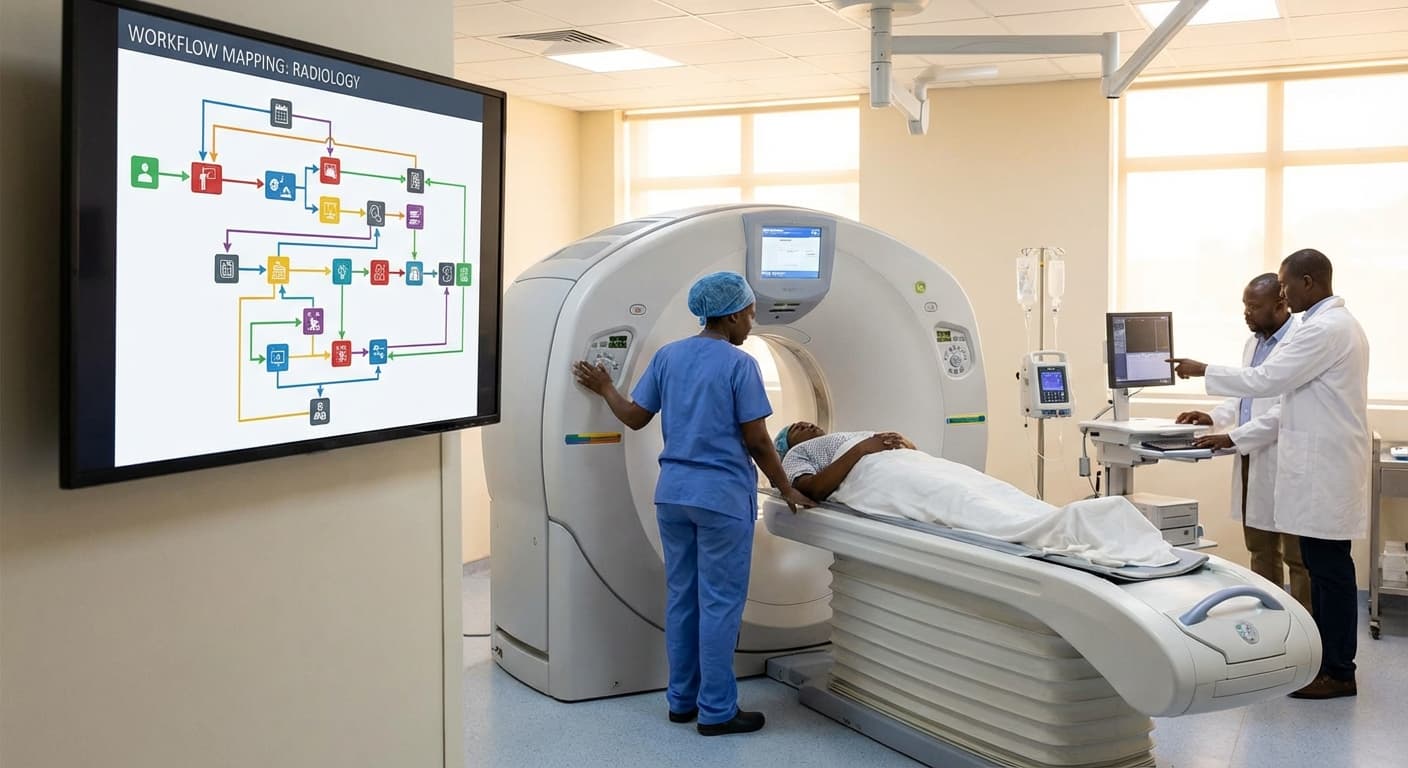
Department Workflow Mapping Service (Radiology/ICU/OT/Lab/Dialysis) in Guinea-Bissau
Engineering Excellence & Technical Support
Department Workflow Mapping Service (Radiology/ICU/OT/Lab/Dialysis) High-standard technical execution following OEM protocols and local regulatory frameworks.
Streamlined Radiology Image Acquisition & Reporting
Our service maps and optimizes the workflow for radiology departments in Guinea-Bissau, from patient registration and imaging request to image acquisition, processing, and final report generation. This reduces turnaround times, improves diagnostic accuracy, and enhances resource utilization.
Optimized ICU Patient Care Pathways
We analyze and re-engineer critical care unit (ICU) workflows, focusing on patient admission, monitoring, treatment protocols, and interdisciplinary communication. This ensures timely interventions, efficient bed management, and improved patient outcomes in high-acuity settings.
Efficient Operating Theatre (OT) Scheduling & Procedure Flow
Our service maps the entire operating theatre workflow, from pre-operative patient preparation and scheduling to intra-operative team coordination, instrument management, and post-operative handoffs. This maximizes theatre utilization, minimizes delays, and enhances surgical team efficiency.
What Is Department Workflow Mapping Service (Radiology/icu/ot/lab/dialysis) In Guinea-bissau?
Department Workflow Mapping Service in Guinea-Bissau refers to the systematic analysis, documentation, and optimization of processes within specific healthcare departments, including Radiology, Intensive Care Units (ICUs), Operating Theaters (OTs), Laboratories, and Dialysis units. This service aims to identify inefficiencies, bottlenecks, and areas for improvement in patient flow, resource utilization, and information management. It employs methodologies such as process mapping, data analysis, and stakeholder interviews to create a visual representation of current operational procedures and subsequently design more efficient future-state workflows.
| Department | Who Needs It | Typical Use Cases |
|---|---|---|
| Radiology | Radiology department managers, hospital administrators, imaging technologists, PACS administrators. | Optimizing patient scheduling for imaging procedures, improving report turnaround times, streamlining image acquisition and retrieval processes, reducing equipment downtime, enhancing inter-departmental communication for urgent cases. |
| Intensive Care Unit (ICU) | ICU directors, nurse managers, physicians, respiratory therapists, critical care pharmacists. | Improving patient admission and discharge processes, optimizing nurse-to-patient ratios, streamlining medication administration, enhancing communication between care teams, reducing response times to critical events, managing equipment and consumables effectively. |
| Operating Theater (OT) | Surgical department chiefs, O.R. managers, anesthesiologists, surgeons, scrub nurses, sterilization technicians. | Optimizing surgical scheduling and patient flow through the O.R., reducing turnover times between cases, improving sterile supply chain management, enhancing communication among surgical teams, ensuring efficient use of surgical equipment and personnel. |
| Laboratory | Laboratory directors, pathologists, medical technologists, phlebotomists, laboratory information system (LIS) managers. | Streamlining sample accessioning and processing, improving test turnaround times, optimizing quality control procedures, enhancing specimen tracking and management, reducing errors in sample handling and analysis, improving communication with clinical departments. |
| Dialysis | Nephrology department heads, dialysis unit managers, nephrologists, nurses, biomedical engineers. | Optimizing patient scheduling for dialysis sessions, improving patient throughput and chair utilization, streamlining supply chain for dialysis consumables, enhancing equipment maintenance and downtime management, improving patient safety protocols, optimizing staff allocation. |
Key Components of Department Workflow Mapping Service
- Process Identification and Documentation: Identifying all discrete steps within a department's operational processes.
- Data Collection and Analysis: Gathering quantitative and qualitative data on cycle times, resource allocation, error rates, and patient throughput.
- Bottleneck Identification: Pinpointing stages where work is delayed or impeded.
- Root Cause Analysis: Investigating the underlying reasons for identified inefficiencies.
- Future-State Design: Developing optimized workflows that address identified issues.
- Technology Integration Assessment: Evaluating the role of information systems and medical equipment in workflow efficiency.
- Change Management Planning: Outlining strategies for the successful implementation of new workflows.
- Performance Monitoring Framework: Establishing metrics and methods for ongoing workflow evaluation.
Who Needs Department Workflow Mapping Service (Radiology/icu/ot/lab/dialysis) In Guinea-bissau?
In Guinea-Bissau, a Department Workflow Mapping Service is crucial for optimizing the operational efficiency and patient care delivery across several critical departments. This service is designed to analyze, document, and redesign the intricate processes within specific hospital units. By understanding the current flow of information, resources, and patient journeys, this service can identify bottlenecks, redundancies, and areas for improvement. This leads to enhanced staff productivity, reduced wait times, improved diagnostic accuracy, and ultimately, better health outcomes for patients. The service is particularly vital for departments that handle high patient volumes, complex procedures, and time-sensitive interventions, where even small inefficiencies can have significant consequences.
| Department | Target Customers | Key Needs Addressed by Workflow Mapping |
|---|---|---|
| Radiology | Radiology departments in hospitals, diagnostic imaging centers. | Streamlining patient scheduling and imaging requests, optimizing image interpretation and reporting turnaround times, improving equipment utilization, reducing radiation exposure through efficient protocols. |
| Intensive Care Unit (ICU) | ICU departments in hospitals, critical care units. | Optimizing patient admission and transfer processes, ensuring timely delivery of critical medications and treatments, improving communication between care teams, managing equipment and resource allocation, enhancing patient monitoring and data capture. |
| Operating Theatre (OT) | Operating theatres in hospitals, surgical centers. | Improving surgical scheduling and room utilization, optimizing instrument and supply management, streamlining patient preparation and post-operative care handoffs, reducing surgical delays and cancellations, enhancing teamwork and communication among surgical staff. |
| Laboratory | Clinical laboratories in hospitals, private diagnostic labs. | Optimizing sample collection, processing, and testing workflows, improving turnaround times for lab results, ensuring quality control and accreditation compliance, managing reagent and equipment inventory, streamlining result reporting and communication to clinicians. |
| Dialysis | Dialysis centers, nephrology departments in hospitals. | Streamlining patient scheduling and management for dialysis sessions, optimizing staff allocation and patient-to-staff ratios, ensuring efficient preparation and post-dialysis care, managing equipment maintenance and sterilization, improving patient flow and reducing wait times for treatment. |
Who Needs Department Workflow Mapping Service in Guinea-Bissau?
- Hospitals and healthcare facilities in Guinea-Bissau seeking to improve operational efficiency.
- Healthcare administrators and managers responsible for departmental performance.
- Quality improvement teams focused on enhancing patient safety and care delivery.
- IT departments looking to implement or optimize healthcare information systems.
- External consultants or organizations aiming to support the healthcare sector in Guinea-Bissau.
Department Workflow Mapping Service (Radiology/icu/ot/lab/dialysis) Process In Guinea-bissau
This document outlines the standard workflow for requesting and executing a Department Workflow Mapping Service for key hospital departments (Radiology, ICU, OT, Lab, Dialysis) within Guinea-Bissau's healthcare system. The service aims to analyze, document, and optimize operational processes within these critical areas to improve efficiency, reduce errors, and enhance patient care. The process begins with an inquiry from a hospital department and concludes with the delivery of a comprehensive workflow map and recommendations.
| Stage | Description | Key Activities | Responsible Parties | Deliverables | Estimated Timeline (Working Days) |
|---|---|---|---|---|---|
| Initial contact from a hospital department expressing interest in workflow mapping and understanding their specific needs and objectives. | Initial meeting/call, understanding department's current challenges, defining scope of mapping, identifying key stakeholders. | Requesting Department (e.g., Head of Radiology), Service Provider Representatives | Preliminary understanding of project scope, identified key personnel. | 1-3 |
| Formal proposal outlining the service scope, methodology, timelines, costs, and expected outcomes, followed by an agreement. | Developing detailed proposal, cost estimation, contract negotiation, signing of Memorandum of Understanding (MoU) or Service Level Agreement (SLA). | Service Provider (Workflow Mapping Team), Requesting Department Management, Hospital Administration | Signed contract/MoU/SLA, Agreed-upon project plan. | 3-7 |
| Gathering comprehensive information about the current workflow through observation, interviews, and document review. | Observing patient flow, staff interactions, equipment usage, documentation practices; interviewing staff at all levels; reviewing existing SOPs, forms, and records. | Service Provider (Workflow Analysts, Subject Matter Experts), Department Staff | Raw data, observational notes, interview transcripts, collected documents. | 7-14 |
| Visually representing the current processes using standardized notation and creating detailed documentation. | Creating process flowcharts (e.g., using BPMN), documenting roles and responsibilities, identifying bottlenecks, inefficiencies, and pain points. | Service Provider (Workflow Analysts, Documentation Specialists) | Draft workflow maps (digital and/or physical), detailed process descriptions. | 5-10 |
| Presenting the draft workflow maps and documentation to the department for review and feedback. | Conducting validation workshops/meetings, gathering feedback from department staff and management, incorporating revisions. | Service Provider, Requesting Department Staff & Management | Revised workflow maps, documented feedback and agreed-upon changes. | 3-5 |
| Compiling a comprehensive report containing the final workflow maps, analysis, identified issues, and recommendations for improvement, followed by a presentation. | Writing final report, developing actionable recommendations (e.g., for process optimization, technology adoption, training needs), preparing presentation slides, delivering presentation to stakeholders. | Service Provider (Project Manager, Analysts), Requesting Department Management, Hospital Leadership | Final Workflow Mapping Report, Presentation slides, Executive summary. | 5-7 |
| Assisting the department in implementing the recommended changes and monitoring progress. | Providing guidance on implementation, facilitating training, conducting follow-up assessments, measuring impact of changes (optional, depending on agreement). | Service Provider (Consultants), Requesting Department | Implementation progress reports, post-implementation assessment findings (if applicable). | Ongoing/As per agreement |
Workflow Stages
- Inquiry & Needs Assessment
- Proposal & Agreement
- Data Collection & Analysis
- Workflow Mapping & Documentation
- Validation & Feedback
- Report Generation & Presentation
- Implementation Support & Follow-up
Department Workflow Mapping Service (Radiology/icu/ot/lab/dialysis) Cost In Guinea-bissau
The cost of a Department Workflow Mapping Service for specialized medical departments like Radiology, Intensive Care Unit (ICU), Operating Theater (OT), Laboratory, and Dialysis in Guinea-Bissau can vary significantly. This service is crucial for optimizing efficiency, identifying bottlenecks, and improving patient care within these high-stakes environments. Several factors influence the pricing, making it difficult to provide a single fixed cost. These factors include the scope and complexity of the workflow, the size of the department, the number of staff involved, the level of detail required in the mapping, and the experience and reputation of the consulting firm or individual providing the service. Given Guinea-Bissau's economic context and the specialized nature of this service, costs are typically negotiated on a project-by-project basis. Local currency (Guinea-Bissau Peso - XOF) pricing will be influenced by the prevailing economic conditions, the availability of local expertise, and any potential import costs for specialized tools or software if not locally available.
| Service Component | Estimated Cost Range (XOF) |
|---|---|
| Initial Consultation & Needs Assessment | 50,000 - 150,000 |
| Workflow Data Collection (Observation & Interviews) | 200,000 - 700,000 (per department/week, depending on size) |
| Data Analysis & Bottleneck Identification | 150,000 - 500,000 |
| Workflow Mapping & Visualization | 100,000 - 400,000 |
| Report Generation & Recommendations | 150,000 - 600,000 |
| Project Management & Coordination | 100,000 - 300,000 |
| Estimated Total Project Cost (Small to Medium Department) | 750,000 - 2,650,000 |
| Estimated Total Project Cost (Large & Complex Department) | 2,500,000 - 7,000,000+ |
Key Pricing Factors for Department Workflow Mapping Service in Guinea-Bissau
- Scope and Complexity: Mapping a simple process flow versus a highly intricate and multi-stage workflow will have different cost implications.
- Department Size and Staff Count: Larger departments with more staff require more observation, interviews, and data collection, increasing the time and effort involved.
- Level of Detail: The granularity of the mapping (e.g., from patient admission to discharge vs. specific procedure steps) directly impacts the depth of analysis and associated costs.
- Data Collection Methods: The mix of methods used (e.g., direct observation, interviews, surveys, system analysis) and their duration will influence pricing.
- Reporting and Deliverables: The format and depth of the final report, including recommendations, visualization tools, and implementation plans, will affect the cost.
- Consultant Experience and Expertise: Highly specialized consultants or established firms with a proven track record will command higher fees.
- Project Duration: The estimated timeline for the project will be a primary driver of cost.
- Travel and Accommodation: If consultants are not local, travel and accommodation expenses within Guinea-Bissau will be factored in.
- Technology and Tools: The use of specialized workflow mapping software or other analytical tools might add to the cost.
- Customization Requirements: Unique departmental needs or specific integration requirements will necessitate a tailored approach, potentially increasing costs.
Affordable Department Workflow Mapping Service (Radiology/icu/ot/lab/dialysis) Options
Our Affordable Department Workflow Mapping Service provides a comprehensive solution for optimizing operations in critical hospital departments, including Radiology, ICU, Operating Theatre (OT), Laboratory, and Dialysis. We meticulously analyze your existing workflows to identify bottlenecks, inefficiencies, and areas for improvement, delivering clear, actionable maps and recommendations. Our goal is to enhance patient care, reduce operational costs, and improve staff satisfaction.
| Department | Value Bundle Options | Key Benefits | Cost-Saving Strategies Addressed |
|---|---|---|---|
| Radiology | Essential Mapping: Basic current state mapping, bottleneck identification, and initial optimization recommendations. <br><br> Advanced Integration: Includes technology integration review (PACS, RIS), staffing optimization, and throughput enhancement. <br><br> Comprehensive Optimization: Full suite, including SOP development, change management, and continuous improvement framework. | Reduced patient wait times, improved imaging turnaround, enhanced equipment utilization, optimized radiologist/technologist workload. | Minimizing idle equipment time, reducing repeat scans, optimizing staffing schedules, streamlining report generation, reducing supply waste. |
| ICU | Core Process Flow: Mapping of patient admission, transfer, and discharge processes, critical care pathway analysis. <br><br> Resource Allocation: Focus on nurse-patient ratios, equipment availability, and medication administration workflows. <br><br> Interdisciplinary Collaboration: Mapping communication pathways between physicians, nurses, and allied health professionals. | Improved patient outcomes, reduced length of stay, enhanced staff efficiency, better resource allocation, minimized adverse events. | Optimizing nurse staffing based on patient acuity, reducing medication errors, streamlining communication to prevent delays, improving bed management, reducing unnecessary tests/procedures. |
| Operating Theatre (OT) | Surgical Pathway: Mapping patient journey from pre-op to post-op recovery, including scheduling and resource allocation. <br><br> Supplies & Sterilization: Workflow analysis for surgical instruments, implants, and disposables. <br><br> Team Coordination: Optimizing surgeon, anesthesiologist, and nursing team interactions. | Increased OR utilization, reduced surgical delays, improved patient safety, optimized supply chain management, enhanced staff coordination. | Minimizing OR downtime, reducing cancellation rates, optimizing instrument sterilization and turnover, controlling surgical supply costs, streamlining patient flow through the OR. |
| Laboratory | Specimen Lifecycle: Mapping from collection to reporting, including pre-analytical, analytical, and post-analytical phases. <br><br> Test Prioritization: Workflow for STAT vs. routine testing and specimen handling. <br><br> Quality Control & Assurance: Integration of QC procedures into the workflow. | Faster test turnaround times, reduced errors in sample handling and processing, improved diagnostic accuracy, optimized laboratory resource utilization. | Reducing pre-analytical errors, optimizing workflow for high-volume tests, minimizing manual data entry, improving reagent and consumable management, automating reporting where possible. |
| Dialysis | Patient Treatment Flow: Mapping patient registration, treatment scheduling, and monitoring. <br><br> Machine & Station Management: Workflow for dialysis machine setup, cleaning, and maintenance. <br><br> Medication & Fluid Management: Streamlining administration and tracking. | Efficient patient throughput, consistent treatment delivery, improved patient comfort, reduced staff burden, optimized machine uptime. | Maximizing dialysis machine utilization, optimizing patient scheduling to minimize wait times, reducing errors in treatment parameters, efficient management of consumables, streamlining staff tasks. |
Key Components of Our Workflow Mapping Service:
- Current State Workflow Analysis & Documentation
- Identification of Bottlenecks and Inefficiencies
- Root Cause Analysis of Identified Issues
- Future State Workflow Design & Optimization
- Development of Standard Operating Procedures (SOPs)
- Technology Integration Recommendations
- Staff Training & Change Management Support
- Post-Implementation Performance Monitoring
Verified Providers In Guinea-bissau
In Guinea-Bissau's healthcare landscape, identifying reliable and qualified medical providers is paramount for ensuring quality care. Franance Health stands out as a premier choice, distinguished by its rigorous verification processes and commitment to excellence. This document outlines why Franance Health credentials signify the best choice for patients seeking trustworthy healthcare services in Guinea-Bissau.
| Credential Type | Franance Health Verification Process | Significance for Patients |
|---|---|---|
| Medical Licenses | Confirmation with the Ministry of Public Health of Guinea-Bissau. | Guarantees legal right to practice and adherence to national standards. |
| Specialist Certifications | Validation of diplomas and certificates from recognized medical institutions. | Ensures practitioners possess the required advanced knowledge and skills for specific medical areas. |
| Hospital Accreditation | Verification of compliance with national healthcare facility standards and regulations. | Confirms that facilities meet safety, hygiene, and operational benchmarks. |
| Professional Membership | Confirmation of membership in reputable national or international medical associations. | Indicates a commitment to professional development and adherence to best practices. |
| Insurance Provider Affiliation | Verification of acceptance by recognized health insurance providers. | Facilitates easier access to care and financial predictability for patients. |
Understanding Franance Health Credentials
- Accreditation and Licensing: Franance Health ensures all affiliated healthcare facilities and individual practitioners hold valid accreditations and licenses from the relevant Guinean authorities. This is the foundational step in guaranteeing their legal and operational compliance.
- Professional Qualifications Verification: We meticulously verify the educational background, specialized training, and certifications of all healthcare professionals. This includes cross-referencing diplomas, residency certificates, and continuing medical education records.
- Experience and Track Record: Franance Health assesses the practical experience and clinical track record of providers. This involves reviewing patient outcomes where possible, peer reviews, and their history of ethical practice.
- Adherence to Ethical Standards: A critical component of our verification is ensuring providers adhere to the highest ethical standards and patient care protocols. This includes a commitment to patient privacy, informed consent, and non-discrimination.
- Quality Assurance and Patient Feedback: Franance Health incorporates ongoing quality assurance measures and actively collects and analyzes patient feedback. This continuous evaluation helps maintain and elevate service quality.
- Specialized Expertise: For specialized medical needs, Franance Health verifies specific certifications and demonstrable expertise in relevant fields, ensuring patients are connected with the most qualified professionals for their condition.
Scope Of Work For Department Workflow Mapping Service (Radiology/icu/ot/lab/dialysis)
This Scope of Work (SOW) outlines the services to be provided for comprehensive workflow mapping of critical hospital departments: Radiology, Intensive Care Unit (ICU), Operating Theatre (OT), Laboratory (Lab), and Dialysis. The objective is to document current state workflows, identify inefficiencies, and propose optimized future state workflows to enhance operational efficiency, patient care, and resource utilization. This service includes technical deliverables and adherence to standard specifications for accurate and actionable documentation.
| Work Package | Description | Activities | Technical Deliverables | Standard Specifications | ||||||||||||||||||||
|---|---|---|---|---|---|---|---|---|---|---|---|---|---|---|---|---|---|---|---|---|---|---|---|---|
| Kick-off meeting, project team formation, scope validation, and detailed project plan development. | Conduct kick-off meeting, define project governance, identify key stakeholders, develop detailed work breakdown structure (WBS), risk assessment and mitigation plan. | Project Charter, Stakeholder Register, Detailed Project Plan (Gantt chart, WBS). | PMI PMBOK guidelines, ISO 21500. |
| In-depth documentation and analysis of existing workflows for Radiology, ICU, OT, Lab, and Dialysis. | Conduct interviews, facilitate workshops, observe processes (shadowing), review existing SOPs and documentation, map patient journeys, capture data points (e.g., turnaround times, resource utilization). | Current State Workflow Diagrams (e.g., BPMN, Flowcharts), Process Narratives, Data Analysis Reports, Pain Point Identification Reports. | ISO 9001 (Quality Management - for process documentation), BPMN 2.0 standard, specific hospital policies and procedures. |
| Development of optimized and standardized future state workflows based on analysis. | Brainstorming sessions, scenario planning, process re-engineering, identification of best practices, consensus building on proposed changes. | Future State Workflow Diagrams, Proposed Standard Operating Procedures (SOPs), Recommendation Reports for process improvements. | Lean Six Sigma principles, industry best practices for each specialty (e.g., ACR for Radiology, SCCM for ICU), relevant regulatory guidelines. |
| Mapping and optimizing the interactions and handoffs between the specified departments. | Analyze dependencies, identify interface points, map cross-departmental patient flow, ensure seamless transitions. | Inter-departmental Workflow Diagrams, Interface Specification Documents. | HL7 standards (for data exchange where applicable), relevant healthcare integration standards. |
| Consolidation of all deliverables into a comprehensive project report and presentation. | Review and validation of all diagrams and documents with stakeholders, final report writing, presentation of findings and recommendations. | Final Project Report (including executive summary, methodology, findings, recommendations), Presentation Deck, Archived Project Documentation. | Project management best practices, clear and concise reporting standards, data security and confidentiality protocols. |
Key Objectives of Workflow Mapping:
- Accurately document existing patient journeys and departmental processes.
- Identify bottlenecks, redundancies, and areas of potential improvement.
- Standardize processes across shifts and personnel where appropriate.
- Provide a visual and textual representation of current and future state workflows.
- Facilitate better communication and understanding of inter-departmental dependencies.
- Support strategic decision-making for resource allocation and technology adoption.
- Lay the foundation for process re-engineering and automation initiatives.
Service Level Agreement For Department Workflow Mapping Service (Radiology/icu/ot/lab/dialysis)
This Service Level Agreement (SLA) outlines the guaranteed response times and uptime for the Department Workflow Mapping Service, specifically designed for Radiology, Intensive Care Unit (ICU), Operating Theatre (OT), Laboratory, and Dialysis departments. This service aims to ensure efficient and reliable workflow analysis and documentation, contributing to improved operational efficiency and patient care.
| Service Component | Response Time Guarantee | Uptime Guarantee |
|---|---|---|
| Initial Consultation & Needs Assessment | Within 2 business days | N/A (Service initiation) |
| Data Collection & On-site Observation | Scheduled within 5 business days of agreement | N/A (Service execution) |
| Workflow Diagram Generation & Initial Draft Report | Within 10 business days of data collection completion | N/A (Service execution) |
| Review Meeting & Feedback Incorporation | Scheduled within 5 business days of draft report submission | N/A (Service execution) |
| Final Workflow Mapping Report Delivery | Within 5 business days of incorporating feedback | N/A (Service completion) |
| Ad-hoc Support & Clarification Requests | Email/Ticket response within 4 business hours | 99.5% during agreed service hours (e.g., 8 AM - 6 PM, Mon-Fri) |
| System Availability for Collaboration Tools (if applicable) | N/A | 99.8% during agreed service hours |
Scope of Service
- Workflow mapping and analysis for Radiology departments.
- Workflow mapping and analysis for Intensive Care Units (ICU).
- Workflow mapping and analysis for Operating Theatres (OT).
- Workflow mapping and analysis for Laboratory departments.
- Workflow mapping and analysis for Dialysis departments.
- Documentation and reporting of identified workflows.
- Consultation and support for workflow optimization based on analysis.
Frequently Asked Questions

Ready when you are
Let's scope your Department Workflow Mapping Service (Radiology/ICU/OT/Lab/Dialysis) in Guinea-Bissau project in Guinea-Bissau.

Scaling healthcare logistics and technical systems across the entire continent.