
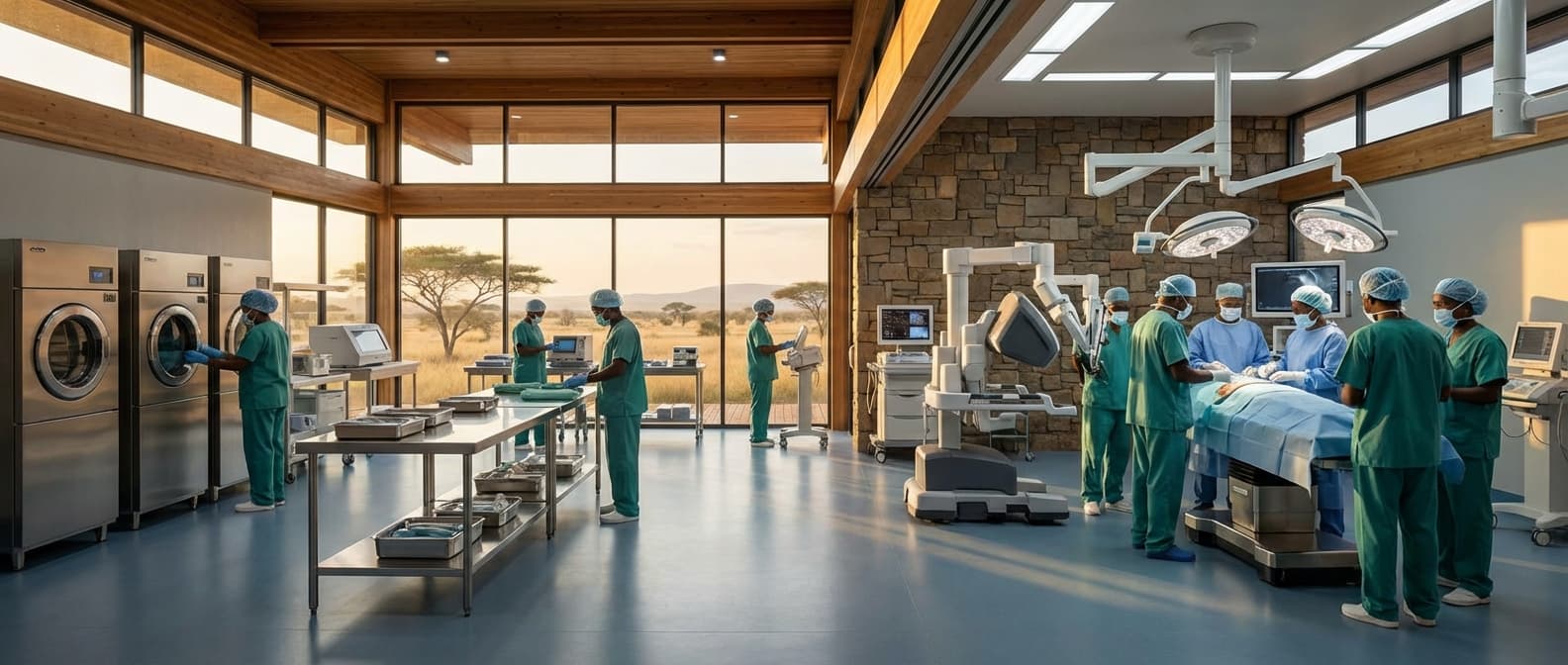
Operating Theatre Turnkey Build in Guinea-Bissau
Engineering Excellence & Technical Support
Complete OR design, equipment integration and commissioning High-standard technical execution following OEM protocols and local regulatory frameworks.
Advanced Modular Operating Theatre Design
Implementation of state-of-the-art modular operating theatre units designed for optimal workflow, infection control, and patient safety, incorporating advanced ventilation systems and seamless integration of medical gases and electrical infrastructure, tailored for the specific climatic and logistical challenges in Guinea-Bissau.
Robust Power & Backup Systems
Installation of highly reliable, multi-layered power supply solutions, including redundant generators and uninterruptible power supplies (UPS), specifically engineered to ensure continuous and stable power for critical medical equipment and life support systems within the operating theatre, mitigating risks associated with the national grid's inconsistencies.
Integrated Water Purification & Sterilization
Deployment of a comprehensive water treatment and sterilization system, guaranteeing a supply of sterile water for surgical procedures and instrument sterilization, crucial for preventing hospital-acquired infections in a region where access to reliably clean water can be a significant concern. This includes advanced filtration and UV disinfection technologies.
What Is Operating Theatre Turnkey Build In Guinea-bissau?
An Operating Theatre Turnkey Build in Guinea-Bissau refers to a comprehensive service that delivers a fully functional and equipped operating theatre, ready for immediate use, from initial design and construction through to final commissioning. This integrated approach minimizes the burden on the client by encompassing all aspects of the project lifecycle. The service typically includes site assessment, architectural and engineering design (adhering to international and local healthcare standards), civil works (construction, refurbishment), MEP (Mechanical, Electrical, and Plumbing) systems installation and integration (including specialized medical gases, ventilation, and power redundancy), sterile environment control systems, integrated medical equipment supply and installation, IT infrastructure deployment, final testing and commissioning, and staff training on new systems and equipment.
| Who Needs It? | Typical Use Cases | ||||
|---|---|---|---|---|---|
| Hospitals (public and private) in Guinea-Bissau seeking to upgrade or establish new operating theatre facilities. | Establishment of new surgical departments in existing healthcare facilities. | Government health ministries or agencies tasked with improving healthcare infrastructure. | Non-governmental organizations (NGOs) and international aid agencies developing or expanding medical services. | Private medical investors seeking to build state-of-the-art surgical centers. | Institutions requiring specialized surgical capabilities (e.g., cardiac, neurosurgery, trauma). |
| Expansion of hospital capacity to accommodate increased patient demand for surgical procedures. | Replacement of outdated or non-compliant operating theatre infrastructure. | Development of surgical services in remote or underserved regions. | Implementation of advanced surgical techniques requiring specialized equipment and environments. | Creating modular or temporary operating theatre solutions for disaster response or specific public health campaigns. | Building fully equipped operating theatres as part of new hospital constructions. |
Key Components of an Operating Theatre Turnkey Build
- Site analysis and feasibility studies
- Conceptual and detailed architectural and engineering design
- Civil construction and interior finishing (wall cladding, flooring, ceiling systems)
- MEP system design and installation (HVAC with HEPA filtration, medical gas pipelines, emergency power generation, specialized lighting)
- Sterilization and infection control systems integration
- Supply and installation of integrated medical equipment (surgical lights, booms, anesthesia machines, patient monitors, imaging devices)
- IT and communication infrastructure setup (network, PACS connectivity)
- Waste management system integration
- Testing, commissioning, and validation
- User training and handover protocols
Who Needs Operating Theatre Turnkey Build In Guinea-bissau?
Operating theatre turnkey builds are specialized projects that offer a comprehensive, ready-to-use surgical suite. In Guinea-Bissau, such a service would be highly beneficial for healthcare institutions aiming to rapidly upgrade or establish advanced surgical capabilities with minimal disruption and a guaranteed outcome. These projects typically encompass design, construction, equipment procurement, installation, and commissioning of operating theatres, ensuring compliance with international standards and local regulations. The turnkey approach streamlines the complex process, allowing facilities to focus on patient care rather than project management.
| Department/Area | Needs Addressed by Turnkey Build | Key Equipment/Features |
|---|---|---|
Target Customers and Departments for Operating Theatre Turnkey Builds in Guinea-Bissau
- {"item":"Public Hospitals","description":"National and regional hospitals seeking to modernize their surgical infrastructure to provide a wider range of complex procedures and improve patient outcomes. This includes enhancing capacity for emergency surgeries and specialized interventions."}
- {"item":"Private Healthcare Providers","description":"Hospitals and clinics owned by private entities looking to establish or expand state-of-the-art surgical departments to attract a higher patient volume, offer specialized medical tourism, and compete with international standards."}
- {"item":"Non-Governmental Organizations (NGOs) & International Aid Agencies","description":"Organizations focused on improving healthcare access and quality in Guinea-Bissau, particularly in underserved areas. Turnkey solutions provide a reliable and efficient way to deploy fully functional surgical facilities for humanitarian projects."}
- {"item":"Military Hospitals & Clinics","description":"Healthcare facilities serving military personnel and their families that require advanced surgical capabilities for trauma care, routine procedures, and specialized medical needs."}
- {"item":"Research and Training Institutions","description":"Medical schools or research centers that need advanced operating theatres equipped for surgical training, skill development, and clinical research, ensuring hands-on experience with modern technology."}
Operating Theatre Turnkey Build Process In Guinea-bissau
The turnkey build process for an operating theatre in Guinea-Bissau is a comprehensive undertaking involving multiple stages, from initial client inquiry to final handover and commissioning. This process is designed to deliver a fully functional, state-of-the-art operating theatre facility tailored to the specific needs and local context of the client. It requires meticulous planning, robust project management, and adherence to international standards, while also navigating local regulations and logistical challenges inherent in Guinea-Bissau.
| Phase | Key Activities | Deliverables | Considerations for Guinea-Bissau |
|---|---|---|---|
| Inquiry & Needs Assessment | Client contact, understanding requirements, capacity, budget, scope. | Initial project brief, preliminary requirements document. | Language barriers, cultural nuances, understanding local healthcare priorities. |
| Feasibility & Site Assessment | Site survey, structural analysis, utility availability, regulatory review, risk assessment. | Feasibility report, site assessment findings, preliminary risk register. | Infrastructure limitations (unreliable power/water), logistical challenges for site access, land ownership issues. |
| Conceptual Design & Scope | Developing layout, room configurations, preliminary equipment list, defining project scope. | Conceptual design drawings, project scope statement, preliminary budget. | Balancing international standards with local resource availability and sustainability. |
| Detailed Design & Engineering | Architectural, structural, MEP design, infection control, medical gas, lighting, specialized equipment integration. | Complete set of detailed design drawings and specifications, bill of quantities. | Availability of specialized engineers and designers, ensuring compliance with evolving local regulations. |
| Procurement & Supply Chain | Supplier selection, RFPs, contract negotiation, import/export management, logistics. | Procurement plan, contracts, equipment and material delivery schedule. | Complex customs procedures, import duties, limited local supply chain, potential delays due to transportation. |
| Permitting & Approvals | Submitting applications, liaising with authorities, addressing queries. | All necessary building and operational permits. | Bureaucratic processes, potential for extended timelines, need for strong local partnerships. |
| Site Preparation & Civil Works | Demolition, excavation, foundation, structural construction. | Prepared site, completed building shell. | Availability of skilled local labor, weather conditions (rainy season), site security. |
| Construction & Installation | Internal construction, MEP installation, medical gases, finishes, equipment mounting. | Completed operating theatre interior, installed systems and major equipment. | Quality of local construction materials, skilled tradespeople, adherence to installation protocols for specialized equipment. |
| Quality Control & Assurance | Inspections, material testing, system checks, compliance audits. | Quality control reports, test certificates, assurance documentation. | Establishing robust QA/QC procedures independent of local standards, ensuring international compliance. |
| Commissioning & Testing | System functional tests, performance verification, integrated system testing. | Commissioning reports, test results, performance validation. | Ensuring access to specialized testing equipment, training of local technicians for ongoing maintenance. |
| Training & Handover | Operator training, maintenance training, final inspections, documentation provision. | Trained staff, operation and maintenance manuals, handover certificate. | Providing training in appropriate languages, cultural sensitivity in training delivery, ensuring knowledge transfer. |
| Post-Occupancy & Support | Performance monitoring, addressing defects, providing maintenance. | Post-occupancy reports, ongoing support agreements. | Establishing a reliable local support network, availability of spare parts, long-term sustainability planning. |
Operating Theatre Turnkey Build Process Workflow in Guinea-Bissau
- 1. Initial Inquiry & Needs Assessment: The process begins with a client (hospital, government ministry, NGO) expressing interest and providing initial requirements for an operating theatre. This involves understanding the scope of services to be offered, capacity needs, budget constraints, and any existing infrastructure limitations.
- 2. Feasibility Study & Site Assessment: A detailed evaluation of the proposed site is conducted. This includes assessing structural integrity, access to utilities (power, water, waste management), potential environmental impacts, and compliance with local building codes and zoning regulations. This stage also involves an initial risk assessment.
- 3. Conceptual Design & Scope Definition: Based on the needs assessment and feasibility study, a conceptual design is developed. This outlines the overall layout, room configurations (scrub areas, pre-op, post-op, sterilization, etc.), and preliminary specifications for major equipment and systems. The project scope is formally defined and agreed upon.
- 4. Detailed Design & Engineering: This is a critical phase where architectural, structural, mechanical, electrical, and plumbing (MEP) designs are finalized. Specific attention is paid to infection control measures, ventilation (HVAC), lighting, medical gas systems, and specialized operating theatre equipment integration. All designs must comply with relevant international healthcare building standards (e.g., HTM, JCI guidelines) and local requirements.
- 5. Procurement & Supply Chain Management: The selection and procurement of all materials, equipment, and specialized systems are managed. This involves identifying reliable suppliers, obtaining competitive quotes, managing import/export logistics (which can be complex in Guinea-Bissau), and ensuring timely delivery to the site.
- 6. Permitting & Regulatory Approvals: Obtaining all necessary permits and approvals from Guinean authorities (ministries of health, construction, environment, etc.) is a crucial, and often time-consuming, step. This requires diligent documentation and adherence to local bureaucratic processes.
- 7. Site Preparation & Civil Works: Once approvals are secured, the site is prepared. This includes demolition (if necessary), excavation, foundation work, and the construction of the main building structure according to the approved detailed designs.
- 8. Construction & Installation: This phase involves the construction of internal walls, installation of MEP systems, medical gas lines, specialized flooring, ceiling, lighting, and finishes. The installation of major operating theatre equipment (surgical lights, tables, anesthesia machines, imaging systems) is integrated seamlessly.
- 9. Quality Control & Assurance: Throughout the construction and installation phases, rigorous quality control and assurance checks are performed. This ensures that all work meets specifications, adheres to safety standards, and complies with infection control protocols.
- 10. Commissioning & Testing: All installed systems and equipment undergo comprehensive testing and commissioning. This includes testing HVAC systems for air changes and pressure differentials, verifying medical gas purity and flow, testing electrical systems for reliability and safety, and ensuring all equipment functions as intended.
- 11. Training & Handover: Hospital staff (surgeons, nurses, technicians, maintenance personnel) receive thorough training on the operation and maintenance of the new operating theatre and its equipment. Once all testing is successful and training is complete, the facility is formally handed over to the client.
- 12. Post-Occupancy Evaluation & Support: Following handover, a period of post-occupancy evaluation may be conducted to identify any issues and ensure the facility is operating optimally. Ongoing support and maintenance services can also be arranged.
Operating Theatre Turnkey Build Cost In Guinea-bissau
Building a turnkey operating theatre in Guinea-Bissau involves a complex interplay of factors that significantly influence the final cost. These elements range from the initial design and specialized medical equipment to the skilled labor and regulatory compliance required. Given the developing infrastructure and unique economic landscape of Guinea-Bissau, pricing can exhibit considerable variability. The local currency, the West African CFA franc (XOF), is used for all transactions. While global benchmarks exist, local sourcing, import duties, transportation logistics, and the availability of specialized expertise within the country all contribute to determining the final price. It is crucial for any project developer to engage with local construction firms, medical equipment suppliers, and project managers experienced in the Guinean-Bissau market to obtain accurate and competitive quotes.
| Cost Component Category | Estimated Range (XOF) | Notes |
|---|---|---|
| Basic Infrastructure & Site Preparation (per m²) | 250,000 - 750,000 | Varies greatly depending on existing structure, land conditions, and utility access. |
| Architectural & Engineering Design Fees | 5,000,000 - 25,000,000 | Depends on the complexity of the design and the reputation of the firm. |
| Construction Materials (per m² - average) | 300,000 - 900,000 | Includes concrete, steel, specialized sterile finishes. Import costs can significantly inflate this. |
| Specialized Medical Equipment (per operating theatre) | 50,000,000 - 300,000,000+ | This is highly variable. A fully equipped theatre with advanced imaging and robotics will be at the higher end. |
| HVAC & HEPA Filtration System | 15,000,000 - 70,000,000 | Crucial for infection control; often requires imported, specialized units. |
| Medical Gas Systems Installation | 10,000,000 - 40,000,000 | Includes pipework, regulators, and specialized alarms. |
| Backup Power (Generator & UPS) | 8,000,000 - 35,000,000 | Essential for uninterrupted power supply. |
| Labor Costs (total project) | 15,000,000 - 60,000,000 | Influenced by the availability of skilled labor and project duration. |
| Import Duties, Taxes & Logistics (estimated percentage of equipment/material cost) | 20% - 50% | Can be a substantial cost driver for imported items. |
| Project Management & Supervision | 10,000,000 - 50,000,000 | Typically a percentage of the total project cost or a fixed fee. |
| Contingency (percentage of total estimated cost) | 10% - 20% | Recommended to cover unexpected expenses. |
| Estimated Total Turnkey Operating Theatre Build Cost (per theatre) | 150,000,000 - 700,000,000+ XOF | This is a broad estimate. A small, basic theatre might be at the lower end, while a state-of-the-art facility will be at the higher end and beyond. |
Key Pricing Factors for Turnkey Operating Theatre Builds in Guinea-Bissau
- Infrastructure & Site Preparation: Costs associated with preparing the construction site, including land acquisition (if applicable), clearing, grading, and ensuring access to utilities (water, electricity, sewage). Older buildings may require extensive structural modifications.
- Architectural & Engineering Design: Fees for specialized architectural and engineering services to design an operating theatre that meets international standards for sterility, airflow (HVAC systems), lighting, and workflow. This includes infection control considerations.
- Construction Materials: The cost of raw building materials. While some may be locally sourced, others, especially specialized construction materials for sterile environments, might need to be imported, incurring additional shipping and customs duties.
- Specialized Medical Equipment: This is often the most significant cost component. It includes surgical lights, operating tables, anesthesia machines, patient monitors, sterilizers (autoclaves), imaging equipment (e.g., C-arm), surgical instruments, and potentially robotic systems.
- Medical Gas Systems: Installation and integration of medical oxygen, nitrous oxide, medical air, and vacuum systems, including pipework, regulators, and outlets. Reliability and safety are paramount here.
- HVAC & Air Filtration Systems: Advanced heating, ventilation, and air conditioning (HVAC) systems with HEPA filtration are critical for maintaining sterile environments and controlling air pressure differentials. These are often imported and require specialized installation.
- Electrical Systems & Backup Power: Robust electrical systems, including uninterruptible power supplies (UPS) and backup generators, are essential to ensure continuous operation during power outages, which are common in Guinea-Bissau.
- Plumbing & Water Systems: Installation of specialized plumbing for sterile water supply, waste disposal, and potentially decontamination areas. Water treatment systems might also be necessary depending on the local water quality.
- Finishing & Interior Works: Specialized wall and floor finishes that are non-porous, seamless, and easy to clean and disinfect are crucial. This includes sterile coatings and specific ceiling materials.
- Labor Costs: The cost of skilled and unskilled labor. Availability of experienced medical construction specialists and tradespeople can impact pricing.
- Import Duties & Taxes: Significant costs can be incurred through import duties, VAT, and other taxes on imported medical equipment, specialized materials, and machinery.
- Transportation & Logistics: Moving materials and equipment to the construction site, especially in remote areas, can be costly due to the state of infrastructure.
- Project Management & Supervision: Fees for project managers, site supervisors, and quality control personnel to oversee the entire build process.
- Commissioning & Testing: Costs associated with testing all systems (medical gases, HVAC, electrical) and calibrating equipment to ensure it functions correctly and safely.
- Regulatory Approvals & Inspections: Fees for obtaining necessary permits, licenses, and undergoing inspections by local health authorities.
- Contingency: A crucial element to account for unforeseen issues, price fluctuations, and potential delays.
Affordable Operating Theatre Turnkey Build Options
Building an operating theatre can be a significant investment. However, by exploring affordable turnkey build options, healthcare facilities can achieve their goals without compromising on quality or functionality. Turnkey solutions offer a comprehensive approach, encompassing design, construction, and equipment installation, streamlining the entire process. This allows for better cost control and predictability. Value bundles are pre-defined packages that combine essential services and equipment at a discounted rate. Cost-saving strategies focus on optimizing every stage of the build, from initial planning to material selection and operational efficiency.
| Value Bundle/Strategy | Description | Cost-Saving Benefit |
|---|---|---|
| Basic Functionality Bundle | Includes essential sterile air handling units, basic surgical lighting, standard operating table, and essential instrument trolleys. | Lower upfront cost, suitable for general surgical needs. |
| Specialty Focus Bundle | Tailored for specific surgical disciplines (e.g., orthopedics, laparoscopy) with relevant specialized equipment, lighting, and imaging integration. | Optimizes equipment procurement by bundling, potentially better negotiated prices. |
| Energy Efficiency Package | Incorporates energy-efficient LED lighting, optimized HVAC systems, and high-performance insulation. | Reduces long-term operational costs through lower energy consumption. |
| Phased Development Approach | Building the operating theatre in stages, allowing for initial operational use and expansion as budget allows. | Manages cash flow, reduces the immediate financial burden. |
| Strategic Equipment Sourcing | Leveraging bulk purchasing, refurbished high-quality equipment, or partnerships with medical equipment providers. | Significant reduction in capital expenditure on medical devices. |
| Standardized Design Elements | Utilizing pre-designed, modular components and standardized layouts where possible. | Reduces design time and custom fabrication costs, speeds up construction. |
| Integrated IT and AV Solutions | Bundling necessary IT infrastructure, communication systems, and audio-visual equipment for seamless integration. | Streamlines procurement and installation, potentially better bundle pricing. |
| Negotiated Service and Maintenance Contracts | Securing long-term service agreements for essential equipment at a fixed, predictable cost. | Avoids unexpected repair expenses, predictable operational expenditure. |
Key Components of Affordable Operating Theatre Turnkey Builds
- Comprehensive Project Management: A single point of contact managing all aspects of the build.
- Modular Construction Options: Faster build times and potential cost reductions compared to traditional methods.
- Integrated Medical Gas Systems: Ensuring safe and efficient delivery of essential gases.
- High-Quality, Durable Medical Equipment: Balancing cost with long-term reliability and performance.
- Specialized Lighting and Ventilation: Creating an optimal and sterile surgical environment.
- Infection Control Features: Incorporating materials and designs that minimize contamination risks.
- Customizable Layouts: Adapting designs to specific surgical specialties and workflow requirements.
- Post-Installation Support and Training: Ensuring smooth handover and staff proficiency.
Verified Providers In Guinea-bissau
In Guinea-Bissau, ensuring access to reliable and qualified healthcare providers is paramount. Franance Health stands out as a leading entity in verifying and endorsing healthcare professionals and institutions, offering a crucial layer of trust and quality assurance for patients seeking medical services. Their rigorous credentialing process is designed to uphold the highest standards of medical practice, patient safety, and ethical conduct. By choosing providers accredited by Franance Health, individuals can be confident they are receiving care from individuals and facilities that have undergone thorough vetting and meet stringent criteria. This commitment to excellence makes Franance Health credentials a powerful indicator of superior healthcare delivery in Guinea-Bissau.
| Category | Franance Health Verified Status | Benefits to Patients |
|---|---|---|
| Doctors & Specialists | Verified & Certified | Guaranteed to possess legitimate qualifications and experience, reducing risk of misdiagnosis or malpractice. |
| Hospitals & Clinics | Accredited & Endorsed | Ensures adherence to safety regulations, proper equipment, and quality of care standards. |
| Medical Laboratories | Certified & Audited | Confirms accuracy and reliability of diagnostic tests and results. |
| Pharmaceutical Providers | Licensed & Inspected | Ensures availability of genuine medications and safe dispensing practices. |
Why Franance Health Credentials Matter:
- Rigorous Vetting Process: Franance Health employs a comprehensive evaluation of medical qualifications, professional licenses, and practical experience.
- Commitment to Patient Safety: Their standards prioritize protocols and practices that ensure the well-being and safety of all patients.
- Upholding Ethical Standards: Certified providers adhere to a strict code of professional ethics and conduct.
- Access to Quality Care: Patients can trust that Franance Health-accredited providers offer a higher caliber of medical services.
- Promoting Transparency: The credentialing process fosters transparency in the healthcare sector, empowering patients to make informed decisions.
Scope Of Work For Operating Theatre Turnkey Build
This Scope of Work (SOW) outlines the requirements for a turnkey build of an operating theatre. It covers all aspects from design and construction to commissioning and handover, ensuring a fully functional and compliant operating theatre environment. The SOW details the technical deliverables expected and defines the standard specifications that must be adhered to throughout the project. This document serves as the primary reference for all parties involved in the project.
| Technical Deliverable | Description | Standard Specification / Reference Document |
|---|---|---|
| Architectural Drawings | Detailed plans including layout, room dimensions, door/window specifications, and finishes. | Local building codes, healthcare facility design guidelines (e.g., HBN, FGI), client-specific requirements. |
| Structural Engineering Drawings | Load-bearing capacity, foundation design, and any required structural modifications. | Relevant structural engineering codes and standards. |
| MEP Design Drawings | Detailed schematics for HVAC, electrical power distribution, lighting, plumbing, and drainage systems. | ASHRAE standards, IEC standards, local electrical and plumbing codes, infection control guidelines. |
| Medical Gas Systems Design | Schematics for oxygen, medical air, vacuum, and nitrous oxide systems, including distribution, alarms, and outlets. | NFPA 99, ISO 7396 series, HTM 02-01, local medical gas regulations. |
| HVAC System Design | Specifications for air changes per hour (ACH), pressure differentials, temperature and humidity control, HEPA filtration. | ASHRAE 170, ISO 14644, infection control guidelines. |
| Electrical Power and Lighting Design | Uninterruptible Power Supply (UPS) systems, emergency power, surgical lighting specifications, general lighting levels. | IEC 60364, local electrical codes, medical lighting standards. |
| Plumbing and Drainage Design | Water supply, waste disposal, specialized drainage requirements. | Local plumbing codes, water quality standards. |
| Operating Theatre Equipment Specifications | Detailed specifications for surgical lights, operating tables, anesthesia machines, monitoring equipment, etc. | Manufacturer's specifications, CE marking, FDA approval, relevant medical device standards. |
| Cleanroom Construction and Certification Report | Verification of air quality and contamination levels. | ISO 14644-1 and -2, GMP guidelines. |
| Validation and Commissioning Report | Documentation of system functionality, performance testing, and adherence to design specifications. | Client's commissioning plan, industry best practices. |
| As-Built Drawings | Accurate record of the final constructed facility, reflecting any deviations from the original design. | Client-specific requirements, CAD standards. |
| Operation and Maintenance (O&M) Manuals | Comprehensive guides for operating and maintaining all installed systems and equipment. | Manufacturer's manuals, project-specific documentation. |
| Training Materials and Records | User manuals and training documentation for all equipment and systems, along with attendance records. | Client-specific requirements. |
Key Project Phases and Activities
- Project Planning and Design
- Procurement and Supply Chain Management
- Civil and Structural Works
- MEP (Mechanical, Electrical, Plumbing) Systems Installation
- Medical Gas Systems Installation
- Operating Theatre Equipment Installation and Integration
- Cleanroom Construction and Certification
- Finishing and Interior Works
- Testing, Commissioning, and Validation
- Training and Handover
- Documentation and As-Built Drawings
Service Level Agreement For Operating Theatre Turnkey Build
This Service Level Agreement (SLA) outlines the response times and uptime guarantees for the Operating Theatre Turnkey Build project. It defines the expected performance standards and the remedies for non-compliance.
| Service Component | Response Time Target | Resolution Time Target (Critical Issues) | Uptime Guarantee |
|---|---|---|---|
| Overall Operating Theatre Availability (Post-Commissioning) | 4 Business Hours (Acknowledgement) | 24 Business Hours (Functional Restoration) | 99.5% |
| Critical HVAC System Failure | 1 Business Hour (Acknowledgement) | 8 Business Hours (Functional Restoration) | 99.9% |
| Critical Lighting System Failure | 1 Business Hour (Acknowledgement) | 6 Business Hours (Functional Restoration) | 99.9% |
| Medical Gas System Failure | 1 Business Hour (Acknowledgement) | 4 Business Hours (Functional Restoration) | 99.9% |
| Infection Control System Failure (e.g., Laminar Flow, Air Filtration) | 2 Business Hours (Acknowledgement) | 12 Business Hours (Functional Restoration) | 99.8% |
| Non-critical Equipment Malfunction (e.g., patient monitor) | 4 Business Hours (Acknowledgement) | 48 Business Hours (Functional Restoration or Temporary Replacement) | N/A (Covered by overall availability) |
| Planned Maintenance (Scheduled with advance notice) | N/A | As per agreed schedule | N/A (Downtime during planned maintenance is not counted against uptime guarantee, but notification is required) |
Key Definitions
- Operating Theatre Turnkey Build: The complete design, construction, installation, commissioning, and handover of a fully functional operating theatre, including all necessary infrastructure, equipment, and systems.
- Service Hours: The period during which support services are available, typically 24 hours a day, 7 days a week, unless otherwise specified.
- Downtime: Any period when the operating theatre or critical supporting systems are unavailable for use due to a failure or planned maintenance.
- Response Time: The maximum time allowed for the service provider to acknowledge and begin addressing a reported issue.
- Resolution Time: The maximum time allowed for the service provider to resolve a reported issue to a functional state.
- Uptime Guarantee: The percentage of time the operating theatre and its critical systems are expected to be operational and available for use.
- Critical Issue: An issue that renders the operating theatre completely unusable or poses a significant risk to patient safety.
Frequently Asked Questions

Ready when you are
Let's scope your Operating Theatre Turnkey Build in Guinea-Bissau project in Guinea-Bissau.

Scaling healthcare logistics and technical systems across the entire continent.