
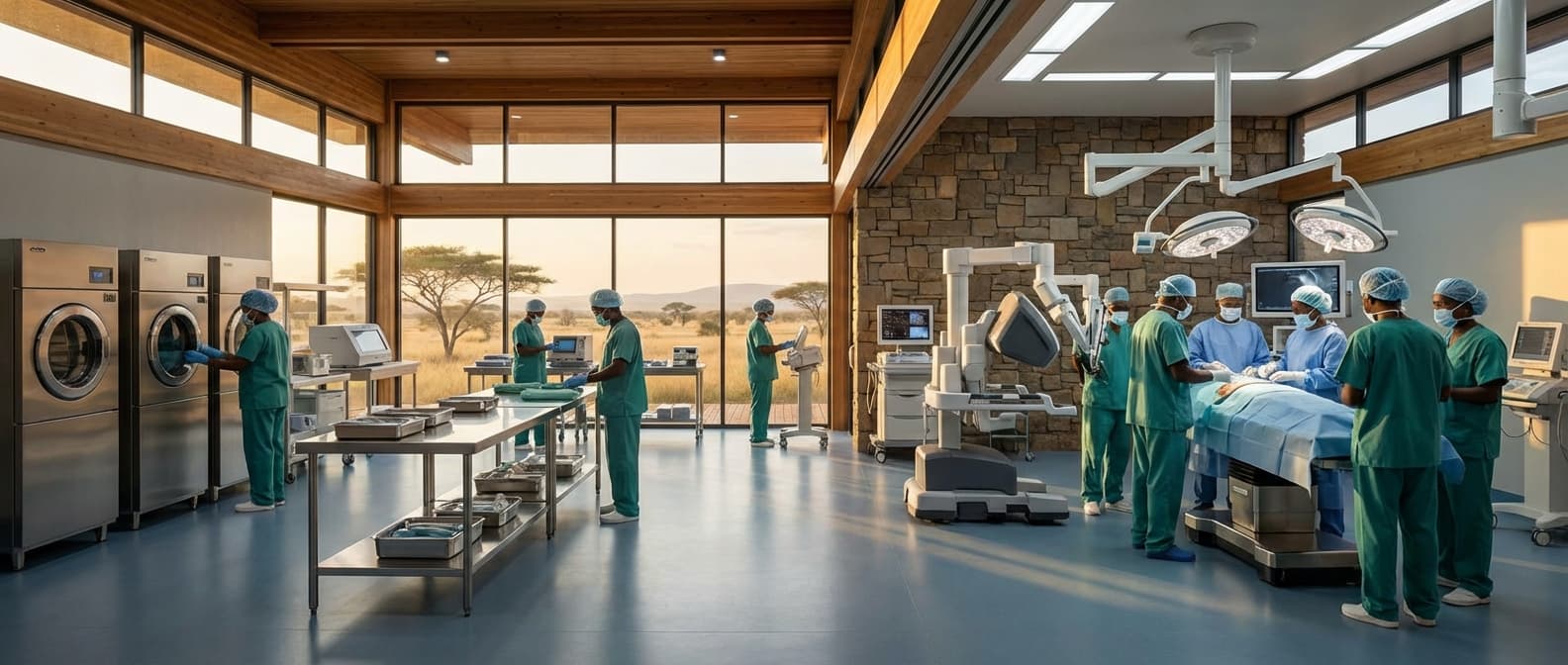
CSSD Design & Validation in Guinea-Bissau
Engineering Excellence & Technical Support
CSSD workflow design, validation and process development High-standard technical execution following OEM protocols and local regulatory frameworks.
Advanced Sterilization Workflow Design
Expertly designing and implementing optimized CSSD workflows in Guinea-Bissau, ensuring adherence to international sterilization standards and best practices. This includes meticulous planning of material flow, decontamination zones, sterilization processes, and sterile storage to minimize cross-contamination and maximize efficiency.
Robust Validation & Quality Assurance Protocols
Establishing and executing comprehensive validation protocols for all sterilization equipment and processes. This ensures consistent and effective sterilization, with a strong emphasis on record-keeping, performance monitoring, and ongoing quality assurance to meet regulatory requirements and guarantee patient safety in healthcare settings across Guinea-Bissau.
Sustainable CSSD Infrastructure Planning
Developing tailored, sustainable CSSD infrastructure plans for Guinea-Bissau's unique healthcare landscape. This involves careful consideration of available resources, local climate conditions, and future scalability to design facilities that are both cost-effective and operationally sound for long-term medical instrument reprocessing.
What Is Cssd Design & Validation In Guinea-bissau?
CSSD (Central Sterile Supply Department) design and validation in Guinea-Bissau refers to the comprehensive process of planning, constructing, equipping, and verifying the operational efficacy of a facility dedicated to the decontamination, sterilization, and sterile storage of medical devices and instruments. This service is critical for ensuring patient safety by preventing healthcare-associated infections (HAIs) through robust infection prevention and control (IPC) measures. The design phase focuses on optimizing workflow, ensuring compliance with international standards and local regulations, and incorporating appropriate technologies for efficient processing. Validation is a rigorous, documented process that provides a high degree of assurance that the CSSD will consistently perform as intended, meeting predetermined specifications and quality attributes. This includes prospective, concurrent, and retrospective validation of all processes, equipment, and systems.
| Stakeholder Group | Needs & Rationale for CSSD Design & Validation | Typical Use Cases |
|---|---|---|
| Hospitals & Healthcare Facilities | Essential for providing safe surgical care, complying with national and international healthcare standards, and reducing the incidence of HAIs. Critical for facilities performing any invasive procedures. | Establishing a new CSSD, upgrading an existing one, implementing new sterilization technologies, responding to audit findings, meeting accreditation requirements. |
| Surgical Centers & Clinics | Ensuring the sterility of instruments for outpatient procedures, thereby safeguarding patient health and maintaining the facility's reputation. | Setting up dedicated sterile processing areas, ensuring compliance with regulations for minor surgical interventions. |
| Government Health Ministries & Regulatory Bodies | Establishing and enforcing standards for IPC in healthcare settings, ensuring a baseline level of patient safety across the country, and supporting public health initiatives. | Developing national IPC guidelines, licensing healthcare facilities, conducting public health inspections, allocating resources for healthcare infrastructure development. |
| International Health Organizations & NGOs | Supporting the development of robust healthcare infrastructure in resource-limited settings, improving patient outcomes, and preventing disease transmission. | Funding and implementing projects to establish or upgrade CSSDs in public hospitals, providing technical assistance and training, conducting needs assessments for healthcare facilities. |
| Medical Device Manufacturers & Suppliers | Ensuring their equipment is installed, operated, and maintained according to specifications, and supporting clients in achieving validated sterile processing. | Providing installation and validation services for their sterilizers, washer-disinfectors, and other related equipment; offering technical support and training. |
Key Components of CSSD Design & Validation in Guinea-Bissau
- Needs Assessment: Evaluating current healthcare infrastructure, surgical volumes, and specific IPC requirements.
- Space Planning & Layout Design: Optimizing workflow from soiled to sterile areas, considering instrument turnaround times, and adhering to unidirectional flow principles.
- Equipment Selection & Specification: Identifying appropriate sterilizers (e.g., autoclaves, low-temperature sterilizers), washer-disinfectors, drying cabinets, and sterile packaging systems.
- Utility Requirements: Defining specifications for water (purified, distilled), steam, electricity, and ventilation systems.
- Material Selection: Specifying materials for surfaces (floors, walls, countertops) that are non-porous, durable, and easy to clean and disinfect.
- Process Design: Developing Standard Operating Procedures (SOPs) for decontamination, cleaning, inspection, assembly, packaging, sterilization, sterile storage, and distribution.
- Environmental Monitoring: Designing systems for monitoring temperature, humidity, and air changes per hour (ACPH) in critical areas.
- Quality Management System (QMS) Integration: Establishing a QMS framework that encompasses all CSSD operations, including record-keeping, training, and continuous improvement.
- Validation Protocols: Developing detailed protocols for Installation Qualification (IQ), Operational Qualification (OQ), and Performance Qualification (PQ) for all equipment and processes.
- Training & Competency Assessment: Designing and implementing training programs for CSSD personnel, followed by competency assessments.
Who Needs Cssd Design & Validation In Guinea-bissau?
In Guinea-Bissau, robust Central Sterile Services Department (CSSD) design and validation are crucial for ensuring patient safety and preventing healthcare-associated infections (HAIs). While the healthcare infrastructure may be developing, the fundamental need for sterile instruments and equipment remains paramount. Therefore, any healthcare facility that performs surgical procedures, diagnostic tests requiring sterile instruments, or handles any invasive medical devices stands to benefit significantly from proper CSSD design and validation. This includes both public and private sector facilities.
| Customer Type | Primary Departments Benefiting from CSSD Design & Validation | Specific Needs Addressed |
|---|---|---|
| Public Hospitals | Operating Theatres, Emergency Rooms, Intensive Care Units (ICUs), Outpatient Clinics (requiring minor procedures), Maternity Wards | Ensuring availability of sterile instruments for a high volume of diverse procedures, infection control, resource optimization, staff training on sterile processing protocols. |
| Private Hospitals/Surgical Centers | Operating Rooms, Endoscopy Suites, Ophthalmology Departments, Orthopedic Departments | Maintaining high standards of sterility for elective and complex procedures, reputation building, compliance with potential international accreditation (even if not yet fully implemented locally), patient confidence. |
| Clinics & Health Centers | Minor Procedure Rooms, Consultation Rooms (for basic sterile interventions) | Providing safe sterile supplies for routine vaccinations, wound care, minor surgical excisions, preventing localized outbreaks of HAIs. |
| Dental Clinics | Dental Surgery Rooms | Sterilization of dental instruments (scalers, drills, surgical tools) to prevent transmission of blood-borne pathogens and other infections. |
| Diagnostic Laboratories | Microbiology Labs, Pathology Labs (requiring sterile sample handling tools) | Ensuring sterile tools and containers for accurate diagnostic testing, preventing contamination of samples and false results. |
Target Customers & Departments for CSSD Design & Validation in Guinea-Bissau
- Hospitals (Public & Private)
- Clinics & Health Centers performing minor procedures
- Surgical Centers
- Dental Clinics with surgical components
- Diagnostic Laboratories with sterile procedure requirements
Cssd Design & Validation Process In Guinea-bissau
The Central Sterile Supply Department (CSSD) design and validation process in Guinea-Bissau, like in many healthcare settings, follows a structured workflow to ensure the effective and safe sterilization of medical instruments. This process is crucial for preventing healthcare-associated infections (HAIs) and maintaining the quality of patient care. The workflow typically begins with an inquiry and culminates in fully validated, operational systems.
| Phase | Key Activities | Deliverables/Outcomes | Key Stakeholders | Considerations for Guinea-Bissau |
|---|---|---|---|---|
| Receive inquiry from healthcare facility. Define the scope of services the CSSD will provide. Assess existing infrastructure, patient load, and types of procedures. Determine sterilization needs (e.g., steam, low-temperature). | Needs assessment report, scope of work document. | Healthcare facility management, clinical staff, potential CSSD personnel. | Limited availability of specialized consultants. Focus on essential services and common procedures. Leverage existing infrastructure where possible. Assess local capacity for training. |
| Evaluate technical and economic feasibility. Develop preliminary layouts and workflow diagrams. Identify potential equipment options and space requirements. Estimate budget. Begin regulatory compliance review. | Feasibility report, preliminary design drawings, initial budget estimates. | Architects, engineers (mechanical, electrical), CSSD specialists, facility management, finance department. | Consideration of local building codes and material availability. Simplicity of design for ease of maintenance. Cost-effectiveness and durability of equipment. |
| Finalize architectural and engineering designs. Select specific sterilization equipment (autoclaves, washer-disinfectors, packaging systems). Specify utilities (water, steam, electricity, ventilation). Develop detailed specifications for all components. | Detailed design drawings, equipment specifications, utility requirements, final budget. | Architects, engineers, CSSD specialists, equipment manufacturers/suppliers, procurement team. | Ensuring equipment is suitable for the local power supply and water quality. Prioritizing equipment with readily available spare parts and local technical support. Designing for energy efficiency. |
| Issue tenders for equipment and construction. Select vendors and award contracts. Oversee the manufacturing and delivery of equipment. Manage construction and installation activities. Ensure adherence to design specifications and safety standards. | Procured equipment, completed construction, installed systems. | Procurement department, project managers, construction teams, equipment suppliers, CSSD specialists. | Challenges in logistics and transportation. Importance of rigorous vendor selection and supervision. Potential delays due to customs or import procedures. |
| Test all installed equipment and systems to ensure they operate according to manufacturer specifications. Verify functionality of utilities. Conduct preliminary performance tests (e.g., cycle testing). Train CSSD staff on operation and maintenance. | Commissioning reports, equipment test results, initial training records. | Equipment technicians, CSSD specialists, facility engineers, CSSD staff. | Need for robust training programs that are hands-on and practical. Availability of qualified technical personnel for commissioning. |
| Perform full validation of sterilization processes (IQ - Installation Qualification, OQ - Operational Qualification, PQ - Performance Qualification). Establish routine monitoring procedures (e.g., biological indicators, chemical indicators, process parameters). Develop standard operating procedures (SOPs) for all CSSD functions. Regular maintenance and recalibration. Auditing and continuous improvement. | Validation certificates, documented SOPs, routine monitoring logs, maintenance records, audit reports. | Validation specialists, CSSD manager, CSSD staff, quality assurance personnel. | Establishing a robust quality management system. Training staff on record-keeping and documentation. Securing a consistent supply of validation consumables (e.g., biological indicators). Periodic re-validation and external audits as needed. |
CSSD Design & Validation Process Workflow
- Inquiry and Needs Assessment
- Feasibility Study & Initial Design
- Detailed Design & Equipment Selection
- Procurement & Installation
- Commissioning & Performance Qualification (PQ)
- Validation & Ongoing Monitoring
Cssd Design & Validation Cost In Guinea-bissau
Designing and validating a Central Sterile Services Department (CSSD) in Guinea-Bissau involves several cost factors that can influence the overall investment. These factors range from the initial planning and architectural design to the procurement of specialized equipment, staff training, and ongoing validation processes. The specific pricing can vary significantly based on the size and scope of the CSSD, the level of technology implemented, and the chosen vendors. It's crucial to consider these elements when budgeting for such a critical healthcare infrastructure. Local currency, the West African CFA franc (XOF), is used for all transactions, and exchange rates with major international currencies should be monitored for potential fluctuations.
| Cost Component | Estimated Range (XOF) | Notes |
|---|---|---|
| Design & Consultancy | 1,500,000 - 5,000,000 | Varies by project scope and consultant's expertise. |
| Basic Equipment (Small Facility) | 10,000,000 - 30,000,000 | Includes 1-2 autoclaves, washer-disinfector, basic supplies. |
| Advanced Equipment (Medium Facility) | 30,000,000 - 80,000,000 | Multiple high-capacity autoclaves, automated systems, advanced cleaning units. |
| Infrastructure/Renovation | 2,000,000 - 10,000,000 | Dependent on existing building condition and required modifications. |
| Initial Validation & Commissioning | 1,000,000 - 3,000,000 | Covers initial testing and certification of key equipment. |
| Staff Training (per person) | 200,000 - 500,000 | Includes theoretical and practical training, may vary by complexity. |
| Installation & Setup | 500,000 - 2,000,000 | Depends on the number and complexity of installed equipment. |
| Annual Validation & Maintenance (Estimate) | 2,000,000 - 6,000,000 | Includes re-validation, routine checks, and potential service contracts. Excludes consumables. |
Key Pricing Factors for CSSD Design & Validation in Guinea-Bissau
- 1. Design and Consultancy Fees: This includes architectural plans, engineering assessments, workflow design, and consultancy services from specialized CSSD professionals. The complexity and duration of the design phase will directly impact these costs.
- 2. Equipment Procurement: This is often the most significant cost component. It includes sterilization equipment (autoclaves, washer-disinfectors), cleaning supplies, packaging materials, storage solutions, and quality control instrumentation. The quantity, capacity, and technological sophistication of the equipment will dictate the price.
- 3. Infrastructure and Renovation: Costs associated with preparing or renovating the physical space for the CSSD. This might involve plumbing, electrical upgrades, ventilation systems, specialized flooring, and partitioning to meet hygiene standards.
- 4. Validation and Commissioning: This is a critical ongoing cost. It involves rigorous testing and certification of equipment and processes to ensure they meet international standards (e.g., ISO, AAMI). This includes initial validation, performance qualification, and ongoing re-validation.
- 5. Staff Training: Training of CSSD personnel in sterilization techniques, equipment operation, quality control, and infection prevention is essential. The number of staff and the extent of training will influence this cost.
- 6. Installation and Setup: Fees for the professional installation of equipment and the setup of the entire CSSD operational flow.
- 7. Consumables and Maintenance: Initial stocking of consumables (detergents, packaging) and budgeting for ongoing maintenance and repair contracts for equipment.
- 8. Regulatory and Certification Fees: Any applicable fees for permits, licenses, or certifications required by local health authorities.
Affordable Cssd Design & Validation Options
Designing and validating a Central Sterile Supply Department (CSSD) is a crucial investment for any healthcare facility, ensuring patient safety and operational efficiency. While high-end solutions exist, there are often cost-effective approaches that deliver excellent results without breaking the bank. This document outlines affordable CSSD design principles, validation essentials, and explores value bundles and cost-saving strategies to help facilities optimize their sterile processing capabilities within budget.
| Value Bundle Name | Included Services/Products | Cost-Saving Strategy | Potential Benefits |
|---|---|---|---|
| Basic CSSD Workflow Design & Validation Package | Initial site assessment, basic workflow layout consultation, essential sterilization validation (e.g., steam penetration testing), washer-disinfector performance verification. | Focus on essential regulatory requirements, reduces consultant hours by streamlining initial scope. | Ensures foundational compliance and patient safety at a lower entry cost. |
| Modular Decontamination Room Kit | Prefabricated wall panels, integrated sinks and workstations, basic ventilation, pre-piped utilities. | Reduces on-site construction time and labor, predictable material costs. | Faster setup, consistent quality, adaptability to smaller spaces. |
| Essential Instrument Tracking & Validation Bundle | Basic barcode scanning system for instrument trays, initial validation of scanner accuracy, limited software features for basic inventory and load control. | Phased technology adoption, avoids full enterprise system costs upfront. | Improved traceability, compliance with load control, supports basic recall management. |
| Staff Competency & SOP Development Package | Training modules for core CSSD processes, development of standardized operating procedures (SOPs) for decontamination, cleaning, sterilization, and sterile storage. | Reduces training errors and rework, standardized procedures minimize validation deviations. | Improved staff performance, reduced reprocessing failures, stronger audit results. |
| Budget-Conscious Equipment Sizing Consultation | Analysis of instrument reprocessing needs, recommendations for appropriately sized washer-disinfectors and sterilizers based on current and projected volumes. | Prevents over-capitalization on oversized equipment, optimizes energy and consumable usage. | Lower upfront equipment cost, reduced operational expenses. |
Key Considerations for Affordable CSSD Design & Validation
- Modular Design: Opting for modular or prefabricated CSSD units can significantly reduce construction time and costs compared to traditional builds. These systems can be adapted to various space constraints.
- Right-Sizing Equipment: Carefully assess the volume and types of instrumentation to avoid over-investing in oversized or underutilized equipment. Consult with manufacturers and CSSD experts for appropriate sizing.
- Streamlined Workflow: Designing a logical and efficient workflow is paramount. This minimizes movement, reduces the risk of recontamination, and maximizes staff productivity. Think 'clean to dirty' flow from the outset.
- Prioritizing Essential Validation: Focus on the critical validation processes required by regulatory bodies and standards (e.g., steam sterilization efficacy, washer-disinfector performance). Non-essential or overly complex validation steps can be deferred or simplified.
- Leveraging Technology Wisely: While advanced tracking systems are beneficial, consider phased implementation or starting with essential barcode scanning for basic instrument tracking to manage upfront costs.
- Standardized Processes: Implementing and adhering to standardized operating procedures (SOPs) for decontamination, sterilization, and sterile storage reduces errors, training time, and the need for extensive, costly rework or validation failures.
- Staff Training & Competency: Investing in comprehensive and ongoing staff training is a cost-saving measure in the long run. Competent staff make fewer errors, leading to fewer reprocessing failures and reduced validation challenges.
- Phased Validation Approach: For new builds or major renovations, consider a phased validation approach. Validate critical areas and equipment first, then proceed with further validation as the facility scales or budgets allow.
- Consultant Expertise: Engaging a CSSD consultant for initial design and validation planning can prevent costly mistakes and ensure compliance. Their expertise can guide you toward the most effective and economical solutions.
- Used or Refurbished Equipment (with caution): For non-critical equipment or in budget-constrained situations, consider high-quality refurbished equipment from reputable vendors. Ensure thorough inspection and validation.
Verified Providers In Guinea-bissau
Ensuring access to quality healthcare is paramount, and in Guinea-Bissau, the role of verified providers is crucial. Franance Health stands out as a leading entity in this regard. Their rigorous credentialing process guarantees that all affiliated healthcare professionals and facilities meet the highest standards of competence, ethics, and patient safety. This meticulous verification is not just a formality; it's a commitment to providing the best possible care to the population. Choosing a Franance Health verified provider means opting for reliability, expertise, and a patient-centered approach, making them the premier choice for healthcare needs in Guinea-Bissau.
| Provider Type | Verification Process | Key Benefits for Patients |
|---|---|---|
| Doctors and Specialists | Review of medical degrees, licenses, and specialization certifications; background checks. | Access to competent and qualified medical practitioners with verified expertise. |
| Clinics and Hospitals | Inspection of facilities for compliance with health and safety regulations; assessment of equipment and staff qualifications. | Safe and well-equipped healthcare environments with trained personnel. |
| Diagnostic Laboratories | Verification of equipment calibration, quality control procedures, and personnel expertise. | Accurate and reliable diagnostic results for effective treatment. |
| Pharmacies | Inspection of drug storage, dispensing practices, and pharmacist qualifications. | Access to authentic medications and safe pharmaceutical services. |
Why Franance Health Credentials Matter:
- Rigorous vetting of medical professionals' qualifications and experience.
- Verification of adherence to ethical medical practices and patient care standards.
- Ensuring facilities meet safety and hygiene regulations.
- Promoting transparency and accountability in healthcare delivery.
- Building trust and confidence for patients seeking reliable medical services.
Scope Of Work For Cssd Design & Validation
This Scope of Work (SOW) outlines the design, validation, technical deliverables, and standard specifications required for the Central Sterile Supply Department (CSSD). It details the project's objectives, phases, responsibilities, and expected outcomes to ensure a functionally efficient, safe, and compliant CSSD facility.
| Deliverable | Description | Standard/Specification Reference | Responsibility |
|---|---|---|---|
| Conceptual Design Report | Initial layout, workflow analysis, equipment list, and preliminary budget. | Local Health Authority Guidelines, WHO Guidelines on CSSD, ISO 13485 (Quality Management for Medical Devices) | Design Consultant, Client Project Team |
| Detailed Architectural Drawings | Finalized layout, room dimensions, finishes, services integration (electrical, plumbing, HVAC). | Local Building Codes, Healthcare Facility Design Standards (e.g., AIA Guidelines for Design and Construction of Healthcare Facilities) | Architectural Designer |
| Detailed Mechanical, Electrical, and Plumbing (MEP) Drawings | Specifications for HVAC, lighting, water supply, drainage, power distribution, and medical gas systems. | ASHRAE Standards, NFPA Standards, Local Electrical and Plumbing Codes | MEP Engineers |
| Equipment Specifications and Selection | Detailed technical specifications for all CSSD equipment (autoclaves, washers, sterilizers, etc.) and procurement support. | Manufacturer Specifications, EN Standards (e.g., EN 285 for Steam Sterilizers), AAMI Standards (e.g., ST46 for Steam Sterilization) | Equipment Specialist, Design Consultant |
| Workflow Diagrams and SOPs | Detailed operational procedures for receiving, cleaning, disinfection, sterilization, storage, and distribution of sterile items. | ISO 13485, Local Regulatory Requirements, Manufacturer's Instructions for Use (IFU) | CSSD Manager, Infection Control Team, Design Consultant |
| Validation Protocol (IQ/OQ/PQ) | Installation Qualification (IQ), Operational Qualification (OQ), and Performance Qualification (PQ) plans for all equipment and processes. | FDA Guidance on Process Validation, ISO 17665 (Sterilization of Health Care Products - Moist Heat), AAMI Standards | Validation Specialist, Client Quality Assurance |
| Validation Reports | Documentation of successful IQ, OQ, and PQ for all systems and equipment. | As per Validation Protocol | Validation Specialist |
| Training Manuals | Comprehensive training materials for CSSD staff on equipment operation, maintenance, and infection control protocols. | Manufacturer's Manuals, SOPs | Training Coordinator, Senior CSSD Staff |
| As-Built Drawings | Final drawings reflecting the actual constructed facility and installed systems. | Local Regulatory Requirements | Contractor, Design Team |
Project Phases
- Phase 1: Planning and Conceptualization
- Phase 2: Detailed Design
- Phase 3: Procurement and Construction Support
- Phase 4: Validation and Commissioning
- Phase 5: Training and Handover
Service Level Agreement For Cssd Design & Validation
This Service Level Agreement (SLA) outlines the guaranteed response times and uptime for the CSSD (Central Sterile Supply Department) Design & Validation services provided by [Your Company Name]. This SLA is designed to ensure the highest level of support and operational reliability for your critical CSSD infrastructure.
| Service Component | Response Time Guarantee | Uptime Guarantee | |
|---|---|---|---|
| Critical Design/Validation Issues (e.g., non-functional layout, protocol failure) | 2 Hours (Acknowledgement) | N/A (Design/Validation are project-based, uptime applies to operational support if applicable) | 8 Business Hours (Resolution/Action Plan) |
| High Priority Design/Validation Questions/Clarifications | 4 Business Hours (Acknowledgement) | N/A | 1 Business Day (Resolution/Action Plan) |
| Standard Design/Validation Support Requests | 8 Business Hours (Acknowledgement) | N/A | 3 Business Days (Resolution/Action Plan) |
| General Inquiries/Consultations | 1 Business Day (Acknowledgement) | N/A | 5 Business Days (Resolution/Action Plan) |
Scope of Service
- CSSD functional design and layout review.
- Equipment selection and integration consultation.
- Validation protocol development (IQ, OQ, PQ).
- Validation execution support and data analysis.
- Troubleshooting and issue resolution related to design and validation.
- Documentation review and approval processes.
Frequently Asked Questions

Ready when you are
Let's scope your CSSD Design & Validation in Guinea-Bissau project in Guinea-Bissau.

Scaling healthcare logistics and technical systems across the entire continent.