
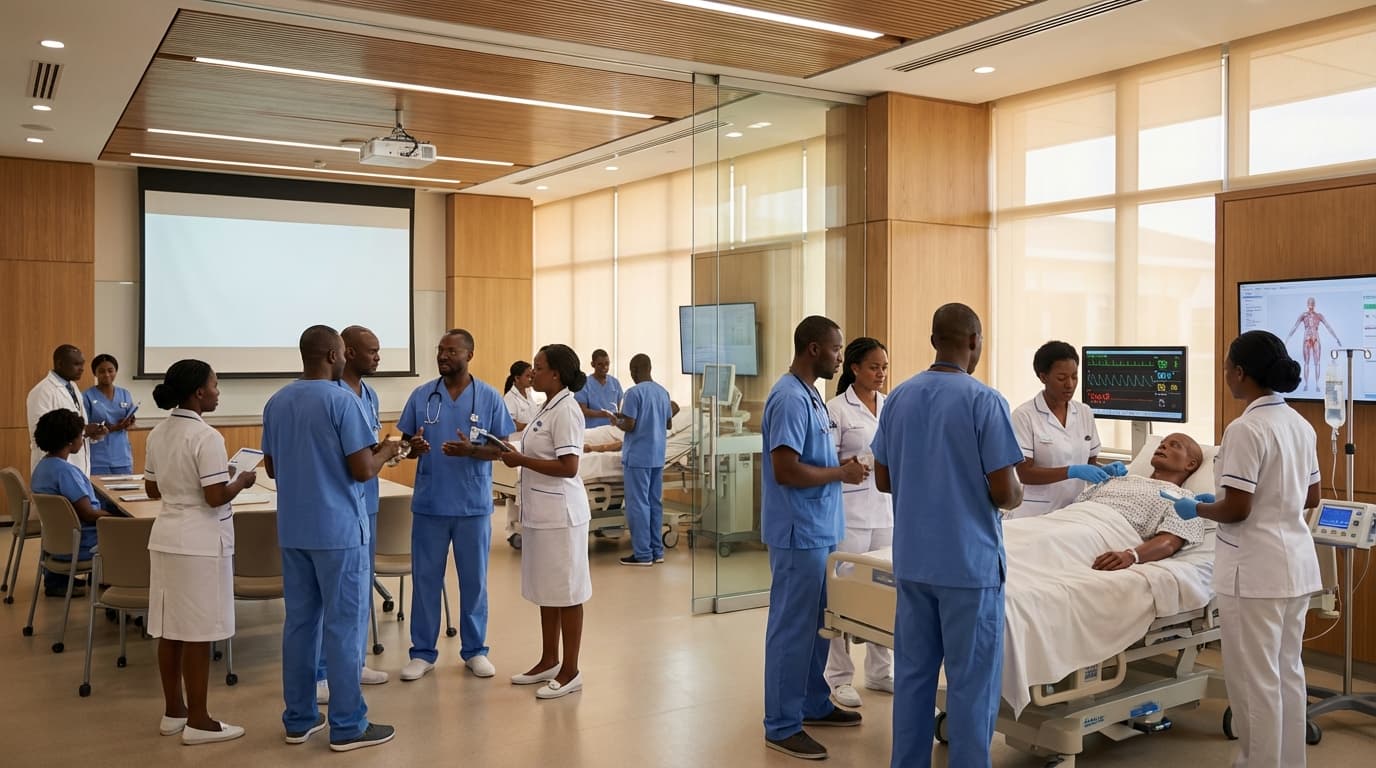
Equipment Training & Education in Ghana
Engineering Excellence & Technical Support
Comprehensive equipment training and certification programs High-standard technical execution following OEM protocols and local regulatory frameworks.
Interactive Equipment Simulators
Empowering Ghanaian professionals with state-of-the-art virtual simulators for hands-on practice on complex machinery, reducing risks and accelerating skill acquisition in sectors like agriculture, mining, and construction.
Digital Twin Technology Adoption
Leveraging digital twin technology to create virtual replicas of critical equipment. This allows for remote monitoring, predictive maintenance training, and scenario-based problem-solving, enhancing operational efficiency and reducing downtime across industries in Ghana.
Mobile-First Learning Platforms
Delivering accessible, on-demand equipment training modules via mobile applications. This ensures that technicians and operators across Ghana's diverse geographical landscape can access essential knowledge and skill development anytime, anywhere.
What Is Equipment Training & Education In Ghana?
Equipment training and education in Ghana refers to the provision of structured learning programs designed to impart the necessary knowledge and practical skills for the safe, efficient, and effective operation, maintenance, and troubleshooting of various types of equipment. This encompasses a spectrum of learning modalities, from foundational theoretical understanding to hands-on competency development, tailored to specific equipment types and industry requirements. The objective is to enhance user proficiency, minimize operational risks, prolong equipment lifespan, and optimize productivity within Ghanaian industries and sectors.
| Who Needs Equipment Training & Education? | Typical Use Cases | ||||||||||||||||
|---|---|---|---|---|---|---|---|---|---|---|---|---|---|---|---|---|---|
| Industrial Operators & Technicians: Personnel directly operating machinery, assembly lines, or production equipment. | Manufacturing: Training on CNC machines, automated production lines, forklifts, and material handling equipment. | Construction Workers & Supervisors: Individuals operating heavy machinery, power tools, and specialized construction equipment. | Construction: Operation of excavators, bulldozers, cranes, concrete mixers, and scaffolding systems. | Healthcare Professionals: Staff operating medical diagnostic and treatment equipment. | Healthcare: Training on MRI machines, CT scanners, ultrasound devices, laboratory analysers, and patient monitoring systems. | Agriculture Professionals & Farmers: Individuals using modern agricultural machinery and equipment. | Agriculture: Operation of tractors, harvesters, irrigation systems, and crop processing machinery. | Logistics & Warehousing Staff: Personnel managing and operating material handling and storage equipment. | Logistics: Training on forklifts, pallet jacks, automated storage and retrieval systems (ASRS), and conveyor belts. | Oil & Gas Personnel: Technicians and engineers working with specialized drilling, processing, and safety equipment. | Oil & Gas: Operation of drilling rigs, pumps, valves, safety valves, and refinery equipment. | IT Technicians & Support Staff: Individuals maintaining and repairing IT infrastructure and devices. | Information Technology: Installation, configuration, and troubleshooting of servers, networking equipment, and end-user devices. | Mining Sector Employees: Workers operating heavy mining machinery and processing equipment. | Mining: Operation of haul trucks, excavators, crushers, and processing plant machinery. | Public Utility Workers: Technicians working with infrastructure maintenance equipment. | Utilities: Training on equipment for water treatment plants, power substations, and telecommunications infrastructure. |
Key Components of Equipment Training & Education in Ghana
- Theoretical Knowledge Transfer: Covering principles of operation, safety protocols, technical specifications, and regulatory compliance.
- Practical Skill Development: Hands-on sessions for operation, calibration, routine maintenance, minor repairs, and diagnostic procedures.
- Safety and Hazard Awareness: Emphasis on identifying and mitigating risks associated with equipment use, including emergency response.
- Troubleshooting and Diagnostics: Training on systematic approaches to identify and resolve common equipment malfunctions.
- Maintenance and Servicing: Instruction on preventive and corrective maintenance strategies, including the use of specialized tools and documentation.
- Regulatory Compliance: Ensuring trainees understand and adhere to relevant Ghanaian safety and operational standards.
- Documentation and Record Keeping: Training on the proper use of user manuals, service logs, and incident reporting.
- Continuous Professional Development: Offering advanced modules and refreshers for skill enhancement and adaptation to new technologies.
Who Needs Equipment Training & Education In Ghana?
This document outlines the critical need for equipment training and education in Ghana. The rapid industrialization and technological advancements across various sectors necessitate a skilled workforce capable of operating, maintaining, and troubleshooting modern machinery. Without adequate training, businesses face increased operational risks, decreased productivity, higher maintenance costs, and potential safety hazards. Investing in equipment training is not merely an expense; it's a strategic imperative for economic growth, individual career development, and national competitiveness.
| Target Customer Sector | Key Departments/Roles Requiring Training | Types of Equipment/Skills |
|---|---|---|
| Manufacturing & Industrial | Production Floor Staff, Maintenance Engineers, Quality Control Technicians, Supervisors | Assembly Line Machinery, CNC Machines, Welding Equipment, Material Handling Equipment, Robotics, Quality Testing Instruments |
| Construction | Site Supervisors, Equipment Operators, Mechanics, Safety Officers | Heavy Machinery (Excavators, Bulldozers, Cranes), Power Tools, Scaffolding, Concrete Mixers, Surveying Equipment |
| Agriculture | Tractor Operators, Farm Managers, Mechanized Harvesting Staff, Irrigation Technicians | Tractors, Harvesters, Sprayers, Irrigation Systems, Processing Equipment |
| Mining & Extractive | Mine Operators, Heavy Equipment Mechanics, Geologists (using specialized equipment), Safety Personnel | Drilling Rigs, Haul Trucks, Loaders, Crushing & Screening Plants, Underground Mining Equipment |
| Healthcare | Medical Technicians, Radiographers, Laboratory Staff, Biomedical Engineers | Diagnostic Imaging Machines (X-ray, MRI, CT), Laboratory Analyzers, Surgical Equipment, Patient Monitoring Devices |
| Logistics & Transportation | Forklift Operators, Warehouse Managers, Vehicle Mechanics, Fleet Managers | Forklifts, Cranes, Conveyor Systems, Fleet Management Software, Vehicle Maintenance Tools |
| Energy & Utilities | Plant Operators, Maintenance Technicians, Electrical Engineers, Safety Inspectors | Turbines, Generators, Power Distribution Equipment, Water Treatment Machinery, Safety Gear |
| Educational & Vocational | Instructors, Lecturers, Technical Staff | All types of equipment relevant to their curriculum, training aids, simulators |
| Government Agencies | Public Works Staff, Agricultural Extension Officers, Disaster Management Teams | Road Construction Equipment, Agricultural Machinery, Emergency Response Equipment |
| SMEs | Operators, Technicians, Business Owners | Varies widely depending on the specific business; examples include sewing machines, printing presses, food processing equipment, small-scale construction tools |
Target Customers for Equipment Training & Education in Ghana
- Manufacturing and Industrial Companies
- Construction Firms
- Agricultural Cooperatives and Large-Scale Farms
- Mining and Extractive Industries
- Healthcare Institutions
- Logistics and Transportation Companies
- Energy and Utilities Providers
- Educational and Vocational Training Institutions
- Government Agencies (e.g., Public Works, Agriculture)
- Small and Medium Enterprises (SMEs) involved in production or service delivery
Equipment Training & Education Process In Ghana
The equipment training and education process in Ghana, from initial inquiry to successful execution, follows a structured workflow designed to ensure effective knowledge transfer and practical skill development for users. This process typically involves several key stages, beginning with a clear identification of training needs and culminating in post-training support.
| Stage | Description | Key Activities | Responsible Parties | Deliverables/Outcomes |
|---|---|---|---|---|
| Inquiry & Needs Assessment | The initial phase where a client or organization expresses interest in training for specific equipment and the training provider assesses their needs. | Client initiates contact, discusses equipment, target audience, desired learning outcomes, existing skill levels. Provider asks clarifying questions. | Client/Organization, Training Provider (e.g., Equipment Supplier, Specialized Training Institute) | Clear understanding of training requirements, target audience profile, specific equipment models, skill gaps identified. |
| Proposal & Planning | Based on the needs assessment, the training provider develops a comprehensive proposal outlining the training program. | Provider develops training objectives, scope, duration, content outline, methodology, trainer profiles, and cost estimates. Client reviews and approves. | Training Provider, Client/Organization | Approved training proposal, mutually agreed-upon objectives, outline of training content and methodology. |
| Curriculum Development & Customization | The detailed design of the training materials and practical exercises tailored to the client's specific context and equipment. | Developing training modules, presentations, manuals, hands-on exercises, case studies, and assessment tools. Adapting generic content to local conditions and specific equipment configurations. | Training Provider (Instructional Designers, Subject Matter Experts) | Comprehensive training curriculum, participant manuals, trainer guides, practical demonstration guides, assessment questionnaires. |
| Logistics & Scheduling | Arranging all practical aspects for the training to take place effectively. | Booking training venue (on-site or off-site), scheduling dates and times, confirming participant numbers, arranging for equipment availability (if not client-owned), travel and accommodation for trainers (if applicable). | Training Provider, Client/Organization | Confirmed training schedule, secured training venue, confirmed participant list, logistical arrangements in place. |
| Training Delivery & Execution | The core phase where the actual training is conducted. | Delivering theoretical sessions (lectures, presentations), conducting practical demonstrations, hands-on exercises, simulations, Q&A sessions, and interactive learning activities. | Certified Trainers, Participants | Knowledge transfer, skill development, practical competency building. |
| Assessment & Evaluation | Measuring the effectiveness of the training and the participants' learning. | Conducting pre- and post-training assessments (quizzes, practical tests), gathering feedback from participants on the training content, delivery, and trainers. Analyzing results to identify areas of success and improvement. | Trainers, Participants, Training Provider | Participant performance data, training feedback reports, identification of knowledge/skill gaps, evaluation of training effectiveness. |
| Certification & Follow-up | Formally recognizing the participants' achievement and providing ongoing support. | Issuing certificates of completion or competency to successful participants. Providing post-training support, such as refresher courses, technical assistance, or performance monitoring. Maintaining records of training. | Training Provider, Client/Organization | Certificates of completion, post-training support mechanisms, client satisfaction, improved operational efficiency. |
Workflow Stages for Equipment Training & Education in Ghana
- Inquiry & Needs Assessment
- Proposal & Planning
- Curriculum Development & Customization
- Logistics & Scheduling
- Training Delivery & Execution
- Assessment & Evaluation
- Certification & Follow-up
Equipment Training & Education Cost In Ghana
The cost of equipment training and education in Ghana is highly variable, influenced by a range of factors that impact the final price. These factors include the complexity and specialization of the equipment, the duration and depth of the training program, the expertise and reputation of the training provider, and the location where the training is conducted. Government regulations and certification requirements can also add to the overall cost. For instance, training on highly technical industrial machinery will naturally command a higher price than a basic user-level course on common office equipment. Similarly, comprehensive certification courses will be more expensive than introductory workshops. The market is diverse, with training offered by specialized technical institutions, private training companies, equipment manufacturers' representatives, and even some vocational schools. Prices are typically quoted in Ghanaian Cedi (GHS).
| Training Category (Examples) | Estimated Price Range (GHS) | Typical Duration |
|---|---|---|
| Basic Office Equipment (Printers, Scanners, Basic Software) | 150 - 500 | Half-day to 1 day |
| Intermediate IT Skills (Networking Fundamentals, Advanced Excel) | 400 - 1,200 | 2-3 days |
| General Industrial Machinery Operation (e.g., Forklifts, Small Construction Equipment) | 800 - 2,500 | 3-5 days |
| Specialized Technical Equipment (Medical Devices, Advanced Manufacturing) | 2,000 - 10,000+ | 1 week to several weeks |
| Heavy Construction/Mining Equipment Operation & Maintenance | 3,000 - 15,000+ | 1-4 weeks |
| Software Application Training (e.g., CAD, Accounting Software, ERP Modules) | 500 - 3,000 | 1-5 days |
| Safety Training (e.g., OSHA equivalents, Electrical Safety) | 300 - 1,000 | 1-2 days |
Key Pricing Factors for Equipment Training & Education in Ghana
- Equipment Type & Complexity: Basic vs. advanced, industrial vs. consumer, specialized machinery.
- Training Duration & Depth: Short workshops vs. multi-day courses, theoretical vs. hands-on.
- Provider's Reputation & Expertise: Established institutions, certified instructors, manufacturer-backed training.
- Location of Training: Metro areas (Accra, Kumasi) may have higher costs than rural areas.
- Certification & Accreditation: Courses leading to recognized certifications often cost more.
- Materials & Resources: Inclusion of manuals, software, consumables, and simulator access.
- Customization Needs: Tailored training programs for specific organizational requirements.
- Class Size & Format: Individual training vs. group sessions, in-person vs. online.
Affordable Equipment Training & Education Options
Acquiring and mastering new equipment is crucial for business growth and operational efficiency. Fortunately, there are numerous affordable avenues for equipment training and education. Understanding value bundles and implementing cost-saving strategies can significantly reduce the financial burden while maximizing the benefits of skilled personnel. Value bundles often combine training modules with equipment rentals, software access, or ongoing support, offering a comprehensive package at a reduced price compared to purchasing each component individually. Cost-saving strategies range from leveraging online resources and government grants to negotiating group discounts and exploring train-the-trainer programs.
| Value Bundle Type | Components Included | Potential Cost Savings | Best For |
|---|---|---|---|
| Comprehensive Training Package | Online courses, in-person workshops, certification exams, study materials | Reduced overall training cost, streamlined learning process | Organizations needing in-depth, certified training for multiple employees. |
| Equipment Rental & Training Combo | Temporary equipment rental, basic operational training, troubleshooting guides | Avoids upfront purchase costs, immediate operational readiness | Businesses with short-term equipment needs or those evaluating new machinery. |
| Software & Skill Development | Software license, e-learning modules, user guides, expert support | Bundled software and training often cheaper than separate purchases | Companies implementing new software-driven equipment or processes. |
| Maintenance & Repair Training | Basic maintenance courses, repair manuals, access to spare parts catalog | Reduces reliance on external repair services, extends equipment lifespan | Organizations aiming to improve in-house maintenance capabilities. |
| Onboarding & New Hire Training | Essential equipment operation, safety protocols, company-specific procedures | Faster employee integration, reduced onboarding time and cost | Businesses with high employee turnover or rapid growth. |
Cost-Saving Strategies for Equipment Training & Education
- Online Learning Platforms: Utilize platforms offering pre-recorded courses, webinars, and interactive modules for flexible and cost-effective learning.
- Manufacturer-Provided Resources: Many manufacturers offer free or low-cost training materials, documentation, and introductory webinars.
- Government Grants & Subsidies: Explore local, regional, and national government programs designed to support workforce development and skills training.
- Industry Associations: Join relevant industry associations that often provide member discounts on training programs and access to exclusive educational content.
- Community Colleges & Vocational Schools: These institutions frequently offer affordable courses and certifications related to specific equipment operation and maintenance.
- Train-the-Trainer Programs: Invest in training a few key personnel who can then train other employees internally, reducing the need for external trainers.
- Group Discounts: Negotiate bulk discounts when enrolling multiple employees from your organization in the same training program.
- Rental Packages with Training: Some equipment rental companies offer bundled packages that include initial training or access to training resources.
- Apprenticeship Programs: Consider formal apprenticeship programs that combine on-the-job training with structured education, often subsidized.
- Open-Source & Free Resources: For certain software-related equipment, explore open-source alternatives and free online tutorials and forums.
Verified Providers In Ghana
In Ghana's evolving healthcare landscape, identifying truly verified and reputable providers is paramount for ensuring quality care. Franance Health stands out as a premier platform for accessing such services. Their rigorous credentialing process, which involves thorough verification of medical professionals' licenses, qualifications, and experience, guarantees that users are connected with highly competent and trustworthy healthcare providers. This commitment to verification not only builds essential trust but also significantly enhances patient safety and treatment efficacy. By choosing Franance Health, individuals are opting for a healthcare experience that prioritizes excellence, accountability, and peace of mind, making them the best choice for healthcare needs in Ghana.
| Provider Type | Franance Health Verification Standard | Why it Matters for Patients |
|---|---|---|
| Doctors (Specialists & General Practitioners) | Verification of medical license, degree, post-graduate qualifications, and active practice status. | Ensures competence and up-to-date medical knowledge for accurate diagnosis and effective treatment. |
| Nurses | Verification of nursing council registration, educational credentials, and relevant certifications. | Guarantees skilled and compassionate care, adherence to medical protocols, and patient well-being. |
| Pharmacists | Verification of pharmacy council license, professional qualifications, and ethical standing. | Ensures safe dispensing of medications, accurate advice on drug usage, and prevention of adverse drug interactions. |
| Therapists (Physical, Occupational, etc.) | Verification of professional licensing, specialized training, and experience in their respective fields. | Provides access to evidence-based rehabilitation and therapeutic interventions for improved recovery and quality of life. |
| Diagnostic Centers | Verification of laboratory accreditation, equipment calibration, and qualified technical staff. | Ensures accuracy and reliability of diagnostic tests, crucial for informed medical decisions. |
Key Benefits of Choosing Franance Health Verified Providers:
- Unparalleled Trustworthiness: Franance Health's stringent verification ensures you're dealing with licensed and qualified professionals.
- Enhanced Patient Safety: Reduced risk of encountering unqualified practitioners.
- Access to Quality Care: Connect with experienced specialists and general practitioners.
- Peace of Mind: Confidence in the healthcare services you receive.
- Streamlined Access: Easy platform to find and book appointments with verified providers.
Scope Of Work For Equipment Training & Education
This document outlines the Scope of Work (SOW) for providing comprehensive equipment training and education services. The objective is to ensure that designated personnel possess the necessary knowledge, skills, and understanding to safely, efficiently, and effectively operate, maintain, and troubleshoot the specified equipment. This SOW details the technical deliverables and standard specifications that will guide the training program.
| Deliverable | Description | Standard Specification | Format/Method |
|---|---|---|---|
| Training Curriculum Development | Creation of a structured learning program tailored to the specific equipment and target audience. | Modules aligned with industry best practices and manufacturer recommendations. Clearly defined learning objectives and assessment criteria. | Digital document (PDF/Word) and presentation slides. |
| Instructor-Led Training Sessions | Delivery of theoretical knowledge and practical demonstrations by qualified instructors. | Minimum instructor-to-trainee ratio of 1:10. Sessions conducted in a controlled environment with access to the actual equipment or a functional equivalent. | On-site or remote (virtual) sessions, scheduled at mutually agreed times. |
| Hands-on Practical Exercises | Opportunities for trainees to actively engage with the equipment under instructor supervision. | Realistic scenarios and simulations designed to reinforce learned concepts. Successful completion of predefined tasks. | Practical application during instructor-led sessions. |
| Training Manuals & Guides | Comprehensive written materials for reference and post-training study. | Clear, concise language with diagrams, illustrations, and step-by-step instructions. Compliant with relevant safety standards. | Printed copies and/or digital (PDF) versions. |
| Competency Assessment Tools | Methods to evaluate trainee understanding and skill proficiency. | Written quizzes, practical skill evaluations, scenario-based tests. Pass/fail criteria defined for each assessment. | Digital forms and/or paper-based assessments. |
| Post-Training Support Documentation | Resources for ongoing reference and problem-solving. | FAQ documents, troubleshooting flowcharts, quick reference guides. | Digital (PDF) and accessible via a designated portal/platform. |
| Training Completion Certificates | Formal acknowledgment of successful participation and/or competency achievement. | Issued for each trainee who meets the defined assessment criteria. | Digitally signed or physically printed certificates. |
| Training Feedback & Evaluation Reports | Mechanisms for collecting feedback on the training program's effectiveness. | Anonymous surveys for trainees and stakeholders. Summary reports detailing strengths and areas for improvement. | Digital reports (PDF/Excel). |
Key Training Modules & Content Areas
- Equipment Overview & Principles of Operation
- Safe Operating Procedures (SOPs)
- Routine Inspection & Maintenance
- Troubleshooting & Fault Diagnosis
- Advanced Operation & Optimization Techniques
- Emergency Procedures & Response
- Software/Control System Navigation & Configuration (if applicable)
- Parts Identification & Replacement
- Documentation & Record Keeping
Service Level Agreement For Equipment Training & Education
This Service Level Agreement (SLA) outlines the guaranteed response times and uptime for equipment training and education services provided by [Your Company Name] to [Client Company Name]. This SLA is effective as of [Start Date] and will remain in effect until [End Date], unless otherwise terminated according to the terms of the Master Service Agreement.
| Service Component | Response Time Guarantee | Uptime Guarantee |
|---|---|---|
| Initial Inquiry/Request for Training Information | Within 2 business days | N/A |
| Confirmation of Training Schedule/Logistics | Within 3 business days of request submission | N/A |
| Technical Support for Training Platform Access Issues (during scheduled training) | Within 30 minutes of reported issue | 99.5% during scheduled training hours |
| Technical Support for Training Platform Access Issues (outside scheduled training) | Within 4 business hours of reported issue | N/A |
| Responses to Post-Training Questions (via designated channel) | Within 1 business day | N/A |
| Availability of Recorded Training Sessions (if applicable) | Within 24 hours of session completion | 99.0% for hosted recordings |
Key Service Metrics
- Training Delivery: All scheduled training sessions will be delivered as agreed upon in the Statement of Work (SOW).
- Content Updates: Training materials will be updated by [Frequency, e.g., quarterly, annually] to reflect significant equipment or software changes.
- Technical Support for Training Platform: Support will be provided for the platform used for remote or blended learning.
- Instructor Availability: Instructors will be available for scheduled sessions and agreed-upon follow-up support.
Frequently Asked Questions

Ready when you are
Let's scope your Equipment Training & Education in Ghana project in Ghana.

Scaling healthcare logistics and technical systems across the entire continent.