
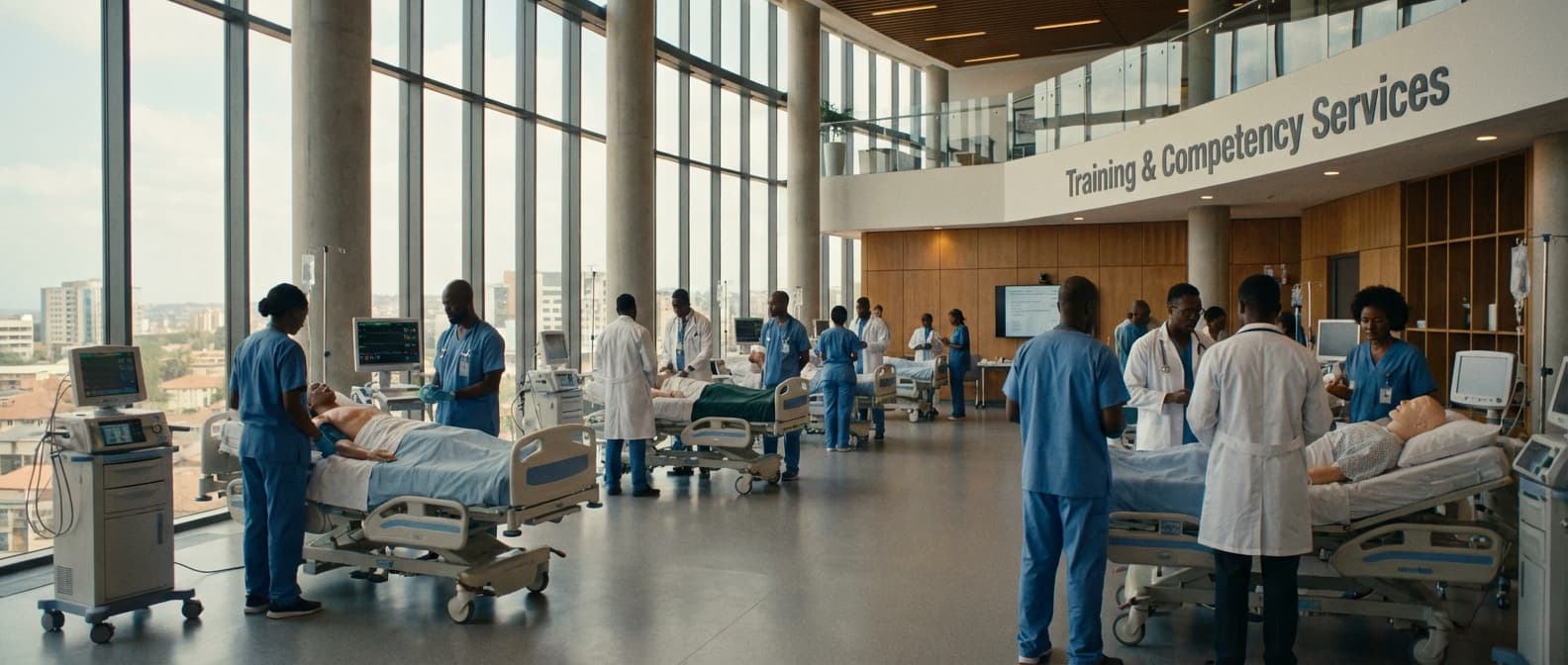
Biomedical Engineering First-Line Support Training Service in Ghana
Engineering Excellence & Technical Support
Biomedical Engineering First-Line Support Training Service High-standard technical execution following OEM protocols and local regulatory frameworks.
Localized Biomedical Equipment Diagnostics
Mastering the identification and troubleshooting of common medical devices prevalent in Ghanaian healthcare settings, including portable X-ray units, ultrasound machines, and laboratory centrifuges, ensuring rapid and effective first-line repairs.
Essential Preventative Maintenance Protocols
Developing proficiency in executing standardized preventative maintenance schedules for critical medical equipment, focusing on timely calibration, cleaning, and component checks to minimize downtime and extend equipment lifespan within resource-constrained environments.
Clinical Workflow Integration & User Support
Gaining expertise in understanding the clinical applications of medical devices and providing effective user training and technical support to healthcare professionals, ensuring seamless integration of equipment into patient care workflows and empowering end-users to operate devices safely and efficiently.
What Is Biomedical Engineering First-line Support Training Service In Ghana?
Biomedical Engineering First-Line Support Training Service in Ghana refers to a structured educational program designed to equip individuals with the foundational knowledge and practical skills necessary to perform initial troubleshooting, maintenance, and basic repair of biomedical equipment within healthcare facilities. This service is crucial for ensuring the operational readiness and safety of medical devices, thereby directly impacting patient care quality. The training focuses on common issues, preventative maintenance protocols, and the ability to accurately diagnose and escalate complex problems to specialized biomedical engineers or external service providers. It emphasizes adherence to safety standards and proper documentation procedures.
| Who Needs This Service? | Typical Use Cases | |||||||
|---|---|---|---|---|---|---|---|---|
| Healthcare Facility Technicians (e.g., hospital maintenance staff, ward assistants with technical aptitude) | Routine inspection and cleaning of medical equipment. | Responding to immediate equipment alarms or minor malfunctions. | Performing basic battery replacements or filter changes. | Verifying equipment functionality after routine maintenance. | Documenting equipment status and service interventions. | Escalating complex issues to senior biomedical engineers. | Assisting senior engineers with diagnostics and repairs. | Performing initial checks on newly installed or relocated equipment. |
| Biomedical Engineering Students and Graduates | Entry-level preparation for roles in healthcare technology management. | Gaining practical experience in a supervised environment. | Familiarization with the operational realities of medical devices in a Ghanaian hospital setting. | Developing confidence in handling common equipment issues. | ||||
| Clinical Staff with Technical Responsibilities | Empowering nurses and other clinical personnel to perform basic troubleshooting to minimize patient care disruption. | Performing simple user-level maintenance (e.g., cleaning, ensuring proper connections). | ||||||
| Biomedical Equipment Manufacturers/Distributors (as trainers or for their service personnel) | Ensuring their local service partners are adequately trained for first-line support. | Providing standardized training to their own field service technicians in Ghana. |
Key Components of Biomedical Engineering First-Line Support Training in Ghana:
- Fundamentals of Biomedical Equipment Operation and Principles
- Basic Troubleshooting Methodologies for Common Malfunctions
- Preventative Maintenance Techniques and Schedules
- Safe Handling and Operation of Medical Devices
- Introduction to Diagnostic Tools and Testing Equipment
- Understanding of Biomedical Equipment Standards and Regulations (Ghanaian context)
- Documentation and Reporting Procedures for Service Calls
- Basic Repair and Calibration of Specific Equipment Categories (e.g., vital signs monitors, infusion pumps)
- Emergency Response Protocols for Equipment Failures
Who Needs Biomedical Engineering First-line Support Training Service In Ghana?
Biomedical Engineering First-Line Support Training Service in Ghana is crucial for ensuring the efficient and safe operation of medical equipment within healthcare facilities. This training equips individuals with the foundational knowledge and practical skills to perform basic troubleshooting, preventative maintenance, and routine checks on medical devices. This not only minimizes downtime and reduces the burden on specialized biomedical engineers but also enhances patient care by ensuring equipment reliability.
| Target Customer/Department | Key Roles/Individuals Benefiting | Specific Needs Addressed |
|---|---|---|
| Hospitals (Public & Private) | Clinical Officers, Nurses, Biomedical Engineering Technicians (junior level), Maintenance Staff, Ward Managers | Basic troubleshooting of common equipment failures (e.g., ECG machines, patient monitors, infusion pumps), routine checks and calibrations, identifying major faults requiring senior engineer intervention, preventative maintenance tasks. |
| Clinics & Health Centers | Clinical Officers, Nurses, Health Assistants, Facility Managers | Ensuring functionality of essential equipment, basic disinfection and cleaning protocols, simple troubleshooting of critical devices, awareness of equipment limitations and safety checks. |
| Diagnostic Laboratories | Laboratory Technicians, Lab Assistants, Lab Managers | Maintaining the operational readiness of diagnostic equipment (e.g., centrifuges, microscopes, basic analyzers), performing user-level maintenance, identifying issues requiring specialized calibration or repair. |
| Ministry of Health / Ghana Health Service | Regional Biomedical Engineering Officers, District Health Managers, Procurement Officers | Standardizing first-line support capabilities across facilities, improving equipment uptime in public health sector, cost-effective equipment management, informed decision-making for equipment maintenance budgets. |
| NGOs | Project Managers, Healthcare Coordinators, Local Staff at project sites | Empowering local personnel to manage and maintain donated or procured medical equipment, ensuring sustainability of healthcare projects, remote troubleshooting support. |
| Medical Equipment Suppliers/Distributors | Field Service Technicians (entry-level), Customer Support Staff | Upskilling staff for initial customer support, enabling them to resolve minor issues remotely or on-site, improving customer satisfaction, reducing call-outs for simple problems. |
| Educational Institutions | Lecturers in Biomedical Engineering/Technology, Students (undergraduate and diploma) | Providing practical, hands-on training relevant to the Ghanaian context, preparing graduates for entry-level roles in healthcare facilities, enhancing curriculum with real-world application. |
Target Customers and Departments for Biomedical Engineering First-Line Support Training Service in Ghana:
- Healthcare Facilities: Hospitals (public and private), clinics, health centers, diagnostic laboratories.
- Government Health Agencies: Ministry of Health, regional health directorates, Ghana Health Service.
- Non-Governmental Organizations (NGOs): Organizations involved in healthcare delivery and medical equipment provision.
- Medical Equipment Suppliers and Distributors: Companies that sell and maintain medical devices in Ghana.
- Educational Institutions: Universities and technical colleges offering biomedical engineering or related programs.
Biomedical Engineering First-line Support Training Service Process In Ghana
This document outlines the typical workflow for a Biomedical Engineering First-Line Support Training Service in Ghana, covering the process from initial inquiry to the successful execution of the training. The service aims to equip healthcare professionals and technicians with essential skills to manage and maintain biomedical equipment, thereby enhancing healthcare delivery and reducing equipment downtime.
| Phase | Key Activities | Responsible Parties | Deliverables/Outcomes |
|---|---|---|---|
| Client (e.g., hospital, clinic, Ministry of Health) expresses interest in first-line support training. Service provider initiates contact to understand specific training needs, target audience (e.g., nurses, technicians, biomedical engineers), types of equipment involved, and desired skill levels. | Client, Service Provider (Sales/Consulting Team) | Initial understanding of training requirements, identified gaps in technical skills. |
| Service provider develops a detailed training proposal outlining course content, duration, methodology, trainer qualifications, proposed dates, location, and cost. Proposal is submitted to the client for review. Negotiations may occur regarding scope, budget, and timeline. | Service Provider (Training Department, Sales Team), Client | Comprehensive training proposal, agreement on key training parameters. |
| Upon agreement on the proposal, a formal contract or Memorandum of Understanding (MoU) is signed between the service provider and the client. This document details the scope of work, payment terms, intellectual property, confidentiality, and dispute resolution. | Service Provider (Legal Department, Management), Client (Procurement, Legal Department) | Signed contract/MoU, formal commitment to the training service. |
| Based on the agreed needs assessment and proposal, the training curriculum is finalized. This may involve customizing modules to specific equipment prevalent in the client's facility and adapting the language and examples to the Ghanaian context. Practical exercises and simulations are designed. | Service Provider (Training Department, Subject Matter Experts) | Detailed training curriculum, course materials (manuals, presentations, practical guides). |
| The service provider coordinates all logistical aspects, including booking training venues (if external), arranging for necessary equipment for practical sessions (either provided by the client or the service provider), scheduling trainers, and confirming participant lists with the client. Travel and accommodation arrangements for trainers are made. | Service Provider (Operations/Logistics Team), Client (Facility Management, HR) | Confirmed training schedule, secured training venue and equipment, finalized participant list. |
| The service provider communicates final training details, including date, time, location, pre-requisites (if any), and a brief overview of the agenda to the confirmed participants and their supervisors. This ensures participants are well-informed and prepared. | Service Provider (Training Coordinator), Client (HR, Department Heads) | Informed participants, reduced no-shows, readiness for training. |
| The training is conducted by qualified biomedical engineering trainers. The session typically includes theoretical lectures, demonstrations, hands-on practical exercises, troubleshooting scenarios, and Q&A sessions. Emphasis is placed on safety protocols and proper documentation. | Service Provider (Trainers), Participants | Knowledge transfer, skill development, practical competency in first-line biomedical equipment support. |
| Following the formal training, the service provider may offer a period of follow-up support. This could include access to a technical helpline, online resources, or occasional remote assistance for participants encountering specific challenges in their day-to-day work. | Service Provider (Technical Support Team, Trainers) | Continued learning, problem resolution, reinforcement of skills. |
| Participant understanding and satisfaction are assessed through post-training tests, practical assessments, and feedback forms. The service provider also gathers feedback from client management on the overall effectiveness of the training program. | Service Provider (Training Department), Participants, Client Management | Assessment of learning outcomes, identification of areas for improvement in future training. |
| A comprehensive training report is prepared, summarizing the training conducted, participant attendance, assessment results, and feedback received. Certificates of completion are issued to participants who successfully meet the training objectives. Invoices for services rendered are submitted. | Service Provider (Training Department, Finance Department), Client | Training completion reports, certificates for participants, final payment. |
Biomedical Engineering First-Line Support Training Service Process
- Inquiry & Needs Assessment
- Proposal Development & Negotiation
- Contracting & Agreement
- Training Design & Customization
- Logistics & Scheduling
- Pre-Training Communication
- Training Delivery
- Post-Training Support
- Evaluation & Feedback
- Reporting & Certification
Biomedical Engineering First-line Support Training Service Cost In Ghana
Biomedical Engineering First-Line Support Training services in Ghana are crucial for ensuring the proper functioning and maintenance of medical equipment, thereby contributing to effective healthcare delivery. The cost of these training services is influenced by several key factors, leading to a range of pricing in the local currency (Ghanaian Cedi - GHS). Understanding these factors is vital for healthcare institutions and individuals seeking to invest in such training.
The primary pricing determinants include the scope and depth of the training program, the qualifications and experience of the trainers, the duration of the training, the location and facilities provided, and the specific type and complexity of the biomedical equipment covered. For instance, a comprehensive program covering a wide array of diagnostic and therapeutic devices will naturally command a higher price than a specialized course focused on a single piece of equipment. Similarly, training delivered by highly accredited and experienced biomedical engineers with international certifications will be more expensive than that offered by less experienced local professionals. The mode of delivery (on-site at the client's facility versus at a training center) and any included hands-on practical sessions with actual equipment also play a significant role in cost determination. Government-accredited or internationally recognized certifications often add to the premium.
| Training Service Type | Typical Duration | Estimated Cost Range (GHS) | Key Inclusions |
|---|---|---|---|
| Basic First-Line Support (Common Equipment) | 2-3 Days | GHS 1,500 - GHS 3,500 | Introduction to common medical devices, basic troubleshooting, preventive maintenance, safety procedures. |
| Intermediate First-Line Support (Specialized Equipment) | 3-5 Days | GHS 3,000 - GHS 7,000 | In-depth training on specific equipment categories (e.g., imaging, life support), advanced troubleshooting, minor repairs, calibration basics. |
| Advanced First-Line Support & Basic Repair (Complex Devices) | 5-7 Days | GHS 5,000 - GHS 12,000+ | Comprehensive coverage of complex equipment, component-level diagnostics, basic repair techniques, regulatory compliance, hands-on practice with advanced simulators or actual equipment. |
| Customized/On-site Training | Variable (per agreement) | GHS 2,000 - GHS 15,000+ (depending on scope & duration) | Tailored curriculum to specific institutional needs, on-site delivery, often includes equipment-specific modules. Pricing is highly project-based. |
| Refresher/Update Courses | 1-2 Days | GHS 800 - GHS 2,000 | Updates on new technologies, re-certification, reinforcement of core skills. |
Key Pricing Factors for Biomedical Engineering First-Line Support Training in Ghana
- Scope and Depth of the Training Program
- Qualifications and Experience of Trainers
- Duration of the Training
- Location and Facilities Provided
- Type and Complexity of Biomedical Equipment Covered
- Mode of Delivery (On-site vs. Training Center)
- Inclusion of Practical/Hands-on Sessions
- Certification (Local Accreditation vs. International Recognition)
Affordable Biomedical Engineering First-line Support Training Service Options
This document outlines affordable first-line biomedical engineering support training service options, focusing on value bundles and cost-saving strategies. Effective first-line support is crucial for ensuring medical equipment reliability, patient safety, and operational efficiency. Investing in well-trained technicians minimizes downtime, reduces the need for costly external repairs, and optimizes device performance.
| Training Service Option | Typical Components | Cost-Saving Strategy Integration | Estimated Cost Range (per technician, annual) |
|---|---|---|---|
| Basic Skill Development Package | Core principles of biomedical device operation, basic troubleshooting (e.g., power issues, connectivity), safety protocols, preventative maintenance fundamentals. | Focuses on common issues, reducing reliance on higher-tier support for minor problems. Empowers staff to perform routine checks, extending equipment lifespan. | $300 - $800 |
| Intermediate Troubleshooting & Repair Bundle | Advanced troubleshooting techniques, component-level diagnostics, common repair procedures for specific device categories (e.g., patient monitoring, basic lab equipment). | Enables in-house resolution of a broader range of issues, significantly cutting down on external service call fees and downtime. Offers modular training for specific equipment needs. | $700 - $1500 |
| Comprehensive Support & Specialization Track | In-depth training on complex devices, advanced diagnostics, software troubleshooting, specialized repair techniques, and basic calibration. May include simulation labs. | Maximizes in-house repair capabilities for a wider array of equipment, minimizing the need for manufacturer-specific service contracts. Specialized tracks allow for targeted skill development, improving efficiency with critical devices. | $1200 - $2500+ |
| On-Demand Online Learning Platform Access | Access to a vast library of self-paced modules, video tutorials, interactive simulations, and knowledge bases covering a wide spectrum of biomedical devices and technical topics. | Scalable and cost-effective for training large teams or providing continuous learning. Reduces travel and trainer costs. Allows technicians to learn at their own pace and focus on areas needing improvement. | $100 - $500 (subscription-based) |
| Train-the-Trainer Programs | Develops internal subject matter experts who can then train and mentor junior technicians, creating a sustainable in-house training ecosystem. | Leverages internal resources to reduce ongoing training costs. Fosters knowledge sharing and institutional learning. Creates a cascading effect of skill development. | Variable, depending on program depth and duration (often bundled with other services) |
Key Value-Added Components of Training Services
- Hands-on practical training: Essential for skill development and confidence-building.
- Remote support and troubleshooting modules: Equips technicians to resolve common issues without immediate on-site presence.
- Simulation-based learning: Provides a safe environment to practice complex procedures and emergency responses.
- Access to online resource libraries: Includes technical manuals, troubleshooting guides, and software updates.
- Certification programs: Validates acquired skills and enhances technician credibility.
- Post-training follow-up and refresher courses: Ensures knowledge retention and adaptation to new technologies.
- Customizable training pathways: Tailored to specific equipment types, skill levels, and organizational needs.
Verified Providers In Ghana
In Ghana's evolving healthcare landscape, access to verified and trustworthy providers is paramount. Franance Health stands out as a leader in this regard, offering a platform dedicated to connecting individuals with reputable healthcare professionals and facilities. Their rigorous credentialing process ensures that every provider listed on their platform meets stringent quality and ethical standards. This commitment to verification offers peace of mind to patients, assuring them of safe, effective, and patient-centered care. By prioritizing transparency and quality assurance, Franance Health not only simplifies the process of finding healthcare but also elevates the overall standard of healthcare delivery in Ghana, making them the best choice for your health needs.
| Provider Type | Key Verification Criteria | Benefits for Patients |
|---|---|---|
| Doctors | Medical Council Registration, Specialization Accreditation, Clean Disciplinary Record | Access to qualified specialists, accurate diagnosis, effective treatment plans |
| Hospitals & Clinics | Licensing by the Ministry of Health, Compliance with Health Standards, Qualified Medical Staff | Safe and well-equipped facilities, comprehensive medical services, professional care |
| Laboratories | Accreditation by relevant bodies, Use of certified equipment, Trained Technicians | Accurate and reliable diagnostic tests, timely results |
| Pharmacies | Pharmacy Council Registration, Verified Drug Supply Chain, Licensed Pharmacists | Access to authentic medications, expert advice on drug usage and safety |
Why Franance Health Providers are the Best Choice:
- Rigorous Verification Process: Franance Health meticulously vets all healthcare professionals and facilities.
- Commitment to Quality: Providers adhere to high standards of medical practice and patient care.
- Transparency and Trust: Patients can be confident in the credentials and legitimacy of listed providers.
- Enhanced Patient Safety: Reduced risk of encountering unqualified or unethical practitioners.
- Streamlined Access to Care: Easy and reliable way to find trusted healthcare services.
- Focus on Patient Well-being: Providers are dedicated to delivering comprehensive and compassionate care.
- Contribution to Healthcare Standards: Franance Health actively works to improve the overall quality of healthcare in Ghana.
Scope Of Work For Biomedical Engineering First-line Support Training Service
This Scope of Work (SOW) outlines the requirements for a Biomedical Engineering First-Line Support Training Service. The objective is to equip designated personnel with the foundational knowledge and practical skills necessary to effectively perform first-line support for biomedical equipment, ensuring timely and accurate initial troubleshooting, basic maintenance, and escalation procedures. This training will enhance equipment uptime, patient safety, and operational efficiency within the healthcare facility. The service includes both theoretical instruction and hands-on practical sessions, delivered by qualified trainers with extensive experience in biomedical engineering and clinical support.
| Technical Deliverable | Standard Specification | Description | Acceptance Criteria |
|---|---|---|---|
| Training Curriculum | Comprehensive and modular, covering all listed modules. | Detailed breakdown of learning objectives, content, and duration for each module, tailored to the facility's equipment inventory. | Curriculum reviewed and approved by the client's Biomedical Engineering Department head. |
| Training Materials (Participant) | High-quality, user-friendly, and accessible digital or printed format. | Includes presentations, handouts, case studies, checklists, and practical exercise guides. | Materials are clear, concise, accurate, and relevant to the training objectives. Availability of all materials prior to training commencement. |
| Training Materials (Trainer) | Comprehensive trainer's guide and presentation slides. | Includes detailed lesson plans, facilitator notes, assessment tools, and demonstration guides. | Materials are well-structured and enable consistent delivery of training by authorized trainers. |
| Hands-on Training Equipment | Functional and representative medical equipment for practical sessions. | A selection of common biomedical devices relevant to the facility's first-line support needs, in good working order. | Equipment is readily available, calibrated (where applicable), and safe for use during training. Availability of sufficient quantity for hands-on practice. |
| Qualified Trainers | Certified and experienced biomedical engineers or technicians. | Trainers must possess a minimum of X years of experience in biomedical equipment support and a proven track record in training delivery. | Trainer qualifications (CVs, certifications) submitted and approved by the client. Positive feedback from previous training engagements (if available). |
| Post-Training Assessment | Written and practical assessments. | Includes multiple-choice questions, scenario-based problem-solving, and practical demonstration of skills. | Assessments accurately measure the achievement of learning objectives. Passing score of Y% for both written and practical components. |
| Certificate of Completion | Standardized certificate for each participant. | Issued upon successful completion of the training and assessment. | Certificates include participant name, training title, date, and issuing organization's accreditation (if applicable). |
| Training Environment | Adequate classroom and practical training space. | Includes seating for participants, projection equipment, whiteboards/flip charts, and a dedicated area for hands-on equipment practice. | Space is clean, well-lit, temperature-controlled, and free from distractions. Access to power outlets and necessary network connectivity. |
| Reporting and Feedback Mechanism | Formal training report and participant feedback forms. | Report includes attendance, assessment results, and overall training evaluation. Feedback forms gather participant perspectives on content, delivery, and trainers. | Training report submitted within Z business days of training completion. Feedback forms analyzed and summarized for continuous improvement. |
Key Training Modules and Objectives
- {"title":"Module 1: Introduction to Biomedical Equipment Management","objectives":["Define the scope and importance of biomedical equipment management.","Identify key regulatory bodies and standards applicable to medical devices.","Recognize the principles of patient safety related to medical equipment."],"description":"Understanding the role of biomedical engineering in healthcare, regulatory compliance, and safety standards."}
- {"title":"Module 2: Fundamentals of Biomedical Equipment Operation","objectives":["Explain the basic operational principles of selected common medical devices (e.g., infusion pumps, vital signs monitors, ECG machines).","Identify common electrical hazards and safety precautions.","Recognize basic troubleshooting steps for common equipment malfunctions."],"description":"Basic principles of operation for common biomedical devices, including electrical safety and common failure modes."}
- {"title":"Module 3: First-Line Troubleshooting Techniques","objectives":["Apply systematic troubleshooting methodologies.","Utilize diagnostic tools and software effectively.","Document troubleshooting steps and outcomes accurately."],"description":"Systematic approaches to identifying and resolving common issues before escalation."}
- {"title":"Module 4: Preventative Maintenance (Basic)","objectives":["Perform visual inspections and functional checks.","Execute basic cleaning and disinfection procedures.","Understand the importance of preventative maintenance schedules."],"description":"Understanding and performing routine checks and basic preventative maintenance tasks."}
- {"title":"Module 5: Documentation and Reporting","objectives":["Complete service reports accurately and comprehensively.","Understand and follow incident reporting procedures.","Communicate effectively with end-users and senior biomedical staff."],"description":"Properly documenting service activities, incident reporting, and communication protocols."}
- {"title":"Module 6: Escalation Procedures","objectives":["Identify situations requiring escalation.","Follow established escalation pathways and protocols.","Provide necessary information for effective handover to senior technicians."],"description":"Knowing when and how to escalate complex issues to specialized biomedical engineering teams."}
Service Level Agreement For Biomedical Engineering First-line Support Training Service
This Service Level Agreement (SLA) outlines the performance expectations and guarantees for the Biomedical Engineering First-Line Support Training Service. It defines the responsibilities of both the service provider and the client regarding response times, issue resolution, and service uptime.
| Service Level | Definition | Response Time Guarantee | Resolution Time Target |
|---|---|---|---|
| Critical Incident | An issue that completely prevents the delivery or utilization of the training service, impacting all users or a significant portion thereof. Examples include complete system outage, inability to access the training platform. | Within 1 Business Hour | Within 4 Business Hours |
| High Priority Incident | An issue that significantly degrades the training experience or functionality, affecting a substantial number of users or critical training modules. Examples include major feature malfunction, performance degradation impacting live sessions. | Within 2 Business Hours | Within 8 Business Hours |
| Medium Priority Incident | An issue that affects a limited number of users or non-critical functionalities, causing inconvenience but not preventing core training activities. Examples include minor bug in a non-essential module, difficulty accessing specific resources. | Within 4 Business Hours | Within 2 Business Days |
| Low Priority Incident/Inquiry | General questions, feature requests, or minor cosmetic issues that do not impede the training process. Examples include clarification on content, suggestions for improvement. | Within 1 Business Day | As resources permit, within 5 Business Days |
| Uptime Guarantee | The percentage of time the training platform and its core functionalities are available and operational. | 99.5% Monthly Uptime | N/A |
Key Service Components
- Training Program Delivery
- Technical Support for Training Environment
- Knowledge Base Access
- Performance Monitoring and Reporting
Frequently Asked Questions

Ready when you are
Let's scope your Biomedical Engineering First-Line Support Training Service in Ghana project in Ghana.

Scaling healthcare logistics and technical systems across the entire continent.