
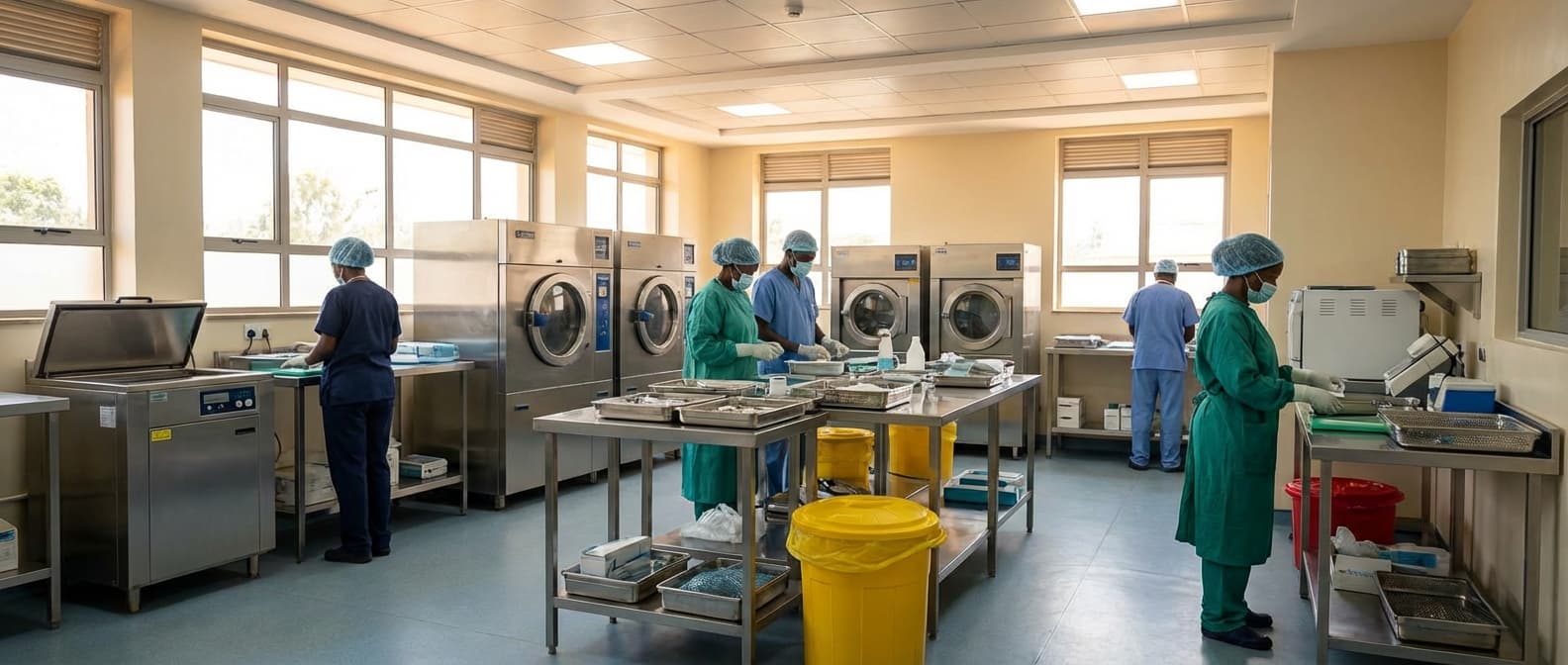
Endoscope Reprocessing Equipment Support Service in Ghana
Engineering Excellence & Technical Support
Endoscope Reprocessing Equipment Support Service High-standard technical execution following OEM protocols and local regulatory frameworks.
Rapid Response & Uptime Guarantee
We offer 24/7 emergency technical support and guaranteed rapid response times for endoscope reprocessing equipment across Ghana. Our proactive maintenance strategies and readily available spare parts minimize downtime, ensuring your vital sterilization processes remain operational and patient safety is never compromised.
Expert Diagnostics & Remote Assistance
Leveraging advanced diagnostic tools and remote monitoring capabilities, our certified technicians can swiftly identify and resolve equipment issues. This allows for efficient troubleshooting and problem-solving, often before on-site intervention is required, saving valuable time and resources for healthcare facilities in Ghana.
Compliance & Training Excellence
Our comprehensive support services include ensuring your endoscope reprocessing equipment meets all relevant Ghanaian and international regulatory standards. We provide hands-on training for your biomedical and CSSD staff on proper equipment operation, maintenance, and validation, empowering your team for optimal performance and adherence to best practices.
What Is Endoscope Reprocessing Equipment Support Service In Ghana?
Endoscope reprocessing equipment support service in Ghana refers to the provision of specialized technical assistance, maintenance, repair, and calibration for the automated and semi-automated equipment used in the cleaning, disinfection, and sterilization of flexible and rigid endoscopes. This service is crucial for ensuring the safety and efficacy of endoscopic procedures by maintaining the functional integrity and microbiological safety of the endoscopes, thereby preventing healthcare-associated infections (HAIs). It encompasses a range of activities designed to optimize the performance and longevity of reprocessing systems.
| Service Recipient | Need for Service | Typical Use Cases |
|---|---|---|
| Hospitals (Public and Private): | Hospitals performing endoscopic procedures are primary recipients. The volume and complexity of reprocessing requirements necessitate reliable equipment. | Maintenance of automated endoscope reprocessors (AERs), washer-disinfectors, drying cabinets, and leak testing equipment. Ensuring compliance with national and international infection control guidelines. |
| Specialized Clinics (e.g., Gastroenterology, Urology, Pulmonology, ENT): | Clinics with dedicated endoscopy suites require consistent uptime and performance of their reprocessing equipment to offer uninterrupted patient care. | Ensuring the operational readiness of reprocessing units for flexible sigmoidoscopes, gastroscopes, colonoscopes, bronchoscopes, and cystoscopes. |
| Diagnostic and Imaging Centers: | Facilities offering diagnostic endoscopic services need to maintain the highest standards of patient safety and equipment functionality. | Support for the reprocessing workflow in centers performing diagnostic procedures such as upper endoscopy, lower endoscopy, and bronchoscopy. |
| Medical Equipment Suppliers and Distributors: | Companies that sell and distribute endoscope reprocessing equipment often partner with support service providers to offer comprehensive after-sales service to their clients. | Providing warranty and post-warranty technical support, installation, and commissioning of new reprocessing systems. |
| Healthcare Facilities Undergoing Renovation or Expansion: | When upgrading or expanding endoscopy units, facilities may require support for the installation, commissioning, and initial validation of new reprocessing equipment. | Integration of new reprocessing technology into existing healthcare infrastructure, ensuring seamless operation. |
Key Components of Endoscope Reprocessing Equipment Support Service
- Preventive Maintenance: Scheduled inspections, cleaning, lubrication, and replacement of wear-and-tear components (e.g., seals, filters, pumps) to minimize downtime and prevent equipment failure.
- Corrective Maintenance/Repair: Troubleshooting and resolving equipment malfunctions, including electrical, mechanical, and software issues. This involves diagnosis, part replacement, and functional testing.
- Calibration and Performance Verification: Regular calibration of critical parameters such as water temperature, chemical concentration, flow rates, and cycle times to ensure compliance with manufacturer specifications and regulatory standards (e.g., AAMI ST58, ISO 15883).
- Validation Services: Assistance with the validation of reprocessing cycles to confirm that the equipment consistently achieves the required level of decontamination and disinfection/sterilization.
- Technical Training and Consultation: Providing training to biomedical technicians and nursing staff on the proper operation, troubleshooting, and routine maintenance of the equipment.
- Parts and Consumables Management: Ensuring the availability and timely delivery of genuine spare parts, consumables (e.g., filters, detergents, disinfectants), and accessories.
- Documentation and Reporting: Maintaining detailed records of all maintenance, repair, calibration, and validation activities for compliance and audit purposes.
Who Needs Endoscope Reprocessing Equipment Support Service In Ghana?
Endoscope reprocessing equipment support services are crucial for any healthcare facility in Ghana that utilizes endoscopes for diagnostic and therapeutic procedures. Proper and efficient reprocessing of these delicate instruments is paramount to patient safety, infection control, and the longevity of expensive equipment. This service ensures that equipment functions optimally, minimizes downtime, and adheres to stringent sterilization protocols.
| Customer Type | Key Departments/Users | Specific Needs |
|---|---|---|
| Public Hospitals | Gastroenterology, Pulmonology, Urology, Gynecology, Surgery, Infection Control | Routine maintenance, repair of automated reprocessors and washer-disinfectors, validation and performance testing, staff training, spare parts procurement. |
| Private Hospitals | Gastroenterology, Pulmonology, Urology, Gynecology, Surgery, Endoscopy Units, Infection Control | Preventive maintenance contracts, rapid response repair for critical equipment, upgrades, calibration, compliance support for international standards. |
| Specialty Clinics | Endoscopy Suites, Procedure Rooms | Installation and setup of new reprocessing equipment, troubleshooting minor issues, regular servicing to ensure consistent performance, consumables supply. |
| Diagnostic Centers | Endoscopy Units | Support for automated cleaning and disinfection units, validation of cleaning cycles, maintenance of drying and storage cabinets. |
| Surgical Centers | Endoscopy Departments | Emergency repair services to avoid procedure cancellations, maintenance of a fleet of reprocessing machines, scheduled servicing to prevent breakdowns. |
Target Customers and Departments in Ghana Requiring Endoscope Reprocessing Equipment Support Service
- Hospitals (Public and Private)
- Specialty Clinics (e.g., Gastroenterology, Pulmonology, Urology, Gynecology)
- Diagnostic Centers
- Surgical Centers
Endoscope Reprocessing Equipment Support Service Process In Ghana
This document outlines the Endoscope Reprocessing Equipment Support Service Process in Ghana, detailing the workflow from the initial customer inquiry to the successful execution of the service. This process ensures efficient and effective maintenance and repair of critical endoscope reprocessing equipment, contributing to patient safety and healthcare facility functionality.
| Stage | Key Activities | Responsible Party | Key Deliverables/Outcomes |
|---|---|---|---|
| Inquiry & Initial Contact | Receive customer request, gather basic information (equipment, issue, contact). | Customer, Support Provider Front Desk/Call Center | Logged inquiry, initial understanding of need. |
| Service Request & Scheduling | Generate formal service request, check technician availability, send quotation, obtain approval. | Support Provider Service Coordinator, Customer | Approved service request, scheduled appointment, agreed quotation. |
| Pre-Service Preparation | Procure/allocate parts, brief technician, arrange travel, review safety. | Support Provider Logistics, Service Technician | Prepared technician with necessary resources, confirmed travel arrangements. |
| On-Site Service Execution | Diagnose, repair/maintain equipment, replace parts, test, calibrate, train staff. | Service Technician, Customer (for access and verification) | Repaired/maintained equipment, validated performance, trained staff. |
| Post-Service Verification & Documentation | Customer sign-off, generate service report, issue invoice. | Service Technician, Customer Representative, Support Provider Administration | Signed service report, final invoice, completed service record. |
| Follow-up & Feedback | Contact customer for satisfaction check, collect feedback, update records. | Support Provider Customer Service, Service Coordinator | Customer satisfaction confirmed, service improvement insights, updated service history. |
Endoscope Reprocessing Equipment Support Service Process in Ghana
- 1. Inquiry & Initial Contact:
- Customer (e.g., hospital, clinic) identifies a need for support.
- Inquiry received via phone, email, or online portal.
- Contact details, equipment make/model, and nature of the issue are recorded.
- Initial assessment to determine urgency and type of support required (e.g., preventive maintenance, repair, installation, training).
- 2. Service Request & Scheduling:
- A formal service request is generated, including all collected information.
- Service technician availability is checked.
- Customer is provided with an estimated service window or appointment date.
- Quotation for service costs (parts, labor, travel) is prepared and sent for approval.
- 3. Pre-Service Preparation:
- Upon quotation approval, necessary parts and tools are identified and procured/allocated.
- Service technician is briefed on the specific equipment and reported issue.
- Travel arrangements are made to the customer's location in Ghana.
- Safety protocols for on-site work are reviewed.
- 4. On-Site Service Execution:
- Technician arrives at the facility at the scheduled time.
- Equipment is assessed and diagnosed thoroughly.
- Necessary repairs or maintenance are performed as per manufacturer guidelines and best practices.
- If parts are required, they are replaced efficiently.
- Performance testing and calibration are conducted to ensure optimal functionality.
- Any training required for the facility's staff on equipment operation or basic troubleshooting is provided.
- 5. Post-Service Verification & Documentation:
- Customer representative verifies the completed service and satisfactory performance of the equipment.
- Service report is generated, detailing work performed, parts used, time taken, and any recommendations.
- Service report is signed by both technician and customer representative.
- Invoices are generated based on the approved quotation and service report.
- 6. Follow-up & Feedback:
- Follow-up contact with the customer after a specified period to ensure continued satisfaction and address any lingering concerns.
- Feedback is collected to identify areas for service improvement.
- Service records are maintained for future reference and warranty tracking.
Endoscope Reprocessing Equipment Support Service Cost In Ghana
Ensuring the proper reprocessing of endoscopes is paramount for patient safety and preventing healthcare-associated infections. In Ghana, the cost of support services for endoscope reprocessing equipment can vary significantly based on several key pricing factors. These services typically encompass maintenance (preventive and corrective), repairs, spare parts, calibration, and sometimes training on equipment operation and maintenance. The demand for these services, the complexity of the equipment, and the availability of qualified technicians all play a role in determining the overall cost. Understanding these factors is crucial for healthcare facilities in Ghana to budget effectively and ensure their reprocessing equipment remains in optimal working condition.
| Service Component | Estimated Cost Range (GHS) | Notes |
|---|---|---|
| Annual Preventive Maintenance Contract (for a standard AER) | 8,000 - 25,000+ | Covers scheduled checks, cleaning, and basic calibrations. Varies by machine model and provider. |
| Corrective Maintenance (Hourly Labor Rate) | 200 - 600+ | Charged for on-site technician time for repairs. May be higher for specialized technicians. |
| Cost of Common Spare Parts (e.g., filters, seals, pumps) | 500 - 5,000+ | Highly variable depending on the specific part and equipment model. Genuine parts are often more expensive. |
| Emergency Call-Out Fee | 500 - 2,000+ | An additional charge for urgent service outside of standard working hours or for rapid response. |
| Equipment Calibration (per instance) | 1,000 - 3,000+ | Ensures accuracy of disinfection cycles. May be included in comprehensive contracts. |
| On-site Technician Training (per day) | 1,500 - 4,000+ | For staff on operation, basic troubleshooting, and maintenance. Excludes travel and accommodation. |
| Logistics and Transportation (for parts/technicians) | Variable | Adds to the cost, especially for remote locations or imported parts. |
Key Pricing Factors for Endoscope Reprocessing Equipment Support Service in Ghana:
- Type and Brand of Equipment: High-end, technologically advanced, or specialized endoscope reprocessing machines (e.g., automated endoscope reprocessors - AERs) generally incur higher support costs due to their complexity and proprietary nature. Support for well-established brands might be more readily available but could still be premium-priced.
- Scope of Service Agreement: A comprehensive service contract covering preventive maintenance, unlimited corrective maintenance, spare parts, and emergency call-outs will be more expensive than a basic maintenance plan. Annual contracts are common.
- Frequency and Type of Maintenance: Scheduled preventive maintenance visits are typically billed per visit or as part of a contract. Corrective maintenance, involving repairs due to equipment failure, is usually charged on an hourly basis for labor plus the cost of any replaced parts.
- Availability of Local Technicians and Expertise: If specialized technicians need to be flown in from outside Ghana, or if the equipment requires manufacturer-specific training, this will significantly increase costs due to travel, accommodation, and per diem expenses. The availability of skilled local technicians can lead to more competitive pricing.
- Spare Parts Costs: The cost of genuine and readily available spare parts for specific endoscope reprocessing equipment is a major component of service costs. Import duties and taxes on imported spare parts can also contribute to higher prices.
- Age and Condition of Equipment: Older or poorly maintained equipment may require more frequent and extensive repairs, leading to higher overall support costs. Extended warranties for newer equipment will also factor into the initial purchase price.
- Service Provider Reputation and Experience: Established service providers with a proven track record and strong customer support might command higher prices, reflecting their reliability and expertise.
- Geographic Location of the Service Call: While less of a factor for major urban centers, if a service call is required in a remote or less accessible area of Ghana, transportation costs for technicians and parts could increase the overall service fee.
Affordable Endoscope Reprocessing Equipment Support Service Options
Providing reliable and cost-effective support for endoscope reprocessing equipment is crucial for healthcare facilities. This service aims to ensure the longevity and optimal performance of your reprocessing systems, thereby safeguarding patient safety and minimizing operational disruptions. Understanding various service options and strategic approaches to cost savings can significantly benefit your budget and workflow.
| Value Bundle | Included Services | Key Benefits | Cost-Saving Strategies |
|---|---|---|---|
| Basic Support | Annual Preventive Maintenance (1-2 visits), Priority On-Demand Repair | Ensures basic functionality, reduces unexpected downtime | Bundled pricing for maintenance, negotiated repair rates |
| Comprehensive Care | Quarterly Preventive Maintenance, On-Demand Repair (24/7 availability), Remote Diagnostics, Priority Parts Access | Maximizes uptime, extends equipment lifespan, proactive issue resolution | Reduced emergency repair costs, optimized part inventory, potential for remote issue resolution |
| Total Performance Package | Bi-monthly Preventive Maintenance, Unlimited On-Demand Repair, Remote Monitoring & Diagnostics, Staff Training, Annual Equipment Audit, Guaranteed Parts Availability | Optimal equipment performance, highest patient safety assurance, streamlined operations, enhanced staff competency | Significant reduction in costly breakdowns, improved operational efficiency, potential for bulk purchasing discounts on parts and consumables, reduced training costs through improved in-house skills |
| Customizable Solution | Tailored to specific needs and budget, can mix and match services | Flexibility to address unique facility requirements | Pay only for needed services, negotiate specific service level agreements (SLAs) |
Endoscope Reprocessing Equipment Support Service Options
- {"title":"Preventive Maintenance Contracts","description":"Regular scheduled maintenance by certified technicians to identify and address potential issues before they lead to breakdowns. This includes calibration, cleaning, part replacement (as needed), and system checks."}
- {"title":"On-Demand Repair Services","description":"Access to expert technicians for immediate troubleshooting and repair when equipment malfunctions occur. This is ideal for facilities with a lower volume of reprocessing or a robust internal maintenance team."}
- {"title":"Parts & Consumables Supply","description":"Ensuring a consistent and timely supply of genuine or high-quality compatible parts and essential consumables (e.g., detergents, disinfectants, filters) at competitive prices."}
- {"title":"Remote Monitoring & Diagnostics","description":"Utilizing advanced technology to remotely monitor equipment performance, detect anomalies, and often resolve minor issues without an on-site visit."}
- {"title":"Training & Staff Education","description":"Providing comprehensive training for your reprocessing staff on equipment operation, proper maintenance, and troubleshooting to improve in-house capabilities and reduce reliance on external support."}
- {"title":"Equipment Audits & Performance Analysis","description":"Periodic assessments of your reprocessing workflow and equipment performance to identify areas for optimization, efficiency improvements, and potential cost savings."}
Verified Providers In Ghana
In Ghana's evolving healthcare landscape, identifying reliable and credentialed medical providers is paramount for ensuring quality care. Franance Health stands out as a leading platform dedicated to connecting individuals with verified healthcare professionals. This commitment to verification is not just a procedural step; it's the cornerstone of their service, offering a crucial layer of trust and confidence to patients seeking medical assistance. By meticulously vetting their network of doctors, specialists, and healthcare facilities, Franance Health ensures that every provider listed meets stringent standards for expertise, ethical practice, and patient safety. This rigorous credentialing process safeguards patients from unqualified practitioners and facilitates access to a higher caliber of medical service.
| Credentialing Aspect | Franance Health's Approach | Patient Benefit |
|---|---|---|
| Medical Licenses & Registrations | Mandatory verification of all relevant medical board registrations and current licenses in Ghana. | Ensures providers are legally authorized to practice and meet baseline professional requirements. |
| Educational Background & Specialization | Thorough review of academic qualifications, degrees, and specialized training from accredited institutions. | Confirms expertise and suitability for specific medical needs. |
| Professional Experience & Practice History | Assessment of years in practice, surgical experience (where applicable), and any disciplinary actions. | Provides insight into practical competence and a track record of service. |
| Reputation & Patient Feedback | Incorporation of patient testimonials and feedback mechanisms to gauge provider satisfaction and service quality. | Offers real-world perspectives on the patient experience and provider demeanor. |
| Ethical Compliance | Adherence to a code of conduct and ethical guidelines expected of all registered healthcare professionals. | Promotes a culture of integrity and patient-focused care. |
Why Franance Health Credentials Matter:
- Enhanced Patient Safety: Verification reduces the risk of encountering unqualified or fraudulent healthcare providers, protecting individuals from potential harm and exploitation.
- Guaranteed Quality of Care: Franance Health's vetting process confirms that providers possess the necessary qualifications, experience, and adherence to medical best practices.
- Increased Trust and Confidence: Knowing that a provider has been thoroughly vetted by a reputable platform like Franance Health builds essential trust, allowing patients to focus on their recovery.
- Streamlined Healthcare Access: The platform simplifies the process of finding and booking appointments with credible healthcare professionals, saving valuable time and reducing stress.
- Promotion of Ethical Standards: Franance Health actively promotes and enforces ethical conduct among its network, fostering a patient-centric healthcare environment.
Scope Of Work For Endoscope Reprocessing Equipment Support Service
This Scope of Work (SOW) outlines the services to be provided for the maintenance, repair, and calibration of endoscope reprocessing equipment. The primary objective is to ensure the continued functionality, reliability, and adherence to regulatory standards of the equipment, thereby safeguarding patient safety and operational efficiency within the healthcare facility.
| Technical Deliverable | Description | Standard Specification / Acceptance Criteria | Frequency / Trigger | Documentation Required |
|---|---|---|---|---|
| Preventive Maintenance (PM) | Scheduled inspections, cleaning, lubrication, and adjustment of endoscope reprocessing equipment (e.g., automated endoscope reprocessors, drying and storage cabinets, leak testers). | PM to be performed according to manufacturer’s recommendations and relevant industry standards (e.g., AAMI ST91). All functional checks must pass, and critical components replaced as needed. | Quarterly, Semi-Annually, Annually (as per manufacturer recommendations and equipment type). | PM Report detailing activities performed, parts replaced, test results, and technician's signature. Calibration certificates for relevant instruments used during PM. |
| Corrective Maintenance (CM) | On-demand repair services for equipment malfunctions and breakdowns. | Equipment restored to full operational status within agreed-upon response and resolution times. Repairs to utilize OEM or equivalent parts. Post-repair functional testing and verification. | As needed, upon equipment failure or malfunction. | CM Report detailing the issue, actions taken, parts used, test results, and technician's signature. Proof of replacement parts. |
| Calibration Services | Calibration of critical measurement and control components within reprocessing equipment (e.g., temperature sensors, flow meters, pressure gauges, disinfectant concentration monitors). | All calibrated instruments must meet or exceed manufacturer’s specifications and relevant industry tolerance levels. Calibration to be traceable to national or international standards (e.g., NIST). | Annually, or as per manufacturer recommendation and regulatory requirements. | Calibration Certificate for each calibrated component, including measurement data, uncertainties, and technician's signature. Asset tag updated with calibration date and next due date. |
| Performance Verification / Validation | Post-maintenance and post-repair verification of equipment performance to ensure it meets specified reprocessing parameters. | Successful completion of all manufacturer-specified performance tests and validation protocols. Verification of cleaning efficacy and disinfection parameters (e.g., cycle times, temperatures, chemical concentrations). | After significant repairs, PM, or as required by policy. | Performance Verification Report detailing tests performed, results, and technician's signature. |
| Technical Support and Troubleshooting | Remote or on-site assistance to facility staff for operational issues, error code interpretation, and general inquiries related to endoscope reprocessing equipment. | Prompt response to inquiries. Provision of clear and actionable guidance. Escalation of complex issues to senior technicians or engineers. | As needed, during facility operating hours. | Call log or service request record detailing the inquiry, response provided, and resolution status. |
| Parts and Consumables Management | Procurement and stocking of essential spare parts and consumables required for maintenance and repairs. | Availability of critical parts to minimize downtime. Parts to be genuine OEM or equivalent. Proper inventory management. | Ongoing, based on usage and manufacturer recommendations. | Inventory reports, purchase orders, and stock level records. |
| Training and Knowledge Transfer | Basic operational and troubleshooting training for facility Biomedical Engineering staff or relevant end-users. | Facility staff to gain a foundational understanding of equipment operation, basic maintenance procedures, and common troubleshooting steps. | Periodically, or as new equipment is introduced. | Training attendance records and brief training summary report. |
| Compliance Reporting | Provision of documentation and reports necessary to demonstrate compliance with regulatory requirements. | All documentation to be accurate, complete, and readily available for audit purposes. | Ongoing, and as required by regulatory bodies or internal audits. | Summarized compliance reports, audit support documentation. |
Objectives of Endoscope Reprocessing Equipment Support Service
- Ensure the consistent operational readiness of all endoscope reprocessing equipment.
- Minimize downtime of reprocessing equipment through proactive maintenance and prompt repairs.
- Maintain compliance with all relevant regulatory standards (e.g., FDA, AAMI, local health authorities) for endoscope reprocessing.
- Verify and document the performance and calibration of all critical components.
- Provide technical expertise and support for troubleshooting and operational issues.
- Ensure the safe and effective reprocessing of flexible endoscopes.
Service Level Agreement For Endoscope Reprocessing Equipment Support Service
This Service Level Agreement (SLA) outlines the guaranteed support and performance standards for the Endoscope Reprocessing Equipment provided by [Your Company Name] to [Client Name]. This SLA covers response times for reported incidents and uptime guarantees for critical equipment functions.
| Service Component | Severity Level | Response Time Target | Resolution Time Target | Uptime Guarantee |
|---|---|---|---|---|
| Endoscope Reprocessing Equipment Support | Level 1 (Critical) | 1 Hour | 4 Business Hours | 98.0% (Monthly) |
| Endoscope Reprocessing Equipment Support | Level 2 (Major) | 2 Business Hours | 8 Business Hours | 98.0% (Monthly) |
| Endoscope Reprocessing Equipment Support | Level 3 (Minor) | 4 Business Hours | 2 Business Days | 98.0% (Monthly) |
| Preventative Maintenance Visits | N/A | Scheduled per Maintenance Plan | N/A | N/A |
Key Service Definitions
- Incident: Any event that degrades or interrupts the normal operation of the Endoscope Reprocessing Equipment.
- Severity Level 1 (Critical): Complete system failure, inability to process any endoscopes, posing an immediate risk to patient care.
- Severity Level 2 (Major): Significant degradation of performance, affecting the processing of a substantial portion of endoscopes or a critical function, but with some workaround possible.
- Severity Level 3 (Minor): Minor performance issue or functional impairment that does not significantly impact the overall processing capability or patient care.
- Response Time: The maximum time allowed from the moment an incident is reported and acknowledged by [Your Company Name]'s support team to the initiation of troubleshooting or diagnostic efforts.
- Resolution Time: The maximum time allowed from the initiation of troubleshooting to the restoration of the Endoscope Reprocessing Equipment to its normal operating state, or a mutually agreed-upon acceptable workaround.
- Uptime Guarantee: The percentage of time the Endoscope Reprocessing Equipment is available and fully functional during scheduled operating hours.
Frequently Asked Questions

Ready when you are
Let's scope your Endoscope Reprocessing Equipment Support Service in Ghana project in Ghana.

Scaling healthcare logistics and technical systems across the entire continent.