
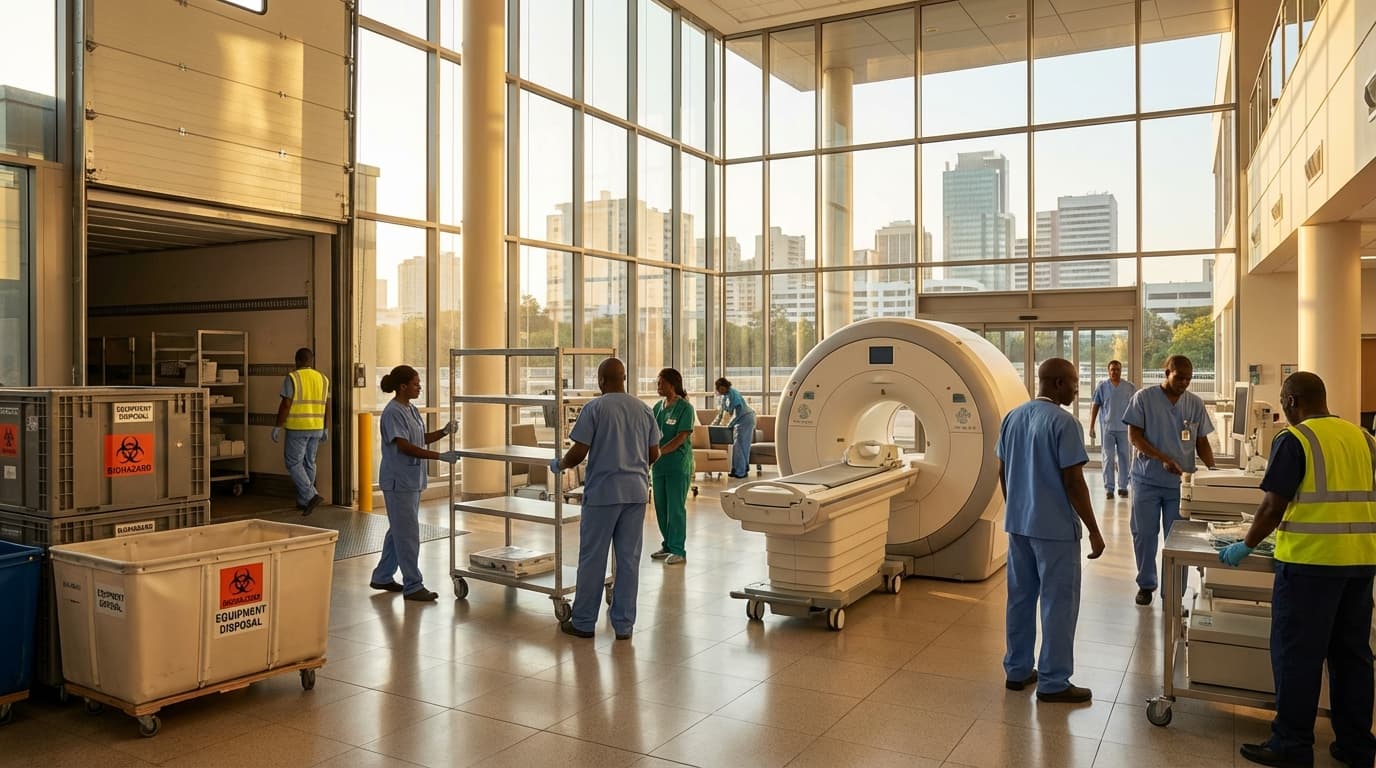
Heavy Medical Equipment De-Installation Service (MRI/CT/Cath Lab) in Ghana
Engineering Excellence & Technical Support
Heavy Medical Equipment De-Installation Service (MRI/CT/Cath Lab) High-standard technical execution following OEM protocols and local regulatory frameworks.
Certified Safety Protocols & Compliance
Our team adheres to stringent international safety standards and Ghanaian regulatory requirements for the de-installation of high-risk medical equipment. We ensure complete environmental containment and safe handling to protect personnel, facilities, and the equipment itself.
Precision Engineering & Component Management
We employ specialized tools and techniques for the meticulous de-assembly of complex MRI, CT, and Cath Lab systems. Our expertise includes precise component segregation, labeling, and secure packaging for efficient transport and future reinstallation.
Minimized Downtime & Expedited Logistics
We understand the critical nature of these medical systems. Our project management and execution are optimized for speed and efficiency, minimizing disruption to your operations and ensuring timely removal with seamless logistical coordination for onward shipping.
What Is Heavy Medical Equipment De-installation Service (Mri/ct/cath Lab) In Ghana?
Heavy Medical Equipment De-Installation Service (MRI/CT/Cath Lab) in Ghana refers to the specialized process of safely and meticulously dismantling, packing, and preparing for transport large-scale, high-value medical imaging and interventional equipment such as Magnetic Resonance Imaging (MRI) scanners, Computed Tomography (CT) scanners, and Cardiac Catheterization (Cath) Laboratories. This service is critical for healthcare facilities undergoing significant renovations, relocations, upgrades, or decommissioning of existing infrastructure. It demands a unique combination of technical expertise, adherence to stringent safety protocols, and knowledge of logistics specific to Ghana's infrastructure and regulatory environment. The process involves disassembling complex systems, managing hazardous materials (e.g., cryogens in MRI), ensuring data integrity and secure handling of sensitive electronic components, and preparing the equipment for either storage, inter-facility transfer, or international shipment. The scope typically encompasses electrical disconnection, mechanical disassembly, component segregation, protective crating, and detailed documentation for chain of custody and re-installation readiness.
| Stakeholder/Scenario | Requirement for De-Installation Service | Typical Use Case Examples |
|---|---|---|
| Hospitals & Diagnostic Centers | Relocation of facilities, renovation of imaging suites, technology upgrades, equipment replacement. | A hospital moves to a new wing, requiring their existing MRI to be carefully de-installed and re-installed in the new location. A diagnostic center upgrades its CT scanner, necessitating the removal of the older unit. |
| Medical Equipment Manufacturers & Distributors | End-of-life equipment removal, site preparation for new installations, inter-facility transfers. | A manufacturer is replacing an older model with a new one at a client site and needs the old unit removed. A distributor needs to prepare a site for a new Cath Lab installation by removing the existing equipment. |
| Government Health Agencies | Decommissioning of public health facilities, asset redistribution, or disposal. | A public hospital undergoes significant restructuring, and its outdated CT scanner needs to be de-installed and either moved to another facility or prepared for auction/disposal. |
| Equipment Leasing Companies | End of lease term equipment retrieval and preparation for return or resale. | A leased MRI contract expires, and the leasing company contracts a de-installation service to safely remove the equipment from the lessee's premises. |
Key Components of Heavy Medical Equipment De-Installation Service:
- Systematic Disassembly: Expert breakdown of complex equipment into manageable modules.
- Cryogen Management (MRI): Safe venting and management of liquid helium or nitrogen.
- Electrical & Network Disconnection: Isolation of power, data, and control systems.
- Mechanical Dismantling: Separation of structural and functional components.
- Component Protection & Packing: Use of specialized cushioning, anti-static materials, and custom crating.
- Hazardous Material Handling: Compliance with regulations for any identified hazardous substances.
- Documentation & Inventory: Detailed logging of all removed components and their condition.
- Site Remediation (Optional): Preparing the vacated space for subsequent use.
- Logistics Coordination: Planning for internal or external transportation.
Who Needs Heavy Medical Equipment De-installation Service (Mri/ct/cath Lab) In Ghana?
Heavy medical equipment like MRI scanners, CT scanners, and Cath Labs are complex, high-value assets that require specialized expertise for de-installation. This is not a task for general contractors. De-installation involves careful dismantling, packaging, transportation, and often, preparation for re-installation or disposal. This specialized service is crucial for various scenarios within Ghana's healthcare infrastructure.
| Target Customer | Relevant Departments/Functions |
|---|---|
| Public Hospitals (e.g., Korle-Bu Teaching Hospital, Ghana Health Service Facilities) | Radiology Department, Cardiology Department, Biomedical Engineering Department, Facilities Management, Procurement Department |
| Private Hospitals & Clinics (e.g., Accra Specialist Hospital, Lister Hospital) | Radiology Department, Cardiology Department, Hospital Administration, IT Department, Facilities Management |
| Diagnostic Imaging Centers | Operations Management, Technical Operations, Client Services |
| Medical Equipment Suppliers & Resellers | Logistics Department, Technical Services, Sales Department |
| Government Ministries (e.g., Ministry of Health) | Procurement and Supply Chain Management, Public Health Infrastructure Development |
| Research & Academic Institutions (e.g., University of Ghana Medical School) | Research Facilities Management, Departmental Administration, IT and Infrastructure Support |
| International NGOs & Aid Organizations | Project Management, Logistics and Operations, Procurement |
| Third-Party Service Providers (e.g., Maintenance Companies) | Field Service Management, Operations, Project Management |
Who Needs Heavy Medical Equipment De-Installation Service (MRI/CT/Cath Lab) in Ghana?
- Hospitals undergoing renovation or relocation.
- Healthcare facilities upgrading to newer imaging technologies.
- Medical centers decommissioning old equipment.
- Organizations involved in the refurbishment and resale of medical equipment.
- Government health ministries managing public hospital assets.
- Private healthcare providers expanding or consolidating services.
- Companies providing medical equipment maintenance and repair.
- Research institutions acquiring or moving advanced imaging systems.
- Disaster relief organizations redeploying medical infrastructure.
- International aid agencies involved in healthcare development.
Heavy Medical Equipment De-installation Service (Mri/ct/cath Lab) Process In Ghana
This document outlines the comprehensive workflow for the Heavy Medical Equipment De-Installation Service (MRI/CT/Cath Lab) in Ghana, from initial client inquiry to the successful completion of the de-installation process. Our streamlined approach ensures minimal disruption, adherence to safety protocols, and professional execution for sensitive and complex medical machinery.
| Stage | Description | Key Activities | Deliverables/Outcomes | Timeline Estimate (Ghana Context) |
|---|---|---|---|---|
| Initial Inquiry & Consultation | The client contacts our service provider with a request for de-installation of heavy medical equipment. | Understand client's needs, identify equipment type (MRI, CT, Cath Lab), confirm location in Ghana, and gather preliminary information. | Initial understanding of scope, client requirements documented. | 1-3 Business Days |
| Site Assessment & Planning | A detailed on-site evaluation is conducted by our technical team. | Assess physical space, access points, power requirements, structural integrity, environmental factors, and any potential logistical challenges. Develop a detailed de-installation plan and risk assessment. | Comprehensive site report, detailed de-installation plan, risk mitigation strategies. | 3-7 Business Days (depending on location and complexity) |
| Quotation & Agreement | Based on the site assessment and plan, a formal quotation is provided. | Detailed breakdown of costs (labor, specialized tools, materials, transportation, insurance), proposed schedule, and terms and conditions. Contractual agreement is finalized. | Formal quotation, signed service agreement, payment schedule. | 2-5 Business Days |
| Pre-De-installation Preparations | All necessary preparations are made before the actual de-installation begins. | Mobilize specialized tools and equipment, coordinate with facility management for necessary permits and access, ensure safety protocols are in place, inform relevant stakeholders, and secure necessary transport. | Work site prepared, permits secured, team and equipment ready. | 1-3 Business Days (concurrent with agreement) |
| Equipment Disconnection & Dismantling | The core de-installation process is executed by our trained technicians. | Safely disconnect power, coolant lines, data cables, and other connections. Systematically dismantle the equipment according to manufacturer specifications and safety standards, paying close attention to critical components. | Equipment safely disconnected and partially or fully dismantled. | Variable (depends on equipment size and complexity: 2-10+ Business Days) |
| Specialized Packaging & Handling | Each component is carefully packaged for protection during transit. | Utilize specialized crating, shock-absorbent materials, and custom-designed packaging to protect sensitive parts from damage and environmental factors. | All dismantled components are securely and safely packaged. | Concurrent with dismantling |
| Transportation & Logistics | The de-installed equipment is transported to its designated destination. | Coordinate specialized transport vehicles (e.g., flatbeds, climate-controlled trucks), manage loading and unloading procedures, ensure all necessary documentation and permits for transit are in order. | Equipment safely transported to the next location. | Variable (depends on distance within Ghana and destination) |
| Final Site Clearance & Handover | The original de-installation site is restored and the process is formally concluded. | Remove all debris, ensure the site is clean and safe, conduct a final walkthrough with the client to confirm all tasks are completed, and provide documentation of the de-installation. | Clean and safe site, final handover documentation, client sign-off. | 1-2 Business Days |
| Post-De-installation Support | Continued support and verification as needed. | Address any post-de-installation queries, provide documentation for future re-installation or disposal, and maintain client relationship. | Client satisfaction, ongoing support. | As needed |
Key Stages of the De-Installation Process:
- Initial Inquiry & Consultation
- Site Assessment & Planning
- Quotation & Agreement
- Pre-De-installation Preparations
- Equipment Disconnection & Dismantling
- Specialized Packaging & Handling
- Transportation & Logistics
- Final Site Clearance & Handover
- Post-De-installation Support
Heavy Medical Equipment De-installation Service (Mri/ct/cath Lab) Cost In Ghana
De-installing heavy medical equipment such as MRI, CT scanners, and Cath Labs is a complex and specialized process requiring trained technicians, specialized tools, and careful logistical planning. The cost of these services in Ghana can vary significantly based on several factors. These factors include the type and model of the equipment, the complexity of the installation, the accessibility of the site, and the experience and reputation of the service provider. Factors like the need for specialized lifting equipment, environmental controls during de-installation, and the distance to the new location or disposal site also play a role in the final pricing. Due to the intricate nature of these operations, it's crucial to obtain detailed quotes from multiple reputable service providers to ensure competitive pricing and quality service.
| Equipment Type | Estimated De-Installation Cost Range (GHS) | Notes |
|---|---|---|
| CT Scanner | 15,000 - 40,000 | Varies by scanner size, imaging capabilities, and site complexity. |
| MRI Scanner (Standard Bore) | 25,000 - 60,000 | Includes magnet handling, shielding removal, and potential structural modifications. |
| MRI Scanner (Wide Bore / High Field) | 40,000 - 100,000+ | Significantly higher due to magnet weight, shielding, and advanced systems. |
| Cath Lab (Angiography System) | 20,000 - 50,000 | Involves dismantling multiple components, including X-ray generators and detectors. |
| Other Heavy Medical Equipment (e.g., Linear Accelerators, Ultrasound Systems - high-end) | 10,000 - 30,000 | Depends on the specific equipment and its installation requirements. |
Key Factors Influencing Heavy Medical Equipment De-Installation Costs in Ghana:
- Equipment Type & Model: Larger and more complex machines (e.g., wide-bore MRI vs. standard CT) incur higher costs.
- Site Accessibility: Difficult access for equipment removal (e.g., narrow corridors, upper floors) adds to labor and equipment needs.
- De-installation Complexity: Intricate wiring, cooling systems, or structural modifications needed for removal increase costs.
- Logistics & Transportation: Distance to the new installation site or disposal facility, and the need for specialized transport vehicles.
- Service Provider Expertise: Reputable companies with specialized training and certifications may charge more but offer greater reliability.
- Dismantling & Reassembly Requirements: If the equipment needs to be partially reassembled at the new site, this adds to the overall cost.
- Regulatory Compliance & Permits: Costs associated with obtaining necessary permits or adhering to specific disposal regulations.
- Insurance & Risk Mitigation: Comprehensive insurance coverage for potential damages during the process.
- Downtime Considerations: The provider's ability to minimize hospital downtime during de-installation might be a premium service.
Affordable Heavy Medical Equipment De-installation Service (Mri/ct/cath Lab) Options
De-installing heavy medical equipment like MRI, CT scanners, and Cath Labs is a complex and specialized undertaking. Choosing an affordable service requires understanding the various options, value bundles, and effective cost-saving strategies. This guide aims to provide clarity on obtaining these services without compromising safety or efficiency. Affordable doesn't mean cheap; it means maximizing value for your investment. We'll explore how to approach this process to secure the best outcomes for your facility.
| Value Bundle Options | Description | Potential Cost-Saving Benefits |
|---|---|---|
| Basic De-installation | Includes disconnection, dismantling, and preparation for transport of the primary equipment. | Lower upfront cost for essential services. Ideal for clients handling their own crating and secondary logistics. |
| Comprehensive De-installation Package | Includes basic de-installation, professional crating, packaging, and coordination of transport logistics. | Streamlines the process, reduces the need for separate vendors, and minimizes coordination headaches. Potential discounts for bundled services. |
| De-installation with Site Restoration | Includes comprehensive de-installation, crating, and basic site cleanup/restoration of the area where the equipment was located. | Avoids additional contractor costs for site remediation. Ensures a cleaner handover of the space. |
| Full Service (De-installation to Relocation) | Includes de-installation, crating, secure transport, and re-installation at a new location. | The most convenient option, providing end-to-end management. Negotiated rates for the entire project can offer significant savings compared to individual service procurements. |
| Equipment Disposal/Recycling Integration | Bundles de-installation with environmentally responsible disposal or recycling services. | Consolidates vendors and ensures compliance with disposal regulations. Potential rebates or reduced disposal fees for certain materials. |
Key Considerations for Affordable De-Installation:
- Specialized Expertise: Ensure the service provider has proven experience with the specific equipment being de-installed (MRI, CT, Cath Lab).
- Safety Protocols: Verify adherence to all safety regulations and best practices for handling heavy, sensitive, and potentially hazardous equipment.
- Insurance and Liability: Confirm adequate insurance coverage from the de-installation company.
- Logistics and Planning: Understand their approach to site assessment, transportation coordination, and timeline management.
- Equipment Condition and Documentation: Clarify how they handle the condition of the equipment post-de-installation and provide necessary documentation.
- Regulatory Compliance: Ensure they are knowledgeable about and compliant with all relevant local, state, and federal regulations.
- Reputation and References: Seek out testimonials and case studies from previous clients.
- Scalability: Can they handle future de-installation needs or provide ongoing support?
Verified Providers In Ghana
In Ghana's evolving healthcare landscape, identifying trusted and accredited medical facilities is paramount for ensuring quality care. Franance Health stands out as a beacon of reliability, rigorously vetting and verifying healthcare providers to offer Ghanaians peace of mind. This commitment to credentialing means that when you choose a Franance Health verified provider, you are opting for a facility that meets stringent standards of professionalism, ethical practice, and patient safety. Their meticulous verification process encompasses a deep dive into qualifications, certifications, infrastructure, and patient feedback, ensuring that every listed provider is not just a practitioner, but a dedicated professional committed to excellence.
| Credential Aspect | Franance Health Verification Process | Benefit to Patients |
|---|---|---|
| Professional Qualifications & Certifications | Verifies medical licenses, specialist certifications, and ongoing professional development. | Ensures you are treated by competent and up-to-date medical experts. |
| Infrastructure & Equipment | Assesses the facility's equipment, cleanliness, and adherence to health and safety regulations. | Guarantees a safe and well-equipped environment for diagnosis and treatment. |
| Ethical Practices & Patient Rights | Reviews adherence to medical ethics, patient confidentiality, and patient rights protocols. | Confirms that your care will be delivered with integrity and respect for your autonomy. |
| Patient Feedback & Satisfaction | Gathers and analyzes feedback from real patients regarding their experiences. | Provides insights into the provider's patient care quality and responsiveness. |
| Regulatory Compliance | Confirms that the provider meets all national and local healthcare regulations. | Offers assurance that the facility operates within legal and established healthcare frameworks. |
Why Franance Health Verified Providers are the Best Choice:
- Unwavering commitment to patient safety and quality standards.
- Access to a network of highly qualified and certified healthcare professionals.
- Transparent and thoroughly vetted provider credentials.
- Enhanced patient confidence and reduced healthcare anxiety.
- Streamlined access to reliable medical services across Ghana.
- A pledge to ethical medical practices and patient-centric care.
Scope Of Work For Heavy Medical Equipment De-installation Service (Mri/ct/cath Lab)
This Scope of Work (SOW) outlines the services required for the professional de-installation of heavy medical equipment, specifically MRI, CT scanners, and Cath Labs. The service provider will be responsible for the safe, efficient, and compliant removal of these complex systems from their current locations within the healthcare facility. This includes all associated components, cabling, and ancillary equipment. Adherence to all relevant safety regulations, manufacturer guidelines, and facility protocols is paramount. The service provider must possess the necessary expertise, specialized tools, and qualified personnel to execute this task without compromising patient safety, facility integrity, or equipment preservation.
| Equipment Type | Key Considerations for De-installation | Standard Specifications / Requirements |
|---|---|---|
| MRI (Magnetic Resonance Imaging) | Magnet quench procedures (if applicable), RF shielding removal, cryogen management, power disconnection, patient table and gantry disassembly, gradient coil handling, and heavy component rigging. | Adherence to Siemens, GE, Philips, or other manufacturer's specific de-installation manuals. Compliance with radiation safety standards (if applicable to associated equipment). Containment and venting procedures for cryogens. Use of specialized lifting and rigging equipment capable of handling multi-ton components. Environmental control during disassembly to prevent moisture ingress. |
| CT Scanner (Computed Tomography) | Gantry disassembly, X-ray tube handling, detector array removal, power supply disconnection, couch mechanism disassembly, and associated cabling management. Cooling system management. | Follow manufacturer's specific de-installation guidelines (e.g., Siemens, GE, Philips, Canon). Safe handling and disposal of high-voltage components. Proper procedures for managing and disposing of X-ray tube assemblies. Dust and debris containment during disassembly. Electrical safety protocols for high-voltage systems. |
| Cath Lab (Cardiac Catheterization Laboratory) | C-arm disassembly and removal, detector handling, patient table removal, console and workstation disconnection, power and data cable management, associated ancillary equipment removal (e.g., injectors, monitors). | Compliance with manufacturer's de-installation procedures (e.g., Siemens, GE, Philips). Safe handling of imaging detectors and C-arm components. Electrical safety for high-power X-ray generators. Management of specialized cooling systems (if applicable). Secure disconnection and management of all data and control cabling. Verification of laser safety protocols (if applicable). |
Technical Deliverables
- De-installation Plan: A detailed plan outlining the sequence of de-installation steps, safety procedures, equipment staging, and waste disposal for each specific equipment type.
- Site Survey Report: A comprehensive report documenting the existing site conditions, access routes, potential hazards, and any pre-de-installation preparation required.
- De-installation Execution: The physical removal of the medical equipment and all associated components from their installed locations.
- Component Labeling and Inventory: All removed components will be clearly labeled with equipment type, serial number, and condition. A detailed inventory of all removed items will be provided.
- Cabling Management: Safe disconnection and organized removal of all power, data, and RF cabling associated with the equipment.
- Structural Integrity Verification: Confirmation that the de-installation process has not compromised the structural integrity of the surrounding walls, floors, or ceilings.
- Site Restoration (Minor): Removal of any temporary supports or fixtures used during de-installation. Major building modifications are outside this scope unless explicitly stated.
- Transportation Preparation: Equipment will be prepared for safe transport, including securing delicate components and applying protective coverings.
- Waste Disposal Documentation: Proper disposal of all removed materials, including refrigerants (if applicable), in accordance with environmental regulations. Certificates of disposal will be provided.
- Final De-installation Report: A comprehensive report detailing the completed de-installation, including any encountered issues, resolutions, and confirmation of site handover.
Service Level Agreement For Heavy Medical Equipment De-installation Service (Mri/ct/cath Lab)
This Service Level Agreement (SLA) outlines the guaranteed response times and uptime expectations for the de-installation of heavy medical equipment, specifically MRI, CT, and Cath Lab systems. This agreement is between [Your Company Name] (hereinafter referred to as 'Service Provider') and [Client Company Name] (hereinafter referred to as 'Client').
| Service Component | Response Time Guarantee | Uptime Guarantee (Post-De-installation) |
|---|---|---|
| Initial Response to Service Request (Non-Emergency) | Within [e.g., 4] business hours of notification. | N/A (Uptime applies to operational equipment, de-installation is a planned event) |
| On-Site Arrival for Scheduled De-installation | As per agreed-upon schedule in the Work Order. | N/A |
| Completion of De-installation (Standard System) | Within [e.g., 3] business days from on-site commencement. | N/A |
| Completion of De-installation (Complex/Multiple Systems) | As per agreed-upon schedule in the Work Order. | N/A |
| Response to De-installation Related Issues (Post-Completion) | Within [e.g., 2] business hours. | N/A |
| Re-installation (if applicable, separate agreement) | TBD | TBD |
Key Service Components
- Scope of Service: De-installation of specified MRI, CT, and Cath Lab equipment, including safe disconnection, dismantling, packaging, and preparation for transport.
- Service Hours: [Specify days and hours of operation, e.g., Monday-Friday, 8:00 AM - 5:00 PM, excluding national holidays]
- Contact Information: [Provide primary contact person, phone number, and email address for service requests]
- Definition of Downtime: For the purposes of this SLA, downtime refers to the period during which the equipment is unusable or unavailable due to a failure in the de-installation process initiated by the Service Provider, or if the de-installation is not completed within the agreed-upon timeframe due to Service Provider negligence.
Frequently Asked Questions

Ready when you are
Let's scope your Heavy Medical Equipment De-Installation Service (MRI/CT/Cath Lab) in Ghana project in Ghana.

Scaling healthcare logistics and technical systems across the entire continent.