
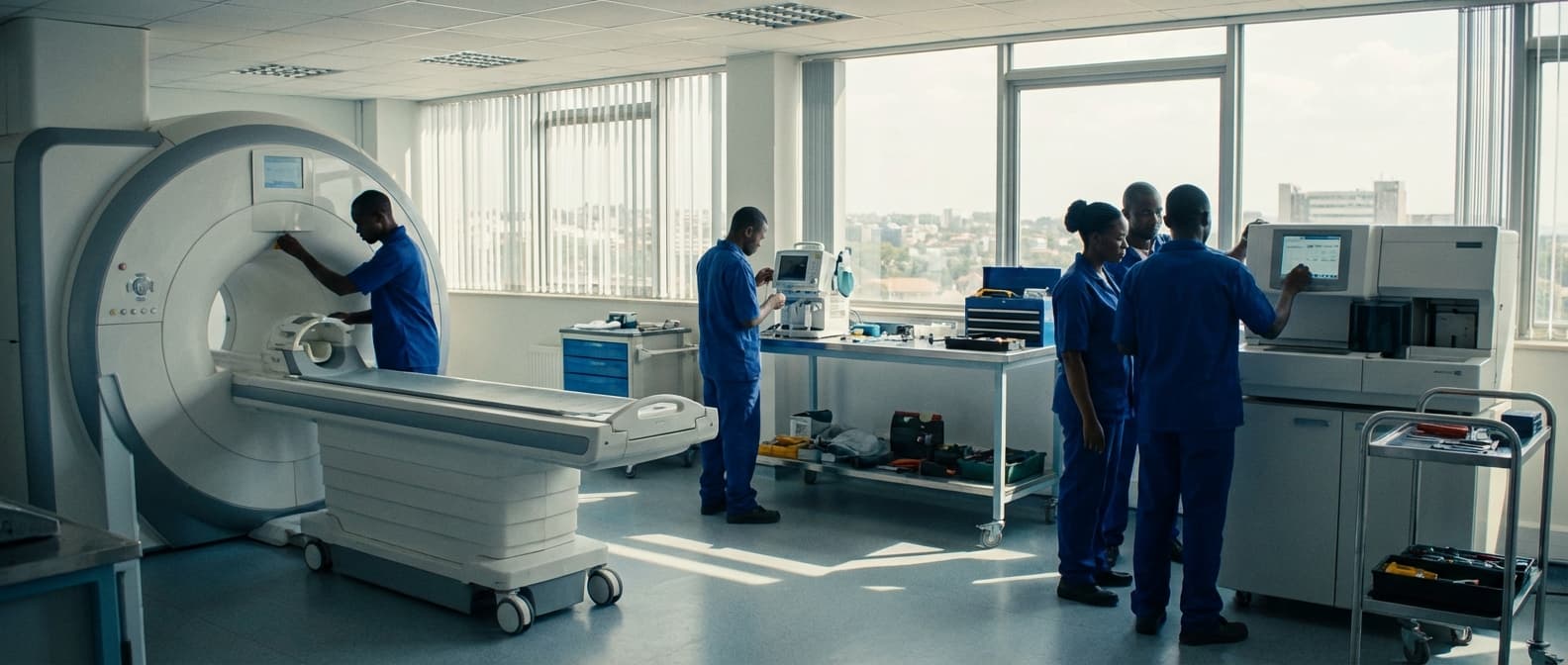
Uptime, Downtime & Root-Cause Analysis Reporting Service in Ghana
Engineering Excellence & Technical Support
Uptime, Downtime & Root-Cause Analysis Reporting Service High-standard technical execution following OEM protocols and local regulatory frameworks.
Proactive Uptime Monitoring & Alerting
Leveraging real-time, granular monitoring of critical infrastructure across Ghana, our service proactively detects and alerts stakeholders to potential service disruptions BEFORE they impact end-users. This minimizes downtime by enabling swift response and intervention based on predictive analytics and customizable threshold alerts.
Automated Downtime Quantification & Impact Analysis
Upon detecting an outage, our service automatically quantifies the exact duration and scope of downtime. This includes identifying affected services, user segments, and potential business impact, providing immediate, data-driven insights for rapid damage assessment and resource allocation.
Advanced Root-Cause Analysis & Trending
Beyond identifying downtime, our platform employs sophisticated diagnostic tools to pinpoint the definitive root cause of incidents. We provide comprehensive reports detailing contributing factors, sequence of events, and historical trending of recurring issues, empowering Ghanaian businesses to implement permanent fixes and prevent future occurrences.
What Is Uptime, Downtime & Root-cause Analysis Reporting Service In Ghana?
In Ghana, the Uptime, Downtime & Root-Cause Analysis Reporting Service is a critical operational intelligence offering designed to provide businesses with comprehensive visibility into the availability and performance of their IT infrastructure and critical business systems. This service focuses on two primary metrics: Uptime (the period during which a system is operational and accessible) and Downtime (the period when a system is non-operational or inaccessible). Beyond mere measurement, it delves into Root-Cause Analysis (RCA), a systematic process to identify the underlying reasons for system failures or performance degradations. The objective is to move beyond reactive problem-solving to proactive prevention and continuous improvement by understanding 'why' failures occur.
The service involves the deployment of monitoring agents and sensors across networks, servers, applications, databases, and cloud environments. These tools collect real-time data on system health, resource utilization, transaction performance, and error rates. When deviations from baseline performance or complete outages are detected, automated alerts are triggered. Subsequently, a structured RCA methodology is applied, which may include log analysis, event correlation, performance profiling, and expert human review, to pinpoint the exact cause of the issue. The outcome is a detailed report outlining the incident's duration, impact, contributing factors, and actionable recommendations for remediation and future prevention. This reporting can be delivered through dashboards, scheduled reports, and on-demand incident summaries.
| Use Case Category | Typical Scenarios | Service Components Involved | Business Impact |
|---|---|---|---|
| IT Infrastructure Monitoring | Server crashes, network latency, storage failures, data center outages. | Network monitoring, server performance monitoring, hardware health checks, environmental monitoring (for data centers). | Reduced operational efficiency, data loss, extended service disruption, increased repair costs. |
| Application Performance Management (APM) | Slow application response times, transaction errors, application crashes, database performance bottlenecks. | Application transaction tracing, code-level diagnostics, database query analysis, error logging and aggregation. | Degraded user experience, decreased productivity, customer churn, revenue loss, reputational damage. |
| Cloud Service Availability | Cloud instance failures, cloud storage unavailability, API gateway errors, SaaS application outages. | Cloud infrastructure monitoring (AWS, Azure, GCP), SaaS performance monitoring, cloud API health checks. | Disruption of hosted services, inability to access cloud-based resources, compliance issues. |
| Network Service Reliability | Internet connectivity issues, VPN failures, inter-branch communication disruptions, VoIP call quality degradation. | WAN/LAN monitoring, router/switch performance, bandwidth utilization analysis, latency and jitter measurement. | Interrupted business operations, communication breakdown, impact on remote workforces. |
| Business Process Uptime | Inability to process orders, failed payment gateway transactions, disruptions in customer support workflows. | End-to-end business process monitoring, integration point monitoring, synthetic transaction testing. | Direct revenue loss, decreased customer satisfaction, operational gridlock. |
| Security Incident Impact Assessment | Assessing the downtime and performance impact of cyberattacks (e.g., DDoS, ransomware). | Correlation of security alerts with performance metrics, impact analysis of security events. | Extended downtime due to security breaches, potential data compromise, significant recovery efforts. |
Who Needs Uptime, Downtime & Root-Cause Analysis Reporting Service in Ghana?
- Enterprise Businesses: Organizations with complex IT infrastructures, mission-critical applications (e.g., ERP, CRM, financial systems), and high dependency on system availability for revenue generation and customer satisfaction.
- Telecommunications Providers: Companies relying on uninterrupted network services and customer-facing applications.
- Financial Institutions (Banks, Fintechs): Requiring stringent uptime for transaction processing, online banking, and regulatory compliance.
- E-commerce Platforms & Online Retailers: Directly impacted by downtime, which translates to lost sales and customer trust.
- Government Agencies & Public Services: Needing to ensure the continuous availability of essential services like healthcare systems, emergency response, and citizen portals.
- Managed Service Providers (MSPs) & IT Outsourcing Companies: Offering these services to their clients as a value-added component of their support offerings.
- Cloud Service Providers & Data Centers: To monitor and report on the availability and performance of their hosted infrastructure.
- Businesses undergoing Digital Transformation: As new digital services are introduced, their availability and performance become paramount.
Who Needs Uptime, Downtime & Root-cause Analysis Reporting Service In Ghana?
In today's dynamic business environment, especially in Ghana, ensuring the continuous availability and optimal performance of IT systems is paramount. Businesses of all sizes and across various sectors face the challenge of unexpected disruptions and the need to quickly identify and resolve the underlying causes. Our Uptime, Downtime & Root-Cause Analysis Reporting Service is designed to address these critical needs, offering a comprehensive solution for proactive monitoring, insightful reporting, and swift problem resolution. This service empowers organizations to minimize losses, maintain customer trust, and achieve their operational objectives.
| Target Customer Segment | Typical Departments Involved |
|---|---|
| Financial Institutions (Banks, Fintechs) | IT Operations, Risk Management, Compliance, Business Continuity Planning, Customer Service |
| Telecommunications Companies | Network Operations Center (NOC), IT Infrastructure, Service Delivery, Customer Support |
| E-commerce & Retail Businesses | IT Operations, Operations Management, Customer Experience, Marketing |
| Manufacturing & Industrial Companies | Production IT, Plant Management, Operations, Maintenance |
| Healthcare Providers (Hospitals, Clinics) | IT Department, Medical Records Department, Patient Services, Administration |
| Government Agencies & Public Services | IT Department, Operations, Public Service Delivery, Security |
| Logistics & Transportation Companies | Fleet Management IT, Operations Control, Dispatch, Customer Service |
| Educational Institutions (Universities, Schools) | IT Department, Academic Affairs, Administration, Student Services |
| SMEs with Online Presence/Services | Owner/Manager, IT Support (Internal or External), Operations Staff |
Who Needs Uptime, Downtime & Root-Cause Analysis Reporting Service in Ghana?
- Businesses heavily reliant on digital operations and online services.
- Organizations where system downtime directly impacts revenue, customer satisfaction, or regulatory compliance.
- Companies seeking to optimize IT infrastructure performance and prevent recurring issues.
- IT departments struggling with the time and resources required for in-depth issue investigation.
- Service providers who need to assure their clients of reliable service delivery.
Uptime, Downtime & Root-cause Analysis Reporting Service Process In Ghana
This document outlines the standard workflow for providing Uptime, Downtime, and Root-Cause Analysis (RCA) reporting services within Ghana. The process is designed to be transparent, efficient, and to deliver actionable insights to clients regarding their system availability and performance issues.
| Stage | Description | Key Activities | Responsible Party | Deliverables/Outcomes |
|---|---|---|---|---|
| The client expresses interest in Uptime, Downtime, and RCA reporting services. | Initial discussion of client's needs, system infrastructure, and desired outcomes. Understanding of pain points related to system availability. | Client, Service Provider Sales/Consultant | Understanding of client's requirements, preliminary assessment of service feasibility. |
| Detailed understanding of the client's specific requirements is established. | Technical assessment of the client's environment. Definition of monitoring parameters (uptime metrics, downtime categories). Development of a customized service proposal outlining scope, methodologies, timelines, and pricing. | Service Provider Technical Team, Sales/Consultant, Client | Formal service proposal, including Service Level Agreements (SLAs), pricing, and estimated timelines. |
| Formal agreement on the service terms and initiation of the client relationship. | Contract negotiation and signing. Collection of necessary client credentials and access. Introduction to the client's technical point of contact. Onboarding materials and initial training (if required). | Client, Service Provider Legal/Sales, Technical Team | Signed service agreement. Client access granted. Dedicated account manager assigned. |
| Establishing the infrastructure for continuous monitoring and data capture. | Deployment of monitoring tools (agents, probes, API integrations) on the client's infrastructure. Configuration of monitoring parameters as per the agreed scope. Testing of monitoring agents and data streams. | Service Provider Technical Team | Operational monitoring systems. Baseline performance data collected. |
| Proactive identification and initial response to system disruptions. | Continuous monitoring of client systems for deviations from normal operating parameters. Automated alerts and notifications upon detection of downtime or performance degradation. Initial diagnostic steps to confirm the issue. | Service Provider Monitoring Team | Timely alerts on incidents. Initial incident logs created. |
| In-depth investigation to identify the underlying causes of downtime or performance issues. | Gathering logs, event data, and system metrics related to the incident. Interviewing client personnel. Applying various RCA methodologies (e.g., 5 Whys, Fishbone Diagram). Documenting the causal chain. | Service Provider RCA Specialist, Technical Team, Client SMEs | Detailed RCA report outlining the root cause, contributing factors, and impact. |
| Compiling and presenting findings to the client. | Generating comprehensive reports on uptime/downtime statistics, incident summaries, and RCA findings. Visualizing data with charts and graphs. Delivering reports through agreed-upon channels (email, portal, presentation). | Service Provider Reporting Team, Account Manager | Regularly scheduled uptime/downtime reports. Specific RCA reports for identified incidents. |
| Ensuring client understanding and facilitating corrective actions. | Reviewing reports with the client. Discussing findings and implications. Providing recommendations for preventive measures and system improvements. Tracking the implementation of recommendations. | Account Manager, RCA Specialist, Client | Client understanding of issues. Action plans for improvement. Feedback on service quality. |
| Formal conclusion of the service engagement. | Final reporting and archival of data. Review of overall service performance against SLAs. Decommissioning of monitoring tools (if applicable). Final invoicing and payment. | Account Manager, Finance Department, Client | Completed service delivery. Archived data. Final client satisfaction confirmation. |
Service Workflow Stages
- Inquiry & Initial Consultation
- Scope Definition & Proposal
- Service Agreement & Onboarding
- Data Collection & Monitoring Setup
- Incident Detection & Response
- Root-Cause Analysis (RCA)
- Report Generation & Delivery
- Review & Follow-up
- Service Closure
Uptime, Downtime & Root-cause Analysis Reporting Service Cost In Ghana
Reporting on uptime, downtime, and conducting root-cause analysis (RCA) are critical for businesses to ensure operational efficiency, customer satisfaction, and service reliability. In Ghana, the cost of these services can vary significantly based on several factors. These services are typically offered by IT consulting firms, managed service providers (MSPs), and specialized analytics companies. The pricing structure often involves a combination of one-time setup fees, recurring subscription costs, and project-based charges for deep-dive RCA investigations.
| Service Type / Package | Typical Pricing Range (GHS) | Key Inclusions / Notes |
|---|---|---|
| Basic Uptime/Downtime Monitoring & Reporting | 800 - 2,500 per month | Automated monitoring of key systems, daily/weekly status reports, basic alert notifications. |
| Standard Uptime, Downtime & Performance Reporting | 2,000 - 6,000 per month | More granular monitoring, performance metrics, trend analysis, monthly comprehensive reports, basic incident logging. |
| Advanced Monitoring, RCA Lite & Proactive Alerts | 5,000 - 15,000+ per month | Real-time monitoring, proactive anomaly detection, initial root-cause identification during incidents, advanced dashboards, dedicated support. |
| Comprehensive Managed Service (Monitoring, RCA, Proactive Management) | 10,000 - 30,000+ per month | End-to-end IT infrastructure monitoring, continuous RCA, trend forecasting, proactive issue resolution, detailed SLA reporting, regular performance reviews. |
| Project-Based Root-Cause Analysis (per incident) | 1,500 - 10,000+ per incident | Deep-dive investigation into specific downtime events, detailed RCA report, recommendations for prevention. Cost varies greatly with incident complexity. |
| Initial Setup & Configuration Fee | 500 - 5,000 (one-time) | Cost for deploying monitoring agents, configuring dashboards, and initial system integration. Varies based on infrastructure size. |
Key Pricing Factors for Uptime, Downtime & Root-Cause Analysis Reporting Services in Ghana:
- {"title":"Scope and Complexity of Infrastructure:","description":"The size and complexity of your IT infrastructure (servers, networks, applications, cloud services) directly impact the effort required for monitoring, data collection, and analysis. Larger, more distributed, or heterogeneous environments will naturally incur higher costs."}
- {"title":"Level of Service and Reporting Frequency:","description":"The desired level of detail in reporting, the frequency of reports (daily, weekly, monthly), and the need for real-time alerts will influence the cost. More granular and frequent reporting demands more sophisticated tools and dedicated analyst time."}
- {"title":"Tooling and Technology:","description":"The type of monitoring and analytics tools employed by the service provider is a significant cost driver. Sophisticated, AI-driven platforms offering advanced anomaly detection and predictive analytics will be more expensive than basic log-based systems."}
- {"title":"Root-Cause Analysis Depth:","description":"Simple identification of downtime is different from in-depth RCA that involves forensic analysis, identifying contributing factors, and recommending preventative measures. Complex RCA often involves specialized expertise and more time, leading to higher costs."}
- {"title":"Service Level Agreements (SLAs):","description":"The stringency of SLAs, particularly around response times for critical incidents and uptime guarantees, will affect pricing. Providers who offer higher uptime guarantees and rapid incident response will typically charge a premium."}
- {"title":"Provider Expertise and Reputation:","description":"Established providers with a strong track record, certified professionals, and a deep understanding of the Ghanaian IT landscape may command higher fees but also offer greater reliability and value."}
- {"title":"Integration Requirements:","description":"If the reporting service needs to integrate with existing ticketing systems, ITSM platforms, or other business applications, this can add to the implementation cost."}
- {"title":"On-Demand vs. Managed Services:","description":"Engaging a provider for ad-hoc RCA investigations will be priced differently than a comprehensive managed service that includes continuous monitoring and proactive reporting."}
Affordable Uptime, Downtime & Root-cause Analysis Reporting Service Options
Finding reliable and affordable uptime, downtime, and root-cause analysis (RCA) reporting services is crucial for any business aiming to minimize disruptions and optimize performance. This service provides vital insights into system availability, identifies the sources of failures, and helps prevent recurrence. We offer flexible value bundles and cost-saving strategies to cater to various business needs and budgets.
| Value Bundle | Description | Included Features | Target Audience | Pricing Tier |
|---|---|---|---|---|
| Essential Monitoring | Basic uptime tracking and essential downtime reporting. | Real-time Uptime Monitoring, Detailed Downtime Reports (monthly), Basic Alerting, Historical Data (6 months). | Small businesses, startups, projects with limited budgets. | Starter |
| Pro Analytics | Enhanced downtime analysis and introductory RCA capabilities. | All Essential Monitoring features, Automated Root-Cause Analysis (basic), Customizable Alerting, Historical Data (1 year), Executive Summaries. | Growing businesses, teams needing deeper insights into outages. | Growth |
| Enterprise Solutions | Comprehensive monitoring, advanced RCA, and dedicated support for complex environments. | All Pro Analytics features, Advanced Root-Cause Analysis, SLA Compliance Tracking, Proactive Recommendations, Historical Data (unlimited), Dedicated Account Manager, API Access. | Large enterprises, organizations with mission-critical systems, compliance-driven industries. | Premium |
| Custom Bundle | Tailored to your unique requirements, combining specific features from different tiers. | Configurable based on client needs. | Any size business with specialized monitoring or reporting demands. | Custom |
Key Features of Our Reporting Services
- Real-time Uptime Monitoring: Continuous tracking of your systems and applications to ensure maximum availability.
- Detailed Downtime Reports: Comprehensive logs of every outage, including duration, affected services, and user impact.
- Automated Root-Cause Analysis: AI-powered tools to quickly pinpoint the underlying issues leading to downtime.
- Customizable Alerting: Notifications tailored to your specific requirements, delivered via email, SMS, or integration with your preferred communication channels.
- Historical Performance Data: Trend analysis and reporting to identify recurring problems and areas for improvement.
- Executive Summaries & Technical Deep Dives: Reports designed for both management and technical teams.
- SLA Compliance Tracking: Monitoring and reporting against your Service Level Agreements.
- Proactive Incident Prevention Recommendations: Actionable insights to mitigate future risks.
Verified Providers In Ghana
In Ghana's rapidly evolving healthcare landscape, identifying truly verified providers is paramount for ensuring quality care and patient safety. Franance Health stands out as a beacon of trust, meticulously vetting its network of healthcare professionals and facilities. Their rigorous credentialing process, which goes beyond basic licensing, involves comprehensive background checks, verification of educational qualifications, and confirmation of professional experience and certifications. This commitment to thoroughness means that when you choose a Franance Health verified provider, you are selecting a healthcare professional who has met the highest standards of competence, ethics, and dedication to patient well-being. This dedication translates into a superior healthcare experience, characterized by informed decision-making, effective treatment, and ultimately, better health outcomes.
| Verification Aspect | Franance Health's Approach | Benefit to Patients |
|---|---|---|
| Licensing and Registration | Confirms active and valid professional licenses from relevant Ghanaian regulatory bodies. | Ensures providers are legally permitted to practice medicine. |
| Educational Qualifications | Verifies degrees, diplomas, and specialized training from accredited institutions. | Guarantees a strong foundation of medical knowledge and expertise. |
| Professional Experience | Assesses the duration and nature of clinical practice and specialized experience. | Indicates practical skills and a proven track record in specific medical fields. |
| Certifications and Specializations | Validates post-graduate certifications and specializations in various medical disciplines. | Confirms advanced knowledge and skills for specific health needs. |
| Background Checks | Conducts thorough background checks to identify any disciplinary actions or legal issues. | Protects patients from potentially harmful or unethical practitioners. |
| Peer Reviews and References | May involve gathering feedback from peers and professional references. | Provides additional insight into a provider's professional conduct and reputation. |
Why Franance Health Verified Providers are the Best Choice:
- Unwavering commitment to patient safety and quality of care.
- Rigorous credentialing process exceeding standard requirements.
- Access to a network of highly qualified and experienced healthcare professionals.
- Reduced risk of encountering fraudulent or substandard providers.
- Enhanced peace of mind and confidence in your healthcare decisions.
- Improved access to comprehensive and reliable medical services.
Scope Of Work For Uptime, Downtime & Root-cause Analysis Reporting Service
This Scope of Work (SOW) outlines the requirements for a comprehensive Uptime, Downtime, and Root-Cause Analysis (RCA) Reporting Service. The service aims to provide clear, actionable insights into system availability, identify causes of outages, and recommend preventative measures to improve overall reliability. This document specifies the technical deliverables and standard specifications for the service.
| Deliverable | Description | Technical Specifications & Standards | Frequency/Trigger |
|---|---|---|---|
| Uptime/Downtime Monitoring Report | A periodic report detailing system availability and unavailability periods. | Metrics to include: Total Uptime (%), Total Downtime (minutes/hours), Number of Downtime Events, Average Downtime Duration. Data to be collected via established monitoring tools (e.g., Nagios, Zabbix, Prometheus, CloudWatch, Azure Monitor). Reports to be generated in CSV and PDF formats. Timezone consistency to be maintained (e.g., UTC). | Daily, Weekly, Monthly (configurable) |
| Downtime Event Notification | Real-time or near-real-time alerts upon detection of a downtime event. | Notifications to include: Affected system/service, Start time of downtime, Severity level, Initial known cause (if available). Notification channels to include: Email, Slack, PagerDuty (or equivalent). Thresholds for severity to be agreed upon. | Immediate upon detection of downtime |
| Root-Cause Analysis (RCA) Report | A detailed report for each significant downtime event, investigating the underlying cause. | Report structure to include: Executive Summary, Timeline of Events, Impact Assessment, Root Cause Identification (using methodologies like 5 Whys, Fishbone Diagram), Contributing Factors, Resolution Steps Taken, Recommendations for Prevention, Lessons Learned. Data sources for analysis to include: Monitoring logs, application logs, system event logs, network traffic analysis, configuration change logs. Reports to be delivered in PDF format with clear diagrams and data visualizations where applicable. | Within 48-72 hours of downtime resolution (configurable) |
| Trend Analysis Report | A periodic report highlighting trends and patterns in downtime events over time. | Analysis to include: Frequency of downtime by system/service, Common root causes, Impact of downtime by category, Performance degradation trends. Reports to be generated in PDF format, incorporating graphical representations of trends. | Monthly, Quarterly (configurable) |
| Data Retention Policy | Defined policy for storing and managing historical uptime, downtime, and RCA data. | Data to be retained for a minimum of [Specify Duration, e.g., 1 year] for analysis and auditing purposes. Data anonymization or pseudonymization to be implemented if required by privacy regulations. | Ongoing |
| Service Level Agreement (SLA) Compliance Report | Report demonstrating adherence to agreed-upon uptime SLAs. | Metrics to include: Actual uptime vs. SLA target, Availability credits calculation (if applicable). Reports to be generated in PDF format. | Monthly, Quarterly (aligned with SLA review periods) |
Service Objectives
- Accurately monitor and report on system uptime and downtime.
- Conduct thorough root-cause analysis for all significant downtime events.
- Provide clear, concise, and actionable RCA reports.
- Identify trends and patterns in downtime to proactively address recurring issues.
- Contribute to a continuous improvement cycle for system reliability and performance.
- Maintain a high degree of data accuracy and integrity in all reporting.
Service Level Agreement For Uptime, Downtime & Root-cause Analysis Reporting Service
This Service Level Agreement (SLA) outlines the guaranteed uptime, response times for incidents, and the process for root-cause analysis reporting for the Uptime, Downtime & Root-Cause Analysis Reporting Service (hereinafter referred to as the "Service"). This SLA is an integral part of the Master Service Agreement between [Your Company Name] (hereinafter referred to as "Provider") and the Customer.
| Service Metric | Uptime Guarantee | Response Time Target (for Incident Reporting) | Resolution Time Target (for Critical Incidents) | RCA Report Delivery |
|---|---|---|---|---|
| Uptime | 99.9% (Monthly) | |||
| Incident Response | Critical: 15 minutes | |||
| Major: 30 minutes | ||||
| Minor: 1 hour | ||||
| Incident Resolution | Critical: 4 hours (target) | Within 2 business days of resolution | ||
| Root-Cause Analysis | To be provided for all Critical and Major Incidents |
Definitions
- Uptime: The percentage of time the Service is available and operational, excluding Scheduled Downtime and Excusable Downtime.
- Downtime: Any period during which the Service is not available or operational.
- Scheduled Downtime: Planned periods of unavailability for maintenance, upgrades, or other preventive measures, which will be communicated to the Customer in advance.
- Excusable Downtime: Downtime caused by factors outside the Provider's reasonable control, including but not limited to, Force Majeure events, Customer's equipment or network failures, or third-party service outages not directly attributable to the Provider's infrastructure.
- Incident: Any event that causes or may cause a disruption to the Service.
- Root-Cause Analysis (RCA): A systematic process of identifying the underlying causes of an Incident to prevent recurrence.
- Critical Incident: An Incident that renders the Service completely unavailable or significantly impairs its core functionality, affecting a large portion of users.
- Major Incident: An Incident that causes a significant degradation of Service performance or availability, affecting a substantial number of users or a key feature.
- Minor Incident: An Incident that causes a minor degradation of Service performance or availability, affecting a limited number of users or a non-critical feature.
Frequently Asked Questions

Ready when you are
Let's scope your Uptime, Downtime & Root-Cause Analysis Reporting Service in Ghana project in Ghana.

Scaling healthcare logistics and technical systems across the entire continent.