
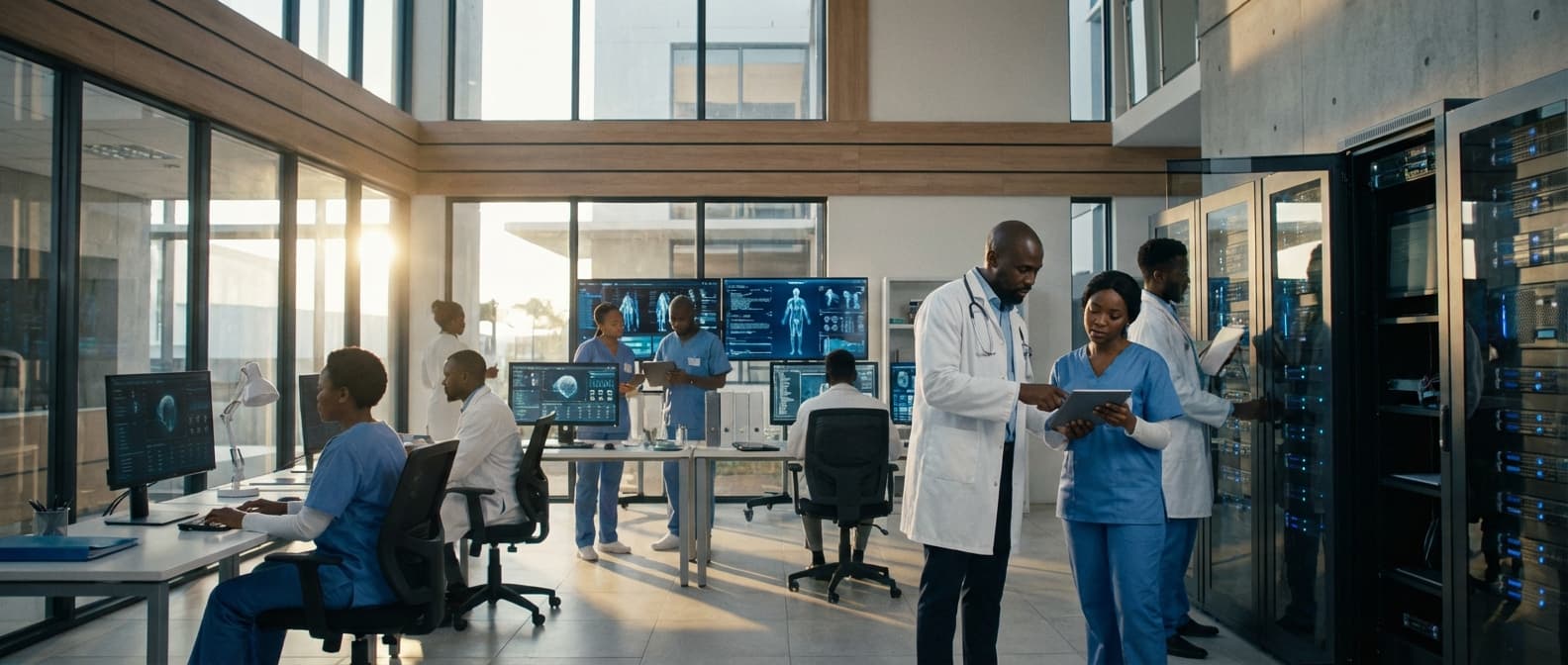
Tele-Radiology in Ghana
Engineering Excellence & Technical Support
24/7 access to certified radiologists providing rapid, accurate remote interpretation of diagnostic imaging studies. High-standard technical execution following OEM protocols and local regulatory frameworks.
Remote Access & Cloud-Based Platform
Leveraging secure cloud infrastructure, Ghanaian radiologists can access and interpret medical images from anywhere, anytime, drastically reducing turnaround times and improving patient care accessibility across remote regions. This also ensures data redundancy and disaster recovery.
AI-Powered Diagnostic Support
Integration of Artificial Intelligence (AI) tools assists Ghanaian radiologists in identifying subtle abnormalities, prioritizing urgent cases, and improving diagnostic accuracy. This AI support enhances efficiency and helps overcome potential shortages of specialized expertise.
Seamless Telemedicine Integration
Our tele-radiology solution integrates seamlessly with existing telemedicine platforms in Ghana, enabling direct consultation and image sharing between referring physicians and remote radiologists. This fosters a collaborative approach to patient management and ensures prompt medical decision-making.
What Is Tele-radiology In Ghana?
Tele-radiology in Ghana refers to the transmission of radiological images, such as X-rays, CT scans, and MRIs, from one geographic location to another for the interpretation and reporting by a radiologist. This service leverages telecommunications technology to bridge the gap in radiological expertise, particularly in areas with limited access to specialized medical professionals. It enables remote diagnosis, consultation, and second opinions, significantly enhancing the reach and efficiency of diagnostic imaging services within the Ghanaian healthcare landscape.
| Who Needs Tele-Radiology? | Typical Use Cases in Ghana |
|---|---|
| Hospitals and Clinics in Remote or Underserved Areas: Lacking in-house radiologists or specialized equipment. | Emergency Department Consultations: Rapid interpretation of critical imaging studies (e.g., trauma, stroke). |
| Smaller Healthcare Facilities: Needing access to expert interpretations without the expense of hiring full-time specialists. | Subspecialty Consultations: Accessing expertise in areas like neuroradiology, musculoskeletal radiology, or pediatric radiology. |
| Public Health Initiatives: Facilitating large-scale screening programs or disease surveillance. | Rural Health Centers: Providing diagnostic capabilities for conditions typically requiring advanced imaging. |
| Referral Centers: Augmenting existing radiology departments during periods of high demand or staff shortages. | Quality Improvement and Training: Providing second reads for quality assurance and educational purposes for local practitioners. |
| Disaster Response and Outbreak Management: Enabling rapid diagnostic support in challenging environments. | Post-operative Imaging Review: Expediting review of post-surgical scans for patient management. |
Key Aspects of Tele-Radiology in Ghana
- Remote Image Transmission: Secure and efficient transfer of medical imaging data (DICOM format) over networks.
- Expert Interpretation: Board-certified radiologists providing diagnostic reports remotely.
- Teleradiology Platforms: Utilization of specialized software for image viewing, annotation, communication, and reporting.
- Interoperability: Integration with existing Picture Archiving and Communication Systems (PACS) and Electronic Health Records (EHRs).
- Quality Assurance: Implementation of protocols for image quality control and reporting accuracy.
- Consultation and Second Opinions: Facilitating access to subspecialty expertise.
- Workflow Optimization: Streamlining the reporting process and reducing turnaround times.
Who Needs Tele-radiology In Ghana?
Tele-radiology, the practice of interpreting medical images remotely, offers a powerful solution to address existing gaps in radiology services across Ghana. The demand for accessible, high-quality diagnostic imaging is significant, particularly in underserved areas and within facilities facing radiologist shortages. By leveraging technology, tele-radiology can bridge geographical barriers, improve turnaround times for critical diagnoses, and enhance the overall efficiency of healthcare delivery.
| Customer Type | Department(s) Served | Key Needs Addressed |
|---|---|---|
| Rural/Remote Hospitals & Clinics | Radiology, Emergency, General Medicine, Surgery | Lack of local radiologists, delayed diagnosis, patient travel burden |
| District/Regional Hospitals | Radiology, Emergency, various clinical specialties | Radiologist shortages, high workload, need for specialized interpretations |
| Tertiary/Teaching Hospitals | Radiology (all subspecialties), all clinical departments | Subspecialty access, managing peak demand, quality assurance |
| Private Diagnostic Centers | Radiology, specific clinical services (e.g., cardiology, neurology) | Expanding service offerings, cost-effective access to expertise |
| Emergency Departments | Emergency Medicine, Trauma Surgery, Internal Medicine | 24/7 urgent interpretation, rapid decision-making |
| Outpatient Departments | General Medicine, Orthopedics, Pediatrics, etc. | Improved workflow, reduced patient waiting times |
| Maternity Wards/Antenatal Clinics | Obstetrics and Gynecology | Timely ultrasound interpretation, fetal monitoring |
| Oncology Departments | Oncology, Radiology | Cancer staging, treatment monitoring, recurrence detection |
| Orthopedic Departments | Orthopedics, Radiology | Diagnosis and management of musculoskeletal conditions |
| Neurology/Neurosurgery Departments | Neurology, Neurosurgery, Radiology | Diagnosis of neurological disorders, surgical planning |
Target Customers and Departments for Tele-Radiology in Ghana
- {"title":"Hospitals and Clinics in Rural and Remote Areas","description":"These facilities often lack in-house radiologists, leading to delays in diagnosis or the need for patients to travel long distances to access imaging services. Tele-radiology provides them with immediate access to expert interpretation."}
- {"title":"District and Regional Hospitals","description":"Even larger district and regional hospitals may experience radiologist shortages or an overwhelming workload. Tele-radiology can supplement their existing teams, ensuring timely reporting and reducing burnout."}
- {"title":"Tertiary and Teaching Hospitals","description":"While these institutions typically have more resources, tele-radiology can be used for subspecialty interpretations (e.g., neuro-radiology, musculoskeletal radiology) or to manage peak demand, further enhancing their diagnostic capabilities."}
- {"title":"Private Diagnostic Imaging Centers","description":"Centers that aim to expand their reach or offer specialized services without necessarily hiring full-time subspecialists can benefit greatly from tele-radiology partnerships."}
- {"title":"Emergency Departments (EDs)","description":"Rapid interpretation of imaging studies (e.g., CT scans for trauma, X-rays for fractures) is crucial in ED settings. Tele-radiology can provide 24/7 coverage for urgent cases, leading to quicker treatment decisions."}
- {"title":"Outpatient Departments (OPDs)","description":"For routine imaging, tele-radiology can help improve workflow efficiency and reduce waiting times for patients needing diagnostic reports."}
- {"title":"Maternity Wards and Antenatal Clinics","description":"Access to timely ultrasound interpretation for expectant mothers is vital for monitoring fetal health and identifying potential complications."}
- {"title":"Oncology Departments","description":"Regular imaging is essential for staging cancer, monitoring treatment response, and detecting recurrence. Tele-radiology can ensure consistent and expert oversight."}
- {"title":"Orthopedic Departments","description":"Accurate interpretation of X-rays, CTs, and MRIs is critical for diagnosing and managing bone and joint conditions, including trauma and degenerative diseases."}
- {"title":"Neurology and Neurosurgery Departments","description":"Expert interpretation of brain and spine imaging is paramount for diagnosing neurological disorders and guiding surgical interventions."}
Tele-radiology Process In Ghana
The Tele-Radiology process in Ghana facilitates access to expert radiological interpretation for healthcare facilities, especially those in remote or underserved areas. This workflow ensures timely and accurate diagnostic imaging, bridging the gap in specialist availability. The process begins with an inquiry from a referring facility and culminates in the delivery of a comprehensive radiology report. Key stakeholders include the referring facility, the radiologist, and the tele-radiology service provider (which may be a government initiative, a private company, or a non-profit organization).
| Stage | Description | Key Activities | Responsible Parties | Technology/Tools |
|---|---|---|---|---|
| Inquiry and Patient Registration | The process is initiated when a healthcare facility requires a radiological interpretation for a patient. | Referring physician identifies the need for imaging. Patient details and clinical history are collected. A request form is generated. | Referring Facility (Doctor, Nurse, Radiographer) | Electronic Health Records (EHR) system (if available), Paper-based request forms |
| Image Acquisition and Transmission | Radiological images are captured and securely sent to the tele-radiology service. | Radiographer performs the imaging procedure (X-ray, CT, Ultrasound, MRI). Images are anonymized. Images are uploaded to a secure Picture Archiving and Communication System (PACS) or a dedicated tele-radiology platform. | Radiographer (at referring facility) | X-ray machines, CT scanners, Ultrasound machines, MRI scanners, PACS software, Secure internet connection, VPNs, Cloud storage |
| Triage and Assignment | Incoming studies are prioritized and assigned to an appropriate radiologist. | A system or dedicated personnel reviews incoming studies. Urgent cases are flagged. Studies are assigned based on radiologist's sub-specialty and workload. | Tele-Radiology Service Provider (System Administrator, Radiologist) | Teleradiology platform software, Worklist management system |
| Image Interpretation | A qualified radiologist reviews the images and provides a diagnostic interpretation. | Radiologist accesses the images and patient clinical information. Radiologist analyzes the images for abnormalities. Radiologist dictates or types findings and impressions. | Radiologist (remote or on-site) | High-resolution diagnostic monitors, PACS viewer, Voice recognition software, Dictation software |
| Report Generation and Transmission | A formal radiology report is created and sent back to the referring facility. | Report is generated based on the radiologist's interpretation. Report is reviewed for accuracy and completeness. Report is transmitted back to the referring facility electronically. | Radiologist, Tele-Radiology Service Provider (Report generation) | Radiology Information System (RIS), PACS, Secure email, Fax (less common), Dedicated reporting portal |
| Feedback and Follow-up | Ensuring the referring physician receives and understands the report and plans subsequent patient management. | Referring physician receives and reviews the report. Discussion may occur between referring physician and radiologist if clarification is needed. Follow-up imaging or consultations are scheduled if required. | Referring Facility (Doctor), Tele-Radiology Service Provider (for queries) | Phone, Email, Secure messaging within the platform |
Tele-Radiology Workflow in Ghana
- Inquiry and Patient Registration
- Image Acquisition and Transmission
- Triage and Assignment
- Image Interpretation
- Report Generation and Transmission
- Feedback and Follow-up
Tele-radiology Cost In Ghana
Tele-radiology services in Ghana offer a critical solution for improving access to diagnostic imaging, especially in remote or underserved areas. The cost of these services is influenced by several factors, making it difficult to provide a single fixed price. These factors include the complexity and type of imaging modality (e.g., X-ray, CT, MRI, Ultrasound), the specific examination required, the expertise and specialization of the remote radiologist, the infrastructure costs associated with the tele-radiology platform (software, hardware, internet connectivity), and the operational overheads of the provider. Pricing is typically done on a per-study basis, with variations occurring between different healthcare facilities, private vs. public institutions, and the volume of cases processed.
While exact figures can fluctuate, we can explore typical pricing factors and provide estimated ranges in Ghana's local currency, the Ghanaian Cedi (GHS). It's important to note that these are general estimates and actual costs may vary. For precise pricing, direct consultation with tele-radiology providers in Ghana is recommended.
| Imaging Modality/Examination Type | Estimated Cost Range (GHS) |
|---|---|
| X-ray (e.g., Chest, Limb) | 50 - 150 |
| Ultrasound (e.g., Abdomen, Pelvis, Obstetric) | 80 - 250 |
| CT Scan (e.g., Head, Abdomen/Pelvis) | 250 - 800 |
| MRI Scan (e.g., Brain, Spine, Joint) | 600 - 2000+ |
| Mammography | 100 - 300 |
| Specialized Reads (e.g., Interventional Radiology, Cardiac) | Varies significantly, often higher than standard scans. |
Key Pricing Factors for Tele-Radiology in Ghana
- Type of Imaging Modality: Different imaging techniques have distinct costs associated with their acquisition and interpretation. X-rays are generally the least expensive, followed by ultrasounds, CT scans, and MRIs, which are the most costly due to equipment and specialized interpretation needs.
- Complexity of the Examination: A routine chest X-ray will be priced differently than a complex neurological CT scan or a multi-sequence MRI study. The amount of data to be reviewed and the level of detail required influence the radiologist's time and expertise, thus impacting cost.
- Radiologist's Specialization and Experience: Highly specialized radiologists (e.g., neuroradiologists, pediatric radiologists) or those with extensive experience may command higher fees.
- Turnaround Time (TAT): Faster reporting times (e.g., STAT reads) often incur a premium. Standard turnaround times are usually more affordable.
- Volume and Contractual Agreements: Larger healthcare facilities or those with long-term contracts may negotiate bulk discounts or preferential pricing.
- Technology and Platform Costs: The underlying tele-radiology platform, including software licensing, hardware maintenance, and secure data transmission, contributes to the overall service cost.
- Geographic Location and Provider: Prices can vary between urban centers and more remote regions, and between different tele-radiology service providers.
- Ancillary Services: Additional services like peer review, second opinions, or advanced reporting features might add to the base cost.
Affordable Tele-radiology Options
Tele-radiology offers a cost-effective solution for medical facilities by providing access to specialized radiologists remotely. This allows for faster diagnoses, improved patient outcomes, and reduced overhead compared to in-house radiology departments. Key to managing these costs are 'value bundles' and strategic cost-saving measures.
| Cost-Saving Strategy | Description | Impact on Affordability |
|---|---|---|
| Volume-Based Pricing/Tiered Packages | Tele-radiology providers often offer lower per-study rates for higher volumes of imaging studies. Tiered packages cater to different facility needs and budgets. | Directly reduces the cost per interpretation as volume increases. Predictable costs for facilities with consistent imaging loads. |
| Off-Peak Hours/Night Coverage | Utilizing tele-radiologists for overnight or weekend reads can be significantly cheaper than employing in-house staff for 24/7 coverage. | Reduces labor costs associated with round-the-clock staffing. Leverages a global pool of radiologists available during off-peak times for the facility. |
| Subspecialty Access without Direct Hiring | Instead of hiring expensive in-house subspecialists, facilities can access expert reads for complex cases through tele-radiology at a fraction of the cost. | Eliminates the high overhead of recruiting, employing, and retaining subspecialty radiologists. Provides access to expertise on demand. |
| Technology Integration & Workflow Optimization | Efficiently integrated tele-radiology platforms can reduce turnaround times, minimize manual data entry, and streamline communication, leading to operational cost savings. | Reduces administrative burden and potential for errors, freeing up internal staff and improving efficiency. Faster reporting can lead to quicker patient management and reduced length of stay. |
| Flexible Service Models (e.g., Primary vs. Secondary Reads) | Choosing between primary interpretation (initial read) and secondary interpretation (second opinion) allows facilities to tailor services to their specific needs and budget constraints. | Facilities can opt for more cost-effective solutions when a full primary read isn't always necessary, or for targeted subspecialty second opinions. |
| Long-Term Contracts & Commitment | Committing to longer-term contracts can often unlock significant discounts on tele-radiology services. | Offers greater cost certainty and potential for substantial savings over the contract duration. |
Understanding Value Bundles in Tele-Radiology
- {"title":"What are Value Bundles?","description":"Value bundles in tele-radiology are pre-defined service packages that combine multiple services at a predictable, often discounted, price. Instead of paying per-study, facilities can opt for a bundle that covers a specific volume, types of studies, or a defined period."}
- {"title":"Components of Value Bundles","description":"These can include a mix of primary reads (initial interpretations), secondary reads (second opinions), subspecialty reads (e.g., neuroradiology, musculoskeletal), preliminary reads for urgent cases, and potentially quality assurance or peer review services."}
- {"title":"Benefits of Value Bundles","description":"Predictable budgeting, simplified billing, potential for volume discounts, improved access to specialized expertise, and streamlined workflow management are key advantages."}
Verified Providers In Ghana
In Ghana's healthcare landscape, identifying truly reliable and high-quality healthcare providers is paramount for individuals seeking the best possible care. Verified providers stand out by meeting stringent criteria, ensuring competence, ethical practices, and patient safety. Among these, Franance Health has established itself as a leading entity, consistently demonstrating a commitment to excellence that makes them a top choice for discerning patients.
| Key Indicator | Franance Health's Commitment | Patient Benefit |
|---|---|---|
| Medical Expertise | Verified academic and professional qualifications of all practitioners. | Access to competent and knowledgeable healthcare professionals. |
| Patient Safety | Strict adherence to healthcare regulations and best practices; ongoing monitoring. | Reduced risk of medical errors and improved patient safety. |
| Ethical Standards | Emphasis on integrity, transparency, and patient rights. | Trustworthy and respectful healthcare interactions. |
| Accessibility | Streamlined processes for finding and connecting with verified providers. | Easier and more convenient access to quality healthcare. |
| Continuity of Care | Focus on coordinated care and comprehensive treatment plans. | Improved health outcomes through integrated medical services. |
Why Franance Health Represents the Best Choice in Verified Providers in Ghana:
- Rigorous Credentialing Process: Franance Health adheres to a comprehensive vetting system that goes beyond basic licensing. This includes verification of medical degrees, specialist certifications, professional experience, and a thorough background check of all healthcare professionals associated with their network.
- Commitment to Quality Assurance: They implement ongoing quality assurance programs to monitor patient outcomes, clinical practices, and patient satisfaction. This proactive approach ensures that standards are not only met but consistently exceeded.
- Patient-Centric Approach: Franance Health prioritizes the patient experience, focusing on clear communication, empathy, and providing personalized care plans. Their network of providers is selected for their ability to build trust and deliver compassionate healthcare.
- Access to Specialized Expertise: Through their extensive network, Franance Health grants access to a wide range of medical specialists and advanced treatment options, often bridging gaps in specialized care availability within Ghana.
- Ethical Practice and Integrity: A cornerstone of Franance Health's operation is their unwavering commitment to ethical medical practice. They uphold the highest standards of integrity, ensuring transparency and patient advocacy in all their dealings.
- Technological Integration: Leveraging modern technology for appointment scheduling, record keeping, and even telehealth services, Franance Health enhances accessibility and efficiency for their patients.
- Positive Patient Testimonials and Reputation: The consistent positive feedback and strong reputation of Franance Health within the Ghanaian community are testaments to their reliability and the quality of care they provide.
Scope Of Work For Tele-radiology
This document outlines the Scope of Work (SOW) for the provision of Tele-Radiology services. It details the technical deliverables and standard specifications required to ensure the efficient and high-quality remote interpretation of medical imaging studies. The objective is to establish a clear framework for the tele-radiology provider to meet the radiologist's needs and patient care standards.
| Specification Category | Technical Requirement | Standard/Guideline | Notes |
|---|---|---|---|
| Image Viewing | Resolution | Minimum 5MP (3MP for scout/localizers) | Ensures adequate detail for diagnostic interpretation. |
| Image Viewing | Grayscale Bit Depth | Minimum 12-bit | Supports a wide range of pixel values for optimal contrast. |
| Image Viewing | Luminance | Minimum 300 cd/m² (500 cd/m² recommended) | Adequate brightness for distinguishing subtle details. |
| Image Viewing | Contrast Ratio | Minimum 1000:1 | Differentiates between adjacent tissue densities. |
| Image Viewing | DICOM Conformance | Full DICOM 3.0 conformance | Enables interoperability with PACS and other DICOM devices. |
| Network Connectivity | Bandwidth | Minimum 100 Mbps (symmetrical) | Sufficient for rapid image loading and transmission. Higher bandwidth may be required for advanced modalities. |
| Network Connectivity | Latency | Below 100 ms | Minimizes delays in image loading and interactive use. |
| Network Connectivity | Security | AES-256 encryption, TLS 1.2+ | Protects data in transit from unauthorized access. |
| Reporting | Report Format | Structured reports with standardized templates | Enhances consistency and data extractability. |
| Reporting | Voice Recognition Accuracy | Minimum 98% word recognition accuracy | Reduces post-dictation editing time. |
| System Performance | Image Load Time | Less than 5 seconds for standard studies | Ensures efficient workflow. |
| System Performance | Report Generation Time | Less than 10 minutes post-dictation (average) | Facilitates timely patient care. |
| Data Security | Access Control | Role-based access control (RBAC) | Limits access to sensitive patient data based on user roles. |
| Data Security | Audit Trails | Comprehensive logging of all user activity | Provides accountability and supports compliance. |
| Data Security | Data Encryption | AES-256 for data at rest | Protects stored patient information. |
Key Technical Deliverables
- Secure and reliable PACS (Picture Archiving and Communication System) access for image viewing and reporting.
- High-resolution diagnostic workstations with DICOM-compliant monitors.
- Robust and secure VPN (Virtual Private Network) connection for remote access.
- Advanced dictation and voice recognition software for efficient report generation.
- Integrated RIS (Radiology Information System) or seamless integration capabilities with the existing RIS.
- Real-time communication tools (e.g., secure messaging, video conferencing) for radiologist consultation.
- Data security and privacy compliance (HIPAA, GDPR, or equivalent) with audit trails.
- System uptime and availability guarantees with defined service level agreements (SLAs).
- Regular system maintenance, updates, and patches to ensure optimal performance and security.
- Disaster recovery and business continuity plan.
- User training and ongoing technical support for radiologists and IT staff.
- Performance monitoring and reporting tools.
Service Level Agreement For Tele-radiology
This Service Level Agreement (SLA) outlines the performance standards and guarantees for the Tele-Radiology service provided by [Provider Name] to [Client Name]. This SLA is an integral part of the Master Service Agreement (MSA) between the parties.
| Service Metric | Uptime Guarantee | Response Time (Acknowledgement of Request) | Response Time (Report Delivery - Routine) | Response Time (Report Delivery - Urgent) |
|---|---|---|---|---|
| Tele-Radiology Platform Availability | 99.8% (excluding scheduled maintenance) | |||
| Radiology Interpretation Services | 99.8% (excluding scheduled maintenance) | Within 15 minutes of request receipt | Within 24 business hours of request receipt | Within 4 business hours of request receipt |
| Image Transmission & Access | 99.8% (excluding scheduled maintenance) |
Key Service Commitments
- Availability: The Tele-Radiology platform and associated services will be available and operational for use as specified in the Uptime Guarantee section.
- Response Times: Urgent and routine radiology interpretation requests will be acknowledged and initiated within the response times outlined in this agreement.
- Data Security & Confidentiality: All patient data will be handled in accordance with HIPAA and other relevant privacy regulations, with robust security measures in place.
- Reporting Accuracy: Interpretations will be performed by qualified and licensed radiologists, adhering to best practices and clinical standards.
Frequently Asked Questions

Ready when you are
Let's scope your Tele-Radiology in Ghana project in Ghana.

Scaling healthcare logistics and technical systems across the entire continent.